Rediscovering the Septuagint (LXX): Psalm 17

Here is a direct side-by-side comparison of the Masoretic Text with the LXX.  I have concluded that the LXX is much to be preferred over the Masoretic Text, a position from which the Eastern Orthodox Church never deviated. Perhaps, if you take the time to read my comparisons and other articles, you will arrive at the same conclusion.

The Septuagint version I am using is the Lexham English Septuagint 2nd Edition, which is available in print or as part of Logos Bible Software. Occasionally I also use the Brenton translation of the LXX for insight into difficult passages.

If you want to know more, click on the following links.

Masoretic Text Septuagint Significance

1 Hear a just cause, O LORD, Attend to my cry; Give ear to my prayer which is not from deceitful lips. 2 Let my vindication come from Your presence; Let Your eyes look on the things that are upright. 3 You have tested my heart; You have visited me in the night; You have tried me and have found nothing; I have purposed that my mouth shall not transgress. 4 Concerning the works of men, By the word of Your lips, I have kept away from the paths of the destroyer. 5 Uphold my steps in Your paths, That my footsteps may not slip. 6 I have called upon You, for You will hear me, O God; Incline Your ear to me, and hear my speech. Psalm 17:1–6 (NKJV) 

1 Hear, O Lord, my righteous cause. Give heed to my entreaty. Pay attention to my prayer, which is not with deceitful lips. 2 Let my judgment come out from your face. Let my eyes see uprightness. 3 You tested my heart; you observed during the night; you purged me, and injustice was not found in me. 4 In order that my mouth would not speak the works of humans, because of the words of your lips, I guarded against stubborn ways. 5 Establish my steps in your paths, so my steps are not shaken. 6 I cried aloud, because you heard me, O God. Bend your ear to me and give ear to my words. Psalm 16:1–6 (LES2) 

The MT objectifies David’s request, but the LXX keeps it personal. The LXX says that David prayed, not cried out. In verse 2 the MT says that God’s eyes look on upright things. David says, “Let my eyes see uprightness.” Verse 3 in the MT says that God visited David in the night, tried him, and found nothing. It concludes the verse by David’s saying, “I have purposed that my mouth shall not transgress.” The LXX says that God observed him, purged him with fire, and no injustice was found in him. The LXX begins the MT’s verse 4 at the end of verse 3. The Lexham LXX translates verse 4 awkwardly. Brenton has this:

“As for the works of men, by the words of thy lips I have guarded myself from hard ways,” which is close to the MT. The MT and LXX agree in verse 6, except the LXX makes the first clause in the past tense.

7 Show Your marvelous lovingkindness by Your right hand, O You who save those who trust in You From those who rise up against them. 8 Keep me as the apple of Your eye; Hide me under the shadow of Your wings, 9 From the wicked who oppress me, From my deadly enemies who surround me. Psalm 17:7–9 (NKJV) 

7 Magnify your mercy, the one who saves those who place their hope upon you from those who have stood against your right hand. 8 Guard me as the apple of your eye. Shelter me in the protection of your wings, 9 from the face of the ungodly who afflicted me. My enemies surrounded my soul; Psalm 16:7–9 (LES2) 

The MT asks God to show lovingkindness by his right hand, but the LXX says that David trusted God to save him from those who resist God’s right hand. The MT and LXX agree in the rest of this passage.

10 They have closed up their fat hearts; With their mouths they speak proudly. 11 They have now surrounded us in our steps; They have set their eyes, crouching down to the earth, 12 As a lion is eager to tear his prey, And like a young lion lurking in secret places. Psalm 17:10–12 (NKJV) 

10 they enclosed themselves with their stiff fat; their mouth spoke arrogance. 11 While casting me out, they now encircled me; they set their eyes to turn me in the earth. 12 They took me up as a lion ready for the prey, and as a cub in the den in hidden places. Psalm 16:10–12 (LES2) 

In verse 11, David says that his enemies cast him out and encircled him, making me think this concerns his being driven from Israel by King Saul’s relentless pursuit. The last part of the verse seems to say that David’s enemies wish to drag him down to the ground.

13 Arise, O LORD, Confront him, cast him down; Deliver my life from the wicked with Your sword, 14 With Your hand from men, O LORD, From men of the world who have their portion in this life, And whose belly You fill with Your hidden treasure. They are satisfied with children, And leave the rest of their possession for their babes. 15 As for me, I will see Your face in righteousness; I shall be satisfied when I awake in Your likeness. Psalm 17:13–15 (NKJV) 

13 Rise up, O Lord. Anticipate them and overthrow them. Rescue my soul from the ungodly with your large sword, 14 from the enemies of your hand, O Lord. Remove them from the earth; distribute them in their life. And their belly was filled with the things you have hidden. They were satisfied with what belongs to pigs, and they left the remainder to their infants. 15 But I will see your face in righteousness. I will be satisfied with the seeing of your glory. Psalm 16:13–15 (LES2) 

I prefer the LXX’s rendering of verse 13, where David asks God to anticipate and overthrow the ungodly with his large sword, not just sword. The MT asks God to deliver David with “your hand,” but the LXX asks God to deliver David from the enemies of God’s hand. The LXX asks God to remove them from the earth, which is left out of the MT. The MT says the ungodly are satisfied with children, but the LXX says “with what belongs to pigs.” The MT concludes the passage by David’s saying that he will be satisfied when he awakes with God’s likeness. The LXX says he will be satisfied with seeing God’s glory.  Interesting. It seems that both are true.


Rediscovering the Septuagint (LXX): Isaiah 2:6-22

Here is a direct side-by-side comparison of the Masoretic Text with the LXX.  I have concluded that the LXX is much to be preferred over the Masoretic Text, a position from which the Eastern Orthodox Church never deviated. Perhaps, if you take the time to read my comparisons and other articles, you will arrive at the same conclusion.

The Septuagint version I am using is the Lexham English Septuagint 2nd Edition, which is available in print or as part of Logos Bible Software. Occasionally I also use the Brenton translation of the LXX for insight into difficult passages.

If you want to know more, click on the following links.

Masoretic Text Septuagint Significance

6 For You have forsaken Your people, the house of Jacob, Because they are filled with eastern ways; They are soothsayers like the Philistines, And they are pleased with the children of foreigners. 7 Their land is also full of silver and gold, And there is no end to their treasures; Their land is also full of horses, And there is no end to their chariots. 8 Their land is also full of idols; They worship the work of their own hands, That which their own fingers have made. 9 People bow down, And each man humbles himself; Therefore do not forgive them. Isaiah 2:6–9 (NKJV) 

6 For he has released his people, the house of Israel, because, as it was from the beginning, their region has been filled with omens like the region of the foreigners, and many foreign children were born to them. 7 For their territory was filled with silver and gold, and there was no counting their treasures; and the land was filled with horses, and there was no counting their chariots. 8 And the land was filled with abominations, the works of their hands, and they worshiped the things their fingers made. 9 And a person bowed, and a man was made low, and I will certainly not forgive them. Isaiah 2:6–9 (LES2) 

Brenton translates the Greek word aniemi, as “forsaken,” which agrees with the MT. The Lexham LXX translates the Greek word literally as “released.” It is a word used to describe releasing a goat, which brings to mind the scapegoat which was released into the wilderness bearing the sins of the nation. (Leviticus 16:10) In the verse in Leviticus uses the related Greek word aphiemi. I think Brenton and the MT got it right. 

The MT and LXX more or less agree in the next part of verse 6 through verse 7. In verse 8, the MT says the land was full of idols. The LXX uses the word abominations, with it being understood through context that these abominations were idols. In the last part of verse 9, the MT objectifies the judgment, saying, “do not forgive them.” The LXX has God personally saying, “I will certainly not forgive them.”

God will judge Israel’s inveterate idolatry and her satanic practices, which continue to this day.

10 Enter into the rock, and hide in the dust, From the terror of the LORD And the glory of His majesty. 11 The lofty looks of man shall be humbled, The haughtiness of men shall be bowed down, And the LORD alone shall be exalted in that day. 12 For the day of the LORD of hosts Shall come upon everything proud and lofty, Upon everything lifted up— And it shall be brought low— Isaiah 2:10–12 (NKJV) 

10 And now, enter into the rocks and hide in the earth from the face of the fear of the Lord and from the glory of his strength, when he rises to shatter the earth. 11 For the eyes of the Lord are high, but humanity is low, and the height of humans will be brought low, and the Lord alone will be raised in that day. 12 For Lord Sabaoth’s day is against every insolent person and arrogant person and upon every high and lofty person, and they will be brought low, Isaiah 2:10–12 (LES2) 

The MT uses “rock” in the singular; whereas the LXX makes the word plural. The MT says to hide in the dust, but the LXX says hide in the earth itself. The inspiration of this fear, according to the MT, is the terror of the Lord and glory of his majesty. The LXX says that it is from the “face” of the fear of the Lord, which references his awe inspiring presence. The LXX adds that this will take place when God rises to shatter the earth, referencing the second coming of Christ, which is also called the “day of the Lord.” 

14 Then the sky receded as a scroll when it is rolled up, and every mountain and island was moved out of its place. 15 And the kings of the earth, the great men, the rich men, the commanders, the mighty men, every slave and every free man, hid themselves in the caves and in the rocks of the mountains, 16 and said to the mountains and rocks, “Fall on us and hide us from the face of Him who sits on the throne and from the wrath of the Lamb! 17 For the great day of His wrath has come, and who is able to stand?” Revelation 6:14–17 (NKJV) 

Verse 12 identifies this day belonging to the Lord of hosts or Sabaoth, which clearly refers to Christ’s coming with the armies of heaven. (Revelation 19:11-16) All those who refuse to humble themselves by confessing that Jesus is Lord will be brought low in judgment. (Romans 14:11)

13 Upon all the cedars of Lebanon that are high and lifted up, And upon all the oaks of Bashan; 14 Upon all the high mountains, And upon all the hills that are lifted up; 15 Upon every high tower, And upon every fortified wall; 16 Upon all the ships of Tarshish, And upon all the beautiful sloops. 17 The loftiness of man shall be bowed down, And the haughtiness of men shall be brought low; The LORD alone will be exalted in that day, 18 But the idols He shall utterly abolish. 19 They shall go into the holes of the rocks, And into the caves of the earth, From the terror of the LORD And the glory of His majesty, When He arises to shake the earth mightily. Isaiah 2:13–19 (NKJV) 

13 and it is against every cedar of Lebanon of those that are high and lofty, and against every oak tree of Bashan, 14 and against every mountain and against every high hill, 15 and against every high tower and against every high city wall, 16 and against every sea ship and against every sight of ships of beauty. 17 And every person will be brought low, and humanity’s pride will fall; and the Lord alone will be raised in that day. 18 And they will conceal artificial gods, 19 bringing them into the caverns and into the clefts of the cliffs and into the holes of the earth from the face of the fear of the Lord and from the repute of his strength, when he stands to shatter the earth. Isaiah 2:13–19 (LES2) 

The MT and LXX essentially agree in verses 13-18, but diverge in verse 19. After prophesying that humanity’s pride will fall, Isaiah says in the LXX that those being judged, who are fleeing God’s wrath, will conceal their false gods in caverns and other hiding places in the earth, signifying a continued lack of repentance for their idolatry. In addition, the LXX uses a much stronger word than “shake.” It says God will shatter the earth, breaking it into pieces. 

20 In that day a man will cast away his idols of silver And his idols of gold, Which they made, each for himself to worship, To the moles and bats, 21 To go into the clefts of the rocks, And into the crags of the rugged rocks, From the terror of the LORD And the glory of His majesty, When He arises to shake the earth mightily. 22 Sever yourselves from such a man, Whose breath is in his nostrils; For of what account is he? Isaiah 2:20–22 (NKJV) 

20 For in that day humanity will cast out its silver and golden idols, which they made to worship vain things and bats, 21 to enter into the holes of the solid rock and into the clefts of the rocks, away from the face of the fear of the Lord and away from the glory of his might, whenever he arises to shatter the earth. Isaiah 2:20–21 (LES2) 

The MT says that that idolators will cast away their idols under the influence of the terror of God and his judgments, throwing them to moles and bats. The LXX says that the idols were designed to worship vain things and bats. Both repeat that unrepentant people will try to hide from God in the day of judgment, when he comes to shake / shatter the earth. 

The MT adds verse 22, which seems completely out of place.


Should Christians Use the Septuagint for the Old Testament?

Septuagint
Introduction

Many Christians are not familiar with the Septuagint, which is abbreviated as the LXX. It is an ancient (287 BC) Greek translation of the Old Testament from the now dead language some call Paleo-Hebrew. The Western church decided to abandon the LXX a few centuries after Christ as a result of Jerome’s choice to use a proto-Masoretic Hebrew version of the Old Testament for his Latin Vulgate Bible. Eventually what is called the Masoretic Text of the Hebrew Bible was adopted as the “gold standard” for the Hebrew scriptures in the West, even though many passages quoted from the LXX by the New Testament had been changed. This created some controversy at the time, but the MT won out. The Eastern Orthodox Church, however, has retained the LXX as its Old Testament until the present day.

Based upon what follows and my own comparisons of the MT to the LXX, I have come to believe that the MT was designed to hide the power of the Old Testament’s witness to Jesus the Messiah. Perhaps you will agree with me by the end of this article.
septuagintPaleo-Hebrew

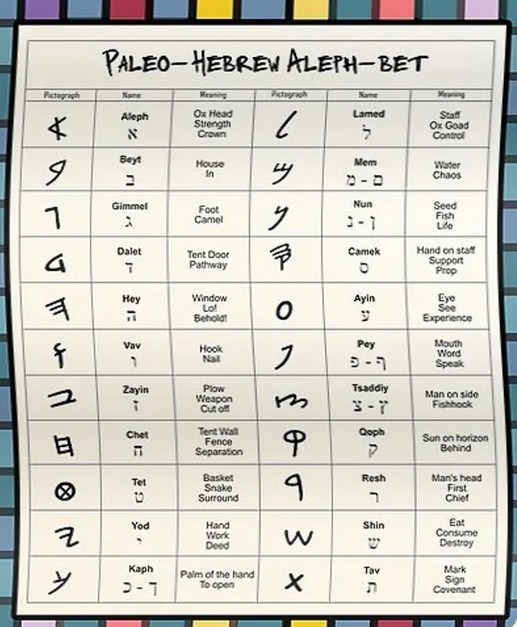
The original Hebrew scriptures were written in what is now called Paleo-Hebrew (c. 1000-586 BC). It was related to Sumerian and used a Phoenician pictograph script pictured on the right. The only fragments we have left are documents among the Dead Sea scrolls discovered at Qumran. 

The term “Paleo-Hebrew” was coined by the biblical scholar and paleographer Solomon Birnbaum in 1954. Birnbaum introduced the name to differentiate the script used in the ancient kingdoms of Israel and Judah from the “Phoenician” label that had been used by previous scholars. His argument was that it was inaccurate to label the script of the Hebrews as “Phoenician” simply because the Phoenicians used a nearly identical writing system in the northern Levant. By proposing the term “Paleo-Hebrew,” Birnbaum sought to emphasize the script’s role in the literary and national life of the Israelites, regardless of the fact that it shared a common origin with the broader Proto-Canaanite family of scripts. (Gab AI)
 

Modern Hebrew

Modern Hebrew was developed from Aramaic, the language of ancient Babylon, and uses a block style script. The script we see in modern Hebrew Bibles and on street signs in Israel is not the original script of the First Temple period. The transition to the “square” script occurred in stages:

    1. Aramaic Influence (The Exile): During the Babylonian exile (6th century BC), the Jewish people were heavily exposed to Aramaic, which functioned as the lingua franca of the Near East under the Neo-Babylonian and then the Achaemenid Persian Empires. The Aramaic script, also a descendant of the Phoenician system, was evolving into a stylized, more efficient form.
    2. The “Ashuri” Transition: Following the return from Babylon, there was a gradual shift. The Aramaic “square” style was adopted by Jewish scribes for writing Hebrew. This is why it is called Ashuri (Assyrian or Imperial Aramaic script). It wasn’t an overnight replacement; for several centuries, both scripts existed in parallel. The Dead Sea Scrolls, discovered at Qumran, provide clear evidence of this transition, with some texts written in the Paleo-Hebrew script and others in the evolving square script.
    3. Standardization: By the 1st century AD, Rabbinic Judaism began moving toward a standardized, formal script. The square script eventually became the standard for sacred texts, while the Paleo-Hebrew script was abandoned by Jews. (Gab AI)

The Septuagint

The Septuagint (LXX) was a Greek translation of the Hebrew scriptures put together by 72 (perhaps 70) Jewish scholars under the auspices of King Ptolemy II of Egypt, who wished to add a Greek version of the Hebrew scriptures to his library in Alexandria. Greek at the time was the dominant language in the world; so, the LXX soon became the most used compilation of the Old Testament in the Greek speaking world, which included Palestine. Paleo-Hebrew had become limited to scholars for the most part; so, for the scriptures to be properly understood by common people, they needed to be in Greek. The Pentateuch portion was completed by 282 BC. The rest of the Old Testament was completed around 246 BC. This original version of the Septuagint is called the Alexandrian version. Other versions came later and were called the Septuagint, but only a few were based on the original. Some later Greek translations were based on whatever version of Hebrew existed at the time.  

Barry Setterfied, who did extensive research on the LXX, says that it was translated from Paleo-Hebrew directly into Greek. (The Alexandrian Septuagint History) This is extremely significant since it makes the LXX the oldest translation of the original Paleo-Hebrew scriptures which were inspired by the Holy Spirit.

The LXX gained widespread acceptance among the Jews and was the version used by Christians and quoted for the most part (70-80 %) in the New Testament. Manuscripts like Codex Vaticanus and Sinaiticus (4th century CE) are major witnesses to this. 

The early Christians, many of whom were Jewish, quoted the Old Testament often in personal letters which still exist. Those quotes, as well as those made by the New Testament authors, usually match the Septuagint instead of the MT.

Rabbi Akiva’s Influence

By 100 AD the Christian church was growing rapidly all over the earth. The Romans had destroyed Jerusalem and the temple, thus fulfilling Jesus’ prophecy. By 135 AD, the failed Bar Kokhba rebellion had resulted in the expulsion of the Jews from their land and its being renamed Palestine. Prior to the Bar Kokhba revolt, during the siege of Jerusalem in 70 AD, the Emperor Vespasian authorized the establishment of a Jewish academy at Yavneh (Jamnia) which is located in the southern coastal plain of the Levant, roughly six kilometers from the Mediterranean Sea and about 20 kilometers south of Jaffa. 

The rabbinic institutions and the rationale for them grew under the Roman aegis after the destruction of the Temple. They developed into the national government under the Romans. Yavneh, “Jamnia” in Greek, became the center of rabbinic authority. (Gruber, Daniel. Rabbi Akiva’s Messiah: The Origins of Rabbinic Authority (Kindle Locations 293-295). Elijah Publishing. Kindle Edition.)

Rabbi Akiva, who was born around 50 AD, was about 20 years old when Jerusalem and the temple were destroyed by the Romans. He was executed in 135 AD at the age of 85 by the Romans for his active role in supporting bar Kokhba during his rebellion, whom he publicly designated as the Jewish Messiah. Akiva hated Christ, Christians, and Christian writings. He rose to power at Yavneh and worked tirelessly to consolidate rabbinic power so that it was the dominant voice within Judaism, displacing all other influences, including the priesthood, the prophets, political rulers, the Torah, and even God.

The Jewish Encyclopedia defines “Rabbinical Authority” as “The power or right of deciding the Law, in dubious cases, or of interpreting, modifying, or amplifying, and occasionally of abrogating it, as vested in the Rabbis as its teachers and expounders.” (Gruber, Kindle Locations 2710-2712)

“The Rabbis are the source of their own authority to annul the Torah. .. The Rabbis could establish conditions and practices that contradicted and even nullified the Torah. According to the Rabbis, God Himself would obey whatever they decided. … The Rabbis claimed the sanction of the Torah for whatever they decreed, even if it was the uprooting of Torah. … This was more than the assertion of a different ‘religious’ system. The Torah governs every aspect of the life of Israel. By governing the Torah, the Rabbis would govern Israel. … The objective was to bring Israel under the rule of the Rabbis. If the Scriptures stood in the way, the Scriptures had to be uprooted. … There was a radical and irreconcilable conflict between the Torah and the Rabbis as to the basis and structure of authority, as well as its source and administration. That is why the Rabbis gave themselves the right to alter, revise, trespass and uproot the original commandments. … R. Akiva sought to fence the people off from the Torah and from all other influences that would have challenged rabbinic authority. In the system he erected, no one else had the right to interpret Torah. Not the am ha’aretz, nor the priests, nor the prophets, nor the Sadducees, the Qumran Covenanters, the Talmedei Yeshua, nor anyone else. Not even God.” [Daniel Gruber, Rabbi Akiva’s Messiah: The Origins of Rabbinic Authority, pp.82-85, Elijah Publishing, 1999 with references].

So while we do not have all the necessary before-and-after documents to accurately gauge the extent of Akiva’s influence on the text of Tanakh [Torah], it is fair to say that it was significant. To some extent, he set the canon and most likely “standardized” the Hebrew text itself. He authorized a new Greek translation and a new Aramaic Targum of his own text. In whatever language a Jew read or heard the Scriptures, he would be hearing from Akiva. (Gruber, Kindle locations 2378-2381)

Akiva authorized his disciple Aquila of Sinope to produce a Greek translation of the Old Testament to replace the Septuagint in order to remove some of the clear references to Christ and discredit the New Testament. This translation reflected his views. 

The Encyclopedia Judaica adds that he also “inspired his disciple Aquila, a convert, to write a Greek translation of the Bible in the spirit of his teachings (Jerome to Isa. 7: 14). A careful examination of the translation… shows that it follows Akiva’s exegesis. The standard Aramaic translation of the Pentateuch, Targum Onkelos, invariably reflects Akiva’s halakhic rulings… (Gruber, Kindle locations 1150-1153)

“Of further significance in this direction was Akiva’s endeavor to establish the correct view of traditions and to reduce the number of divergent practices and views by giving in most cases only one opinion.” 36 An editor who is going to give only one opinion is going to give his own, or, what amounts to the same thing, the one with which he agrees. Here, as with the text of Tanakh [Torah], Akiva seems to have formulated a comprehensive strategy. With Tanakh, Akiva authorized a new Targum for those who spoke Aramaic, and a new Greek translation for those who did not. No matter what language a person used, Akiva established the authority. He did the same with the oral tradition. He put it in writing to increase his leverage against the traditional rabbis, but he knew that he had to formulate a plan for the transitional period. So he gave some of his disciples a new official mission. They would be the official reciters of the “correct” oral tradition. (Gruber, Kindle Locations 3426-3433)

Professor S.H. Horn (Archaeology, Andrews University, Michigan) writes:

“However, the facts – that a unified [Hebrew] text suddenly became the standard at the end of the first century and that not one copy of a divergent text survived (except the Dead Sea scrolls that had already been hidden when Jamnia convened), indicate clearly that the Council of Jamnia must have taken action in this matter. Moreover, the fact that Aquila, one of Akiva’s pupils, soon thereafter produced a new Greek translation that slavishly translated the [new] unified Hebrew text for the use of the Diaspora Jews gives credence to the idea that Akiva must have been a key influence in the standardization of the Hebrew text.”15

Only small remnants of the Paleo-Hebrew scriptures still exist, mainly fragments found at Qumran and various ancient inscriptions. This suggests that they could have been deliberately destroyed to prevent any direct comparison between them and the modern Hebrew translation called the MT. It fits Akiva’s pattern of eliminating all versions of the oral law of which he did not approve.

The new Greek translation was done by Akiva’s pupil Aquila and was completed in 128 AD. We know that this was a Greek version of what is now called the Masoretic text. This means that the Masoretic text must have been Akiva’s rabbinic version of the Hebrew Old Testament. All existing texts which were in accord with the LXX used by the Christians were then burnt. This is hinted at by Gruber’s comment that  “The Rabbis decreed that even a Tanakh scroll should be burned if it was written by a [Christian]. ‘R. Nahman said: We have it on tradition that a scroll of the Law which has been written by a [Christian] should be burnt.’ R. Akiva says: One burns the whole thing, because it was not written in holiness.‘”13 It was under these conditions that the Masoretic text came into being and every divergent text they could find was destroyed [Professor S.H. Horne, “The Old Testament Text in Antiquity.”] Thus the process called the Council of Jamnia gave us the Hebrew Masoretic text in opposition to the Paleo-Hebrew which gave us the LXX. (Setterfield)

The Transition to Hebrew for the Old Testament

The Septuagint (LXX) did not “stop” being the standard for the Jews in a single moment of consensus; rather, its displacement was a protracted, contested, and ultimately divergent process that separated the paths of Rabbinic Judaism and the Christian Church. For the first two centuries after Christ, the LXX was widely utilized by Greek-speaking Jews. However, as the early Christian movement grew, its heavy reliance on the LXX to prove Christ’s messiahship created a deepening rift.
 
The Jews largely abandoned the LXX by the 3rd century as it became a badge of Christian identification. 
  • The Polemical Shift: When Christians pointed to the LXX—specifically prophecies like Isaiah 7:14 (parthenos/virgin)—to argue for the divinity of Jesus, Jewish authorities viewed the text as “Christianized” or corrupted.
  • The Rise of Alternative Greek Versions: To counter the Christian use of the LXX, Jewish leadership encouraged or sanctioned new Greek translations that adhered strictly to the developing Hebrew tradition. The translation by Aquila of Sinope (c. 130 AD) is the most prominent example; it was designed to be a rigid, anti-Christian tool.
  • Consolidation of the Masoretic Text: By the 2nd and 3rd centuries, the rabbinic movement—centered in places like Yavneh and later Tiberias—prioritized the Hebrew original and Aramaic Targums over the Greek translations. The LXX was largely relegated to the status of a relic of the “Hellenized” past, eventually becoming viewed as an inferior or inaccurate text in the eyes of the Rabbis. (Gab AI)

The Development of the Masoretic Text

The Masoretic text refers to the authoritative Hebrew text of the Tanakh [Torah], complete with vocalization (vowel points) and cantillation marks. The transmission of the text evolved in three key phases:
 
  • The Soferim (Scribes): Initially, the transmission of the text was oral and semi-controlled by the Soferim. They were fastidious, counting letters and words to ensure perfect transmission. However, the text remained largely consonantal.
  • The Masoretes (6th–10th Century AD): The definitive work was done by groups of scribes known as the Masoretes (from Masorah, meaning “tradition”). Working primarily in Tiberias, they faced a critical problem: as Hebrew ceased to be a spoken language, the correct pronunciation of the ancient consonantal text risked being lost.
  • The Innovation of Pointing: To preserve the exact pronunciation and prevent corruption, the Masoretes developed a system of dots and dashes placed above and below the consonants to indicate vowels (niqqud). They also added ta’amim (cantillation marks) to dictate the melodic chanting of the text during synagogue services.

By the 10th century, the Masoretic tradition stabilized. The most famous manuscript from this period is the Aleppo Codex (c. 920 AD) and the Leningrad Codex (1008 AD). These texts are considered to be the “gold standard” for the Hebrew Bible. (Gab AI)

The Church and the LXX

The Christian Church, however, initially remained fundamentally wedded to the LXX, regarding it as the divinely inspired “Bible of the Apostles.” Over time, however, the Jews convinced important church leaders in the West that the “original” Hebrew should be the standard for Old Testament truth. They, of course, were the custodians of the “original” Hebrew, without there being Paleo-Hebrew documents that could verify the existing Hebrew scriptures written in Aramaic block text. 
 
  • The Greek East: In the Greek-speaking Church (the East), the LXX never stopped being the standard. It remains the official Old Testament of the Orthodox Church to this day. The Church consistently rejected the Jewish attempt to replace the LXX with newer Greek versions, viewing those versions as deliberate corruptions of the prophetic text.
  • The Latin West: The shift in the West occurred much later and was driven by linguistic necessity rather than theological rejection. As Latin became the dominant language of Western Christianity, Jerome was commissioned (c. 382 AD) to produce the Vulgate.
  • Jerome’s Decision: Jerome famously decided to translate the Old Testament directly from the Hebrew (the Hebraica Veritas) rather than from the existing Old Latin versions of the LXX. This was a radical move for the time and sparked significant controversy—the famous “revolt of the Oea congregation” over the change in the word for Jonah’s “gourd” illustrates that the common believers still considered the LXX to be the authoritative text.
  • The Eventual Shift: Over the course of the Middle Ages, Jerome’s Vulgate gradually eclipsed the older Latin versions based on the LXX in the Western Church. By the time of the Reformation, the Vulgate was the standard, and the Reformers, in their zeal to return to the “original languages,” largely followed the Masoretic Text—further distancing Western Christianity from the Septuagintal tradition of the Apostles. (Gab AI)

[Evidence shows that the existence and persistent use of the ancient LXX can be traced from about 282 BC right through until 325 AD. Its common use is attested to by the quotations from it by the Jewish historian Eupolemos in the 2nd century BC and by the Dead Sea Scrolls from the 1st and 2nd centuries BC and 1st century AD. The Jewish writers Philo and Josephus also testify to its existence and use in the 1st century AD. From there, Christ, the Apostles, and the Church Fathers affirm its presence and validity right up until the period of the Council of Nicaea. It is around the time of this Council, and for some time after, that the next development takes place. The ancient LXX existed, then, as a generally available manuscript, but its existence became threatened by the orders of the Emperor Constantine in 331 AD. (Setterfield)

Origen was an influential scholar and heretic from the third century who denied the physical resurrection of Christ, the historicity of some parts of the Bible, and was a universalist. He was heavily influenced by Gnostic thought as well.

Origen sought to make the LXX mesh with the Masoretic text, thus compromising the LXX.  

Origen was interested in coordinating the different translations of Scripture in existence. By this time the Jews had moved away from the ancient Alexandrian LXX as well as their own old form of Hebrew writing, known as Paleo-Hebrew. They had gravitated toward the Masoretic Scriptures, which had been formulated in an effort to discredit the use of Old Testament Scripture being used by the Christians to show those Scriptures prophesies (sic) were fulfilled by Jesus of Nazareth. Discussions between Jews and Christians had shown the ancient LXX and the newer Masoretic texts had some definite differences, especially in matters of Christology. Origen attempted to address the differences between them. By 250, he had completed his six-column comparison of Scripture versions, called the Hexapla.25

It is agreed that the six columns of Origen’s Hexapla in order were 1). The Masoretic Hebrew text, 2). A transliteration of the Masoretic Hebrew into Greek, 3). The Greek version of the Masoretic text produced by Rabbi Akiva’s pupil Aquila, 4). An overall precise Greek version of the Masoretic produced by Symmachus at the end of the 2nd century AD, 5). The ancient LXX Greek version, 6). Theodotion, who used the LXX but corrected it freely to conform it with the Masoretic text.26 Extant evidence shows that Origen made every effort to reconcile the different versions of Scripture present at his time. His goal was to produce an updated version of the ancient LXX, and in doing so, he changed parts to conform to the Masoretic.  (Setterfield)

It is clear that the Hexapla stacked the deck against the LXX, putting 5 contrary versions up against it, all of which were linked to  Jewish “anti-Christ” revisions.

In 319 AD, the Arian controversy broke out and spread throughout the Eastern Mediterranean. Its origin is uncertain, although it may have started via Origen. But however it started, this theology denied the deity of Jesus. In 321AD, Arius — after whom the heresy was named — was denounced by the Synod of Alexandria for his denial of Jesus’ deity.  Arius went into Palestine under the protection of the historian Eusebius, who became the Bishop of Caesarea about 314 AD. He was also protected by another Eusebius, the Bishop of Nicomedia.  It was here in Caesarea, which was now [then] held by Eusebius as Bishop, that Origen’s manuscript was still stored. (Setterfield)

It must also be noted that Eusebius of Caesarea’s’ tutor had been Pamphilus, and together they had written the “Defense of Origen.”27 Thus the works of Origen were viewed with favor by Eusebius and colored his theology.  (Setterfield)

It is against this background of the Arian heresy, that another event occurred which is important in the context of the ancient LXX. In 331 AD, 12 years since the Arian heresy broke out, the Emperor Constantine asked his friend and historian, Bishop Eusebius of Caesarea, to make 50 copies of the Bible. Which version was he going to choose? Would it be the LXX which the church had used for over 300 years, or would he choose the newer Masoretic text, and if so, why? (Setterfield)

The fifty copies were made from Origen’s attempts to update the ancient LXX, bringing it in line with the Masoretic. The impetus for Eusebius to do this followed from his appreciation of Origen and the adherence of both of them to the heresy which did not accept Jesus as God. Interestingly, Rabbi Akiva, who had commissioned that same Masoretic text at the Council of Jamnia, had not accepted Jesus’ claims either. (He supported Bar Kokhba as Messiah instead.) (Setterfield)

Thus, the Masoretic from which our Old Testament translations come today, was the result of Akiva, Origen, and Eusebius, none of whom believed in the deity of Jesus Christ. (Setterfield)

Jerome (c. 347–420 AD) helped to shift the Western Church toward using the Hebrew text as the primary basis for the Old Testament rather than the Greek Septuagint. However, he did not translate from the Masoretic Text as we know it today, because the fully developed Masoretic tradition would not be completed for several centuries. (Setterfield)

Instead, Jerome worked from the Hebrew manuscripts available in Palestine around 390–405 AD. Those manuscripts were likely predecessors of what scholars call the proto-Masoretic text, the textual family from which the later Masoretic Text developed. When Jerome began producing what became the Latin Vulgate, he argued that Christians should return to the Hebrew text, which he called the Hebraica Veritas (“Hebrew Truth”). He learned Hebrew from Jewish teachers in Palestine and translated much of the Old Testament directly from Hebrew rather than from the Septuagint. This caused controversy. Augustine worried that replacing the familiar Septuagint could create confusion and potentially undermine passages Christians had traditionally used in theological arguments. (Setterfield)

For centuries after Jerome:

  • The Western Church primarily used the Latin Vulgate.
  • The Eastern churches continued using the Septuagint.

Jerome’s influence became much greater over a thousand years later. Reformers such as Martin Luther and John Calvin strongly preferred the Hebrew text for the Old Testament. Jerome’s arguments for the Hebraica Veritas were frequently cited in support of that position. As a result:

  • Most Protestant Old Testaments came to be translated primarily from the Masoretic Text.
  • The Roman Catholic Church retained the Vulgate as its official Bible for many centuries.
  • The Eastern Orthodox churches continued to give the Septuagint a central role. (Chat GPT)

The following is a good summary of what led to the Masoretic Text. (Start at 3:35 and end at 7:25.)

The Dead Sea Scrolls

The Dead Sea Scrolls (DSS) provide us with more evidence.  The DSS fall into two distinct groups:  those written before 70 A.D. and those written after 100 A.D. The earlier DSS were reportedly written between 250 BC and 68 AD. It is important for us to understand that there was no chain of custody for these documents. Some scholars believe they were produced centuries later. If these dates are correct, at that time there were three distinct groups of Jewish leaders:  the Pharisees, the Sadducees, and the Essenes.  The Essenes lived in the caves near Qumran and had in their possession some of the ancient Scriptures.  In addition to preserving these, they also copied some of the scrolls themselves between 150 BC and 68 AD.

Biblia Hebraica concludes from these and other facts:  “Recent Aramaic findings among the Dead Sea Scrolls read most closely with the LXX, and not with the Masoretic text. … This suggests that the older LXX may be more accurate than the newer Masoretic text which was given to Jerome.” [When Jerome translated the Latin Vulgate, he was preparing to use the ancient LXX text. But his Jewish friends convinced him that the newer Masoretic Hebrew text was superior 21].

A more recent comment concerning the Dead Sea Scrolls is also relevant: In a review of some of this scholarship, Hershal Shanks notes that ”…many Hebrew texts [are available] that were the base text for Septuagintal translations…”. Further he notes that what “…texts like 4QSama show is that the Septuagintal translations are really quite reliable” and ”…gives new authority to the Greek translations against the Masoretic text”. Quoting Frank Moore Cross (a co-author of the book under review), Hershal continues ”We could scarcely hope to find closer agreement between the Old Greek [Septuagintal] tradition and 4QSama than actually is found in our fragments”.22 Modern scholarship on the DSS therefore supports the contention that the ancient LXX text is in accord with the original Hebrew Old Testament as it existed in the 1st and 2nd centuries BC and the early 1st century AD. (Setterfield)

A Few Examples of the Differences between the MT and LXX

Genealogies of  Genesis 5 and 11

There is a systematic omission of 100 years from the age of the Patriarchs at the birth of the son in the chosen line in Genesis 5 and 11 in the Masoretic Text from Jamnia when compared with the ancient Septuagint, LXX. It needs to be noted that this omission was not there in the early work of Josephus prior to Jamnia. This is documented, as well, in the comments and responses to this article in the sections on the genealogies and the section on Josephus. Why was this cipher for 100 omitted from so many ages of the men at the birth of their sons? There was a strong belief at the time that it was dishonoring to the Lord to wait for a long time before the first child/son was born. What is interesting is that the men mentioned as being born in Genesis 5 and 11 are nowhere stated to be the firstborn sons. But evidently on the assumption that they were, the cipher for 100 was systematically chopped from the ages of the fathers at the sons’ births, as this was felt to be more honoring to the Lord. (Setterfield, Genealogy Differences)

Setterfield elsewhere shows that Akiva’s tampering with the genealogies of Genesis was done to accomplish two anti-Christ purposes. First, he wished to prove that Noah was the second Adam, not Christ. Secondly, he wished to claim that Melchisadek was Shem, not a type of Christ. 

Jeremiah 23:6

In the short time that I have been comparing the LXX to the what my NKJV (MT) says, I have noted quite a few differences, some of them being quite significant. Some of the variances in the MT hide obvious allusions to Christ. One that is rather startling is the rendering of Jeremiah 23:6. The MT says:

6 In His days Judah will be saved, And Israel will dwell safely; Now this is His name by which He will be called: THE LORD OUR RIGHTEOUSNESS Jeremiah 23:6 (NKJV)

The Septuagint reads as follows:

6 In his days both Judah will be delivered, and Israel will encamp confidently, and this is his name, which the Lord will call him: “Jozadak.” Jeremiah 23:6 (LES2) 

I believe this is a clear example of the MT removing an allusion to Christ. Jozadak was a priest whose son was the high priest, Joshua (Jesus). Here is what Zechariah 6:11 says in the LXX:

11 And you will take silver and gold, and you will make crowns and place them upon the head of the great priest Joshua, the son of Jehozadak.  Zechariah 6:11 (LES2) 

Since all scripture ultimately points to Christ, this passage in Zechariah, alluded to in Jeremiah 23:6, must refer to Christ’s  being granted lordship in heaven after his ascension. 

13 I continued to watch in a vision of the night, and look, upon the clouds of the heavens, a being like a son of man came, and the ancient of days was present, and his attendants were present with him. 14 Authority and royal honor was granted to him, and all the peoples of the earth according to races, and all honor will be directed to him, and his authority is an eternal authority that will not be removed, and his kingdom is one that will not perish. Daniel 7:13–14 (LES2) 
Deuteronomy 32:43

Another striking example occurs in Hebrews 1:6.  There we read,  “And again, when God brings his first begotten into the world He says: ‘Let all the angels of God worship him’. ” This is referenced as a quote from Deuteronomy 32:43 in both the ancient Septuagint  and the Dead Sea Scrolls as well as in the footnotes of a number of modern translations. However, when you try to look it up in our modern translations (all of which are from the Masoretic), it does not exist in Deuteronomy 32.  Our modern translations only read “Rejoice, O Gentiles with His people; for He will avenge the blood of His servants … ”  It is in the ancient versions we  find the words: “Rejoice you heavens with him, and let all the angels of God worship him; rejoice you Gentiles with his people, and let all the sons of God strengthen themselves in him; for he will avenge the blood of his sons…”  Thus the Masoretic text from Rabbi Akiva deletes a key passage pointing to the deity of Christ, a passage which the Apostles used in their presentation of the Gospel and which was part of their Old Testament. (Setterfield)

Psalm 40:6

Again in Hebrews 10:5, we find a difference.  The writer quotes Psalm 40:6 from the ancient LXX. (Note that some Psalms in the LXX are numbered differently from the standard usage today. Thus Psalm 40 in our Bibles is actually Psalm 39 in the LXX). Hebrews quotes the Psalm, saying “Therefore, when He came into the world, He said: ‘Sacrifice and offering you did not desire, but a body you have prepared for me’…”  Again, we cannot find these words in the modern translations.The Masoretic text is contorted by Rabbi Akiva to omit these words in Psalm 40.  They have been replaced with “Sacrifice and offering you did not desire; my ears you have opened…”  Thus, any implication regarding the Incarnation was deleted.  These are but two of the many examples of quotes used by writers of the New Testament which do not match what we read today in our Old Testaments. (Setterfield)

Conclusion

When one compares key verses that have a connection to Christ, it is apparent that changes were made to blunt this testimony and cast doubt on the New Testament scriptures. 

The fact that the Septuagint is quoted in the New Testament is the strongest argument that it is the version Christians should use.

If you take the time to read through the MT Old Testament and compare it to a parallel LXX translation, you will see for yourself. I am currently in the process of doing this and recording my findings, which you can access by clicking this link. I wrote an article describing some of what I have discovered in the process. I am enjoying viewing the Old Testament through the lens of the Septuagint. The various characters have come alive in a fresh new way. Often their words and dialogues seem more real and believable. I encourage everyone to read the LXX for yourself.

Rediscovering the Septuagint (LXX): Isaiah 2:1-5

Here is a direct side-by-side comparison of the Masoretic Text with the LXX.  I have concluded that the LXX is much to be preferred over the Masoretic Text, a position from which the Eastern Orthodox Church never deviated. Perhaps, if you take the time to read my comparisons and other articles, you will arrive at the same conclusion.

The Septuagint version I am using is the Lexham English Septuagint 2nd Edition, which is available in print or as part of Logos Bible Software. Occasionally I also use the Brenton translation of the LXX for insight into difficult passages.

If you want to know more, click on the following links.

Masoretic Text Septuagint Significance

1 The word that Isaiah the son of Amoz saw concerning Judah and Jerusalem. Isaiah 2:1 (NKJV) 

1 The word that came to Isaiah son of Amoz about Judea and about Jerusalem: Isaiah 2:1 (LES2) 

The MT says that Isaiah “saw” the word of prophecy, but the LXX says that it “came to” him. Little changes to God’s Word add up.

2 Now it shall come to pass in the latter days That the mountain of the LORD’s house Shall be established on the top of the mountains, And shall be exalted above the hills; And all nations shall flow to it. 3 Many people shall come and say, “Come, and let us go up to the mountain of the LORD, To the house of the God of Jacob; He will teach us His ways, And we shall walk in His paths.” For out of Zion shall go forth the law, And the word of the LORD from Jerusalem. Isaiah 2:2–3 (NKJV)  2 That the mountain of the Lord will be evident in the last days, and the house of God will be at the top of the mountains, and it will be raised above the hills, and all the nations will come to it. 3 And many nations will go and will say, “Come on and let us go up to the mountain of the Lord and into the house of the God of Jacob; and he will proclaim his way to us, and we will walk in it.” For a law will come out from Zion and a word of the Lord from Jerusalem. Isaiah 2:2–3 (LES2) 

Next the MT says that “the mountain of the Lord shall be established on top of the mountains,” indicating Israel’s rise to prominence and perhaps rule over the nations. The LXX, on the other hand, says that “the mountain of the Lord will be evident in the last days and the house of God will be at the top of the mountains.” This is fundamentally different and can best be understood when viewed through the lens of the New Covenant. 

Isaiah 65:1 says that God made himself evident to those who did not consult him. This refers to God’s making himself known to the Gentiles and Jews by revealing Christ to them. The mountain of the Lord, Mount Zion in the New Covenant, is the church of Christ, the “one new man” composed of Jews and Gentiles, who make up the spiritual house of God. (Hebrews 12:22-24, 1 Peter 2:5) All nations are pouring into God’s spiritual house through the preaching of the gospel.

The law that come out from Zion should also be understood in terms of the New Covenant. It is what James called the “royal law” of love (James 2:8) and what Paul called the “law of the spirit of life in Christ Jesus.” (Romans 8:2)

Starting on Pentecost, the word of the Lord has been proclaimed throughout the world, starting at Jerusalem.

4 He shall judge between the nations, And rebuke many people; They shall beat their swords into plowshares, And their spears into pruning hooks; Nation shall not lift up sword against nation, Neither shall they learn war anymore. 5 O house of Jacob, come and let us walk In the light of the LORD. Isaiah 2:4–5 (NKJV)  4 And he will judge between the nations and will refute a great people, and they will break their swords into plows and their spears into sickles. And no nation will take a sword against a nation, and they will no longer study to make war. 5 And now, house of Jacob, come, let us go to the light of the Lord. Isaiah 2:4–5 (LES2)  This passage speaks of the new heavens and earth which will become a reality following Christ’s second coming. In the meantime, God is calling the house of Jacob and the world to go to the light of the Lord, who is Jesus. (John 8:12, 12:46)


Rediscovering the Septuagint (LXX): Isaiah 1:10-31

Here is a direct side-by-side comparison of the Masoretic Text with the LXX.  I have concluded that the LXX is much to be preferred over the Masoretic Text, a position from which the Eastern Orthodox Church never deviated. Perhaps, if you take the time to read my comparisons and other articles, you will arrive at the same conclusion.

The Septuagint version I am using is the Lexham English Septuagint 2nd Edition, which is available in print or as part of Logos Bible Software. Occasionally I also use the Brenton translation of the LXX for insight into difficult passages.

If you want to know more, click on the following links.

Masoretic Text Septuagint Significance

10 Hear the word of the LORD, You rulers of Sodom; Give ear to the law of our God, You people of Gomorrah: 11 “To what purpose is the multitude of your sacrifices to Me?” Says the LORD. “I have had enough of burnt offerings of rams And the fat of fed cattle. I do not delight in the blood of bulls, Or of lambs or goats. 12 “When you come to appear before Me, Who has required this from your hand, To trample My courts? 13 Bring no more futile sacrifices; Incense is an abomination to Me. The New Moons, the Sabbaths, and the calling of assemblies— I cannot endure iniquity and the sacred meeting. 14 Your New Moons and your appointed feasts My soul hates; They are a trouble to Me, I am weary of bearing them. 15 When you spread out your hands, I will hide My eyes from you; Even though you make many prayers, I will not hear. Your hands are full of blood. Isaiah 1:10–15 (NKJV) 

10 Hear the word of the Lord, rulers of Sodom! Pay attention to the law of God, people of Gomorrah! 11 “What is the multitude of your sacrifices to me?” says the Lord. “I am full of burnt offerings of rams, and I do not wish for the fat of lambs and the blood of bulls and he-goats, 12 not even if you come to appear before me. For who sought these things from your hands? Trampling my court, 13 you shall not continue! If you bring fine flour, it is pointless. Incense is an abomination to me; I do not tolerate your new moon festivals and Sabbaths and great day. Fasting and rest, 14 and your new moons and your festivals, my soul hates. You have become excess to me; I will no longer forgive your sins. 15 When you stretch out your hands, I will turn back my eyes away from you; and if you increase your petition, I will not listen to you, for your hands are full of blood. Isaiah 1:10–15 (LES2) 

Here the prophet and God continue the theme begun in the previous verse and identify Jerusalem spiritually as Sodom and Gomorrah. This identification is repeated in Jeremiah 23:14, Ezekiel 16:46, and Revelation 11:8. The verse in Revelation identifies the city as being where Jesus was crucified, thus making it certain that it is a reference to Jerusalem.

The remainder of this passage lists Israel’s sins and God’s disgust. God says Israel’s sacrifices have become an abomination to him and will not continue. (Verse 13 in LXX) This presages the destruction of the temple. God will turn his back on Israel and Jerusalem. 

16 “Wash yourselves, make yourselves clean; Put away the evil of your doings from before My eyes. Cease to do evil, 17 Learn to do good; Seek justice, Rebuke the oppressor; Defend the fatherless, Plead for the widow. 18 “Come now, and let us reason together,” Says the LORD, “Though your sins are like scarlet, They shall be as white as snow; Though they are red like crimson, They shall be as wool. 19 If you are willing and obedient, You shall eat the good of the land; 20 But if you refuse and rebel, You shall be devoured by the sword”; For the mouth of the LORD has spoken. Isaiah 1:16–20 (NKJV) 

16 Wash yourselves; become clean! Remove the vices from your selves; desist from your vices before my eyes! 17 Learn to do good; seek out fair judgment; rescue one who has been wronged; give a fair judgment to the orphan and vindicate the widow. 18 And come let us dispute,” says the Lord, “and if your sins are like red, I will whiten them like snow; and if they are like scarlet, I will whiten them like wool. 19 And if you are willing and listen to me, you will eat the good things of the land. 20 But if you are not willing and do not listen to me, a sword will devour you!” For the mouth of the Lord has spoken these things. Isaiah 1:16–20 (LES2) 

The Greek word that is translated as “vice” in the LXX can also mean “depravity.” There is not much difference between the MT and LXX in this passage. The LXX makes God the one who whitens Israel’s scarlet sins instead of its simply happening. We know that only through Christ’s blood can we be forgiven and the stain of our sin removed. (Ephesians 1:7)

Even though the immediate fulfillment of a sword devouring Jerusalem will be at the hands of Babylon, when viewed through the lens of the New Covenant, Israel will be devoured by the sword after they refuse to receive and instead murder their Messiah, which happened in the Great Revolt of 70 AD and later in the aftermath of the Bar Kokhba rebellion.

21 How the faithful city has become a harlot! It was full of justice; Righteousness lodged in it, But now murderers. 22 Your silver has become dross, Your wine mixed with water. 23 Your princes are rebellious, And companions of thieves; Everyone loves bribes, And follows after rewards. They do not defend the fatherless, Nor does the cause of the widow come before them. 24 Therefore the Lord says, The LORD of hosts, the Mighty One of Israel, “Ah, I will rid Myself of My adversaries, And take vengeance on My enemies. 25 I will turn My hand against you, And thoroughly purge away your dross, And take away all your alloy. 26 I will restore your judges as at the first, And your counselors as at the beginning. Afterward you shall be called the city of righteousness, the faithful city.” Isaiah 1:21–26 (NKJV) 

21 How did a faithful city, Zion, full of justice, become a prostitute, she in whom justice slept in her, but now murderers do? 22 Your silver is not genuine; your innkeepers mix the wine with water. 23 Your rulers resist—companions of thieves, lovers of gifts, pursuers of rewards, not judging the fatherless, and disregarding the case of widows. 24 On account of this, this is what the Lord, the master, Sabaoth says: “Woe to you who have power over Israel, for my wrath will not cease among the opponents, and I will execute fair judgment from my enemies. 25 And I will bring my hand upon you and burn you into something clean; and I will destroy those who resist, and I will take all lawbreakers away from you. 26 And I will establish your judges as in earlier times, and your counselors as from the beginning; and after these things it will be called City of Righteousness, Faithful Metropolis Zion. Isaiah 1:21–26 (LES2) 

The MT and LXX agree in verses 21-23, where Isaiah lays out some of the details of Jerusalem’s sin. 

In verse 21, Jerusalem is identified as a harlot. Her idolatry and rebellion against God is regarded as betrayal of a marriage vow. Revelation 17:16-18 also mentions a harlot that will be judged near the end. The identify of this harlot is a mystery, but perhaps it is related to this reference in Isaiah.

In verse 24, we see where the MT lessens the impact of the judgment written in the LXX. The MT says, “Ah, I will rid myself of my adversaries and take vengeance on my enemies,” leaving us to guess who they might be. The LXX, however, pronounces a “woe” over the leaders of Israel, literally “you strong men of Israel” who had become God’s opponents. Verse 25 shows that this is the correct way to interpret verse 24 because God tells Jerusalem he will turn his hand against her and “burn you into something clean.” He promises to destroy those who resist, which is a reference to her rulers, according to verse 23.

The promise of Jerusalem’s becoming a righteous city will be fulfilled at the Second Coming when the New Jerusalem will descend from heaven. (Revelation 21:10)

27 Zion shall be redeemed with justice, And her penitents with righteousness. 28 The destruction of transgressors and of sinners shall be together, And those who forsake the LORD shall be consumed. 29 For they shall be ashamed of the terebinth trees Which you have desired; And you shall be embarrassed because of the gardens Which you have chosen. 30 For you shall be as a terebinth whose leaf fades, And as a garden that has no water. 31 The strong shall be as tinder, And the work of it as a spark; Both will burn together, And no one shall quench them. Isaiah 1:27–31 (NKJV) 

27 For her captivity will escape with justice and with mercy. 28 And the lawbreakers and the sinful will be shattered together, and those who forsake the Lord will be brought to an end, 29 since they will be ashamed because of their idols, which they preferred, and are ashamed at the gardens, which they desired. 30 For they will be like a terebinth tree that has cast off its leaves, and like an orchard that does not have water. 31 And their strength will be like a stalk of flax, and their workings like a spark, and the lawbreakers and the sinful will be burned up together, and there will be no quencher.” Isaiah 1:27–31 (LES2) 

The LXX makes it very clear that God’s judgment is upon Jerusalem for her idolatry. The language is straightforward. 

In summary, Isaiah Chapter One lays out God”s judgment against Jerusalem for her blatant sins. She is compared to Sodom and Gomorrah, from which God saved a remnant in the persons of Lot and his two daughters. God promises to preserve a “seed” out of Zion, which is the Lord Jesus. (Galatians 3:16) Israel is also called out for her spiritual harlotry which is revealed through her continual worship of idols. God offers a solution through repentance and a washing away or whitening of her sins, which points to the atoning sacrifice and blood of our Lord Jesus. The Lord promises that eventually Jerusalem will become a righteous city, which refers to the New Jerusalem consisting of New Covenant born-again children of God. Paul made it clear that the earthly city of Jerusalem is irredeemable. (Galatians 4:21-26) Flesh and blood cannot enter the kingdom of God, only that which is recreated by the Spirit. (1 Corinthians 15:50)


Rediscovering the Septuagint (LXX): Isaiah 1:1-9

Here is a direct side-by-side comparison of the Masoretic Text with the LXX.  I have concluded that the LXX is much to be preferred over the Masoretic Text, a position from which the Eastern Orthodox Church never deviated. Perhaps, if you take the time to read my comparisons and other articles, you will arrive at the same conclusion.

The Septuagint version I am using is the Lexham English Septuagint 2nd Edition, which is available in print or as part of Logos Bible Software. Occasionally I also use the Brenton translation of the LXX for insight into difficult passages.

If you want to know more, click on the following links.

Masoretic Text Septuagint Significance

1 The vision of Isaiah the son of Amoz, which he saw concerning Judah and Jerusalem in the days of Uzziah, Jotham, Ahaz, and Hezekiah, kings of Judah. Isaiah 1:1 (NKJV) 

1 The vision that Isaiah son of Amoz saw, which he saw against Judea and against Jerusalem during the reign of Uzziah and Jotham and Ahaz and Hezekiah who ruled Judea: Isaiah 1:1 (LES2) 

Here we see clearly how the MT routinely deemphasizes God’s judgment against Israel. It uses the word “concerning,” while the LXX says “against.”

2 Hear, O heavens, and give ear, O earth! For the LORD has spoken: “I have nourished and brought up children, And they have rebelled against Me; 3 The ox knows its owner And the donkey its master’s crib; But Israel does not know, My people do not consider.” Isaiah 1:2–3 (NKJV) 

2 Hear, O heaven, and hearken, O earth, because the Lord has spoken: “I fathered and raised sons, but they have rejected me. 3 An ox knows its owner and a donkey the feeding trough of its master, but Israel has not known me and the people have not understood me.” Isaiah 1:2–3 (LES2) 

The MT uses “nourished,” but the LXX uses “fathered.” The MT says “rebelled,” but the LXX says “rejected.” The MT says that Israel “does not know,” but the LXX says, “Israel has not known me.” A case can be made that the nation as a whole never knew God. It was only select people who actively and faithfully served the Lord throughout her history. This group is called the remnant. (Psalm 103:7, Romans 11:1-5)

4 Alas, sinful nation, A people laden with iniquity, A brood of evildoers, Children who are corrupters! They have forsaken the LORD, They have provoked to anger The Holy One of Israel, They have turned away backward. Isaiah 1:4 (NKJV) 

4 Woe to you, sinful nation, people full of sin, evil seed, lawless sons! You have forsaken the Lord, and you provoked the Holy One of Israel to anger. Isaiah 1:4 (LES2) 

The MT uses the word “alas,” but the LXX uses the more forceful phrase, “Woe to you.” This is the same Greek construct used by Jesus in the woes he pronounced in various places. (Matthew 11 and 23, Luke 6, 10, and 11) The MT says that the children are “corrupters,” but the LXX says they are “lawless.” Otherwise the two versions agree.

5 Why should you be stricken again? You will revolt more and more. The whole head is sick, And the whole heart faints. 6 From the sole of the foot even to the head, There is no soundness in it, But wounds and bruises and putrefying sores; They have not been closed or bound up, Or soothed with ointment. Isaiah 1:5–6 (NKJV) 

5 Why should you be smitten still, continuing in lawlessness? Every head is in distress, and every heart is in sorrow. 6 From feet to head, neither a wound nor a bruise nor a purulent blow; there is no emollient to put on or oil or bandages. Isaiah 1:5–6 (LES2) 

The MT speaks of Israel as a whole, but the LXX addresses the individuals, saying “every head is in distress and every heart is in sorrow.” Verse 6 in the LXX is difficult. It seems to be saying that the wound is not external or able to be treated easily, but is on the inside and spiritual. The MT says it differently, but arrives at the same conclusion.

7 Your country is desolate, Your cities are burned with fire; Strangers devour your land in your presence; And it is desolate, as overthrown by strangers. 8 So the daughter of Zion is left as a booth in a vineyard, As a hut in a garden of cucumbers, As a besieged city. 9 Unless the LORD of hosts Had left to us a very small remnant, We would have become like Sodom, We would have been made like Gomorrah. Isaiah 1:7–9 (NKJV) 

7 Your land is deserted; your cities are burned. As for your territory, foreigners devour it before you, and it has been made desolate, overthrown by a foreign people. 8 The daughter of Zion will be left behind like a tent in a vineyard, and like a garden watcher’s hut in a cucumber bed, like a besieged city. 9 And if the Lord Sabaoth had not left us seed, we would have become like Sodom and we would have been made like Gomorrah. Isaiah 1:7–9 (LES2) 

The MT and LXX agree in verses 7 and 8, but diverge significantly in verse 9. The MT obscures the reference to Christ by calling the “seed” a “very small remnant.” The seed points to Christ. (Galatians 3:16) Paul picked up on this when he quoted this verse in Romans, using the LXX.

29 And as Isaiah said before: “Unless the LORD of Sabaoth had left us a seed, We would have become like Sodom, And we would have been made like Gomorrah.” Romans 9:29 (NKJV) 

Of all the natural descendants of Abraham, only a remnant will be saved – those who are part of the elect, chosen in Christ before the foundation of the world. (Romans 9:26, Isaiah 10:22, Ephesians 1:3-4) This remnant is part of the group called the Israel of God or the church, which is composed of both Jew and Gentile who have become “one new man” in Christ. There is no longer any distinction between the two. (Galatians 3:28-29, Ephesians 2:14-16)


Rediscovering the Septuagint (LXX): Isaiah 65:17-25

Here is a direct side-by-side comparison of the Masoretic Text with the LXX.  I have concluded that the LXX is much to be preferred over the Masoretic Text, a position from which the Eastern Orthodox Church never deviated. Perhaps, if you take the time to read my comparisons and other articles, you will arrive at the same conclusion.

The Septuagint version I am using is the Lexham English Septuagint 2nd Edition, which is available in print or as part of Logos Bible Software. Occasionally I also use the Brenton translation of the LXX for insight into difficult passages.

If you want to know more, click on the following links.

Masoretic Text Septuagint Significance

17 “For behold, I create new heavens and a new earth; And the former shall not be remembered or come to mind. 18 But be glad and rejoice forever in what I create; For behold, I create Jerusalem as a rejoicing, And her people a joy. 19 I will rejoice in Jerusalem, And joy in My people; The voice of weeping shall no longer be heard in her, Nor the voice of crying. Isaiah 65:17–19 (NKJV) 

17 “For there will be a new heaven and a new earth, and they will not remember the former things, and it will not arise in their heart; 18 but they will find cheer and rejoicing in it, for look, I am making Jerusalem a cause for rejoicing and my people a cause for cheer. 19 And I will rejoice over Jerusalem and will be cheerful over my people, and a sound of weeping and a sound of shouting will no longer be heard in her. Isaiah 65:17–19 (LES2) 

The MT says “I will create,” but the LXX simply says, “there will be.” The MT makes heavens plural, but the LXX uses the singular. The MT makes “the former” the subject, but the LXX makes “they” the subject. The MT commands us to be glad and rejoice, but the LXX simply states that “they” will do that. The second half of verse 18 and all of verse 19 agree. 

The New Testament speaks of the new heaven and earth which will be created after the old sin corrupted version is destroyed.

1 Now I saw a new heaven and a new earth, for the first heaven and the first earth had passed away. Also there was no more sea. 2 Then I, John, saw the holy city, New Jerusalem, coming down out of heaven from God, prepared as a bride adorned for her husband. 3 And I heard a loud voice from heaven saying, “Behold, the tabernacle of God is with men, and He will dwell with them, and they shall be His people. God Himself will be with them and be their God. 4 And God will wipe away every tear from their eyes; there shall be no more death, nor sorrow, nor crying. There shall be no more pain, for the former things have passed away.” Revelation 21:1–4 (NKJV) 

10 But the day of the Lord will come as a thief in the night, in which the heavens will pass away with a great noise, and the elements will melt with fervent heat; both the earth and the works that are in it will be burned up. 11 Therefore, since all these things will be dissolved, what manner of persons ought you to be in holy conduct and godliness, 12 looking for and hastening the coming of the day of God, because of which the heavens will be dissolved, being on fire, and the elements will melt with fervent heat? 13 Nevertheless we, according to His promise, look for new heavens and a new earth in which righteousness dwells. 2 Peter 3:10–13 (NKJV) 

The NT passages above place the recreated heaven(s) and earth after the cataclysmic destruction of the old at the day of the Lord, when Jesus returns. The heavenly Jerusalem, which is Christ’s bride, the resurrected and glorified elect, descends from heaven to the new earth. God will dwell with men after the elimination of all pain and death. The former sin corrupted creation will be gone forever.

20 “No more shall an infant from there live but a few days, Nor an old man who has not fulfilled his days; For the child shall die one hundred years old, But the sinner being one hundred years old shall be accursed. Isaiah 65:20 (NKJV) 

20 Neither will there be any longer in that place an untimely death or an old man who does not fulfill his time, for the child will be a hundred years old, and the sinner who dies a hundred years old will be accursed. Isaiah 65:20 (LES2) 

This is where Isaiah seems to depart from what the New Testament says about the new heavens and earth. In verse 20, death is still present as are sinners. Some believe this refers to a “millennial” reign of Christ on the earth, in which saved and unsaved people will live together and enjoy the blessings of Christ’s rule. This is also a post-millennial concept, but will be prior to Christ’s Second Coming and the final judgment, during which time God’s blessings will be enjoyed in a tremendous way as God’s kingdom gains sway over a greater number of people. I personally hold to an amillennial or realized millennium position, which holds that the church age in which we live is the millennium. However, since all of this is in the future, we are trying to predict what will happen. God surprised the world, and especially the religious people, at his first coming. I have no doubt he will do the same at Christ’s Second Coming. I have jokingly told people that I am a pan-millennialist, meaning everything will “pan out” at the end when it actually comes to pass, probably at the expense of most of our theologies of the end times. That being said, as you have no doubt concluded, I do not know exactly what to make of verse 20.

21 They shall build houses and inhabit them; They shall plant vineyards and eat their fruit. 22 They shall not build and another inhabit; They shall not plant and another eat; For as the days of a tree, so shall be the days of My people, And My elect shall long enjoy the work of their hands. 23 They shall not labor in vain, Nor bring forth children for trouble; For they shall be the descendants of the blessed of the LORD, And their offspring with them. 24 “It shall come to pass That before they call, I will answer; And while they are still speaking, I will hear. 25 The wolf and the lamb shall feed together, The lion shall eat straw like the ox, And dust shall be the serpent’s food. They shall not hurt nor destroy in all My holy mountain,” Says the LORD. Isaiah 65:21–25 (NKJV) 

21 And they will build houses, and they themselves will inhabit them; and they will plant vineyards, and they themselves will eat their produce. 22 They will surely not build and others inhabit; they will surely not plant and others eat; for the days of my people will be like the days of the tree of life, for the deeds of their labor will grow old. 23 My chosen ones will not toil in vain or bear children for a curse, for they are seed blessed by God and their offspring with them. 24 And this will happen: Before they cry out, I will hear them; while they are still speaking, I will say, ‘What is it?’ 25 At that time wolves and lambs will feed together, and a lion will eat straw like an ox, and a serpent will eat dirt like bread; and they will not cause injury or harm on my holy mountain,” says the Lord. Isaiah 65:21–25 (LES2) 

In verse 21, the MT and LXX essentially agree. In verse 22, there is an interesting difference. The MT says that the days of God’s people will be like that of a tree, but the LXX says it will be like the days of the tree of life, which is never ending. (Genesis 3:22) Jesus said that anyone who eats the bread of life, which means to believe in him, will never die. (John 6:47-51) Since the Old Testament points to Christ (John 5:39), we can only properly understand it by viewing it through the lens of the New Covenant. Using this principle of interpretation, we are right back at the new heavens and earth prophesied in 2 Peter 3 and Revelation 21. 

In verse 23, the MT and LXX both use the singular form of seed that is blessed by the Lord, even though it is translated as plural descendants in the MT. This is a common way that the MT translates the word seed that obscures the reference to the holy seed, which is Christ. (Galatians 3:16)  The offspring of the holy seed are those who are born again, using the hermeneutic of John 5:39, as above. 

In verse 24, the MT uses different wording from the LXX here as elsewhere when translating the same sequence of words. The MT says “before they call, I will answer.” The LXX says, “before they cry out, I will hear them.” The New Testament teaches us that if God hears us, he will answer our prayers. (1 John 5:14-15) Next the MT says, “while they are still speaking, I will hear.” The LXX says, “while they are still speaking, I will say, ‘What is it?'” The personal response is far more powerful than simply saying that God hears us. 

In verse 25, the MT and LXX essentially agree. 


Rediscovering the Septuagint (LXX): Isaiah 65:8-16

Here is a direct side-by-side comparison of the Masoretic Text with the LXX.  I have concluded that the LXX is much to be preferred over the Masoretic Text, a position from which the Eastern Orthodox Church never deviated. Perhaps, if you take the time to read my comparisons and other articles, you will arrive at the same conclusion.

The Septuagint version I am using is the Lexham English Septuagint 2nd Edition, which is available in print or as part of Logos Bible Software. Occasionally I also use the Brenton translation of the LXX for insight into difficult passages.

If you want to know more, click on the following links.

Masoretic Text Septuagint Significance

8 Thus says the LORD: “As the new wine is found in the cluster, And one says, ‘Do not destroy it, For a blessing is in it,’ So will I do for My servants’ sake, That I may not destroy them all. Isaiah 65:8 (NKJV) 

8 This is what the Lord says: “The way the grape will be found in the cluster and they will say, ‘Do not harm it because the blessing is in it,’ so I will do for the sake of the one who serves me; I will not destroy them all on account of this one. Isaiah 65:8 (LES2) 

I believe this verse in the LXX points to Christ, which is the reason the MT obscures the meaning. The LXX makes it clear that God will spare some on account of the one, which is Christ. Otherwise, God would be just in destroying the entire nation. This agrees with what Paul wrote in Romans.

27 Isaiah also cries out concerning Israel: “Though the number of the children of Israel be as the sand of the sea, The remnant will be saved. 28 For He will finish the work and cut it short in righteousness, Because the LORD will make a short work upon the earth.” 29 And as Isaiah said before: “Unless the LORD of Sabaoth had left us a seed, We would have become like Sodom, And we would have been made like Gomorrah.” Romans 9:27–29 (NKJV) 

The seed Paul mentions is Christ. Except for Christ, the descendants of Abraham would have been utterly destroyed, but as it is, a remnant will be saved, those who believe in the Messiah, our Lord Jesus.

9 I will bring forth descendants from Jacob, And from Judah an heir of My mountains; My elect shall inherit it, And My servants shall dwell there. Isaiah 65:9 (NKJV) 

9 I will bring forth the seed from Jacob and from Judah, and they will inherit my holy mountain, and my chosen ones and my servants will inherit it, and they will dwell there. Isaiah 65:9 (LES2) 

The LXX is not translated completely accurately here. “Seed” is singular, but so is what is translated as “they.” It should read, “I will bring forth the seed from Jacob and from Judah, and he will inherit my holy mountain…” This speaks of Jesus the Messiah, Lord of all. “Chosen ones”, “servants,” and “they” are all plurals, meaning those who confess Christ, the chosen remnant of both Jew and Gentile will inherit as a result of being “in Christ.”

10 Sharon shall be a fold of flocks, And the Valley of Achor a place for herds to lie down, For My people who have sought Me. Isaiah 65:10 (NKJV) 

10 And folds of flocks will be in the forest, and the valley of Achor will be like a resting place for herds, for my people who have sought me. Isaiah 65:10 (LES2) 

The MT and LXX are in agreement here, except that Sharon, a fertile plain, in the MT is “forest” in the LXX. 

11 “But you are those who forsake the LORD, Who forget My holy mountain, Who prepare a table for Gad, And who furnish a drink offering for Meni. 12 Therefore I will number you for the sword, And you shall all bow down to the slaughter; Because, when I called, you did not answer; When I spoke, you did not hear, But did evil before My eyes, And chose that in which I do not delight.” Isaiah 65:11–12 (NKJV) 

11 But you who have forsaken me and who forget my holy mountain, and who prepare a table for a demon and fill up a mixture to Fortune, 12 I will give you over to the sword; you will all fall in slaughter. Because I called you and you did not listen; I spoke and you ignored me, and you did evil before me, and you chose the things that I did not wish for.” Isaiah 65:11–12 (LES2) 

The significant difference between the MT and LXX in this passage is the MT says that those who forsook the Lord prepared a “table for Gad, and… furnished a drink offering for Meni,” but the LXX says they did it for “a demon and fill up a mixture to Fortune.” Gad in Hebrew means “fortune,” as does Meni, which can also mean “destiny.” The LXX calls this false god of Fortune or Destiny a demon, to which other verses in the Old and New Testaments agree. (Deuteronomy 32:17, Psalm 106:37, 1 Corinthians 10:20) Israel’s inveterate idolatry was called out once again.

13 Therefore thus says the Lord GOD: “Behold, My servants shall eat, But you shall be hungry; Behold, My servants shall drink, But you shall be thirsty; Behold, My servants shall rejoice, But you shall be ashamed; 14 Behold, My servants shall sing for joy of heart, But you shall cry for sorrow of heart, And wail for grief of spirit. Isaiah 65:13–14 (NKJV) 

13 Because of this, this is what the Lord says: “Look! Those who serve me will eat, but you will be hungry. Look! Those who serve me will drink, but you will be thirsty. Look! Those who serve me will be cheerful, but you will be ashamed. 14 Look! Those who serve me will rejoice with cheer, but you will cry out because of the pain in your heart, and you will howl because of the crushing of your spirit. Isaiah 65:13–14 (LES2)

The MT and LXX agree in this passage, which is reminiscent of Jesus’ teaching.

21 Blessed are you who hunger now, For you shall be filled. Blessed are you who weep now, For you shall laugh. 22 Blessed are you when men hate you, And when they exclude you, And revile you, and cast out your name as evil, For the Son of Man’s sake. 23 Rejoice in that day and leap for joy! For indeed your reward is great in heaven, For in like manner their fathers did to the prophets. 24 “But woe to you who are rich, For you have received your consolation. 25 Woe to you who are full, For you shall hunger. Woe to you who laugh now, For you shall mourn and weep. 26 Woe to you when all men speak well of you, For so did their fathers to the false prophets. Luke 6:21–26 (NKJV) 

15 You shall leave your name as a curse to My chosen; For the Lord GOD will slay you, And call His servants by another name; 16 So that he who blesses himself in the earth Shall bless himself in the God of truth; And he who swears in the earth Shall swear by the God of truth; Because the former troubles are forgotten, And because they are hidden from My eyes. Isaiah 65:15–16 (NKJV) 

15 For you will leave your name behind as satisfaction for my chosen people, but the Lord will destroy you. And a new name will be proclaimed over those who serve me, 16 which will be praised upon the earth, for they will bless the true God; and those who swear an oath upon the earth will swear by the true God, for they will forget their former affliction, and it will not arise in their heart. Isaiah 65:15–16 (LES2) 

This passage points to those who put their faith in Christ, those called by a “new name,” which might be “Christians.” It is interesting that the name of the Jews will be left as a curse by God’s chosen people, according to the MT. The LXX says that the name of the Jews will be left behind as a “satisfaction” for them. The Greek word can mean being filled or abundance. The closest idea in the New Testament, as I see it, is when Paul says that the falling away of the Jews has led to a fullness of Gentiles coming into God’s kingdom.

25 For I do not desire, brethren, that you should be ignorant of this mystery, lest you should be wise in your own opinion, that blindness in part has happened to Israel until the fullness of the Gentiles has come in. Romans 11:25 (NKJV) 

God pledges to destroy the Jews, but we know that he has and will draw to himself a remnant from that group for the sake of his promises to Abraham, Isaac, and Jacob. They will not utterly be destroyed. This is true for Gentiles as well. All who reject Christ will be destroyed at the final judgment.

Those chosen by God who are called by a new name, Christians, will be praised on the earth and will bless the true God. This promise of praise to a great extent will be fulfilled when Christ returns. Historically the name of those who serve Christ has been denigrated and persecuted over the years. The true God is the Father of our Lord Jesus, who has become our Father through the new birth. Those who deny Christ do not have the true God. (1 John 2:23) Therefore, the Jews who deny Christ do not serve the God we serve. In those parts of the world heavily influenced by Christianity, oaths in court are taken in the name of the true God.

According to the LXX, seen through the lens of the New Testament, when Christ returns, we will forget our former sufferings. (Revelation 21:4) The last part of verse 16 in the MT makes no sense to me, unless it means that our former troubles will be hidden from God’s eyes, but what does that mean exactly?


Rediscovering the Septuagint (LXX): Isaiah 65:1-7

Here is a direct side-by-side comparison of the Masoretic Text with the LXX.  I have concluded that the LXX is much to be preferred over the Masoretic Text, a position from which the Eastern Orthodox Church never deviated. Perhaps, if you take the time to read my comparisons and other articles, you will arrive at the same conclusion.

The Septuagint version I am using is the Lexham English Septuagint 2nd Edition, which is available in print or as part of Logos Bible Software. Occasionally I also use the Brenton translation of the LXX for insight into difficult passages.

If you want to know more, click on the following links.

Masoretic Text Septuagint Significance

1 “I was sought by those who did not ask for Me; I was found by those who did not seek Me. I said, ‘Here I am, here I am,’ To a nation that was not called by My name. Isaiah 65:1 (NKJV)

1 “I became evident [emphanes] to those who did not consult [eperotao] me; I was found [heurisko] by those who did not seek [zeteo] me. I said, ‘Look! Here I am,’ to a people [nation – ethnos] who have not called upon my name. Isaiah 65:1 (LES2) 

The subtle differences between the MT and LXX often hide God’s grace in the New Covenant. The MT says God was “sought” by people who did not ask for him, which is a contradictory statement. The LXX says that God made himself manifest to those who did not inquire, consult, or ask for him. God revealed and reveals himself to those who were or are not actively seeking him or perhaps did or do not know who he is. This seems to fit with one of Jesus’ parables, when he said that after the ones first invited to the feast (the Jews) refused to come, he instructed his servant…

23 … ‘Go out into the highways and hedges, and compel them to come in, that my house may be filled. Luke 14:23 (NKJV)

We cannot know God until he reveals himself to us. (Matthew 16:17) Jesus made it clear that unless the Spirit of God draws us, we cannot come to him. (John 6:44) The Son of God himself can stand in front of a person whose heart is hard and closed to God, and he will not understand who he is or heed his words. But when God reveals himself, as he did to Peter and to countless thousands of others, our hearts will see and we will respond by properly revering and worshiping the Lord.

This people or nation who had not previously called upon God’s name can be no other than the Gentiles. Paul confirms this in Romans Chapter 10, a passage in which he explains that God has included the Gentiles in God’s kingdom. (Romans 10:12) Then he goes on to quote Isaiah 65:1.

20 But Isaiah is very bold and says: “I was found [heurisko] by those who did not seek [zeteo] Me; I was made manifest [emphanes] to those who did not ask [eperotao] for Me.” Romans 10:20 (NKJV) 

No doubt, he recited this from memory. His quote agrees with the Greek in the LXX, except he switched the order of the phrases. 

Paul personally experienced God’s mercy in this way when Jesus dramatically revealed himself to him as he was on the way to persecute believers in Damascus. God still reveals himself to people who are not seeking him. This is currently happening on a large scale in Muslim countries through dreams and visions.

2 I have stretched out My hands all day long to a rebellious people, Who walk in a way that is not good, According to their own thoughts; 3 A people who provoke Me to anger continually to My face; Who sacrifice in gardens, And burn incense on altars of brick; 4 Who sit among the graves, And spend the night in the tombs; Who eat swine’s flesh, And the broth of abominable things is in their vessels; 5 Who say, ‘Keep to yourself, Do not come near me, For I am holier than you!’ These are smoke in My nostrils, A fire that burns all the day. 6 “Behold, it is written before Me: I will not keep silence, but will repay— Even repay into their bosom— 7 Your iniquities and the iniquities of your fathers together,” Says the LORD, “Who have burned incense on the mountains And blasphemed Me on the hills; Therefore I will measure their former work into their bosom.” Isaiah 65:2–7 (NKJV) 

2 I stretched out my hands all day to a people who resisted [apeitheo] and opposed [antilego] , to those who walked in a way that was not good but followed after their sins. 3 This people who provokes me is before me always; they sacrifice in their gardens and burn incense on their bricks to demons that do not exist; 4 among their graves and in caves they who eat swine meat and the broth of sacrifices sleep for the sake of dreams; all their vessels are defiled, 5 they who say, ‘Depart far from me, do not approach me for I am clean.’ This is the smoke of my wrath; fire burns in it all the day. 6 Look! It is written before me, ‘I will not keep silent, until I pay back into their bosom 7 their sins and the sins of their fathers,’ ” says the Lord. “They burn incense upon the mountains, and they taunt me upon the hills. I will pay back their deeds to their bosom.” Isaiah 65:2–7 (LES2) 

This section applies to the nation of Israel, those who are not part of God’s elect. The MT calls them a “rebellious people,” but the LXX is more specific, calling them “a people who resisted and opposed” God. Stephen used the same sort of language in his final sermon before the Jews stoned him to death.

51 “You stiff-necked and uncircumcised in heart and ears! You always resist the Holy Spirit; as your fathers did, so do you. Acts 7:51 (NKJV) 

Paul quoted this verse in Romans chapter 10.

21 But to Israel he says: “All day long I have stretched out My hands To a disobedient [apeitheo] and contrary [antilego] people.” Romans 10:21 (NKJV) 

The Greeks words match those in Isaiah, showing that he used the LXX as his source and understood this passage to apply to unrepentant Israel.

The MT says Israel followed after her “thoughts.” The LXX say, “sins.” The LXX says that the sacrifices they made upon bricks were to demons (who did not exist). We know from other places that demons are real; so, this passage must be a reference to demons portraying themselves as gods, which are not really gods at all. This seems to be Paul’s line of thinking in other places were he addresses the subject. (Galatians 4:8, 1 Corinthians 10:21) People who bow down to idols are surrendering to evil spirits who are not by nature gods at all, but who do oppress people in all sorts of ways. This is another example of how the devil deceives people into serving him.

The rest of this passage lays out the reasons for God’s judgement of the Jews who rejected him and his Son, Jesus the Messiah. All who reject the magnificently gracious offer in the gospel, both Jew and Gentile, judge themselves unworthy of eternal life and worthy of God’s judgment. (Acts 13:46)


Rediscovering the Septuagint (LXX): Isaiah 64

Here is a direct side-by-side comparison of the Masoretic Text with the LXX.  I have concluded that the LXX is much to be preferred over the Masoretic Text, a position from which the Eastern Orthodox Church never deviated. Perhaps, if you take the time to read my comparisons and other articles, you will arrive at the same conclusion.

The Septuagint version I am using is the Lexham English Septuagint 2nd Edition, which is available in print or as part of Logos Bible Software. Occasionally I also use the Brenton translation of the LXX for insight into difficult passages.

If you want to know more, click on the following links.

Masoretic Text Septuagint Significance

1 Oh, that You would rend the heavens! That You would come down! That the mountains might shake at Your presence— 2 As fire burns brushwood, As fire causes water to boil— To make Your name known to Your adversaries, That the nations may tremble at Your presence! 3 When You did awesome things for which we did not look, You came down, The mountains shook at Your presence. Isaiah 64:1–3 (NKJV) 

1 If you open the heavens, trembling will take hold of the mountains at you, and they will melt 2 like wax melts before a fire. And fire will consume the enemies, and your name will be evident among the enemies. The nations will be troubled before your face. 3 When you do glorious things, trembling will take hold of the mountains before you. Isaiah 64:1–3 (LES2) 

The MT makes verse 1 a prayer, but the LXX simply describes what would happen should God roll back the firmament, exposing his glorious presence to the world below. The apostle Peter used this passage as a basis for describing what the glorious appearing of the Lord will be like.

10 But the day of the Lord will come as a thief in the night, in which the heavens will pass away with a great noise, and the elements will melt with fervent heat; both the earth and the works that are in it will be burned up. 11 Therefore, since all these things will be dissolved, what manner of persons ought you to be in holy conduct and godliness, 12 looking for and hastening the coming of the day of God, because of which the heavens will be dissolved, being on fire, and the elements will melt with fervent heat? 13 Nevertheless we, according to His promise, look for new heavens and a new earth in which righteousness dwells. 2 Peter 3:10–13 (NKJV) 

In verse 3, the MT says these things already happened, but the LXX places them in the future, as does Peter.

4 For since the beginning of the world Men have not heard nor perceived by the ear, Nor has the eye seen any God besides You, Who acts for the one who waits for Him. 5 You meet him who rejoices and does righteousness, Who remembers You in Your ways. You are indeed angry, for we have sinned— In these ways we continue; And we need to be saved. Isaiah 64:4–5 (NKJV) 

4 We have not heard for eternity and our eyes have not seen any god except you and your works, which you will do for those who wait for mercy. 5 He will meet with those who do righteousness, and they will remember your ways. Look! You have become angry, and we have sinned; because of this we have been led astray. Isaiah 64:4–5 (LES2) 

The MT says that God will act for the one who waits for him. The LXX says it will be done for the one who waits for mercy. Both admit Israel’s sin. The MT says “we need to be saved.” The LXX says “we have been led astray.” Both are true. Israel was led astray by her sin, idols, and by her refusal to walk in God’s ways, including the rejection of the Messiah. This going astray (Greek – planao, from which our word “planet” derives) resembles Satan’s and the fallen angels’ going astray and wandering from their assigned paths and roles. Ironically, every time a Christian uses the word “planet” to describe the earth, it is a reminder that we like sheep have been misled and have gone astray, not the least of which is by denying the truth of what the Bible says concerning the creation and shape of the earth and heavens. (Isaiah 53:6)

6 But we are all like an unclean thing, And all our righteousnesses are like filthy rags; We all fade as a leaf, And our iniquities, like the wind, Have taken us away. 7 And there is no one who calls on Your name, Who stirs himself up to take hold of You; For You have hidden Your face from us, And have consumed us because of our iniquities. Isaiah 64:6–7 (NKJV) 

6 We all have become like unclean people; all our righteousness is like the rag of a woman who sits apart, and we have disappeared like leaves because of our lawless acts; in this way the wind will carry us away. 7 There is no one who calls upon your name and who remembers to take hold of you, because you turned your face away from us and handed us over because of our sins. Isaiah 64:6–7 (LES2) 

The MT chooses the word “thing” to clarify “unclean.” The LXX  uses the word “people.” Both were the choices of the translator, since the text is ambiguous and means simply “unclean.” The MT uses the plural of righteousness, suggesting it is our righteous acts that are unclean, but the LXX uses the singular form, indicating it is something deeper than an action. It affects the core of our being. The LXX makes it clear that we are to compare our uncleanness to a menstrual rag. Blood made a person unclean (Leviticus 15:25), but the blood of Christ has the opposite effect of cleansing us from sin! (1 John 1:7)

The Greek word translated as “disappeared” in verse 6 can also mean “fallen off.” Verse 7 in the MT says that God has “consumed us because of our iniquities.” The LXX says that he “handed us over because of our sins,” which refers to the captivity in Babylon and also our bondage to sin and Satan in general when applied to all humanity. In other words, we reap what we sow.

8 But now, O LORD, You are our Father; We are the clay, and You our potter; And all we are the work of Your hand. 9 Do not be furious, O LORD, Nor remember iniquity forever; Indeed, please look—we all are Your people! Isaiah 64:8–9 (NKJV) 

8 And now, O Lord, you are our father, and we are clay; all of us are the work of your hands. 9 Do not be very angry with us, and do not remember our sins for a time. And now, look upon us because we all are your people. Isaiah 64:8–9 (LES2) 

Both the MT and LXX describe God as our father, the distinctive title for God Jesus left us with. The MT inserts the phrase, “you are the potter,” which the LXX does not do, but it is understood from the context. The MT uses the singular form of hand, but the LXX makes it plural. Otherwise, the MT and LXX are extremely close.

10 Your holy cities are a wilderness, Zion is a wilderness, Jerusalem a desolation. 11 Our holy and beautiful temple, Where our fathers praised You, Is burned up with fire; And all our pleasant things are laid waste. 12 Will You restrain Yourself because of these things, O LORD? Will You hold Your peace, and afflict us very severely? Isaiah 64:10–12 (NKJV) 

10 The city of your holiness has become deserted; Zion has become deserted, Jerusalem a curse. 11 The house, our sanctuary, and the glory, which our fathers blessed, has been burned with fire, and all of our glorious things have fallen. 12 And at all these things you have shown toleration, O Lord, and you have kept silent and have made us very low. Isaiah 64:10–12 (LES2) 

For some reason the MT makes cities plural, but the LXX keeps it singular because Jerusalem is the focus, which the MT says is a “desolation,” but the LXX calls it a “curse.” The MT and LXX use different adjectives to describe the temple and holy things, but the final difference is that the MT says that God afflicts “us very severely.” The LXX says that God has “made us very low [humble].” The Scriptures say that God allows us to suffer the consequences of our sins to produce repentance and humility in us so that we might turn to him in repentance so that he might ultimately bless us. (Lamentations 3:32-42) This is what God desires to work in all of us.


Share this post...