
Have We Sacrificed God’s Word to a False God?

In the early days of the Christian church an angel appeared to Cornelius, a Roman Centurion, and told him, “Send men to Joppa, and call for Simon whose surname is Peter, who will tell you words by which you and all your household will be saved.” (Acts 11:14) Not surprisingly, Cornelius immediately obeyed. Peter, with a group of men who accompanied him, visited Cornelius’ home, preached the words of the gospel to them, and watched somewhat dumbfounded as the Holy Spirit “fell upon” their listeners in the same way as had happened to the disciples in the upper room on Pentecost! As Jesus previously promised Peter, the Holy Spirit used that man to unlock the door of salvation to the Gentiles. A Jewish man, who had to be convinced by a vision repeated three times that he even was permitted to go into the home of a Gentile, was the one God used! God loves to use the most unlikely people to accomplish his will. Peter thought that salvation was for the Jews only, something that Jewish tradition steadfastly held and still does. But it was a lie. God’s purpose was always to include in his kingdom those from every people group. Peter, like many others, was reluctant to let go of such a dearly held belief that exalted his people, but once he did, he realized how much more glorious is the New Covenant compared to the old one. Paul showed how God’s promise of including the Gentiles went all the way back to Abraham. 

8 And the Scripture, foreseeing that God would justify the Gentiles by faith, preached the gospel to Abraham beforehand, saying, “In you all the nations shall be blessed.” 9 So then those who are of faith are blessed with believing Abraham. Galatians 3:8–9 (NKJV) 

When God opens our hearts to the truth of his Word, it can turn our lives upside down and bring down persecution upon us.

It certainly was so for Peter and the other disciples. Christ’s death and resurrection was the greatest story ever told. I could not be kept quiet. As those early disciples preached the good news, two things happened. Some believed and were saved. Others were incensed by the gospel and persecuted anyone who preached or believed it.

Truth brings division between those who love and receive it and those who hate and reject it.  

It is seldom easy for us to accept a new way of seeing things. We just naturally cling to our traditions and long held beliefs, even though they may be in error. That’s just part of what it means to be human. Jesus said:

39 “And no one, after drinking old wine wishes for new; for he says, ‘The old is good enough.’ ” Luke 5:39 (NASB95) 

When God restored the ancient truth of justification by faith during the Protestant Reformation, those steeped in the traditions and practices of the Roman Catholic Church reacted by persecuting those that promoted this new/old doctrine. When the Anabaptists took hold of the early Christian practice of believer baptism, those who held to the long accepted tradition of infant baptism, both Catholic and Protestant, persecuted, sometimes to death, those who held firmly to the new, yet old, way of baptizing people after they confess Christ is Lord.

Any time God restores truth to his church, we can be sure that the resistance will be fierce. 

Today we do not see persecution in the West regarding justification and believer baptism, but the fight for the restoration of old truth continues. There are other hotly contested issues presently before the church that divide people – abortion, LGTBQ+, Christian Zionism, and biblical cosmology, to list a few. Few in the early church had doubts about any of these hotly contested issues, but now they have become battlegrounds that require people to make a decision.

Truth, until it becomes commonly accepted, always causes conflict.

Mark Twain is reputed to have said, “It is easier to fool people than to convince them that they have been fooled.” Our pride finds it to becounterfeit quite difficult to admit we were conned. God did not deceive the Jews when he chose them for the glorious privilege of being his special people to receive his precious promises and be the bloodline for the coming Messiah. The Lord gave them plenty of hints that ultimately his plan was to save the world, not just the descendants of Abraham, but when we have a certain way of looking at things ingrained into us, it can be almost impossible to escape the power of that tradition. Today, despite the clear teachings of the New Testament to the contrary, many Christians have been deceived into believing that Jewish people are “God’s chosen people” just because of physical descent from Abraham. In the New Testament, there are no such distinctions. All that now matters is the new birth through faith in Christ, but old traditions die hard and tons of people refuse to let go of the lie of Christian Zionism.

It is sinful to adamantly cling to a lie when we are confronted by God’s truth, but we all are prone to it.

Only the Holy Spirit can set us free from powerful deceptions.

Simply by believing the words of life contained in the gospel message, Cornelius and his household were saved that day, which was confirmed by their speaking in tongues, an unmistakable sign of their having received the baptism in the Holy Spirit. Peter correctly reasoned that only born again children of God can receive the Holy Spirit (Luke 11:13); therefore it became crystal clear to him that, in the New Covenant, God no longer makes a distinction between Jews and Gentiles. All that matters now is faith in Christ, which includes publicly acknowledging him as the risen Lord.

9 that if you confess with your mouth the Lord Jesus and believe in your heart that God has raised Him from the dead, you will be saved. 10 For with the heart one believes unto righteousness, and with the mouth confession is made unto salvation. Romans 10:9–10 (NKJV) 

Isn’t it amazing that we can be forgiven, made right in God’s eyes, receive eternal life, and become part of God’s family simply by believing words that come from God?

Believing what God says not only saves us but also greatly honors God. Disbelieving him is a betrayal of the very worst sort. It is the same as calling him a liar.

Therefore, believing God’s words is our highest calling and poses the greatest test we will ever face.

Adam and Eve failed to believe God when confronted by Satan’s clever lie. They did not pass the test, but now we have the opportunity to honor God by holding what he has spoken in the highest esteem, even in the face of the devil’s most convincing lies to the contrary. 

4 But Jesus answered him, saying, “It is written, ‘Man shall not live by bread alone, but by every word of God.’ ” Luke 4:4 (NKJV) 

Jesus told us that we are to live by every single word that God has spoken. Not a single one is unimportant or can be discarded or rendered meaningless through artful manipulation.

Jesus reprimanded the Jews for doing just such a thing. (Mark 7:13) Yet, today many in the church practice the same sort of self-deception by changing the clear meaning of scripture to make it agree with a lie.

If we allow some other belief or criteria to determine how we understand and interpret the Bible, we have committed a form of idolatry.

The Holy Spirit inspired Moses to write Genesis. Chapter One describes the creation of the heavens and earth. Moses, the ancient Israelites, and the early church, including our Lord Jesus who created it all, believed the Genesis account to be literally true. But today, we prefer the theories developed by men who contradict the biblical account and have influenced God’s people to abandon the literal truth of the Word of God.

Anything that contradicts God’s Word is a lie by definition.

God did not hide the truth of his creation from his people so that later ungodly men could figure it out, proving that the Bible is false. Satan told Adam and Eve that God lied to them and was hiding the truth. He claims he can give us access to previously hidden (occult) knowledge that defies the Bible. He did it in the garden and repeated that ruse again through Copernicus, Newton, Einstein, Hawking, et al.  We should know his ways by now, but wordshuman beings fall for the same old tricks over and over. We desperately need a Savior and the Word of God!

God never authorized us to select which words of the Bible to believe and which to reject. Unless the context of a passage demands us to do so, we are not permitted to designate some verses as metaphorical only, phenomenological, or merely poetic. God regards us as his children. He would not lie to us.

God did not inspire words that have no credibility in the “real world.”

God never plays with words. He doesn’t use poetry to describe what he knows is not real. He uses poetry to reinforce and beautify the truth. He says what he means and means what he says. He never misleads us. He always speaks the truth, even when he employs poetry. Anyone who says otherwise is calling God a liar and trying to deceive us.

160 The beginning (Greek - arche) of your words is truth, and for eternity are all the judgments of your righteousness. Psalm 118:160 (LES2) [This is Psalm 119 in the MT]

1 In the beginning (Greek - arche) was the Word, and the Word was with God, and the Word was God. 2 He was in the beginning with God. John 1:1–2 (NKJV) 

The beginning of God’s Word in the Bible is Genesis. God wants us to know that the first book of the Bible is the truth, not “just poetry” or phenomenological language that describes false appearances.

Try to imagine that we are obliged to trust without reservation a God who misleads us in the very first chapter of his book! God is not like that! We trust him because he is faithful and true always.

In the beginning, Jesus, the Word made flesh, was present as the Creator. (John 1:3) Our Lord Jesus said we are not permitted to “break” any word of God, meaning we have no authority to alter it in any way. (John 10:35) Only God has the right to tell us how to interpret his Word. There is no higher authority than the Holy Spirit when it comes to teaching us what it means.

It is a violation of the highest order to allow the devil or men or science so-called to dictate how the Scriptures must be interpreted. The Holy Spirit shows us how scripture interprets scripture.

The Bible proclaims that Jesus rose physically from the dead. It claims that his resurrected body later physically ascended into heaven, where he now sits on God’s throne, waiting for his Father to give him the “green light” to return to earth as the Judge of the living and the dead. That is quite a claim, isn’t it? It is every bit as “unbelievable” as the Genesis account of creation, the flood of Noah, the parting of the Red Sea, and the taking of Elijah physically into heaven. Yet, without hesitation, many of us ask people to believe that these gospel claims are 100% true, while at the same time waffling on the Genesis account’s truthfulness. What is wrong with us? Can we not see that if Genesis is not true, nothing is believable after that?

The devil laughs at such duplicity in the church. He and the atheists know that we don’t really believe the whole Bible after all, just the parts we like.

Every generation has its giants to confront and idols to smash. Moses had to face down Pharaoh and the gods of Egypt. Joshua fought the Canaanites and the Anakim. David slew Goliath. Elijah confronted the prophets of Baal and Jezebel. Jesus stood firm against Satan himself. Paul refused to flinch before the persecutions of Rabbinic Judaism and heathen Rome. Some of the early Christians had to choose between death or bowing to Caesar’s claim to be lord. The reformers stood against the behemoth of the Roman Church, and many died upholding the right to have the Scriptures in our own language. 

What are the giants confronting the church today? One way to tell is by seeing what makes people mad.

During COVID, anyone who refused to go along with “trusting the science” was persecuted. The anger of the compliant against those who stood their ground against the government’s lies was tangible.

Science, or more properly the religion of scientism, has become a huge idol in our country and the world. Anyone who dares stand against it will suffer the consequences.

Many have allowed this god to dictate what we can believe in the Bible and what must be relegated to myth and poetry. Obeying this false god is a great sin which many, many Christians continue to commit.

The words of Nathan the prophet still boldly ring out to all who allow science to displace God’s Word in regard to creation. “You are the man!” We commit idolatry if we revere the authority of science more than God and his Word!

Since when does any worldly belief system have the right to tell us how to interpret the Bible? Since when do we have the authority to determine what parts of God’s Word can be believed and what parts can be winked at? Did God give us this freedom? Not to my knowledge. Why do we so easily betray our Reformation heritage of Sola Scriptura? Are we really so spineless that we cannot make a stand? Are we embarrassed by God’s Word? Are we afraid of being thought a fool? If so, let us consider Paul’s words.

3 But with me it is a very small thing that I should be judged by you or by a human court... 1 Corinthians 4:3 (NKJV) 

Do we think the credibility of the gospel improves by our agreeing that Genesis is not a trustworthy account of creation? Is the resurrection more believable if we at the same time we insist that the Bible is wrong when it says God’s throne is right above us atop the firmament? Can the resurrection be real if heaven and earth are not what the Bible says they are? Isn’t it time for the church to throw caution to the wind and embrace God’s Word without reservation or qualification? I wonder what would happen? I hope we find out.

Comparing MT to the Septuagint (LXX): Genesis Chapter One

In this article, I compare the Masoretic Text (MT) to the Septuagint (LXX) in Genesis Chapter One to help the reader see that there are differences. I plan to extend this series to include several more sections of the Old Testament.

Masoretic Text Septuagint Significance

1 In the beginning God created the heavens and the earth. 2 The earth was formless and void, and darkness was over the surface of the deep, and the Spirit of God was moving over the surface of the waters. Genesis 1:1–2 (NASB95) 

1 In the beginning, God made the heavens and the earth. 2 But the earth was unseen and unprepared, and darkness was upon the deep. And the spirit of God rushed upon the water. Genesis 1:1–2 (LES2) 

Little things matter. God warned us not to add to or subtract from God’s Word. The LXX uses better words to describe the earth in the beginning – unseen and unprepared. The MT adds  the word surface to deep. Rushed upon carries a different idea than moving over.

3 Then God said, “Let there be light”; and there was light. 4 God saw that the light was good; and God separated the light from the darkness. 5 God called the light day, and the darkness He called night. And there was evening and there was morning, one day. Genesis 1:3–5 (NASB95) 

3 And God said, “Let light come into being.” And light came into being. 4 And God saw the light, that it was good. And God made a separation between the light and the darkness. 5 And God named the light day and the darkness he named night. And there was evening, and there was morning, the first day. Genesis 1:3–5 (LES2) 

I see little difference between the MT and LXX in this passage.

6 Then God said, “Let there be an expanse in the midst of the waters, and let it separate the waters from the waters.” 7 God made the expanse, and separated the waters which were below the expanse from the waters which were above the expanse; and it was so. 8 God called the expanse heaven. And there was evening and there was morning, a second day. Genesis 1:6–8 (NASB95) 

6 And God said, “Let a firmament come into being in the midst of the water, and let a separator be in the midst of the water.” And so it happened. 7 And God made the firmament, and God made a separation in the midst of the water that was under the firmament and in the midst of the water that was upon the firmament. 8 And God named the firmament heaven. And God saw that it was good. And there was evening, and there was morning, the second day. Genesis 1:6–8 (LES2) 

The MT uses the Hebrew word raqia for the solid firmament, which the NASB translates as expanse in order to conform God’s Word to the heliocentric theory. The LXX uses the Greek word stereoma, which connotes something solid, just like raqia. The MT makes water plural, but the LXX uses the singular. I suppose this is because before the creation of the firmament on day two, there was simply water, not more than one. After the separation, there were waters above and below. The MT says the upper waters were above the firmament, but the LXX says upon the firmament. The MT leaves out God calling the firmament good.

9 Then God said, “Let the waters below the heavens be gathered into one place, and let the dry land appear”; and it was so. 10 God called the dry land earth, and the gathering of the waters He called seas; and God saw that it was good. 11 Then God said, “Let the earth sprout vegetation, plants yielding seed, and fruit trees on the earth bearing fruit after their kind with seed in them”; and it was so. 12 The earth brought forth vegetation, plants yielding seed after their kind, and trees bearing fruit with seed in them, after their kind; and God saw that it was good. 13 There was evening and there was morning, a third day. Genesis 1:9–13 (NASB95) 

9 And God said, “Let the water that is under the heavens be gathered together into one assembly, and let the dryness appear.” And so it happened. And the water under the heavens was brought together into their assembly, and the dryness appeared. 10 And God named the dryness earth, and the assemblies of the waters he named seas. And God saw that it was good. 11 And God said, “Let the earth sprout fodder plants, sowing seed according to kind and according to likeness, and fruit-bearing tree making fruit whose seed is itself in the tree, according to kind in regard to likeness upon the earth.” And so it happened. 12 And the earth brought forth fodder plants, sowing seed according to kind and according to likeness, and the fruit-bearing tree making fruit whose seed is itself in the tree, corresponding to its kind upon the earth. And God saw that it was good. 13 And there was evening, and there was morning, the third day. Genesis 1:9–13 (LES2) 

The MT leaves out a repetition in verse 9. Instead of dryness, the MT uses dry land. It also uses gathered instead of assembled, which carries a slightly different connotation. The LXX calls vegetation fodder plants yielding seed according to kind and likeness. The MT leaves out according to kind and likeness. The MT leaves out words in verse 11 concerning fruit trees, too. The MT makes for easier reading, but we are not supposed to omit words that God spoke. 

14 Then God said, “Let there be lights in the expanse of the heavens to separate the day from the night, and let them be for signs and for seasons and for days and years; 15 and let them be for lights in the expanse of the heavens to give light on the earth”; and it was so. 16 God made the two great lights, the greater light to govern the day, and the lesser light to govern the night; He made the stars also. 17 God placed them in the expanse of the heavens to give light on the earth, 18 and to govern the day and the night, and to separate the light from the darkness; and God saw that it was good. 19 There was evening and there was morning, a fourth day. Genesis 1:14–19 (NASB95) 

14 And God said, “Let luminaries come into being in the firmament of the heavens for illumination of the earth and rule the days and the nights and make a separation in the midst of the day and in the midst of the night. And let them be for a sign and for seasons and for days and for years. 15 And let them be for illumination in the firmament of the heavens so that they might give light upon the earth.” And so it happened. 16 And God made the two big luminaries, the big luminary to have authority over the day, and the little luminary to have authority over the night and the stars. 17 And God placed them in the firmament of the heavens so that they might shine upon the earth 18 and rule over the day and the night and to make a separation in the midst of the light and in the midst of the darkness. And God saw that it was good. 19 And there was evening, and there was morning, the fourth day. Genesis 1:14–19 (LES2)

The luminaries or lights were set in the solid firmament to illuminate the earth, but the MT leaves out this phrase and the phrase to rule the days and nights. The MT does include their separating role, however. Both versions call both the sun and moon lights or luminaries, contradicting modern science’s claim that the moon is merely a reflector. The LXX seems to indicate the moon has authority over the stars, but the MT changed the wording to be that God created the stars, which, of course, he did. 

20 Then God said, “Let the waters teem with swarms of living creatures, and let birds fly above the earth in the open expanse of the heavens.” 21 God created the great sea monsters and every living creature that moves, with which the waters swarmed after their kind, and every winged bird after its kind; and God saw that it was good. 22 God blessed them, saying, “Be fruitful and multiply, and fill the waters in the seas, and let birds multiply on the earth.” 23 There was evening and there was morning, a fifth day. Genesis 1:20–23 (NASB95) 

20 And God said, “Let the water bring forth living, creeping things and birds flying above the earth in relation to the firmament of the heavens.” And so it happened. 21 And God made the very large fish and every life of living creeping things that the water brought forth according to their kind and every bird with wings according to kind. And God saw that it was good. 22 And God blessed them, saying, “Increase and multiply and fill the waters in the seas, and let the birds multiply upon the earth.” 23 And there was evening, and there was morning, the fifth day. Genesis 1:20–23 (LES2)

Let the waters teem is quite different from let the water bring forth. The MT adds and let birds fly, whereas the LXX seems to indicate the water also brought forth the birds. The MT says that the birds fly above the earth in the face of the firmament (NKJV), whereas the LXX uses the Greek word kata, which means in relation to, under, or before the firmament. The NASB once again employs eisegesis to make the words agree with the heliocentric lie. The MT uses the words sea monsters. The LXX uses the Greek word ketos, which can mean huge fish or sea monsters. 

24 Then God said, “Let the earth bring forth living creatures after their kind: cattle and creeping things and beasts of the earth after their kind”; and it was so. 25 God made the beasts of the earth after their kind, and the cattle after their kind, and everything that creeps on the ground after its kind; and God saw that it was good. 26 Then God said, “Let Us make man in Our image, according to Our likeness; and let them rule over the fish of the sea and over the birds of the sky and over the cattle and over all the earth, and over every creeping thing that creeps on the earth.” 27 God created man in His own image, in the image of God He created him; male and female He created them. 28 God blessed them; and God said to them, “Be fruitful and multiply, and fill the earth, and subdue it; and rule over the fish of the sea and over the birds of the sky and over every living thing that moves on the earth.” 29 Then God said, “Behold, I have given you every plant yielding seed that is on the surface of all the earth, and every tree which has fruit yielding seed; it shall be food for you; 30 and to every beast of the earth and to every bird of the sky and to every thing that moves on the earth which has life, I have given every green plant for food”; and it was so. 31 God saw all that He had made, and behold, it was very good. And there was evening and there was morning, the sixth day.  Genesis 1:24–31 (NASB95) 

24 And God said, “Let the earth bring forth a living creature according to kind, quadrupeds and creeping things and wild animals of the earth according to kind.” And so it happened. 25 And God made the wild animals of the earth according to kind and the livestock according to kind and all the creeping things of the earth according to their kind. And God saw that it was good. 26 And God said, “Let us make humankind according to our image and according to our likeness, and let them rule over the fish of the sea and the birds of the heavens and the livestock and all the earth and all the creeping things that creep upon the earth.” 27 And God made humankind; he made him according to the image of God; he made them male and female. 28 And God blessed them, saying, “Increase and multiply, and fill the earth, and gain dominion over it, and rule over the fish of the sea and the birds of the heavens and all the livestock and all the earth and all the creeping things that creep upon the earth.” 29 And God said, “Look, I have given to you every herb that has sowable seed that is upon all the earth, and every tree that has sowable seed in its fruit will become food for you, 30 and for all the wild animals of the earth and for all the birds of the heavens and for every creeping thing that creeps upon the earth that has soul of life in itself. And all green fodder will be for food.” And so it happened. 31 And God saw everything that he made, and look, it was very good! And there was evening, and there was morning, the sixth day. Genesis 1:24–31 (LES2) 

The MT uses the word cattle, but the LXX uses quadrupeds, which is a much broader term. For some reason the MT repeats the phrase made them in his own image. In verse 30, the LXX uses the term “soul of life” instead of simply the word life, as is found in the MT. 

Conclusion

Most of the differences between the MT and LXX in Genesis Chapter One are relatively minor, unless one is a stickler for knowing exactly what the text says, which I am. Since I believe the LXX was translated directly from the paleo-Hebrew, is an older translation than the MT, which was done after Christianity began to spread, and the LXX is quoted in the New Testament, I believe it should our go to version, as is the case with the Eastern Orthodox Church. Therefore, I find that the changes that the MT makes are troubling, a harbinger of things to come.

More articles on the Septuagint

When it comes to lying, go big or go home.

Propagandists know that when it comes to lying, a big lie is often more readily believed than a small one. Most of us cannot imagine that anyone or any group would attempt to lie on a grand scale and be able to pull it off. Common wisdom is that it cannot be done, but it happens all the time.

A minority in possession of a convincing lie often is able to deceive the majority, especially if it uses trusted spokespeople to repeat that lie until it becomes regarded as the truth.

counterfeitOver time, such lies, though initially resisted by those who understand what is happening, become accepted by the majority after the resisters die out. Those who believe the lie ironically become its ardent defenders, thus making the deception self-propagating. Once it becomes a settled belief among the majority, it is very difficult for us to entertain or accept an opposing version of things. This is one reason why brainwashing works so well. Children can be easily taught to believe a lie, since they have no adult ability to properly weigh evidence. Once they embrace the deception at a young age, they will simply continue to believe as adults, unless someone is able to show them the truth in a way they can receive it.

It seems that it is easier to fool people than to convince them that they have been fooled.

A counterfeitcontemporary example of the use of propaganda to plant and perpetuate a lie is the history of how Darwin’s theory of evolution over time has become accepted as proven “science” by a majority (approx. 75%), even though it is inherently untestable, is without confirming physical evidence, runs contrary to the established law of entropy, and flatly contradicts the Bible. The quote on the left above shows how propagandists “mess with” our minds. Tyson knows the difference between a theory and a fact, but he equates the two to fool the ignorant masses. As we all should know, theories, by definition, are unproven, and any that have remained unproven for as long as these two theories have are essentially unprovable and, therefore, unscientific. Yes, things fall down, but it is not mass attracting mass. Electromagnetism, combined with the principles of buoyancy and density, adequately explains reality.

Satan’s lies are meant to make us question God’s integrity and accept a version of reality that contradicts God’s Word in order to convince us to transfer our allegiance to him. This goes all the way beck to Eden.

Satan asked Eve, “Why did God say not to eat from every tree in the garden?” (Genesis 3:1 LXX) Rather than question the serpent’s motives and truthfulness, Eve was tricked into questioning God’s integrity and the truth of God’s warning. The arch-deceiver accused God of being a liar.

When it comes to lying, Satan’s motto seems to be, “Go big or go home.”

Darwin provided an alternate version of origins that contradicts the Bible but satisfies man’s sinful desire to be free from any acknowledgement of or responsibility to a Creator. Today the theory of evolution, which is really an untestable hypothesis, has been so widely accepted that the “educated” feel free to mock and resist any attempt to introduce biblical creationism into a science curriculum. The widespread acceptance of the theory of evolution proves that lying on a grand scale definitely exists and that such lies work extremely well against those who imagine that so-called science is the highest form of truth.

One of Satan’s most subtle tricks is to convince Christians to reinterpret God’s Word to force it to agree with his lies.

This clever ruse continues to make fools of many who profess devotion to the Bible. Anyone who thinks the Big Bang theory or heliocentrism can somehow co-exist with God’s description of creation in Genesis Chapter One and the biblical heavens and earth described throughout the Bible have fallen for this deception. (Approximately 71% are convinced that heliocentrism is true, and around 50% believe in the Big Bang.) Those who practice this dishonest form of Bible interpretation (Matthew 15:6) betray their loyalty to the Scriptures while being convinced of their devotion to God and his Word. 

We should be very careful about interpreting God’s Word in such a way to make it conform to outside criteria, such as what science tells us, instead of letting it speak for itself. 

spider web

We should also avoid making our own logic or experience the measuring stick for what is true. God’s Word is true, period.

Satan knows how to appeal to our imaginations in a way that makes his counterfeit of God’s truth powerfully appeal to our fleshly hearts and minds. For a great example, consider what a grip the science fiction of outer space has on many people, who seem to prefer Satan’s version of the cosmos to God’s truth as revealed in the Bible. To illustrate the irony of all this, many Christians who love God, when confronted with biblical cosmology, insist that the pagan universe of modern astrophysics glorifies God more than the heavens and earth revealed in the Bible! This is alarming, ironic, and profoundly sad. The true heavens proclaim the glory of God (Psalm 19:1). Satan’s fake universe insinuates that there is no God. Only the Holy Spirit can impart to us a love of God’s truth and set us free from the devil’s web of deception. (2 Thessalonians 2:9-12)

Even though Satan was defeated by our Lord, he should never be taken lightly. Jesus warned us that he deceives the entire world (Revelation 12:9), but sadly most Christians vastly underestimate the scope of his lies.

Satan encourages us to believe that we are capable of figuring out the answers to the big questions of life – how things came to be, what is our purpose and destiny, what is the nature of the cosmos, and how does everything work without our needing any help from God. This attitude gained traction during the Enlightenment when the great thinkers of that age did their best to “unchain” us from dependence upon the Bible as our highest source of truth. 

The truth is that we seldom discover truth all by ourselves, if ever.

Wisdom, understanding, and knowledge either come from God, or we get a falsified occult version from the pit of hell. (Proverbs 2:6)

Satan seems to be more than willing to let us believe that the “insights” he provides come from our own brilliance. I have come to believe that anyone whom the world labels a “genius” is probably an agent of Satan. The etymology of that word gives it away. It comes from Latin and refers to a guardian spirit associated with the person. Many would be shocked to discover that Isaac Newton and Copernicus were influenced heavily by Egyptian hermeticism which is connected with sun worship. There is truly nothing new under the sun. (Ecclesiastes 1:9)

How shocking it is to discover that modern astrophysics is a form of paganism that Bible loving and God-revering Christians ardently defend as if it were God’s truth, while relegating God’s Word in Genesis Chapter One and elsewhere to the realm of rather meaningless poetry.

Yes, lies on a grand scale exist and prosper today. All it takes is for Satan to convince us that what is called science has greater authority than the Bible so that we reinterpret what God said to match what godless men say. Go big or go home.

The unwavering truth is that any so-called scientific breakthrough that contradicts God’s written Word is, by definition, a lie. This basic principle never changes. 

Satan has counterfeited a great number of extremely important foundational ideas: God, creation, how to reach our full potential as human beings, cosmology, the Old Testament, God’s chosen people, Israel, and eschatology. I will briefly comment on each one below and provide links to other articles in which I go into greater depth.

  • God. In the garden of Eden, Satan introduced himself as an alternate god, asking Adam and Eve to believe and follow him instead of their Creator. Over the centuries, all sorts of other false gods have arisen, each being a counterfeit designed to take glory and our allegiance from the true God and and give them to demons. According to God’s Word, anyone who rejects Christ is not serving the true God. Go big or go home.
22 Who is a liar but he who denies that Jesus is the Christ? He is antichrist who denies the Father and the Son. 23 Whoever denies the Son does not have the Father either; he who acknowledges the Son has the Father also. 1 John 2:22–23 (NKJV) 
  • Creation. As mentioned above, the theory of evolution seeks to replace the Creator with a quasi-scientific explanation of how all life came into being. Going beyond Darwinism, the Big Bang theory purports to give us a godless way the entire universe came into being. The purpose of these evolutionary lies is tempt us to deny God’s existence, absolve ourselves of any responsibility toward him, and steal from us any sense of meaning and purpose beyond the experience of pleasure and the acquisition of wealth and power. Embracing such lies results in the loss of the ability to properly reason, as has become somewhat obvious, it seems. Go big or go home.
21 because, although they knew God, they did not glorify Him as God, nor were thankful, but became futile in their thoughts, and their foolish hearts were darkened. 22 Professing to be wise, they became fools, Romans 1:21–22 (NKJV) 
  • Reaching our full potential. Jesus said he came to provide us with abundant life (John 10:10) if we place our faith and allegiance in him. Satan offers an alternate path to “godhood” that is based on the acquisition of knowledge, which will ultimately lead to our destruction. The truth is that we can only become what God intends by submitting our lives to Christ and learning to live through the power of his indwelling Holy Spirit. Conversely, the serpent told Eve that she could become “like God” by independently partaking of what the devil promised would provide her with hidden (occult) and forbidden knowledge. Through the centuries this lie has taken many forms including the heresy of Gnosticism (knowledge), Buddhism, Hinduism, New Age paganism, the Jewish Kabbalah, Trans-humanism, etc. The rise of modern theoretical “science,” which should be called the religion of “Scientism,” to the exalted status it has acquired today is a result of believing this lie. Science has become one of our greatest false gods that many Christians believe has greater authority than the Bible. Go big or go home.
  • Cosmology. Satan introduced an esoteric or occult cosmology during the Enlightenment. I have written extensively on this subject. If you wish to read more, click here for a list of articles. Once again, the purpose of this counterfeit is to “disprove” the Bible, eliminate the need for God’s existence, steal his glory, and alienate mankind from our Creator. Go big or go home.
  • The Old Testament. The Alexandrian Septuagint (LXX) was translated from paleo-Hebrew into Greek by 70 or 72 Jewish scholars at the request of King Ptolemy of Egypt. It was completed over 200 years before Christ and was the most accepted version of the Hebrew scriptures in the Greek speaking world. It was the version quoted in the New Testament and by the Jewish historian SeptuagintJosephus. The Masoretic text (MT) was introduced after the resurrection of Christ and appears to have been used to cast doubt upon some of the verses quoted in the New Testament that show that Jesus is the Christ. In around the year 300, a great controversy arose resulting in the Western church’s moving toward acceptance of the MT over the Septuagint, which was set in stone by Jerome’s using it to translate the Vulgate into Latin and the Reformers accepting it as being more reliable than the more ancient LXX. The Eastern Orthodox Church, to its credit, has retained the LXX to this day. I have been diligently comparing the LXX to the MT and find that there are many minor and major differences. My position is that I believe the LXX is to be preferred because it is validated by the New Testament and is an older translation. I find it somewhat shocking that the Western church could be led astray in this matter. Go big or go home. If you wish to read my article on this subject, click here.
  • God’s Chosen People, Israel, and Eschatology. I put these three together because the false teaching of Dispensationalism is responsible for the lot. John Nelson Darby and C.I. Scofield introduced the Dispensational heresy in the late 1800’s, which contradicted the covenant theology held by the church for the previous 1800 years. Dispensationalism makes modern Israel the focus of the end times and insists that the natural descendants of Abraham are still God’s chosen people, even though they refuse to acknowledge Christ. This false teaching, which contradicts Paul’s and Jesus’ clear words about the kingdom of God, the identity of true Jews, and the church, became widespread due to the publishing of the Scofield Reference Bible by Oxford University Press in the early 20th century and its distribution to seminaries all over the USA. This project was underwritten by Jewish Zionists, particularly Samuel Untermeyer, as a way to garner support for the establishment of the modern nation state of Israel. Believing this lie has resulted in the growth of Christian Zionism, which holds that Christians have a moral obligation to support the nation of Israel in all things, including its genocide of the Christians in Gaza, lest we forfeit our blessings from God. This contradicts the New Testament which clearly states that we are blessed with all spiritual blessings in Christ. (Ephesians1:3) This has produced an Israel-focused eschatology (doctrine of the end times) rather than a Christ-centered one and has deceived Christians into unreservedly supporting a nation that is decidedly against (anti-) Christ.

Much more could be written about these things, but I hope you have read enough to make you want to investigate further. Do not take my word for it. Search the scriptures to see of these things are true. Resolve to study God’s Word so that you can recognize and refute Satan’s counterfeits. It is time for a brand new Reformation in which we recapture the Reformer’s creed – Sola Scriptura! Let’s go big after God’s Word and send the devil’s lies packing.

Click here to go to series home page.

Five Men Who Loved Israel

This article focuses on the testimony of five men who loved Israel – Jesus, John, Peter, Stephen, and Paul. All were Jews who made great sacrifices to demonstrate their love for the people of Israel. I will focus on Jesus, Stephen, and Paul, but mention Peter and John in passing. Jesus died for the Jews and the whole world. Stephen died while pleading for that nation to repent and believe the gospel. Paul experienced all sorts of persecution and suffering at the hands of the Jews as he fearlessly sought to persuade them to believe that Jesus is the Messiah. Their loving and truthful testimony concerning Israel is therefore significant.

Jesus

No one loved Israel more than our Lord Jesus. In the face of an increasing hostility from Jewish leaders, against him and his mission, he fearlessly testified to his identity as the Messiah and did not flinch from an excruciating atoning death to open a path to forgiveness and a right standing with God the Father. He demonstrated his love by laying down his life quite literally as God’s Lamb. The Holy Spirit gives us a glimpse into his compassionate soul in the following verse.

37 “O Jerusalem, Jerusalem, the one who kills the prophets and stones those who are sent to her! How often I wanted to gather your children together, as a hen gathers her chicks under her wings, but you were not willing! Matthew 23:37 (NKJV) 

As opposition mounted and the time of his crucifixion drew near, Jesus told the Jewish leaders that God, his heavenly Father, would destroy them, the city of Jerusalem, and the temple as a just punishment for the terrible crime of killing God’s own Son.

41 Now as He drew near, He saw the city and wept over it, 42 saying, “If you had known, even you, especially in this your day, the things that make for your peace! But now they are hidden from your eyes. 43 For days will come upon you when your enemies will build an embankment around you, surround you and close you in on every side, 44 and level you, and your children within you, to the ground; and they will not leave in you one stone upon another, because you did not know the time of your visitation.” Luke 19:41–44 (NKJV) 

By laying out for them the exact reason for this coming desolation, the Lord left them without excuse.

33 “Hear another parable: There was a certain landowner who planted a vineyard and set a hedge around it, dug a winepress in it and built a tower. And he leased it to vinedressers and went into a far country. 34 Now when vintage-time drew near, he sent his servants to the vinedressers, that they might receive its fruit. 35 And the vinedressers took his servants, beat one, killed one, and stoned another. 36 Again he sent other servants, more than the first, and they did likewise to them. 37 Then last of all he sent his son to them, saying, ‘They will respect my son.’ 38 But when the vinedressers saw the son, they said among themselves, ‘This is the heir. Come, let us kill him and seize his inheritance.’ 39 So they took him and cast him out of the vineyard and killed him. 40 “Therefore, when the owner of the vineyard comes, what will he do to those vinedressers?” 41 They said to Him, “He will destroy those wicked men miserably, and lease his vineyard to other vinedressers who will render to him the fruits in their seasons.” 42 Jesus said to them, “Have you never read in the Scriptures: ‘The stone which the builders rejected Has become the chief cornerstone. This was the LORD’s doing, And it is marvelous in our eyes’? 43 “Therefore I say to you, the kingdom of God will be taken from you and given to a nation bearing the fruits of it. 44 And whoever falls on this stone will be broken; but on whomever it falls, it will grind him to powder.” 45 Now when the chief priests and Pharisees heard His parables, they perceived that He was speaking of them. 46 But when they sought to lay hands on Him, they feared the multitudes, because they took Him for a prophet. Matthew 21:33–46 (NKJV) 

By refusing to acknowledge their Messiah, not only would the Jews lose their temple and city, the kingdom of God also would be transferred to another people, whom the Bible clearly identifies in the words of another Jewish disciple of our Lord Jesus who loved Israel, whose name was Peter.

7 Therefore, to you who believe, He is precious; but to those who are disobedient, “The stone which the builders rejected Has become the chief cornerstone,” 8 and “A stone of stumbling And a rock of offense.” They stumble, being disobedient to the word, to which they also were appointed. 9 But you are a chosen generation, a royal priesthood, a holy nation, His own special people, that you may proclaim the praises of Him who called you out of darkness into His marvelous light; 10 who once were not a people but are now the people of God, who had not obtained mercy but now have obtained mercy. 1 Peter 2:7–10 (NKJV)

Peter here refers to the mystery of Christ, that one new man (Ephesians 2:15) has been created in Christ of all who put their faith and allegiance in him, composed of both Jews and Gentiles, men and women, slaves and free. (Ephesians 3:4-6)

In his great mercy, God included the entire world in his redemptive plan. Jesus came from the Jews, but he died for the world.!

16 For God so loved the world that He gave His only begotten Son, that whoever believes in Him should not perish but have everlasting life. John 3:16 (NKJV) 

Jesus’ loving yet stern testimony was that his own people, those who steadfastly refused to acknowledge him, would be destroyed for not believing and receiving him as their Messiah. The gospel continues to beckon all those who are willing to repent and believe its message, both Jew and Gentile. Those who reject that message will be lost, both Jew and Gentile. God is no respecter of persons.

17 For God did not send His Son into the world to condemn the world, but that the world through Him might be saved. 18 “He who believes in Him is not condemned; but he who does not believe is condemned already, because he has not believed in the name of the only begotten Son of God. John 3:17–18 (NKJV) 

John the apostle, another Jewish man who loved Israel, penned these words of Scripture. There is no other name under heaven by which anyone can be saved – not in the name of Abraham, Moses, or Israel, only by the name of Jesus. The following is the apostle Peter’s declaration.

10 let it be known to you all, and to all the people of Israel, that by the name of Jesus Christ of Nazareth, whom you crucified, whom God raised from the dead, by Him this man stands here before you whole. 11 This is the ‘stone which was rejected by you builders, which has become the chief cornerstone.’ 12 Nor is there salvation in any other, for there is no other name under heaven given among men by which we must be saved.” Acts 4:10–12 (NKJV) 

Stephen

Stephen was a Jewish disciple of our Lord who became the first martyr as a result of honestly testifying to the Jewish leaders regarding their continued resistance to the truth. As he preached his last sermon, which provoked the Jews around him to murder him in a paroxysm of anger, these were the key words.

51 “You stiff-necked and uncircumcised in heart and ears! You always resist the Holy Spirit; as your fathers did, so do you. 52 Which of the prophets did your fathers not persecute? And they killed those who foretold the coming of the Just One, of whom you now have become the betrayers and murderers, 53 who have received the law by the direction of angels and have not kept it.” Acts 7:51–53 (NKJV)

These convicting words were uttered in a kind of “tough” love . When we truly love someone, we tell him what he needs to hear, even if for the moment it is painful. Jesus did this when he confronted the Pharisees in John Chapter 8. He told those men, who thought they already had their tickets punched for the kingdom of God, that the devil was their father! (John 8:44) This offended and angered them, but it was the truth. Jesus wanted them to wake up and repent for their idolatry, but they loved something else more than God.

Stephen accused the Jews of an ongoing idolatry that manifested itself at Mount Sinai during their desert wandering and continued to Stephen’s day.

38 “This is he who was in the congregation in the wilderness with the Angel who spoke to him on Mount Sinai, and with our fathers, the one who received the living oracles to give to us, 39 whom our fathers would not obey, but rejected. And in their hearts they turned back to Egypt, 40 saying to Aaron, ‘Make us gods to go before us; as for this Moses who brought us out of the land of Egypt, we do not know what has become of him.’ 41 And they made a calf in those days, offered sacrifices to the idol, and rejoiced in the works of their own hands. 42 Then God turned and gave them up to worship the host of heaven, as it is written in the book of the Prophets: ‘Did you offer Me slaughtered animals and sacrifices during forty years in the wilderness, O house of Israel? 43 You also took up the tabernacle of Moloch, And the star of your god Remphan, Images which you made to worship; And I will carry you away beyond Babylon.’ Acts 7:38–43 (NKJV) 

This idolatry got so bad in Elijah’s day that the prophet thought he was the only true worshiper of God left, but God informed him that israelthen, as now, God always reserves an elect group for himself. For the rest, however, idolatry and disobedience were the norm.

Stephen’s reference to the star of Remphan, which is identified as Chiun in Amos 5:26, is none other than Saturn, part of the “host of heaven,” whose hexagonal symbol is found throughout the occult world and today decorates the flag of the nation of Israel. David had no star associated with his name. Solomon, his son, fell into gross idolatry during his reign. Perhaps that star relates to him, but it is definitely found in the occult Jewish book of mysticism called the Kabbalah.

Modern Israel does not serve the God of the Bible. The Word of God clearly states that those who reject the Son, Jesus, also reject the Father.

22 Who is a liar but he who denies that Jesus is the Christ? He is antichrist who denies the Father and the Son. 23 Whoever denies the Son does not have the Father either; he who acknowledges the Son has the Father also. 1 John 2:22–23 (NKJV) 

Israel has been an anti-Christ nation since it put to death the Messiah. Their hatred of our Lord, his followers, and his gospel continues to this day.

There is no such thing as a Judaeo-Christian tradition. The only thing shared is the Old Covenant scripture with its legal system.

The New Covenant is a clear departure from the Old Covenant of the Jews. The resurrection and crowning of Jesus as Lord of lords has made the two irreconcilable, which Paul clearly demonstrated, notwithstanding the deception of the Jewish Roots Movement.

The Jews’ continued derogation of Christ makes Judaism absolutely incompatible with Christianity. 

The need for preachers to confront those Jews who continue to resist the gospel as Stephen did still exists. But what do we have today? Christians are telling anti-Christ Jews that they are God’s chosen people, a title which they gladly claim for themselves, making them more or less untouchable and irreproachable. Nothing could be farther from the truth, however. Nothing could inure Jews into unbelief more than such a claim.

Nothing could guarantee their eternal damnation more than telling them that they who reject Christ are God’s special people.

Stephen had to know that his words would provoke his hearers to fury, but he loved them enough to tell them the truth. He faced his death with courage and forgiveness in his heart toward his tormentors. His last words were a plea for God to forgive his enemies. (Acts 7:60) His prayer was heard. One of those who stood by as an assenting witness to his martyrdom was a man named Saul of Tarsus.

Paul

Little did Stephen know that God had already chosen this man Saul, who was later renamed Paul, to be one of his most important preachers and apostles. Stephen’s forceful words and his courageous death must have greatly impacted this young Pharisee; although the results were not seen immediately. In the short run, Saul became the church’s greatest persecutor who hunted down Christians in order to imprison, torture, and put them to death. Paul later testified that one of his goals was to coerce them into denying Christ.

9 “Indeed, I myself thought I must do many things contrary to the name of Jesus of Nazareth. 10 This I also did in Jerusalem, and many of the saints I shut up in prison, having received authority from the chief priests; and when they were put to death, I cast my vote against them. 11 And I punished them often in every synagogue and compelled them to blaspheme; and being exceedingly enraged against them, I persecuted them even to foreign cities. Acts 26:9–11 (NKJV) 

But God… Those are two of the most important words in the Bible. But God had other plans, which were set into motion as Paul rode to Damascus in pursuit of followers of Christ. God literally knocked Paul off his high horse and revealed Christ to him. Paul repented on the spot and believed on the name of the Lord Jesus. Our Lord warned him quite plainly that suffering would accompany his future testimony and ministry, but he did not flinch from it. Over the course of his remaining life he experienced suffering on many different levels – physical, emotional, and spiritual. One of his greatest torments was knowing that his people, the Israelites, were sentencing themselves to an eternity without God by rejecting the gospel. (Acts 13:46) In the following passage he expresses just how much he loved his natural people.

1 I tell the truth in Christ, I am not lying, my conscience also bearing me witness in the Holy Spirit, 2 that I have great sorrow and continual grief in my heart. 3 For I could wish that I myself were accursed from Christ for my brethren, my countrymen according to the flesh, 4 who are Israelites, to whom pertain the adoption, the glory, the covenants, the giving of the law, the service of God, and the promises; 5 of whom are the fathers and from whom, according to the flesh, Christ came, who is over all, the eternally blessed God. Amen. Romans 9:1–5 (NKJV) 

The Jews had every advantage and should have recognized and received Jesus as their Messiah. In their ongoing rebellion against God, they murdered Jesus and continue to persecute his followers. Near the end of Paul’s life, he wrote the following summary statement regarding the Jews.

14 For you, brethren, became imitators of the churches of God which are in Judea in Christ Jesus. For you also suffered the same things from your own countrymen, just as they did from the Judeans, 15 who killed both the Lord Jesus and their own prophets, and have persecuted us; and they do not please God and are contrary to all men, 16 forbidding us to speak to the Gentiles that they may be saved, so as always to fill up the measure of their sins; but wrath has come upon them to the uttermost. 1 Thessalonians 2:14–16 (NKJV) 

Today the pro-Israel Jewish Anti-defamation League would label Paul as an antisemite because of these words. Nevertheless, they are true and come from someone who loved his countrymen enough to wish himself accursed by God if it would bring about their salvation. Paul’s words agree with Stephen’s and our Lord’s.

  • They killed the Lord and his prophets. Jesus said that the blood of all righteous men murdered by the Jews cried out for vengeance, which he said would befall that generation.
47 Woe to you! For you build the tombs of the prophets, and your fathers killed them. 48 In fact, you bear witness that you approve the deeds of your fathers; for they indeed killed them, and you build their tombs. 49 Therefore the wisdom of God also said, ‘I will send them prophets and apostles, and some of them they will kill and persecute,’ 50 that the blood of all the prophets which was shed from the foundation of the world may be required of this generation, 51 from the blood of Abel to the blood of Zechariah who perished between the altar and the temple. Yes, I say to you, it shall be required of this generation. Luke 11:47–51 (NKJV) 

This was Paul’s and the Holy Spirit’s evaluation of those Jews who actively resist the gospel and deride Christ. To paint them as God’s beloved chosen people is not true to Scripture or to reality. As I have written elsewhere, there is only one chosen people, those God elected in Christ before the world began (Ephesians 1:3-4), which includes both Jews and Gentiles.

Jewishness has been redefined in the New Covenant. It no longer is based upon biology but upon the new birth. Today, the only true Jew is the person who puts his or her faith in our Lord Jesus.

Anyone who claims to be a Jew based upon descent from Abraham, without believing in Christ, is not a true Jew.

39 They answered and said to Him, “Abraham is our father.” Jesus said to
 them, “If you were Abraham’s children, you would do the works of 
Abraham. 40 But now you seek to kill Me, a Man who has told you the 
truth which I heard from God. Abraham did not do this. 41 You do the 
deeds of your father.” Then they said to Him, “We were not born of 
fornication; we have one Father—God.” 42 Jesus said to them, “If God 
were your Father, you would love Me, for I proceeded forth and came from
 God; nor have I come of Myself, but He sent Me. 43 Why do you not 
understand My speech? Because you are not able to listen to My word. 44 
You are of your father the devil, and the desires of your father you 
want to do. He was a murderer from the beginning, and does not stand in 
the truth, because there is no truth in him. When he speaks a lie, he 
speaks from his own resources, for he is a liar and the father of it. 
John 8:39–44 (NKJV) 

28 For he is not a Jew who is one outwardly, nor is circumcision that which is outward in the flesh; 29 but he is a Jew who is one inwardly; and circumcision is that of the heart, in the Spirit, not in the letter; whose praise is not from men but from God. Romans 2:28–29 (NKJV) 

6 But it is not that the word of God has taken no effect. For they are not all Israel who are of Israel, 7 nor are they all children because they are the seed of Abraham; but, “In Isaac your seed shall be called.” 8 That is, those who are the children of the flesh, these are not the children of God; but the children of the promise are counted as the seed. Romans 9:6–8 (NKJV) 

7 Therefore know that only those who are of faith are sons of Abraham. 8 And the Scripture, foreseeing that God would justify the Gentiles by faith, preached the gospel to Abraham beforehand, saying, “In you all the nations shall be blessed.” 9 So then those who are of faith are blessed with believing Abraham. Galatians 3:7–9 (NKJV) 

Some of you, my readers, may be angry at me at this point. If so, it is likely because you have believed the lie that love for God requires supporting those who do not love him, the unrepentant Jews. You may have become guilty of adding to the gospel by claiming that faith in Christ alone does not save us. Rather we must also bless the nation of Israel, a people who oppose the gospel. You may have believed that your spiritual blessings hinge upon being a blessing to unbelieving Jews. If so, you have become guilty of nullifying God’s Word, which says that we have been blessed with all spiritual blessings in Christ. Period. (Ephesians 1:3-4)

It is true that God has redeemed many Jewish people by drawing them to Christ, and it is my hope and prayer that multitudes of those descended from Abraham will one day confess Christ is Lord. When that happens, they will be included in the “one new man” in Christ. (Ephesians 2:15) Until that takes place, however, Jews are just as much on the outside looking in as are unbelieving Gentiles. There is only one way to God, and his name is Jesus. God is no respecter of persons.

6 Jesus said to him, “I am the way, the truth, and the life. No one comes to the Father except through Me. John 14:6 (NKJV) 

10 let it be known to you all, and to all the people of Israel, that by the name of Jesus Christ of Nazareth, whom you crucified, whom God raised from the dead, by Him this man stands here before you whole. 11 This is the ‘stone which was rejected by you builders, which has become the chief cornerstone.’ 12 Nor is there salvation in any other, for there is no other name under heaven given among men by which we must be saved.” Acts 4:10–12 (NKJV) 

The Jews do not have their own covenant with God and can by-pass faith in Christ. It is an outright lie with a political agenda. The nation of Israel is trying to build and earthly kingdom without ever submitting to Christ, but with Christian support, but our Lord taught that his kingdom is not of this world. (John 18:36) May God release his people from the false teachings of Dispensationalism and the Judaizers.

Should Christians Use the Septuagint for the Old Testament?

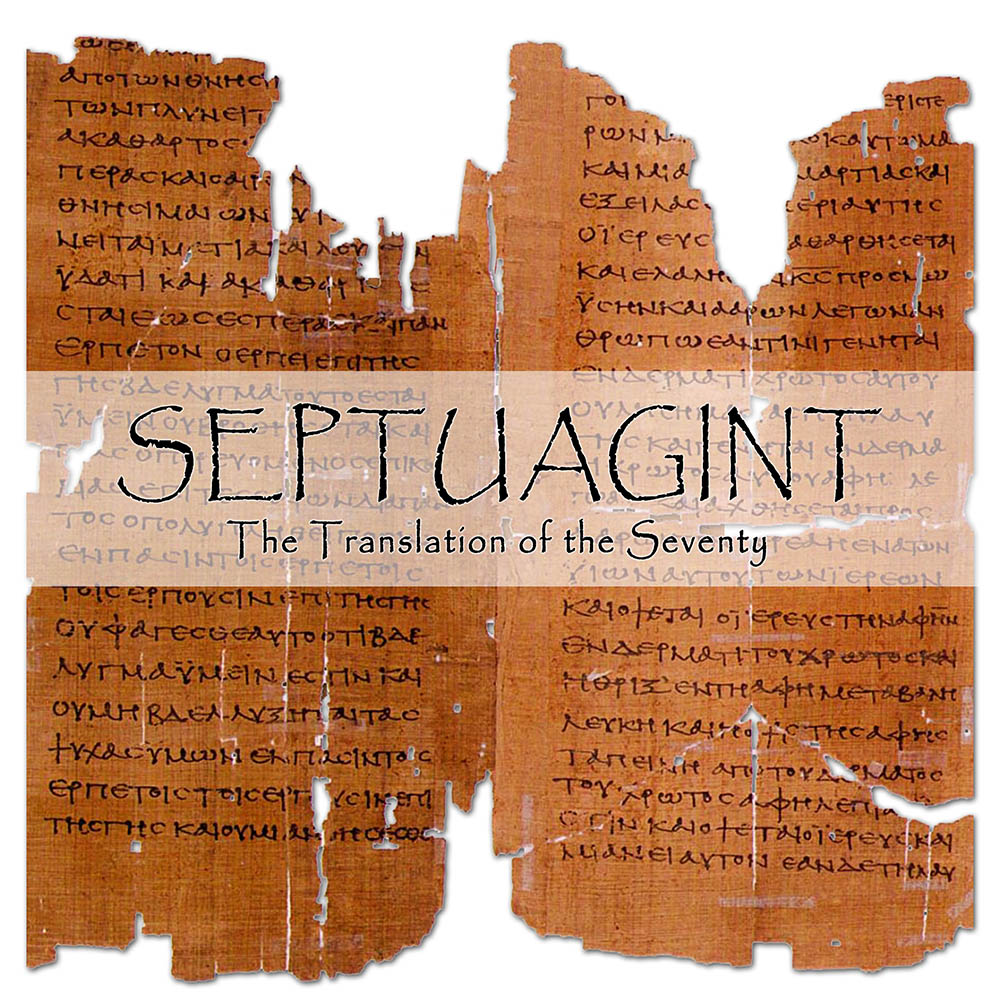
Septuagint
Perhaps, like most of us, you have never even thought to ask whether the Septuagint (LXX) should be preferred over the Hebrew Masoretic text (MT), which is the basis of our English Old Testament Bibles. You may not even know what the LXX is. Likewise you may be unaware of the history of the MT. Perhaps you have noticed, however, that some of the quotations from the Old Testament (LXX) cited in the New Testament do not fully agree with the Old Testament (MT) version of those verses in our Bibles? If you pay attention to details, you have, and, like me, you may have wondered about this. Did Jesus and the apostles misquote the Old Testament? Are our current Old Testament translations superior to what was available then or might it be the other way around? This article is my attempt to answer these questions in pursuit of the answer to the question posed in the title of this article.

In order to do this, I will address the following:

  1. In what language were the original Hebrew scriptures written?
  2. Do we still have any of those original documents or copies of them?
  3. When did modern Hebrew come into use?
  4. What is the Septuagint (LXX), who authored it, why was it written, and when? What older Hebrew texts did it rely upon?
  5. When and how did the Masoretic text (MT) come to be? 
  6. How did the MT become the standard for Protestant Old Testament scriptures?
  7. What are some examples of the significant differences between the LXX and the MT?
septuagintThe original Hebrew scriptures were written in what is called paleo-Hebrew (c. 1000-586 BC). The only fragments we have left of documents written in that language are among the Dead Sea scrolls discovered at Qumran.

Paleo-Hebrew, pictured at right, was more of a pictograph script. Modern Hebrew was developed from Aramaic and has a block style.

The fact that these are the only extant examples of the early writings of the Israelites amazes me. Why would the Jews not have taken more care to preserve such important documents? The probable answer to this question will be shown later in this article. Likewise, I will show how the Dead Sea scrolls represent more than one version of the Old Testament writings, but generally support the Septuagint.

The Babylonian Exile of the Jews took place between 586-539 BC. It was approximately during this time that the modern Hebrew square script began to be developed from Aramaic. 

From 500-300 BC paleo-Hebrew began to be replaced by the new square script. During the restoration of the second temple, proto-Masoretic texts began to be developed.

The Septuagint (LXX) was a Greek translation of the Hebrew scriptures put together by 72 (perhaps 70) Jewish scholars under the auspices of King Ptolemy II of Egypt who wished to add the Hebrew scriptures to his library in Alexandria. 

Greek at the time was the dominant language in the world; so, the LXX soon became the most used compilation of the Old Testament in the Greek speaking world, which included Palestine. Hebrew had become limited to scholars for the most part; so, for the scriptures to be properly understood by common people, they needed to be in Greek. The Pentateuch portion was completed by 282 BC. The rest of the Old Testament was completed around 246 BC. This original version of the Septuagint is called the Alexandrian version. Other versions came later and were called the Septuagint, but were not the same. 

Barry Setterfied, who did extensive research on the LXX, says that it was translated from Paleo-Hebrew directly into Greek. (The Alexandrian Septuagint History) This is extremely significant since these would have been the oldest copies of the original scriptures.

The LXX gained widespread acceptance among the Jews and was the version used by Christians and quoted in the New Testament. Manuscripts like Codex Vaticanus and Sinaiticus (4th century CE) are major witnesses to this. 

The early Christians, many who were Jewish, quoted the Old Testament often in personal letters which still exist. Those quotes, as well as those made by the New Testament authors, match the Septuagint, but not the later Masoretic text.

The Masoretes were a group of Jewish scholars who worked between roughly 500-1000 AD. They worked to finish compiling modern Hebrew by adding vowel points, cantillation marks, and textual notes during the time ranging from 600-1000 AD.

They solidified the textual tradition that became known as the Masoretic text (MT) and finished the work of standardizing the modern Hebrew square script. Experts agree that the Masoretes used different sources than those used by the authors of the Septuagint for some of their work. The Septuagint preserves textual variants sometimes older or different from the later Hebrew MT.

Rabbi Akiba and The Council of Jamnia

This is where things get very interesting. Following the fall of Jerusalem, the Pharisees were the only religious group who retained power among the Jewish Diaspora. They used their influence to establish what is called Rabbinic Judaism in the absence of a temple and sacrificial system. At this time Christianity was flourishing and using Jewish scriptures to prove that Jesus is the Messiah. Rabbi Akiba was a fierce opponent of Christianity and convened a council in Jamnia.

Since the Council of Jamnia is frequently claimed never to have existed, here are some historical facts. When Vespasian became Emperor, in fulfillment of a statement by Rabbi Yohannan ben Zakkai, this rabbi was given the imperial right to establish  an Academy or Rabbinical School at Yavneh (Jamnia). Over a period of time, through a series of cunning maneuvers, Rabbi Akiba gained control over the Academy. He had a passionate hatred of Jesus and he admired Bar Kokhba. Rabbi Akiba ended up supporting Bar Kokhba as the Messiah. Akiba came with a purpose in mind: to give rabbinical Judaism complete control over every aspect of Jewish life. This process did not happen overnight. However, over a period of time, this was achieved by Akiba and the Council of Jamnia.

This process is outlined in detail in Dan Gruber’s book Rabbi Akiba’s Messiah. He says

Akiba’s opposition to the [Christians] led him to sponsor a new rabbinical Greek Bible and a rabbinical, colloquial Targum [commentary]. It also led him to alter Pharasaic tradition. In his efforts to bring Jewish life under rabbinic authority, Akiba was consistent and relentless. Sometimes Akiba intentionally held to certain doctrines just to contradict the beliefs of the [Christians], as he had done in his struggle against Gamaliel…. He put the oral law in writing to increase his leverage against the traditional rabbis…

The new Greek translation was done by Akiba’s pupil Aquila and was completed in 128 AD. We know that this was a Greek version of what is now called the Masoretic text. This means that the Masoretic text must have been Akiba’s rabbinic version of the Hebrew Old Testament. All existing texts which were in accord with the LXX used by the Christians were then burnt. This is hinted at by Gruber’s comment that  “The Rabbis decreed that even a Tanakh scroll should be burned if it was written by a [Christian]. ‘R. Nahman said: We have it on tradition that a scroll of the Law which has been written by a [Christian] should be burnt.’ R. Akiba says: One burns the whole thing, because it was not written in holiness.‘”13 It was under these conditions that the Masoretic text came into being and every divergent text they could find was destroyed [Professor S.H. Horne, “The Old Testament Text in Antiquity.”] Thus the process called the Council of Jamnia gave us the Hebrew Masoretic text in opposition to the paleo-Hebrew which gave us the LXX. (Satterfield)

It is instructive that the only paleo-Hebrew Old Testament documents are those found at Qumran. It seems very odd to me that more care was not taken to preserve them, unless they were deliberately destroyed because the Masoretic texts disagreed with them.

Rabbi Akiba and others at the Council of Jamnia denied that Jesus of Nazareth was the long-awaited Messiah. The Christians, however, had been using the Scriptures to prove that Jesus was the Savior, the Messiah. Thus, it was either the Council of Jamnia itself or a group related to or supported by them who literally re-wrote the ancient Scriptures. The most obvious thing they did was to write them in a more modern Hebrew type. The ancient, or Paleo-Hebrew was more like script and the modern Hebrew which they used was and is comprised of the square characters we see today. However, that was not all they did.

They quietly changed a number of the prophecies used by the Christians so they would not appear to be fulfilled by Jesus, or at least not match what was being quoted in the Christian writings.14 They also, for a rather strange reason, chose to shorten the genealogies in Genesis 5 and 11, effectively chopping off over 1800 years in total.

There is a systematic omission of 100 years from the age of the Patriarchs at the birth of the son in the chosen line in Genesis 5 and 11 in the Masoretic Text from Jamnia when compared with the ancient Septuagint, LXX. It needs to be noted that this omission was NOT there in the early work of Josephus prior to Jamnia. This is documented, as well, in the comments and responses to this article in the sections on the genealogies and the section on Josephus. Why was this cipher for 100 omitted from so many ages of the men at the birth of their sons? There was a strong belief at the time that it was dishonoring to the Lord to wait for a long time before the first child/son was born. What is interesting is that the men mentioned as being born in Genesis 5 and 11 are nowhere stated to be the firstborn sons. But evidently on the assumption that they were, the cipher for 100 was systematically chopped from the ages of the fathers at the sons’ births, as this was felt to be more honoring to the Lord.

Satterfield elsewhere shows that Akiba’s tampering with the genealogies of Genesis was done to accomplish two anti-Christ purposes. First, he wished to prove that Noah was the second Adam, not Christ. Secondly, he wished to claim that Melchisadek was Shem, not a type of Christ. (Satterfield, Genealogy Differences)

The old original form of written Hebrew, used at least from the time of the Exodus, was called Paleo-Hebrew. Its appearance was rather like a semi-pictogram-script form when compared with the square ‘modern’ Hebrew characters. A comparison of the two can be found in the Wikipedia article on the two. Paleo Hebrew was used right up until 135 AD by which time Modern Hebrew had taken over completely. The Dead Sea Scrolls show that Paleo-Hebrew was often used for Scriptural work up until 70 AD. However, around 100 AD, the Council of Jamnia, under Rabbi Akiba, produced a version of Scripture written in the square ‘modern’ characters, without the vowel pointings. This meant the Jews had to depend on the rabbis to tell them what the words actually were (hill? hell? hall? etc.), thus reinforcing Rabbinical tradition rather than remain true to the original text. Dan Gruber, in Rabbi Akiba’s Messiah, the Origins of Rabbinic Authority, explains it in the following:

“The Rabbis are the source of their own authority to annul the Torah. .. The Rabbis could establish conditions and practices that contradicted and even nullified the Torah. According to the Rabbis, God Himself would obey whatever they decided. … The Rabbis claimed the sanction of the Torah for whatever they decreed, even if it was the uprooting of Torah. … This was more than the assertion of a different ‘religious’ system. The Torah governs every aspect of the life of Israel. By governing the Torah, the Rabbis would govern Israel. … The objective was to bring Israel under the rule of the Rabbis. If the Scriptures stood in the way, the Scriptures had to be uprooted. … There was a radical and irreconcilable conflict between the Torah and the Rabbis as to the basis and structure of authority, as well as its source and administration. That is why the Rabbis gave themselves the right to alter, revise, trespass and uproot the original commandments. … R. Akiba sought to fence the people off from the Torah and from all other influences that would have challenged rabbinic authority. In the system he erected, no one else had the right to interpret Torah. Not the am ha’aretz, nor the priests, nor the prophets, nor the Sadducees, the Qumran Covenanters, the Talmedei Yeshua, nor anyone else. Not even God.” [Daniel Gruber, Rabbi Akiba’s Messiah: The Origins of Rabbinic Authority, pp.82-85, Elijah Publishing, 1999 with references].

The changes we find dating from the time of the Council of Jamnia are deliberate. There are too many of them in specific places to be the result of accumulated errors by isolated copyists over the centuries or millennia.

Evidence of the many changes dispels any impression that Akiba’s “scribes were careful not to lose a jot or tittle,” as rabbinic tradition has indicated. That is simply not true. Akiba and his colleagues had a specific agenda to fulfill and they left no stone unturned to accomplish that

Professor S.H. Horn (Archaeology, Andrews University, Michigan) writes:

“However, the facts – that a unified [Hebrew] text suddenly became the standard at the end of the first century and that not one copy of a divergent text survived (except the Dead Sea scrolls that had already been hidden when Jamnia convened), indicate clearly that the Council of Jamnia must have taken action in this matter. Moreover, the fact that Aquila, one of Akiba’s pupils, soon thereafter produced a new Greek translation that slavishly translated the [new] unified Hebrew text for the use of the Diaspora Jews gives credence to the idea that Akiba must have been a key influence in the standardization of the Hebrew text.”15

In other words, the Masoretic text that is in common use today originated at the Council of Jamnia around 100 AD, and Aquila’s Greek translation from Akiba’s Masoretic was finalized about 128 AD.

By 100 A.D., when Akiba and the Council of Jamnia were altering the Old Testament Scriptures, the New Testament Gospels and letters had already been written.  However we know from the letters written back and forth by the early church fathers that the quotes being used by them and referred to by them were from the ancient Septuagint and not from the Masoretic.

It would take over 200 more years for the Masoretic text to be accepted by the church, as a result of a request Constantine made. (Satterfield)

The Dead Sea Scrolls

The Dead Sea Scrolls (DSS) provide us with more evidence.  The DSS fall into two distinct groups:  those written before 70 A.D. and those written after 100 A.D. The earlier DSS were written between 250 BC and 68 AD.  At this time there were three distinct groups of Jewish leaders:  the Pharisees, the Sadducees, and the Essenes.  The Essenes lived in the caves near Qumran, and had in their possession some of the ancient Scriptures.  In addition to preserving these, they also copied some of the scrolls themselves between 150 BC and 68 AD.

Biblia Hebraica concludes from these and other facts:  “Recent Aramaic findings among the Dead Sea Scrolls read most closely with the LXX, and not with the Masoretic text. … This suggests that the older LXX may be more accurate than the newer Masoretic text which was given to Jerome.” [When Jerome translated the Latin Vulgate, he was preparing to use the ancient LXX text. But his Jewish friends convinced him that the newer Masoretic Hebrew text was superior 21].

A more recent comment concerning the Dead Sea Scrolls is also relevant: In a review of some of this scholarship, Hershal Shanks notes that ”…many Hebrew texts [are available] that were the base text for Septuagintal translations…”. Further he notes that what “…texts like 4QSama show is that the Septuagintal translations are really quite reliable” and ”…gives new authority to the Greek translations against the Masoretic text”. Quoting Frank Moore Cross (a co-author of the book under review), Hershal continues ”We could scarcely hope to find closer agreement between the Old Greek [Septuagintal] tradition and 4QSama than actually is found in our fragments”.22 Modern scholarship on the DSS therefore supports the contention that the ancient LXX text is in accord with the original Hebrew Old Testament as it existed in the 1st and 2nd centuries BC and the early 1st century AD. (Satterfield)

How the Masoretic text became the standard for Protestant Bibles

[Evidence shows that[ the existence and persistent use of the ancient LXX can be traced from about 282 BC right through until 325 AD. Its common use is attested to by the quotations from it by the Jewish historian Eupolemos in the 2nd century BC and by the Dead Sea Scrolls from the 1st and 2nd centuries BC and 1st century AD. The Jewish writers Philo and Josephus also testify to its existence and use in the 1st century AD. From there, Christ, the Apostles, and the Church Fathers affirm its presence and validity right up until the period of the Council of Nicaea. It is around the time of this Council, and for some time after, that the next development takes place. The ancient LXX existed, then, as a generally available manuscript, but its existence became threatened by the orders of the Emperor Constantine in 331 AD. (Satterfield)

Origen was an influential scholar and heretic from the third century who denied the physical resurrection of Christ, the historicity of some parts of the Bible, and was a universalist. He was heavily influenced by Gnostic thought as well.

Origen sought to make the LXX mesh with the Masoretic text, thus compromising the LXX.  

Origen was interested in coordinating the different translations of Scripture in existence. By this time the Jews had moved away from the ancient Alexandrian LXX as well as their own old form of Hebrew writing, known as paleo-Hebrew. They had gravitated toward the Masoretic Scriptures, which had been formulated in an effort to discredit the use of Old Testament Scripture being used by the Christians to show those Scriptures prophesies (sic) were fulfilled by Jesus of Nazareth. Discussions between Jews and Christians had shown the ancient LXX and the newer Masoretic texts had some definite differences, especially in matters of Christology. Origen attempted to address the differences between them. By 250, he had completed his six-column comparison of Scripture versions, called the Hexapla.25

It is agreed that the six columns of Origen’s Hexapla in order were 1). The Masoretic Hebrew text, 2). A transliteration of the Masoretic Hebrew into Greek, 3). The Greek version of the Masoretic text produced by Rabbi Akiba’s pupil Aquila, 4). An overall precise Greek version of the Masoretic produced by Symmachus at the end of the 2nd century AD, 5). The ancient LXX Greek version, 6). Theodotion, who used the LXX but corrected it freely to conform it with the Masoretic text.26 Extant evidence shows that Origen made every effort to reconcile the different versions of Scripture present at his time. His goal was to produce an updated version of the ancient LXX, and in doing so, he changed parts to conform to the Masoretic.  (Satterfield)

In 319 AD, the Arian controversy broke out and spread throughout the Eastern Mediterranean. Its origin is uncertain, although it may have started via Origen. But however it started, this theology denied the deity of Jesus. In 321AD, Arius — after whom the heresy was named — was denounced by the Synod of Alexandria for his denial of Jesus’ deity.   Arius went into Palestine under the protection of the historian Eusebius, who became the Bishop of Caesarea about 314 AD. He was also protected by another Eusebius, the Bishop of Nicomedia.  It was here in Caesarea, which was now held by Eusebius as Bishop, that Origen’s manuscript was still stored.

It must also be noted that Eusebius of Caesarea’s’ tutor had been Pamphilus, and together they had written the “Defense of Origen.”27 Thus the works of Origen were viewed with favor by Eusebius and colored his theology.

It is against this background of the Arian heresy, that another event occurred which is important in the context of the ancient LXX. In 331 AD, 12 years since the Arian heresy broke out, the Emperor Constantine asked his friend and historian, Bishop Eusebius of Caesarea, to make 50 copies of the Bible. Which version was he going to choose? Would it be the LXX which the church had used for over 300 years, or would he choose the newer Masoretic text, and if so, why?

The fifty copies were made from Origen’s attempts to update the ancient LXX, bringing it in line with the Masoretic. The impetus for Eusebius to do this followed from his appreciation of Origen and the adherence of both of them to the heresy which did not accept Jesus as God. Interestingly, Rabbi Akiba, who had commissioned that same Masoretic text at the Council of Jamnia, had not accepted Jesus’ claims either. (He supported Bar Kochba as Messiah instead.)

Thus, the Masoretic from which our Old Testament translations come today, was the result of Akiba, Origen, and Eusebius, none of whom believed in the deity of Jesus Christ. (Satterfield)

Jerome (c. 347–420 AD) helped to shift the Western Church toward using the Hebrew text as the primary basis for the Old Testament rather than the Greek Septuagint. However, he did not translate from the Masoretic Text as we know it today, because the fully developed Masoretic tradition would not be completed for several centuries.

Instead, Jerome worked from the Hebrew manuscripts available in Palestine around 390–405 AD. Those manuscripts were likely predecessors of what scholars call the proto-Masoretic text, the textual family from which the later Masoretic Text developed. When Jerome began producing what became the Latin Vulgate, he argued that Christians should return to the Hebrew text, which he called the Hebraica Veritas (“Hebrew Truth”). He learned Hebrew from Jewish teachers in Palestine and translated much of the Old Testament directly from Hebrew rather than from the Septuagint. This caused controversy. Augustine worried that replacing the familiar Septuagint could create confusion and potentially undermine passages Christians had traditionally used in theological arguments.

For centuries after Jerome:

    • The Western Church primarily used the Latin Vulgate.
    • The Eastern churches continued using the Septuagint.
    • The Church did not formally declare that the Hebrew text was superior to the Septuagint.

What Jerome did accomplish was to preserve in Latin a translation based on a Hebrew textual tradition very close to the later Masoretic Text. Jerome’s influence became much greater over a thousand years later. Reformers such as Martin Luther and John Calvin strongly preferred the Hebrew text for the Old Testament. Jerome’s arguments for the Hebraica Veritas were frequently cited in support of that position.

As a result:

    • Most Protestant Old Testaments came to be translated primarily from the Masoretic Text.
    • The Roman Catholic Church retained the Vulgate as its official Bible for many centuries.
    • The Eastern Orthodox churches continued to give the Septuagint a central role. (Chat GPT)

Some Examples of Differences between the LXX and Masoretic Text

In the short time that I have been comparing the LXX to the what my NKJV (MT) says, I have noted quite a few differences, some of them being quite significant. Some of the variances in the MT hide obvious allusions to Christ. One that is rather startling is the rendering of Jeremiah 23:6. The MT says:

6 In His days Judah will be saved, And Israel will dwell safely; Now this is His name by which He will be called: THE LORD OUR RIGHTEOUSNESS Jeremiah 23:6 (NKJV)

The Septuagint reads as follows:

6 In his days both Judah will be delivered, and Israel will encamp confidently, and this is his name, which the Lord will call him: “Jozadak.” Jeremiah 23:6 (LES2) 

I believe this is a clear example of the MT removing an allusion to Christ. Jozadak was a priest whose son was the high priest, Joshua (Jesus). Here is what Zechariah 6:11 says in the LXX:

11 And you will take silver and gold, and you will make crowns and place them upon the head of the great priest Joshua, the son of Jehozadak.  Zechariah 6:11 (LES2) 

Since all scripture ultimately points to Christ, this passage in Zechariah, alluded to in Jeremiah 23:6, must refer to Christ’s  being granted lordship in heaven after his ascension. 

13 I continued to watch in a vision of the night, and look, upon the clouds of the heavens, a being like a son of man came, and the ancient of days was present, and his attendants were present with him. 14 Authority and royal honor was granted to him, and all the peoples of the earth according to races, and all honor will be directed to him, and his authority is an eternal authority that will not be removed, and his kingdom is one that will not perish. Daniel 7:13–14 (LES2) 

Another striking example occurs in Hebrews 1:6.  There we read,  “And again, when God brings his first begotten into the world He says: ‘Let all the angels of God worship him’. ” This is referenced as a quote from Deuteronomy 32:43 in both the ancient Septuagint  and the Dead Sea Scrolls as well as in the footnotes of a number of modern translations. However, when you try to look it up in our modern translations (all of which are from the Masoretic), it does not exist in Deuteronomy 32.  Our modern translations only read “Rejoice, O Gentiles with His people; for He will avenge the blood of His servants … ”  It is in the ancient versions we  find the words: “Rejoice you heavens with him, and let all the angels of God worship him; rejoice you Gentiles with his people, and let all the sons of God strengthen themselves in him; for he will avenge the blood of his sons…”  Thus the Masoretic text from Rabbi Akiba deletes a key passage pointing to the deity of Christ, a passage which the Apostles used in their presentation of the Gospel and which was part of their Old Testament.

Again in Hebrews 10:5, we find a difference.  The writer quotes Psalm 40:6 from the ancient LXX. (Note that some Psalms in the LXX are numbered differently from the standard usage today. Thus Psalm 40 in our Bibles is actually Psalm 39 in the LXX). Hebrews quotes the Psalm, saying “Therefore, when He came into the world, He said: ‘Sacrifice and offering you did not desire, but a body you have prepared for me’…”  Again, we cannot find these words in the modern translations.The Masoretic text is contorted by Rabbi Akiba to omit these words in Psalm 40.  They have been replaced with “Sacrifice and offering you did not desire; my ears you have opened…”  Thus, any implication regarding the Incarnation was deleted.  These are but two of the many examples of quotes used by writers of the New Testament which do not match what we read today in our Old Testaments. (Satterfield)

If you take the time to read through the MT Old Testament and compare it to a parallel LXX translation, you will see for yourself.  

Conclusion

Satterfield makes a strong case historically for Christians to use the Septuagint.

When one compares key verses that have a connection to Christ, it is apparent that changes were made to blunt this testimony and cast doubt on the New Testament scriptures.

The fact that the Septuagint is quoted in the New Testament is the strongest argument that it is the version Christians should use.

septuagintThe logic is inescapable. If anything is written in the New Testament, it is, by definition, the inspired Word of God. This means that any quote from the LXX is the inspired Word of God, too. Until a Bible is published that uses the LXX as the basis for the Old Testament, we must rely upon reading the MT and LXX side by side. If you wish to purchase the LXX for yourself, I have been informed that Brenton’s is a very good translation. I am happy to say that Thomas Nelson is preparing to publish an Orthodox Study Bible that uses the LXX for the Old Testament and the NKJV for the New. I have already pre-ordered mine.


More articles on identifying and countering deception.

Whose Reputation Are We Trying to Protect?

Many people regard the Genesis version of creation and the shape of the heavens and earth, which is called biblical enclosed cosmology, as a foolish conspiracy theory or government psy-op that does not even warrant investigation.

Imagine a Christian saying that God’s Word is a psy-op! And, yet, that is exactly what a pastor friend said as much to me.

Many Christians do not want to be associated with what some call “flat earth” because they think that linking the gospel to such a controversial topic as what the Bible teaches in Genesis would place an unwelcome hurdle in front of God seekers. Do we really believe that the Genesis account of creation is more incredible than Noah’s  flood, the ten plagues in Egypt, the crossing of the Red Sea, Joshua stopping the sun and moon, God making the shadow go backwards, the virgin birth, the resurrection, and the ascension of Christ into heaven, where he currently sits enthroned at God’s right hand?

Are we going to ignore the constant reference throughout the Bible of heaven being up, the earth below, and Sheol underneath?

God has built enough mystery into his creation and our experience of life that we are required to exercise faith in something – either what God has said or what scientists or occultists tell us.

Often the latter two options are one and the same. Science pretends to explain everything away, reducing life and creation to materialism, completing excluding the spiritual side of things, which the Bible says came first and is more real. Science has become an idol for many.

Satan desires to strip away our childlike faith in God’s words and replace it with the god of human reasoning.

Nowhere is this more apparent than when cosmology is discussed.

I have been warned by well-intentioned friends that my reputation and standing as a Bible teacher in the body of Christ has been damaged by my public profession that I believe that the Genesis account of creation is literally true.

Never would I have thought that believing the Bible is literally true would compromise my reputation with other Christians. What does that say about the condition of the modern church?

Should I be concerned about this? Would God’s honor be increased if I retracted and said that I no longer believe that what Genesis says is actually true but only has an appearance of truth? That is what the popular phenomenological interpretation tells us. Would God be glorified if I announced that Genesis is not supposed to be taken as literally true; rather, it is meant to be enjoyed as a poetic description of creation to tide us over until brilliant astronomers would discover the truth? Will God be pleased if I to put more trust in men who contradict the Bible than I do in what is written in the Scriptures?

Would not such a flip flop be detrimental to God’s honor and reputation as a truth teller?

reputationFor the sake of us Christians who live post-Enlightenment, should not the Holy Spirit have inspired Moses to write something more scientifically accurate in Genesis that would agree with modern astrophysics? Or could it be that God wrote exactly what he meant for us to know and believe because it is the truth?

God put his honor and reputation on the line in Genesis by telling us that he created everything in six days, including a heaven-earth-Sheol system enclosed in a solid dome called the firmament.

It is my privilege to stand up for what God wrote and defend his integrity and honor before a mocking world. How about you? Whose reputation are we trying to protect anyway? Ours or God’s?

Is God a Liar?

liarIs God a liar? Earlier in my life I would not have guessed that at 74 years of age I would be spending a great deal of energy defending God’s integrity to other Christians. It is not surprising that atheists claim that the Bible is a primitive fairy tale, but it is tragic that so many of us Christians believe that the Creator lied to us! Poor liars share blatant untruths that are easily discovered and refuted. Really good liars know how to couch their fabrications in enough ambiguity to give themselves some deniability if their mendacity is eventually discovered. If God is a liar, then he falls into the second category, which would make him very evil indeed. Yet that is exactly what many Christians claim. 

Where am I going with this? As you may know, over two years ago my eyes were opened to one of the greatest satanic lies of all time. Heliocentrism, with its required Big Bang antecedent, was introduced some five hundred years ago by a Roman Catholic astronomer named Nicolaus Copernicus at the encouragement of the Pope. His theory flatly contradicts the Bible’s testimony in Genesis and elsewhere, which makes it odd that a so-called Christian leader would support it. But the Catholic church long ago abandoned the Bible as the ultimate source of truth. Before heliocentrism gained traction, almost everyone in the world, except for a few ancient Greeks and Egyptian hermeticists, believed the biblical version of things in some form or another. Almost every culture and civilization understood the earth to be an enclosed circular plane. This belief is now blamed on scientific ignorance, but perhaps they got their view from Adam who got his from God. Just a thought.

liarThough initially resisted by the Protestant Reformers for being contrary to the Bible’s teaching, eventually heliocentrism gained favor and now is almost universally believed.

As a result of the acceptance of what is now considered a scientific fact, Bible scholars felt compelled to alter their interpretation of Genesis and other enclosed cosmology verses and passages in the Bible. Today, scholars agree that God spoke phenomenologically in such passages, using poetic language to communicate spiritual truths. This was exactly the same interpretation strategy employed to provide wiggle room for biological evolutionary Darwinism to be true. 

By claiming that God spoke words that have no literal meaning, but only seem so, we accuse God of dissimulation. It is similar to when parents tell their children that a stork delivered them to the family, knowing full well that it is a lie. Perhaps we can excuse parents for wanting to protect their children from knowing about sexual matters at too young an age, but it is still a lie. How much better to tell the truth without being specific – something like, “You are a gift from God. When you get older I will tell you more.” However, since we are quite human and born liars, we often resort to telling a falsehood to avoid an uncomfortable situation. But God is a stickler for truth by nature. (Numbers 23:19)

The Lord would never lie about his creation because what he made testifies to his character.

18 For the wrath of God is revealed from heaven against all ungodliness and unrighteousness of men, who suppress the truth in unrighteousness, 19 because what may be known of God is manifest in them, for God has shown it to them. 20 For since the creation of the world His invisible attributes are clearly seen, being understood by the things that are made, even His eternal power and Godhead, so that they are without excuse, Romans 1:18–20 (NKJV)

If God lied to us about his creation, certainly we would have an excuse since he would be guilty of giving false testimony.

If we claim that God was less than candid about his creation and therefore modify the obvious meaning of God’s Word to make it fit the claims of accepted “science,” for all practical purposes, we call God a liar of the very worst sort.

Not only did he mislead his people for thousands of years, he now has put a stumbling block in front of those who previously trusted his every word.

Are we now to understand that sometimes God speaks phenomenologically about other things we thought were literally true, such as Christ’s resurrection? 

Maybe our Lord did not actually rise bodily from the dead, but only appeared to do so, to his scientifically ignorant disciples. Perhaps miracles did not really happen after all, but only appeared to take place because the biblical authors were uninformed. 

Once we assume for ourselves the authority to interpret some passages of Scripture poetically or phenomenologically, we can end up in some real difficulties.

To add to the confusion, those who claim God spoke poetically in Genesis also affirm a belief in the inerrancy of Scripture, citing such verses as the following.

15 Be diligent to present yourself approved to God, a worker who does not need to be ashamed, rightly dividing the word of truth. 2 Timothy 2:15 (NKJV)

35 If He called them gods, to whom the word of God came (and the Scripture cannot be broken), John 10:35 (NKJV) 

4 But He answered and said, “It is written, ‘Man shall not live by bread alone, but by every word that proceeds from the mouth of God.’ ” Matthew 4:4 (NKJV) 

We cannot have it both ways. We cannot say God sometimes speaks things that are not meant to be taken at face value while at the same time claiming he always and unequivocally tells the truth.

The only times we can interpret God’s words less than literally is when the context demands it. The context of Genesis does not demand it, which is proved by the fact that the Israelites, Jesus, and the early Christians all believed the Bible’s version of cosmology. Are we really more informed than Jesus? No, it is not the context, but modern astrophysics demands it. Whom are we serving anyway?

Satan’s deceptions are so subtle that sometimes we are not even aware that we are questioning God’s integrity and knowledge. We cleverly formulate nuanced interpretations that we think will get us off the hook with God, but they do not. He sees right through our duplicity, just as he recognized and called out the hypocrisy of the Jewish leaders of his day.

And so you cancel the word of God in order to hand down your own tradition. And this is only one example among many others.” Mark 7:13 (NLT)

Most heliocentrists do not realize how far afield from the Bible’s version of reality they have been taken by Satan’s lies. I have written dozens of articles in an effort to bring this to light. A good place to start might be the one entitled, The Genesis Testimony, in which I contrast the Genesis account with what heliocentrists believe. It may shock you.

Anyone who believes in heliocentrism is forced to reject the six-day account of creation and to accept all manner of unproven theories and concepts.

Below is an example.

deception

In summary, when we change God’s Word to conform to modern thinking, we declare that the Creator is either a liar or did not understand what he made. Isaiah had some penetrating words relating to such a mindset.

Surely you have things turned around!...shall the thing formed say of him who formed it, “He has no understanding”? Isaiah 29:16 (NKJV)

When we do not believe that the Bible means what it says or says what it means, we call God a liar.

...the one who does not believe God has made Him a liar... 1 John 5:10 (NASB95)

Adam and Eve did not vocalize that they believed that God lied to them, but their actions spoke loudly and clearly. They gave the serpent’s words more credence than God’s! Are we any different?

Every generation encounters the temptation to disbelieve God and his words.

excuseSatan seeks to overwhelm us with deception to divorce us from God’s truth in every area. As Jesus said, the devil is the father of lies, and there is absolutely no truth in him. (John 8:44) Over the centuries, Satan has managed to deceive the whole world (Revelation 12:9), which has resulted in the entire world system being under his power (1 John 5:19).

In many places, even now, Christians are facing stiff persecution and even death for confessing that Christ is Lord.

In the West, it seems that currently our biggest test of allegiance to Christ may  be whether we will resolutely hold to the truth of God’s Word or surrender our minds and hearts to the wisdom of men.

The only way to escape the devil’s web of enslaving lies is to turn to Christ and to make a decision to firmly believe every one of God’s words found in the Bible, even when we do not completely understand them.

So Jesus was saying to those Jews who had believed Him, “If you continue in My word, then you are truly disciples of Mine; 32 and you will know the truth, and the truth will make you free.” John 8:31–32 (NASB95)

Jesus made it clear that we do not get to choose which of the words of the Bible are true and which are not (John 10:35).

We do not have the authority to declare that the Bible contains truth, but not every single word is true (Matthew 4:4).

Neither do we have any right to dilute the impact of God’s words or nullify them through reinterpretation to fit our own grid of understanding (Mark 7:13).

To be true to God, we must be willing to make a stand for his revealed truth, even if it means we must call some men liars, maybe even the majority of men.

Truth is not established by what the majority believes, but by what God says.

May it never be! Rather, let God be found true, though every man be found a liar, as it is written, “THAT YOU MAY BE JUSTIFIED IN YOUR WORDS, AND PREVAIL WHEN YOU ARE JUDGED.” Romans 3:4 (NASB95)

If things go true to form, some will mock my words as being those of a moronic conspiracy theorist. Satan mocked Eve for “naively” believing God’s words. The devil seeks to intimidate us because we do not understand everything. He gladly provides occult knowledge to fill in the gap. God requires us to trust him and be satisfied with what he reveals to us. (Proverbs 3:5-6) The occult secrets of the universe that Satan offers that contradict the Bible must be rejected in favor of God’s truth. We will have to choose whose moron we are going to be – God’s or the devil’s. Paul chose to be God’s fool. (1 Corinthians 4:10) So should we. God is not a liar, and we should never call him one.

What Did Jesus Say about a Third Temple?

templeThe idea of constructing a third Jewish temple is a topic of current interest. Many believe that the nation of Israel has plans to do just that, building it on the temple mount after removing the Islamic holy place currently located there. Along with this would be a re-institution of Old Covenant animal sacrifices. Thanks to the Dispensational teachings of John Darby and Cyrus Scofield, millions of Christians believe all of this must take place before Jesus returns and support Israel in this matter, believing them to be “God’s chosen people.” Did Jesus have anything to say about these things?

To arrive at an answer, here are three questions we need to answer.

  1. Why did Jesus prophesy the destruction of the Temple, which took place in 70 AD?
  2. Why did Jesus say, if this temple, meaning his body, were destroyed, he would raise it again in three days?
  3. Why did Jesus tell the Samaritan woman that all true believers would worship God in spirit and truth without regard to a physical location?

Why the Temple Was Destroyed

Just before his crucifixion, Jesus prophesied the complete destruction of the Jerusalem and the temple.

Then as He went out of the temple, one of His disciples said to Him, “Teacher, see what manner of stones and what buildings are here!” 2 And Jesus answered and said to him, “Do you see these great buildings? Not one stone shall be left upon another, that shall not be thrown down.” Mark 13:1–2 (NKJV) 

This in itself was shocking enough to his disciples, but the reason for this happening was even more startling. Our Lord provided this rationale in parabolic form.

Hear another parable: There was a certain landowner who planted a vineyard and set a hedge around it, dug a winepress in it and built a tower. And he leased it to vinedressers and went into a far country. 34 Now when vintage-time drew near, he sent his servants to the vinedressers, that they might receive its fruit. 35 And the vinedressers took his servants, beat one, killed one, and stoned another. 36 Again he sent other servants, more than the first, and they did likewise to them. 37 Then last of all he sent his son to them, saying, ‘They will respect my son.’ 38 But when the vinedressers saw the son, they said among themselves, ‘This is the heir. Come, let us kill him and seize his inheritance.’ 39 So they took him and cast him out of the vineyard and killed him. 40 “Therefore, when the owner of the vineyard comes, what will he do to those vinedressers?” 41 They said to Him, “He will destroy those wicked men miserably, and lease his vineyard to other vinedressers who will render to him the fruits in their seasons.” 42 Jesus said to them, “Have you never read in the Scriptures: ‘The stone which the builders rejected Has become the chief cornerstone. This was the LORD’s doing, And it is marvelous in our eyes’? 43 “Therefore I say to you, the kingdom of God will be taken from you and given to a nation bearing the fruits of it. 44 And whoever falls on this stone will be broken; but on whomever it falls, it will grind him to powder.” 45 Now when the chief priests and Pharisees heard His parables, they perceived that He was speaking of them. 46 But when they sought to lay hands on Him, they feared the multitudes, because they took Him for a prophet. Matthew 21:33–46 (NKJV)

The descendants of Abraham, except for a relatively few godly men and women, were rebels against God from start to finish.

Their history as a nation begins, in a sense, at the miraculous Exodus from Egypt. Their forty years of desert wandering after leaving Egypt and entering Canaan contained numerous examples of idolatry and rebellion against God. At one point, God was ready to destroy them and start again with Moses, but Moses interceded on their behalf. (Exodus 32:11) After they conquered Canaan, at the end of Joshua’s life, that great leader prophesied their future apostasy, despite their protests that they would be faithful to God.

But Joshua said to the people, “You cannot serve the LORD, for He is a holy God. He is a jealous God; He will not forgive your transgressions nor your sins. 20 If you forsake the LORD and serve foreign gods, then He will turn and do you harm and consume you, after He has done you good.” Joshua 24:19–20 (NKJV)

Israel was part of the Old Covenant. As such, they were not able to keep God’s commandments, because no one can.

There is not one single righteous person apart from our Lord. (Romans 3:10) It is only through Jesus that anyone can be saved. (Philippians 3:9) The temple and sacrificial system were instituted as pictures of the perfect temple and sacrifice that was to come, in the person of our Lord Jesus Christ, through his incarnation and offering of himself upon the cross as God’s Lamb.

The blood of animals could never remove sin – not then, not ever. Those sacrifices merely postponed judgment until the arrival of the Messiah.

But in those sacrifices there is a reminder of sins every year. 4 For it is not possible that the blood of bulls and goats could take away sins. Hebrews 10:3–4 (NKJV)

When Jesus arrived, John the Baptist announced to the Jews and the world that God’s Lamb had come at last.

The next day John saw Jesus coming toward him, and said, “Behold! The Lamb of God who takes away the sin of the world! John 1:29 (NKJV)

Jesus came to fulfill Isaiah 53, but the Jewish leaders did not receive him or believe in him.

He was in the world, and the world was made through Him, and the world did not know Him. 11 He came to His own, and His own did not receive Him. 12 But as many as received Him, to them He gave the right to become children of God, to those who believe in His name: 13 who were born, not of blood, nor of the will of the flesh, nor of the will of man, but of God. John 1:10–13 (NKJV)

Only a remnant of people among the Jews were able to recognize and receive Jesus as Savior and Lord. The Jewish leaders put him to death, which was a horrible irony. The most privileged people in the world, the descendants of Abraham, whom God had chosen to husband the Scriptures and provide the human lineage of the Messiah, chose to murder instead of worship him. As a result of their horrible betrayal, those Jews who refused to later repent at the preaching of the gospel were sentenced to pay for their monumental sin.

All the postponed judgment for Israel’s continual disobedience came upon that generation, embodied in the grisly destruction of the city and temple.

Woe to you! For you build the tombs of the prophets, and your fathers killed them. 48 In fact, you bear witness that you approve the deeds of your fathers; for they indeed killed them, and you build their tombs. 49 Therefore the wisdom of God also said, ‘I will send them prophets and apostles, and some of them they will kill and persecute,’ 50 that the blood of all the prophets which was shed from the foundation of the world may be required of this generation, 51 from the blood of Abel to the blood of Zechariah who perished between the altar and the temple. Yes, I say to you, it shall be required of this generation. Luke 11:47–51 (NKJV)

In addition, the kingdom of God was taken from them and given to a most surprising group of people – the elect in Christ, otherwise known as the body of Christ, the one new man in Christ, and the church. Paul called this a mystery – something hidden beforehand, but later revealed by God.

For this reason I, Paul, the prisoner of Christ Jesus for you Gentiles—2 if indeed you have heard of the dispensation of the grace of God which was given to me for you, 3 how that by revelation He made known to me the mystery (as I have briefly written already, 4 by which, when you read, you may understand my knowledge in the mystery of Christ), 5 which in other ages was not made known to the sons of men, as it has now been revealed by the Spirit to His holy apostles and prophets: 6 that the Gentiles should be fellow heirs, of the same body, and partakers of His promise in Christ through the gospel, Ephesians 3:1–6 (NKJV)

This people is composed of born-again individuals from every ethnic group, including the Jews. 

Jesus Is the New Covenant Tabernacle of God

The New Covenant made the old one obsolete and no longer valid. It has been replaced by something infinitely superior.

In that He says, “A new covenant,” He has made the first obsolete. Now what is becoming obsolete and growing old is ready to vanish away. Hebrews 8:13 (NKJV)

When Jesus became a human, he also became the true tabernacle of God on the earth, replacing the temple building as the abiding place of God’s presence.

And the Word became flesh and dwelt [Greek: skenoo - tabernacled] among us, and we beheld His glory, the glory as of the only begotten of the Father, full of grace and truth. John 1:14 (NKJV)

The Greek word for “tabernacled” used in the above verse is the same root word for “tent of meeting” employed by the Greek translation of the Old Testament, the Septuagint, which was used by Jesus and the apostles. The apostle John understood, when he wrote his gospel, that Jesus carried God’s presence with him, making the Old Covenant temple obsolete. This was not apparent to the apostles until after the resurrection, but by the time of Stephen, it was clearly understood. 

“Our fathers had the tabernacle of witness in the wilderness, as He appointed, instructing Moses to make it according to the pattern that he had seen, 45 which our fathers, having received it in turn, also brought with Joshua into the land possessed by the Gentiles, whom God drove out before the face of our fathers until the days of David, 46 who found favor before God and asked to find a dwelling for the God of Jacob. 47 But Solomon built Him a house. 48 “However, the Most High does not dwell in temples made with hands, as the prophet says: 49 ‘Heaven is My throne, And earth is My footstool. What house will you build for Me? says the LORD, Or what is the place of My rest? 50 Has My hand not made all these things?’ 51 “You stiff-necked and uncircumcised in heart and ears! You always resist the Holy Spirit; as your fathers did, so do you. 52 Which of the prophets did your fathers not persecute? And they killed those who foretold the coming of the Just One, of whom you now have become the betrayers and murderers, 53 who have received the law by the direction of angels and have not kept it.” Acts 7:44–53 (NKJV)

God used the tent in the wilderness and the physical temple building as pictures of the heavenly reality of his presence and throne. Nevertheless, it was never the Lord’s intention that physical structures of any kind would be his ultimate dwelling place. From the beginning, his plan was to tabernacle among men. (Revelation 21:3) This was accomplished when Jesus died, rose again, and ascended to God’s right hand.

Our Lord sent his Holy Spirit to indwell those who believe in him.

Paul wrote:

Do you not know that you are the temple of God and that the Spirit of God dwells in you? 17 If anyone defiles the temple of God, God will destroy him. For the temple of God is holy, which temple you are. 1 Corinthians 3:16–17 (NKJV)

Peter agreed:

Coming to Him as to a living stone, rejected indeed by men, but chosen by God and precious, 5 you also, as living stones, are being built up a spiritual house, a holy priesthood, to offer up spiritual sacrifices acceptable to God through Jesus Christ. 6 Therefore it is also contained in the Scripture, “Behold, I lay in Zion A chief cornerstone, elect, precious, And he who believes on Him will by no means be put to shame.” 7 Therefore, to you who believe, He is precious; but to those who are disobedient, “The stone which the builders rejected Has become the chief cornerstone,” 1 Peter 2:4–7 (NKJV)

Knowing that the nation of Israel as a whole would utterly reject and murder him, Jesus mysteriously told those unbelievers that, if they destroyed his body, the true temple of God, he would raise it again in three days.

So the Jews answered and said to Him, “What sign do You show to us, since You do these things?” 19 Jesus answered and said to them, “Destroy this temple, and in three days I will raise it up.” 20 Then the Jews said, “It has taken forty-six years to build this temple, and will You raise it up in three days?” 21 But He was speaking of the temple of His body. 22 Therefore, when He had risen from the dead, His disciples remembered that He had said this to them; and they believed the Scripture and the word which Jesus had said. John 2:18–22 (NKJV)

Putting this together, it is clear that Jesus is himself God’s final temple. Those who are included in his body, the church, share in the glorious privilege of “housing” God.

And I will pray the Father, and He will give you another Helper, that He may abide with you forever—17 the Spirit of truth, whom the world cannot receive, because it neither sees Him nor knows Him; but you know Him, for He dwells with you and will be in you. 18 I will not leave you orphans; I will come to you. 19 “A little while longer and the world will see Me no more, but you will see Me. Because I live, you will live also. 20 At that day you will know that I am in My Father, and you in Me, and I in you. John 14:16–20 (NKJV)

Jesus is the fulfillment of all that God spoke beforehand. To go back to the Old Covenant picture after the New Covenant fulfillment has arrived would be a blasphemous transgression.

Paul wrote:

For I through the law died to the law that I might live to God. 20 I have been crucified with Christ; it is no longer I who live, but Christ lives in me; and the life which I now live in the flesh I live by faith in the Son of God, who loved me and gave Himself for me. 21 I do not set aside the grace of God; for if righteousness comes through the law, then Christ died in vain.” Galatians 2:19–21 (NKJV)

It is understandable why Jewish people who reject Christ would want to rebuild the temple and re-institute animal sacrifices, but it is inconceivable that anyone who understands the New Covenant would support such a move!

New Covenant Worship Is Not Connected to Any Physical Location

Jesus told the Samaritan woman at the well that New Covenant worship would not be connected to any building or place.

The woman said to Him, “Sir, I perceive that You are a prophet. 20 Our fathers worshiped on this mountain, and you Jews say that in Jerusalem is the place where one ought to worship.” 21 Jesus said to her, “Woman, believe Me, the hour is coming when you will neither on this mountain, nor in Jerusalem, worship the Father. 22 You worship what you do not know; we know what we worship, for salvation is of the Jews. 23 But the hour is coming, and now is, when the true worshipers will worship the Father in spirit and truth; for the Father is seeking such to worship Him. 24 God is Spirit, and those who worship Him must worship in spirit and truth.” 25 The woman said to Him, “I know that Messiah is coming” (who is called Christ). “When He comes, He will tell us all things.” 26 Jesus said to her, “I who speak to you am He.” John 4:19–26 (NKJV)

Our Lord openly admitted to this woman that he is the Messiah, something that had been reserved to a precious few people. He also told her that the temple was, as of that moment, obsolete – “the hour is coming, and now is…”

There will never again be a time when true worship will revert to a temple built with human hands. 

But I saw no temple in it, for the Lord God Almighty and the Lamb are its temple. 23 The city had no need of the sun or of the moon to shine in it, for the glory of God illuminated it. The Lamb is its light. Revelation 21:22–23 (NKJV)

A Reconstruction of a Physical Temple Is Part of an Antichrist Agenda

The Jewish people, except for that remnant who confesses Christ, remain adamant in their repudiation of their Messiah. This, by definition, makes them “antichrist.”

Who is a liar but he who denies that Jesus is the Christ? He is antichrist who denies the Father and the Son. 23 Whoever denies the Son does not have the Father either; he who acknowledges the Son has the Father also. 1 John 2:22–23 (NKJV)

Israel’s leaders insist, however, that they are God’s chosen people, using misguided Christians indoctrinated into Dispensationalism to affirm that claim, but that cannot possibly be the case. There is only one New Covenant chosen people, those who are chosen in Christ before the foundation of the world. This group includes Jews and Gentiles.

Blessed be the God and Father of our Lord Jesus Christ, who has blessed us with every spiritual blessing in the heavenly places in Christ, 4 just as He chose us in Him before the foundation of the world, that we should be holy and without blame before Him in love, 5 having predestined us to adoption as sons by Jesus Christ to Himself, according to the good pleasure of His will, 6 to the praise of the glory of His grace, by which He made us accepted in the Beloved. Ephesians 1:3–6 (NKJV)

A third physical temple would be a further repudiation of Christ and the New Covenant. If such is ever constructed, it will not be to honor the one true God, but it will be for antichrist.

templeI suppose that some will label me antisemitic for what I have written, but that would mean that the Bible is antisemitic, as were Jesus, John, Stephen, and Paul. None of them were, and neither am I. I do not hate the Jewish people or Israel, but I will not affirm them in their rebellion against God. Neither should you. The most loving thing we can do for anyone who is alienated from God is to call him or her to repent and to affirm that only through faith in and allegiance to Christ can anyone be saved. May our Lord draw many more people of Jewish descent into his kingdom. Amen.

Don’t Hedge Your Bets

To hedge a bet means to wager on different outcohedgemes of the same event so that, no matter what, some sort of return will be guaranteed. An example of this is when individuals or groups contribute to candidates in both political parties during an election. A close cousin of this in the investing world is called diversification. Common wisdom is to spread investments into a wide variety of options so that, if one gives a poor return, others will do better. The opposite of this, in country jargon, is called putting all our eggs in one basket. Drop that one basket and all is lost.

When it comes to the kingdom of God, however, diversification and hedging bets is a dishonest strategy.

Jesus advised us to go “all in” for him, putting all our eggs in his basket, so to speak. He gave us an example of a man who sold everything he had to acquire one pearl of great price, meaning we should trade everything for him. The apostle Paul relinquished all that previously had been important to pursue Christ.

But what things were gain to me, these I have counted loss for Christ. 8 Yet indeed I also count all things loss for the excellence of the knowledge of Christ Jesus my Lord, for whom I have suffered the loss of all things, and count them as rubbish, that I may gain Christ 9 and be found in Him, not having my own righteousness, which is from the law, but that which is through faith in Christ, the righteousness which is from God by faith; 10 that I may know Him and the power of His resurrection, and the fellowship of His sufferings, being conformed to His death, 11 if, by any means, I may attain to the resurrection from the dead. Philippians 3:7–11 (NKJV)

Our devotion to Christ is tested in all sorts of ways during our lifetimes. A big test is connected to our desire for recognition and approval.

Almost everyone desires to be held in esteem by others and to be shown respect. 

Paul’s decision to follow Christ without reservation devastated his worldly ambitions and desire for esteem among his countrymen. He had to count what he previously treasured as so much trash. He lost his reputation, wealth, and place among the rising stars of Judaism. In exchange, however, he gained the approbation of God. To be sure, he came out ahead in the long run, but at great short term personal cost.

Jesus warned us that, if we value the praise of men more than God’s approval, it will hinder our pursuit of God’s kingdom.

How can you believe, who receive honor from one another, and do not seek the honor that comes from the only God? John 5:44 (NKJV)

The desire to gain or maintain approval from others can be a great hindrance even for those who have been born again. 

The desire to be thought well of by others can motivate us to keep silent regarding our allegiance to Christ.

Nevertheless even among the rulers many believed in Him, but because of the Pharisees they did not confess Him, lest they should be put out of the synagogue; 43 for they loved the praise of men more than the praise of God. John 12:42–43 (NKJV)

During the COVID scare, Mattias Desmet wrote some insightful articles on the importance of speaking out against tyranny. I did my best to share what I thought to be the truth about the mRNA jab, etc. from a biblical perspective, which brought some criticism my way. After my retirement from pastoring about three years ago, the Holy Spirit had some surprises for me. As a result of what I believe God has shown me about two very controversial topics – biblical cosmology vs heliocentrism and Dispensationalism vs. the New Covenant, I have learned even more about the necessity of and challenges connected with making a stand for the truth of God’s Word. 

Jesus and the truth always spark controversy because people generally love lies and the comfort they bring more than we love God’s challenging truth.

And this is the condemnation, that the light has come into the world, and men loved darkness rather than light, because their deeds were evil. 20 For everyone practicing evil hates the light and does not come to the light, lest his deeds should be exposed. John 3:19–20 (NKJV)

When I grasped that heliocentrism and the globe earth are satanic lies and made known my belief that Genesis Chapter One is the literal truth regarding the heavens and earth and not mere poetic disinformation, I ran into a buzz saw of human disapproval. For the first time in my “career” as a teacher of God’s Word, I was told that I do not know how to properly interpret the Bible. Other Christians, who profess to believe the Bible is 100% true, claimed that I am “crazy,” “deceived,” “ignorant,” and foolishly throwing away my ministry. After all, who would be stupid enough to invite me to teach in their church now? To be fair, a minority believed what I wrote, and I have discovered a entirely new set of friends who have also seen the truth. Hallelujah! For the most part, however, I sadly report that I heard the voice of the serpent coming through some of my family, friends, and acquaintances, when they said that God did not mean what he said in Genesis.

Almost unbelievably, other Christians attempted to make me feel foolish for upholding God’s Word!

At first I was taken aback. I imagined that my years of teaching the Bible would count for something, but not in this case.

I crossed the line by agreeing with the Reformers and daring to say that God’s Word trumps much of the accumulated scientific “truth” of the past 500 years. How dare I?

hedgeI have to admit, it was a little unnerving to make this stand at first. I could not and cannot answer every question put to me, but neither can heliocentrists. It is not easy to break loose from a lifetime of brainwashing.

hedge

There are plenty of good empirical arguments for the biblical version of the earth and heavens, but I soon realized that, for the Christian, it boils down to one simple issue: do we believe God and his Word or not?

It has become apparent to me that most Christians I know choose to hedge their bets when it comes to Genesis.

We choose to be in the “God camp” when it comes to biological creation, but we remain in the “world’s camp” when in comes to cosmology. The world winks at us when we claim that Adam and Eve were real people while maintaining that the six days of creation are poetry not meant to be taken literally. The devil knows that those two beliefs are incompatible. They both cannot be true. It is similar to trying to eat our piece of cake and keep it for later. It cannot be done. Choose one.

Either we take the six days of creation literally, or we lose Adam and Eve. Once we say it is okay to dismiss one portion of the Bible, it will not be long before all is called into question.

However, if we dare to take those six days literally, we will pay the price of being mocked and scorned. If we declare that we live on a circular plane enclosed by the dome of the firmament, just as the Bible says, we will be ridiculed. Why? 

Satan knows that a right understanding of the heavens testifies to God’s existence and glory.

The heavens set out in detail the glory of God. And the firmament reports the creation of his hands. Psalm 19:1 (LES2- Septuagint)

The Big Bang – Heliocentric – Globe model testifies that the Bible is false and there is no God, or, if he exists, he is untrustworthy and far away.

It should not surprise us that leading astrophysicists are atheists. It is also no accident that many who come to believe that the earth is what the Bible says also become believers in Christ.

The existence of a solid firmament testifies to God’s existence. Everyone understands that such a structure did not get there by itself. 

It is impossible to save heliocentrism without the evolutionary cosmology of the Big Bang, and one cannot hold to the literal truth of Genesis Chapter One and believe in heliocentrism. (I show this in my article entitled, “The Creation Account Cannot Be Harmonized with Heliocentrism.”)

Therefore, Christian heliocentrists are stuck between a rock – God’s Word, and a hard place – evolution. This forces us to make a decision regarding whether we value most highly God’s approval or man’s?

since they feared and were shamed before people, they will be overthrown; but the one who trusts in the Lord will rejoice. Ungodliness gives a man a misstep, but the one who relies on the master will be saved. Proverbs 29:25 (LES2-Septuagint)

Let us all take courage and stop waffling when it comes to biblical truth. Go all in for Jesus. Do not be ashamed of him or his words.

For whoever is ashamed of Me and My words, of him the Son of Man will be ashamed when He comes in His own glory, and in His Father’s, and of the holy angels. Luke 9:26 (NKJV)

God always tells the truth, even though the whole world believes a lie. (Romans 3:4) It is time for us to unashamedly declare that we believe God’s Genesis cosmology over Satan’s, regardless of the personal cost. The world likely will mock us, but God will smile. Let us be willing to sacrifice our reputations for the glory and honor of God. We will not regret it.

Mistranslating the Word “Seed” Produces Bad Theology

Recently I was reading Genesis Chapter 26 and was struck with the inconsistent way the NKJV seedtreated the Hebrew word “zera,” which is the singular form of “seed.” In verses 3 and 4, the translators choose the plural word “descendants” three of the four times and the singular word “seed” once. Why do this? Would it not have been better to translate each instance as it was originally written – the singular form of “seed?” Is this not yet another instance of translators’ bias and eisegesis that hugely impacts the uninformed reader and has produced some very bad theology?

The apostle Paul provided us with the proper way to understand the meaning of the singular form of the word “seed.” 

Now to Abraham and his Seed were the promises made. He does not say, “And to seeds,” as of many, but as of one, “And to your Seed,” who is Christ. Galatians 3:16 (NKJV) 

We therefore now understand that the correct way to interpret the word “seed” in the New Covenant is that it is identified with Christ. 

If we apply Paul’s insight to Genesis 26:3-4, we gain a rather different perspective.

Dwell in this land, and I will be with you and bless you; for to you and your descendants (seed = Christ) I give all these lands, and I will perform the oath which I swore to Abraham your father. 4 And I will make your descendants (seed = Christ) multiply as the stars of heaven; I will give to your descendants (seed = Christ) all these lands; and in your seed (Christ) all the nations of the earth shall be blessed; Genesis 26:3–4 (NKJV)

To be fair, it is reasonable for the translators to assume that the singular word “seed” also means all of Abraham’s offspring, but that is an inference, not a faithful translation. When we take the liberty to change words to fit our preconceived notions, it is a violation of a sacred trust.

I believe that the promises made to the patriarchs regarding the “seed” were meant to cause us to ponder what might be the meaning, as Paul surely did. In this instance, the translators stripped away the mystery that was meant to lead us to Christ. By so doing, they set the table for a monumental lie to influence millions of believers to reach the false conclusion that the “seed” can be equated with modern Israel, rather than Christ.

Often we only come to such an proper understanding of the meaning of God’s words after the Holy Spirit brings us to faith in Christ. It is only then that we are able to return to the Scriptures and see them in an entirely new and correct light.

You search the Scriptures, for in them you think you have eternal life; and these are they which testify of Me. 40 But you are not willing to come to Me that you may have life. John 5:39–40 (NKJV)

When translators hide the original meaning of words, presumably in an attempt to provide clarity, they can rob us of discovering the true and richer meaning.

Once we see what Paul saw, the door of revelation swings wide open. We understand that only those who are “in” Christ can share in the promises made to the “seed.”

Therefore know that only those who are of faith are sons of Abraham. 8 And the Scripture, foreseeing that God would justify the Gentiles by faith, preached the gospel to Abraham beforehand, saying, “In you all the nations shall be blessed.” 9 So then those who are of faith are blessed with believing Abraham. Galatians 3:7–9 (NKJV)

Blessed be the God and Father of our Lord Jesus Christ, who has blessed us with every spiritual blessing in the heavenly places in Christ, Ephesians 1:3 (NKJV)

The New Testament teaches that the natural descendants of Abraham are not his true offspring, unless they are also born again by faith in Christ. Through the gospel, all nations, tribes, and ethnic groups are being brought into the kingdom of God and participate in the blessing given to the “seed.”

And they sang a new song, saying: “You are worthy to take the scroll, And to open its seals; For You were slain, And have redeemed us to God by Your blood Out of every tribe and tongue and people and nation, 10 And have made us kings and priests to our God; And we shall reign on the earth.” Revelation 5:9–10 (NKJV)

Paul taught that the body of Christ, the church, the temple that God is constructing from born-again people, is made up of Jew and Gentile.

Now, therefore, you are no longer strangers and foreigners, but fellow citizens with the saints and members of the household of God, 20 having been built on the foundation of the apostles and prophets, Jesus Christ Himself being the chief cornerstone, 21 in whom the whole building, being fitted together, grows into a holy temple in the Lord, 22 in whom you also are being built together for a dwelling place of God in the Spirit. Ephesians 2:19–22 (NKJV)

He calls this enormous group “one new man.”

For He Himself is our peace, who has made both one, and has broken down the middle wall of separation, 15 having abolished in His flesh the enmity, that is, the law of commandments contained in ordinances, so as to create in Himself one new man from the two, thus making peace, 16 and that He might reconcile them both to God in one body through the cross, thereby putting to death the enmity. 17 And He came and preached peace to you who were afar off and to those who were near. 18 For through Him we both have access by one Spirit to the Father. Ephesians 2:14–18 (NKJV)

The proper way to understand how the singular “seed” could become as numerous as the stars of heaven is to realize that all born-again people are “in Christ” and part of the “one new man.”

Jesus elaborated on this by saying…

Most assuredly, I say to you, unless a grain of wheat falls into the ground and dies, it remains alone; but if it dies, it produces much grain. John 12:24 (NKJV)

Jesus, the singular seed or grain of wheat, went to the cross and died in order to rise again and multiply himself through the miracle of the new birth.

Improper translation can lead to bad theology, in this case, to error of Dispensationalism. Today many misinformed believers think that the “seed” is the same thing as ethnic Israel, rather than referring to Jesus, thus giving to ethnic and political Israel what belongs to Christ alone. Many believe that the Jewish people of biological descent are God’s chosen people by virtue of the passage in Genesis 26:3-4 and elsewhere. Paul made it clear, however, that the New Covenant made such thinking obsolete. Now we are to understand that the only true Jew is anyone, Jew or Gentile, who has been born again through faith in Christ.

For he is not a Jew who is one outwardly, nor is circumcision that which is outward in the flesh; 29 but he is a Jew who is one inwardly; and circumcision is that of the heart, in the Spirit, not in the letter; whose praise is not from men but from God. Romans 2:28–29 (NKJV)

It could not be any clearer, but, sadly, many Christians will defend the Dispensational lie at the expense of New Covenant truth because of years of clever brainwashing. 

Through the miracle of the new birth, the “Israel of God” is the “one new man” in Christ. To think differently reveals a fundamental misunderstanding of the New Covenant. 

Political Zionism has a vested interest in our misconstruing Scripture to further the lie that modern Israel equates with “God’s chosen people.” Only those who are born again fit that description. Biological descent means nothing in God’s eyes.

For in Christ Jesus neither circumcision nor uncircumcision avails anything, but a new creation. Galatians 6:15 (NKJV)
Share this post...