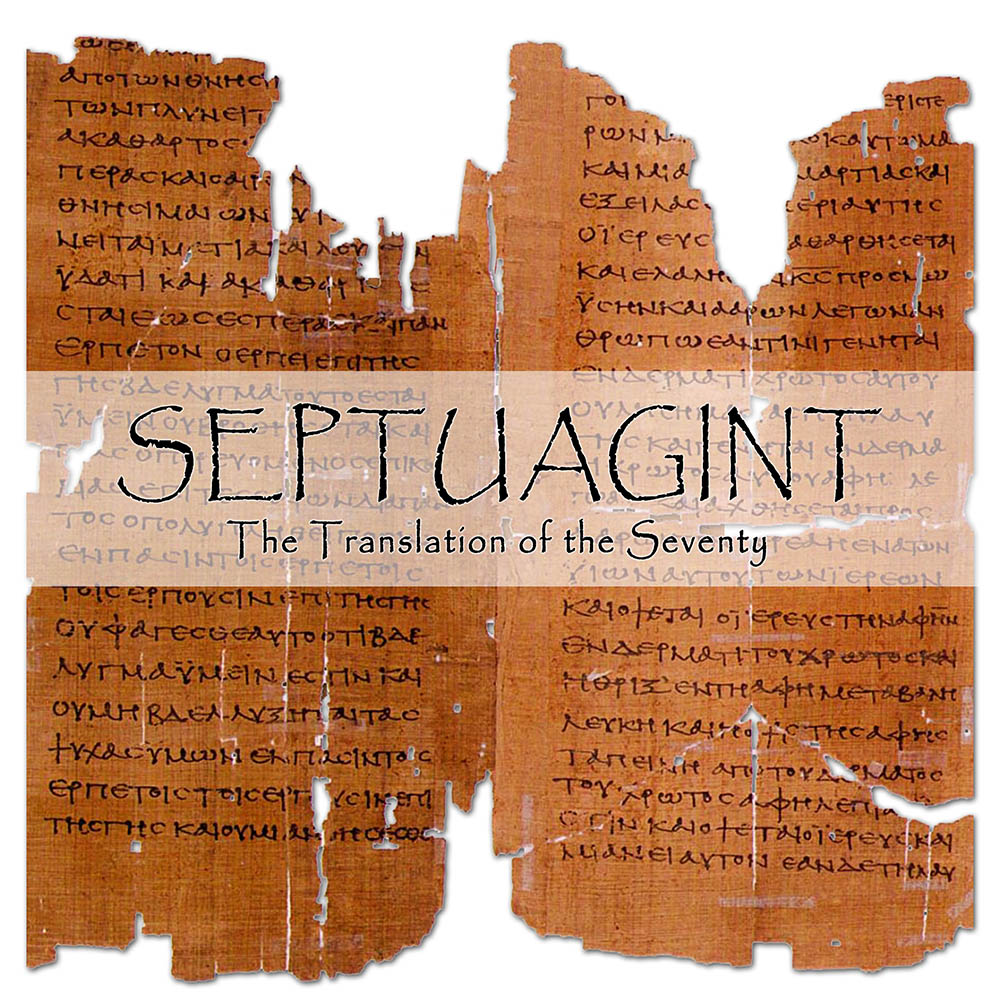
Here is a direct side-by-side comparison of the Masoretic Text with the LXX. I have concluded that the LXX is much to be preferred over the Masoretic Text, a position from which the Eastern Orthodox Church never deviated. Perhaps, if you take the time to read my comparisons and other articles, you will arrive at the same conclusion.
The Septuagint version I am using is the Lexham English Septuagint 2nd Edition, which is available in print or as part of Logos Bible Software. Occasionally I also use the Brenton translation of the LXX for insight into difficult passages.
If you want to know more, click on the following links.
- Why Christians Should Prefer the Septuagint over the Masoretic Text.
- Some Insights Gained through Comparing the Masoretic Text to the Septuagint
- More side by side comparisons of the Masoretic Text (MT) to the Septuagint (LXX).
| Masoretic Text | Septuagint | Significance |
|
8 Thus says the LORD: “As the new wine is found in the cluster, And one says, ‘Do not destroy it, For a blessing is in it,’ So will I do for My servants’ sake, That I may not destroy them all. Isaiah 65:8 (NKJV) |
8 This is what the Lord says: “The way the grape will be found in the cluster and they will say, ‘Do not harm it because the blessing is in it,’ so I will do for the sake of the one who serves me; I will not destroy them all on account of this one. Isaiah 65:8 (LES2) |
I believe this verse in the LXX points to Christ, which is the reason the MT obscures the meaning. The LXX makes it clear that God will spare some on account of the one, which is Christ. Otherwise, God would be just in destroying the entire nation. This agrees with what Paul wrote in Romans. 27 Isaiah also cries out concerning Israel: “Though the number of the children of Israel be as the sand of the sea, The remnant will be saved. 28 For He will finish the work and cut it short in righteousness, Because the LORD will make a short work upon the earth.” 29 And as Isaiah said before: “Unless the LORD of Sabaoth had left us a seed, We would have become like Sodom, And we would have been made like Gomorrah.” Romans 9:27–29 (NKJV) The seed Paul mentions is Christ. Except for Christ, the descendants of Abraham would have been utterly destroyed, but as it is, a remnant will be saved, those who believe in the Messiah, our Lord Jesus. |
|
9 I will bring forth descendants from Jacob, And from Judah an heir of My mountains; My elect shall inherit it, And My servants shall dwell there. Isaiah 65:9 (NKJV) |
9 I will bring forth the seed from Jacob and from Judah, and they will inherit my holy mountain, and my chosen ones and my servants will inherit it, and they will dwell there. Isaiah 65:9 (LES2) |
The LXX is not translated completely accurately here. “Seed” is singular, but so is what is translated as “they.” It should read, “I will bring forth the seed from Jacob and from Judah, and he will inherit my holy mountain…” This speaks of Jesus the Messiah, Lord of all. “Chosen ones”, “servants,” and “they” are all plurals, meaning those who confess Christ, the chosen remnant of both Jew and Gentile will inherit as a result of being “in Christ.” |
|
10 Sharon shall be a fold of flocks, And the Valley of Achor a place for herds to lie down, For My people who have sought Me. Isaiah 65:10 (NKJV) |
10 And folds of flocks will be in the forest, and the valley of Achor will be like a resting place for herds, for my people who have sought me. Isaiah 65:10 (LES2) |
The MT and LXX are in agreement here, except that Sharon, a fertile plain, in the MT is “forest” in the LXX. |
|
11 “But you are those who forsake the LORD, Who forget My holy mountain, Who prepare a table for Gad, And who furnish a drink offering for Meni. 12 Therefore I will number you for the sword, And you shall all bow down to the slaughter; Because, when I called, you did not answer; When I spoke, you did not hear, But did evil before My eyes, And chose that in which I do not delight.” Isaiah 65:11–12 (NKJV) |
11 But you who have forsaken me and who forget my holy mountain, and who prepare a table for a demon and fill up a mixture to Fortune, 12 I will give you over to the sword; you will all fall in slaughter. Because I called you and you did not listen; I spoke and you ignored me, and you did evil before me, and you chose the things that I did not wish for.” Isaiah 65:11–12 (LES2) |
The significant difference between the MT and LXX in this passage is the MT says that those who forsook the Lord prepared a “table for Gad, and… furnished a drink offering for Meni,” but the LXX says they did it for “a demon and fill up a mixture to Fortune.” Gad in Hebrew means “fortune,” as does Meni, which can also mean “destiny.” The LXX calls this false god of Fortune or Destiny a demon, to which other verses in the Old and New Testaments agree. (Deuteronomy 32:17, Psalm 106:37, 1 Corinthians 10:20) Israel’s inveterate idolatry was called out once again. |
|
13 Therefore thus says the Lord GOD: “Behold, My servants shall eat, But you shall be hungry; Behold, My servants shall drink, But you shall be thirsty; Behold, My servants shall rejoice, But you shall be ashamed; 14 Behold, My servants shall sing for joy of heart, But you shall cry for sorrow of heart, And wail for grief of spirit. Isaiah 65:13–14 (NKJV) |
13 Because of this, this is what the Lord says: “Look! Those who serve me will eat, but you will be hungry. Look! Those who serve me will drink, but you will be thirsty. Look! Those who serve me will be cheerful, but you will be ashamed. 14 Look! Those who serve me will rejoice with cheer, but you will cry out because of the pain in your heart, and you will howl because of the crushing of your spirit. Isaiah 65:13–14 (LES2) |
The MT and LXX agree in this passage, which is reminiscent of Jesus’ teaching. 21 Blessed are you who hunger now, For you shall be filled. Blessed are you who weep now, For you shall laugh. 22 Blessed are you when men hate you, And when they exclude you, And revile you, and cast out your name as evil, For the Son of Man’s sake. 23 Rejoice in that day and leap for joy! For indeed your reward is great in heaven, For in like manner their fathers did to the prophets. 24 “But woe to you who are rich, For you have received your consolation. 25 Woe to you who are full, For you shall hunger. Woe to you who laugh now, For you shall mourn and weep. 26 Woe to you when all men speak well of you, For so did their fathers to the false prophets. Luke 6:21–26 (NKJV) |
|
15 You shall leave your name as a curse to My chosen; For the Lord GOD will slay you, And call His servants by another name; 16 So that he who blesses himself in the earth Shall bless himself in the God of truth; And he who swears in the earth Shall swear by the God of truth; Because the former troubles are forgotten, And because they are hidden from My eyes. Isaiah 65:15–16 (NKJV) |
15 For you will leave your name behind as satisfaction for my chosen people, but the Lord will destroy you. And a new name will be proclaimed over those who serve me, 16 which will be praised upon the earth, for they will bless the true God; and those who swear an oath upon the earth will swear by the true God, for they will forget their former affliction, and it will not arise in their heart. Isaiah 65:15–16 (LES2) |
This passage points to those who put their faith in Christ, those called by a “new name,” which might be “Christians.” It is interesting that the name of the Jews will be left as a curse by God’s chosen people, according to the MT. The LXX says that the name of the Jews will be left behind as a “satisfaction” for them. The Greek word can mean being filled or abundance. The closest idea in the New Testament, as I see it, is when Paul says that the falling away of the Jews has led to a fullness of Gentiles coming into God’s kingdom. 25 For I do not desire, brethren, that you should be ignorant of this mystery, lest you should be wise in your own opinion, that blindness in part has happened to Israel until the fullness of the Gentiles has come in. Romans 11:25 (NKJV) God pledges to destroy the Jews, but we know that he has and will draw to himself a remnant from that group for the sake of his promises to Abraham, Isaac, and Jacob. They will not utterly be destroyed. This is true for Gentiles as well. All who reject Christ will be destroyed at the final judgment. Those chosen by God who are called by a new name, Christians, will be praised on the earth and will bless the true God. This promise of praise to a great extent will be fulfilled when Christ returns. Historically the name of those who serve Christ has been denigrated and persecuted over the years. The true God is the Father of our Lord Jesus, who has become our Father through the new birth. Those who deny Christ do not have the true God. (1 John 2:23) Therefore, the Jews who deny Christ do not serve the God we serve. In those parts of the world heavily influenced by Christianity, oaths in court are taken in the name of the true God. According to the LXX, seen through the lens of the New Testament, when Christ returns, we will forget our former sufferings. (Revelation 21:4) The last part of verse 16 in the MT makes no sense to me, unless it means that our former troubles will be hidden from God’s eyes, but what does that mean exactly? |