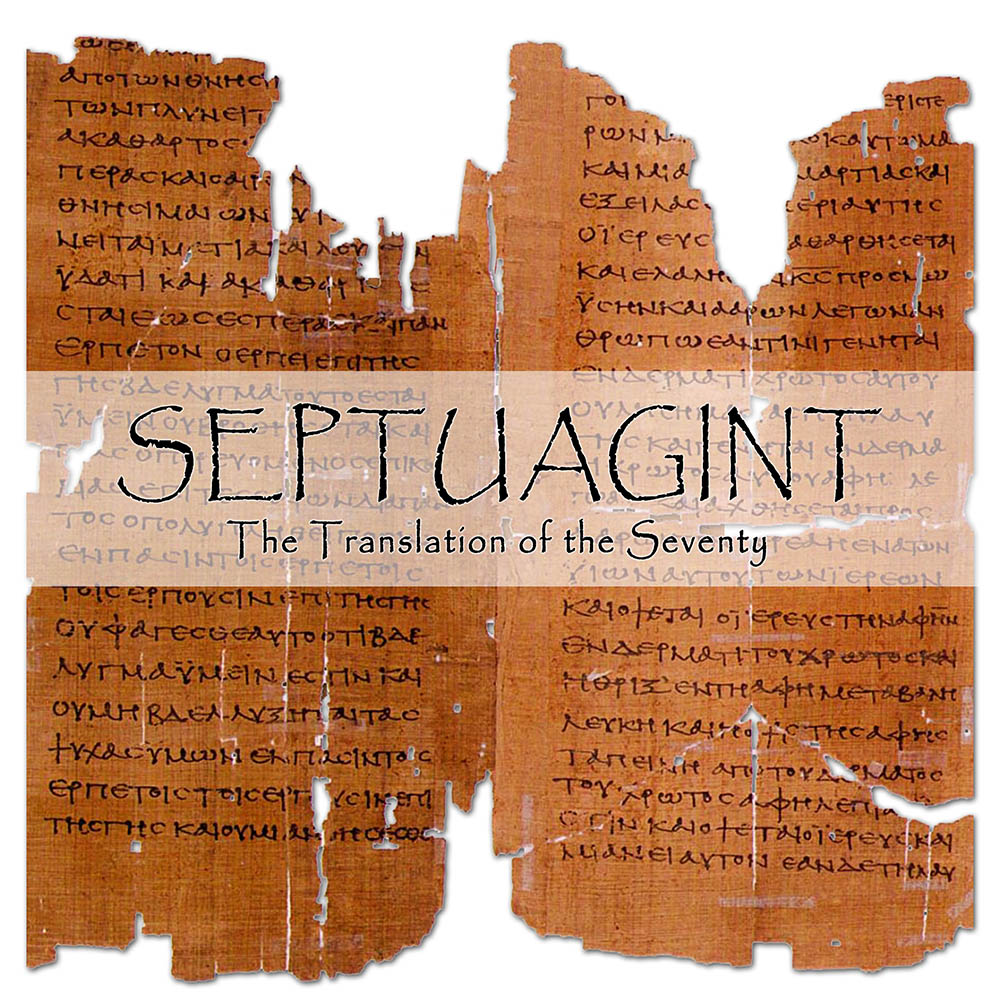
Here is a direct side-by-side comparison of the Masoretic Text with the LXX. I have concluded that the LXX is much to be preferred over the Masoretic Text, a position from which the Eastern Orthodox Church never deviated. Perhaps, if you take the time to read my comparisons and other articles, you will arrive at the same conclusion.
The Septuagint version I am using is the Lexham English Septuagint 2nd Edition, which is available in print or as part of Logos Bible Software. Occasionally I also use the Brenton translation of the LXX for insight into difficult passages.
If you want to know more, click on the following links.
- Why Christians Should Prefer the Septuagint over the Masoretic Text.
- Some Insights Gained through Comparing the Masoretic Text to the Septuagint
- More side by side comparisons of the Masoretic Text (MT) to the Septuagint (LXX).
| Masoretic Text | Septuagint | Significance |
|
1 For Zion’s sake I will not hold My peace, And for Jerusalem’s sake I will not rest, Until her righteousness goes forth as brightness, And her salvation as a lamp that burns. 2 The Gentiles shall see your righteousness, And all kings your glory. You shall be called by a new name, Which the mouth of the LORD will name. 3 You shall also be a crown of glory In the hand of the LORD, And a royal diadem In the hand of your God. 4 You shall no longer be termed Forsaken, Nor shall your land any more be termed Desolate; But you shall be called Hephzibah, and your land Beulah; For the LORD delights in you, And your land shall be married. 5 For as a young man marries a virgin, So shall your sons marry you; And as the bridegroom rejoices over the bride, So shall your God rejoice over you. Isaiah 62:1–5 (NKJV) |
1 Because of Zion I will not be silent, and because of Jerusalem I will not lift up my voice, until her righteousness goes forth like a light; and my salvation will burn like a torch. 2 And nations will see your righteousness, and kings your glory, and he will call you by a new name, which the Lord will name it. 3 And you will be a beautiful crown in the hand of the Lord and a royal diadem in the hand of your God. 4 And you will no longer be called “Abandoned,” and your land will no longer be called “Desolate,” for you will be called “My Delight,” and your land will be called “Inhabited.” For the Lord has found pleasure in you, and your land will be given in marriage. 5 And as a youth lives with a virgin, so your sons will live, and it will be that the way a bridegroom is cheerful over a young wife, so the Lord will be cheerful over you. Isaiah 62:1–5 (LES2) |
The MT says the speaker will not rest until God restores Jerusalem’s righteousness. The LXX uses words that are a bit of a challenge to translate, but I think the best would be to more or less agree with the MT. I would translate it, “I will not rest or relax until…” That is how Brenton translates it. In verse 2, the MT says, “You will be called by a new name.” The LXX says, “He, meaning God, will call you by a new name.” It was at Antioch that believers in Jesus were first called Christians. That name has remained in place for centuries. |
|
6 I have set watchmen on your walls, O Jerusalem; They shall never hold their peace day or night. You who make mention of the LORD, do not keep silent, 7 And give Him no rest till He establishes And till He makes Jerusalem a praise in the earth. Isaiah 62:6–7 (NKJV) |
6 And upon your walls, Jerusalem, I have appointed guards all day and all night who will never keep silent, remembering the Lord. 7 For there is none like you, if he sets things right and makes Jerusalem a thing of pride upon the earth. Isaiah 62:6–7 (LES2) |
I am always extremely interested in how the LXX verses compare to the MT in those passages that have been “banners” for the Christian Zionist movement. Thousands of Christian intercessors quote the MT version of this verse to justify ceaseless prayer for the current city of Jerusalem, believing that they are to give God no rest until he makes modern Jerusalem a praise in the earth. There is a huge difference between “give him no rest until he…makes Jerusalem a praise in the earth” and “there is none like you (plural) if he sets things right (literally – makes a correction) and makes Jerusalem a thing of pride in the earth.” The New Testament contrasts the heavenly Jerusalem to the one on the earth at present. 21 Tell me, you who desire to be under the law, do you not hear the law? 22 For it is written that Abraham had two sons: the one by a bondwoman, the other by a freewoman. 23 But he who was of the bondwoman was born according to the flesh, and he of the freewoman through promise, 24 which things are symbolic. For these are the two covenants: the one from Mount Sinai which gives birth to bondage, which is Hagar—25 for this Hagar is Mount Sinai in Arabia, and corresponds to Jerusalem which now is, and is in bondage with her children—26 but the Jerusalem above is free, which is the mother of us all. Galatians 4:21–26 (NKJV) There is an earthly Jerusalem, which is still in bondage, and a heavenly one, which is the glorious city of God composed of blood-bought saints who trust in Jesus. 22 But you have come to Mount Zion and to the city of the living God, the heavenly Jerusalem, to an innumerable company of angels, 23 to the general assembly and church of the firstborn who are registered in heaven, to God the Judge of all, to the spirits of just men made perfect, 24 to Jesus the Mediator of the new covenant, and to the blood of sprinkling that speaks better things than that of Abel. Hebrews 12:22–24 (NKJV) I find it disheartening that we Christians are so easily fooled into substituting natural Israel for the Israel of God and natural Jerusalem for the heavenly one. Our focus has been displaced from Jesus onto natural Israel, a nation which has usurped that which belongs to Christ alone, thanks to the support of millions of Christians who have swallowed error of Dispensationalism and Christian Zionism. The Bride of Christ has been tricked into believing that the bridegroom prefers his mother (Israel) to the church, his bride. She has been duped into relinquishing her privilege and position to a brazen prostitute who claims she has always been God’s first love! Like Athaliah of old, she was willing to kill the legal heir (Jesus) in order to usurp the kingdom for herself. The church has been duped into thinking she is a “rebound” relationship of a rejected suitor who still pines for his first love, his own mother. Now that the church is waking up to the deception, Zionists cry “antisemitism,” just as Athaliah cried “treason,” when the rightful heir was installed. I hope the supreme irony and ludicrousness of this is apparent. |
|
8 The LORD has sworn by His right hand And by the arm of His strength: “Surely I will no longer give your grain As food for your enemies; And the sons of the foreigner shall not drink your new wine, For which you have labored. 9 But those who have gathered it shall eat it, And praise the LORD; Those who have brought it together shall drink it in My holy courts.” Isaiah 62:8–9 (NKJV) |
8 The Lord has sworn by his glory and by the strength of his arm, “I will certainly no longer give your grain and meat to your enemies, and foreign sons will certainly no longer drink your wine over which you toiled; 9 but those who have gathered them will eat them and will glorify the Lord, and those who have gathered them will drink them in my holy dwellings. Isaiah 62:8–9 (LES2) |
The MT says “right hand,” but the LXX says “glory.” I prefer “strength of his arm” in the LXX to “the arm of his strength” in the MT. The MT says the people of God will drink their wine in God’s holy courts, but the LXX uses a word that most easily translates into cottages or farmhouses. |
|
10 Go through, Go through the gates! Prepare the way for the people; Build up, Build up the highway! Take out the stones, Lift up a banner for the peoples! Isaiah 62:10 (NKJV) |
10 Walk through my gates and prepare a way for my people and cast the stones out of the way; raise a signal for the nations! Isaiah 62:10 (LES2) |
The MT uses the Hebrew word “am” for peoples, but the LXX uses the word “ethnos” for the nations. The sign or signal to the nations was the resurrection of Christ, which our Lord called the “sign of Jonah.” (Luke 11:29) The Holy Spirit works with the church to continue to produce “signs following” the preaching of the gospel. (Mark 16:20) |
|
11 Indeed the LORD has proclaimed To the end of the world: “Say to the daughter of Zion, ‘Surely your salvation is coming; Behold, His reward is with Him, And His work before Him.’ ” 12 And they shall call them The Holy People, The Redeemed of the LORD; And you shall be called Sought Out, A City Not Forsaken. Isaiah 62:11–12 (NKJV) |
11 For look, the Lord has made it heard to the end of the earth. Say to the daughter of Zion: “Look! The Savior has come near to you; he has his reward, and his work is before his face.” 12 And he will call it “Holy People, Ransomed by the Lord,” and you will be called “Sought-After City” and “Not Forsaken.” Isaiah 62:11–12 (LES2) |
God has caused the gospel of our Lord Jesus Christ to go to the ends of the earth. The Savior (Greek – soter) (The Hebrew word for salvation is yeshua.) has already come near to us. He has his reward already: he has been declared Lord of lords. All those who call upon the name of Jesus will be saved. They will be called the Holy People or saints. Christians are the elect of God (Ephesians 1:3-4), the Sought after City, the new Jerusalem. |