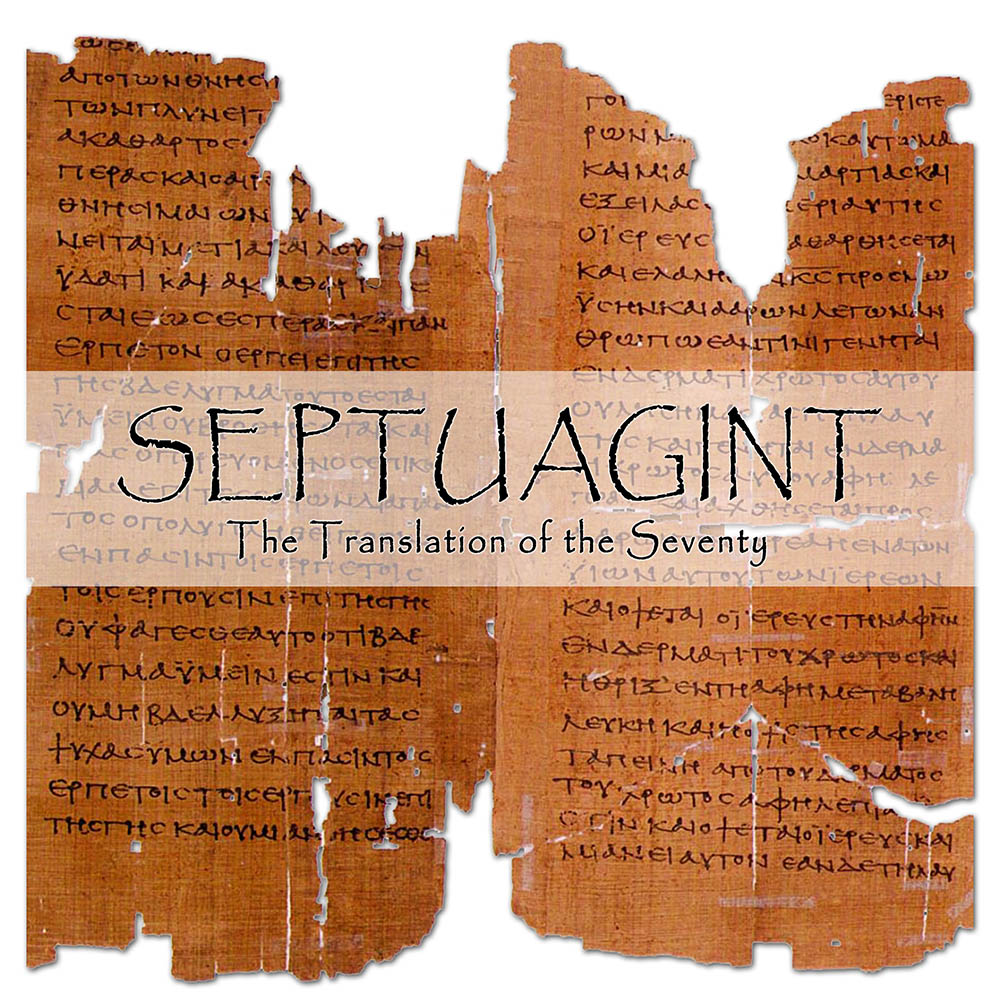
I hope you will journey with me in rediscovering the beauty of God’s Word in the Septuagint (LXX). In 285 BC, the LXX was translated from paleo-Hebrew by 70 Jewish translators into Greek, the language of most of the civilized world at that time. Due to its pre-Christ and pre-fall of Jerusalem date, the LXX cannot be accused of being influenced by any underlying animosity toward Christ or Christianity or desire to elevate Judaism’s claim to God’s blessings or the promised land. Most Christians believe the Masoretic Text (MT), upon which our English Old Testament is based, is written in the original Hebrew, but it too is a translation from the ancient and by then dead paleo-Hebrew Phoenician pictograph script into the modern Hebrew block script derived from Aramaic. The Masoretes completed it between 600 t0 1000 AD, by which time the Jews had become hostile to the Christian message, which shows up in various omissions, changes, and obfuscations of verses and passages that clearly point to Christ in the LXX.
Jesus taught us that all scripture points to him (John 5:39). As a rule, the Septuagint more clearly points to Jesus than does the MT.
In the West, Christians have not questioned the MT since Jerome chose it as the basis for his Latin Vulgate Old Testament. The Eastern Orthodox Church, to their credit, never deviated from the Septuagint, preserving it for later generations to rediscover. Because of the power of tradition, it is quite difficult for many of us in the West to think of the LXX as being more trustworthy than the MT, but I have found that a side-by-side comparison indicates otherwise.
In this series of articles, I have undertaken to illustrate the similarities and differences between the MT and LXX by examining various passages. Below is another example. The Septuagint version I am using is the Lexham English Septuagint 2nd Edition. It is available in print or digitally through Logos Bible Software. Occasionally I reference Brenton’s translation, which is a good one, but the English is somewhat dated.
| Masoretic Text | Septuagint | Significance |
|
1 Oh, that You would rend the heavens! That You would come down! That the mountains might shake at Your presence— 2 As fire burns brushwood, As fire causes water to boil— To make Your name known to Your adversaries, That the nations may tremble at Your presence! 3 When You did awesome things for which we did not look, You came down, The mountains shook at Your presence. Isaiah 64:1–3 (NKJV) |
1 If you open the heavens, trembling will take hold of the mountains at you, and they will melt 2 like wax melts before a fire. And fire will consume the enemies, and your name will be evident among the enemies. The nations will be troubled before your face. 3 When you do glorious things, trembling will take hold of the mountains before you. Isaiah 64:1–3 (LES2) |
The MT makes verse 1 a prayer, but the LXX simply describes what would happen should God roll back the firmament, exposing his glorious presence to the world below. The apostle Peter used this passage as a basis for describing what the glorious appearing of the Lord will be like. 10 But the day of the Lord will come as a thief in the night, in which the heavens will pass away with a great noise, and the elements will melt with fervent heat; both the earth and the works that are in it will be burned up. 11 Therefore, since all these things will be dissolved, what manner of persons ought you to be in holy conduct and godliness, 12 looking for and hastening the coming of the day of God, because of which the heavens will be dissolved, being on fire, and the elements will melt with fervent heat? 13 Nevertheless we, according to His promise, look for new heavens and a new earth in which righteousness dwells. 2 Peter 3:10–13 (NKJV) In verse 3, the MT says these things already happened, but the LXX places them in the future, as does Peter. |
|
4 For since the beginning of the world Men have not heard nor perceived by the ear, Nor has the eye seen any God besides You, Who acts for the one who waits for Him. 5 You meet him who rejoices and does righteousness, Who remembers You in Your ways. You are indeed angry, for we have sinned— In these ways we continue; And we need to be saved. Isaiah 64:4–5 (NKJV) |
4 We have not heard for eternity and our eyes have not seen any god except you and your works, which you will do for those who wait for mercy. 5 He will meet with those who do righteousness, and they will remember your ways. Look! You have become angry, and we have sinned; because of this we have been led astray. Isaiah 64:4–5 (LES2) |
The MT says that God will act for the one who waits for him. The LXX says it will be done for the one who waits for mercy. Both admit Israel’s sin. The MT says “we need to be saved.” The LXX says “we have been led astray.” Both are true. Israel was led astray by her sin, idols, and by there refusal to walk in God’s ways, including their rejection of the Messiah. This going astray (Greek – planao, from which our word “planet” derives) resembles Satan’s and the fallen angels’ going astray and wandering from their assigned paths and roles. Ironically, every time a Christian uses the word “planet” to describe the earth, it is a reminder that we like sheep have been misled and have gone astray, not the least of which is by denying the truth of what the Bible says concerning the creation and shape of the earth and heavens. (Isaiah 53:6) |
|
6 But we are all like an unclean thing, And all our righteousnesses are like filthy rags; We all fade as a leaf, And our iniquities, like the wind, Have taken us away. 7 And there is no one who calls on Your name, Who stirs himself up to take hold of You; For You have hidden Your face from us, And have consumed us because of our iniquities. Isaiah 64:6–7 (NKJV) |
6 We all have become like unclean people; all our righteousness is like the rag of a woman who sits apart, and we have disappeared like leaves because of our lawless acts; in this way the wind will carry us away. 7 There is no one who calls upon your name and who remembers to take hold of you, because you turned your face away from us and handed us over because of our sins. Isaiah 64:6–7 (LES2) |
The MT chooses the word “thing” to clarify “unclean.” The LXX uses the word “people.” Both were the choices of the translator, since the text is ambiguous and means simply “unclean.” The MT uses the plural of righteousness, suggesting it is our righteous acts that are unclean, but the LXX uses the singular form, indicating it is something deeper than an action. It affects the core of our being. The LXX makes it clear that we are to compare our uncleanness to a menstrual rag. Blood made a person unclean (Leviticus 15:25), but the blood of Christ has the opposite effect of cleansing us from sin! (1 John 1:7) The Greek word translated as “disappeared” in verse 6 can also mean “fallen off.” Verse 7 in the MT says that God has “consumed us because of our iniquities.” The LXX says that he “handed us over because of our sins,” which refers to the captivity in Babylon and also our bondage to sin and Satan in general when applied to all humanity. In other words, we reap what we sow. |
|
8 But now, O LORD, You are our Father; We are the clay, and You our potter; And all we are the work of Your hand. 9 Do not be furious, O LORD, Nor remember iniquity forever; Indeed, please look—we all are Your people! Isaiah 64:8–9 (NKJV) |
8 And now, O Lord, you are our father, and we are clay; all of us are the work of your hands. 9 Do not be very angry with us, and do not remember our sins for a time. And now, look upon us because we all are your people. Isaiah 64:8–9 (LES2) |
Both the MT and LXX describe God as our father, the distinctive title for God Jesus left us with. The MT inserts the phrase, “you are the potter,” which the LXX does not do, but it is understood from the context. The MT uses the singular form of hand, but the LXX makes it plural. Otherwise, the MT and LXX are extremely close. |
|
10 Your holy cities are a wilderness, Zion is a wilderness, Jerusalem a desolation. 11 Our holy and beautiful temple, Where our fathers praised You, Is burned up with fire; And all our pleasant things are laid waste. 12 Will You restrain Yourself because of these things, O LORD? Will You hold Your peace, and afflict us very severely? Isaiah 64:10–12 (NKJV) |
10 The city of your holiness has become deserted; Zion has become deserted, Jerusalem a curse. 11 The house, our sanctuary, and the glory, which our fathers blessed, has been burned with fire, and all of our glorious things have fallen. 12 And at all these things you have shown toleration, O Lord, and you have kept silent and have made us very low. Isaiah 64:10–12 (LES2) |
For some reason the MT makes cities plural, but the LXX keeps it singular because Jerusalem is the focus, which the MT says is a “desolation,” but the LXX calls it a “curse.” The MT and LXX use different adjectives to describe the temple and holy things, but the final difference is that the MT says that God afflicts “us very severely.” The LXX says that God has “made us very low [humble].” The Scriptures say that God allows us to suffer the consequences of our sins to produce repentance and humility in us so that we might turn to him in repentance so that he might ultimately bless us. (Lamentations 3:32-42) This is what God desires to work in all of us. |
Conclusion
If you want to know more about why Christians should prefer the Septuagint to the MT, click on this link. In another article, I share some of the things I have so far learned by making this comparison. As for me, I now prefer the LXX. It was Paul’s and the other apostles’ standard for Old Covenant truth, was used by synagogues in Jesus’s day, and is most often quoted in the New Testament. That makes it good enough for me.