
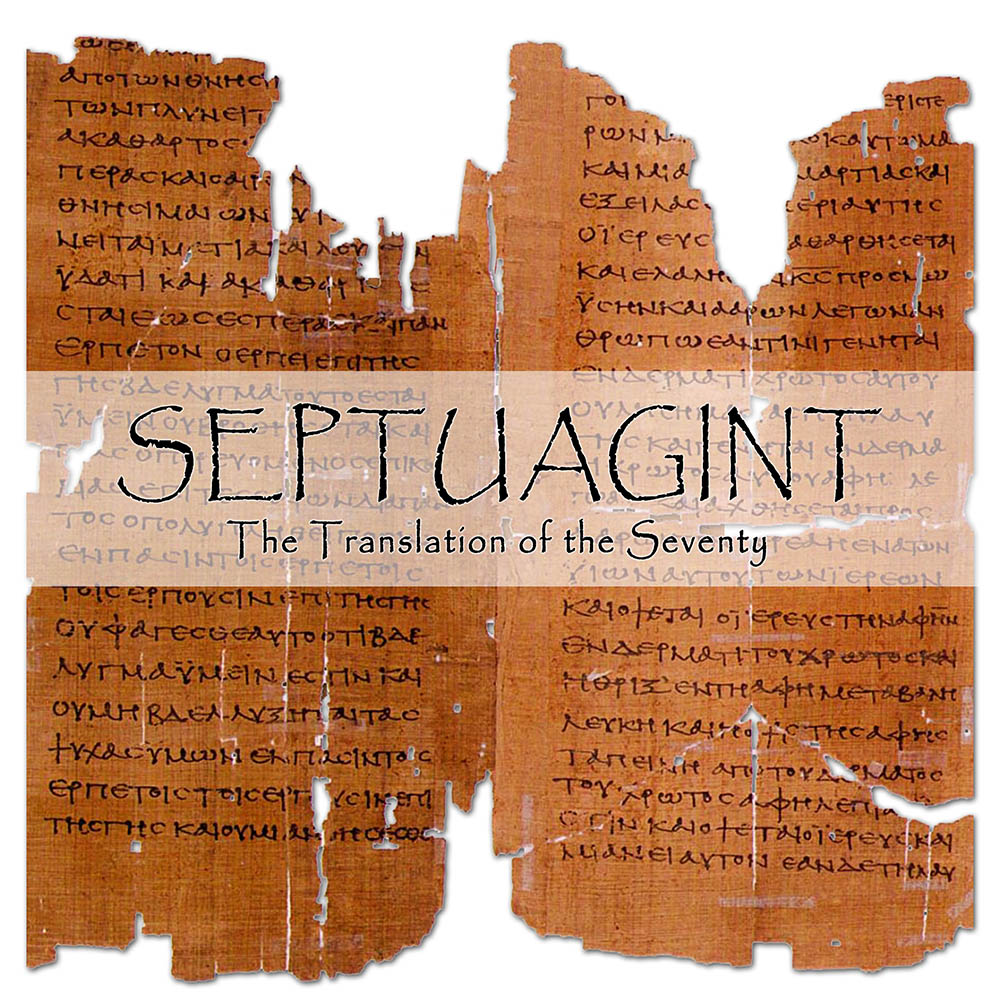
Rediscovering the Septuagint (LXX): Psalm 1

Here is a direct side-by-side comparison of the Masoretic Text with the LXX.  I have concluded that the LXX is much to be preferred over the Masoretic Text, a position from which the Eastern Orthodox Church never deviated. Perhaps, if you take the time to read my comparisons and other articles, you will arrive at the same conclusion.

The Septuagint version I am using is the Lexham English Septuagint 2nd Edition, which is available in print or as part of Logos Bible Software. Occasionally I also use the Brenton translation of the LXX for insight into difficult passages.

If you want to know more, click on the following links.

Masoretic Text Septuagint Significance

1 Blessed is the man Who walks not in the counsel of the ungodly, Nor stands in the path of sinners, Nor sits in the seat of the scornful; 2 But his delight is in the law of the LORD, And in His law he meditates day and night. Psalm 1:1–2 (NKJV) 

1 Blessed is the man who does not go in the counsel of the ungodly, and does not stand in the way of sinners, and does not sit in the seat of evil persons. 2 But rather his will is focused on the law of the Lord, and in his law he will meditate day and night. Psalm 1:1–2 (LES2) 

The MT and LXX essentially agree until the end of verse one. The MT says not to sit in the seat of scoffers, but the LXX warns against the seat of loimos – pests, pestilence, plague, or destroyers.

The second difference is in verse 2. The MT says the godly person delights in the law of God. The LXX says his will is focused on it.  Both agree that the godly person will meditate on God’s law day and night.

3 He shall be like a tree Planted by the rivers of water, That brings forth its fruit in its season, Whose leaf also shall not wither; And whatever he does shall prosper. Psalm 1:3 (NKJV) 

3 He will be like the tree that has been planted along the streams of the rivers, which will give its fruit in its season. And its leaf will not fall off. In all things, however much he does, he will be given prosperity. Psalm 1:3 (LES2) 

The MT and LXX essentially agree in this verse, with minor differences.

4 The ungodly are not so, But are like the chaff which the wind drives away. 5 Therefore the ungodly shall not stand in the judgment, Nor sinners in the congregation of the righteous. 6 For the LORD knows the way of the righteous, But the way of the ungodly shall perish. Psalm 1:4–6 (NKJV) 

4 Not so the ungodly, not so! But rather, they are like the chaff that the wind spreads abroad away from the face of the earth. 5 On this account the ungodly will not stand up in the judgment, nor will the sinful stand in the council of the righteous, 6 because the Lord knows the way of the righteous; but the way of the ungodly will perish. Psalm 1:4–6 (LES2)

Here we see greater divergence. The LXX repeats “not so” to intensify it. It also strengthens the wind’s (Holy Spirit’s) work to drive or spread the ungodly from the face of the earth. This agrees with John the Baptist’s words about our Lord Jesus.

15 Now as the people were in expectation, and all reasoned in their hearts about John, whether he was the Christ or not, 16 John answered, saying to all, “I indeed baptize you with water; but One mightier than I is coming, whose sandal strap I am not worthy to loose. He will baptize you with the Holy Spirit and fire. 17 His winnowing fan is in His hand, and He will thoroughly clean out His threshing floor, and gather the wheat into His barn; but the chaff He will burn with unquenchable fire.” Luke 3:15–17 (NKJV) 

Otherwise, the MT and LXX agree in this passage.


Genesis 4:1-15, 25-26: Cain, Abel, and Seth

Here is a direct side-by-side comparison of the Masoretic Text with the LXX.  I have concluded that the LXX is much to be preferred over the Masoretic Text, a position from which the Eastern Orthodox Church never deviated. Perhaps, if you take the time to read my comparisons and other articles, you will arrive at the same conclusion.

The Septuagint version I am using is the Lexham English Septuagint 2nd Edition, which is available in print or as part of Logos Bible Software. Occasionally I also use the Brenton translation of the LXX for insight into difficult passages.

If you want to know more, click on the following links.

Masoretic Text Septuagint Significance

1 Now Adam knew Eve his wife, and she conceived and bore Cain, and said, “I have acquired a man from the LORD.” 2 Then she bore again, this time his brother Abel. Now Abel was a keeper of sheep, but Cain was a tiller of the ground. 3 And in the process of time it came to pass that Cain brought an offering of the fruit of the ground to the LORD. 4 Abel also brought of the firstborn of his flock and of their fat. And the LORD respected Abel and his offering, 5 but He did not respect Cain and his offering. And Cain was very angry, and his countenance fell. Genesis 4:1–5 (NKJV) 

1 And Adam knew Eve, his wife, and she conceived and brought forth Cain and said, “I have acquired a man through God.” 2 And she proceeded to bring forth his brother, Abel. Abel became a herdsman of sheep, and Cain was working the earth. 3 Now this happened after a number of days: Cain brought some of the fruit of the earth as an offering for the Lord, 4 and Abel himself also brought some of the firstborn of his sheep and some of their hard fat parts. God looked upon Abel and upon his gifts, 5 but he did not pay attention to Cain and upon his offerings. He grieved Cain very much, and he fell in face. Genesis 4:1–5 (LES2) 

The MT says Eve acquired a son through YHVH. The LXX says through theos – God. Jesus told us to call God “Father,” thus settling forever what is the proper name for us to use for God.

Eve understood that all life derives from God, even though we participate in the process. 

God’s lack of respect for Cain’s offering, according to the LXX grieved, saddened, or vexed Cain greatly. 

6 So the LORD said to Cain, “Why are you angry? And why has your countenance fallen? 7 If you do well, will you not be accepted? And if you do not do well, sin lies at the door. And its desire is for you, but you should rule over it.” Genesis 4:6–7 (NKJV) 

6 The Lord God said to Cain, “Why have you become deeply grieved, and why has your face fallen? 7 Have you not sinned if you offer rightly but do not divide rightly? Calm down! His recourse will be to you, and you will rule him.” Genesis 4:6–7 (LES2) 

God’s question was not to discover what was wrong with Cain. He knew. He was trying to help Cain. There was some aspect of Cain’s offering that was not pleasing to God. It was not “divided” rightly. I am not sure what that meant in the case of a food offering, but apparently Cain understood. There is a right thing to do, but it also must be done the right way, at the right time by the right person or people. (A Table Has Four Legs Teaching).

The MT translates verse 7 in a way that does not make sense to me. The admonition for Cain to “rule over” sin is not a command anyone could keep, aside from the Lord Jesus. Now that our Lord has conquered the power of sin on our behalf, we also can experience his victory, which includes being released from sin’s dominion. (Romans 6:14) At this point in history, however, Cain had no ability to conquer sin on his own. He could resist and turn to God for help, but was not able to rule over it. I prefer the LXX, which is more believable. God did not coddle Cain in his depression. Instead he rebuked him, while reassuring him that this rejection of his offering did not take away Cain’s firstborn authority. Abel was still the second born and was accountable to Cain. Sadly, this did not change Cain’s heart or mind which morphed from pain, to bitterness, to murder, just as happened later to Absalom.

8 Now Cain talked with Abel his brother; and it came to pass, when they were in the field, that Cain rose up against Abel his brother and killed him. Genesis 4:8 (NKJV) 

8 And Cain said to Abel, his brother, “Let’s walk through the field.” And this happened while they were in the field: Cain rose against Abel, his brother, and he killed him. Genesis 4:8 (LES2) 

As was the case with Joseph’s brothers later, Cain’s bitterness against God morphed into hatred for the one God favored, his brother Abel. The MT passively says, “they were in the field,” but the LXX says Cain took the initiative to lead Abel into the field and kill him. This was premeditated murder.

This foreshadowed how the leaders of Israel chose to put the favored Son, our Lord Jesus, to death, rather than listen and respond properly to God’s words..

9 Then the LORD said to Cain, “Where is Abel your brother?” He said, “I do not know. Am I my brother’s keeper?” 10 And He said, “What have you done? The voice of your brother’s blood cries out to Me from the ground. 11 So now you are cursed from the earth, which has opened its mouth to receive your brother’s blood from your hand. 12 When you till the ground, it shall no longer yield its strength to you. A fugitive and a vagabond you shall be on the earth.” 13 And Cain said to the LORD, “My punishment is greater than I can bear! 14 Surely You have driven me out this day from the face of the ground; I shall be hidden from Your face; I shall be a fugitive and a vagabond on the earth, and it will happen that anyone who finds me will kill me.” 15 And the LORD said to him, “Therefore, whoever kills Cain, vengeance shall be taken on him sevenfold.” And the LORD set a mark on Cain, lest anyone finding him should kill him. Genesis 4:9–15 (NKJV) 

9 Then God said to Cain, “Where is Abel, your brother?” But he said, “I don’t know. I’m not my brother’s guardian, am I?” 10 God said, “What have you done? The voice of your brother’s blood is crying out to me from the earth. 11 Now, accursed are you upon the earth, which opened its mouth wide to receive the blood of your brother from your hand, 12 because you will work the earth; it will not proceed to give its strength to you. You will moan and tremble upon the earth.” 13 Cain said to the Lord, “My guilt is too great for me to be forgiven. 14 If you throw me out today from the face of the earth, and I will be hidden from your face, then I will be moaning and trembling upon the earth, and anyone who finds me will kill me.” 15 The Lord God said to him, “It will not be like that. Anyone who kills Cain will release seven reprisals. The Lord God has placed a sign for Cain so that none who find him would kill him.” Genesis 4:9–15 (LES2) 

Perhaps Cain did not realize at this point that God knows all things. He certainly was not repentant. We learn here that innocent blood cries out to God for justice. The MT uses two different words for ground (adamah) and earth (eretz), but the LXX consistently uses the Greek word ge, which can mean either earth or land, in every verse.

God cursed Cain. A biblical curse from God is essentially the pronouncement of a judgment incurred by our sin. This is quite different from a curse spoken by someone practicing some form of witchcraft. The MT says that Cain was cursed from the ground (adamah), but the LXX says he was cursed upon the earth (ge). The LXX makes more sense to me. The curse came from God and affected him while he lived on the earth. The earth would not produce like it did before, and Cain would “moan and tremble” in fear, according to the LXX. That is quite different from the MT’s saying he would be a fugitive and vagabond. 

Verse 13 is very different. The MT has Cain saying that his punishment is too great to bear, but the LXX has him saying that his guilt is too great to bear. His great fear is that someone will do to him what he did to Abel. God assured him that this would not happen because of a mysterious mark or sign God placed on him. It is remarkable to me that God would so protect him.

25 And Adam knew his wife again, and she bore a son and named him Seth, “For God has appointed another seed for me instead of Abel, whom Cain killed.” 26 And as for Seth, to him also a son was born; and he named him Enosh. Then men began to call on the name of the LORD. Genesis 4:25–26 (NKJV) 

25 Adam knew Eve, his wife, and, once she conceived, she brought forth a son and called his name Seth, saying, “Because God raised up another offspring for me in the place of Abel, whom Cain killed.” 26 Seth had a son, and he called his name Enosh. This one hoped to invoke the name of the Lord God. Genesis 4:25–26 (LES2) 

As God promised, he continued the line that would eventually result in the birth of the Messiah by raising up Seth as a replacement for Abel. Seth fathered Enosh. The MT says that “then men began to call upon the name of YHVH.” The LXX says that “this one,” meaning Enosh, “hoped” to call upon God’s name. Interesting.


Genesis 3:14-24 – The Curse and Aftermath

Here is a direct side-by-side comparison of the Masoretic Text with the LXX.  I have concluded that the LXX is much to be preferred over the Masoretic Text, a position from which the Eastern Orthodox Church never deviated. Perhaps, if you take the time to read my comparisons and other articles, you will arrive at the same conclusion.

The Septuagint version I am using is the Lexham English Septuagint 2nd Edition, which is available in print or as part of Logos Bible Software. Occasionally I also use the Brenton translation of the LXX for insight into difficult passages.

If you want to know more, click on the following links.

Masoretic Text Septuagint Significance

14 So the LORD God said to the serpent: “Because you have done this, You are cursed more than all cattle, And more than every beast of the field; On your belly you shall go, And you shall eat dust All the days of your life. 15 And I will put enmity Between you and the woman, And between your seed and her Seed; He shall bruise your head, And you shall bruise His heel.” Genesis 3:14–15 (NKJV)

14 The Lord God said to the serpent, “Because you have done this, accursed are you of all the livestock and of all the wild animals of the earth. You will go upon your chest and belly, and you will eat earth all the days of your life. 15 I will place enmity between you and the woman, and between your seed and her seed; he will watch your head carefully, and you will watch his heel carefully.” Genesis 3:14–15 (LES2) 

This is the first time we encounter prophecy in the Bible, which is where we see the biggest contrasts between the MT and LXX. I believe this is because prophecy is the testimony of Jesus, according to Revelation 19:10. The translators of the MT were Jews who most likely held a strong antipathy toward Christ. Consciously or unconsciously, this hatred of Christ, and ultimately of God the Father (John 15:23), seems to have prompted them to change what the prophetic scriptures declare.

The first change is slight, but perhaps quite significant. The MT says the serpent will eat dust all his days, but the LXX says he will eat “earth,” which is the word for the world in which we live. The New Testament declares that Satan goes about as a roaring lion seeking whom he may devour. (1 Peter 5:8) The entire earth has come under a curse, giving the devil permission, within limits, to destroy it and its inhabitants. This continues to this day.

A marked difference occurs at the end of verse 15. The familiar words of the MT do not agree with the LXX. Rather than the “seed” of the woman, who we understand to be Christ, bruising the serpent’s head, the LXX says he will “carefully watch” his head. The serpent, instead of bruising the heel of this man will carefully watch it. How can we explain this?

Perhaps Peter gave us the answer.

8 Be sober, be vigilant; because your adversary the devil walks about like a roaring lion, seeking whom he may devour. 9 Resist him, steadfast in the faith, knowing that the same sufferings are experienced by your brotherhood in the world. 1 Peter 5:8–9 (NKJV) 

Vigilance is keeping a careful watch. God keeps an eye on Satan and his minions. Nothing ever surprises him. Jesus was not surprised when Judas betrayed him in the garden when the soldiers came to arrest him. He was not surprised when he had to endure the fiery ordeal of the cross. We are supposed to be likewise vigilant and ready.

12 Beloved, do not be surprised at the fiery ordeal among you, which comes upon you for your testing, as though some strange thing were happening to you; 1 Peter 4:12 (NASB95) 

Satan, for his part, likewise tries to keep up with what is happening regarding the seed of the woman. Over the centuries he unsuccessfully did his best to eliminate the promised seed altogether. When Christ finally appeared, he first tried to murder him at Herod’s hands. He later tempted Jesus to betray God and made other attempts to kill him. Finally he arranged to have him crucified, thinking that by this he won. 

The reason a serpent would watch a heel would be to strike at it and to prevent its head from being crushed, which is the message of the MT. The LXX says so much more, however, while implying what the MT says. Ultimately, the privilege and responsibility of crushing Satan will fall to the church. (Romans 16:20)

16 To the woman He said: “I will greatly multiply your sorrow and your conception; In pain you shall bring forth children; Your desire shall be for your husband, And he shall rule over you.” Genesis 3:16 (NKJV) 

16 He said to the woman, “Multiplying, I will multiply your pain and your moaning. You will bring forth children in pain, and your recourse will be to your husband, and he will be master over you.” Genesis 3:16 (LES2) 

Once again we see significant differences in this verse. The MT says that the woman’s conception will be multiplied, but the LXX says her moaning or groaning during labor will be multiplied.  The Greek word translated “recourse” is apostrophe, which means literally “turning back.” The woman would look to her husband for aid and security. The MT says the woman’s longing will be for her husband. Both the MT and LXX agree that the husband will have authority over the wife. 

This verse in the MT is often compared to Genesis 4:7, where we see another stark contrast between the MT and LXX. Whereas the MT says that sin desires Cain, but he must rule over it, the LXX says that Abel will have recourse to Cain (be submitted to him), but Cain will have the authority of the firstborn over Abel. 

17 Then to Adam He said, “Because you have heeded the voice of your wife, and have eaten from the tree of which I commanded you, saying, ‘You shall not eat of it’: “Cursed is the ground for your sake; In toil you shall eat of it All the days of your life. 18 Both thorns and thistles it shall bring forth for you, And you shall eat the herb of the field. 19 In the sweat of your face you shall eat bread Till you return to the ground, For out of it you were taken; For dust you are, And to dust you shall return.” Genesis 3:17–19 (NKJV) 

17 And he said to Adam, “Because you obeyed the voice of your wife and ate from the tree of which I commanded you, ‘From only this one, do not eat,’ you ate from that one, the earth is accursed by your works. In pain you will eat it all the days of your life. 18 Thorns and thistles will grow up for you. You will eat the herbs of the field. 19 You will eat your bread by the sweat of your face until you return into the earth from which you were taken; because you are earth, and you will depart into the earth.” Genesis 3:17–19 (LES2) 

Adam is addressed as the one chiefly responsible for what happened. He was the “first born,” so to speak, the first person created. Once again, the MT uses a rather generic form of “ground” which is cursed because of Adam’s sin. The LXX uses the broader word for the earth itself, which includes the ground. The entire earth came under a curse because of Adam’s sin. Therefore the entire earth will need redemption, which Christ provided. At the culmination of time, God will destroy the old heaven and earth and recreate something brand new. (2 Peter 3:13)

Both the MT and LXX agree that Adam will derive sustenance from the earth in pain until he dies and returns to the earth from which his body was derived. At this point, God did not permit Adam to eat animals. That came after the flood.

20 And Adam called his wife’s name Eve, because she was the mother of all living. 21 Also for Adam and his wife the LORD God made tunics of skin, and clothed them. Genesis 3:20–21 (NKJV) 

20 Adam called the name of the woman Zoe, because she was mother of all the living. 21 The Lord God made tunics of skin for Adam and his wife, and he put them on them. Genesis 3:20–21 (LES2) 

The LXX makes it clear that “Eve’s” name means life. This gives us insight into the role of the woman. She is a life giver and nurturer. 

God covered Adam’s and Eve’s nakedness with something more durable than leaves, but doing this required animals to die. Blood had to be spilled to cover their shame. This foreshadowed Christ’s offering of himself as God’s Lamb. He shed his blood to cover our sin and shame. (1 Peter 1:19)

22 Then the LORD God said, “Behold, the man has become like one of Us, to know good and evil. And now, lest he put out his hand and take also of the tree of life, and eat, and live forever”—23 therefore the LORD God sent him out of the garden of Eden to till the ground from which he was taken. 24 So He drove out the man; and He placed cherubim at the east of the garden of Eden, and a flaming sword which turned every way, to guard the way to the tree of life. Genesis 3:22–24 (NKJV) 

22 And the Lord God said, “Look, Adam has become like one of us, knowing good and evil; so now may he never stretch out his hand and take from the tree of life and eat, and will live forever.” 23 So the Lord God sent him away from the luxurious garden to work the earth from which he was taken. 24 So he threw Adam out and settled him opposite the luxurious garden and stationed the cherubim and the flaming, turning sword to guard the way to the tree of life. Genesis 3:22–24 (LES2) 

In the aftermath of the fall of man, God took action to prevent Adam and his descendants from partaking of the tree of life and living forever in a state of sin and separation from God. They were expelled from the garden they had been assigned to keep. Henceforward, the cherubim would serve in that function. 

The cherubim still guard the way into the “holy of holies.” They were embroidered into the curtain of the temple, signifying that only the high priest could enter once a year. Ezekiel saw them beneath the firmament, the barrier between heaven and earth. When Christ died the temple veil was torn in two from top to bottom, signifying the end of the Old Covenant barrier. When he ascended to the Father after his resurrection, he opened the way for us to enter God’s presence which had previously been barred to us. Now those who are in Christ are free to come into God’s presence. (Hebrews 4:16, Ephesians 2:18) When we die, we will go to be with the Lord in heaven, where we now dwell spiritually. (2 Corinthians 5:6-9)


Genesis 3:1-13 – The Fall

Here is a direct side-by-side comparison of the Masoretic Text with the LXX.  I have concluded that the LXX is much to be preferred over the Masoretic Text, a position from which the Eastern Orthodox Church never deviated. Perhaps, if you take the time to read my comparisons and other articles, you will arrive at the same conclusion.

The Septuagint version I am using is the Lexham English Septuagint 2nd Edition, which is available in print or as part of Logos Bible Software. Occasionally I also use the Brenton translation of the LXX for insight into difficult passages.

If you want to know more, click on the following links.

Masoretic Text Septuagint Significance

1 Now the serpent was more cunning than any beast of the field which the LORD God had made. And he said to the woman, “Has God indeed said, ‘You shall not eat of every tree of the garden’?” Genesis 3:1 (NKJV) 

1 The two were naked, both Adam and his wife, and they did not feel shame. Now the serpent was wiser than all the wild animals that were upon the earth that the Lord God made. And the serpent said to the woman, “Why is it that God said, ‘You may not eat from every tree of the garden?’ ” Genesis 3:1 (LES2) 

The LXX puts the last verse of the previous chapter of the MT as the lead in to chapter 3, which provides a stark contrast to the shame felt by Adam and Eve in the aftermath of their sin.

The MT says the serpent was more cunning than the other animals, but the LXX says it was more intelligent. The MT uses the word “field” or “land” to describe its habitat, but the LXX uses the broader word “world.” The serpent was more intelligent than any other animal in the world and was, apparently in this case, filled by Satan.

Was it unusual for a serpent to talk, or was Eve simply not familiar with what animals could and could not do?

As usual, Satan goes after whomever he thinks is most susceptible. Eve had not received a direct word from God. She only knew what Adam had told her about the trees in the garden. We are not sure what sort of experience she had with God at this point either. Did she know the Lord as Adam did?

The question asked in the MT is different from that of the LXX. In the MT the serpent asks, “Has God said,” but in the LXX he asks a deeper question, “Why is it that God said?” The LXX has the serpent luring Eve into questioning God’s motives while also misstating his words, which is very clever indeed. To be fair, it is also possible to translate the Greek word “tis” as “what.” That would make it read, “What is it that God said?” which is comparable to the MT.

2 And the woman said to the serpent, “We may eat the fruit of the trees of the garden; 3 but of the fruit of the tree which is in the midst of the garden, God has said, ‘You shall not eat it, nor shall you touch it, lest you die.’ ” Genesis 3:2–3 (NKJV) 

2 The woman said to the serpent, “From every tree of the garden we may eat, 3 but from the fruit of the tree that is in the middle of the garden God said, ‘You will not eat from it, nor may you touch it, in order that you might not die.’ ” Genesis 3:2–3 (LES2) 

It is interesting that the forbidden tree was in the middle of the garden, not on its edge. Eve correctly responded that she was permitted to eat from “every” tree except the one, contradicting the serpent’s wording which was intended to seem more limiting, which, of course, was the tempter’s design. He wanted Eve to focus on the one thing forbidden instead of all that was permitted.

Eve added that God also forbade touching or grasping the fruit, something that God did not say. We do not know if she fabricated this prohibition herself, or was it what Adam told her to try to further fence off the tree from her. Legalism always goes beyond what God says. As a result, when she touched the fruit and did not die, it might have emboldened her to believe the devil’s lie that eating it would not result in death either.  

4 Then the serpent said to the woman, “You will not surely die. 5 For God knows that in the day you eat of it your eyes will be opened, and you will be like God, knowing good and evil.” Genesis 3:4–5 (NKJV) 

4 The serpent said to the woman, “You certainly will not die; 5 for God knows that in the day you eat from it, your eyes will be opened, and you will be as gods who know good and evil.” Genesis 3:4–5 (LES2) 

In this passage, the MT uses the Hebrew word elohim for God in both places, which is a plural. The LXX uses the singular theos at the beginning of verse 5 for God himself, but uses the plural of that word when describing how Adam and Eve could become “gods.”

The Hebrew uses the plural Elohim with a singular verb. The Greek, however, uses the singular theos with a singular verb and the plural of theos with a plural verb. Christians understand that the plural Elohim reveals the mystery of the Triune God, who is one God, but three distinct persons – Father, Son, and Holy Spirit. The Greek does not communicate that subtlety.

The temptation was to rebel against being in the humble position of a created being, who is completely dependent upon God, in order to become more self-sufficient, especially in the realm of knowledge. Why knowing evil was a temptation is somewhat of a mystery. Perhaps it was mainly a temptation to be godlike, no matter what the cost.

6 So when the woman saw that the tree was good for food, that it was pleasant to the eyes, and a tree desirable to make one wise, she took of its fruit and ate. She also gave to her husband with her, and he ate. 7 Then the eyes of both of them were opened, and they knew that they were naked; and they sewed fig leaves together and made themselves coverings. Genesis 3:6–7 (NKJV) 

6 The woman saw that the tree was good for food and that it was pleasing to the eyes to look at and it was seasonable to look at, and after taking some of its fruit, she ate. She also gave to her husband with her, and they ate. 7 Then the eyes of the two were opened, and they realized that they were naked, and they sewed together fig-tree leaves and made for themselves loincloths. Genesis 3:6–7 (LES2) 

The contrast here is interesting. The MT says that the tree was “desirable to make one wise.” The LXX, in the Lexham translation, however, says it was “seasonable to look at.” The Greek word horaios can also mean “beautiful to contemplate” and “full of the vigor of life.” I rather think that Eve saw it as being the very opposite of what God said. Rather than being something to cause death, it appeared to be full of life. This was a situation beyond Eve’s capacity to discern and reveals why she, and we, desperately need to rely on what God says rather than our own judgment when the two are at odds.

Her first action was to take the fruit. She believed that the act of touching it would kill her; so, this must have been quite a bold thing to do. She must have felt further emboldened when she did not immediately die, which probably encouraged her to go ahead and eat it. 

Adam was with her, apparently acting as the proverbial passive husband while his wife took the lead. He followed her example and also ate, choosing loyalty to her over God. Probably instantly, or at least quite soon, they were filled with shame, a previously unknown emotion that came as a result of their sudden awareness of their nakedness. This takes us back to the first verse of the LXX, which says they were naked and unashamed, which was their condition as God made them. Naked and ashamed was their new condition as a result of knowing good and evil. 

Their first action was to try to cover their nakedness with a kind of primitive clothing made of leaves, which would have been not very durable.

8 And they heard the sound of the LORD God walking in the garden in the cool of the day, and Adam and his wife hid themselves from the presence of the LORD God among the trees of the garden. 9 Then the LORD God called to Adam and said to him, “Where are you?” 10 So he said, “I heard Your voice in the garden, and I was afraid because I was naked; and I hid myself.” 11 And He said, “Who told you that you were naked? Have you eaten from the tree of which I commanded you that you should not eat?” Genesis 3:8–11 (NKJV) 

8 They heard the sound of the Lord God walking about in the garden in the evening, and both Adam and his wife hid from the face of the Lord God in the middle of the tree of the garden. 9 And Lord God summoned Adam and said to him, “Adam, where are you?” 10 He said to him, “I heard the sound of you walking about in the garden, and I was afraid because I am naked, and I hid.” 11 He said to him, “Who told you that you are naked? Unless you have eaten from the tree of which I commanded you ‘From this one alone, do not eat.’ ” Genesis 3:8–11 (LES2) 

Literally verse 8 says they hid in the middle of the tree in the garden, indicating they hid in the tree of the knowledge of good and evil. God was walking about, which indicates he had a body, which makes one suppose that this was a pre-incarnate appearance of our Lord Jesus. What Adam said, probably without his being aware of it, revealed his new fallen condition. He was naked, afraid, and hiding. This is what sin does to people. Unless God comes looking for us, we will never find him. (John 6:44)

God knew that Adam and Eve could never have known of their nakedness unless someone had told them or if they had eaten from the forbidden tree. Perhaps both were true. It is possible, though not recorded, that the serpent told them they were naked. The Bible identifies the devil as the “accuser of the brethren” (Revelation 12:10), who routinely points out our sin and fallen condition.

God knew what had taken place, but tested his creatures to see if Adam and Eve would take responsibility for their sin.

12 Then the man said, “The woman whom You gave to be with me, she gave me of the tree, and I ate.” 13 And the LORD God said to the woman, “What is this you have done?” The woman said, “The serpent deceived me, and I ate.” Genesis 3:12–13 (NKJV) 

12 Adam said, “The woman with me, whom you gave, she gave me something from the tree, and I ate.” 13 The Lord God said to the woman, “What is this you have done?” The woman said, “The serpent deceived me, and I ate.” Genesis 3:12–13 (LES2) 

The MT and LXX agree for once. As is common with man, Adam and Eve blamed someone else for their sins.


Genesis 2 – The Garden and the Woman

Here is a direct side-by-side comparison of the Masoretic Text with the LXX.  I have concluded that the LXX is much to be preferred over the Masoretic Text, a position from which the Eastern Orthodox Church never deviated. Perhaps, if you take the time to read my comparisons and other articles, you will arrive at the same conclusion.

The Septuagint version I am using is the Lexham English Septuagint 2nd Edition, which is available in print or as part of Logos Bible Software. Occasionally I also use the Brenton translation of the LXX for insight into difficult passages.

If you want to know more, click on the following links.

Masoretic Text Septuagint Significance

7 And the LORD God formed man of the dust of the ground, and breathed into his nostrils the breath of life; and man became a living being. Genesis 2:7 (NKJV) 

7 And God formed the human with dust from the earth and blew the breath of life into his face, and the human came into being as a living soul. Genesis 2:7 (LES2) 

I covered Genesis Chapter One in great detail in my biblical cosmology series.

In general, the MT and LXX agree in Genesis 2:7, but the LXX adds some interesting insights. The MT says Adam was formed from the dust of the ground, but the LXX says from the dust from the earth [Greek – ge], the same word that is used for the world in which we live, not just the dirt under our feet. The MT and LXX agree that God blew or breathed the breath of life into Adam. The MT says it was into his nostrils, but the LXX says into his face, which of course includes the nose. The result was that Adam became a living soul or being.

From this passage we learn that humans are composed of a spirit, a soul, and a body (1 Thessalonians 5:23, Hebrews 4:12), the soul being the result of the combination of spirit to the body. When the spirit leaves, the soul departs, leaving the body as a lifeless shell awaiting the resurrection.

8 The LORD God planted a garden eastward in Eden, and there He put the man whom He had formed. 9 And out of the ground the LORD God made every tree grow that is pleasant to the sight and good for food. The tree of life was also in the midst of the garden, and the tree of the knowledge of good and evil. Genesis 2:8–9 (NKJV) 

8 The Lord God planted a paradise in Eden toward the east and there he placed the human that he formed. 9 And God further brought up from the earth every tree beautiful to the sight and good for food, and the tree of life in the midst of the paradise, and the tree for knowing what is known of good and of evil. Genesis 2:8–9 (LES2) 

The MT says that God planted an enclosed garden, but the LXX calls it a garden paradise. The MT and LXX otherwise agree in this passage until the very end of verse 9. The MT calls the latter tree the “tree of the knowledge of good and evil,” but the LXX interestingly says it is “the tree for knowing what is known of good and evil.” The Greek word gnostos is translated “what is known.” It is the root of the English word “gnostic.” Gnosticism, the belief that we achieve apotheosis or godhood through the acquisition of knowledge, is a heresy which began in the garden, plagued the early church, and continues to this day. In occult religions, the lure of hidden or forbidden knowledge is strong. As I wrote elsewhere, modern astrophysics is just another tentacle of this great evil.

10 Now a river went out of Eden to water the garden, and from there it parted and became four riverheads. 11 The name of the first is Pishon; it is the one which skirts the whole land of Havilah, where there is gold. 12 And the gold of that land is good. Bdellium and the onyx stone are there. 13 The name of the second river is Gihon; it is the one which goes around the whole land of Cush. 14 The name of the third river is Hiddekel; it is the one which goes toward the east of Assyria. The fourth river is the Euphrates. Genesis 2:10–14 (NKJV) 

10 But a river goes out from Eden to water the paradise; from that place it separates into four sources. 11 The name of the one is Pishon; this is the one encircling all the land of Havilah, there where the gold is. 12 But the gold of that land is beautiful; and the carbuncle and the green stone are there. 13 The name of the second river is Gihon; this is the one encircling all the land of Cush. 14 The third river is the Tigris; this is the one going opposite the Assyrians. And the fourth river, this is the Euphrates. Genesis 2:10–14 (LES2) 

Here we have an example of the difference in verb tenses. The MT says a river “went” out, but the LXX says it “goes” out, suggesting that at the time Genesis was written, this river still existed and perhaps exists yet. What the MT calls bdellium the LXX uses the Greek word anthrax, which literally means “coal of fire,” and probably references a ruby. The onyx of the MT is the “green stone” of the LXX, which may have been an emerald. 

15 Then the LORD God took the man and put him in the garden of Eden to tend and keep it. 16 And the LORD God commanded the man, saying, “Of every tree of the garden you may freely eat; 17 but of the tree of the knowledge of good and evil you shall not eat, for in the day that you eat of it you shall surely die.” Genesis 2:15–17 (NKJV) 

15 The Lord God took the human that he formed, and he placed him in the paradise to work and to keep it. 16 The Lord God commanded Adam, saying, “From every tree that is in the paradise you may eat for food, 17 but from the tree for knowing good and evil, you will not eat from it. And on whichever day you eat from it, you will surely die.” Genesis 2:15–17 (LES2) 

The MT and LXX essentially agree in this passage. The MT, however, says that Adam was permitted to “freely” eat of all the trees except one. The LXX leaves out the word “freely” and adds the purpose – “for food.” This is not a huge difference, since it is obvious they were free to eat from the permitted trees. However, it is never wise to add to God’s words, subtract from them, or change them, something the MT does regularly.

You may wish to read my article showing my reasons for making the above statement. Just click on the link above.

It is clear that God knew they would eat from the forbidden tree. He had already prepared a plan to redeem fallen mankind.

18 And the LORD God said, “It is not good that man should be alone; I will make him a helper comparable to him.” 19 Out of the ground the LORD God formed every beast of the field and every bird of the air, and brought them to Adam to see what he would call them. And whatever Adam called each living creature, that was its name. 20 So Adam gave names to all cattle, to the birds of the air, and to every beast of the field. But for Adam there was not found a helper comparable to him. Genesis 2:18–20 (NKJV) 

18 The Lord God said, “It is not good that the human is alone; let us make for him a helper like him.” 19 And God further formed from the earth all the wild animals of the field and all the birds of the heavens. And he led them to Adam to see what he would name them, and anything, whatever Adam named it as a living soul, this was its name. 20 Adam gave names to all the livestock and to all the birds of the heavens and to all the wild animals of the field, yet for Adam, no helper resembling him was found. Genesis 2:18–20 (LES2) 

The MT says the woman would be fashioned as a helper comparable to Adam. The LXX says she would be in Greek a boethos kata, a helper  “according to, with respect to, or against” him. The Greek word boethos and related words are used frequently to describe someone, particularly God, who helps, protectors, and guards, such as in Psalm 120.

2 My help [Greek – boetheia] is from the Lord, who made the heavens and the earth. Psalm 120:2 (LES2) 

So the woman was to assist Adam in a godlike way. This makes what happened an even greater tragedy. The one God gave to Adam as his helper led him astray..

21 And the LORD God caused a deep sleep to fall on Adam, and he slept; and He took one of his ribs, and closed up the flesh in its place. 22 Then the rib which the LORD God had taken from man He made into a woman, and He brought her to the man. 23 And Adam said: “This is now bone of my bones And flesh of my flesh; She shall be called Woman, Because she was taken out of Man.” 24 Therefore a man shall leave his father and mother and be joined to his wife, and they shall become one flesh. Genesis 2:21–24 (NKJV) 

21 So God laid a trance upon Adam and put him to sleep; and he took one of his ribs and filled up the flesh in the place of it. 22 The Lord God built the rib that he took from Adam into a woman, and he led her to Adam. 23 And Adam said, “Now this is bone from my bones and flesh from my flesh; she will be named ‘Woman’ because she was taken from her man.” 24 For this reason a man will leave behind his father and his mother and will cleave to his wife, and the two will become one flesh. Genesis 2:21–24 (LES2) 

The LXX adds that God “laid a trance” [Greek – ekstasis] upon Adam, which is an alternate state of mind. We derive our English word “ecstasy” from it. This word is used elsewhere when God is revealing something special, as in Genesis 15:12 and Acts 10:10. Both agree that Adam was “put to sleep” for an “operation” through which God took one of Adam’s ribs and fashioned or “built” it into Eve. So she was literally made from Adam’s bones and flesh.

The LXX says she was “taken from her man.” This foreshadows how God created his church, Christ’s bride, by extracting her from the pierced side of our Lord while he “slept”. The church also was taken from “her man,” and Jesus will cleave to his bride. As our Lord said, no one can snatch her from his hand. (John 10:28)


Genesis 7 – The Great Flood

Here is a direct side-by-side comparison of the Masoretic Text with the LXX.  I have concluded that the LXX is much to be preferred over the Masoretic Text, a position from which the Eastern Orthodox Church never deviated. Perhaps, if you take the time to read my comparisons and other articles, you will arrive at the same conclusion.

The Septuagint version I am using is the Lexham English Septuagint 2nd Edition, which is available in print or as part of Logos Bible Software. Occasionally I also use the Brenton translation of the LXX for insight into difficult passages.

If you want to know more, click on the following links.

Masoretic Text Septuagint Significance

10 And it came to pass after seven days that the waters of the flood were on the earth. 11 In the six hundredth year of Noah’s life, in the second month, the seventeenth day of the month, on that day all the fountains of the great deep were broken up, and the windows of heaven were opened. 12 And the rain was on the earth forty days and forty nights. Genesis 7:10–12 (NKJV) 

10 And this happened: after the seven days, the water of the deluge came upon the earth. 11 In the six hundredth year in the life of Noah, during the second month, on the twenty-seventh of the month, on this day all the springs of the deeps burst forth, and the waterfalls of the heavens were opened. 12 And the rain came upon the earth for forty days and forty nights. Genesis 7:10–12 (LES2)

The Greek word for deluge in the LXX can also mean inundation. Both the MT and LXX say the flood came when Noah was 600 years old, but the MT says it came on  the 17th day of the second month, while the LXX says it was the 27th. Both agree that the springs in the abyss or great deep burst forth. In addition to the water coming from below, the MT says the “windows” or flood gates in heaven were opened. The LXX says that they “waterfalls” (literally cataracts) of heaven were opened. This was much more than a simple rain. 

Genesis 1:6 tells us that earth is surrounded by water.

flood

The waters above are held in place by the solid dome of the firmament. God opened the firmament so that some of those waters flooded the earth from above while simultaneously great volumes of water burst forth from below. Since the biblical earth is a level plain enclosed by the firmament, it is not hard to imagine the water’s rising above the mountains while being contained by the walls of the firmament. It is much more of a problem conceiving of such a thing on the imaginary globe earth. The psalmist tells us that those waters above the firmament are still there (Psalm 148:4), having been replaced or simply recycled via whatever ever system God has in place. 

It is impossible for us to imagine the magnitude and rapidity of the deluge of the earth. The rain continued forty days and nights, but the flood was not simply a matter of a gradual rise of water.

17 Now the flood was on the earth forty days. The waters increased and lifted up the ark, and it rose high above the earth. 18 The waters prevailed and greatly increased on the earth, and the ark moved about on the surface of the waters. 19 And the waters prevailed exceedingly on the earth, and all the high hills under the whole heaven were covered. 20 The waters prevailed fifteen cubits upward, and the mountains were covered. Genesis 7:17–20 (NKJV) 

17 And the deluge happened upon the earth, for forty days and forty nights upon the earth. And the water increased, and it lifted the ark. and it was raised up from the earth. 18 And the water prevailed and increased very much upon the earth, and the ark was being carried upon the water. 19 The water prevailed extremely over the earth and covered up all the high mountains that are under the heavens. 20 The water rose up fifteen cubits, and it covered all the high mountains. Genesis 7:17–20 (LES2) 

Language matters. Active and passive voices are important. Singulars and plurals are significant. The MT routinely changes such things. An example of this is found in verse 18. The MT says the ark moved about on the surface of the waters, but the LXX says it was carried upon the water. The ark was not in control. It had no engine or sail. It was at the mercy of the flood.

Verse 19 says the flood waters covered all the lofty mountains under the heavens. This is an example of the importance of up and down in the Bible. Heaven is always up, above the firmament, and the earth is always below or down. Underneath the earth is Sheol and the great deep. This layered creation is referenced from Genesis to Revelation and supports the Bible’s testimony regarding shape of the earth.


Genesis 6 – The Reason for the Flood

Here is a direct side-by-side comparison of the Masoretic Text with the LXX.  I have concluded that the LXX is much to be preferred over the Masoretic Text, a position from which the Eastern Orthodox Church never deviated. Perhaps, if you take the time to read my comparisons and other articles, you will arrive at the same conclusion.

The Septuagint version I am using is the Lexham English Septuagint 2nd Edition, which is available in print or as part of Logos Bible Software. Occasionally I also use the Brenton translation of the LXX for insight into difficult passages.

If you want to know more, click on the following links.

Masoretic Text Septuagint Significance

1 Now it came to pass, when men began to multiply on the face of the earth, and daughters were born to them, 2 that the sons of God saw the daughters of men, that they were beautiful; and they took wives for themselves of all whom they chose. Genesis 6:1–2 (NKJV)

1 And Noah lived five hundred years, and Noah fathered three sons: Shem, Ham, and Japheth. And it happened when humans began to become numerous upon the earth, and they had daughters, 2 the angels of God, having seen the daughters of humans, that they were beautiful, took for themselves women from all whom they picked out. Genesis 6:1–2 (LES2)

Verse one of chapter six in the LXX is the last verse of chapter five in the MT.

The big difference here is that the MT uses the indefinite term “sons of God,” which can mean angels or men; whereas, the LXX uses the word “angels,” leaving no doubt. 

Chapter six of the Book of 1 Enoch describes a conspiracy of fallen angels who took an oath to bind themselves to disobey God and transgress in this regard, bringing judgment on themselves and catastrophe upon the earth and its creatures. First Enoch is quoted (Jude 14-15) and referenced (Matthew 19:28, 22:30, 25:31-32, 1 Peter 3:19-20, 2 Peter 2:4-5, 3:13, Jude 6, and Revelation 21) in the New Testament, even though it is not considered canonical. The early church was familiar with it and apparently thought it was the Word of God. The Ethiopian Church still considers it to be part of its canon of scripture.

3 And the LORD said, “My Spirit shall not strive with man forever, for he is indeed flesh; yet his days shall be one hundred and twenty years.” 4 There were giants on the earth in those days, and also afterward, when the sons of God came in to the daughters of men and they bore children to them. Those were the mighty men who were of old, men of renown. Genesis 6:3–4 (NKJV) 

3 The Lord God said, “My breath will certainly not reside in these humans for very long because they are flesh, but their days will be one hundred and twenty years.” 4 Now giants were upon the earth in those days, and after that, whenever the sons of God entered into the daughters of humans, they fathered children for themselves; those were the giants who were from long ago, the people of renown. Genesis 6:3–4 (LES2)

Here the MT says God’s Spirit will not strive with man forever, but the LXX says God’s breath (the same word as spirit) will not remain in men for very long, which seems to fit better with what follows – the limiting of the lifespans of humans. 

In verse 4, the LXX picks up the term “sons of God,” which seems to refer back to the angels who selected women with whom to have intercourse and beget children. The LXX says that the ones the MT calls “mighty men” were in fact giants. These were the Nephilim. The human genetic line was contaminated by fallen angels, which many believe was the underlying reason behind God’s destruction of the earth. These fallen hybrids were extremely evil, influencing those around them. The fallen angels were connecting with humans, passing on their own diabolical knowledge and attitude.

It is interesting that today mRNA vaccines threaten to modify human DNA and alter the human genome. Perhaps we are very close to God’s saying, “Enough.” Satan seems to be fixated on altering the genetics of humanity. God’s kingdom will be populated by those who are “born again” by God’s Spirit.

The Book of Enoch corroborates the LXX. 

All of them together (the Watcher angels) went and took wives for themselves, each choosing one for himself. They had sex with them and defiled themselves with them. They taught them charms and spells, and the cutting of roots, and made them acquainted with plants. The women became pregnant and gave birth to large giants, whose height was three thousand ells. (1 Enoch 7:1-3)

5 Then the LORD saw that the wickedness of man was great in the earth, and that every intent of the thoughts of his heart was only evil continually. 6 And the LORD was sorry that He had made man on the earth, and He was grieved in His heart. 7 So the LORD said, “I will destroy man whom I have created from the face of the earth, both man and beast, creeping thing and birds of the air, for I am sorry that I have made them.” 8 But Noah found grace in the eyes of the LORD. Genesis 6:5–8 (NKJV) 

5 Now the Lord God saw that the wicked actions of humans multiplied upon the earth, and everyone was focused in his heart on evil things all their days. 6 And God reflected that he made humankind upon the earth and considered. 7 And God said, “I will discard humanity, whom I made, from the face of the earth, from human to animal, and from creeping things to winged birds of the heavens, because I am angry that I made them.” 8 But Noah found grace before the Lord God. Genesis 6:5–8 (LES2) 

Verse 6 in the LXX in the Brenton translation says:

…then God laid it to heart that he had made man upon the earth, and he pondered it deeply.

Nowhere does it say God was sorry, as if he made a mistake. Instead verse 7 in the LXX says that God was angry that he made men and at what men had become. But Noah found grace in his eyes. When God is angry, it is important to be one whom he favors!

9 This is the genealogy of Noah. Noah was a just man, perfect in his generations. Noah walked with God. 10 And Noah begot three sons: Shem, Ham, and Japheth. 11 The earth also was corrupt before God, and the earth was filled with violence. 12 So God looked upon the earth, and indeed it was corrupt; for all flesh had corrupted their way on the earth. 13 And God said to Noah, “The end of all flesh has come before Me, for the earth is filled with violence through them; and behold, I will destroy them with the earth. Genesis 6:9–13 (NKJV) 

9 Now these are the generations of Noah: Noah, a righteous person who was perfect among his generation. Noah was pleasing to God. 10 Noah fathered three sons: Shem, Ham, and Japheth. 11 Now the earth was marred before God, and the earth was full of wrongdoing. 12 The Lord God saw the earth, and it was corrupted because all flesh was corrupting its way upon the earth. 13 God said to Noah, “The time of all humanity has come before me because the earth was full of wrongdoing from them, and, look, I am destroying them and the earth. Genesis 6:9–13 (LES2) 

The MT says that “this is the genealogy or generations of Noah,” but the LXX says “these are the beginnings of Noah.”  If we accept that a significant part of the problem that marred the earth was the corruption of the genome by fallen angels, pure beginnings and a undefiled genetic line would have been extremely important. The LXX says he was “perfect in his genesis or beginning.” Rather than the MT’s “Noah walked with God,” the LXX says, “Noah was pleasing to God.” How did Noah please God? Was it because he was without sin? Certainly not. Was it because he was a man of faith? Yes. Was it because he was genetically intact, which was pleasing to God? Possibly.

Both the MT and LXX say basically that the earth was ruined (corrupt and marred, but these words can also mean ruined). It was filled with injustice according to the LXX, which no doubt resulted in violence. The LXX says in verse 12 that the earth was “corrupted,” which is a stronger word than “married.” It means destroyed. All mankind was destroying God’s beautiful creation called earth, which continues to this day. 

God told Noah that he decided to destroy those who were destroying the earth along with all other air breathing creatures. The earth itself would be violently altered by what was coming. He said, “Times up!” 

Putting everything together, it seems that man’s sin plus the defilement and genetic corruption introduced by the fallen angels had escalated evil on the earth to an intolerable level. God understood that the only way to prolong his earth was to destroy it and build it back. Apparently the giant DNA was not completely eradicated since they appear after the flood in various places. Perhaps one or more of the wives of Noah’s sons had been tainted, or perhaps the evil angels continued their evil ways with human women.. This is a mystery. 


The Genealogy of Genesis 5 – Adam to Noah

Here is a direct side-by-side comparison of the Masoretic Text with the LXX.  I have concluded that the LXX is much to be preferred over the Masoretic Text, a position from which the Eastern Orthodox Church never deviated. Perhaps, if you take the time to read my comparisons and other articles, you will arrive at the same conclusion.

The Septuagint version I am using is the Lexham English Septuagint 2nd Edition, which is available in print or as part of Logos Bible Software. Occasionally I also use the Brenton translation of the LXX for insight into difficult passages.

If you want to know more, click on the following links.

Septuagint MT Significance

1 This is the book of the generation of humans on the day when God made Adam, he made him according to the image of God. 2 He made them male and female. He blessed them, and he named their name Adam on the day when he made them. 3 Adam lived two hundred and thirty years and fathered a child according to his appearance and according to his image, and he named his name Seth. 4 The days of Adam after he fathered Seth were seven hundred years, and he fathered sons and daughters. 5 And all the days of Adam that he lived were nine hundred and thirty years, and he died. Genesis 5:1–5 (LES2) 

If we continue to compare these genealogies, we will discover that the MT removed a total of 1300 years from the LXX.

1 This is the book of the genealogy of Adam. In the day that God created man, He made him in the likeness of God. 2 He created them male and female, and blessed them and called them Mankind in the day they were created. 3 And Adam lived one hundred and thirty years, and begot a son in his own likeness, after his image, and named him Seth. 4 After he begot Seth, the days of Adam were eight hundred years; and he had sons and daughters. 5 So all the days that Adam lived were nine hundred and thirty years; and he died. Genesis 5:1–5 (NKJV) —

This passage provides an example of death by a thousand cuts. Assuming, for the sake of argument, that the LXX follows the original Paleo-Hebrew more closely than does the MT, as I showed in my article on why Christians should use the LXX, we see numerous departures in the latter. 

The LXX says that this is book of the genesis (Greek) or origin of men (Greek: anthropos). It says Adam himself was made in God’s image. That is a different wording and order from the MT, which. connects Adam with reference to a genealogy and mankind in general being created in God’s image. 

In last part of verse 2, the LXX uses an active verb – “he made them;” whereas, the MT uses a passive one – “they were created.” This sort of thing happens a lot.

Both the MT and LXX use the word “adam” as the name, but the MT translators chose to go with a general term “mankind,” probably because suddenly Adam is a plural “them.” This is a mystery that is clarified and fulfilled in the New Covenant. Eve was in Adam and was considered separate from him (“them”) while she was still “in” him. This foreshadows the mystery of the church, which was taken from the side of the Last Adam, our Lord Jesus. (1 Corinthians 15:47) We are blessed because we who believe are “in Christ,” just as Eve received a blessing while she was still “in” Adam. Therefore, the LXX is correct in identifying the “them” as singular Adam.

In verse 3, the MT shaves 100 years off of Adam’s age when he fathered Seth. Barry Setterfield gave reasons for this in one of his articles on the Septuagint. Below is a summary.

Therefore, the summary of the answer to your question is this: the basic reason why the Council of Jamnia changed the chrono-genealogies in Genesis 5 and 11 was to bolster Akiba’s traditions about Noah being the Second Adam and Shem being Melchizedek. In order to do this exactly, Akiba had to omit 600 years from Genesis 5 and 700 years from Genesis 11. He had the precedent of the Samaritan Pentateuch to back him up since the Samaritans had changed their text of Genesis 5 in a similar way in order to accommodate a strange tradition that they held, so he felt he could act in a similar way.

It is noteworthy that the lifespans of these early men were not shortened, only the time leading up to fathering their sons.

6 Seth lived two hundred and five years, and he fathered Enosh. 7 And after he fathered Enosh, Seth lived seven hundred and seven years, and he fathered sons and daughters. 8 And all the days of Seth were nine hundred and twelve years, and he died. 9 And Enosh lived one hundred and ninety years, and he fathered Kenan. 10 And after he fathered Kenan, Enosh lived seven hundred and fifteen years, and he fathered sons and daughters. 11 And all the days of Enosh were nine hundred and five years, and he died. 12 And Kenan lived one hundred and seventy years, and he fathered Mahalalel. 13 And after he fathered Mahalalel, Kenan lived seven hundred and forty years, and he fathered sons and daughters. 14 And all the days of Kenan were nine hundred and ten years, and he died. 15 And Mahalalel lived one hundred and sixty-five years, and he fathered Jared. 16 And after he fathered Jared, Mahalalel lived seven hundred and thirty years, and he fathered sons and daughters. 17 And all the days of Mahalalel were eight hundred and ninety-five years, and he died. 18 And Jared lived one hundred and sixty-two years, and he fathered Enoch. 19 And after he fathered Enoch, Jared lived eight hundred years, and he fathered sons and daughters. 20 And all the days of Jared were nine hundred and sixty-two years, and he died. 21 And Enoch lived one hundred and sixty-five years, and he fathered Methuselah. 22 Enoch was very pleasing to God for two hundred years after he fathered Methuselah, and he fathered sons and daughters. 23 And all the days of Enoch were three hundred and sixty-five years. 24 And Enoch was very pleasing to God and was not found because God transposed him. 25 And Methuselah lived one hundred and eighty-seven years, and he fathered Lamech. 26 And after he fathered Lamech, Methuselah lived seven hundred and eighty-two years, and he fathered sons and daughters. 27 And all the days of Methuselah, which he lived, were nine hundred and sixty-nine years, and he died. 28 And Lamech lived one hundred and eighty-eight years, and he fathered a son. 29 And he gave him the name Noah, saying, “This one will relieve us from our works and from the pains of our hands and from the earth which the Lord God cursed.” 30 And after he fathered Noah, Lamech lived five hundred and sixty-five years, and he fathered sons and daughters. 31 And all the days of Lamech were seven hundred and fifty-three years, and he died. Genesis 5:6–31 (LES2) 

1 And Noah lived five hundred years, and Noah fathered three sons: Shem, Ham, and Japheth. And it happened when humans began to become numerous upon the earth, and they had daughters, Genesis 6:1 (LES2) 

6 Seth lived one hundred and five years, and begot Enosh. 7 After he begot Enosh, Seth lived eight hundred and seven years, and had sons and daughters. 8 So all the days of Seth were nine hundred and twelve years; and he died. 9 Enosh lived ninety years, and begot Cainan. 10 After he begot Cainan, Enosh lived eight hundred and fifteen years, and had sons and daughters. 11 So all the days of Enosh were nine hundred and five years; and he died. 12 Cainan lived seventy years, and begot Mahalalel. 13 After he begot Mahalalel, Cainan lived eight hundred and forty years, and had sons and daughters. 14 So all the days of Cainan were nine hundred and ten years; and he died. 15 Mahalalel lived sixty-five years, and begot Jared. 16 After he begot Jared, Mahalalel lived eight hundred and thirty years, and had sons and daughters. 17 So all the days of Mahalalel were eight hundred and ninety-five years; and he died. 18 Jared lived one hundred and sixty-two years, and begot Enoch. 19 After he begot Enoch, Jared lived eight hundred years, and had sons and daughters. 20 So all the days of Jared were nine hundred and sixty-two years; and he died. 21 Enoch lived sixty-five years, and begot Methuselah. 22 After he begot Methuselah, Enoch walked with God three hundred years, and had sons and daughters. 23 So all the days of Enoch were three hundred and sixty-five years. 24 And Enoch walked with God; and he was not, for God took him. 25 Methuselah lived one hundred and eighty-seven years, and begot Lamech. 26 After he begot Lamech, Methuselah lived seven hundred and eighty-two years, and had sons and daughters. 27 So all the days of Methuselah were nine hundred and sixty-nine years; and he died. 28 Lamech lived one hundred and eighty-two years, and had a son. 29 And he called his name Noah, saying, “This one will comfort us concerning our work and the toil of our hands, because of the ground which the LORD has cursed.” 30 After he begot Noah, Lamech lived five hundred and ninety-five years, and had sons and daughters. 31 So all the days of Lamech were seven hundred and seventy-seven years; and he died. 32 And Noah was five hundred years old, and Noah begot Shem, Ham, and Japheth. Genesis 5:6–32 (NKJV) 

We see in this genealogy that the MT shaves 100 years off the ages of most of these men before fathering their cited sons. Jared and Methuselah are exceptions, for some reason, probably because the authors of the MT did not need their timeline to change to accomplish their purpose. In their cases the MT and LXX agree. 

Interestingly, the LXX uses the Greek word metatithemi to describe what God did with Enoch. It means to change places. He was removed from the earth and transferred to heaven.

Lamech is another exception to the rule. The LXX says he was 188 years old when he fathered Noah. The MT says he was 182. 

What the LXX says about Noah is extremely interesting. Noah is clearly a type of Christ in that what was spoken over him. The LXX says that he will:

  • “This one will relieve us from our works,” bringing rest. Christ did just that, releasing us from having to work at pleasing God through keeping the Law. (Hebrews 4:8-10) The MT says Noah will “comfort us concerning our work,” a wording which does not properly foreshadow what Christ accomplished for us. 
  • The LXX inserts an “and” in the sentence linking the relief we receive to the “pains of our hands.” The MT, as it typically does, translates this figuratively by saying Noah will comfort us regarding the toil of our hands. The Hebrew here can mean pain, as well. The Greek in the LXX only means pain. 
  • Finally, the LXX says that Noah will relieve us from the earth which God cursed. The MT says the needed comfort that Noah will provide is because God cursed the ground. The New Testament says that creation itself will be released from its terrible bondage caused by sin at Christ’s Second Coming, when God will recreate it. (Romans 8:21)

According to Barry Setterfield, Akiva wished to establish Noah as a second Adam, a title the New Testament gives to Christ, the Last Adam. (1 Corinthians 15:45) Ironically, the LXX makes a better case for such a claim, but we know these things apply to Christ, to whom the entire Old Testament points, because Noah did not accomplish these things. (John 5:39)

The LXX says that Lamech lived a total of 753 years, but the MT says it was 777 years. 

The MT has Methuselah perishing the same year as the flood, perhaps in the flood, but the LXX has him dying five years earlier. Since Methuselah is part of the godly line of humans who eventually produced the Messiah, it is reasonable to assume he did not perish in the flood, God’s judgment on evil humanity.


Key Observations

  • Agreement with NT: A notable difference between the Septuagint and the Masoretic Text is the inclusion of a second Cainan in the Septuagint lineage between Arphaxad and Salah (in Genesis 11) and his appearance in the genealogical lists of Luke 3:36. The Septuagintal chronology for the pre-Flood patriarchs maintains a internal consistency that reflects the authority the early Church granted to the Greek text.
  • The Flood Date: Summing the ages at fatherhood until the Flood, the Septuagint chronology places the Deluge approximately 2,242 years after the Creation. This provides a much broader time frame for the early history of the world than the Masoretic Text, which calculates the same period at 1,656 years.
  • Theological Implications: These ages signify a world closer to the purity of the Garden than the post-Flood era, where lifespans diminish rapidly. The meticulous preservation of these numbers demonstrates the importance of genealogical legitimacy. While modern critics attempt to dismiss these figures as mythological or symbolic, they are central to the biblical witness of an ordered, historic reality where humanity is directly linked to the Creator through specific, named individuals. The Septuagint remains the foundational witness for these timelines in the apostolic tradition. (Gab AI)
Patriarch LXX Age at Fatherhood LXX Total Age MT Age at Fatherhood MT Total Age
Adam 230 930 130 930
Seth 205 912 105 912
Enos 190 905 90 905
Cainan 170 910 70 910
Mahalaleel 165 895 65 895
Jared 162 962 162 962
Enoch 165 365 65 365
Methuselah 187 969 187 969
Lamech 188 753 182 775
Noah 500 950 (Gen. 9:28) 500 950 (Gen. 9:28)
Totals 2162 


1556 (606 years less)  
  Shem, Ham, and Japheth were born 2162 years after creation.


Shem, Ham, and Japheth were born 1556 years after creation.  


Rediscovering the Septuagint (LXX): Psalm 17

Here is a direct side-by-side comparison of the Masoretic Text with the LXX.  I have concluded that the LXX is much to be preferred over the Masoretic Text, a position from which the Eastern Orthodox Church never deviated. Perhaps, if you take the time to read my comparisons and other articles, you will arrive at the same conclusion.

The Septuagint version I am using is the Lexham English Septuagint 2nd Edition, which is available in print or as part of Logos Bible Software. Occasionally I also use the Brenton translation of the LXX for insight into difficult passages.

If you want to know more, click on the following links.

Masoretic Text Septuagint Significance

1 Hear a just cause, O LORD, Attend to my cry; Give ear to my prayer which is not from deceitful lips. 2 Let my vindication come from Your presence; Let Your eyes look on the things that are upright. 3 You have tested my heart; You have visited me in the night; You have tried me and have found nothing; I have purposed that my mouth shall not transgress. 4 Concerning the works of men, By the word of Your lips, I have kept away from the paths of the destroyer. 5 Uphold my steps in Your paths, That my footsteps may not slip. 6 I have called upon You, for You will hear me, O God; Incline Your ear to me, and hear my speech. Psalm 17:1–6 (NKJV) 

1 Hear, O Lord, my righteous cause. Give heed to my entreaty. Pay attention to my prayer, which is not with deceitful lips. 2 Let my judgment come out from your face. Let my eyes see uprightness. 3 You tested my heart; you observed during the night; you purged me, and injustice was not found in me. 4 In order that my mouth would not speak the works of humans, because of the words of your lips, I guarded against stubborn ways. 5 Establish my steps in your paths, so my steps are not shaken. 6 I cried aloud, because you heard me, O God. Bend your ear to me and give ear to my words. Psalm 16:1–6 (LES2) 

The MT objectifies David’s request, but the LXX keeps it personal. The LXX says that David prayed, not cried out. In verse 2 the MT says that God’s eyes look on upright things. David says, “Let my eyes see uprightness.” Verse 3 in the MT says that God visited David in the night, tried him, and found nothing. It concludes the verse by David’s saying, “I have purposed that my mouth shall not transgress.” The LXX says that God observed him, purged him with fire, and no injustice was found in him. The LXX begins the MT’s verse 4 at the end of verse 3. The Lexham LXX translates verse 4 awkwardly. Brenton has this:

“As for the works of men, by the words of thy lips I have guarded myself from hard ways,” which is close to the MT. The MT and LXX agree in verse 6, except the LXX makes the first clause in the past tense.

7 Show Your marvelous lovingkindness by Your right hand, O You who save those who trust in You From those who rise up against them. 8 Keep me as the apple of Your eye; Hide me under the shadow of Your wings, 9 From the wicked who oppress me, From my deadly enemies who surround me. Psalm 17:7–9 (NKJV) 

7 Magnify your mercy, the one who saves those who place their hope upon you from those who have stood against your right hand. 8 Guard me as the apple of your eye. Shelter me in the protection of your wings, 9 from the face of the ungodly who afflicted me. My enemies surrounded my soul; Psalm 16:7–9 (LES2) 

The MT asks God to show lovingkindness by his right hand, but the LXX says that David trusted God to save him from those who resist God’s right hand. The MT and LXX agree in the rest of this passage.

10 They have closed up their fat hearts; With their mouths they speak proudly. 11 They have now surrounded us in our steps; They have set their eyes, crouching down to the earth, 12 As a lion is eager to tear his prey, And like a young lion lurking in secret places. Psalm 17:10–12 (NKJV) 

10 they enclosed themselves with their stiff fat; their mouth spoke arrogance. 11 While casting me out, they now encircled me; they set their eyes to turn me in the earth. 12 They took me up as a lion ready for the prey, and as a cub in the den in hidden places. Psalm 16:10–12 (LES2) 

In verse 11, David says that his enemies cast him out and encircled him, making me think this concerns his being driven from Israel by King Saul’s relentless pursuit. The last part of the verse seems to say that David’s enemies wish to drag him down to the ground.

13 Arise, O LORD, Confront him, cast him down; Deliver my life from the wicked with Your sword, 14 With Your hand from men, O LORD, From men of the world who have their portion in this life, And whose belly You fill with Your hidden treasure. They are satisfied with children, And leave the rest of their possession for their babes. 15 As for me, I will see Your face in righteousness; I shall be satisfied when I awake in Your likeness. Psalm 17:13–15 (NKJV) 

13 Rise up, O Lord. Anticipate them and overthrow them. Rescue my soul from the ungodly with your large sword, 14 from the enemies of your hand, O Lord. Remove them from the earth; distribute them in their life. And their belly was filled with the things you have hidden. They were satisfied with what belongs to pigs, and they left the remainder to their infants. 15 But I will see your face in righteousness. I will be satisfied with the seeing of your glory. Psalm 16:13–15 (LES2) 

I prefer the LXX’s rendering of verse 13, where David asks God to anticipate and overthrow the ungodly with his large sword, not just sword. The MT asks God to deliver David with “your hand,” but the LXX asks God to deliver David from the enemies of God’s hand. The LXX asks God to remove them from the earth, which is left out of the MT. The MT says the ungodly are satisfied with children, but the LXX says “with what belongs to pigs.” The MT concludes the passage by David’s saying that he will be satisfied when he awakes with God’s likeness. The LXX says he will be satisfied with seeing God’s glory.  Interesting. It seems that both are true.


Rediscovering the Septuagint (LXX): Isaiah 2:6-22

Here is a direct side-by-side comparison of the Masoretic Text with the LXX.  I have concluded that the LXX is much to be preferred over the Masoretic Text, a position from which the Eastern Orthodox Church never deviated. Perhaps, if you take the time to read my comparisons and other articles, you will arrive at the same conclusion.

The Septuagint version I am using is the Lexham English Septuagint 2nd Edition, which is available in print or as part of Logos Bible Software. Occasionally I also use the Brenton translation of the LXX for insight into difficult passages.

If you want to know more, click on the following links.

Masoretic Text Septuagint Significance

6 For You have forsaken Your people, the house of Jacob, Because they are filled with eastern ways; They are soothsayers like the Philistines, And they are pleased with the children of foreigners. 7 Their land is also full of silver and gold, And there is no end to their treasures; Their land is also full of horses, And there is no end to their chariots. 8 Their land is also full of idols; They worship the work of their own hands, That which their own fingers have made. 9 People bow down, And each man humbles himself; Therefore do not forgive them. Isaiah 2:6–9 (NKJV) 

6 For he has released his people, the house of Israel, because, as it was from the beginning, their region has been filled with omens like the region of the foreigners, and many foreign children were born to them. 7 For their territory was filled with silver and gold, and there was no counting their treasures; and the land was filled with horses, and there was no counting their chariots. 8 And the land was filled with abominations, the works of their hands, and they worshiped the things their fingers made. 9 And a person bowed, and a man was made low, and I will certainly not forgive them. Isaiah 2:6–9 (LES2) 

Brenton translates the Greek word aniemi, as “forsaken,” which agrees with the MT. The Lexham LXX translates the Greek word literally as “released.” It is a word used to describe releasing a goat, which brings to mind the scapegoat which was released into the wilderness bearing the sins of the nation. (Leviticus 16:10) In the verse in Leviticus uses the related Greek word aphiemi. I think Brenton and the MT got it right. 

The MT and LXX more or less agree in the next part of verse 6 through verse 7. In verse 8, the MT says the land was full of idols. The LXX uses the word abominations, with it being understood through context that these abominations were idols. In the last part of verse 9, the MT objectifies the judgment, saying, “do not forgive them.” The LXX has God personally saying, “I will certainly not forgive them.”

God will judge Israel’s inveterate idolatry and her satanic practices, which continue to this day.

10 Enter into the rock, and hide in the dust, From the terror of the LORD And the glory of His majesty. 11 The lofty looks of man shall be humbled, The haughtiness of men shall be bowed down, And the LORD alone shall be exalted in that day. 12 For the day of the LORD of hosts Shall come upon everything proud and lofty, Upon everything lifted up— And it shall be brought low— Isaiah 2:10–12 (NKJV) 

10 And now, enter into the rocks and hide in the earth from the face of the fear of the Lord and from the glory of his strength, when he rises to shatter the earth. 11 For the eyes of the Lord are high, but humanity is low, and the height of humans will be brought low, and the Lord alone will be raised in that day. 12 For Lord Sabaoth’s day is against every insolent person and arrogant person and upon every high and lofty person, and they will be brought low, Isaiah 2:10–12 (LES2) 

The MT uses “rock” in the singular; whereas the LXX makes the word plural. The MT says to hide in the dust, but the LXX says hide in the earth itself. The inspiration of this fear, according to the MT, is the terror of the Lord and glory of his majesty. The LXX says that it is from the “face” of the fear of the Lord, which references his awe inspiring presence. The LXX adds that this will take place when God rises to shatter the earth, referencing the second coming of Christ, which is also called the “day of the Lord.” 

14 Then the sky receded as a scroll when it is rolled up, and every mountain and island was moved out of its place. 15 And the kings of the earth, the great men, the rich men, the commanders, the mighty men, every slave and every free man, hid themselves in the caves and in the rocks of the mountains, 16 and said to the mountains and rocks, “Fall on us and hide us from the face of Him who sits on the throne and from the wrath of the Lamb! 17 For the great day of His wrath has come, and who is able to stand?” Revelation 6:14–17 (NKJV) 

Verse 12 identifies this day belonging to the Lord of hosts or Sabaoth, which clearly refers to Christ’s coming with the armies of heaven. (Revelation 19:11-16) All those who refuse to humble themselves by confessing that Jesus is Lord will be brought low in judgment. (Romans 14:11)

13 Upon all the cedars of Lebanon that are high and lifted up, And upon all the oaks of Bashan; 14 Upon all the high mountains, And upon all the hills that are lifted up; 15 Upon every high tower, And upon every fortified wall; 16 Upon all the ships of Tarshish, And upon all the beautiful sloops. 17 The loftiness of man shall be bowed down, And the haughtiness of men shall be brought low; The LORD alone will be exalted in that day, 18 But the idols He shall utterly abolish. 19 They shall go into the holes of the rocks, And into the caves of the earth, From the terror of the LORD And the glory of His majesty, When He arises to shake the earth mightily. Isaiah 2:13–19 (NKJV) 

13 and it is against every cedar of Lebanon of those that are high and lofty, and against every oak tree of Bashan, 14 and against every mountain and against every high hill, 15 and against every high tower and against every high city wall, 16 and against every sea ship and against every sight of ships of beauty. 17 And every person will be brought low, and humanity’s pride will fall; and the Lord alone will be raised in that day. 18 And they will conceal artificial gods, 19 bringing them into the caverns and into the clefts of the cliffs and into the holes of the earth from the face of the fear of the Lord and from the repute of his strength, when he stands to shatter the earth. Isaiah 2:13–19 (LES2) 

The MT and LXX essentially agree in verses 13-18, but diverge in verse 19. After prophesying that humanity’s pride will fall, Isaiah says in the LXX that those being judged, who are fleeing God’s wrath, will conceal their false gods in caverns and other hiding places in the earth, signifying a continued lack of repentance for their idolatry. In addition, the LXX uses a much stronger word than “shake.” It says God will shatter the earth, breaking it into pieces. 

20 In that day a man will cast away his idols of silver And his idols of gold, Which they made, each for himself to worship, To the moles and bats, 21 To go into the clefts of the rocks, And into the crags of the rugged rocks, From the terror of the LORD And the glory of His majesty, When He arises to shake the earth mightily. 22 Sever yourselves from such a man, Whose breath is in his nostrils; For of what account is he? Isaiah 2:20–22 (NKJV) 

20 For in that day humanity will cast out its silver and golden idols, which they made to worship vain things and bats, 21 to enter into the holes of the solid rock and into the clefts of the rocks, away from the face of the fear of the Lord and away from the glory of his might, whenever he arises to shatter the earth. Isaiah 2:20–21 (LES2) 

The MT says that that idolators will cast away their idols under the influence of the terror of God and his judgments, throwing them to moles and bats. The LXX says that the idols were designed to worship vain things and bats. Both repeat that unrepentant people will try to hide from God in the day of judgment, when he comes to shake / shatter the earth. 

The MT adds verse 22, which seems completely out of place.


Share this post...