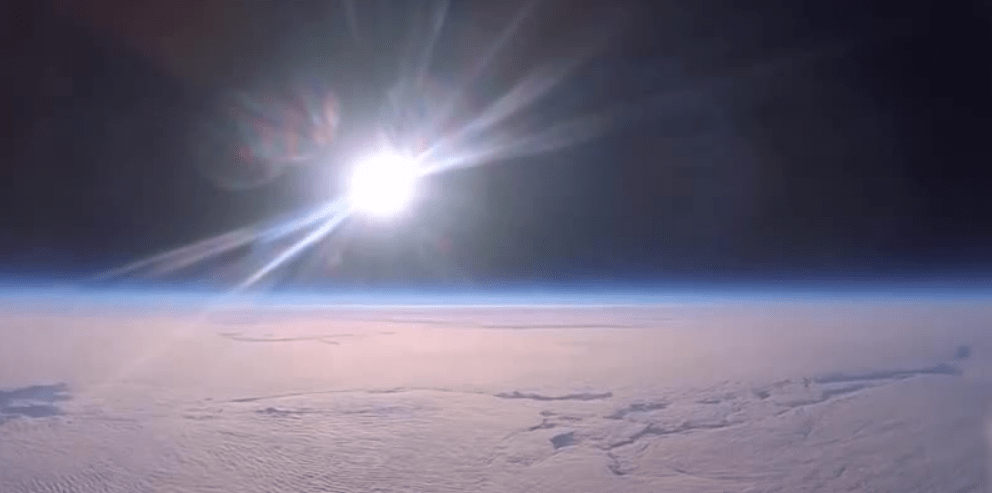
Since coming to believe that the cosmology of Genesis Chapter One is the truth, I have encountered two main arguments Christians use to reject the Bible’s testimony regarding the heavens and earth. First, the claims of modern theoretical astrophysics is offered as proof that Genesis cannot be literally true and therefore must be interpreted poetically. Secondly, it is argued that believing in the literal truth of Genesis Chapter One will 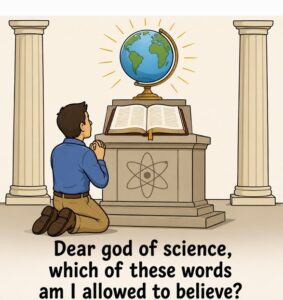 make Christians seem ridiculous and hinder people’s ability to accept the gospel’s claims.
The first argument is something I have written about extensively and have shown that true science, that which is observable, testable, repeatable, and falsifiable, actually supports the biblical view. Regarding allowing so-called science to dictate how we interpret the Bible, however, let me summarize my rebuttal here.
If we allow the claims of the so-called science of astrophysics, which is largely theoretical and untestable, to dictate how we interpret the Bible, it means we recognize that it has authority over God’s Word, which, of course, is a form of idolatry.
20 O Timothy, guard what has been entrusted to you, avoiding worldly and empty chatter and the opposing arguments of what is falsely called “knowledge”— 21 which some have professed and thus gone astray from the faith. Grace be with you. 1 Timothy 6:20–21 (NASB95)
But that is enough on that subject. My response to the second argument will make up the remainder of this article.
The contention that professing belief in biblical cosmology will hinder the effectiveness of the gospel is convoluted reasoning and is what I call a guardian lie. Such a lie stands guard over the entrance to the path leading to truth to block access. It convinces us to go no further, often much to our relief. Most people hope for an excuse to reject this amazing truth because we inherently recognize how costly it will be to embrace it. The world provides all sorts of arguments against the truth, and YouTube has worked its algorithms so that any one doing a search can only mainly find opposing arguments. That is why I created my Resource Page for honest inquirers. But, back to our topic…
The Bible is filled with miracles that defy what is called rational thinking, which is why so many categorically reject all such claims. For example, the very least a person can believe in order to be a Christian was summarized by the apostle Paul.
9 that if you confess with your mouth Jesus as Lord, and believe in your heart that God raised Him from the dead, you will be saved; Romans 10:9 (NASB95)
When Jesus died, he paid the penalty for our sins and made us right with our heavenly Father. When he rose from the dead, it proved that his sacrifice had been accepted and that God made him the undisputed Lord over all creation.
4 who was declared the Son of God with power by the resurrection from the dead, according to the Spirit of holiness, Jesus Christ our Lord, Romans 1:4 (NASB95)
Science tells us, however, that even though people can be dead for a short time and be resuscitated, it is impossible for someone to be in the tomb for three days and come back to life, never to die again. Yet, that is what people must believe in order to be saved. We do not blink an eye or make any sort of excuse when we tell people that this is the case.
If we rightly ask people to lay aside all previous understanding of life and death, the testimony of medical science, and our own experience, in order to accept the gospel’s claims, why then is believing in biblical cosmology a bridge too far? Is it not because the world allows us to believe in Jesus but refuses to let us believe that Genesis is true?
This raises the question, why? Is believing in biblical cosmology a greater threat to the satanic world system than simply believing in Jesus? Is it not because biblical cosmology requires a creator; whereas, modern astrophysics purports to provide a way for us to have gotten here all by ourselves? Will not accepting biblical cosmology turn the hearts of an unbelieving world toward God and ultimately Christ, something Satan fears?
If we believe the Word of God is the truth, we who preach the gospel also believe that God formed Adam out of the dust and breathed his Spirit into him. We believe that Eve was formed from one of Adam’s ribs. We believe that God flooded the entire earth, killing all creatures that breathe, except for those in the Ark. We believe that God appeared to and spoke with Abraham, Isaac, and Jacob. We believe God raised up Moses to deliver Israel from Pharaoh, whose army he drowned in the Red Sea. We believe God gave Moses the Ten Commandments and eventually led Israel into the promised land under Joshua. We believe he stopped a flooding Jordan River to allow Israel to cross over. We believe God knocked down the walls of Jericho when Israel shouted. We believe God took Elijah into heaven via a chariot sucked up by a whirlwind. The list goes on. In the New Testament, we believe that Jesus was born miraculously to a virgin. We believe he turned water into wine, walked on water, healed the sick, and raised the dead. If we believe the Bible, it means we do not believe in evolution. If we embrace the Scripture, it means that sex outside of marriage, abortion, homosexuality, and transgenderism are not good things.
But when we preach the gospel, we do not demand that our hearers must first believe in all these miracles or agree to accept that the aforementioned things the world embraces are sinful in God’s eyes, unless of course one might be an issue that God is particularly focused on and wants the person to repent. No, in most cases we introduce them to Christ, what he did for us on the cross, and the claim that he is Lord as a result of his resurrection. This demands a response from our hearers, the proper one being to acknowledge and declare allegiance to Jesus the Lord.
We trust that once a person acknowledges Christ’s lordship over every area of life, he or she will eventually be led by the Spirit to surrender to all the claims of God’s Word.
When I share the gospel, I do not bring up every miracle of the Bible, some controversial doctrine, or tell people that I believe the earth is an enclosed circular plane as described in the Bible rather than what modern astrophysics says. That topic may come up later, but it is not essential to the gospel and the new birth. However, if I declare that I do not believe Genesis Chapter One is true, why should anyone believe me if a say that the rest of the Bible is true? If God lied in the first chapter of his book, why would anyone think he tells the truth elsewhere? If the creation of the heavens and earth is just poetry and has no basis in reality, why should I think differently about the resurrection?
Therefore, both of these arguments against believing in biblical cosmology are untenable. We should not be embarrassed to boldly claim that all of God’s Word is absolutely true, not just the parts approved by so-called science or which agree with what is currently socially acceptable in the world.
So, perhaps the real reason Christians reject biblical cosmology is not because it would make the gospel look ridiculous, but because we are afraid it will make us look that way.
If so, it means we love ourselves more than God’s Word.
26 “For whoever is ashamed of Me and My words, the Son of Man will be ashamed of him when He comes in His glory, and the glory of the Father and of the holy angels. Luke 9:26 (NASB95)