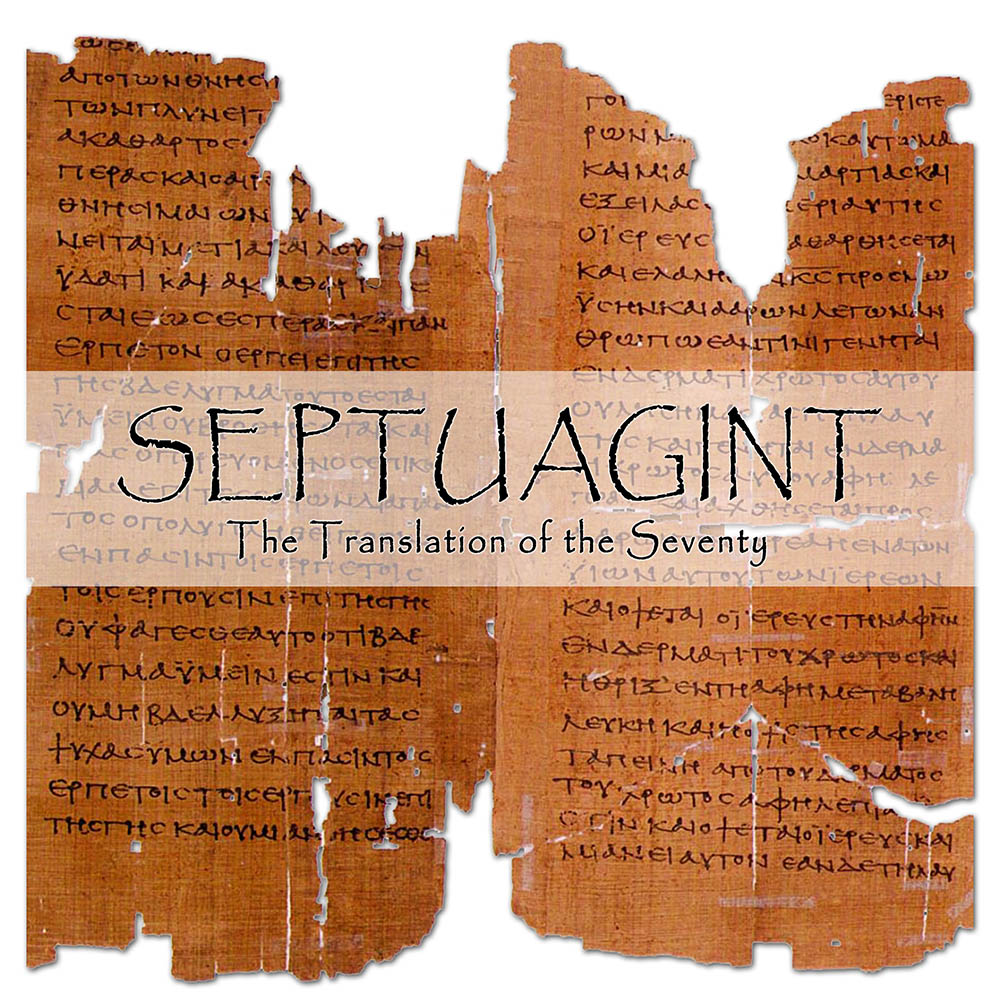
Here is a direct side-by-side comparison of the Masoretic Text with the LXX. I have concluded that the LXX is much to be preferred over the Masoretic Text, a position from which the Eastern Orthodox Church never deviated. Perhaps, if you take the time to read my comparisons and other articles, you will arrive at the same conclusion.
The Septuagint version I am using is the Lexham English Septuagint 2nd Edition, which is available in print or as part of Logos Bible Software. Occasionally I also use the Brenton translation of the LXX for insight into difficult passages.
If you want to know more, click on the following links.
- Why Christians Should Prefer the Septuagint over the Masoretic Text.
- Some Insights Gained through Comparing the Masoretic Text to the Septuagint
- More side by side comparisons of the Masoretic Text (MT) to the Septuagint (LXX).
| Masoretic Text | Septuagint | Significance |
|
1 Now Adam knew Eve his wife, and she conceived and bore Cain, and said, “I have acquired a man from the LORD.” 2 Then she bore again, this time his brother Abel. Now Abel was a keeper of sheep, but Cain was a tiller of the ground. 3 And in the process of time it came to pass that Cain brought an offering of the fruit of the ground to the LORD. 4 Abel also brought of the firstborn of his flock and of their fat. And the LORD respected Abel and his offering, 5 but He did not respect Cain and his offering. And Cain was very angry, and his countenance fell. Genesis 4:1–5 (NKJV) |
1 And Adam knew Eve, his wife, and she conceived and brought forth Cain and said, “I have acquired a man through God.” 2 And she proceeded to bring forth his brother, Abel. Abel became a herdsman of sheep, and Cain was working the earth. 3 Now this happened after a number of days: Cain brought some of the fruit of the earth as an offering for the Lord, 4 and Abel himself also brought some of the firstborn of his sheep and some of their hard fat parts. God looked upon Abel and upon his gifts, 5 but he did not pay attention to Cain and upon his offerings. He grieved Cain very much, and he fell in face. Genesis 4:1–5 (LES2) |
The MT says Eve acquired a son through YHVH. The LXX says through theos – God. Jesus told us to call God “Father,” thus settling forever what is the proper name for us to use for God. Eve understood that all life derives from God, even though we participate in the process. God’s lack of respect for Cain’s offering, according to the LXX grieved, saddened, or vexed Cain greatly. |
|
6 So the LORD said to Cain, “Why are you angry? And why has your countenance fallen? 7 If you do well, will you not be accepted? And if you do not do well, sin lies at the door. And its desire is for you, but you should rule over it.” Genesis 4:6–7 (NKJV) |
6 The Lord God said to Cain, “Why have you become deeply grieved, and why has your face fallen? 7 Have you not sinned if you offer rightly but do not divide rightly? Calm down! His recourse will be to you, and you will rule him.” Genesis 4:6–7 (LES2) |
God’s question was not to discover what was wrong with Cain. He knew. He was trying to help Cain. There was some aspect of Cain’s offering that was not pleasing to God. God said Cain had not “divided” it rightly. I am not sure what that meant in the case of a food offering, but apparently Cain understood. Whereas Abel brought “some of the firstborn” of his flock, Cain only brought “some” of his produce, instead of the first fruits. There is a right thing to do, but it also must be done the right way, at the right time by the right person or people. (A Table Has Four Legs Teaching). The MT translates verse 7 in a way that does not make sense to me. The admonition for Cain to “rule over” sin is not a command anyone could keep, aside from the Lord Jesus. Now that our Lord has conquered the power of sin on our behalf, we also can experience his victory, which includes being released from sin’s dominion. (Romans 6:14) At this point in history, however, Cain had no ability to conquer sin on his own. He could resist and turn to God for help, but was not able to rule over it. I prefer the LXX, which is more believable. God did not coddle Cain in his depression. Instead he rebuked him, while reassuring him that this rejection of his offering did not take away Cain’s firstborn authority. Abel was still the second born and was accountable to Cain. Sadly, this did not change Cain’s heart or mind which morphed from pain, to bitterness, to murder, just as happened later to Absalom. |
|
8 Now Cain talked with Abel his brother; and it came to pass, when they were in the field, that Cain rose up against Abel his brother and killed him. Genesis 4:8 (NKJV) |
8 And Cain said to Abel, his brother, “Let’s walk through the field.” And this happened while they were in the field: Cain rose against Abel, his brother, and he killed him. Genesis 4:8 (LES2) |
As was the case with Joseph’s brothers later, Cain’s bitterness against God transferred into hatred for the one God favored, his brother Abel. The MT passively says, “they were in the field,” but the LXX says Cain took the initiative to lead Abel into the field and kill him. This seems to have been premeditated murder. This foreshadowed how the leaders of Israel chose to put the favored Son, our Lord Jesus, to death, rather than listen and respond properly to God’s words. |
|
9 Then the LORD said to Cain, “Where is Abel your brother?” He said, “I do not know. Am I my brother’s keeper?” 10 And He said, “What have you done? The voice of your brother’s blood cries out to Me from the ground. 11 So now you are cursed from the earth, which has opened its mouth to receive your brother’s blood from your hand. 12 When you till the ground, it shall no longer yield its strength to you. A fugitive and a vagabond you shall be on the earth.” 13 And Cain said to the LORD, “My punishment is greater than I can bear! 14 Surely You have driven me out this day from the face of the ground; I shall be hidden from Your face; I shall be a fugitive and a vagabond on the earth, and it will happen that anyone who finds me will kill me.” 15 And the LORD said to him, “Therefore, whoever kills Cain, vengeance shall be taken on him sevenfold.” And the LORD set a mark on Cain, lest anyone finding him should kill him. Genesis 4:9–15 (NKJV) |
9 Then God said to Cain, “Where is Abel, your brother?” But he said, “I don’t know. I’m not my brother’s guardian, am I?” 10 God said, “What have you done? The voice of your brother’s blood is crying out to me from the earth. 11 Now, accursed are you upon the earth, which opened its mouth wide to receive the blood of your brother from your hand, 12 because you will work the earth; it will not proceed to give its strength to you. You will moan and tremble upon the earth.” 13 Cain said to the Lord, “My guilt is too great for me to be forgiven. 14 If you throw me out today from the face of the earth, and I will be hidden from your face, then I will be moaning and trembling upon the earth, and anyone who finds me will kill me.” 15 The Lord God said to him, “It will not be like that. Anyone who kills Cain will release seven reprisals. The Lord God has placed a sign for Cain so that none who find him would kill him.” Genesis 4:9–15 (LES2) |
Perhaps Cain did not realize at this point that God knows all things. He certainly was not repentant. We learn here that innocent blood cries out to God for justice. The MT uses two different words for ground (adamah) and earth (eretz), but the LXX consistently uses the Greek word ge, which can mean either earth or land, in every verse. God cursed Cain. A biblical curse from God is essentially the pronouncement of a judgment incurred by our sin. This is quite different from a curse spoken by someone practicing some form of witchcraft. The MT says that Cain was cursed from the ground (adamah), but the LXX says he was cursed upon the earth (ge). The LXX makes more sense to me. The curse came from God and affected him while he lived on the earth. The earth would not produce like it did before, and Cain would “moan and tremble” in fear, according to the LXX. That is quite different from the MT’s saying he would be a fugitive and vagabond. Verse 13 is very different. The MT has Cain saying that his punishment is too great to bear, but the LXX has him saying that his guilt is too great to bear. His great fear is that someone will do to him what he did to Abel. God assured him that this would not happen because of a mysterious mark or sign God placed on him. It is amazing to me that God would so protect him. The Law had not been introduced and the requirement to put to death a murderer that was instituted by God after the flood was not in effect either. Nevertheless, Cain punishment was significant. He was cut off from God’s presence, experienced continual fear, and was vulnerable to reprisal without God’s unique protection. |
|
25 And Adam knew his wife again, and she bore a son and named him Seth, “For God has appointed another seed for me instead of Abel, whom Cain killed.” 26 And as for Seth, to him also a son was born; and he named him Enosh. Then men began to call on the name of the LORD. Genesis 4:25–26 (NKJV) |
25 Adam knew Eve, his wife, and, once she conceived, she brought forth a son and called his name Seth, saying, “Because God raised up another offspring for me in the place of Abel, whom Cain killed.” 26 Seth had a son, and he called his name Enosh. This one hoped to invoke the name of the Lord God. Genesis 4:25–26 (LES2) |
As God promised, he continued the line that would eventually result in the birth of the Messiah by raising up Seth as a replacement for Abel, after he was murdered. Satan often tries to destroy the line of the Messiah. Seth fathered Enosh. The MT says that “then men began to call upon the name of YHVH.” The LXX says that “this one,” meaning Enosh, “hoped” to call upon God’s name. Interesting. |
Summary: There are significant differences between the MT and LXX, that in this case are somewhat theological. The idea that there is little difference between the two continues to be refuted. These differences force us to decide which we believe is the true word of God. As mentioned before, since the early church championed the Septuagint, I think we should, too.