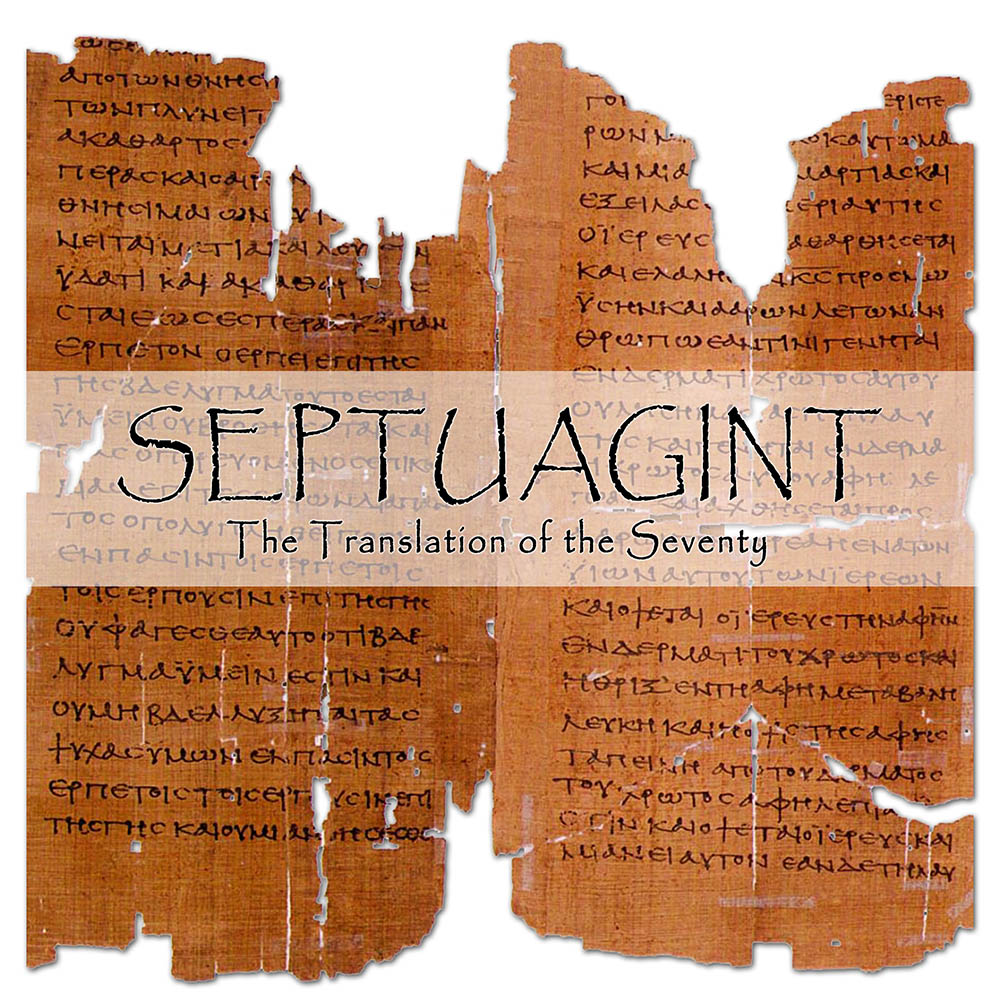
Here is a direct side-by-side comparison of the Masoretic Text with the LXX. I have concluded that the LXX is much to be preferred over the Masoretic Text, a position from which the Eastern Orthodox Church never deviated. Perhaps, if you take the time to read my comparisons and other articles, you will arrive at the same conclusion.
The Septuagint version I am using is the Lexham English Septuagint 2nd Edition, which is available in print or as part of Logos Bible Software. Occasionally I also use the Brenton translation of the LXX for insight into difficult passages.
If you want to know more, click on the following links.
- Why Christians Should Prefer the Septuagint over the Masoretic Text.
- Some Insights Gained through Comparing the Masoretic Text to the Septuagint
- More side by side comparisons of the Masoretic Text (MT) to the Septuagint (LXX).
| Masoretic Text | Septuagint | Significance |
|
1 My God, My God, why have You forsaken Me? Why are You so far from helping Me, And from the words of My groaning? Psalm 22:1 (NKJV) |
2 O God, my God, attend to me. For what purpose did you abandon me? Far away from my salvation are the words of my transgressions. Psalm 21:2 (LES2) |
Parts of this psalm are quoted in the New Testament with reference to Christ’s crucifixion, revealing that the Holy Spirit wants us to see it as a Davidic prophecy. This is one of the times that the New Testament quotes from the MT. The LXX’s wording helps us to properly understand it. 46 And about the ninth hour Jesus cried out with a loud voice, saying, “Eli, Eli, lama sabachthani?” that is, “My God, My God, why have You forsaken Me?” Matthew 27:46 (NKJV) Jesus’ words on the cross echo what David saw hundreds of year earlier. They were in Aramaic, which the gospel writers translated into Greek, the world’s most used language at the time. This verse in the MT is one big question, but the LXX begins with a request, “O God, my God, attend to me.” The Greek word for “attend” means to be near. The speaker, whom we understand to be Jesus, begs for God’s presence to be near, something he had enjoyed for all eternity. When Jesus offered himself as God’s Lamb for the sins of the world, those sins became identified with him for our sake. (2 Corinthians 5:21) God cannot dwell with sin, which probably accounts for Jesus’ experience of abandonment on the cross. The one who never sinned was treated as if he were a sinner. I am sure that Jesus understood the dynamic, but it must have been excruciating, literally. The LXX and MT translated the last word of the verse quite differently. The Hebrew word translated as “groanings” can also mean roaring. The Greek word used in the LXX means trespasses or sins. I am not sure how to understand that phrase n the LXX, unless this particular passage has a double application both to Jesus and David. |
|
2 O My God, I cry in the daytime, but You do not hear; And in the night season, and am not silent. 3 But You are holy, Enthroned in the praises of Israel. 4 Our fathers trusted in You; They trusted, and You delivered them. 5 They cried to You, and were delivered; They trusted in You, and were not ashamed. Psalm 22:2–5 (NKJV) |
3 O my God, I will cry aloud for days to you, and you will not hear; and during the night, there is nothing for my folly. 4 But you, the praise of Israel, dwell in the holy place. 5 Upon you our fathers hoped; they hoped, and you rescued them. 6 To you they cried aloud, and they were saved. Upon you they hoped, and they were not disgraced. Psalm 21:3–6 (LES2) |
Verse 2/3 has some differences which I will not address. The next verse contrasts God’s being enthroned on the praises of Israel in the MT to his dwelling in the Holy Place in the LXX. The MT’s wording is poetic but the LXX is reality. God is enthroned in heaven and is the object of our praise. The remainder of the passage is essentially the same. |
|
6 But I am a worm, and no man; A reproach of men, and despised by the people. 7 All those who see Me ridicule Me; They shoot out the lip, they shake the head, saying, 8 “He trusted in the LORD, let Him rescue Him; Let Him deliver Him, since He delights in Him!” Psalm 22:6–8 (NKJV) |
7 But I am a worm and not a person, a reproach of humanity and an object of contempt of the people. 8 All the ones who look at me turn up their nose at me. They speak with their lips; they shake their head, 9 “He hoped upon the Lord; let him rescue him; let him save him, because he wants him.” Psalm 21:7–9 (LES2) |
There are no real differences here. My only comment is that Jesus endured the rejection our sins deserve so that those who believe in him will never have to experience rejection by God. Hallelujah! |
|
9 But You are He who took Me out of the womb; You made Me trust while on My mother’s breasts. 10 I was cast upon You from birth. From My mother’s womb You have been My God. 11 Be not far from Me, For trouble is near; For there is none to help. Psalm 22:9–11 (NKJV) |
10 For you are the one who drew me out from the womb. You are my hope from the breasts of my mother. 11 Upon you I was cast from the womb. From my mother’s belly, you are my God. Do not turn away from me, for affliction is near, 12 because there is no one who helps. Psalm 21:10–12 (LES2) |
There are no real differences here. I am in awe of Jesus who faced down Satan and the entire world system alone on our behalf! |
|
12 Many bulls have surrounded Me; Strong bulls of Bashan have encircled Me. 13 They gape at Me with their mouths, Like a raging and roaring lion. 14 I am poured out like water, And all My bones are out of joint; My heart is like wax; It has melted within Me. 15 My strength is dried up like a potsherd, And My tongue clings to My jaws; You have brought Me to the dust of death. Psalm 22:12–15 (NKJV) |
13 Young bulls encircled me. Many fat bulls surrounded me. 14 They opened their mouth against me, as a lion that snatches away and roars. 15 I was poured out like water, and all my bones were scattered. My heart became like beeswax melting in the middle of my belly. 16 My strength was dried up like an earthen vessel, and my tongue has been glued to my throat. You led me into the dust of death. Psalm 21:13–16 (LES2) |
The MT says “all my bones are out of joint,” but the LXX says, “all my bones were scattered.” The Greek word is diaspora, the same word used to describe the scattering of the Jews throughout the world. Since this psalm is a prophecy concerning Jesus and the crucifixion, it seems to me that the LXX must be a reference to Christ’s bride, the church, later being scattered throughout the world as a result of the proclamation of the gospel message. When God created Eve, the first bride, Adam remarked: “this is bone of my bones.” (Genesis 2:23) The bride of Christ is “bone of his bones.” It also may have a connection to Ezekiel’s prophecy of the dry bones coming to life through the new birth, the outpouring of the Spirit on Pentecost, and the resurrection. (Ezekiel 37:3-14) |
|
16 For dogs have surrounded Me; The congregation of the wicked has enclosed Me. They pierced My hands and My feet; 17 I can count all My bones. They look and stare at Me. 18 They divide My garments among them, And for My clothing they cast lots. Psalm 22:16–18 (NKJV) |
17 For many dogs encircled me. A gathering of those doing evil surrounded me. They pierced my hands and feet. 18 They can count all my bones; they perceived and gazed upon me. 19 They distributed my garments among themselves, and they cast a lot for my clothing. Psalm 21:17–19 (LES2) |
As I wrote elsewhere, the MT reading of verse 16 is quite weird, which is why the translators of the English Bible did not use it at all. Instead, in this instance, they chose to go with the LXX. The MT reads something like, “…lions, my hands and my feet.” Having recognized the untrustworthiness of the Masoretes in this and other instances, why the translators of our English Bible and many scholars still believe the MT is more reliable than the LXX in general is beyond me. Once we catch a person in a lie, we should beware of trusting them in the future. The other difference is that the MT says, “I can count all my bones;” whereas, the LXX says, “they can count all my bones.” Such changes of subject and verb tenses are frequent and not without consequence. Matthew, Mark, Luke, and John all quote verse 18 in their gospels, proving this psalm is a prophecy about Christ’s crucifixion, something the Masoretes surely knew and wished to obscure in verse 16. |
|
19 But You, O LORD, do not be far from Me; O My Strength, hasten to help Me! 20 Deliver Me from the sword, My precious life from the power of the dog. 21 Save Me from the lion’s mouth And from the horns of the wild oxen! You have answered Me. Psalm 22:19–21 (NKJV) |
20 But you, O Lord, do not delay my rescue; give heed to my help. 21 Rescue my soul from the sword, and my unique one from the hand of a dog. 22 Save me from the mouth of the lion, and my lowliness from the horn of the unicorn. Psalm 21:20–22 (LES2) |
The only difference that I will point out is that the word translated “unicorn” is perhaps the equivalent of the Hebrew word translated as wild oxen. It would have referred to a now extinct wild bovine with two horns called the aurochs. Another possibility is that it might have referred to a rhinoceros, which indeed has one horn. The word did not likely refer to the mythical unicorn so popular today. |
|
22 I will declare Your name to My brethren; In the midst of the assembly I will praise You. 23 You who fear the LORD, praise Him! All you descendants of Jacob, glorify Him, And fear Him, all you offspring of Israel! 24 For He has not despised nor abhorred the affliction of the afflicted; Nor has He hidden His face from Him; But when He cried to Him, He heard. Psalm 22:22–24 (NKJV) |
23 I will set out in detail your name to my brothers. In the middle of the assembly I will sing of you. 24 Those who fear the Lord, praise him all together. Seed of Jacob, glorify him. Let the seed of Israel fear him all together. 25 For he did not scorn nor was he irritated with the entreaty of the poor, nor did he turn his face away from me. And when I cried out to him, he gave ear to me. Psalm 21:23–25 (LES2) |
If this refers to Jesus, it is quite interesting, since the only name he gave us for God’s name is Father. Apparently that is all the detail we need, making all the focus on properly pronouncing God’s name in the Hebrew a moot point. (Click here to read more about this.) The LXX uses the word “poor” instead of “afflicted” in verse 24/25. This is interesting since Jesus said the poor in spirit will inherit the kingdom of heaven. (Matthew 5:3) Rich people might get irritated with the poor, but not God. As in other places, the MT changes first person to third person for some reason, changing it to a description instead of a testimony. |
|
25 My praise shall be of You in the great assembly; I will pay My vows before those who fear Him. 26 The poor shall eat and be satisfied; Those who seek Him will praise the LORD. Let your heart live forever! 27 All the ends of the world Shall remember and turn to the LORD, And all the families of the nations Shall worship before You. 28 For the kingdom is the LORD’s, And He rules over the nations. Psalm 22:25–28 (NKJV) |
26 From you is my praise in the great assembly. I will render my prayers before those who fear him. 27 The poor will eat and be satisfied. The ones who seek him will praise the Lord. Their hearts will live for eternity of eternity. 28 All the ends of the earth will remember and return to the Lord, and all the families of the nations will worship before him. 29 For the kingdom is the Lord’s, and he is Lord over the nations. Psalm 21:26–29 (LES2) |
This passage contains some significant differences. First, the MT changed the praise coming from God to Jesus to praise going to God from the assembly. Secondly, the poor will be satisfied. Those who taste of the Lord’s goodness will never look elsewhere. (Psalm 34:8) Those who seek the Lord will live forever, according to the LXX, which agrees with Jesus’ giving those who believe in him eternal life. (John 10:28) The MT waters that down as a prayer instead of its being a declaration of God’s truth or a promise. Verse 27/28 in the MT says the nations will worship before you, meaning God, but the LXX says they will worship before him, meaning Jesus, who is lord over the nations. (Matthew 28:18) The MT could be understood in the same way, but to me the LXX is clearer. 4 Who shall not fear You, O Lord, and glorify Your name? For You alone are holy. For all nations shall come and worship before You, For Your judgments have been manifested.” Revelation 15:4 (NKJV) |
|
29 All the prosperous of the earth Shall eat and worship; All those who go down to the dust Shall bow before Him, Even he who cannot keep himself alive. 30 A posterity shall serve Him. It will be recounted of the Lord to the next generation, 31 They will come and declare His righteousness to a people who will be born, That He has done this. Psalm 22:29–31 (NKJV) |
30 All the fat of the earth ate and worshiped before him. All the ones who come down into the earth bowed down. And my soul lives for him. 31 My seed will serve him. The generation that is coming will be reported to the Lord. 32 They will report his righteousness to the people who are being born, whom the Lord made. Psalm 21:30–32 (LES2) |
The MT puts the verb in verse 29/30 in the future; whereas, the LXX makes it a past tense. The Hebrew is in the perfect tense, which allows for several possibilities, including past action. I believe this verse says that the dead shall acknowledge Jesus’ lordship. This agrees with Paul’s statement that Jesus descended into Hades and led captivity captive. (Ephesians 4:7-10) Every knee will bow before him, both the living and the dead. (Philippians 2:10, Romans 14:11) The MT includes those “who cannot keep himself alive,” but the LXX has “my soul lives for him.” This is most likely a reference to the resurrected Jesus, who Paul says ever lives for God. (Romans 6:10) Then the speaker, who is Jesus, states that “my seed will serve him (God)”. This I believe refers to those born again by the Spirit, Jesus’ seed, who serve God in the New Covenant. Isaiah 53:10 says that the crucified one will see his seed. 12 But as many as received Him, to them He gave the right to become children of God, to those who believe in His name: 13 who were born, not of blood, nor of the will of the flesh, nor of the will of man, but of God. John 1:12–13 (NKJV) This seed of the Lord will proclaim the good news of the New Covenant gospel throughout the world in the time to come to a people not yet born when David wrote this psalm! |