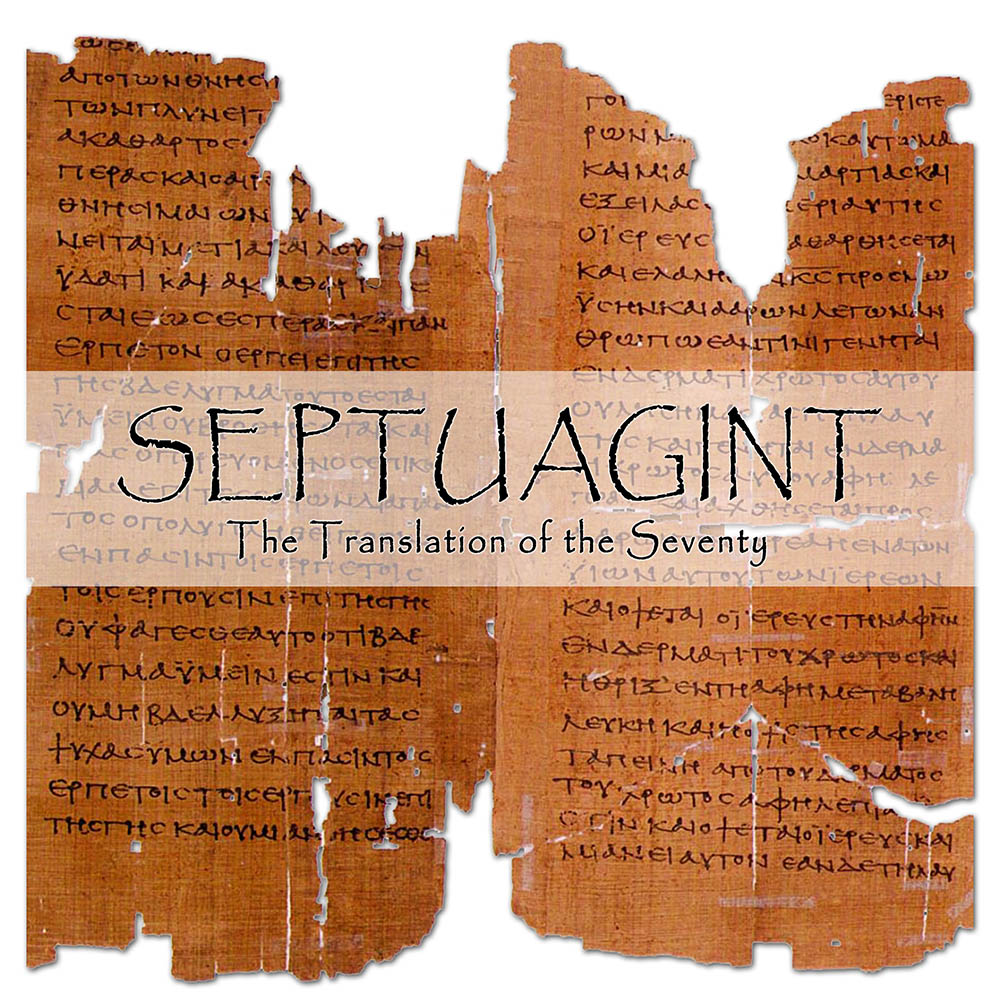
Here is a direct side-by-side comparison of the Masoretic Text with the LXX. I have concluded that the LXX is much to be preferred over the Masoretic Text, a position from which the Eastern Orthodox Church never deviated. Perhaps, if you take the time to read my comparisons and other articles, you will arrive at the same conclusion.
The Septuagint version I am using is the Lexham English Septuagint 2nd Edition, which is available in print or as part of Logos Bible Software. Occasionally I also use the Brenton translation of the LXX for insight into difficult passages.
If you want to know more, click on the following links.
- Why Christians Should Prefer the Septuagint over the Masoretic Text.
- Some Insights Gained through Comparing the Masoretic Text to the Septuagint
- More side by side comparisons of the Masoretic Text (MT) to the Septuagint (LXX).
| Masoretic Text | Septuagint | Significance |
|
1 The LORD says to my Lord: “Sit at My right hand Until I make Your enemies a footstool for Your feet.” 2 The LORD will stretch forth Your strong scepter from Zion, saying, “Rule in the midst of Your enemies.” Psalm 110:1–2 (NASB95) |
1 The Lord said to my Lord, “Be seated at my right side until I set your enemies as a footstool for your feet.” 2 The Lord will send out a rod of power from Zion, “Rule in the middle of your enemies. Psalm 109:1–2 (LES2) |
There is no difference here between the LXX and MT. Perhaps this is because it seems to support the nation of Israel’s being the subject of God’s address. For covenant theologians, we know that the Israel of God is the One New Man in Christ, the church, which is composed of both Jew and Gentile. The New Testament quotes verse one in several places (Matthew 22:44, Mark 12:36, Luke 20:42-43, Acts 2:35, and Hebrews 1:13). Jesus used it to illustrate his divinity, when he asked the Pharisees why his ancestor David called him “lord,” something no father would ever say to his son. |
|
3 Your people will volunteer freely in the day of Your power; In holy array, from the womb of the dawn, Your youth are to You as the dew. Psalm 110:3 (NASB95) |
3 With you is authority in the day of your power, with the splendor of the holy ones. From the womb, before the morning, I fathered you.” Psalm 109:3 (LES2) |
The MT changed “with the splendor of your holy ones,” to “in holy array.” The Bible calls born-again believers “holy ones” or saints, who will accompany Christ at his second coming, the day of his power and authority. (Revelation 19:14) In addition, here is where the MT erases a clear reference to Christ, God’s Son. The MT changed “I begot you” to “your youth are to you as the dew.” What!? I begot you is a clear reference to Christ. (Psalm 2:7, Acts 13:33, Hebrews 1:5) In Psalm 2, the MT retains the reference to the begotten Son. Perhaps it was changed in Psalm 110 because the first and the fourth verses are quoted in the New Testament to prove Christ is the Messiah. Maybe it was just too much to leave the reference to his being begotten in there, too. Jesus is the eternal Logos who was born of a virgin after being conceived by the Holy Spirit. He is the “first begotten from the dead” (Colossians 1:18) by means of the resurrection. Through Christ all who believe in him are reborn by the Spirit. |
|
4 The LORD has sworn and will not change His mind, “You are a priest forever According to the order of Melchizedek.” Psalm 110:4 (NASB95) |
4 The Lord swore and will not regret, “You are a priest for eternity according to the order of Melchizedek.” Psalm 109:4 (LES2) |
The MT and LXX are essentially in agreement. This verse is quoted in Hebrews 5:6 and 7:17 and cited in Hebrews 5, 6, and 7, to illustrate that Christ’s priesthood is of an entirely different order and nature than the Levitical one, his being the priest of the New Covenant. |
|
5 The Lord is at Your right hand; He will shatter kings in the day of His wrath. 6 He will judge among the nations, He will fill them with corpses, He will shatter the chief men over a broad country. 7 He will drink from the brook by the wayside; Therefore He will lift up His head. Psalm 110:5–7 (NASB95) |
5 The Lord at your right hand crushed together kings in the day of his anger. 6 He will judge among the nations. He will fill up with corpses. He will crush the heads of many upon the earth. 7 From a torrent in the way he will drink. On account of this he will raise up his head. Psalm 109:5–7 (LES2) |
In this passage the MT and LXX are essentially in agreement. |
| As I compare numerous Old Testament passages in the MT to the LXX, I am reminded of the old saying, “death by a thousand cuts.” Nothing in the MT destroys the New Testament claims about Christ, but the recurrence of omissions and obfuscations hides Christ and erodes confidence in the New Testament, which quotes the LXX, all in a way that dishonors God. |