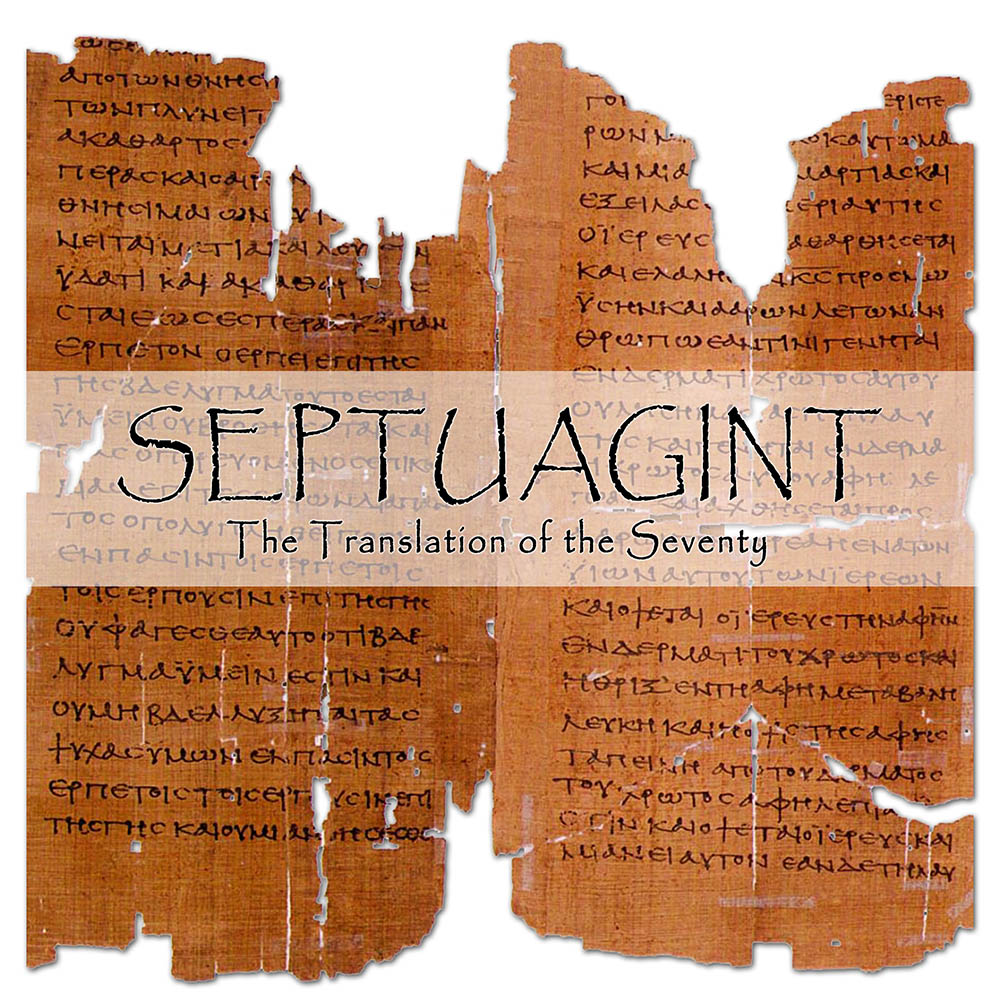
Here is a direct side-by-side comparison of the Masoretic Text with the LXX. I have concluded that the LXX is much to be preferred over the Masoretic Text, a position from which the Eastern Orthodox Church never deviated. Perhaps, if you take the time to read my comparisons and other articles, you will arrive at the same conclusion.
The Septuagint version I am using is the Lexham English Septuagint 2nd Edition, which is available in print or as part of Logos Bible Software. Occasionally I also use the Brenton translation of the LXX for insight into difficult passages.
If you want to know more, click on the following links.
- Why Christians Should Prefer the Septuagint over the Masoretic Text.
- Some Insights Gained through Comparing the Masoretic Text to the Septuagint
- More side by side comparisons of the Masoretic Text (MT) to the Septuagint (LXX).
| Masoretic Text | Septuagint | Significance |
|
1 Listen to Me, O islands, And pay attention, you peoples from afar. The LORD called Me from the womb; From the body of My mother He named Me. 2 He has made My mouth like a sharp sword, In the shadow of His hand He has concealed Me; And He has also made Me a select arrow, He has hidden Me in His quiver. Isaiah 49:1–2 (NASB95) |
1 “Listen to me, islands, and pay attention, nations! After a long time it will come about,” says the Lord. He called my name from my mother’s belly, 2 and he made my mouth like a sharp sword, and he hid me under the protection of his hand. He made me like a choice arrow, and he hid me in his quiver. Isaiah 49:1–2 (LES2) |
The most notable difference is that the MT omits the phrase, “After a long time it will come about,” which makes this passage a prophetic announcement of something to take place in the distant future, rather than something already accomplished. The MT wishes to identify this passage with Israel; whereas, the LXX should be understood as a prophecy about Christ. |
|
3 He said to Me, “You are My Servant, Israel, In Whom I will show My glory.” 4 But I said, “I have toiled in vain, I have spent My strength for nothing and vanity; Yet surely the justice due to Me is with the LORD, And My reward with My God.” Isaiah 49:3–4 (NASB95) |
3 And he said to me, “You are my servant, Israel, and I will be glorified in you.” 4 And I said, “I have toiled in vain, for pointlessness, and I have given my strength for nothing. On account of this my judgment is with the Lord, and my hard work before my God. Isaiah 49:3–4 (LES2) |
The differences between these passages is worth noting, but does not vary in meaning. |
|
5 And now says the LORD, who formed Me from the womb to be His Servant, To bring Jacob back to Him, so that Israel might be gathered to Him (For I am honored in the sight of the LORD, And My God is My strength), 6 He says, “It is too small a thing that You should be My Servant To raise up the tribes of Jacob and to restore the preserved ones of Israel; I will also make You a light of the nations So that My salvation may reach to the end of the earth.” Isaiah 49:5–6 (NASB95) |
5 And now this is what the Lord—who formed me from the belly as his bondservant in order to gather Jacob and Israel to himself—says: “I will be gathered and glorified before the Lord, and God will be strength for me.” 6 And he said to me, “It is a great thing for you to be called my child, to establish the tribes of Jacob and to return the dispersion of Israel. Look! I have given you as a covenant for a nation, as a light for the nations so that you may become salvation as far as the end of the earth.” Isaiah 49:5–6 (LES2) |
The first rather striking difference is that the MT eliminates the “and” that the LXX places between Jacob and Israel, rather than identifying the two, as in the MT. Perhaps the LXX is a reference to the biological descendants of Abraham (Jacob) and the church (Israel). It can be clearly shown that the NT identifies the church with Israel. Whether this is the correct understanding, I believe the LXX preserves the right wording. Next, the MT changes “I will be gathered and glorified before the Lord” to “so that Israel might be gathered to him.” This is a big difference. “I” refers to a person, who is Christ, not the nation of Israel. This becomes apparent in the next verse. The MT changes, “It is a great thing for you to be called my child” to “It is too small a thing that you should be my servant!” This is a travesty. Jesus was and is God’s only begotten Son, which is a great thing indeed, something shared with us who believe in him via the new birth. (1 John 3:1) Next, there is quite a difference between “preserved ones” and “dispersion.” But even more startling is how the MT omits the phrase, “I have given you as a covenant for the nation (Greek: genos – family),” a phrase repeated in verse 8, but then changed to include the nations (Greek: ethnos). This seems to parallel Jesus’ and the church’s ministry, which was first directed to the Jews, the family, but later was more directed toward the nations. The next startling difference which points away from Christ is how the MT changes “so that you may become salvation as far as the end of the earth.” The MT reads, “so that my salvation shall reach the end of the earth. Clearly, there was what seems to be a deliberate effort to hide how plainly the scriptures point to Christ! |
|
7 Thus says the LORD, the Redeemer of Israel and its Holy One, To the despised One, To the One abhorred by the nation, To the Servant of rulers, “Kings will see and arise, Princes will also bow down, Because of the LORD who is faithful, the Holy One of Israel who has chosen You.” Isaiah 49:7 (NASB95) |
7 This is what the Lord who rescues you, the God of Israel, says: “Sanctify the one who despises his life, who is abhorred by the nations, the servants of rulers. Kings will see him and arise; rulers also will worship him for the sake of the Lord, because the Holy One of Israel is faithful, and I have chosen you.” Isaiah 49:7 (LES2) |
This is a serious aberration. Jesus taught his disciples that it is necessary for us to “lose” our lives, if we want to follow him. (Matthew 16:25) From the beginning of his ministry, Jesus understood that it was his mission to die as God’s lamb for the sins of the world (John 1:29), not just the sin of Israel. It became apparent as Jesus progressed toward his death that he embraced his mission and despised his life. This clearly is a reference to Christ that has been removed. Christ is indeed abhorred, despised, and feared by the nations, plural. Both the MT and LXX refer here to the Gentiles, but for some reason the MT makes the word singular. In addition, the LXX makes this a personal word spoken to the “chosen one,” who is Christ – “I have chosen you.” |
|
8 Thus says the LORD, “In a favorable time I have answered You, And in a day of salvation I have helped You; And I will keep You and give You for a covenant of the people, To restore the land, to make them inherit the desolate heritages; 9 Saying to those who are bound, ‘Go forth,’ To those who are in darkness, ‘Show yourselves.’ Along the roads they will feed, And their pasture will be on all bare heights. 10 “They will not hunger or thirst, Nor will the scorching heat or sun strike them down; For He who has compassion on them will lead them And will guide them to springs of water. Isaiah 49:8–10 (NASB95) |
8 This is what the Lord says: “I have listened to you at the acceptable time, and I have helped you in the day of salvation. And I formed you and have given you as a covenant for the nations, to establish the land and to allot deserted lots, 9 saying to those in chains, ‘Come out!’ and to those in darkness, ‘Be revealed!’ They will be fed in all the ways, and their pasture will be in all their paths. 10 They will not hunger or thirst, and the burning heat and the sun will not strike them, but the one who shows mercy will comfort them, and he will lead them through springs of waters. Isaiah 49:8–10 (LES2) |
The translators of the LXX chose the Greek word that means “listened to” instead of the Hebrew word the MT uses that means “answered.” Next the MT says that God “will keep” or guard this chosen one. The LXX says that God formed or molded him, which I see as an allusion to the incarnation, when the Scripture says that God prepared a body for the eternal Logos. (John 1:14) This is another case when the incarnation is deliberately hidden, just as in the more obvious verse from Psalm 40:6-8, about which I have written previously. Next the MT omits another reference to God’s promise that the Gentiles will be included in the New Covenant. The LXX says that Christ has been given as a “covenant for the nations (ethnos),” but the MT limits the covenant to the “people,” when can mean the nations, but is not clear. It could mean just the Jews,which was probably the intent. In verse 9, the MT agrees with the LXX when it says the chosen one will command, ” Come out,” which could be a direct reference to Christ commanding Lazarus to come out of the tomb. (John 11:43) |
| Once again we can observe that the changes between the MT and LXX tend to eliminate or dilute direct references to Christ. Jesus said that the scriptures point to him. (John 5:39-40) Any time the MT hides this clear pointing to Christ, I suspect foul play, which would not be surprising considering the antipathy the Jews have for Christ and the post-resurrection development of the MT. |