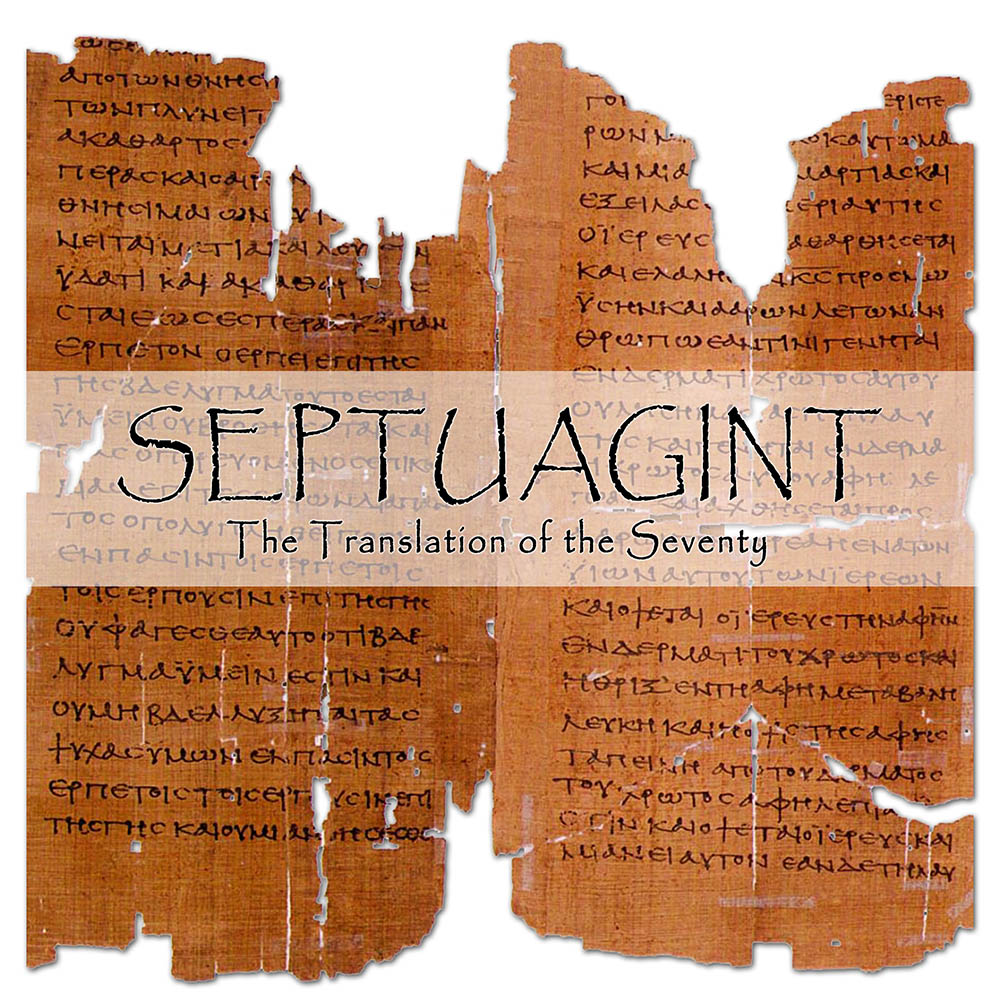
Here are a few New Testament quotes that come directly from the Septuagint, showing that it was the version of the Scriptures used by the early church and the Holy Spirit. I have concluded that the LXX is much to be preferred over the Masoretic Text, a position from which the Eastern Orthodox Church never deviated. Perhaps, if you take the time to read my comparisons and other articles, you will arrive at the same conclusion.
The Septuagint version I am using is the Lexham English Septuagint 2nd Edition, which is available in print or as part of Logos Bible Software. Occasionally I also use the Brenton translation of the LXX for insight into difficult passages.
If you want to know more, click on the following links.
- Why Christians Should Prefer the Septuagint over the Masoretic Text.
- Some Insights Gained through Comparing the Masoretic Text to the Septuagint
- More side by side comparisons of the Masoretic Text (MT) to the Septuagint (LXX).
NT Quote |
LXX |
MT |
Comment |
|
23 “Behold, the virgin shall be with child, and bear a Son, and they shall call His name Immanuel,” which is translated, “God with us.” Matthew 1:23 (NKJV) |
14 Because of this, the Lord himself will give you a sign: Look, the virgin [Greek – parthenos] will conceive in the womb and will bear a son, and you will call his name Immanuel. Isaiah 7:14 (LES2) |
14 Therefore the Lord Himself will give you a sign: Behold, the virgin [Hebrew – almah] shall conceive and bear a Son, and shall call His name Immanuel. Isaiah 7:14 (NKJV) |
In the LXX, the Greek word parthenos is used for virgin. It has only that meaning. In the MT, the Hebrew word almah is used, the normal meaning of which is young girl, but it can mean virgin. The translators perhaps employed a bit of eisegesis here by choosing the word “virgin” to agree with the quote in Matthew 1:23. There is no reason to choose which word to use when quoting the LXX, which agrees 100% with the NT quote. |
|
36 the son of Cainan, the son of Arphaxad, the son of Shem, the son of Noah, the son of Lamech, Luke 3:36 (NKJV) |
10 And these are the generations of Shem: Shem was one hundred years old when he fathered Arpachshad during the second year after the flood. 11 And Shem lived for five hundred years after he fathered Arpachshad, and he fathered sons and daughters, and he died. 12 And Arpachshad lived one hundred and thirty-five years and fathered Kenan. 13 And Arpachshad lived after he fathered Kenan for four hundred and thirty years, and he fathered sons and daughters, and he died. And Kenan lived one hundred and thirty years, and he fathered Shelah, and Kenan lived after he fathered Shelah for three hundred and thirty years, and he fathered sons and daughters, and he died. 14 And Shelah lived one hundred and thirty years and fathered Eber. Genesis 11:10–14 (LES2) |
10 This is the genealogy of Shem: Shem was one hundred years old, and begot Arphaxad two years after the flood. 11 After he begot Arphaxad, Shem lived five hundred years, and begot sons and daughters. 12 Arphaxad lived thirty-five years, and begot Salah. 13 After he begot Salah, Arphaxad lived four hundred and three years, and begot sons and daughters. 14 Salah lived thirty years, and begot Eber. Genesis 11:10–14 (NKJV) |
As I mentioned in a previous article, the MT omits 1300 hundred years from the genealogies in Genesis 5 and 11, it also omits Kenan’s name, which is written as Cainan in the NT. |
|
18 “The Spirit of the LORD is upon Me, Because He has anointed Me To preach the gospel to the poor; He has sent Me to heal the brokenhearted, To proclaim liberty to the captives And recovery of sight to the blind, To set at liberty those who are oppressed; Luke 4:18 (NKJV) |
1 The Spirit of the Lord is upon me, on account of which he has anointed me; he has sent me to bring good news to the poor, to heal those who are crushed in heart, to announce release to the captives and recovery of sight to the blind, Isaiah 61:1 (LES2) |
1 “The Spirit of the Lord GOD is upon Me, Because the LORD has anointed Me To preach good tidings to the poor; He has sent Me to heal the brokenhearted, To proclaim liberty to the captives, And the opening of the prison to those who are bound; Isaiah 61:1 (NKJV) |
Jesus was well-known for opening blind eyes (e.g. John 9), which Isaiah 61:1 says is one of the major signs of the Messiah. The MT leaves out this reference to Christ’s ministry, which is specifically quoted from the LXX in the NT. Once again, one thinks that this was a deliberate attempt to undermine the validity of the NT and the church’s claim that Jesus is the Messiah. Jesus specifically referenced this sign to John the Baptist’s disciples. 4 Jesus answered and said to them, “Go and tell John the things which you hear and see: 5 The blind see and the lame walk; the lepers are cleansed and the deaf hear; the dead are raised up and the poor have the gospel preached to them. 6 And blessed is he who is not offended because of Me.” Matthew 11:4–6 (NKJV) |
|
14 Then Joseph sent and called his father Jacob and all his relatives to him, seventy-five people. Acts 7:14 (NKJV) |
25 These are the sons of Bilhah, whom Laban gave to Rachel his daughter, who bore these for Jacob, all seven souls. 26 All souls who entered with Jacob into Egypt, who came out from his thighs, except for the wives of the sons of Jacob, all sixty-six souls. 27 The sons of Joseph who were born to him in the land of Egypt: nine souls. All the souls of the house of Jacob who entered into Egypt: seventy-five. Genesis 46:25–27 (LES2) 1 These are the names of the sons of Israel who entered Egypt together with Jacob, their father; each one entered with their whole household: 2 Reuben, Simeon, Levi, Judah, 3 Issachar, Zebulun, and Benjamin, 4 Dan, Naphtali, Gad, and Asher. 5 Joseph was already in Egypt. And all the souls from Jacob were seventy-five. Exodus 1:1–5 (LES2) |
25 These were the sons of Bilhah, whom Laban gave to Rachel his daughter, and she bore these to Jacob: seven persons in all. 26 All the persons who went with Jacob to Egypt, who came from his body, besides Jacob’s sons’ wives, were sixty-six persons in all. 27 And the sons of Joseph who were born to him in Egypt were two persons. All the persons of the house of Jacob who went to Egypt were seventy. Genesis 46:25–27 (NKJV) 1 Now these are the names of the children of Israel who came to Egypt; each man and his household came with Jacob: 2 Reuben, Simeon, Levi, and Judah; 3 Issachar, Zebulun, and Benjamin; 4 Dan, Naphtali, Gad, and Asher. 5 All those who were descendants of Jacob were seventy persons (for Joseph was in Egypt already). Exodus 1:1–5 (NKJV) |
This quote by Stephen in his speech before the Jews who afterward stoned him to death is directly from the LXX. It can only be surmised why the MT translators changed the number, but one cannot rule out their trying to contradict Stephen. The Holy Spirit’s summary judgment of the Jewish leaders, given by Stephen and recorded in Acts, is that they always resist the Holy Spirit. (Acts 7:51) Paul later corroborated these words by saying that they are contrary to all men and do not please God. (1 Thessalonians 2:15) The Talmud says that Jesus [Yeshu] is boiling in excrement for all eternity for contradicting the wisdom of the Jewish sages (Gittin 56b–57a). It seems reasonable that such a powerful group as the Jewish rabbis, which was and is so decidedly “antichrist,” would do everything in their power to discredit the gospel, which they consider to be pure heresy. If the changes in the MT were pure accident, one would think some of them would be positive regarding Christianity, but all I have observed go against Christ and the gospel. |
|
9 Therefore God also has highly exalted Him and given Him the name which is above every name, Philippians 2:9 (NKJV) |
2 I will worship at your holy temple, and I will give thanks to your name, for your mercy and your truthfulness, because you magnified your holy one above every name. Psalm 137:2 (LES2) |
2 I will worship toward Your holy temple, And praise Your name For Your lovingkindness and Your truth; For You have magnified Your word above all Your name. Psalm 138:2 (NKJV) |
Paul by revelation from the Holy Spirit was able to see references to Christ throughout the Old Testament. He understood that the verse from the psalms on the left is a reference to Christ, which he quoted in Philippians 2:9. The MT gives us an incomprehensible substitute, which claims that God has magnified his word above his name. We know from John 1:14 that Jesus is the Word of God in human form. Jesus is not above himself or his heavenly Father. The MT is a fabrication. |
|
6 But when He again brings the firstborn into the world, He says: “Let all the angels of God worship Him.” Hebrews 1:6 (NKJV) |
43 Delight, O heavens, with him and worship him, you sons of God. Delight, O nations, with his people and prevail with him, all you angels of God. For he will avenge the blood of his sons, and he will avenge and he will repay the enemies with vengeance, and he will repay those who hate, and the Lord will cleanse out the land of his people.’ ” Deuteronomy 32:43 (LES2) | 43 “Rejoice, O Gentiles, with His people; For He will avenge the blood of His servants, And render vengeance to His adversaries; He will provide atonement for His land and His people.” Deuteronomy 32:43 (NKJV) |
The Holy Spirit inspired the author of Hebrews to abbreviate this quote from the LXX. In this case, the phrase “sons (Greek – huios) of God” through context is understood to be angels by the author of Hebrews. This seems to be confirmed later in the LXX verse when Moses wrote, “all you angels (Greek – angelos) of God.” The MT eliminates this reference to Christ’s being worshiped by angels altogether. But see how much the MT erases from what is contained in the LXX. One important phrase is “he will avenge the blood of his sons” which the MT replaced with “servants.” One of the defining elements of the New Covenant is that all born-again believers are sons of God and children of Abraham. (Galatians 3:26-29) Jesus also told us that as sons we will abide in God’s house forever, unlike the temporary place occupied by servants. (John 8:35) Because the Jews did not accept Jesus as their Messiah, the kingdom of God was stripped from them and given to the church, the other “nation” to which Jesus referred. (Matthew 21:43 and 1 Peter 2:9) Jesus clearly taught that the Jews who did not accept him were not even considered children of Abraham. (John 8:44) The New Covenant requires a new birth, as Jesus told Nicodemus. (John 3:7) It is the only basis for inclusion in the greater covenant Jesus inaugurated through his blood. The promise in Deuteronomy 32:43 is that God will avenge the blood of his sons who are martyred for their faith, something the Jews actively did at the time of the writing of the New Testament. Instead of promising to provide atonement for his people, the promise is that the land will be cleansed, which happened in 70 AD. Those Jews who refused to acknowledge Jesus is Lord and Messiah were destroyed and the land was cleansed from a Jewish presence, except for those who had put their faith in Jesus and become part of the Israel of God. (Galatians 6:16) |
|
7 You have made him a little lower than the angels; You have crowned him with glory and honor, And set him over the works of Your hands. Hebrews 2:7 (NKJV) |
5 What is a man that you remember him? Or a son of a man that you observe him? 6 You made him somewhat less than angels (Greek – angelos); you crowned him with glory and honor. Psalm 8:5–6 (LES2) |
4 What is man that You are mindful of him, And the son of man that You visit him? 5 For You have made him a little lower than the angels (Hebrew – elohim), And You have crowned him with glory and honor. Psalm 8:4–5 (NKJV) |
The quote comes directly from the LXX, which uses the Greek word for angels. The translators of the NKJV practiced some eisegesis by translating “elohim” into angels, when it is a common name for God in the MT. The NASB displays more integrity by properly rendering it as “God.” |
|
5 Therefore, when He came into the world, He said: “Sacrifice and offering You did not desire, But a body You have prepared (Greek – katartidzo) for Me. Hebrews 10:5 (NKJV) |
7 You did not want sacrifice and offering, but you restored (Greek – katartidzo) a body to me. You did not ask for whole burnt offering and an offering concerning sin. Psalm 39:7 (LES2) |
6 Sacrifice and offering You did not desire; My ears You have opened. Burnt offering and sin offering You did not require. Psalm 40:6 (NKJV) |
Don’t let the numbering of the Psalm confuse you. The LXX uses a different numbering system in some cases. The quote in Hebrews 10:5 is a direct quote of the LXX. The Greek word katartidzo is the same in both the LXX and the NT, but is translated differently into English as “prepared” and “restored.” Since this verse was used by Christians to prove that Jesus is the Christ, it seems that the translators of the MT conveniently removed it to cast suspicion on the reliability of the NT’s use of the LXX. If the Holy Spirit inspired the writers of the NT to quote the LXX, it confirms that the LXX is God’s Word. |