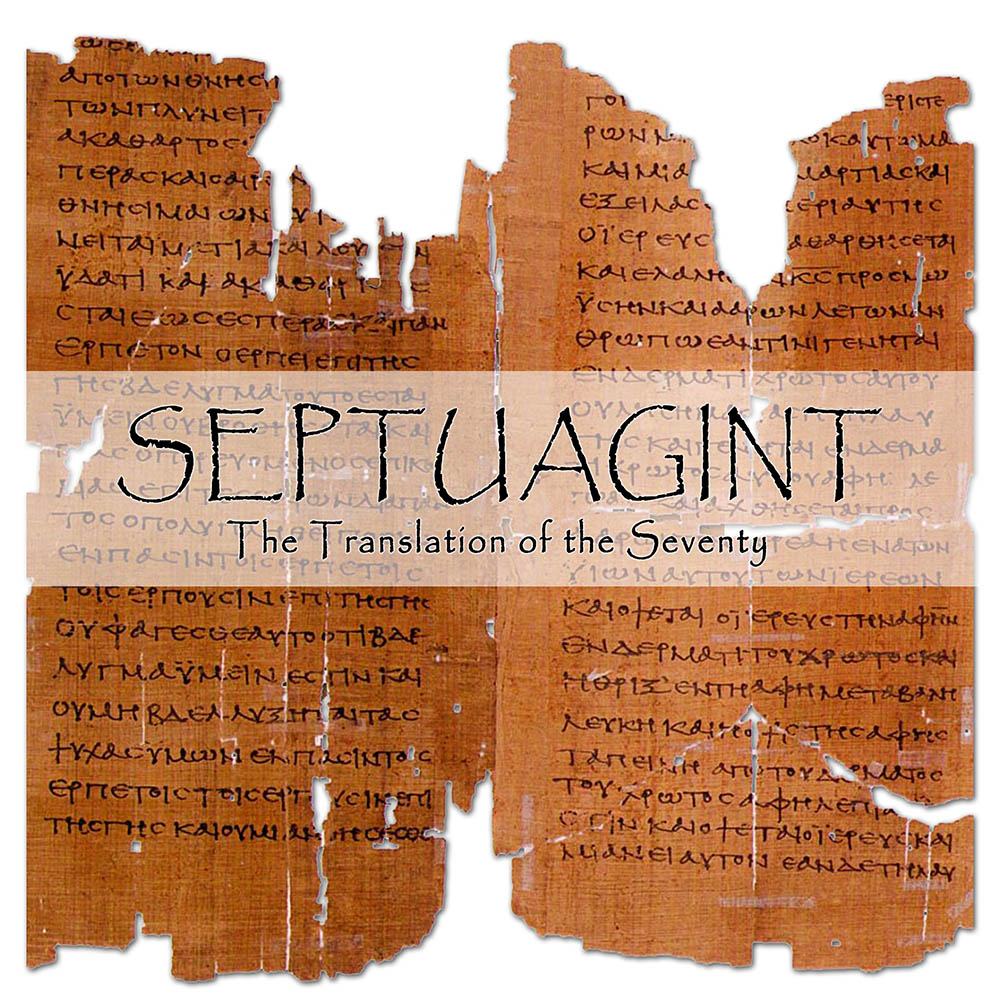
Here is a direct side-by-side comparison of the Masoretic Text with the LXX. I have concluded that the LXX is much to be preferred over the Masoretic Text, a position from which the Eastern Orthodox Church never deviated. Perhaps, if you take the time to read my comparisons and other articles, you will arrive at the same conclusion.
The Septuagint version I am using is the Lexham English Septuagint 2nd Edition, which is available in print or as part of Logos Bible Software. Occasionally I also use the Brenton translation of the LXX for insight into difficult passages.
If you want to know more, click on the following links.
- Why Christians Should Prefer the Septuagint over the Masoretic Text.
- Some Insights Gained through Comparing the Masoretic Text to the Septuagint
- More side by side comparisons of the Masoretic Text (MT) to the Septuagint (LXX).
| Masoretic Text | Septuagint | Significance |
|
1 In that day the LORD with His severe sword, great and strong, Will punish Leviathan the fleeing serpent, Leviathan that twisted serpent; And He will slay the reptile that is in the sea. Isaiah 27:1 (NKJV) |
1 On that day God will bring the holy and great and mighty sword against the dragon, a fleeing serpent, against the dragon, a twisted serpent; he will slay the dragon. Isaiah 27:1 (LES2) |
The MT calls the sword of God “severe,” but the LXX says it is “holy.” I think it is the “sword of the Lord” mentioned in the New Testament, which is the Word of God (Hebrews 4:12, Ephesians 6:17) coming forth from the mouth of the Lord Jesus. (Revelation 2:16) The MT identifies the great foe of the Lord as Leviathan, which in Hebrew means serpent, sea monster, or dragon. The LXX simply says it is the dragon, a fleeing, twisted serpent, which is easily identified with Satan. 9 So the great dragon was cast out, that serpent of old, called the Devil and Satan, who deceives the whole world; he was cast to the earth, and his angels were cast out with him. 10 Then I heard a loud voice saying in heaven, “Now salvation, and strength, and the kingdom of our God, and the power of His Christ have come, for the accuser of our brethren, who accused them before our God day and night, has been cast down. Revelation 12:9–10 (NKJV) Satan is identified with a serpent in Genesis 3:1 and 2 Corinthians 11:3. Jesus said he saw Satan fall from heaven like lightning (Luke 10:18), which likely refers to the passage in Revelation 12. Eventually the dragon will be slain and cast into the lake of fire. (Revelation 20:10) Apparently, the church will have a role to play in this event. (Romans 16:20) |
|
2 In that day sing to her, “A vineyard of red wine! 3 I, the LORD, keep it, I water it every moment; Lest any hurt it, I keep it night and day. 4 Fury is not in Me. Who would set briers and thorns Against Me in battle? I would go through them, I would burn them together. 5 Or let him take hold of My strength, That he may make peace with Me; And he shall make peace with Me.” Isaiah 27:2–5 (NKJV) |
2 On that day a beautiful vineyard; a desire to begin with it. 3 I am a fortified city, a besieged city; I will water it pointlessly, for it will be captured by night, and by day the wall will fall. 4 There is no city that did not seize it. Who will assign me to guard a stalk in a field? I assigned it because of this warring city. Accordingly, because of this, the Lord did all that he ordained. I have been burned up. 5 Those who dwell in it will cry out, “Let us make peace!” Isaiah 27:2–5 (LES2) |
Here is where the MT parts ways from the LXX, apparently intending to blunt the severity of God’s judgment against Israel, which it often does. For example, the MT says that the Lord will keep and water the vineyard, meaning Israel, “lest any hurt it.” The LXX says, “I will water it pointlessly, for it will be captured.” |
|
6 Those who come He shall cause to take root in Jacob; Israel shall blossom and bud, And fill the face of the world with fruit. 7 Has He struck Israel as He struck those who struck him? Or has He been slain according to the slaughter of those who were slain by Him? 8 In measure, by sending it away, You contended with it. He removes it by His rough wind In the day of the east wind. 9 Therefore by this the iniquity of Jacob will be covered; And this is all the fruit of taking away his sin: When he makes all the stones of the altar Like chalkstones that are beaten to dust, Wooden images and incense altars shall not stand. Isaiah 27:6–9 (NKJV) |
6 Those who come are children of Jacob; Israel will sprout and bloom, and the inhabited world will be filled with his fruit. 7 Would he also be struck just as he himself struck? And would he be slain just as he himself slayed? 8 Fighting and reproaching, he will send them away. Were you not trying by the harsh wind to slay them with a wind of wrath? 9 Because of this, the lawlessness of Jacob will be taken away. And this is his praise: When I take away his sin, when they make all the stones of the altars broken up like fine dust, and surely their trees will not remain, and their idols will be cut out just like a forest far away. Isaiah 27:6–9 (LES2) |
Verse 6 is a reference to the church, those who are born of God by the Spirit and are the true children of Abraham. (Galatians 3:26-28) Those among the Jews who rejected Christ “will be sent away.” (verse 8) Verse 9 returns to the New Covenant, saying that God will be praised by those who believe the gospel, which announces Christ’s taking away our sins. The eventual judgment of Jerusalem in 70 AD will “make all the stones of the altars like fine dust.” The trees will be cut down, as happened during that momentous siege. Titus ordered the systematic destruction of the surrounding environment to facilitate the Roman military operation. According to historical records, including the accounts preserved from the period, the Roman legions cut down all trees within a radius of 90 stadia—approximately fifteen kilometers—of the city.This scorched-earth policy transformed the once-fertile landscape around Jerusalem into a barren, desolate space, marking the final stages of the city’s destruction and the fulfillment of the encirclement that preceded the breach of the walls. [Gab AI] |
|
10 Yet the fortified city will be desolate, The habitation forsaken and left like a wilderness; There the calf will feed, and there it will lie down And consume its branches. 11 When its boughs are withered, they will be broken off; The women come and set them on fire. For it is a people of no understanding; Therefore He who made them will not have mercy on them, And He who formed them will show them no favor. Isaiah 27:10–11 (NKJV) |
10 The inhabited flock will be neglected, like an abandoned flock, and for a long time it will be a pasture, and there they will rest. 11 And after some time there will be nothing green in it, because it will be dried up. Women who come from a spectacle, come! For there is no people that has intelligence. Because of this, the one who made them will surely not have pity, and the one who formed them will surely not show mercy. Isaiah 27:10–11 (LES2) |
Another way to translate the LXX is “The flock that lived there will be left, like an abandoned flock.” Jerusalem will be left desolate after the Babylonian deportation and after 70 AD. God would have no pity or mercy. |
|
12 And it shall come to pass in that day That the LORD will thresh, From the channel of the River to the Brook of Egypt; And you will be gathered one by one, O you children of Israel. Isaiah 27:12 (NKJV) |
12 And this will happen on that day: God will fence in the people from the channel of the river as far as the Rhinokorura. But as for you, gather the sons of Israel one by one. Isaiah 27:12 (LES2) |
I am not sure how to interpret the first part of verse 12, but I understand the last part to mean that God will save a remnant. |
|
13 So it shall be in that day: The great trumpet will be blown; They will come, who are about to perish in the land of Assyria, And they who are outcasts in the land of Egypt, And shall worship the LORD in the holy mount at Jerusalem. Isaiah 27:13 (NKJV) |
13 And this will happen on that day: they will trumpet with the great trumpet, and those who have been destroyed in the territory of the Assyrians and those who have been destroyed in Egypt will come and bow down before the Lord on the holy mountain, Jerusalem. Isaiah 27:13 (LES2) |
One day every knee will bow and every tongue confess that Jesus is Lord. (Romans 14:11, Philippians 2:10) |
Summary: This chapter is a sad example of the MT’s propensity to hide the severity of God’s judgment against Israel and the glorious New Covenant.