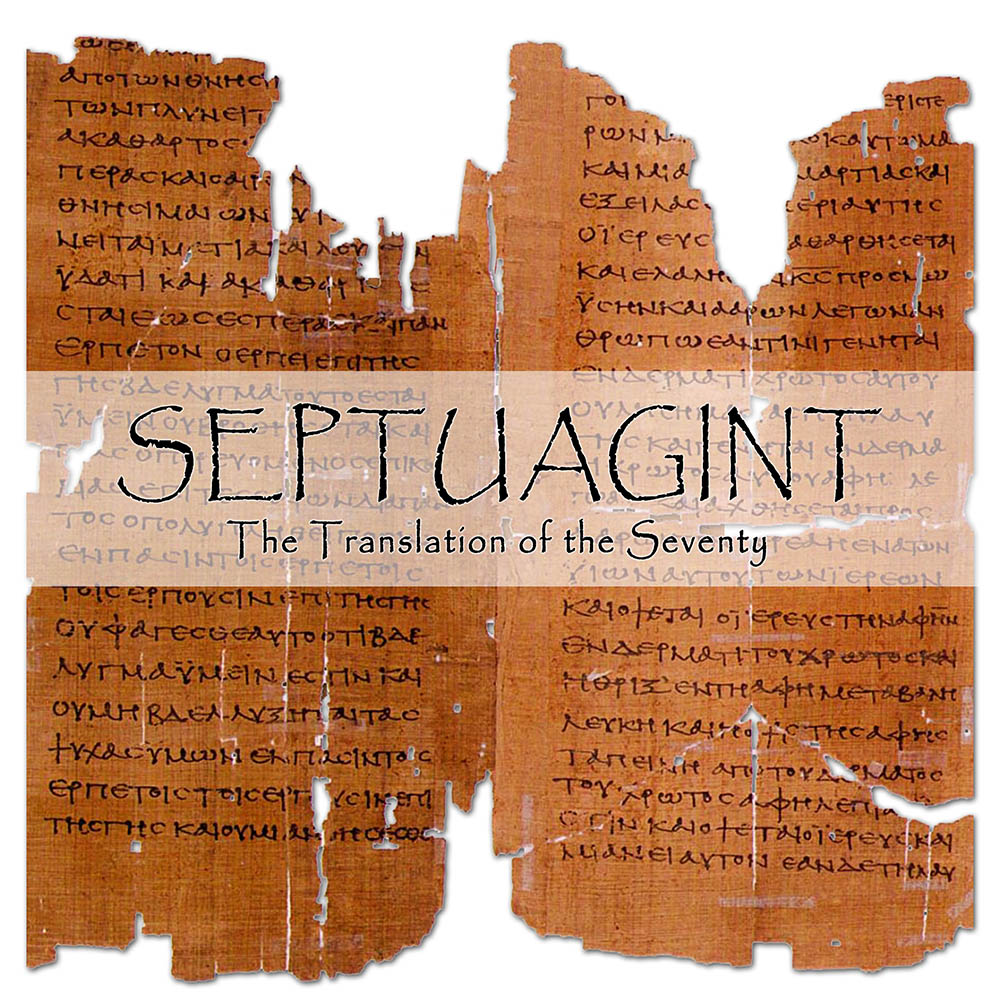
Here is a direct side-by-side comparison of the Masoretic Text (MT) with the Septuagint (LXX). I have concluded that the LXX is much to be preferred over the Masoretic Text, a position from which the Eastern Orthodox Church never deviated. Perhaps, if you take the time to read my comparisons and other articles, you will arrive at the same conclusion.
The Septuagint version I am using is the Lexham English Septuagint 2nd Edition, which is available in print or as part of Logos Bible Software. Occasionally I also use the Brenton translation of the LXX for insight into difficult passages.
If you want to know more, click on the following links.
- Why Christians Should Prefer the Septuagint over the Masoretic Text.
- Some Insights Gained through Comparing the Masoretic Text to the Septuagint
- More side by side comparisons of the Masoretic Text (MT) to the Septuagint (LXX).
| Masoretic Text | Septuagint | Significance |
|
A Meditation Concerning the Words of Cush, a Benjamite. 1 O LORD my God, in You I put my trust; Save me from all those who persecute me; And deliver me, 2 Lest they tear me like a lion, Rending me in pieces, while there is none to deliver. Psalm 7:title–2 (NKJV) |
1 A PSALM OF DAVID, WHICH HE SANG TO THE LORD CONCERNING THE WORDS OF HUSHAI, A BENJAMITE. 2 O Lord, my God, in you I placed my hope. Save me from all those pursuing me and rescue me, 3 lest he snatch my soul as a lion while there is no one to redeem nor to save. Psalm 7:1–3 (LES2) |
David had a counselor and friend named Hushai, but he was an Archite. We do not know who this person was. The LXX indicates that David is being pursued, not simply persecuted. This fits with what we know about David’s being hunted down by Saul. To me, the phrase in the LXX, “lest he snatch my soul as a lion,” is more gripping than what is written in the MT, “lest he tear me like a lion, rending me in pieces.” The last bit of that seems like a editorial insertion. The MT simply says, “there is none to deliver,” but the LXX says, “there is no one to redeem or save.” Both verbs, redeem and save, are closely linked to the New Testament’s description of what Christ accomplished for us. |
|
3 O LORD my God, if I have done this: If there is iniquity in my hands, 4 If I have repaid evil to him who was at peace with me, Or have plundered my enemy without cause, 5 Let the enemy pursue me and overtake me; Yes, let him trample my life to the earth, And lay my honor in the dust. Selah Psalm 7:3–5 (NKJV) |
4 O Lord, my God, if I did this, if there is injustice in my hands, 5 if I returned evil to those repaying good to me, may I then perish empty from my enemies. 6 Therefore let the enemy pursue my soul, and let him seize it, and let him trample my life to the earth, and let him cause my glory to dwell in the dust. Psalm 7:4–6 (LES2) |
The meaning of various words in this passage are quite different. Iniquity is different from injustice. “Him who was at peace with me” is different from “those repaying good to me.” The end of verse 5 has David saying that if he is guilty, “may I then perish empty from my enemies.” The MT, on the other hand, adds another potential offense, “or have plundered my enemies without cause.” Verse 6 in the MT says, “Let the enemy pursue and overtake me,” but the LXX says it with more “oomph,” – “Let the enemy pursue my soul and let him seize it.” |
|
6 Arise, O LORD, in Your anger; Lift Yourself up because of the rage of my enemies; Rise up for me to the judgment You have commanded! 7 So the congregation of the peoples shall surround You; For their sakes, therefore, return on high. 8 The LORD shall judge the peoples; Judge me, O LORD, according to my righteousness, And according to my integrity within me. Psalm 7:6–8 (NKJV) |
7 Rise up, O Lord, in your wrath. Be lifted high among the boundaries of my enemies. Awake, O Lord, my God, with the command that you ordered. 8 And the gathering of the people will surround you and return for this into the heights. 9 The Lord will judge the peoples. Judge me, O Lord, according to my righteousness and according to my innocence in me. Psalm 7:7–9 (LES2) |
There is quite a difference between “rage’ and “boundaries.” David boldly asks God to act and to judge, trusting that he is innocent. I think that verse 8 was difficult to translate from Phoenician Paleo-Hebrew into both Aramaic-based Hebrew and into Greek. |
|
9 Oh, let the wickedness of the wicked come to an end, But establish the just; For the righteous God tests the hearts and minds. 10 My defense is of God, Who saves the upright in heart. Psalm 7:9–10 (NKJV) |
10 Let the wickedness of the sinners indeed be ended. And make straight the righteous one by examining hearts and minds, O God. 11 My help is righteous from God, who saves those who are right in their heart. Psalm 7:10–11 (LES2) |
The wording is different, but the thought is the same. |
|
11 God is a just judge, And God is angry with the wicked every day. 12 If he does not turn back, He will sharpen His sword; He bends His bow and makes it ready. 13 He also prepares for Himself instruments of death; He makes His arrows into fiery shafts. Psalm 7:11–13 (NKJV) |
12 God is a righteous judge, and strong and longsuffering, not bringing wrath each and every day. 13 If you do not repent, he will polish and make ready his large sword. He stretched out his bow and prepared it. 14 And with it he prepared an implement of death; he completed his arrows against those burning ones. Psalm 7:12–14 (LES2) |
The MT omits the phrase describing God as “strong and longsuffering.” The MT says that “God is angry with the wicked every day,” but the LXX says that God is “not bringing wrath each and every day.” Hmmm. Next, the MT says that if God does not repent, he will take vengeance, but the LXX says, “if you do not repent, he will…,” meaning the responsibility to repent is on us. The MT probably got the meaning right on the last part of the last verse. |
|
14 Behold, the wicked brings forth iniquity; Yes, he conceives trouble and brings forth falsehood. 15 He made a pit and dug it out, And has fallen into the ditch which he made. 16 His trouble shall return upon his own head, And his violent dealing shall come down on his own crown. Psalm 7:14–16 (NKJV) |
15 Look, he labored and produced lawlessness; he conceived toil and fathered injustice. 16 He dug a pit, and he dug it up, and he will fall into the hole that he made. 17 His labor will return unto his head, and his injustice will come down on the top of his head. Psalm 7:15–17 (LES2) |
These two passages essentially agree. |
|
17 I will praise the LORD according to His righteousness, And will sing praise to the name of the LORD Most High. Psalm 7:17 (NKJV) |
18 I will give thanks to the Lord according to his righteousness, and I will sing to the name of the Lord, the Most High. Psalm 7:18 (LES2) |
This verse agrees. |
Summary: Although the fundamental meaning of the psalm is in agreement between the MT and LXX, several words and phrases are different. Some passages must have been difficult to translate, which could be the reason for the divergence, but other passages illustrate what is common with the MT. Occasionally the meaning is opposite; such as when the MT says God is angry every day, but the LXX says the opposite. I think these things matter. One has to decide which version to accept. I have decided to go with the LXX for reasons already mentioned.