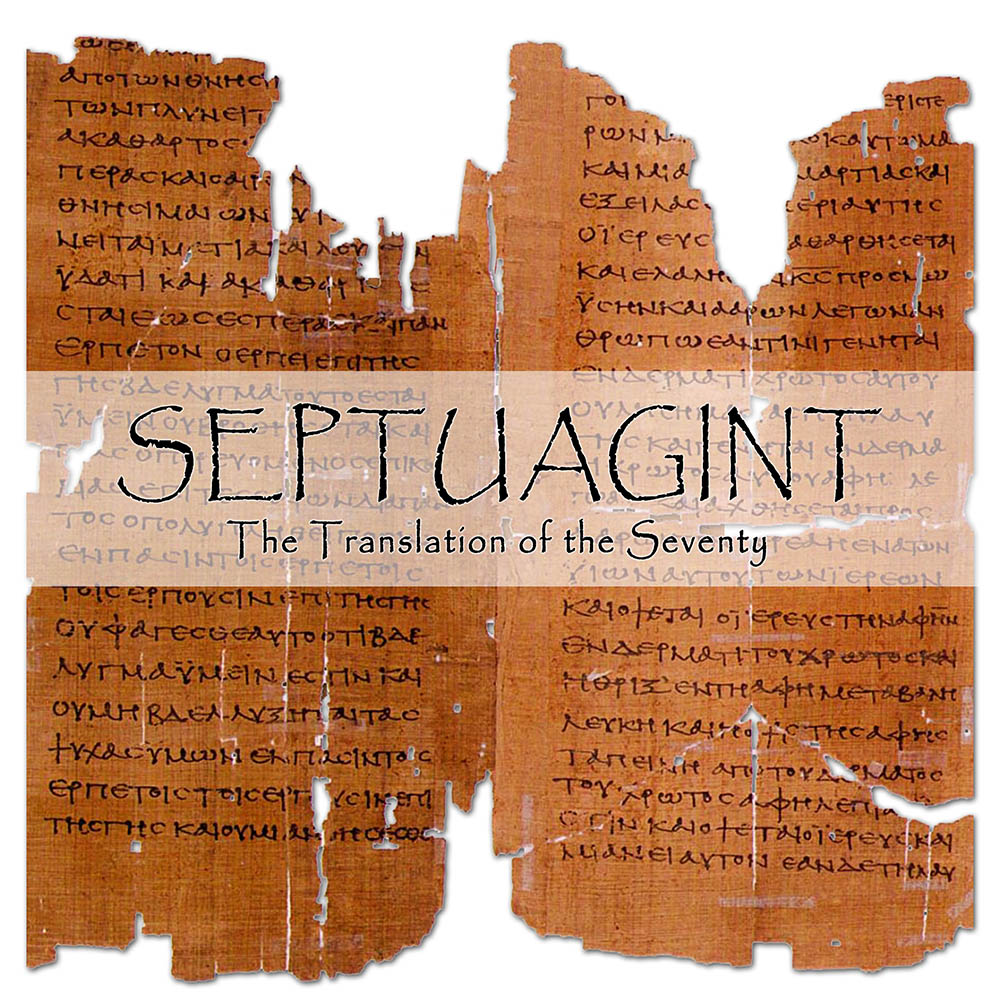
Here is a direct side-by-side comparison of the Masoretic Text with the LXX. I have concluded that the LXX is much to be preferred over the Masoretic Text, a position from which the Eastern Orthodox Church never deviated. Perhaps, if you take the time to read my comparisons and other articles, you will arrive at the same conclusion.
The Septuagint version I am using is the Lexham English Septuagint 2nd Edition, which is available in print or as part of Logos Bible Software. Occasionally I also use the Brenton translation of the LXX for insight into difficult passages.
If you want to know more, click on the following links.
- Why Christians Should Prefer the Septuagint over the Masoretic Text.
- Some Insights Gained through Comparing the Masoretic Text to the Septuagint
- More side by side comparisons of the Masoretic Text (MT) to the Septuagint (LXX).
| Masoretic Text | Septuagint | Significance |
|
1 In the year that King Uzziah died, I saw the Lord sitting on a throne, high and lifted up, and the train of His robe filled the temple. 2 Above it stood seraphim; each one had six wings: with two he covered his face, with two he covered his feet, and with two he flew. 3 And one cried to another and said: “Holy, holy, holy is the LORD of hosts; The whole earth is full of His glory!” Isaiah 6:1–3 (NKJV) |
1 And this happened in the year when Uzziah the king died: I saw the Lord seated on a high and raised throne, and the building was full of his glory. 2 And seraphim stood around him; each one had six wings, and with two they were covering their face, and with two they were covering their feet, and with two they were flying. 3 And one cried aloud to the other, and they were saying, “Holy, holy, holy, is the Lord Sabaoth; the whole land is full of his glory!” Isaiah 6:1–3 (LES2) |
John 12:41 reveals that Isaiah’s vision in this chapter is of the Lord Jesus. This is not surprising since all of the Bible points to Christ. (John 5:39) The LXX does not mention any robe, only the Lord, his throne, and his glory. No temple is mentioned either, but a house. The MT says the seraphim stood above him, but the LXX says they stood around him. They cried out, “Holy, holy, holy,” which some believe is a reference to Father, Son, and Holy Spirit. They also announced that the entire earth (ge) is filled with God’s glory. If only our eyes were opened fully to this marvelous reality! |
|
4 And the posts of the door were shaken by the voice of him who cried out, and the house was filled with smoke. 5 So I said: “Woe is me, for I am undone! Because I am a man of unclean lips, And I dwell in the midst of a people of unclean lips; For my eyes have seen the King, The LORD of hosts.” Isaiah 6:4–5 (NKJV) |
4 And the lintel was lifted because of the sound that they were shouting, and the building filled with smoke. 5 And I said, “Oh, I am wretched, because I am pierced; for I live in the middle of a people having impure lips, being a person and having impure lips, and I have seen the king, the Lord Sabaoth, with my eyes!” Isaiah 6:4–5 (LES2) |
In the experience of the shaking and smoke-filled glory, Isaiah literally said, “I am suffering because I am pierced [in my heart].” This was because he was aware of his sin and that of his people while at the same time beholding king Jesus. |
|
6 Then one of the seraphim flew to me, having in his hand a live coal which he had taken with the tongs from the altar. 7 And he touched my mouth with it, and said: “Behold, this has touched your lips; Your iniquity is taken away, And your sin purged.” Isaiah 6:6–7 (NKJV) |
6 And one of the seraphim was sent to me, and in its hand it was holding a coal that it took with a holder from the altar. 7 And it touched my mouth and said, “Look, this has touched your lips and will take away your transgressions and will purge away your sins.” Isaiah 6:6–7 (LES2) |
The MT says a seraphim flew to Isaiah, but the LXX said God sent it to him. Much better. The MT said the live coal took away his sin, but the LXX says it will take it away, pointing to the future sacrifice Jesus would make. Verb tenses matter. |
|
8 Also I heard the voice of the Lord, saying: “Whom shall I send, And who will go for Us?” Then I said, “Here am I! Send me.” Isaiah 6:8 (NKJV) |
8 And I heard the voice of the Lord saying, “Whom shall I send, and who will go to this people?” And I said, “Look, I am here; send me!” Isaiah 6:8 (LES2) |
The MT says, “Who will go for us,” but the LXX says, “who will go to this people.” The missionary apostolic call to go make disciples is given to God’s blood-bought people. When we truly encounter God and his grace, our response will be, “Send me.” |
|
9 And He said, “Go, and tell this people: ‘Keep on hearing, but do not understand; Keep on seeing, but do not perceive.’ 10 “Make the heart of this people dull, And their ears heavy, And shut their eyes; Lest they see with their eyes, And hear with their ears, And understand with their heart, And return and be healed.” Isaiah 6:9–10 (NKJV) |
9 And he said, “Go and say to this people, ‘You will hear by hearing and not understand; and although looking, you will look and not see.’ 10 For the heart of this people has been thickened; and they have heard heavily with their ears, and they closed their eyes in case they see with their eyes and hear with their ears and understand with their heart and turn, and I will heal them.” Isaiah 6:9–10 (LES2) |
God called Isaiah and Christ’s disciples to take the good news to people who are spiritually blind and deaf. Jesus quoted this verse. 13 Therefore I speak to them in parables, because seeing they do not see, and hearing they do not hear, nor do they understand. 14 And in them the prophecy of Isaiah is fulfilled, which says: ‘Hearing you will hear and shall not understand, And seeing you will see and not perceive; 15 For the hearts of this people have grown dull. Their ears are hard of hearing, And their eyes they have closed, Lest they should see with their eyes and hear with their ears, Lest they should understand with their hearts and turn, So that I should heal them.’ Matthew 13:13–15 (NKJV) The quote in Matthew is almost 100% verbatim compared to Isaiah. The Jewish people, for the most part, were and are blind and deaf to the reality of Jesus’ being the Messiah. |
|
11 Then I said, “Lord, how long?” And He answered: “Until the cities are laid waste and without inhabitant, The houses are without a man, The land is utterly desolate, 12 The LORD has removed men far away, And the forsaken places are many in the midst of the land. 13 But yet a tenth will be in it, And will return and be for consuming, As a terebinth tree or as an oak, Whose stump remains when it is cut down. So the holy seed shall be its stump.” Isaiah 6:11–13 (NKJV) |
11 And I said, “Until when, Lord?” And he said, “Until cities are desolated to the point of not being inhabited and houses to the point of there being no people, and the land will be left deserted.” 12 And after these things God will distance the people, and those left behind will increase on the land. 13 And still the tenth part is on it, and again it will become plunder like a terebinth tree and like an acorn when it falls from its case. Isaiah 6:11–13 (LES2) |
When Isaiah asks how long this blindness will continue, God tells him until the destruction of Jerusalem, which was the final element of Christ’s first coming. It was only when the temple and sacrificial system were destroyed that the veil came off God’s new covenant people, and we saw more clearly the glory of what God has done in Christ. The MT adds something to the end of verse 13 to make it sound as if the nation of Israel will be somehow restored, but that is not in the LXX. The holy seed is Christ (Galatians 3:16), not some remnant of national Israel. Some of the changes made to the MT were designed to prop up the Zionist position that has deceived so many Christians into abandoning a proper understanding of the New Covenant. |