 People love word games. I play Wordle almost every day. Even Bible translators play word games. One of their favorite is called “Translator’s Bias.” The goal of this game, even if it is unconsciously done, is to translate a word in such a fashion that it will obscure its plain meaning in order to guide readers into accepting the translator’s presuppositions. This happens all the time as translators wrestle with the difficult task of how to best communicate the meaning of scripture. The New Living Translation does this on purpose in an attempt to accurately present larger ideas instead of the literal meaning of specific words. Sometimes they hit a home run. At other times they sadly miss the mark, forcing us to turn to a more literal translation to properly understand a passage. It is a sad state of affairs, however, when translations that are supposed to be literal also engage in obfuscation of the text.
The pernicious effect of the Enlightenment has so infiltrated Christianity that we now view and interpret the Word of God through the lens of logic and science.
We have accepted the notion that what is called science is the best explanation of reality available. In so doing, we demand our interpretation of the Bible to conform to what are considered to be unassailable scientific truths or facts. We have capitulated to the devil by elevating reason above revelation.
Genesis Chapter One is a great example of this travesty in action. When Darwin first introduced his theory of biological evolution, it was hailed as a scientific breakthrough by many. Those who adhered to the Bible saw that it was a satanic lie, but over time more and more of those who say they believe the Bible began to accept Darwin’s theory as the truth. As a consequence, interpreters found it necessary to reinterpret the scriptures to fit the new paradigm, coming up with all sort of clever ways to twist the obvious meaning into something that was able to adjust to the new science. The advent of what is called “creation science” gave a scientific footing for those who believe that the Genesis account of biological creation is actually true. Now there are many Christians who can argue scientifically for a young earth and biological creation. Even though worldly scientists scoff at such beliefs, Christians do not feel foolish in arguing for something that has scientific backing.
The same creationists, however, will likely throw out the part of the six day creation that pertains to cosmology because there are so few who deem it scientifically plausible. Most of the time biblical cosmology is scorned and not given the time of day, so to speak. It does not matter that God spoke it. What matters is what does science say. This is a triumph of science over revelation, the word of men over the Word of God.
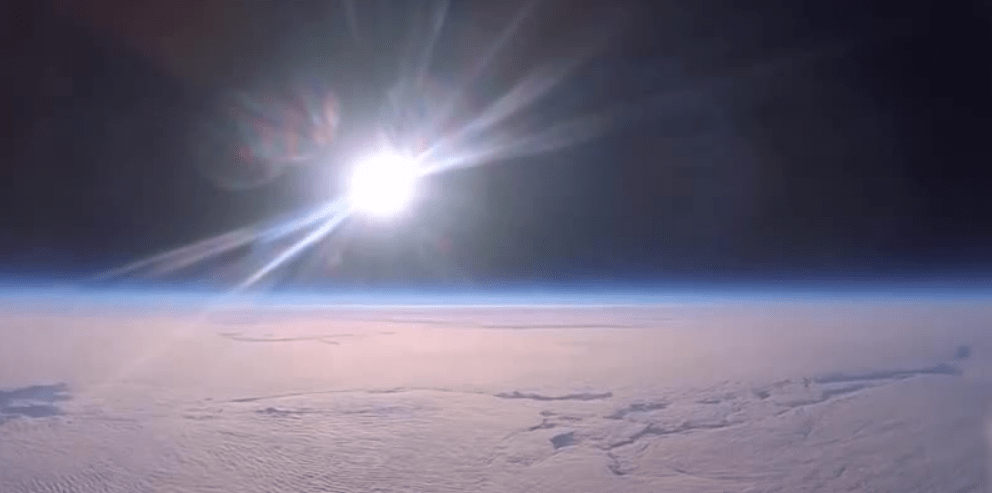
This capitulation to science is revealed in how scholars routinely translate the Hebrew word “raqia” into English. The people who wrote the Bible and lived at that time understood it to mean a solid dome that enclosed the stationary plane of the earth and the seas, separating the waters above from the waters below. (If you want to read more about the raqia, click here.) The KJV and NKJV give us an honest translation by using the word “firmament,” which communicates the idea of solidity. Almost every other version bows the knee to post-Copernican astrophysics by using vague words such as sky or expanse, which are misleading. When God’s Word is twisted to agree with a satanic lie, we have bowed the knee to science falsely so called.
As a result of our capitulation to “science,” most Christians today believe in the heliocentric lie without realizing that it contradicts the Bible and dishonors God. It also renders the entire Bible suspect, if the very first chapter cannot be relied upon to communicate reality.
(If you wish to learn more, I have written another article that focuses on the occult origins of astrophysics.)
This morning I read Psalm 104:3 in my daily devotions, which says that God “lays out the beams of his upper chambers in the waters.” (NKJV) The Hebrew word (aliyyah) translated “upper chambers” could be rendered more literally “roof chambers,” which accurately communicates the concept of the firmament being a roof over the earth, above which is God’s throne. (I wrote another article going into more detail about this place called heaven.)
My notation in the margin next to Psalm 104:3 took me to Amos 9:6.
He who builds His layers [Hebrew: maalah] in the sky, And has founded His strata [Hebrew: aguddah] in the earth; Who calls for the waters of the sea, And pours them out on the face of the earth— The LORD is His name. Amos 9:6 (NKJV)
I have numerous Bible translations, but for my daily reading and study I use the NKJV. I switched to this version because it accurately translates raqia as the firmament. It is a fairly good translation, but I like the NASB the best. In this instance, the NKJV let me down. The Hebrew word it renders as “layers” (maalah) communicates little of the literal meaning, which the NASB better translates “upper chambers,” which corresponds to Psalm 104:3.
Below is the NASB rendering of the verse in Amos.
The One who builds His upper chambers in the heavens And has founded His vaulted dome [aguddah] over the earth, He who calls for the waters of the sea And pours them out on the face of the earth, The LORD is His name. Amos 9:6 (NASB95)
I suppose you noticed how differently the NASB translated the Hebrew word “aguddah.” The literal meaning is bands, thongs, slavery fetters, or bunch (as a bunch of hyssop). Why then did the NASB translate this “vaulted dome?”
We are told in Genesis that another term for firmament is heaven. (Genesis 1:8) We are also told that heaven has multiple layers called “the heavens.” God apparently dwells in the third heaven. (2 Corinthians 12:2) We know so little about the heavens that it is quite probable that the first heaven, our atmos has multiple layers. We are still discovering what has been deliberately obfuscated by so-called scientists for centuries. So, we see that translating aguddah as vaulted dome is consistent with other scriptures, but is not a literal rendering. Here we seem to have translator’s bias in support of biblical cosmology, instead of against it as usually happens.
When we interpret the Word of God, it is important that we allow it to speak for itself instead of twisting its meaning to fit a preferred paradigm. Let us not resort to word games as we search for truth, even if that search leads us away from long cherished presuppositions.
Click here to go to series home page.