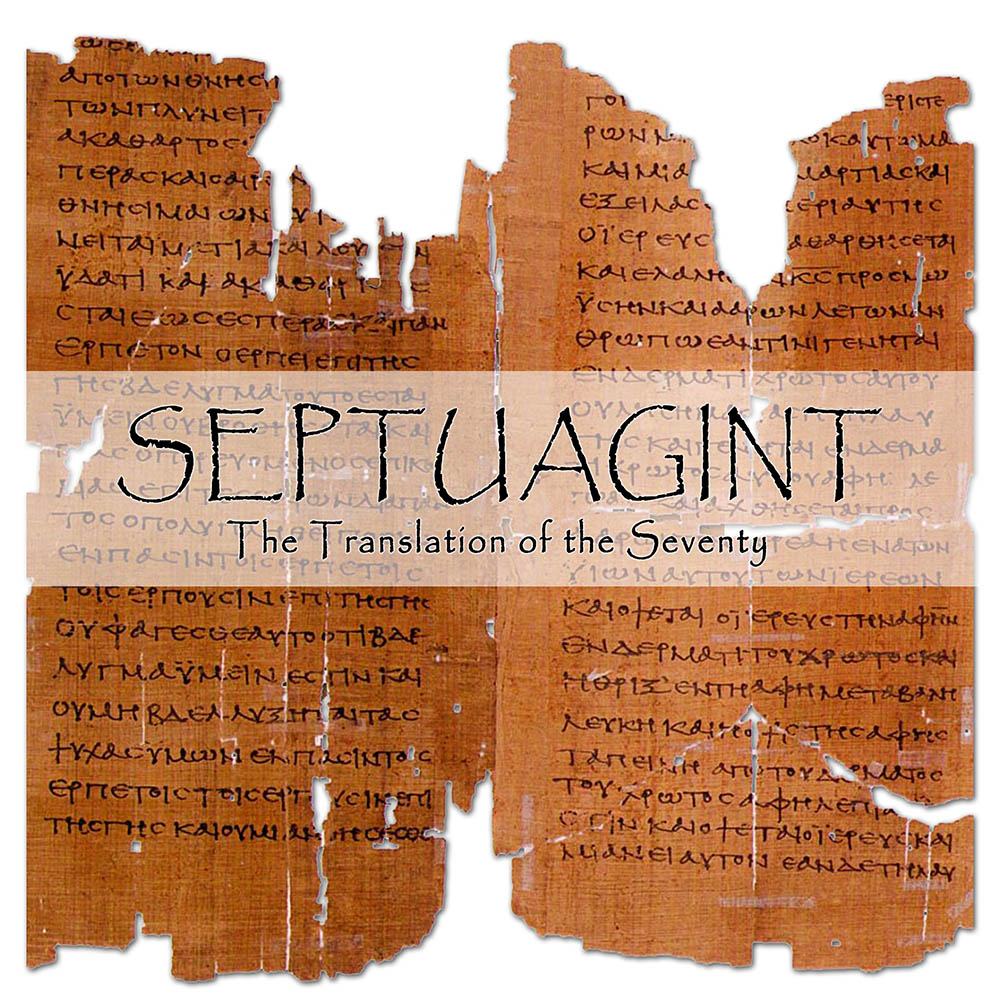
Here is a direct side-by-side comparison of the Masoretic Text with the LXX. I have concluded that the LXX is much to be preferred over the Masoretic Text, a position from which the Eastern Orthodox Church never deviated. Perhaps, if you take the time to read my comparisons and other articles, you will arrive at the same conclusion.
The Septuagint version I am using is the Lexham English Septuagint 2nd Edition, which is available in print or as part of Logos Bible Software. Occasionally I also use the Brenton translation of the LXX for insight into difficult passages.
If you want to know more, click on the following links.
- Why Christians Should Prefer the Septuagint over the Masoretic Text.
- Some Insights Gained through Comparing the Masoretic Text to the Septuagint
- More side by side comparisons of the Masoretic Text (MT) to the Septuagint (LXX).
| Masoretic Text | Septuagint | Significance |
|
1 “Hear this, O house of Jacob, who are named Israel And who came forth from the loins of Judah, Who swear by the name of the LORD And invoke the God of Israel, But not in truth nor in righteousness. 2 “For they call themselves after the holy city And lean on the God of Israel; The LORD of hosts is His name. Isaiah 48:1–2 (NASB95) |
1 Listen to these things, house of Jacob, who are called by the name of Israel and have come out from Judah, who swear by the name of the Lord God of Israel, who remember without truth and without righteousness, 2 and who cleave to the name of the holy city and who lean on the God of Israel; the Lord Sabaoth is his name. Isaiah 48:1–2 (LES2) |
The passage agrees. The Hebrew word in the MT that is translated “call upon” in verse 2 literally means “remember,” which agrees with the LXX. |
|
3 “I declared the former things long ago And they went forth from My mouth, and I proclaimed them. Suddenly I acted, and they came to pass. 4 “Because I know that you are obstinate, And your neck is an iron sinew And your forehead bronze, Isaiah 48:3–4 (NASB95) |
3 I still declared the former things, and it went out from my mouth and was heard. I acted suddenly and it came about. 4 I know that you are hard and your neck is an iron sinew and your forehead is brass. Isaiah 48:3–4 (LES2) |
In verse 3, “proclaimed” in the MT literally means “heard,” which agrees with the LXX. The passage agrees. |
|
5 Therefore I declared them to you long ago, Before they took place I proclaimed them to you, So that you would not say, ‘My idol has done them, And my graven image and my molten image have commanded them.’ 6 “You have heard; look at all this. And you, will you not declare it? I proclaim to you new things from this time, Even hidden things which you have not known. 7 “They are created now and not long ago; And before today you have not heard them, So that you will not say, ‘Behold, I knew them.’ Isaiah 48:5–7 (NASB95) |
5 And I declared old things to you before they came upon you; I made them heard by you, lest you say, “The idols did it for me” or say, “The graven and molten images have commanded me.” 6 You have heard everything, and you have not perceived; but I have made new things from the present time heard by you, which are about to happen, and you did not speak. 7 It is happening now, not long ago; you did not hear these things in former days. Do not say, “Indeed, I know these things.” Isaiah 48:5–7 (LES2) |
The MT departs from the LXX in verse 6. The LXX says that Israel has not “perceived” (seen and understood) the new things which are about to happen. When Christ came to establish the New Covenant, it was something entirely new and unknown before. The Jews, except for the believing remnant, did not perceive or receive Christ or the gospel of the New Covenant. (John 1:11) |
|
8 “You have not heard, you have not known. Even from long ago your ear has not been open, Because I knew that you would deal very treacherously; And you have been called a rebel from birth. 9 “For the sake of My name I delay My wrath, And for My praise I restrain it for you, In order not to cut you off. Isaiah 48:8–9 (NASB95) |
8 You have not perceived or known, and I have not opened your ears from the beginning, for I knew that rebelling, you would rebel, and you will be called wicked even from the belly. 9 For the sake of my name I will show my wrath to you, and I will bring my glorious deeds upon you, that I might not utterly destroy you. Isaiah 48:8–9 (LES2) |
This passage agrees with Stephen’s summation of Israel’s history in Acts 7:51 and Paul’s in 1 Thessalonians 2:15-16. Natural Israel, due to the fallen nature of mankind, could not possibly please God, something that can only be done by faith. (Hebrews 11:6) Israel’s and all mankind’s fallen nature always produces a rebellious attitude toward God which invites his judgment. Only those who believe in Christ are saved. In verse 9, the MT says that God will delay his judgment, but the LXX says God will “show my wrath,” which indeed happened when Babylon destroyed Jerusalem and the temple, a foreshadowing of the later destruction in 70 AD by the Romans. In God’s mercy, he did not utterly destroy the Jewish people. A remnant continues to be saved. This remnant is beloved for the sake of the fathers. (Romans 11:28) |
|
10 “Behold, I have refined you, but not as silver; I have tested you in the furnace of affliction. 11 “For My own sake, for My own sake, I will act; For how can My name be profaned? And My glory I will not give to another. Isaiah 48:10–11 (NASB95) |
10 Look! I have not sold you for silver, but I have rescued you from the furnace of poverty. 11 For my sake I will act for you, because my name is being profaned, and I will not give my glory to another. Isaiah 48:10–11 (LES2) |
Verse 10 in the MT does not resemble the LXX. Verse 11 basically agrees. |
|
12 “Listen to Me, O Jacob, even Israel whom I called; I am He, I am the first, I am also the last. 13 “Surely My hand founded the earth, And My right hand spread out the heavens; When I call to them, they stand together. Isaiah 48:12–13 (NASB95) |
12 Listen to me, Jacob, and Israel whom I call. I am the first, and I am for eternity, 13 and my hand has founded the earth, and my right hand firmed up the heavens. I will summon them, and they will stand at once, Isaiah 48:12–13 (LES2) |
Verse 12 clearly points to Christ, the Alpha and Omega. (Revelation 21:6) Jesus, the eternal Logos, who became a human being (John 1:14), created all things. (John 1:3) In verse 13, the word for “firmed up” in Greek is stereoo, which means to make solid. This is a clear reference to the dome of the firmament, which God created on the second day (Genesis 1:6), the existence of which is flatly denied by modern astrophysics and by many Christians who choose to believe men rather than God. |
|
14 “Assemble, all of you, and listen! Who among them has declared these things? The LORD loves him; he will carry out His good pleasure on Babylon, And His arm will be against the Chaldeans. 15 “I, even I, have spoken; indeed I have called him, I have brought him, and He will make his ways successful. Isaiah 48:14–15 (NASB95) |
14 and they all will be gathered and listen. Who has declared these things to them? Loving you, I have carried out your will upon Babylon, to carry away the seed of the Chaldeans. 15 I spoke; I called; I led him and prospered him on his way. Isaiah 48:14–15 (LES2) |
The MT apparently took a difficult passage in the original Paleo-Hebrew and converted into something pro-Israel, as it sometimes does. The LXX’s rendering is difficult to understand. Who is speaking in verse 14, saying, “Loving you, I have carried out your will…” My thinking is that it refers back to the Alpha and Omega in verse 12, our Lord Jesus, in his pre-incarnate state as the divine Logos. The Greek word translated “carry away” literally means “to lift up.” Another way to translate this might be, “I lifted up the seed of the Chaldeans… I led him and prospered him on his way.” |
|
16 “Come near to Me, listen to this: From the first I have not spoken in secret, From the time it took place, I was there. And now the Lord GOD has sent Me, and His Spirit.” 17 Thus says the LORD, your Redeemer, the Holy One of Israel, “I am the LORD your God, who teaches you to profit, Who leads you in the way you should go. Isaiah 48:16–17 (NASB95) |
16 Come to me and hear these things. I have not spoken in secret from the beginning; when it happened, I was there, and now the lord Lord sent me and his spirit away. 17 This is what the Lord who rescues, the Holy One of Israel, says: “I am your God; I have shown you, for you to find the way in which you should walk. Isaiah 48:16–17 (LES2) |
The pre-incarnate Logos appears to continue as the speaker in this passage. He says that God “sent” him (Greek – apostello, from which we derive the word “apostle”). The New Testament says that Jesus is our apostle or sent one. (Hebrews 3:1) If we allow that Jesus is the speaker, we have an affirmation of his divinity in verse 17, which he claimed in John 8:58. Jesus was sent by God to show us the way to the Father. (John 14:6, John 1:18) |
|
18 “If only you had paid attention to My commandments! Then your well-being would have been like a river, And your righteousness like the waves of the sea. 19 “Your descendants would have been like the sand, And your offspring like its grains; Their name would never be cut off or destroyed from My presence.” Isaiah 48:18–19 (NASB95) |
18 And if you had listened to my commandments, your peace would have been like a river, and your righteousness like a wave of the sea; 19 and your offspring would have been like the sand, and those offspring of your belly like the dust of the earth, and now you would not be utterly destroyed, and your name would not perish before me. Isaiah 48:18–19 (LES2) |
In verse 18, Jesus, the pre-incarnate Logos continues to speak. The Jews did not receive Christ when he came in the flesh. (John 1:11). As a result of their not realizing the time of their heavenly visitation (Luke 19:44), great destruction came upon them in 70 AD, just as Jesus said it would (Mark 13:2). Only the remnant escaped, whom Jesus forewarned to flee from the city when they say the Roman army surrounding it. 20 “But when you see Jerusalem surrounded by armies, then know that its desolation is near. 21 Then let those who are in Judea flee to the mountains, let those who are in the midst of her depart, and let not those who are in the country enter her. 22 For these are the days of vengeance, that all things which are written may be fulfilled. Luke 21:20–22 (NKJV) |
|
20 Go forth from Babylon! Flee from the Chaldeans! Declare with the sound of joyful shouting, proclaim this, Send it out to the end of the earth; Say, “The LORD has redeemed His servant Jacob.” 21 They did not thirst when He led them through the deserts. He made the water flow out of the rock for them; He split the rock and the water gushed forth. 22 “There is no peace for the wicked,” says the LORD. Isaiah 48:20–22 (NASB95) |
20 Come out of Babylon; flee from the Chaldeans! Announce it with a sound of cheer and let this be heard! Announce it to the end of the earth, and say, “The Lord has rescued his servant Jacob!” 21 And if they thirst, he will bring them water through the desert; he will bring it out for them from a rock. A rock will split open, and water will flow, and my people will drink. 22 “There is no rejoicing,” says the Lord, “among the ungodly.” Isaiah 48:20–22 (LES2) |
The exodus from Babylon after 70 years of captivity foreshadowed the exodus from Jerusalem by those who were rescued through believing the gospel and were saved from that “perverse generation” (Acts 2:40) which experienced God’s wrath in 70 AD. The rock that was split open in the wilderness was a type of Christ (1 Corinthians 10:4), who became a well of salvation to those who believe in him. (John 7:37-39) Those who reject the gospel will find no joy. |
Summary: It is impossible to properly understand this prophecy unless we see Christ in it, something that is true for the entire Bible.