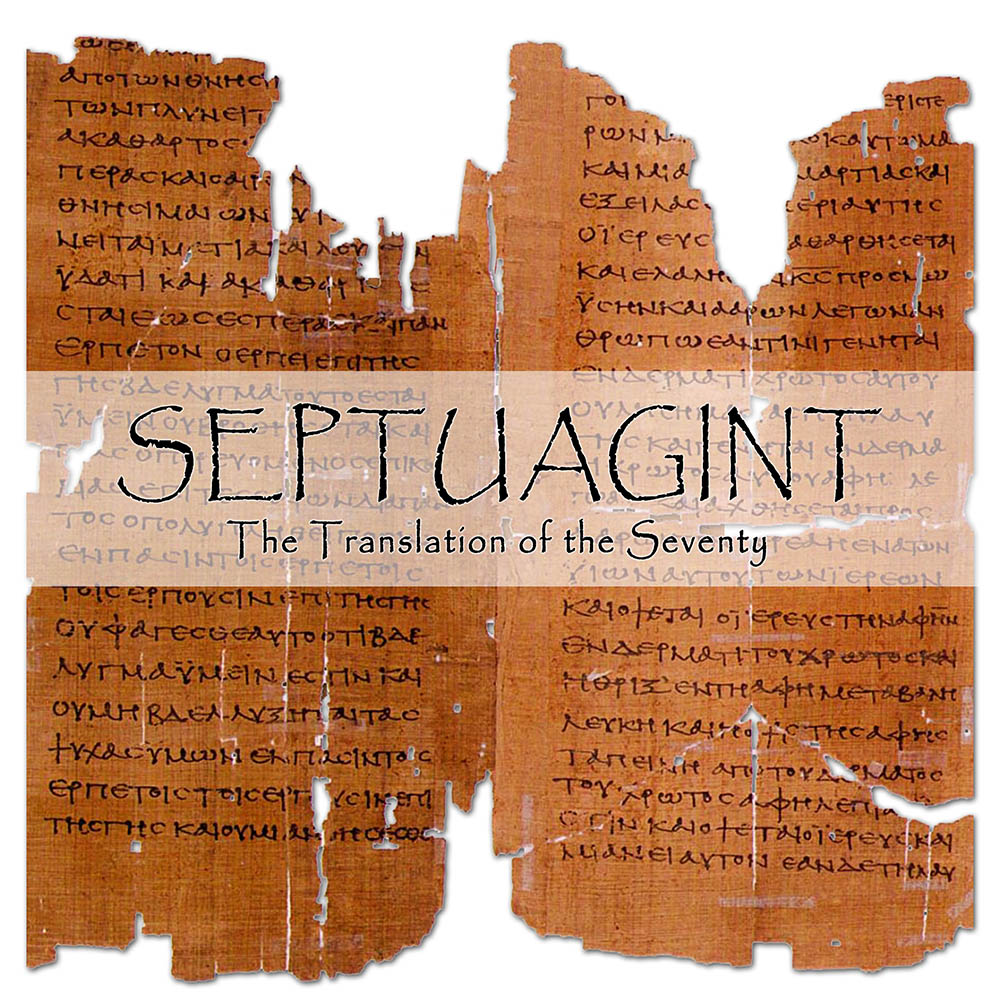
Here is a direct side-by-side comparison of the Masoretic Text with the LXX. I have concluded that the LXX is much to be preferred over the Masoretic Text, a position from which the Eastern Orthodox Church never deviated. Perhaps, if you take the time to read my comparisons and other articles, you will arrive at the same conclusion.
The Septuagint version I am using is the Lexham English Septuagint 2nd Edition, which is available in print or as part of Logos Bible Software. Occasionally I also use the Brenton translation of the LXX for insight into difficult passages.
If you want to know more, click on the following links.
- Why Christians Should Prefer the Septuagint over the Masoretic Text.
- Some Insights Gained through Comparing the Masoretic Text to the Septuagint
- More side by side comparisons of the Masoretic Text (MT) to the Septuagint (LXX).
| Septuagint | MT | Significance |
|
1 After these words, the word of the Lord came to Abram in a vision, saying, “Do not fear, Abram, I am shielding you. Your reward will be very abundant.” Genesis 15:1 (LES2) |
1 After these things the word of the LORD came to Abram in a vision, saying, “Do not be afraid, Abram. I am your shield, your exceedingly great reward.” Genesis 15:1 (NKJV) |
The MT changes “After these words (rhema)” to after these things. This many not seem significant, but any translator who feels free to substitute a different word, perhaps with good intentions, is not a trustworthy servant of God. God said it the way he meant for us to read it. Secondly, the LXX using a present tense verb to describe God’s active protection of Abram and a future tense verb to promise a great reward. This very different from identifying God as permanently being those two things. It has become apparent to me that the MT translators, having been expelled from their ancient land and having no temple, used the MT to lay a theological groundwork for their still being God’s chosen people with a title to the land, something Zionist supported Dispensational Theology would later teach in contradiction to long accepted covenant theology, which gave rise to Christian Zionism and the fusion of US foreign policy with that of modern Israel. |
|
2 Abram said, “Master and Lord, what will you give me? I am departing childless, except for the son of Masek, my house servant, this Eliezer of Damascus.” 3 And Abram said, “Since you have not given to me offspring, my house servant will be my heir.” 4 And at once the voice of the Lord came to him, saying, “This man will not be your heir, rather one who will come from you, he will be your heir. 5 He led him outside and said to him, “Look up now to the heavens and count the stars, if you can count them.” And he said, “Your offspring will be like this.” 6 And Abram trusted God, and it was reckoned to him as righteousness. Genesis 15:2–6 (LES2) |
2 But Abram said, “Lord GOD, what will You give me, seeing I go childless, and the heir of my house is Eliezer of Damascus?” 3 Then Abram said, “Look, You have given me no offspring; indeed one born in my house is my heir!” 4 And behold, the word of the LORD came to him, saying, “This one shall not be your heir, but one who will come from your own body shall be your heir.” 5 Then He brought him outside and said, “Look now toward heaven, and count the stars if you are able to number them.” And He said to him, “So shall your descendants be.” 6 And he believed in the LORD, and He accounted it to him for righteousness. Genesis 15:2–6 (NKJV) |
The first thing we see is how Abram addressed God. The LXX says, “Master (despotes) and Lord (kurios).” The MT uses the Hebrew names Adonai and YHWH, which are never used in the LXX. Some think these names came to be emphasized when the Babylonian occult Kabbalah gained wide acceptance in Rabbinic Judaism, a position it still occupies today in modern Judaism. Jesus taught us to address God as Abba, Father. He gave us no other name. We should beware using MT names for God in my opinion. Secondly, the MT replaces “depart” with “go.” Once again, this seemingly innocuous change reveals a looseness with God’s Word that is not good. Depart emphasizes Abraham’s coming death; whereas, go indicates merely his present status. Also, the MT leaves out Masek’s name for some reason. Thirdly, the MT changes “come from you” to “come from your own body.” Another minor change that, when added together with countless others, makes me increasingly leery of the MT. I am not sure why the MT leaves out the word “up” when God told Abraham to look toward heaven. The Up-Down aspect of theology is significant and is repeated all the way through the New Testament. Perhaps the MT thought it was obvious that “up” was implied, but why leave out a word inspired by the Holy Spirit? In both the LXX and MT, the singular “seed” is translated as descendants, which is translator’s bias in operation. Although, “seed” implies its multiplication into many, the singular aspect of the Word is emphasized by Paul when he wrote that the seed is Christ. (Galatians 3:16) By changing “seed” to “descendants,” it makes it more difficult to see this wonderful Christological truth. Genesis 15:6 is directly quoted by Paul from the LXX in Romans 4:3. Thankfully the MT agrees with the LXX here. |
|
7 And he said to him, “I am the God who brought you out of the territory of Chaldeans to give you this land to inherit.” 8 He said, “Master, Lord, how will I know that I will inherit it?” 9 He said to him, “Bring me a three-year-old heifer and a three-year-old goat and a three-year-old ram and a turtledove and a pigeon.” 10 He brought him all these and divided them down the middle and set them facing one another, but he did not divide the birds. 11 Birds came down on the carcasses, the halves, and Abram sat down with them. 12 About sunset, a trance fell on Abram, and look, a great dark fear fell upon him. 13 And it was said to Abram, “Knowing, you will know that your offspring will be foreign in a land not its own, and they will afflict it, and they will enslave them, and they will humble them for four hundred years. 14 I will judge the nation that they serve; after these things they will come out here with much baggage. 15 You will depart to your ancestors with peace, after growing to a good old age. 16 The fourth generation, they will be brought back here; for the sins of the Amorites have not yet become enough.” Genesis 15:7–16 (LES2) |
7 Then He said to him, “I am the LORD, who brought you out of Ur of the Chaldeans, to give you this land to inherit it.” 8 And he said, “Lord GOD, how shall I know that I will inherit it?” 9 So He said to him, “Bring Me a three-year-old heifer, a three-year-old female goat, a three-year-old ram, a turtledove, and a young pigeon.” 10 Then he brought all these to Him and cut them in two, down the middle, and placed each piece opposite the other; but he did not cut the birds in two. 11 And when the vultures came down on the carcasses, Abram drove them away. 12 Now when the sun was going down, a deep sleep fell upon Abram; and behold, horror and great darkness fell upon him. 13 Then He said to Abram: “Know certainly that your descendants will be strangers in a land that is not theirs, and will serve them, and they will afflict them four hundred years. 14 And also the nation whom they serve I will judge; afterward they shall come out with great possessions. 15 Now as for you, you shall go to your fathers in peace; you shall be buried at a good old age. 16 But in the fourth generation they shall return here, for the iniquity of the Amorites is not yet complete.” Genesis 15:7–16 (NKJV) |
The MT changes “territory” to “Ur.” Once again, as mentioned above, Abram uses “Master” and “Lord” to address God in the LXX, but Adonai and YHVH in the MT. According the New Testament, the approved way of addressing God, according to Christ, is “Abba” or “Father.” Any emphasis on using other Hebrew names for God is likely rooted in the Kabbalah. The passage regarding dividing the animals is essentially the same. In verse 11, the MT departs from the LXX by changing birds to vultures and replacing “Abram sat down with them” to “Abram drove them away.” Once again, we must ask ourselves if making the story sound better justifies changing divinely inspired words. As I get older, I have become more and more concerned with wanting to know exactly what it says. In verse 12, the MT replaces “trance” or ekstasis in Greek with “deep sleep.” They seem like two very different things to me. Ekstasis is the same Greek word used in Acts 10:10 when Peter had the vision of a sheet lowered from heaven. He certainly was not in a “deep sleep.” In verse 13, the MT leaves out “humble them.” Verse 15 changes “growing to a good old age” to “buried at a good old age.” Verse 16 changes “enough” to “complete.” The meaning is very close but not exact. |
|
17 When the sun approached the west, there was a flame and look, a smoking oven and torches of fire that went through between their divided parts. 18 God established a covenant with Abram in that place, saying, “I will give your offspring this land from the river of Egypt to the great Euphrates; 19 the Kenites and the Kenizzites and the Kadmonites 20 and the Hittites and the Perizzites and the Rephaim and the Amorites and the Canaanites and the Euaians and the Girgashites and the Jebusites.” Genesis 15:17–20 (LES2) |
17 And it came to pass, when the sun went down and it was dark, that behold, there appeared a smoking oven and a burning torch that passed between those pieces. 18 On the same day the LORD made a covenant with Abram, saying: “To your descendants I have given this land, from the river of Egypt to the great river, the River Euphrates—19 the Kenites, the Kenezzites, the Kadmonites, 20 the Hittites, the Perizzites, the Rephaim, 21 the Amorites, the Canaanites, the Girgashites, and the Jebusites.” Genesis 15:17–21 (NKJV) |
“The sun approached the west” is different from “the sun went down.” The LXX wording is consistent with biblical cosmology. According to Psalm 19:6, the sun makes a circuit over the earth. The MT leaves out “there was a flame.” Why leave out this mysterious sentence? Just to make the text flow? The MT also changes “torches of fire” to the singular. Why? Preachers have made much over there being a single torch, but according to the LXX there were several. In verse 18, the LXX says that God established a covenant “in that place,” but the MT says “on that day.” Why? The LXX says that God “will give your seed this land,” meaning it will eventually belong to Jesus, the promised one. The MT changes that to “have given,” which promotes the idea of a permanent possession, a dear claim for Zionists who want us to believe that Palestine still belongs to biological descendants of Abraham rather than to the seed, Christ. (Read “Five Ways Dispensationalism Opposes the New Covenant.”) |