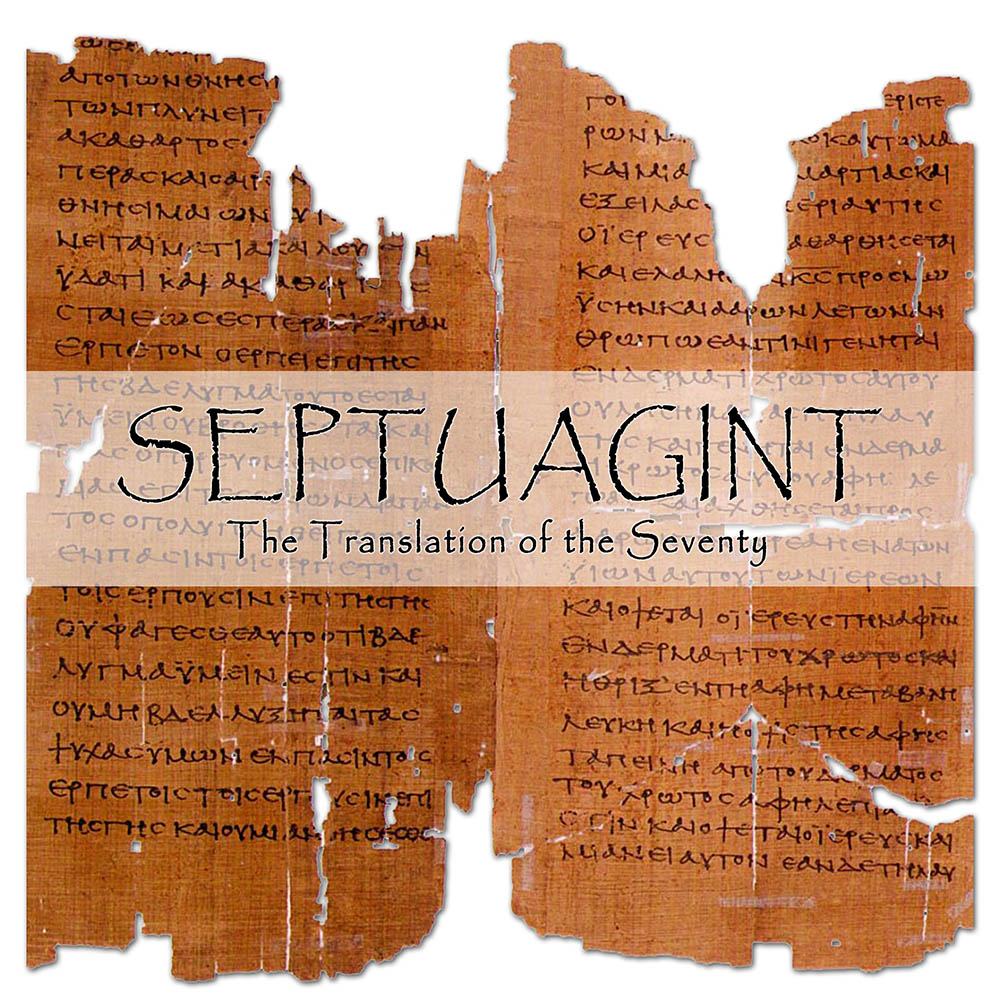
Here is a direct side-by-side comparison of the Masoretic Text with the LXX. I have concluded that the LXX is much to be preferred over the Masoretic Text, a position from which the Eastern Orthodox Church never deviated. Perhaps, if you take the time to read my comparisons and other articles, you will arrive at the same conclusion.
The Septuagint version I am using is the Lexham English Septuagint 2nd Edition, which is available in print or as part of Logos Bible Software. Occasionally I also use the Brenton translation of the LXX for insight into difficult passages.
If you want to know more, click on the following links.
- Why Christians Should Prefer the Septuagint over the Masoretic Text.
- Some Insights Gained through Comparing the Masoretic Text to the Septuagint
- More side by side comparisons of the Masoretic Text (MT) to the Septuagint (LXX).
| Masoretic Text | Septuagint | Significance |
|
1 “Behold, My Servant, whom I uphold; My chosen one in whom My soul delights. I have put My Spirit upon Him; He will bring forth justice to the nations. Isaiah 42:1 (NASB95) |
1 Jacob is my child, I will help him; Israel is my chosen one, my soul has accepted him. I have given my spirit upon him; he will bring forth judgment upon the nations. Isaiah 42:1 (LES2) |
This verse points both to Christ and the New Covenant. Jesus is the “the Servant” whom God helped, but first and foremost, which the MT omits, Jesus was and is God’s Son. (Hebrews 1:1-2) This dual relationship with God, as son and servant, has been passed on to all of those who are born again into God’s family (1 Peter 1:23) through faith in our Lord Jesus. We are sons of the Father (1 John 3:1) and servants of our Lord Jesus (Revelation 1:1). God’s Spirit rested upon Jesus to empower him to do the work to which God had called him. (Luke 4:18) The same Spirit has been given to God’s people to enable us to be witnesses to our Lord Jesus. (Acts 1:8) Jesus brought salvation on his first coming. He will bring judgment when he returns. (Hebrews 9:27-28, Acts 17:31) |
|
2 “He will not cry out or raise His voice, Nor make His voice heard in the street. 3 “A bruised reed He will not break And a dimly burning wick He will not extinguish; He will faithfully bring forth justice. 4 “He will not be disheartened or crushed Until He has established justice in the earth; And the coastlands will wait expectantly for His law.” Isaiah 42:2–4 (NASB95) |
2 He will not cry out or lift up his voice, nor will his voice be heard outside. 3 He will not crush a bruised reed, and he will not extinguish a smoking flax, but he will bring forth justice to truth. 4 He will blaze forth and will not be shattered until he brings justice upon the earth, and the nations will hope in his name. Isaiah 42:2–4 (LES2) |
I will allow that verses 2 and 3 are in agreement, even though it does not match word for word. Verse 4, however, contains a significant disparity. The MT says this one, the Christ, will not be “disheartened,” but the LXX says “shattered or broken in pieces.” None of Jesus’ bones were broken (Psalm 34:20, John 19:36) during his crucifixion, the time at which he brought God’s justice to the earth with regard to sin by paying the just penalty for our transgressions. (2 Corinthians 5:21) The end of verse 4 contains an example of how the MT obscures Christ. It says the “coastlands will wait expectantly for his law.” The LXX points directly to Christ, when it says, “the nations will hope in his name.” (Acts 4:12) |
|
5 Thus says God the LORD, Who created the heavens and stretched them out, Who spread out the earth and its offspring, Who gives breath to the people on it And spirit to those who walk in it, 6 “I am the LORD, I have called You in righteousness, I will also hold You by the hand and watch over You, And I will appoint You as a covenant to the people, As a light to the nations, Isaiah 42:5–6 (NASB95) |
5 This is what the Lord God says, who made heaven and pitched it like a tent, who established the earth and the things in it and gave breath to the people who are upon it and spirit to those who walk upon it. 6 I, the Lord God, have called you in righteousness, and I will hold fast onto your hand and strengthen you and make you a covenant for the nation Isaiah 42:5–6 (LES2) |
Verse 5 agrees. Both the MT and LXX support what Genesis says about the creation of the earth and the heavens, which God pitched or spread out like a tent or garment when he made the firmament. (Ezekiel 1:22) Verse 6 has some dissimilarities. The MT says that God will “watch over” his servant, but the LXX says he will “strengthen” him. Despite the English wording of the LXX, that version says that he will be made a covenant for the “genos,” which means offspring, race, or family. This points directly to the New Covenant, which is essentially one made between the Father and the Son. The Old Covenant of Law depended on our performance of God’s commandments to achieve and maintain a right relationship with him. This always failed because human beings are fundamentally flawed by sin. Therefore, God established a new covenant that is based upon the obedience of his Son. 7 For if that first covenant had been faultless, there would have been no occasion sought for a second. 8 For finding fault with them, He says, “BEHOLD, DAYS ARE COMING, SAYS THE LORD, WHEN I WILL EFFECT A NEW COVENANT WITH THE HOUSE OF ISRAEL AND WITH THE HOUSE OF JUDAH; Hebrews 8:7–8 (NASB95) When we put our faith in the Son, Jesus, his right standing with God is given to us as a gift. (Romans 5:17) Jesus IS the the New Covenant made in his blood. (Luke 22:20) Salvation is a person! (John 14:6) Those who partake of this life giving covenant by faith in Christ become part of the family (genos) of God. (John 1:12-13) The MT adds the phrase, “As a light to the nations,” which the LXX does not contain here. It is a true statement, but I think it was an addition that draws attention away from the basic idea of God’s creating a brand new family through Christ, a new edition of mankind, the remnant that will survive the Last Judgment and live for eternity. (John 5:24) |
|
7 To open blind eyes, To bring out prisoners from the dungeon And those who dwell in darkness from the prison. 8 “I am the LORD, that is My name; I will not give My glory to another, Nor My praise to graven images. 9 “Behold, the former things have come to pass, Now I declare new things; Before they spring forth I proclaim them to you.” Isaiah 42:7–9 (NASB95) |
7 to open the eyes of the blind, to lead those who are bound out from their chains, and those seated in darkness out of prison. 8 I am the Lord God; this is my name. I will not give my glory to another, nor my praises to graven images. 9 Look! The things which were from the beginning have come, and I have made new things known to you, which I reveal even before they are announced. Isaiah 42:7–9 (LES2) |
This is one of the few passages in Isaiah in which the MT and LXX fundamentally agree. Verse 7 contains the signs that would accompany the ministry of God’s Messiah, which Jesus fulfilled. (Luke 7:22) Verse 9 anticipates the preaching (announcing) of the gospel of the New Covenant. |
|
10 Sing to the LORD a new song, Sing His praise from the end of the earth! You who go down to the sea, and all that is in it. You islands, and those who dwell on them. 11 Let the wilderness and its cities lift up their voices, The settlements where Kedar inhabits. Let the inhabitants of Sela sing aloud, Let them shout for joy from the tops of the mountains. 12 Let them give glory to the LORD And declare His praise in the coastlands. Isaiah 42:10–12 (NASB95) |
10 Sing a new song to the Lord. It is his rule; extol his name from the end of the earth, you who go down to the sea and sail it, you islands and you who dwell in them. 11 Be cheerful, desert and its villages, unwalled villages and those who inhabit Kedar! Those who inhabit Petra will be cheerful, from the topmost point of the mountains they will shout; 12 they will give glory to God; they will announce his praises among the islands. Isaiah 42:10–12 (LES2) |
The MT conspicuously omits the sentence, “It is his rule.” This points directly to the resurrected Christ Jesus, who was raised in power as Lord of Lords (Romans 1:4) to whom all authority in heaven and earth has been given (Matthew 28:18). The new song is the gospel message. His name is praised to the ends of the earth. Apostles and evangelists have gone and still go to the far reaches of the world to preach the gospel. Those who hear and believe will be filled with joy and give glory to God. |
|
13 The LORD will go forth like a warrior, He will arouse His zeal like a man of war. He will utter a shout, yes, He will raise a war cry. He will prevail against His enemies. Isaiah 42:13 (NASB95) |
13 The Lord, the God of power, will go out and annihilate his enemies in war; he will arouse his zeal and will shout over his enemies with power. Isaiah 42:13 (LES2) |
This verse points to the second coming of Christ. 11 And I saw heaven opened, and behold, a white horse, and He who sat on it is called Faithful and True, and in righteousness He judges and wages war. 12 His eyes are a flame of fire, and on His head are many diadems; and He has a name written on Him which no one knows except Himself. 13 He is clothed with a robe dipped in blood, and His name is called The Word of God. 14 And the armies which are in heaven, clothed in fine linen, white and clean, were following Him on white horses. 15 From His mouth comes a sharp sword, so that with it He may strike down the nations, and He will rule them with a rod of iron; and He treads the wine press of the fierce wrath of God, the Almighty. 16 And on His robe and on His thigh He has a name written, “KING OF KINGS, AND LORD OF LORDS.” Revelation 19:11–16 (NASB95) |
|
14 “I have kept silent for a long time, I have kept still and restrained Myself. Now like a woman in labor I will groan, I will both gasp and pant. 15 “I will lay waste the mountains and hills And wither all their vegetation; I will make the rivers into coastlands And dry up the ponds. 16 “I will lead the blind by a way they do not know, In paths they do not know I will guide them. I will make darkness into light before them And rugged places into plains. These are the things I will do, And I will not leave them undone.” 17 They will be turned back and be utterly put to shame, Who trust in idols, Who say to molten images, “You are our gods.” Isaiah 42:14–17 (NASB95) |
14 I was silent. Must I always be silent and content? Like a woman in labor, I persevered; I will be impressed and dry up at once. 15 I will desolate the mountain and hill and dry up all their grass, and turn rivers into islands, and dry up marshlands. 16 And I will lead the blind in a way that they have not known, and I will make them walk in paths that they have not known. I will turn the darkness into light for them, and the crooked ways into straight ones. I will perform these words, and I will not forsake them. 17 But they returned to the things behind. You will be ashamed, you who trust in graven images, you who say to molten images, “You are our gods.” Isaiah 42:14–17 (LES2) |
In verse 14, the MT seems to have taken liberties with the ancient Paleo-Hebrew text that must have been difficult to translate. The translators of the LXX seem to have been content to allow the text to remain difficult rather than make up something. The basic idea of the LXX is that the Messiah, Jesus, was required to be silent for a long time. Perhaps that speaks to his present waiting at God’s right hands for his enemies to be made his footstool. (Hebrews 10:13) At God the Father’s appointed time, Christ will return as Judge (Acts 17:31), bringing salvation to those who have declared faith and allegiance in him (Hebrews 9:27-28, 1 Peter 1:13), but destruction to those who turn their backs on him. (1 Thessalonians 1:7-10) |
|
18 Hear, you deaf! And look, you blind, that you may see. 19 Who is blind but My servant, Or so deaf as My messenger whom I send? Who is so blind as he that is at peace with Me, Or so blind as the servant of the LORD? 20 You have seen many things, but you do not observe them; Your ears are open, but none hears. 21 The LORD was pleased for His righteousness’ sake To make the law great and glorious. 22 But this is a people plundered and despoiled; All of them are trapped in caves, Or are hidden away in prisons; They have become a prey with none to deliver them, And a spoil, with none to say, “Give them back!” Isaiah 42:18–22 (NASB95) |
18 Listen, you deaf, and lift up your eyes to see, you blind! 19 Who is blind except my servants, and deaf except those who rule over them? And the servants of God have become blind. 20 You have looked often and not kept watch; your ears are opened, and you have not listened. 21 The Lord God planned that he should be justified and he should magnify praise. 22 And I looked, and the people were spoiled and plundered, for there was a snare in their secret chambers everywhere and in their houses together, wherever they hid themselves; they became booty, and there was no one to rescue the prey, and there was no one who says, “Give it back.” Isaiah 42:18–22 (LES2) |
This passage prophesied the rejection of our Lord by Israel’s leaders. Instead of recognizing their Messiah, they put him to death (Acts 2:23). Instead of receiving the freedom he came to give, they remained in bondage (John 9:38-41), except for the remnant that responded to the gospel and acknowledged Jesus is Lord. (Isaiah 1:9, Romans 9:29) To this day, a remnant of the Jewish people still come to Christ to be included in the remnant of all humanity that continues to respond to the gospel. Those who put their faith in Christ become part of God’s family, the “bride of Christ” (Revelation 21:2,9), the “one new man in Christ,” (Ephesians 2:15) the “Israel of God” (Galatians 6:16) – the church, through which God will be glorified throughout eternity. (Ephesians 3:21) |
|
23 Who among you will give ear to this? Who will give heed and listen hereafter? 24 Who gave Jacob up for spoil, and Israel to plunderers? Was it not the LORD, against whom we have sinned, And in whose ways they were not willing to walk, And whose law they did not obey? 25 So He poured out on him the heat of His anger And the fierceness of battle; And it set him aflame all around, Yet he did not recognize it; And it burned him, but he paid no attention. Isaiah 42:23–25 (NASB95) |
23 Who is among you who gives heed to these things? Listen to what is coming, 24 by which he gave Jacob and Israel as plunder to those who captured him. Was it not God, against whom they sinned and were unwilling to walk in his ways or to listen to his law? 25 And he brought his wrathful anger upon them, and war prevailed over them, and those who burned them to ashes all around, and not one of them knew or took it to heart. Isaiah 42:23–25 (LES2) |
Verses 24 and 25 point to the sacking of Jerusalem by the Roman army and the destruction of the temple in 70 AD, which effectively put an end to the Old Covenant. (Hebrews 8:13) To this day, except for those Jews who are part of the believing remnant, the Jews still do not take what God did to heart. The example of God’s judgment upon his rebellious people is a forewarning to all people everywhere to believe the gospel and declare allegiance to Christ before God’s final judgment! |
Summary: This chapter in Isaiah is a beautiful depiction of the New Covenant, which is even clearer in the LXX.