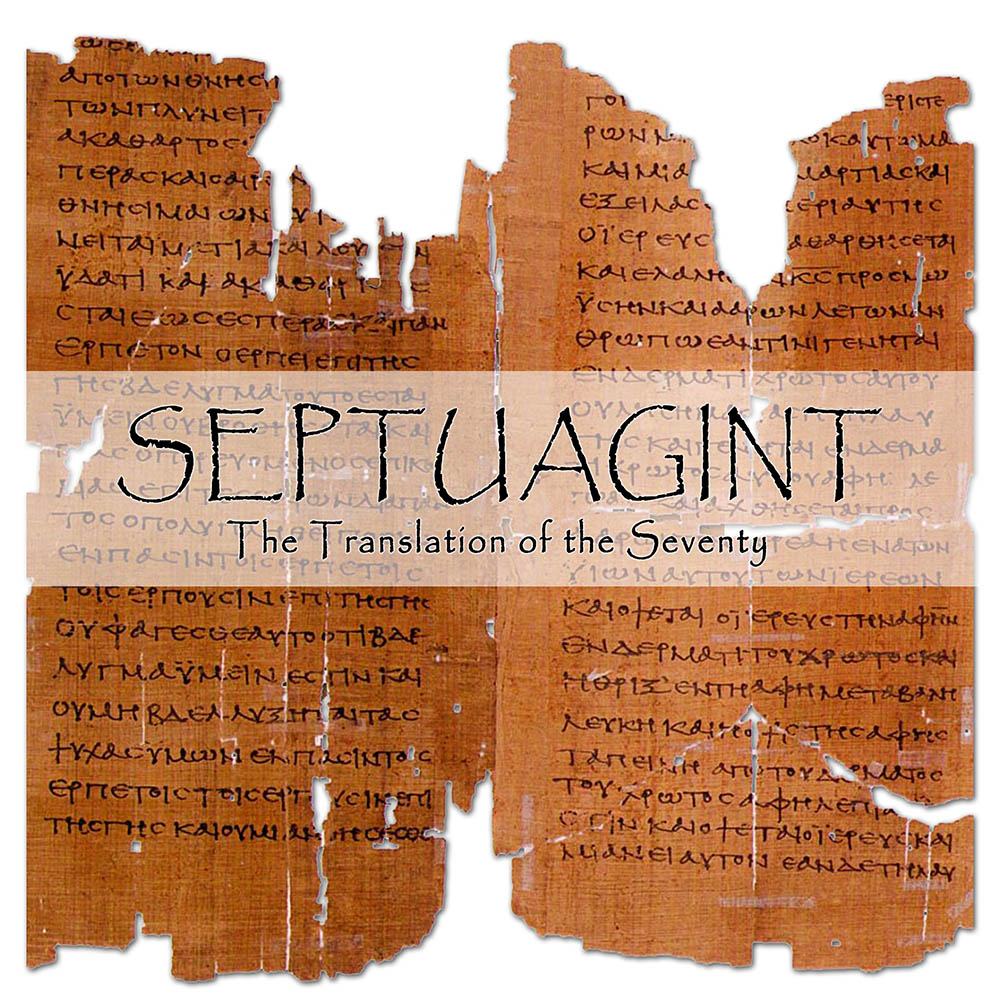
Here is a direct side-by-side comparison of the Masoretic Text with the LXX. I have concluded that the LXX is much to be preferred over the Masoretic Text, a position from which the Eastern Orthodox Church never deviated. Perhaps, if you take the time to read my comparisons and other articles, you will arrive at the same conclusion.
The Septuagint version I am using is the Lexham English Septuagint 2nd Edition, which is available in print or as part of Logos Bible Software. Occasionally I also use the Brenton translation of the LXX for insight into difficult passages.
If you want to know more, click on the following links.
- Why Christians Should Prefer the Septuagint over the Masoretic Text.
- Some Insights Gained through Comparing the Masoretic Text to the Septuagint
- More side by side comparisons of the Masoretic Text (MT) to the Septuagint (LXX).
| Masoretic Text | Septuagint | Significance |
|
10 Now there was a famine in the land; so Abram went down to Egypt to sojourn there, for the famine was severe in the land. 11 It came about when he came near to Egypt, that he said to Sarai his wife, “See now, I know that you are a beautiful woman; 12 and when the Egyptians see you, they will say, ‘This is his wife’; and they will kill me, but they will let you live. 13 “Please say that you are my sister so that it may go well with me because of you, and that I may live on account of you.” Genesis 12:10–13 (NASB95) |
10 And a famine came over the earth, and Abram went down into Egypt to dwell beside there, because the famine over the earth was strong. 11 It happened when Abram came near to enter into Egypt, Abram said to Sarai, his wife, “I know that you are a beautiful woman. 12 So this will happen: when the Egyptians see you, they will say, ‘This is his wife.’ And they will kill me, but they will keep you. 13 Say, then, ‘I am his sister,’ so that it will be well with me because of you, and my soul will live on your account.” Genesis 12:10–13 (LES2) |
This matches almost perfectly. We see that Abram has a few character flaws and is willing to sacrifice his wife’s sexual purity in marriage to save his hide. This unfortunately became somewhat of a family tradition carried forward by Isaac later. |
|
14 It came about when Abram came into Egypt, the Egyptians saw that the woman was very beautiful. 15 Pharaoh’s officials saw her and praised her to Pharaoh; and the woman was taken into Pharaoh’s house. 16 Therefore he treated Abram well for her sake; and gave him sheep and oxen and donkeys and male and female servants and female donkeys and camels. Genesis 12:14–16 (NASB95) |
14 It happened when Abram entered into Egypt, once the Egyptians saw his wife, that she was very beautiful, 15 that rulers of Pharaoh saw her and praised her to Pharaoh, and they led her to Pharaoh. 16 And they treated Abram well because of her, and he had sheep and calves and donkeys, servants and maids, mules and camels. Genesis 12:14–16 (LES2) |
This passage matches fairly closely. Abraham’s scheme plays out, thus jeopardizing Sarai and the messianic line. God came to Sarai’s rescue to save her and God’s plan. |
|
17 But the LORD struck Pharaoh and his house with great plagues because of Sarai, Abram’s wife. 18 Then Pharaoh called Abram and said, “What is this you have done to me? Why did you not tell me that she was your wife? 19 “Why did you say, ‘She is my sister,’ so that I took her for my wife? Now then, here is your wife, take her and go.” 20 Pharaoh commanded his men concerning him; and they escorted him away, with his wife and all that belonged to him. Genesis 12:17–20 (NASB95) |
17 And God afflicted Pharaoh and his house with great and grievous trials because of Sarai, Abram’s wife. 18 Pharaoh, having summoned Abram, said, “What is this you did to me, that you did not tell me that she is your wife? 19 Why did you say, ‘She is my sister,’ so that I took her as a wife for myself? And now, look, your wife is before you; take her; depart!” 20 And Pharaoh commanded men regarding Abram, that they should accompany him and his wife and all that was his, and Lot with him. Genesis 12:17–20 (LES2) |
There is not very much difference between the Hebrew word translated “plagues” and the Greek word translated “trials.” Both can mean “afflictions.” Somehow Pharaoh discovered the truth about Sarai’s relationship with Abram. It is not directly stated whether Pharoah had sex with Sarai, but no offspring resulted, if he did. This would go along with her barrenness until the miracle of Isaac. I wonder what Sarai thought of her brother/husband after this? Was his behavior evidence of a low value put on women? Did it indicate a lack of marital affection, or did it simply point to a rather Machiavellian approach to self-preservation on his part? |
Summary: The Holy Spirit put this episode in the Bible for a reason. Perhaps it was to show Abraham’s lack of moral fiber and Sarai’s courage in the face of compromise. Perhaps it was to show that even the patriarchs were quite flawed, making us realize God’s plan did not depend on perfect people, but on his perfect Son. Maybe it demonstrated God’s ability to protect his people and his plan to bring his Messiah into the world to save his elect. It could be all of the above. With regard to the comparison of the MT to the LXX, once again we see an almost perfect correspondence, which is quite different from anything we find when we compare the psalms and prophets.