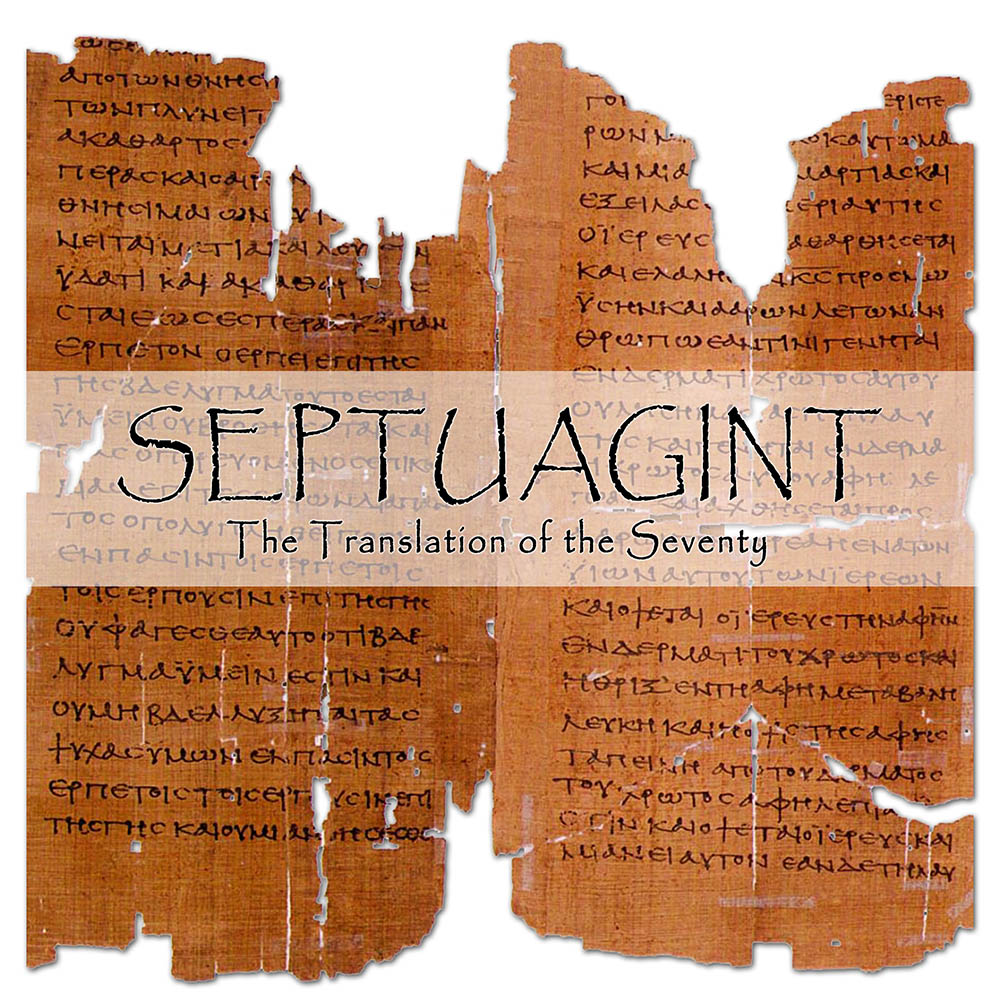
Here is a direct side-by-side comparison of the Masoretic Text with the LXX. I have concluded that the LXX is much to be preferred over the Masoretic Text, a position from which the Eastern Orthodox Church never deviated. Perhaps, if you take the time to read my comparisons and other articles, you will arrive at the same conclusion.
The Septuagint version I am using is the Lexham English Septuagint 2nd Edition, which is available in print or as part of Logos Bible Software. Occasionally I also use the Brenton translation of the LXX for insight into difficult passages.
If you want to know more, click on the following links.
- Why Christians Should Prefer the Septuagint over the Masoretic Text.
- Some Insights Gained through Comparing the Masoretic Text to the Septuagint
- More side by side comparisons of the Masoretic Text (MT) to the Septuagint (LXX).
| Masoretic Text | Septuagint | Significance |
|
1 The LORD is my shepherd; I shall not want. Psalm 23:1 (NKJV) |
1 The Lord shepherds me, and nothing will be lacking for me. Psalm 22:1 (LES2) |
Same… |
|
2 He makes me to lie down in green pastures; He leads me beside the still waters. Psalm 23:2 (NKJV) |
2 In a place of tender grass, there he causes me to dwell. At a river of rest he nourishes me. Psalm 22:2 (LES2) |
In this verse, and going forward, we have to decide if we want poetic beauty or the actual words of God. Both the MT and LXX use the phrase “tender grass,” but the English translators of the MT chose “green pastures.” The MT says “lie down,” but the LXX says “dwell” or “encamp.” The MT literally says that the shepherd “leads me to waters of rest.” The LXX is similar but says that he “nourishes me to maturity” at waters of rest, which is richer in meaning. |
|
3 He restores my soul; He leads me in the paths of righteousness For His name’s sake. Psalm 23:3 (NKJV) |
3 He turns around my soul. He leads me in paths of righteousness on account of His name. Psalm 22:3 (LEScaus2) |
Both the MT and LXX agree that the shepherd “turns back” (MT) or “turns around” (LXX) my soul. The Greek in the LXX is epistrepho, which is the same verb Jesus used when addressing Peter’s future denial and the aftermath. 31 And the Lord said, “Simon, Simon! Indeed, Satan has asked for you, that he may sift you as wheat. 32 But I have prayed for you, that your faith should not fail; and when you have returned to Me, strengthen your brethren.” Luke 22:31–32 (NKJV) Therefore, as is not obvious in the English versions of the MT, the shepherd leads us to repentance. This segues nicely with the next sentence. The MT and LXX agree in the last part of the verse. |
|
4 Yea, though I walk through the valley of the shadow of death, I will fear no evil; For You are with me; Your rod and Your staff, they comfort me. Psalm 23:4 (NKJV) |
4 For even if I should go in the middle of the shadow of death, I will not fear evil things, because you are with me. Your rod and your staff, they exhort me. Psalm 22:4 (LES2) |
The MT and LXX both use the word that means “go,” even though the English translation uses the word “walk.” The MT uses “valley,” while the LXX uses “middle.” Shadow of death agrees, as does not fearing evil because God is with us. In the last sentence, however, we see a important difference. The MT says that God’s rod and staff “console,” but the LXX uses the Greek word parakaleo, which is the same word used for the ministry of the Holy Spirit in the New Testament. The meaning of the Greek word is to encourage, comfort, and exhort, which is wider than the Hebrew word used in the MT. |
|
5 You prepare a table before me in the presence of my enemies; You anoint my head with oil; My cup runs over. Psalm 23:5 (NKJV) |
5 You prepare before me a table opposite those who afflict me. You anoint my head with olive oil. And your drinking cup is satisfying as the best. Psalm 22:5 (LES2) |
The English version of the MT chose the word “enemy” to describe someone who treats with hostility or attacks, which is fair. The LXX uses the Greek word thlibo, which means to press hard upon. Even family and colleagues and coaches sometimes do this. Regardless, the point of the verse is that God makes us overcomers in the presence of hostility and pressure. He sets a table in the midst of our troubles or enemies instead of causing us to flee. Both the MT and LXX agree regarding the shepherd anointing the head with olive oil, which is a picture of the presence, power, and authority of Christ and the Holy Spirit. There is disagreement regarding the last sentence, however. The MT’s “My cup runs over” is different from the literal rendering of the LXX, which says, “your drinking cup intoxicates as the best.” The Lexham translation says “satisfying,” and Brenton says, “cheers.” Perhaps the best way to understand this is by thinking of Pentecost in Acts 2 when the infilling of the Holy Spirit made the disciples appear to be drunk. It also compares to Paul’s admonition in Ephesians 5:18 to avoid getting drunk with wine but be filled with the Holy Spirit. God’s presence can be intoxicating in the finest sense of the word. |
|
6 Surely goodness and mercy shall follow me All the days of my life; And I will dwell in the house of the LORD Forever. Psalm 23:6 (NKJV) |
6 Your mercy will pursue me all the days of my life, and my dwelling will be in the house of the Lord for the length of days. Psalm 22:6 (LES2) |
The MT adds “goodness.” The MT says the psalmist will dwell in God’s house “forever,” but the LXX says it will be for “length of days.” The general thought is a good one. |
Summary: Psalm 23 is the most iconic psalm in the Bible. The beauty of the King James text has been read, spoken aloud, prayed, recited at funerals, and sung over and over again. It is like an old friend or memory with which we dare not tamper. Nevertheless, if we are to respect and love God’s Word, we must treasure what God actually said rather than what men have contrived that he said. The MT and LXX essentially agree in most of this psalm, but there are some differences worth noting, as I described above. I suggest notating our MT Old Testaments, as I have, to remind ourselves of what the LXX says.