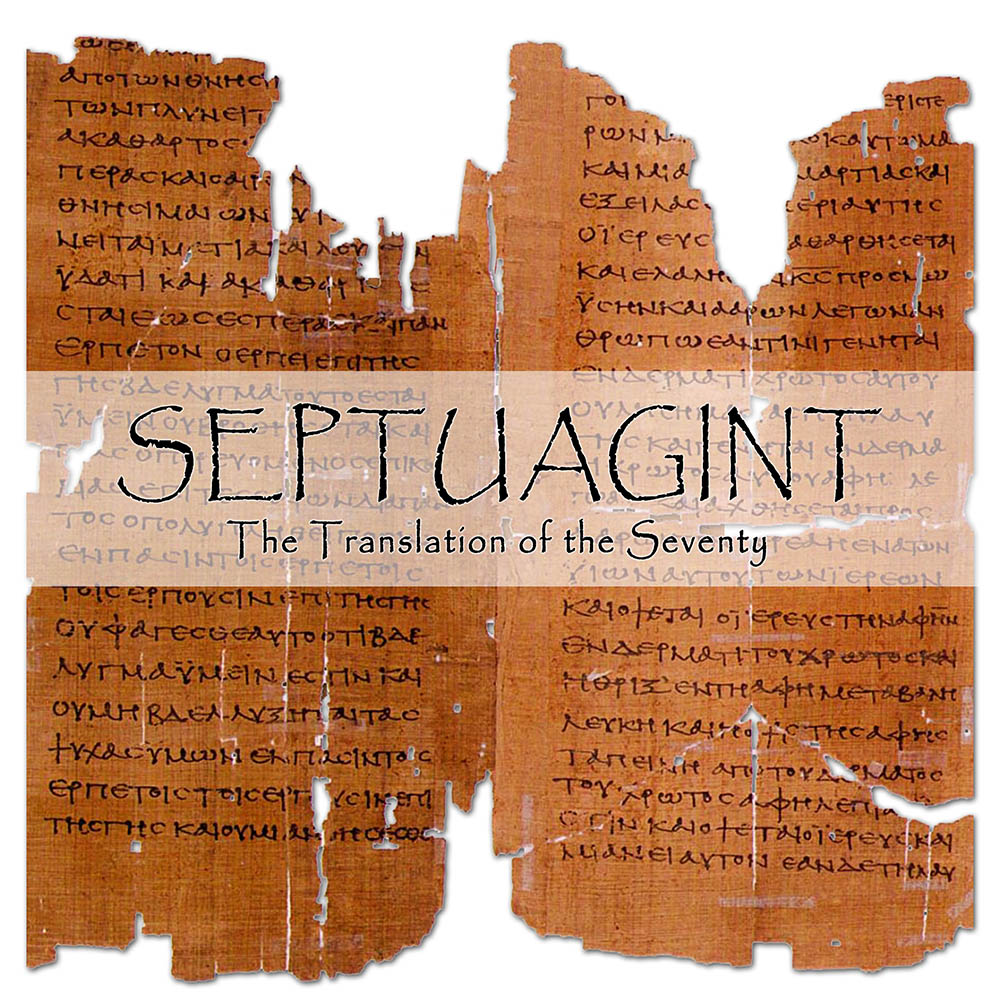
Here is a direct side-by-side comparison of the Masoretic Text with the LXX. I have concluded that the LXX is much to be preferred over the Masoretic Text, a position from which the Eastern Orthodox Church never deviated. Perhaps, if you take the time to read my comparisons and other articles, you will arrive at the same conclusion.
The Septuagint version I am using is the Lexham English Septuagint 2nd Edition, which is available in print or as part of Logos Bible Software. Occasionally I also use the Brenton translation of the LXX for insight into difficult passages.
If you want to know more, click on the following links.
- Why Christians Should Prefer the Septuagint over the Masoretic Text.
- Some Insights Gained through Comparing the Masoretic Text to the Septuagint
- More side by side comparisons of the Masoretic Text (MT) to the Septuagint (LXX).
| Masoretic Text | Septuagint | Significance |
|
1 The heavens declare the glory of God; And the firmament shows His handiwork. 2 Day unto day utters speech, And night unto night reveals knowledge. 3 There is no speech nor language Where their voice is not heard. 4 Their line has gone out through all the earth, And their words to the end of the world. In them He has set a tabernacle for the sun, Psalm 19:1–4 (NKJV) |
2 The heavens set out in detail the glory of God. And the firmament reports the creation of his hands. 3 Day to day spits out speech, and night to night reports knowledge. 4 There are no speeches nor words in which their voices are not heard. 5 Into all the earth their voice went out, and their words into the ends of the inhabited world. Psalm 18:2–5 (LES2) |
The MT says, “the heavens (plural) declare the glory of God.” The LXX says, “set out in detail” or “from beginning to end” the glory of God. In both the word The firmament, according to Genesis Chapter 1, was fashioned on the second day of creation and is a solid dome covering the earth. The psalmist says that it announces or reports regarding God’s creation. Modern astrophysics denies its existence and questions God’s existence and the accuracy and authority of the Bible. (See my article, “Introduction to the Firmament.“) God’s creation properly understood is a voice heard to the ends of the inhabited world. That is why the devil has worked so hard to falsify the Genesis account. The biblical earth is a circle (Isaiah 40:22) that has an outer boundary, which the Bible calls “ends.” This, as far as we can tell without having access to that part of the world, is the ice wall of Antarctica that surrounds the perimeter of the inhabited world. Some think there are lands beyond the ice wall, as reported by Admiral Byrd. If so, apparently the testimony of the heavens might not extend that far. It would likely be beyond the reach of the sun. Part of our problem is that without extensive exploration in that part of the world, we cannot independently verify the location of the base of the firmament, which the Bible says has foundations upon the earth. Some think Admiral Byrd found it, which is why the Antarctic Treaty was signed prohibiting non-government independent access to the entire region. |
|
4 Their line has gone out through all the earth, And their words to the end of the world. In them He has set a tabernacle for the sun, 5 Which is like a bridegroom coming out of his chamber, And rejoices like a strong man to run its race. 6 Its rising is from one end of heaven, And its circuit to the other end; And there is nothing hidden from its heat. Psalm 19:4–6 (NKJV) |
6 In the sun he has placed his tent. And he, as a bridegroom going out from his bridal chamber, will rejoice exceedingly, as a giant to run its course. 7 From the top of the heavens is its going out, and its end is until the top of the heavens. And there is none who will be hidden from its heat. Psalm 18:6–7 (LES2) |
Verse 6 in the LXX is fascinating and somewhat confusing to me. Genesis says that God placed the sun, moon, and stars in the firmament, or second heaven. That would make the firmament a tent or tabernacle for the sun, as indicated in the MT. Perhaps the LXX improperly translated the Paleo-Hebrew, which is my guess, but could it be that the LXX got it right, and we simply do not know what it means? Both the MT and LXX compare the sun to a bridegroom coming out of his chamber, rejoicing exceedingly. The MT says it will pursue its course like a strong man running a race. The LXX uses the word “giant.” The MT calls the sun’s path a circuit or circular path, but the LXX calls it a way or road. Biblical cosmologists often use this verse in the MT to prove from scripture that the sun runs a circular path over the earth. The MT supports this directly. The LXX does not contradict it, but the language is not as confirming. However, taken as a whole, biblical cosmology allows for no other option than a circular path. The MT and LXX both indicate that the sun’s path or circuit runs from one extremity to the other. (End or top both mean extremity in their respective languages.) This confirms the biblical earth concept that heaven also has limits or extremities and is not an infinitely expanding cosmos. The dome of the firmament not only defines the limits of the earth, but it sets heaven’s limits as well. In biblical cosmology, heaven, earth, and Hades are part of one unit. Waters surround it. (Exodus 20:4) 31 And He will send His angels with a great sound of a trumpet, and they will gather together His elect from the four winds, from one end of heaven to the other. Matthew 24:31 (NKJV) Unfortunately, many Christians reject biblical cosmology and prefer the devils explanation to God’s. |
Summary: The first six verses of Psalm 19 have much to say about the heavens and earth and their testimony of God’s greatness and glory. It is interesting to compare the wording in the MT against that of the LXX.