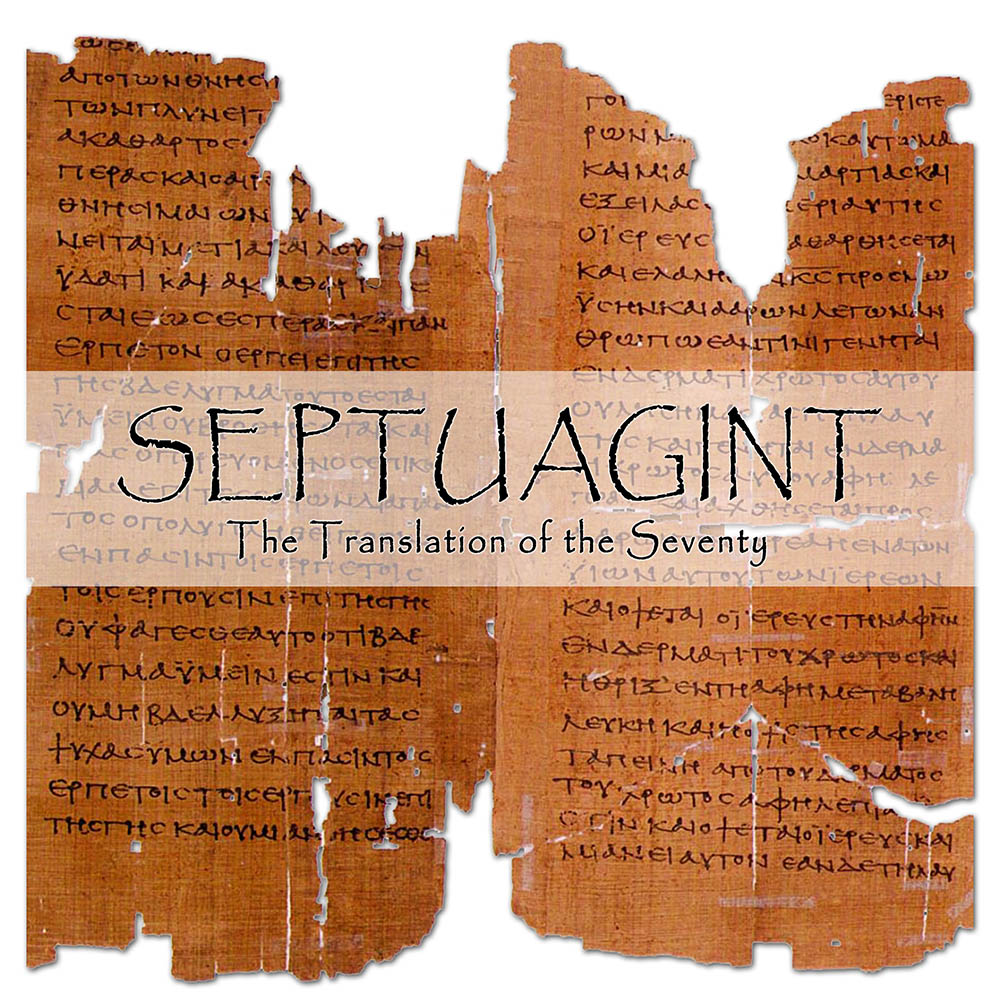
Here is a direct side-by-side comparison of the Masoretic Text with the LXX. I have concluded that the LXX is much to be preferred over the Masoretic Text, a position from which the Eastern Orthodox Church never deviated. Perhaps, if you take the time to read my comparisons and other articles, you will arrive at the same conclusion.
The Septuagint version I am using is the Lexham English Septuagint 2nd Edition, which is available in print or as part of Logos Bible Software. Occasionally I also use the Brenton translation of the LXX for insight into difficult passages.
If you want to know more, click on the following links.
- Why Christians Should Prefer the Septuagint over the Masoretic Text.
- Some Insights Gained through Comparing the Masoretic Text to the Septuagint
- More side by side comparisons of the Masoretic Text (MT) to the Septuagint (LXX).
| Masoretic Text | Septuagint | Significance |
|
To the Chief Musician. A Psalm of David The Servant of the LORD, Who Spoke to the LORD The Words of This Song on the Day that the LORD Delivered Him from the Hand of All His Enemies and from the Hand of Saul. And He Said: Psalm 18:title (NKJV) |
1 FOR THE END, OF DAVID, THE SERVANT OF THE LORD, THAT WHICH HE SPOKE TO THE LORD, THE WORDS OF THIS SONG, IN THE DAY IN WHICH THE LORD RESCUED HIM FROM THE HAND OF ALL HIS ENEMIES AND FROM THE HAND OF SAUL. Psalm 17:1 (LES2) |
Often the LXX includes the title as the first verse, as it does here. This gives us the context of the psalm’s creation. Since David was a prophet, his psalms sometimes speak of future things concerning the Lord. Psalm 22 is an excellent example. It contains a prophecy regarding Christ’s crucifixion. Parts of this psalm are thought to be a prophecy about our Lord’s resurrection. I will not cover the entire psalm because of its length. Instead, I will comment on portions that seem to be prophetically connected to Jesus. |
|
1 I will love You, O LORD, my strength. 2 The LORD is my rock and my fortress and my deliverer; My God, my strength, in whom I will trust; My shield and the horn of my salvation, my stronghold. 3 I will call upon the LORD, who is worthy to be praised; So shall I be saved from my enemies. Psalm 18:1–3 (NKJV) |
2 AND HE SAID, “I love you, O Lord, my strength. 3 The Lord is my strength and my refuge and my savior. My God is a helper, and I will hope in him, my protector and the horn of salvation, my helper. 4 Praising, I will call upon the Lord, and I will be saved from my enemies. Psalm 17:2–4 (LES2) |
The first difference is that the MT uses a future tense verb instead of the present tense of the LXX. The Hebrew verb is in the imperfect tense, which generally is used for ongoing, habitual, and repeated action, just as is the case in the LXX. A better translation might be, “I love you and will love you every day, Lord.” The LXX uses Greek words that seem more personal than the MT’s in verse 3. Strength is “stereoma” in Greek, which is the same word used for “firmament,” above which is God’s throne. Refuge is “kataphuge,” which means exactly what the English word communicates. Savior is “rustes,” which means savior or deliverer. Helper is “boethos,” which means someone who comes to my aid. Protector is the Greek word “hyperaspisteis,” which means protector or champion. Helper in the second instance is the Greek word “antilemptor,” which means protector or helper. The general idea here is that God will save David and, perhaps, Christ from their enemies. |
|
4 The pangs of death surrounded me, And the floods of ungodliness made me afraid. 5 The sorrows of Sheol surrounded me; The snares of death confronted me. 6 In my distress I called upon the LORD, And cried out to my God; He heard my voice from His temple, And my cry came before Him, even to His ears. Psalm 18:4–6 (NKJV) |
5 Pains of death surrounded me, and torrents of lawlessness troubled me. 6 Pains of Hades encircled me. Snares of death came near to me. 7 And when I was afflicted, I called upon the Lord, and to my God I cried aloud. He heard my voice from his holy temple, and my crying before him will enter into his ears. Psalm 17:5–7 (LES2) |
Interestingly, in the LXX the “pains” of death, in verse 4/5, and of Hades, in verse 5/6, uses the same Greek word that is used to describe the pains of childbirth. This fits the crucifixion and resurrection of Christ perfectly. Through his death and rising, Jesus “gave birth” to the church, just as God fashioned Eve from one of Adam’s ribs while he was in a trance-like sleep. For the Christian, going through death is necessary to transition from the “womb” of this world into the glories of heaven. If this passage applies to David, it appears to be poetic language describing a close encounter with death, but if these words apply to Christ on the cross, or perhaps in the grave, they can be taken quite literally. God’s holy temple is located in heaven above the firmament. We know from Paul and Peter that Christ indeed descended into Hades before ascending back to his Father in heaven after the resurrection. 7 But to each one of us grace was given according to the measure of Christ’s gift. 8 Therefore He says: “When He ascended on high, He led captivity captive, And gave gifts to men.” 9 (Now this, “He ascended”—what does it mean but that He also first descended into the lower parts of the earth? 10 He who descended is also the One who ascended far above all the heavens, that He might fill all things.) Ephesians 4:7–10 (NKJV) Here Paul references his theology of up and down, which requires the biblical shape of the earth. Heaven is up, earth is in the middle, and Hades is down. Otherwise, Paul’s words make no sense. 23 Him, being delivered by the determined purpose and foreknowledge of God, you have taken by lawless hands, have crucified, and put to death; 24 whom God raised up, having loosed the pains of death, because it was not possible that He should be held by it. 25 For David says concerning Him: ‘I foresaw the LORD always before my face, For He is at my right hand, that I may not be shaken. 26 Therefore my heart rejoiced, and my tongue was glad; Moreover my flesh also will rest in hope. 27 For You will not leave my soul in Hades, Nor will You allow Your Holy One to see corruption. Acts 2:23–27 (NKJV) In the above passage, Peter uses the same Greek word for pains of childbirth that David used in Psalm 18 in the LXX. Quoting Psalm 16, he mentions that God did not leave Jesus in Hades, meaning he went down there, as Paul taught. God heard Jesus’ prayer when he experienced being encircled, or surrounded as a besieged city, with the pains of Hades. |
|
7 Then the earth shook and trembled; The foundations of the hills also quaked and were shaken, Because He was angry. 8 Smoke went up from His nostrils, And devouring fire from His mouth; Coals were kindled by it. 9 He bowed the heavens also, and came down With darkness under His feet. 10 And He rode upon a cherub, and flew; He flew upon the wings of the wind. 11 He made darkness His secret place; His canopy around Him was dark waters And thick clouds of the skies. 12 From the brightness before Him, His thick clouds passed with hailstones and coals of fire. Psalm 18:7–12 (NKJV) |
8 And the earth was shaken and was trembling. And the foundations of the mountains were stirred up and shaken, because God was angered with them. 9 Smoke went up with his wrath, and fire burst into flame before him. Coals were kindled from him. 10 And he bent the heavens and came down. And darkness was under his feet. 11 And he mounted upon cherubim and flew; he flew upon the wings of the wind. 12 And he set darkness concealing him in a circle around him; his tent is a dark water in clouds of sky. 13 From the brightness before him, the clouds go through, hail and coals of fire. Psalm 17:8–13 (LES2) |
If this passage refers to the resurrection, as it seems, the earthquake mentioned may be the one associated with Christ’s crucifixion and resurrection mentioned in Matthew’s gospel. 51 Then, behold, the veil of the temple was torn in two from top to bottom; and the earth quaked, and the rocks were split, 52 and the graves were opened; and many bodies of the saints who had fallen asleep were raised; 53 and coming out of the graves after His resurrection, they went into the holy city and appeared to many. 54 So when the centurion and those with him, who were guarding Jesus, saw the earthquake and the things that had happened, they feared greatly, saying, “Truly this was the Son of God!” Matthew 27:51–54 (NKJV) Psalm 18 seems to provide more details regarding the Father’s anger at his Son’s unjust execution, which was later unleashed in 70 AD when the city of Jerusalem and the temple were destroyed, as Jesus had prophesied. |
|
13 The LORD thundered from heaven, And the Most High uttered His voice, Hailstones and coals of fire. 14 He sent out His arrows and scattered the foe, Lightnings in abundance, and He vanquished them. 15 Then the channels of the sea were seen, The foundations of the world were uncovered At Your rebuke, O LORD, At the blast of the breath of Your nostrils. 16 He sent from above, He took me; He drew me out of many waters. 17 He delivered me from my strong enemy, From those who hated me, For they were too strong for me. 18 They confronted me in the day of my calamity, But the LORD was my support. 19 He also brought me out into a broad place; He delivered me because He delighted in me. Psalm 18:13–19 (NKJV) |
14 And the Lord thundered from the heavens, and the most high gave his voice. 15 And he dispatched arrows and scattered them, and he multiplied lightning strikes and confounded them. 16 And the running waters of the rivers were seen, and the foundations of the inhabited world were uncovered from your censure, O Lord, from the breathing of the wind of your wrath. 17 He dispatched from the heights and took me; he drew me to himself from many waters. 18 He will rescue me from my strong enemies, and from those who hate me, because they were stronger than me. 19 They took advantage of me in the day of my ill-treatment, and the Lord became my support. 20 And he led me into broad spaces. He will rescue me because he wanted me. Psalm 17:14–20 (LES2) |
Without commenting on all the verses, I want to draw your attention to verse 16, where the LXX says that “the foundations of the inhabited world were uncovered.” The Bible says that the earth is set upon pillars and foundations and does not move, contrary to the anti-biblical narrative of modern astrophysics. In the Bible, these foundations are beneath the surface of the earth. We are not sure where these might touch the realm of Hades, which the Bible locates under the earth. If Christ was in Hades, as the Bible testifies, then God looked down from heaven to rescue his Son, as it says in verse 16/17. The MT and LXX agree on this. Christ had been overpowered by Satan at Calvary, something to which Jesus willingly submitted when he offered his life as God’s Lamb. While Jesus was hanging on the cross, his enemies taunted him. 35 And the people stood looking on. But even the rulers with them sneered, saying, “He saved others; let Him save Himself if He is the Christ, the chosen of God.” 36 The soldiers also mocked Him, coming and offering Him sour wine, 37 and saying, “If You are the King of the Jews, save Yourself.” Luke 23:35–37 (NKJV) They believed that the crucifixion proved that Jesus was an imposter because God allowed him to be so treated. However, Psalm 19/20 refutes this by saying, “He will rescue me because he wanted me.” |
|
20 The LORD rewarded me according to my righteousness; According to the cleanness of my hands He has recompensed me. 21 For I have kept the ways of the LORD, And have not wickedly departed from my God. 22 For all His judgments were before me, And I did not put away His statutes from me. 23 I was also blameless before Him, And I kept myself from my iniquity. 24 Therefore the LORD has recompensed me according to my righteousness, According to the cleanness of my hands in His sight. Psalm 18:20–24 (NKJV) |
21 He will deliver me from my mighty enemies and from those who hate me. And the Lord will repay to me according to my righteousness; and according to the purity of my hands he will repay me, 22 because I kept the ways of the Lord, and I did not act impiously from my God, 23 because all His judgments are before me, and his duties have not departed from me. 24 And I will be without blame with him, and I will guard from my lawlessness. 25 And the Lord will give back to me according to my righteousness and according to the purity of my hands before his eyes. Psalm 17:21–25 (LES2) |
Here for some reason the MT omits “He will deliver me from my mighty enemies and from those who hate me,” which were chiefly the Jewish leaders, who were supported by the Roman government. The one about whom this psalm was written, which must be Christ, then says, “the Lord will repay me according to my righteousness.” There is only one man who could say that, our Lord Jesus. There is none other who deserved for God to raise him from the dead and deliver him. (Romans 3:10) Those who put their faith and allegiance in Christ receive his right standing with God the Father as a gift. (Romans 5:17) |
|
25 With the merciful You will show Yourself merciful; With a blameless man You will show Yourself blameless; 26 With the pure You will show Yourself pure; And with the devious You will show Yourself shrewd. 27 For You will save the humble people, But will bring down haughty looks. Psalm 18:25–27 (NKJV) |
26 With the holy one you will be holy, and with the innocent man you will be innocent, 27 and with the chosen you will be chosen, and with the twisted you will twist about, 28 because you will save a low people, and the eyes of the arrogant you will lower. Psalm 17:26–28 (LES2) |
I included this passage because it illustrates how different the LXX is compared to the MT. There is no relationship between “merciful” and “holy.” Nor is there a connection between “pure” and “chosen.” |
|
43 You have delivered me from the strivings of the people; You have made me the head of the nations; A people I have not known shall serve me. 44 As soon as they hear of me they obey me; The foreigners submit to me. 45 The foreigners fade away, And come frightened from their hideouts. Psalm 18:43–45 (NKJV) |
44 You will rescue me from arguments with the people; you will appoint me for the head of nations; a people whom I did not understand [know] served me. 45 For a report of the ear, they obeyed me. Foreign children lied to me. 46 Foreign children wore out and became lame from their paths. Psalm 17:44–46 (LES2) |
I skipped ahead to this passage, which can be applied to Christ. Jesus has been given authority over all things (Matthew 28:18), including the nations, which he received as an inheritance (Psalm 2:8). Even those who refuse to acknowledge his lordship, those he did not know (Matthew 7:23) regarding salvation (verse 44) will submit to him. Every knee shall bow before him. (Philippians 2:10) |
|
46 The LORD lives! Blessed be my Rock! Let the God of my salvation be exalted. 47 It is God who avenges me, And subdues the peoples under me; 48 He delivers me from my enemies. You also lift me up above those who rise against me; You have delivered me from the violent man. 49 Therefore I will give thanks to You, O LORD, among the Gentiles, And sing praises to Your name. 50 Great deliverance He gives to His king, And shows mercy to His anointed, To David and his descendants forevermore. Psalm 18:46–50 (NKJV) |
47 The Lord lives! And blessed is my God! Let the God of my salvation be exalted! 48 O God, the one who gives vengeance to me and places peoples under me, 49 my deliverer from angry enemies, from those who rise up against me. You will raise me up. From the unjust man you will rescue me. 50 On account of this, I will give thanks to you among the nations, O Lord. And I will sing psalms to your name. 51 God is magnifying the salvation of his king and making mercy to his anointed one, to David and to his seed until eternity.” Psalm 17:47–51 (LES2) |
Here David praises God for delivering him from his enemies, saying that God will “raise me up,” which was literally fulfilled in Christ. God’s mercy is promised to David’s “seed” (singular), which is Christ, for all eternity. This promise of mercy and blessing is extended to all who are “in Christ” via the new birth. The New Covenant makes it clear that the promises made to Abraham and David regarding their “seed” were fulfilled in Christ. (Galatians 3:16) |
Summary: This is a beautiful prophetic psalm about Christ’s resurrection penned by King David. Interestingly, much of it can only be properly understood in the context of the biblical shape of the earth and the theology of up and down.