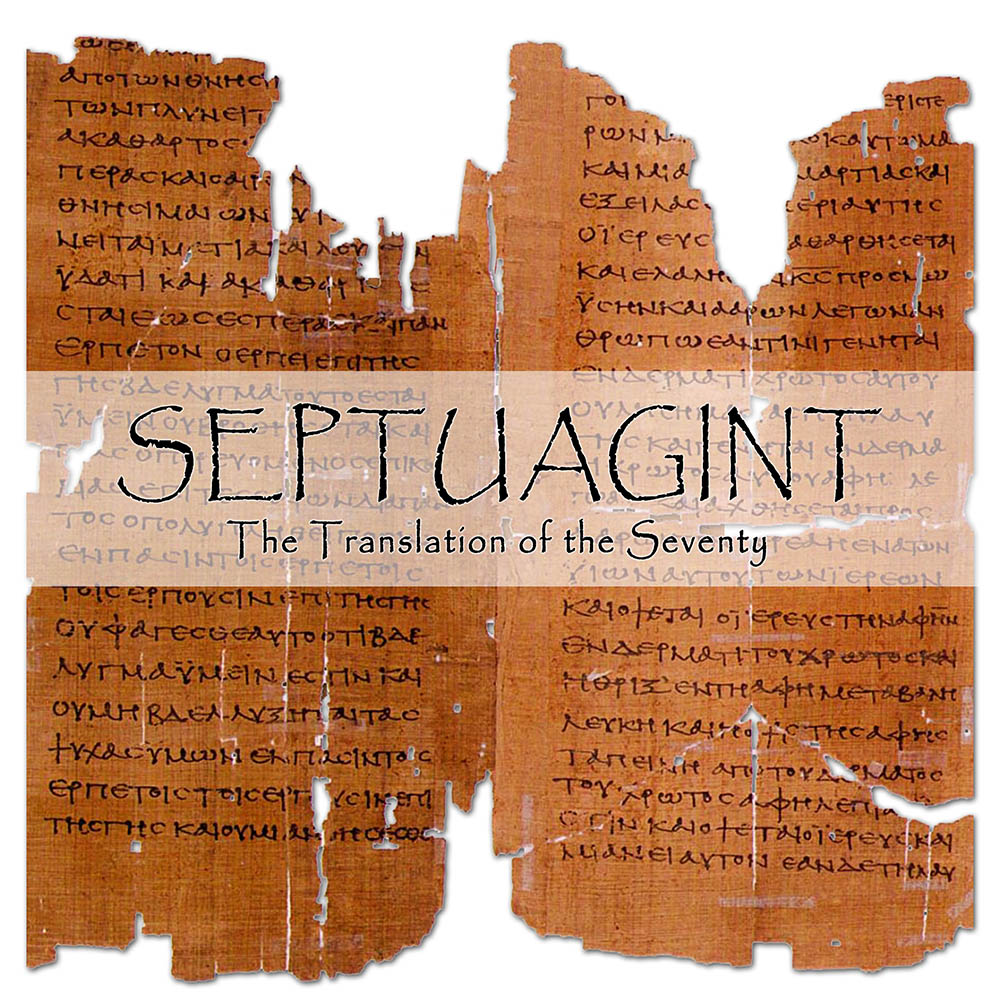
Here is a direct side-by-side comparison of the Masoretic Text with the LXX. I have concluded that the LXX is much to be preferred over the Masoretic Text, a position from which the Eastern Orthodox Church never deviated. Perhaps, if you take the time to read my comparisons and other articles, you will arrive at the same conclusion.
The Septuagint version I am using is the Lexham English Septuagint 2nd Edition, which is available in print or as part of Logos Bible Software. Occasionally I also use the Brenton translation of the LXX for insight into difficult passages.
If you want to know more, click on the following links.
- Why Christians Should Prefer the Septuagint over the Masoretic Text.
- Some Insights Gained through Comparing the Masoretic Text to the Septuagint
- More side by side comparisons of the Masoretic Text (MT) to the Septuagint (LXX).
| Masoretic Text | Septuagint | Significance |
|
1 For the LORD will have mercy on Jacob, and will still choose Israel, and settle them in their own land. The strangers will be joined with them, and they will cling to the house of Jacob. 2 Then people will take them and bring them to their place, and the house of Israel will possess them for servants and maids in the land of the LORD; they will take them captive whose captives they were, and rule over their oppressors. Isaiah 14:1–2 (NKJV) |
1 And the Lord will show mercy to Jacob, and he will again choose Israel; and they will rest in their land, and Gioras will be added to them, and he will be added to the house of Jacob. 2 And nations will take them and lead them into their place, and they will inherit and increase in the land as bondmen and bondwomen; and those who captured them will be captives, and those who dominated them will be dominated. Isaiah 14:1–2 (LES2) |
Gioras means proselyte. This refers to Israel’s restoration to the land after their captivity in Babylon as prophesied by Jeremiah and Isaiah. Modern Zionists would probably choose to apply this to the present day. Certainly the modern nation of Israel seeks to dominate all those whom they perceive as enemies, without ever having surrendered to the lordship of Christ. Theirs is a misbegotten enterprise which cannot end well. |
|
3 It shall come to pass in the day the LORD gives you rest from your sorrow, and from your fear and the hard bondage in which you were made to serve, 4 that you will take up this proverb against the king of Babylon, and say: “How the oppressor has ceased, The golden city ceased! 5 The LORD has broken the staff of the wicked, The scepter of the rulers; 6 He who struck the people in wrath with a continual stroke, He who ruled the nations in anger, Is persecuted and no one hinders. 7 The whole earth is at rest and quiet; They break forth into singing. 8 Indeed the cypress trees rejoice over you, And the cedars of Lebanon, Saying, ‘Since you were cut down, No woodsman has come up against us.’ Isaiah 14:3–8 (NKJV) |
3 And this will happen in that day: The Lord will give you rest from your pain and wrath, from your hard servitude with which you served them. 4 And you will take up this dirge over the king of Babylon, and you will say, “How the demander has stopped, and the taskmaster has stopped! 5 The Lord has crushed the yoke of the sinful, the yoke of the rulers. 6 After striking a nation in wrath with an incurable blow, hitting a nation with a blow of wrath that he did not spare, he rested, confident. 7 All the land cries out with cheer. 8 And the trees of Lebanon were cheerful at you, and the cedar of Lebanon: ‘Since you fell asleep, the one who strikes us has not gone up.’ Isaiah 14:3–8 (LES2) |
In verse 3, we see the difference in wording that is common when comparing the MT with the LXX. Perhaps the ancient now-dead Phoenician Paleo-Hebrew was difficult to translate into the more modern Aramaic version of Hebrew and into Greek. In verse 4, the MT says “proverb,” but the LXX says “dirge,” as would be sung at a funeral. The MT replaces “taskmaster” with “golden city,” which appears to be an editorial insertion. In verse 5, the LXX uses “yoke” twice, which the MT chooses to render as “staff” and “scepter.” The MT seems to mix and match verses 6 and 7. The MT rendering of verse 8 seems good. |
|
9 “Hell from beneath is excited about you, To meet you at your coming; It stirs up the dead for you, All the chief ones of the earth; It has raised up from their thrones All the kings of the nations. 10 They all shall speak and say to you: ‘Have you also become as weak as we? Have you become like us? 11 Your pomp is brought down to Sheol, And the sound of your stringed instruments; The maggot is spread under you, And worms cover you.’ Isaiah 14:9–11 (NKJV) |
9 Hades below was embittered after meeting you; all the giants who ruled the land, who roused all the kings of the nations from their thrones, rose together with you. 10 All will answer and will say to you, ‘Even you were taken, just as we also were, and you were counted among us.’ 11 Your glory, your abundant cheer, went down into Hades; beneath you they will spread decay, and your covering will be a worm. Isaiah 14:9–11 (LES2) |
When I compare passages like this one, it makes me wonder if the Masoretes even used the same source documents. Perhaps they simply took tremendous editorial license. Whatever the case, the two do not match well. Perhaps “disturbed” would be a better English word to translate the Hebrew “ragaz.” That would more nearly match the LXX’s “embittered.” The next part of verse 9 in the MT bears no resemblance to the LXX. I believe the LXX is the most reliable translation of the ancient Paleo-Hebrew because it was done centuries before Christ, and the early church relied upon it, quoting it in the New Testament. Therefore, I accept the LXX version in this passage. That being so, verse 9 seems to indicate that even hell was upset with Babylon. The “giants” make us think of those offspring of the fallen angels mentioned in Genesis, the nephilim, who seemed to still be around in some form or another. Evil principalities and powers seem to rule over geographical areas. Perhaps there is some connection. By some evil means, the nations joined Babylon in rising up. These kings were amazed that even the great Babylon was eventually brought low and taken. |
|
12 “How you are fallen from heaven, O Lucifer, son of the morning! How you are cut down to the ground, You who weakened the nations! 13 For you have said in your heart: ‘I will ascend into heaven, I will exalt my throne above the stars of God; I will also sit on the mount of the congregation On the farthest sides of the north; 14 I will ascend above the heights of the clouds, I will be like the Most High.’ 15 Yet you shall be brought down to Sheol, To the lowest depths of the Pit. Isaiah 14:12–15 (NKJV) |
12 How the dawn-bringer, who rises early, fell from the heavens; the one who sends to all the nations was crushed into the earth. 13 But you said in your mind, ‘I will go up into the heavens; above the stars of the heavens I will set my throne! I will sit on a high mountain, upon the high mountains toward the north. 14 I will go up above the clouds; I will be like the Most High!’ 15 But now you will go down into Hades, and into the foundations of the earth. Isaiah 14:12–15 (LES2) |
The Greek word that the LXX translates as “dawn bringer” is eosphoros, which literally means “dawn light bringer.” The Hebrew in the MT literally translates as “shining one, son of the dawn.” This shining one or light bringer fell from the heavens, which connects to Jesus’ statement about Satan. 18 And He said to them, “I saw Satan fall like lightning from heaven. Luke 10:18 (NKJV) Shining one, light bringer, and lightning all refer to Satan, who at one time must have shown with the glory of God. Now his light is deceptive, as Paul warned. 14 And no wonder! For Satan himself transforms himself into an angel of light. 2 Corinthians 11:14 (NKJV) The MT calls the “high mountains” in verse 13 “the mount of congregation,” apparently wanting to draw attention, once again, to Israel. In verse 15, the MT changes the LXX’s “foundations of the earth” into “the lowest depths of the Pit.” |
|
16 “Those who see you will gaze at you, And consider you, saying: ‘Is this the man who made the earth tremble, Who shook kingdoms, 17 Who made the world as a wilderness And destroyed its cities, Who did not open the house of his prisoners?’ Isaiah 14:16–17 (NKJV) |
16 Those who see you will be astonished at you and say ‘Is this the person who provokes the land, shaking kings, 17 making the whole inhabited land desolate? And he brought down its cities; he did not release those under attack.’ Isaiah 14:16–17 (LES2) |
This passage is mostly in agreement. |
|
18 “All the kings of the nations, All of them, sleep in glory, Everyone in his own house; 19 But you are cast out of your grave Like an abominable branch, Like the garment of those who are slain, Thrust through with a sword, Who go down to the stones of the pit, Like a corpse trodden underfoot. 20 You will not be joined with them in burial, Because you have destroyed your land And slain your people. The brood of evildoers shall never be named. 21 Prepare slaughter for his children Because of the iniquity of their fathers, Lest they rise up and possess the land, And fill the face of the world with cities.” Isaiah 14:18–21 (NKJV) |
18 All the nations’ kings fell asleep in honor, each person in his house. 19 But you will be thrown among the mountains like a loathed corpse, along with many dead, stabbed by swords, going down into the netherworld. The way a blood-stained garment will not be clean, 20 so neither will be you clean, for you destroyed my land and you killed my people. You will certainly not remain into eternity, evil seed! 21 Prepare your children to be slaughtered for the sins of their father, so that they might not rise and inherit the land and fill the land with war. Isaiah 14:18–21 (LES2) |
Verse 18 agrees for the most part. Verse 19, however, does not. The MT’s “thrown out of the grave” does not resemble the LXX’s “thrown among the mountains,” and “abominable branch” is nothing like “loathesome corpse.” Branch does not even go with something from the grave. “Along with many dead” is not even close to the MT’s “like the garment of those who were slain.” Going “down to the stones of the pit” is not the same as “going down to Hades.” “Like a corpse trodden underfoot” does not match “the way a bloodstained garment will not be clean.” It seems the MT may have switched the order of the metaphors. In verse 20, the MT’s “You will not be joined with them in burial” does not agree with the LXX’s “neither will you be clean.” Then the MT says the reason is because this evil one destoyed “your” land and people, but the LXX says it was “my” land and people. The MT’s “The brood of evil doers shall never be named” is not even close to the LXX’s “You will certainly not remain for eternity, evil seed.” Lastly, in verse 21, the unthinkable is that the evil seed would arise and fill the land with “cities” in the MT, but the LXX says with “war.” |
|
22 “For I will rise up against them,” says the LORD of hosts, “And cut off from Babylon the name and remnant, And offspring and posterity,” says the LORD. 23 “I will also make it a possession for the porcupine, And marshes of muddy water; I will sweep it with the broom of destruction,” says the LORD of hosts. Isaiah 14:22–23 (NKJV) |
22 And I will rise against them,” says the Lord Sabaoth, “and I will destroy their name and remnant and seed.” This is what the Lord says: 23 “And I will make Babylonia deserted so that hedgehogs will inhabit it, and it will be as nothing; and I will make it a pit of clay for destruction.” Isaiah 14:22–23 (LES2) |
The MT waxes poetic in describing God’s judgment upon Babylon, adding words and phrases not found in the LXX. |
|
24 The LORD of hosts has sworn, saying, “Surely, as I have thought, so it shall come to pass, And as I have purposed, so it shall stand: 25 That I will break the Assyrian in My land, And on My mountains tread him underfoot. Then his yoke shall be removed from them, And his burden removed from their shoulders. 26 This is the purpose that is purposed against the whole earth, And this is the hand that is stretched out over all the nations. 27 For the LORD of hosts has purposed, And who will annul it? His hand is stretched out, And who will turn it back?” Isaiah 14:24–27 (NKJV) |
24 This is what the Lord Sabaoth says: “The way I have said, so it will be, and the way I have resolved, so it will remain, 25 to destroy the Assyrians upon my land and upon my mountains. And they will be like that which is trampled, and their yoke will be taken away from them, and their glory will be taken away from their shoulders.” 26 This is the plan that the Lord resolved over the whole inhabited land, and this is the high hand over all the nations. 27 For who will disperse what the holy God has resolved? And who will turn back his high hand? Isaiah 14:24–27 (LES2) |
The MT turns a statement into a sworn oath. The MT says that what God “thought” will come to pass, but the LXX says that what God has “spoken” will be. In verse 25, the MT says Assyria’s burden will be removed from Israel’s shoulders, but the LXX uses the word “glory.” In verse 26, the MT says that this is God’s plan “against the whole earth,” but the LXX says his plan was “resolved over the entire inhabited land.” The rest of the passage essentially agrees. |
|
32 What will they answer the messengers of the nation? That the LORD has founded Zion, And the poor of His people shall take refuge in it. Isaiah 14:32 (NKJV) |
32 And what will the kings of nations answer? That the Lord founded Zion, and through him the low among the people will be saved. Isaiah 14:32 (LES2) |
I skipped to verse 32, which shows the pro-Israel / anti-Christ bias of the MT. The MT uses the word “messengers” instead of the LXX’s “kings.” But more importantly, the MT says that “the poor of his people shall take refuge in it,” meaning Zion. The LXX, however, says the humble will be saved “through him,” which points to Jesus. (John 5:39) |
Summary: Anyone who takes the time to diligently compare the MT to the LXX will see through the hoax that there is not much difference. It also becomes plain that the bias of the MT is toward glorifying Israel and obscuring references to Christ. This chapter in Isaiah is a good example.