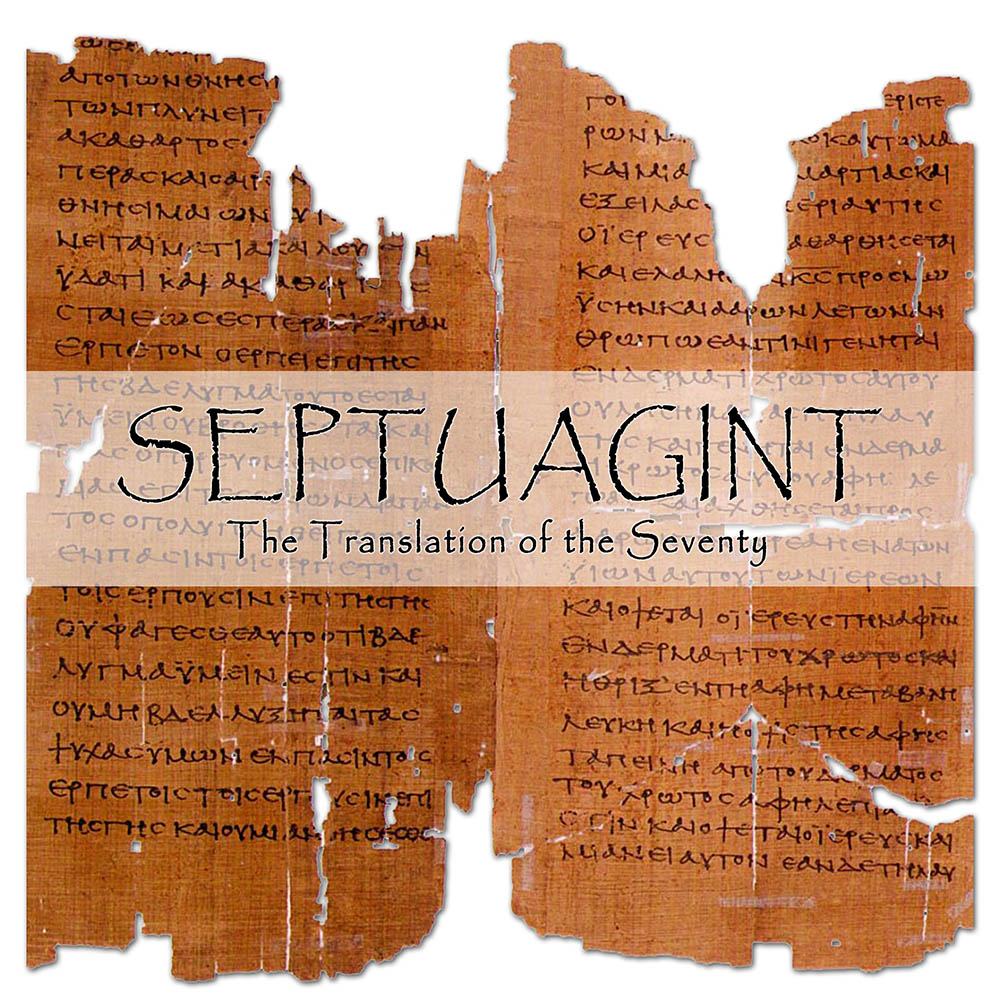
Here is a direct side-by-side comparison of the Masoretic Text with the LXX. I have concluded that the LXX is much to be preferred over the Masoretic Text, a position from which the Eastern Orthodox Church never deviated. Perhaps, if you take the time to read my comparisons and other articles, you will arrive at the same conclusion.
The Septuagint version I am using is the Lexham English Septuagint 2nd Edition, which is available in print or as part of Logos Bible Software. Occasionally I also use the Brenton translation of the LXX for insight into difficult passages.
If you want to know more, click on the following links.
- Why Christians Should Prefer the Septuagint over the Masoretic Text.
- Some Insights Gained through Comparing the Masoretic Text to the Septuagint
- More side by side comparisons of the Masoretic Text (MT) to the Septuagint (LXX).
| Masoretic Text | Septuagint | Significance |
|
1 But now, thus says the LORD, your Creator, O Jacob, And He who formed you, O Israel, “Do not fear, for I have redeemed you; I have called you by name; you are Mine! Isaiah 43:1 (NASB95) |
1 And now this is what the Lord God who made you, Jacob, and who formed you, Israel, says: “Do not be afraid, for I have redeemed you; I have called you your name; you are mine. Isaiah 43:1 (LES2) |
This passage shows agreement between the MT and LXX. It is fascinating that a verse that sounds completely positive about Israel would be essentially the same in both translations. Imagine that. Could it be that the Masoretes did not see any reason to alter the text? |
|
2 “When you pass through the waters, I will be with you; And through the rivers, they will not overflow you. When you walk through the fire, you will not be scorched, Nor will the flame burn you. Isaiah 43:2 (NASB95) |
2 Even if you pass through water, I am with you, and rivers will not overwhelm you; even if you pass through fire, you will not be burned up; the flame will not burn you up. Isaiah 43:2 (LES2) |
The interesting difference here is that verse 2 in the MT says “I will be with you,” but the verb is implied. Literally it says, “I with you.” The Greek, however, inserts the verb to be – “I am with you,” pointing to the Great I Am, whom we know to be our Lord Jesus. (John 8:58) |
|
3 “For I am the LORD your God, The Holy One of Israel, your Savior; I have given Egypt as your ransom, Cush and Seba in your place. 4 “Since you are precious in My sight, Since you are honored and I love you, I will give other men in your place and other peoples in exchange for your life. Isaiah 43:3–4 (NASB95) |
3 For I am the Lord your God, the Holy One of Israel who saves you; I have given Egypt as your ransom, and Ethiopia and Seba on your behalf. 4 Since you have become honored before me, you have been glorified, and I have loved you, and I will give people for you, and rulers for your head. Isaiah 43:3–4 (LES2) |
In verse 3, the MT makes salvation a noun – yasha. The LXX says the Holy One of Israel “saves,” using a verb – sozo. For some reason (wink), the MT leaves out the phrase, “you have been glorified,” which points this passage directly at Jesus. It is certain that the nation of Israel had not been glorified, but our Lord has been, both at the transfiguration and after his resurrection. The Jewish leaders attempted to exchange Jesus’ life for their security. (John 18:14) This was a fatal error. As it turned out, that murderous act cost perhaps millions of Jews their lives in two great calamities of the first and second centuries – the destruction of Jerusalem by the Romans in 70 AD and the aftermath of the Bar Kokhba rebellion in 135 AD. Every nation, individual, and leader who fails to acknowledge Jesus as Lord will perish. (John 3:16) |
|
5 “Do not fear, for I am with you; I will bring your offspring from the east, And gather you from the west. 6 “I will say to the north, ‘Give them up!’ And to the south, ‘Do not hold them back.’ Bring My sons from afar And My daughters from the ends of the earth, 7 Everyone who is called by My name, And whom I have created for My glory, Whom I have formed, even whom I have made.” Isaiah 43:5–7 (NASB95) |
5 Do not be frightened, for I am with you; I will lead your seed from the east, and I will gather you from the west. 6 I will say to the north, “Bring them,” and to the south, “Do not hinder them.” Lead my sons from a far land, and my daughters from the ends of the earth, 7 all who call upon my name. For by my glory I have prepared him and formed him and made him. Isaiah 43:5–7 (LES2) |
Here our hermeneutic will determine the interpretation. If we think God’s ultimate intention is the glorification of Israel, we will only see this passage in that light. If, however, we believe Jesus’ words in John 5:39 that all scripture points to him, which is my position, we will interpret in that light. This passage speaks of the “elect,” whom God chose before the foundation of the world to be “in Christ” (Ephesians 1:4), who will be drawn by the Holy Spirit through the gospel from every nation, tribe, and ethnic group. (Revelation 14:6) The MT says, “Everyone who is called by my name, and whom I have created for my glory.” The LXX says that God’s sons and daughters, through the new birth, will “call upon my name,” the name of Jesus. All who call upon his name will be saved. (Romans 10:13) Verse 7 is the clincher. The LXX says that God the Father “prepared, formed, and made him (singular), meaning our Lord Jesus, for whom God prepared a physical body (Hebrews 10:5) and begot him as a man through the incarnation. (Hebrews 1:5-6) |
|
8 Bring out the people who are blind, even though they have eyes, And the deaf, even though they have ears. 9 All the nations have gathered together So that the peoples may be assembled. Who among them can declare this And proclaim to us the former things? Let them present their witnesses that they may be justified, Or let them hear and say, “It is true.” 10 “You are My witnesses,” declares the LORD, “And My servant whom I have chosen, So that you may know and believe Me And understand that I am He. Before Me there was no God formed, And there will be none after Me. Isaiah 43:8–10 (NASB95) |
8 And I have brought out a blind people, and their eyes will be as if they are blind, and deaf even though they have ears. 9 All the nations have been gathered together, and rulers will be gathered from among them. Who will announce these things? Or who will announce the things to you from the beginning? Let them bring their witnesses and let them be vindicated and let them hear and speak truthfully. 10 “Be witnesses to me, and I am a witness,” says the Lord God, “and the child, whom I have chosen, in order that you may know and believe and understand that I am; before me there is no other God, and there will be no one with me. Isaiah 43:8–10 (LES2) |
The MT uses an infinitive in verse 8 for the verb to bring, but the LXX uses the aorist indicative, indicating once for all past action. When God brought Israel out of Egypt, they were spiritually blind and deaf, a condition that continues to this day, except for the remnant whose eyes and ears and heart God touched and have come to Christ. This condition of spiritual blindness affects all of humanity, not just the Jews, but it was particularly tragic in their case because they were not able to recognize their Messiah at his first appearing. (Luke 19:44) Using the hermeneutic of John 5:39, I believe this passage points to Jesus. He is the “child” or Son whom God chose in order to reveal the Father to the world. (John 17:3) Verse 10 is an exhortation to all who have professed faith and allegiance in him to go and tell others, to be his “witnesses.” (Acts 1:8) |
|
11 “I, even I, am the LORD, And there is no savior besides Me. 12 “It is I who have declared and saved and proclaimed, And there was no strange god among you; So you are My witnesses,” declares the LORD, “And I am God. 13 “Even from eternity I am He, And there is none who can deliver out of My hand; I act and who can reverse it?” Isaiah 43:11–13 (NASB95) |
11 I am God, and there is no one besides me who saves. 12 I have declared, and I have saved; I have reproached, and there was no other among us. You are my witnesses. I am the Lord God, 13 even from the beginning. There is no one who rescues out of my hands; I act, and who will turn it back?” Isaiah 43:11–13 (LES2) |
Using the John 5:39 hermeneutic, the savior is none other than our Lord Jesus, who “has saved,” which is in the aorist indicative tense in the LXX, indicating completed past action. God sees the end from the beginning; so, Isaiah could declare it done before the historical crucifixion and resurrection. (Revelation 13:8, Ephesians 1:4) The MT says that God “proclaimed’ in verse 12, but the LXX says that God “reproached,” which is what happened when Peter preached to the Jews after Pentecost. After reproaching their murder of their Messiah, he exhorted them to repent and believe in Christ, saying, “There is no other name under heaven given among men by which we must be saved.” (Acts 4:12) Peter and the apostles were witnesses to the Lord Jesus, as is every born again person. No one will be able to rescue those who reject the gospel. |
|
14 Thus says the LORD your Redeemer, the Holy One of Israel, “For your sake I have sent to Babylon, And will bring them all down as fugitives, Even the Chaldeans, into the ships in which they rejoice. 15 “I am the LORD, your Holy One, The Creator of Israel, your King.” 16 Thus says the LORD, Who makes a way through the sea And a path through the mighty waters, 17 Who brings forth the chariot and the horse, The army and the mighty man (They will lie down together and not rise again; They have been quenched and extinguished like a wick): Isaiah 43:14–17 (NASB95) |
14 This is what the Lord God who redeems you, the Holy One of Israel says: “For your sake I will send to Babylon, and I will awaken all the refugees, and Chaldeans will be bound in ships. 15 I am the Lord God, your Holy One, the one who brought Israel to light as your king.” 16 This is what the Lord says, who makes in the sea a way and a path in the mighty water, 17 who leads out chariots and horse and a mighty multitude; but they have gone to sleep, and they will not rise; they are extinguished like quenched flax. Isaiah 43:14–17 (LES2) |
Verse 14 seems to focus on the restoration of a remnant who would return from Babylon, foreshadowing the remnant who would later believe in Jesus. Verse 15 is interesting. The MT says, “The Creator of Israel, your King.” The LXX says, “the one who brought Israel to light as your king.” I believe this part of the prophecy points to Jesus, who is the “light of the world.” (John 1:6-9) All who believe on him, the Light, will be saved. (John 1:12-13) Jesus gave us a sign by walking on the water, when he made the “sea a way and a path in the mighty water.” Verse 17 takes us back to Israel’s escape from Pharaoh’s army at the Red Sea, when God made a path through the sea for Israel, which is a type of the church. God has parted the waters of death to make a way for his people to cross over to eternal life. (John 5:24) |
|
18 “Do not call to mind the former things, Or ponder things of the past. 19 “Behold, I will do something new, Now it will spring forth; Will you not be aware of it? I will even make a roadway in the wilderness, Rivers in the desert. Isaiah 43:18–19 (NASB95) |
18 “Do not call to mind the former things, and do not consider the ancient things. 19 Look! I will do new things that will now spring forth, and you will perceive them, and I will make a way in the wilderness and rivers in the waterless place. Isaiah 43:18–19 (LES2) |
This speaks of the New Covenant, a brand new way to be made right with God and enjoy the privileges associated with being his children. It is a “way in the wilderness” of which John the Baptist prophesied. (John 1:23) |
|
20 “The beasts of the field will glorify Me, The jackals and the ostriches, Because I have given waters in the wilderness And rivers in the desert, To give drink to My chosen people. 21 “The people whom I formed for Myself Will declare My praise. Isaiah 43:20–21 (NASB95) |
20 The beasts of the field will bless me, Sirens and the daughters of sparrows, because I provided water in the wilderness and rivers in the waterless place, to give my chosen race to drink, 21 my people whom I have preserved, to tell of my magnificent acts. Isaiah 43:20–21 (LES2) |
Once again, if we believe that the scriptures mainly exist to testify to our Lord Jesus, as he said they do (John 5:39), we will find Jesus in this passage. It is obviously a reference to God’s provision for the Israelites during their desert wandering, but the nation of Israel was a type of God’s New Covenant people, the church, which partake of Christ, who is a well of eternal life to his elect. (John 7:37-39, 1 Corinthians 10:1-4) The church praises for his wonderful sacrifice of himself for our salvation. |
|
22 “Yet you have not called on Me, O Jacob; But you have become weary of Me, O Israel. 23 “You have not brought to Me the sheep of your burnt offerings, Nor have you honored Me with your sacrifices. I have not burdened you with offerings, Nor wearied you with incense. 24 “You have bought Me not sweet cane with money, Nor have you filled Me with the fat of your sacrifices; Rather you have burdened Me with your sins, You have wearied Me with your iniquities. Isaiah 43:22–24 (NASB95) |
22 I have not called you now, Jacob, or made you to toil, Israel. 23 You have not brought to me your sheep for your burnt offering or glorified me with your sacrifices, and I have not made you weary with frankincense, 24 and you have not obtained a sacrifice of silver for me; and have I not desired the fat of your sacrifices, but you have stood before me in your sins and in your injustices. Isaiah 43:22–24 (LES2) |
This passage reproaches Israel for their continual apostasy, which always existed from the Exodus going forward to the present day. (Acts 7:51, 1 Thessalonians 2:14-16) The nation of Israel, being composed of natural, unregenerate people, could not and cannot possibly please the Lord. That is why the New Covenant was necessary. (Hebrews 8:7-8) Those who put their faith and allegiance in Christ exchange their sin for his right standing with God. (2 Corinthians 5:21) Only in Christ can we please the Lord. (Hebrews 11:6) Those who insist that God will restore the natural nation of Israel in the last days do not understand the New Covenant. |
|
25 “I, even I, am the one who wipes out your transgressions for My own sake, And I will not remember your sins. 26 “Put Me in remembrance, let us argue our case together; State your cause, that you may be proved right. 27 “Your first forefather sinned, And your spokesmen have transgressed against Me. 28 “So I will pollute the princes of the sanctuary, And I will consign Jacob to the ban and Israel to revilement. Isaiah 43:25–28 (NASB95) |
25 I am, I am the one who wipes away your lawless acts because of me, and your sins, and will not recall them. 26 But you, recall these things and let us judge; as for you, say your lawless acts first, that you may be vindicated. 27 Your fathers were first, and your rulers acted lawlessly against me, 28 and the rulers have defiled my sacred things, and I gave Jacob over to destruction, and Israel as a reproach.” Isaiah 43:25–28 (LES2) |
There was only one way God would wipe away our transgressions without violating his righteousness. That was for his Son to pay the just penalty for our sins. (Romans 3:26) The Jewish people rejected the righteousness of God in Christ, preferring to try to establish their own righteousness, which can only end in abject failure and bring upon them, and anyone else who attempts the same thing, God’s judgment. (Romans 10:3) The MT says that God “will pollute the princes,” but the LXX says, “the rulers have defiled my sacred things.” The MT often seeks to mitigate Israel’s sin in this fashion. The last part of this passage, which ends the chapter, predicts the destruction of Jerusalem and the temple in 70 AD and the end of the Jewish people’s being the objects of God’s purpose. Jesus made it clear that the kingdom would be taken from them and given to another, which is the church. (Matthew 21:43) God will be glorified in the church for eternity (Ephesians 3:21), not in the natural nation of Israel. |
Summary: Modern scholarship would no doubt criticize my hermeneutic, perhaps insisting that Isaiah did not intend to prophesy about Christ. I contend that modern scholarship and the improper use of hermeneutics intellectualizes Scripture and serves to obscure its purpose, which is to testify to Christ. (John 5:39 and Luke 24:25-27) I believe this chapter clearly points to Christ and the New Covenant.