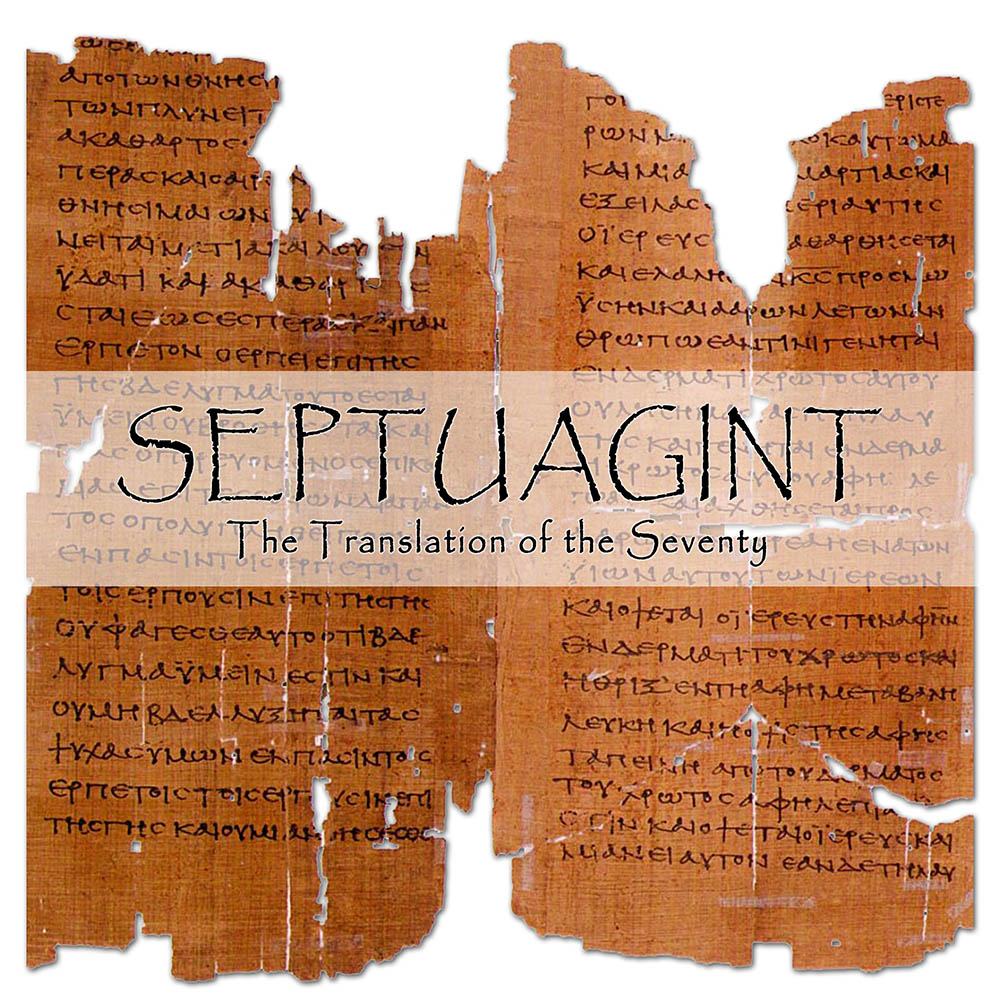
Here is a direct side-by-side comparison of the Masoretic Text with the LXX. I have concluded that the LXX is much to be preferred over the Masoretic Text, a position from which the Eastern Orthodox Church never deviated. Perhaps, if you take the time to read my comparisons and other articles, you will arrive at the same conclusion.
The Septuagint version I am using is the Lexham English Septuagint 2nd Edition, which is available in print or as part of Logos Bible Software. Occasionally I also use the Brenton translation of the LXX for insight into difficult passages.
If you want to know more, click on the following links.
- Why Christians Should Prefer the Septuagint over the Masoretic Text.
- Some Insights Gained through Comparing the Masoretic Text to the Septuagint
- More side by side comparisons of the Masoretic Text (MT) to the Septuagint (LXX).
| Masoretic Text | Septuagint | Significance |
|
1 “But now listen, O Jacob, My servant, And Israel, whom I have chosen: 2 Thus says the LORD who made you And formed you from the womb, who will help you, ‘Do not fear, O Jacob My servant; And you Jeshurun whom I have chosen. Isaiah 44:1–2 (NASB95) |
1 But now listen, Jacob, my child, and Israel, whom I have chosen. 2 This is what the Lord, the God who made you and who formed you from the belly, says: “You will still receive aid; do not be frightened, my servant Jacob, and beloved Israel, whom I have chosen, Isaiah 44:1–2 (LES2) |
As in other places in Isaiah, the MT calls Israel God’s “servant,” but the LXX uses the word “child.” This highlights a difference between serving God under the Law as a slave and serving him in the New Covenant as his child. Even in verse 2, the LXX uses the Greek word pais, which means “child,” even though the English used by the translators is “servant.” The MT calls Israel “Jeshurun,” which means upright one. The LXX calls here “beloved,” using the Greek verb agapao, which the New Testament uses for pure godly love. God has made those who believe in Jesus “upright” or justified, but the greatest blessing in the New Covenant is to be loved by God! (1 John 3:1) This raises the question, “Who is Jacob?” Of course it means natural Israel, but it also points to spiritual Israel, which is Christ (Matthew 2:15) and, by reason of born-again believers’ being “in Christ,” it also includes the church, which is called the “Israel of God.” (Galatians 6:16) Unless we understand this, we cannot fully grasp the nature of the New Covenant or properly interpret Isaiah’s prophecies. |
|
3 ‘For I will pour out water on the thirsty land And streams on the dry ground; I will pour out My Spirit on your offspring And My blessing on your descendants; 4 And they will spring up among the grass Like poplars by streams of water.’ 5 “This one will say, ‘I am the LORD’S’; And that one will call on the name of Jacob; And another will write on his hand, ‘Belonging to the LORD,’ And will name Israel’s name with honor. Isaiah 44:3–5 (NASB95) |
3 because I will provide water in thirst on those who walk in a waterless place; I will put my spirit upon your seed, and my blessing upon your children, 4 and they will rise up as grass from the midst of the water, and like a willow alongside flowing water.” 5 This one will say, “I am God’s,” and this one will give a shout at the name of Jacob, and another will write on his hand, “I belong to God”; at the name of Israel he will also shout. Isaiah 44:3–5 (LES2) |
The MT speaks of water being poured out on the ground, but the LXX promises that God will pour out water on thirsty people. In both the MT and LXX this figure of outpoured water transitions into a pouring out of God’s Spirit and his blessing upon the “seed” (singular) and upon “your children,” which in Greek is teknon, a very different word than seed. The MT also makes this distinction. Because the LXX associates water being poured out on people with the Spirit being poured out, it perfectly fits the New Covenant fulfillment of Joel 2:28-29, which happened in Acts 2:17-21, and of which Jesus prophesied. (John 7:37-39) The remainder of the passage has been and is being fulfilled in the New Covenant as people from all over the world, both Jew and Gentile, are being born again, filled with the Spirit, and giving praise to God. |
|
6 “Thus says the LORD, the King of Israel and his Redeemer, the LORD of hosts: ‘I am the first and I am the last, And there is no God besides Me. 7 ‘Who is like Me? Let him proclaim and declare it; Yes, let him recount it to Me in order, From the time that I established the ancient nation. And let them declare to them the things that are coming And the events that are going to take place. 8 ‘Do not tremble and do not be afraid; Have I not long since announced it to you and declared it? And you are My witnesses. Is there any God besides Me, Or is there any other Rock? I know of none.’ ” Isaiah 44:6–8 (NASB95) |
6 This is what the king of Israel, and the one who rescues him, God Sabaoth says: “I am the first, and I am after these things; except for me there is no God. 7 Who is like me? Let him stand and call and announce and prepare for me from the time since I made humanity for eternity, and let them announce to you the things that are coming before they come to pass. 8 Do not hide yourselves or be misled; did you not give ear from the beginning, and I announced it to you? You are witnesses whether there is a god other than me, and they did not listen at that time.” Isaiah 44:6–8 (LES2) |
This passage clearly points to Jesus, the crucified and risen King of the New Covenant Israel of God, which is a spiritual kingdom. (John 18:33-37) Jesus testifies in Revelation that he is indeed the “first and last, the Alpha and Omega.” (Revelation 22:13) Verse 6 identifies this one, Christ, as God – “except for me there is no God.” This agrees with Jesus’ words when he identified with the Great I AM. (John 8:58) In verses 7-8, God lets us know that the ability to foresee and predict what is coming is proof that he is the true God. Only he controls how things turn out. (Isaiah 46:10) That being the case, we who trust in Christ should not be afraid when times are uncertain. We are witnesses to the One who has all authority in heaven and on earth. (Matthew 28:18) The MT ends this passage with a positive statement about God, but the LXX says that Old Covenant Israel did not listen or believe God’s claims. |
|
9 Those who fashion a graven image are all of them futile, and their precious things are of no profit; even their own witnesses fail to see or know, so that they will be put to shame. 10 Who has fashioned a god or cast an idol to no profit? 11 Behold, all his companions will be put to shame, for the craftsmen themselves are mere men. Let them all assemble themselves, let them stand up, let them tremble, let them together be put to shame. 12 The man shapes iron into a cutting tool and does his work over the coals, fashioning it with hammers and working it with his strong arm. He also gets hungry and his strength fails; he drinks no water and becomes weary. 13 Another shapes wood, he extends a measuring line; he outlines it with red chalk. He works it with planes and outlines it with a compass, and makes it like the form of a man, like the beauty of man, so that it may sit in a house. 14 Surely he cuts cedars for himself, and takes a cypress or an oak and raises it for himself among the trees of the forest. He plants a fir, and the rain makes it grow. 15 Then it becomes something for a man to burn, so he takes one of them and warms himself; he also makes a fire to bake bread. He also makes a god and worships it; he makes it a graven image and falls down before it. 16 Half of it he burns in the fire; over this half he eats meat as he roasts a roast and is satisfied. He also warms himself and says, “Aha! I am warm, I have seen the fire.” 17 But the rest of it he makes into a god, his graven image. He falls down before it and worships; he also prays to it and says, “Deliver me, for you are my god.” 18 They do not know, nor do they understand, for He has smeared over their eyes so that they cannot see and their hearts so that they cannot comprehend. 19 No one recalls, nor is there knowledge or understanding to say, “I have burned half of it in the fire and also have baked bread over its coals. I roast meat and eat it. Then I make the rest of it into an abomination, I fall down before a block of wood!” 20 He feeds on ashes; a deceived heart has turned him aside. And he cannot deliver himself, nor say, “Is there not a lie in my right hand?” Isaiah 44:9–20 (NASB95) |
9 Those who formed and carved idols, all pointless, exercising their desires, which will not benefit them, but they will be put to shame. 10 All those who form a god and carve useless things 11 and all those from whence they have come about have withered, and all the deaf and dumb of humanity. Let them all be gathered together and stand together and be shamed and dishonored together. 12 For a craftsman sharpened an iron tool; he worked it with an axe and set it with an awl, and he worked it with his strong arm; and he will get hungry and weak and drinks no water at all. 13 The craftsman chose a piece of wood and set it with a measure, and fit it with glue, and made it like the shape of a man and like the beauty of a person, to set it up in a house. 14 He cut wood from the forest, which the Lord planted and the rain made grow, 15 in order that people might burn it, and taking some of it he was warmed; and by burning them, they baked bread on them, but with the remainder they produced gods and worship them. 16 He burned up half of the wood by fire, and with half of it he baked bread in the coals, and when he had roasted meat on it, he ate and was satisfied; and when he had warmed himself, he said, “It was nice for me that I was warmed and saw fire.” 17 The remainder he makes into a carved god and worships and prays to it saying, “Rescue me because you are my god!” 18 They did not know to be wise, for they were deprived of sight to see with their eyes and to think with their heart. 19 He did not reckon in his soul or perceive with insight that he burned half of it in the fire and baked bread upon its coals, and when he had roasted meat, he ate, and he made the rest of it into an abomination, and they worship it! 20 Know that their heart is ashes and they are deceived, and no one is able to rescue his own soul. Look, you will not say, “There is a lie in my right hand.” Isaiah 44:9–20 (LES2) |
The MT adds some words, but the general idea is the same. Idol worship is a pointless and futile abomination to God that reveals how deficient we are morally and spiritually. Israel has engaged in the worship of false gods from Genesis until the present. Today Baal and other satanic “god” are worshiped by those who follow the Kabbalah. All those who reject Christ do not have the true God. (1 John 2:23) Whatever they may worship is a false God, no matter what name they may give him. |
|
21 “Remember these things, O Jacob, And Israel, for you are My servant; I have formed you, you are My servant, O Israel, you will not be forgotten by Me. 22 “I have wiped out your transgressions like a thick cloud And your sins like a heavy mist. Return to Me, for I have redeemed you.” 23 Shout for joy, O heavens, for the LORD has done it! Shout joyfully, you lower parts of the earth; Break forth into a shout of joy, you mountains, O forest, and every tree in it; For the LORD has redeemed Jacob And in Israel He shows forth His glory. Isaiah 44:21–23 (NASB95) |
21 “Remember these things, Jacob and Israel, because you are my child; I formed you as my child, and you, Israel, do not forget me. 22 For look; I have blotted your lawless acts out as a cloud, and your sins as darkness. Return to me, and I will redeem you.” 23 Be cheerful, heavens, for God has shown mercy to Israel. Blow the trumpet, foundations of the earth! Call out, mountains, with cheer, hills and all the trees that are on them, for God has redeemed Jacob, and Israel will be glorified. Isaiah 44:21–23 (LES2) |
Once again we see that the MT calls Israel God’s “servant,” but the LXX says he is his “child,” which points to Christ. Again we see the MT assigning to Israel something not belonging to her. It says that she will “not be forgotten by me.” The LXX has God saying, “do not forget me.” Verse 22 is a plea for Israel to repent and believe the gospel. When Jesus hung on the cross, he asked his heavenly Father to forgive those who murdered him. (Luke 23:34) Peter extended an “olive branch” to Israel on the day of Pentecost when he begged his hearers to “repent and believe the gospel” and “be saved from this perverse generation.” (Acts 2:36-40) The Israel that God redeemed through Christ is the spiritual New Covenant Israel, the church, composed of Jew and Gentile. (Ephesians 2:15) This is the true chosen people, elected in Christ from before the foundation of the world. (Ephesians 1:4) The church has already been glorified in Christ (Romans 8:30). The church will bring God eternal glory as well. (Ephesians 3:21) |
|
24 Thus says the LORD, your Redeemer, and the one who formed you from the womb, “I, the LORD, am the maker of all things, Stretching out the heavens by Myself And spreading out the earth all alone, 25 Causing the omens of boasters to fail, Making fools out of diviners, Causing wise men to draw back And turning their knowledge into foolishness, 26 Confirming the word of His servant And performing the purpose of His messengers. It is I who says of Jerusalem, ‘She shall be inhabited!’ And of the cities of Judah, ‘They shall be built.’ And I will raise up her ruins again. 27 “It is I who says to the depth of the sea, ‘Be dried up!’ And I will make your rivers dry. 28 “It is I who says of Cyrus, ‘He is My shepherd! And he will perform all My desire.’ And he declares of Jerusalem, ‘She will be built,’ And of the temple, ‘Your foundation will be laid.’ ” Isaiah 44:24–28 (NASB95) |
24 This is what the Lord who redeems you and forms you from the womb says: “I am the Lord who accomplishes all things; I alone stretched out the heavens and established the earth.” 25 Who else will scatter the omens of the diviners, and the prophecies from the heart, who turns the wise into their opposite and turns their counsel into foolishness 26 and establishes the words of his child and verifies the counsel of his messengers? The one who says to Jerusalem, “You shall be inhabited!” and to the cities of Edom, “You shall be rebuilt!” and will cause her deserted places to spring forth; 27 the one who says to the abyss, “You shall be deserted, and I shall dry up your streams”; 28 the one who tells Cyrus to be wise and “He shall perform all my will”; the one who says to Jerusalem, “You will be built, and I will lay the foundation of my sacred house.” Isaiah 44:24–28 (LES2) |
Here Jesus is identified as the Creator, something confirmed in the opening chapter of John’s gospel. (John 1:3) Paul paraphrased verse 25 to describe the New Covenant gospel. (1 Corinthians 1:19) This link to the gospel is furthered in verse 26 in the LXX, where it says that God “establishes the words of his child,” meaning his only begotten Son, our Lord Jesus. The “counsel of his messengers” is the gospel of the New Covenant kingdom of God, which God confirmed and confirms through signs and wonders and the interior corroboration of the Holy Spirit. (Mark 16:20, Acts 5:12, Acts 14:3, Hebrews 2:4) As prophecy sometimes does, when its meaning is dual, the scene shifts back to Old Covenant Israel at the end of verse 26 through 28. We now know, however, that the ultimate meaning of the foundation of God’s “sacred house” is none other than our Lord Jesus, the chief cornerstone. (1 Corinthians 3:11, Ephesians 2:20) The house itself is the church. (1 Peter 2:4-8) The Old Covenant temple foreshadowed the spiritual reality in the New Covenant. |
Summary: The gospel according to Isaiah is wonderfully expressed in this amazing chapter from Isaiah, which points to Christ, the New Covenant, and the church – the “Israel of God.”