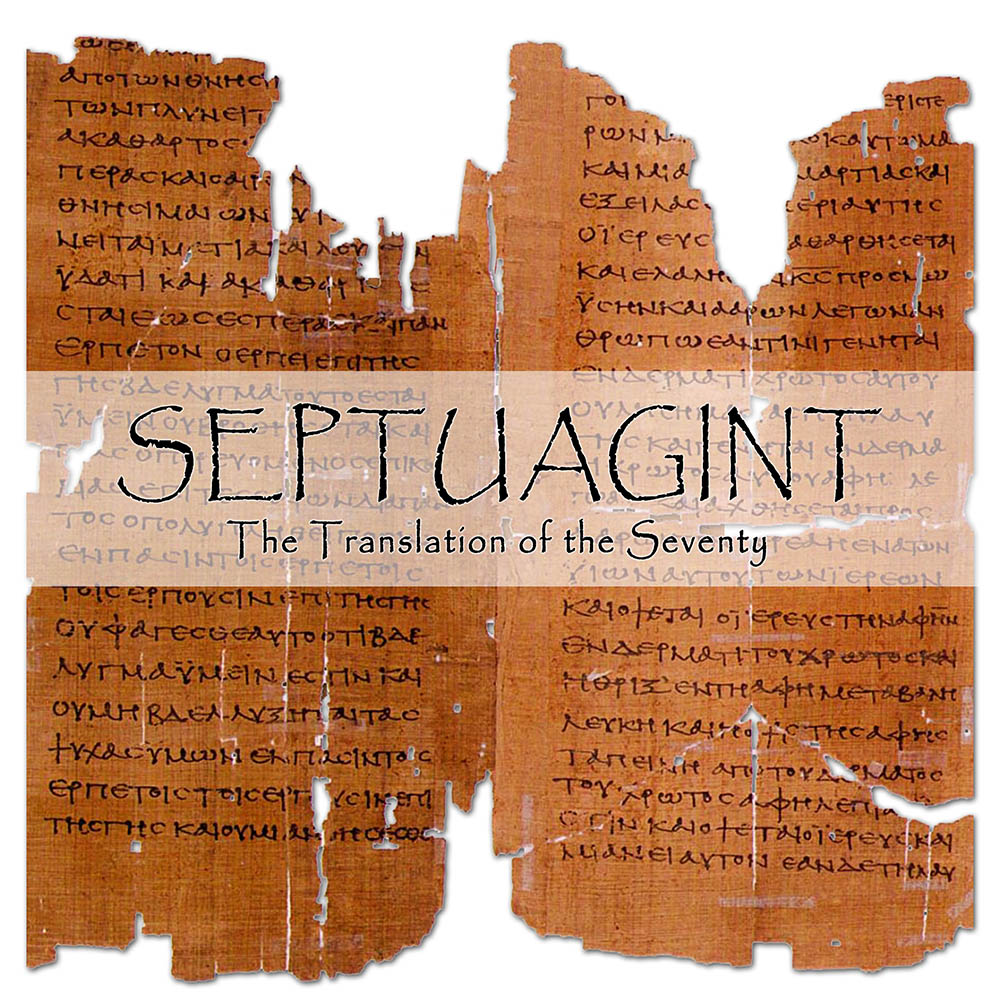
Here is a direct side-by-side comparison of the Masoretic Text with the LXX. I have concluded that the LXX is much to be preferred over the Masoretic Text, a position from which the Eastern Orthodox Church never deviated. Perhaps, if you take the time to read my comparisons and other articles, you will arrive at the same conclusion.
The Septuagint version I am using is the Lexham English Septuagint 2nd Edition, which is available in print or as part of Logos Bible Software. Occasionally I also use the Brenton translation of the LXX for insight into difficult passages.
If you want to know more, click on the following links.
- Why Christians Should Prefer the Septuagint over the Masoretic Text.
- Some Insights Gained through Comparing the Masoretic Text to the Septuagint
- More side by side comparisons of the Masoretic Text (MT) to the Septuagint (LXX).
| Masoretic Text | Septuagint | Significance |
|
1 “The sin of Judah is written with a pen of iron; With the point of a diamond it is engraved On the tablet of their heart, And on the horns of your altars, 2 While their children remember Their altars and their wooden images By the green trees on the high hills. 3 O My mountain in the field, I will give as plunder your wealth, all your treasures, And your high places of sin within all your borders. 4 And you, even yourself, Shall let go of your heritage which I gave you; And I will cause you to serve your enemies In the land which you do not know; For you have kindled a fire in My anger which shall burn forever.” Jeremiah 17:1–4 (NKJV) |
Not in LXX | Here is an example of text the MT adds to what is contained in the LXX. I have been disturbed that some of the “precious promises” I have believed in the Old Testament, as written in the MT, do not exist in the LXX, or are much different. The last thing we want to do is put our trust in words God did not say. We will later see just how important this is when we look at Jeremiah 33:14-26, which is not found in the LXX, but is claimed as a proof text by Zionists. |
|
5 Thus says the LORD: “Cursed is the man who trusts in man And makes flesh his strength, Whose heart departs from the LORD. 6 For he shall be like a shrub in the desert, And shall not see when good comes, But shall inhabit the parched places in the wilderness, In a salt land which is not inhabited. Jeremiah 17:5–6 (NKJV) |
5 Cursed is the person who has hope in humankind and who will lean the flesh of his arm on him and his heart is removed from the Lord. 6 And he will be like the tamarisk in the desert; he will not see when good things come. And he will encamp by the sea and in the wilderness, in a briny land that is not inhabited. Jeremiah 17:5–6 (LES2) |
The main difference between the MT and LXX in this passage is that the LXX adds “by the sea,” which explains why the land is salty. The general ideas is that failure to trust the Lord removes us from blessings and fruitfulness. |
|
7 “Blessed is the man who trusts in the LORD, And whose hope is the LORD. 8 For he shall be like a tree planted by the waters, Which spreads out its roots by the river, And will not fear when heat comes; But its leaf will be green, And will not be anxious in the year of drought, Nor will cease from yielding fruit. Jeremiah 17:7–8 (NKJV) |
7 And blessed is the person who trusts the Lord, and the Lord will be his hope. 8 And he will be like a tree flourishing beside the waters, and it will cast its roots into the moisture. It will not fear when heat comes, and there will be wooded branches on it. It will not fear in the year of drought, and it will not cease making fruit. Jeremiah 17:7–8 (LES2) |
In the LXX, the Greek word for “trusts” is peitho, which means to bind, persuade, win over, or trust. This passage essentially agrees, except the MT says the tree will have green leaves, but the LXX says, wooded branches. |
|
9 “The heart is deceitful above all things, And desperately wicked; Who can know it? 10 I, the LORD, search the heart, I test the mind, Even to give every man according to his ways, According to the fruit of his doings. Jeremiah 17:9–10 (NKJV) |
9 The heart is deeper than all things; a person is also. And who will understand him? 10 I, the Lord, who visits hearts and tests the kidneys to give each according to his ways and according to the fruits of his pursuits. Jeremiah 17:9–10 (LES2) |
This passage is entirely different in the MT, which is what is familiar to most of us. How did the MT get from what the LXX says to its version? Perhaps it is a revelation of the heart of the translators of the MT. The human heart is wicked, without God, but it is also wicked to put words in God’s mouth that he did not say. The LXX makes much more sense in how it segues from verse 9 to 10. Because the heart is deep, only God can understand it. In a similar way, Paul wrote that God’s heart is also unsearchable. (Romans 11:33) We can only know it by revelation from the Holy Spirit. (1 Corinthians 2:11) |
|
11 “As a partridge that broods but does not hatch, So is he who gets riches, but not by right; It will leave him in the midst of his days, And at his end he will be a fool.” Jeremiah 17:11 (NKJV) |
11 The partridge sang; it collected what it did not bring forth. So is the one who makes his wealth without judgment: at the midpoint of his days, they will forsake him, and at his end he will be crazy. Jeremiah 17:11 (LES2) |
The wording is different here, but the general idea is the same. |
|
12 A glorious high throne from the beginning Is the place of our sanctuary. 13 O LORD, the hope of Israel, All who forsake You shall be ashamed. “Those who depart from Me Shall be written in the earth, Because they have forsaken the LORD, The fountain of living waters.” Jeremiah 17:12–13 (NKJV) |
12 A throne of glory, highly exalted, is our sanctuary! 13 O endurance of Israel! O Lord! Let all who forsake you be disgraced; let those who have turned away be written upon the earth, because they have forsaken the spring of life, the Lord. Jeremiah 17:12–13 (LES2) |
The MT adds the phrase, ‘from the beginning,” which is unnecessary. The MT calls the Lord, “the hope of Israel” but the LXX calls him, “the steadfastness” of Israel, which contrasts to Israel’s unfaithfulness. We know that the fountain of life is the Holy Spirit, whom we receive when we believe in Jesus. 37 On the last day, that great day of the feast, Jesus stood and cried out, saying, “If anyone thirsts, let him come to Me and drink. 38 He who believes in Me, as the Scripture has said, out of his heart will flow rivers of living water.” 39 But this He spoke concerning the Spirit, whom those believing in Him would receive; for the Holy Spirit was not yet given, because Jesus was not yet glorified. John 7:37–39 (NKJV) Everyone who rejects Jesus, whether Jew or Gentile, judges himself unworthy of eternal life (Acts 13:46) and cuts himself off from the source of life. Rejecting Jesus is the same thing as rejecting God altogether (1 John 2:22-23). Those who refuse to acknowledge Jesus serve a different “god” altogether. In spiritual warfare, there are only two teams: Jesus and all the rest who rally under Satan’s flag. (John 14:6) To claim that modern unbelieving Jews are God’s “chosen people” is to defy the testimony of the Bible. Jesus said that all who are not with him are against him. (Matthew 12:30) |
|
14 Heal me, O LORD, and I shall be healed; Save me, and I shall be saved, For You are my praise. 15 Indeed they say to me, “Where is the word of the LORD? Let it come now!” 16 As for me, I have not hurried away from being a shepherd who follows You, Nor have I desired the woeful day; You know what came out of my lips; It was right there before You. 17 Do not be a terror to me; You are my hope in the day of doom. 18 Let them be ashamed who persecute me, But do not let me be put to shame; Let them be dismayed, But do not let me be dismayed. Bring on them the day of doom, And destroy them with double destruction! Jeremiah 17:14–18 (NKJV) |
14 Heal me, O Lord, and I will be healed. Save me, and I will be saved, because you are my boast. 15 Look! They say to me, “Where is the word of the Lord? Let it come!” 16 But I have not grown weary of following after you, and I have not desired the day of humankind; you understand. What goes out through my lips is before your face. 17 Do not become like an estranged person to me, by sparing me in an evil day. 18 Let those who pursue me be disgraced, and may I not be ashamed. May they be terrified, and may I not be afraid. Bring an evil day upon them; wound them with a double wound! Jeremiah 17:14–18 (LES2) |
In the LXX, Jeremiah makes his boast in the Lord, which Paul also did in 2 Corinthians 10:17, where he quoted Jeremiah 9:24. Verse 17 in the LXX is difficult to translate. The MT seems to conquer this by having it agree with verse 18. The idea of God’s seeming to be estranged from Jeremiah would have been extremely unsettling, as it was to King David when we composed Psalm 51:11. Brenton translates this verse as follows. Be not to me a stranger, but spare me in the evil day. [Brenton, Sir Lancelot C. L.. English Translation of the Greek Septuagint, Including the Apocrypha . E.C. Marsh. Kindle Edition] I believe that is the best way to understand the verse. My only other comment on this passage is that the Hebrew word chathath, which is translated “dismayed” in the MT, is rendered as “terrified” by the LXX. The word dismay in English can mean to terrify, but also communicates something far less, such as being unsettled or apprehensive. It is important that we know how the LXX translators understood the word. |