The startling difference between the MT and LXX is clearly revealed in the genealogies of Genesis 5 and 11. Here is a direct side-by-side comparison of the Masoretic Text with the LXX. I have concluded that the LXX is much to be preferred over the Masoretic Text, a position from which the Eastern Orthodox Church never deviated. Perhaps, if you take the time to read my comparisons and other articles, you will arrive at the same conclusion.
The Septuagint version I am using is the Lexham English Septuagint 2nd Edition, which is available in print or as part of Logos Bible Software. Occasionally I also use the Brenton translation of the LXX for insight into difficult passages.
If you want to know more, click on the following links.
- Why Christians Should Prefer the Septuagint over the Masoretic Text.
- Some Insights Gained through Comparing the Masoretic Text to the Septuagint
- More side by side comparisons of the Masoretic Text (MT) to the Septuagint (LXX).
| Masoretic Text | Septuagint | Significance |
|
10 And it came to pass after seven days that the waters of the flood were on the earth. 11 In the six hundredth year of Noah’s life, in the second month, the seventeenth day of the month, on that day all the fountains of the great deep were broken up, and the windows of heaven were opened. 12 And the rain was on the earth forty days and forty nights. Genesis 7:10–12 (NKJV) |
10 And this happened: after the seven days, the water of the deluge came upon the earth. 11 In the six hundredth year in the life of Noah, during the second month, on the twenty-seventh of the month, on this day all the springs of the deeps burst forth, and the waterfalls of the heavens were opened. 12 And the rain came upon the earth for forty days and forty nights. Genesis 7:10–12 (LES2) |
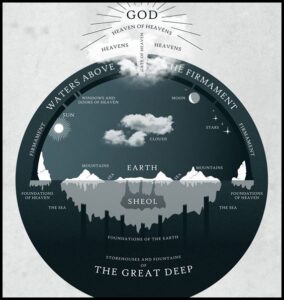
The Greek word for deluge in the LXX can also mean inundation. Both the MT and LXX say the flood came when Noah was 600 years old, but the MT says it came on the 17th day of the second month, while the LXX says it was the 27th. Both agree that the springs in the abyss or great deep burst forth. In addition to the water coming from below, the MT says the “windows” or flood gates in heaven were opened. The LXX says that they “waterfalls” (literally cataracts) of heaven were opened. This was much more than a simple rain. Genesis 1:6 tells us that earth is surrounded by water.
The waters above are held in place by the solid dome of the firmament. God opened the firmament so that some of those waters flooded the earth from above while simultaneously great volumes of water burst forth from below. Since the biblical earth is a level plain enclosed by the firmament, it is not hard to imagine the water’s rising above the mountains while being contained by the walls of the firmament. It is much more of a problem conceiving of such a thing on the imaginary globe earth. The psalmist tells us that those waters above the firmament are still there (Psalm 148:4), having been replaced or simply recycled via whatever ever system God has in place. It is impossible for us to imagine the magnitude and rapidity of the deluge of the earth. The rain continued forty days and nights, but the flood was not simply a matter of a gradual rise of water. |
|
17 Now the flood was on the earth forty days. The waters increased and lifted up the ark, and it rose high above the earth. 18 The waters prevailed and greatly increased on the earth, and the ark moved about on the surface of the waters. 19 And the waters prevailed exceedingly on the earth, and all the high hills under the whole heaven were covered. 20 The waters prevailed fifteen cubits upward, and the mountains were covered. Genesis 7:17–20 (NKJV) |
17 And the deluge happened upon the earth, for forty days and forty nights upon the earth. And the water increased, and it lifted the ark. and it was raised up from the earth. 18 And the water prevailed and increased very much upon the earth, and the ark was being carried upon the water. 19 The water prevailed extremely over the earth and covered up all the high mountains that are under the heavens. 20 The water rose up fifteen cubits, and it covered all the high mountains. Genesis 7:17–20 (LES2) |
Language matters. Active and passive voices are important. Singulars and plurals are significant. The MT routinely changes such things. An example of this is found in verse 18. The MT says the ark moved about on the surface of the waters, but the LXX says it was carried upon the water. The ark was not in control. It had no engine or sail. It was at the mercy of the flood. Verse 19 says the flood waters covered all the lofty mountains under the heavens. This is an example of the importance of up and down in the Bible. Heaven is always up, above the firmament, and the earth is always below or down. Underneath the earth is Sheol and the great deep. This layered creation is referenced from Genesis to Revelation and supports the Bible’s testimony regarding shape of the earth. |