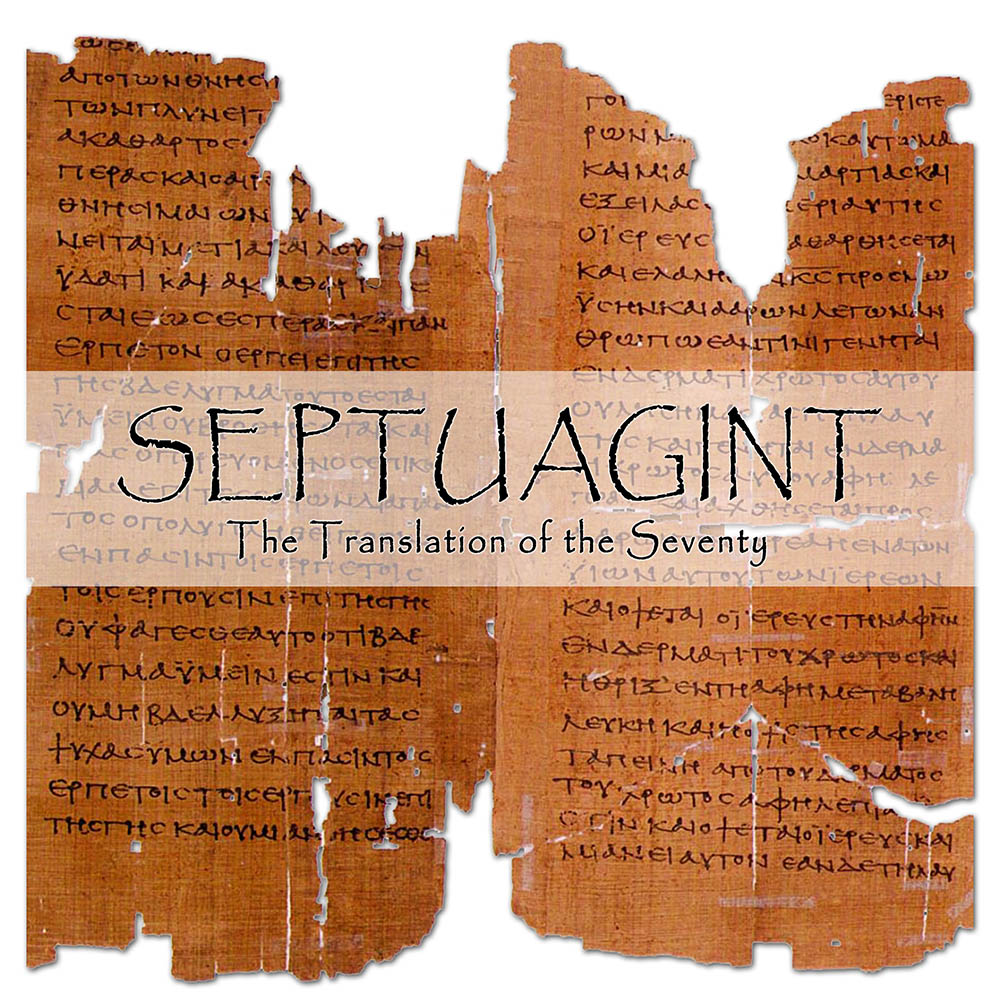
Here is a direct side-by-side comparison of the Masoretic Text with the LXX. I have concluded that the LXX is much to be preferred over the Masoretic Text, a position from which the Eastern Orthodox Church never deviated. Perhaps, if you take the time to read my comparisons and other articles, you will arrive at the same conclusion.
The Septuagint version I am using is the Lexham English Septuagint 2nd Edition, which is available in print or as part of Logos Bible Software. Occasionally I also use the Brenton translation of the LXX for insight into difficult passages.
If you want to know more, click on the following links.
- Why Christians Should Prefer the Septuagint over the Masoretic Text.
- Some Insights Gained through Comparing the Masoretic Text to the Septuagint
- More side by side comparisons of the Masoretic Text (MT) to the Septuagint (LXX).
| Masoretic Text | Septuagint | Significance |
|
1 Now the serpent was more cunning than any beast of the field which the LORD God had made. And he said to the woman, “Has God indeed said, ‘You shall not eat of every tree of the garden’?” Genesis 3:1 (NKJV) |
1 The two were naked, both Adam and his wife, and they did not feel shame. Now the serpent was wiser than all the wild animals that were upon the earth that the Lord God made. And the serpent said to the woman, “Why is it that God said, ‘You may not eat from every tree of the garden?’ ” Genesis 3:1 (LES2) |
The LXX puts the last verse of the previous chapter of the MT as the lead in to chapter 3, which provides a stark contrast to the shame felt by Adam and Eve in the aftermath of their sin. The MT says the serpent was more cunning than the other animals, but the LXX says it was more intelligent. The MT uses the word “field” or “land” to describe its habitat, but the LXX uses the broader word “world.” The serpent was more intelligent than any other animal in the world and was, apparently in this case, filled by Satan. Was it unusual for a serpent to talk, or was Eve simply not familiar with what animals could and could not do? As usual, Satan goes after whomever he thinks is most susceptible. Eve had not received a direct word from God. She only knew what Adam had told her about the trees in the garden. We are not sure what sort of experience she had with God at this point either. Did she know the Lord as Adam did? The question asked in the MT is different from that of the LXX. In the MT the serpent asks, “Has God said,” but in the LXX he asks a deeper question, “Why is it that God said?” The LXX has the serpent luring Eve into questioning God’s motives while also misstating his words, which is very clever indeed. To be fair, it is also possible to translate the Greek word “tis” as “what.” That would make it read, “What is it that God said?” which is comparable to the MT. |
|
2 And the woman said to the serpent, “We may eat the fruit of the trees of the garden; 3 but of the fruit of the tree which is in the midst of the garden, God has said, ‘You shall not eat it, nor shall you touch it, lest you die.’ ” Genesis 3:2–3 (NKJV) |
2 The woman said to the serpent, “From every tree of the garden we may eat, 3 but from the fruit of the tree that is in the middle of the garden God said, ‘You will not eat from it, nor may you touch it, in order that you might not die.’ ” Genesis 3:2–3 (LES2) |
It is interesting that the forbidden tree was in the middle of the garden, not on its edge. Eve correctly responded that she was permitted to eat from “every” tree except the one, contradicting the serpent’s wording which was intended to seem more limiting, which, of course, was the tempter’s design. He wanted Eve to focus on the one thing forbidden instead of all that was permitted. Eve added that God also forbade touching or grasping the fruit, something that God did not say. We do not know if she fabricated this prohibition herself, or was it what Adam told her to try to further fence off the tree from her. Legalism always goes beyond what God says. As a result, when she touched the fruit and did not die, it might have emboldened her to believe the devil’s lie that eating it would not result in death either. |
|
4 Then the serpent said to the woman, “You will not surely die. 5 For God knows that in the day you eat of it your eyes will be opened, and you will be like God, knowing good and evil.” Genesis 3:4–5 (NKJV) |
4 The serpent said to the woman, “You certainly will not die; 5 for God knows that in the day you eat from it, your eyes will be opened, and you will be as gods who know good and evil.” Genesis 3:4–5 (LES2) |
In this passage, the MT uses the Hebrew word elohim for God in both places, which is a plural. The LXX uses the singular theos at the beginning of verse 5 for God himself, but uses the plural of that word when describing how Adam and Eve could become “gods.” The Hebrew uses the plural Elohim with a singular verb. The Greek, however, uses the singular theos with a singular verb and the plural of theos with a plural verb. Christians understand that the plural Elohim reveals the mystery of the Triune God, who is one God, but three distinct persons – Father, Son, and Holy Spirit. The Greek does not communicate that subtlety. The temptation was to rebel against being in the humble position of a created being, who is completely dependent upon God, in order to become more self-sufficient, especially in the realm of knowledge. Why knowing evil was a temptation is somewhat of a mystery. Perhaps it was mainly a temptation to be godlike, no matter what the cost. |
|
6 So when the woman saw that the tree was good for food, that it was pleasant to the eyes, and a tree desirable to make one wise, she took of its fruit and ate. She also gave to her husband with her, and he ate. 7 Then the eyes of both of them were opened, and they knew that they were naked; and they sewed fig leaves together and made themselves coverings. Genesis 3:6–7 (NKJV) |
6 The woman saw that the tree was good for food and that it was pleasing to the eyes to look at and it was seasonable to look at, and after taking some of its fruit, she ate. She also gave to her husband with her, and they ate. 7 Then the eyes of the two were opened, and they realized that they were naked, and they sewed together fig-tree leaves and made for themselves loincloths. Genesis 3:6–7 (LES2) |
The contrast here is interesting. The MT says that the tree was “desirable to make one wise.” The LXX, in the Lexham translation, however, says it was “seasonable to look at.” The Greek word horaios can also mean “beautiful to contemplate” and “full of the vigor of life.” I rather think that Eve saw it as being the very opposite of what God said. Rather than being something to cause death, it appeared to be full of life. This was a situation beyond Eve’s capacity to discern and reveals why she, and we, desperately need to rely on what God says rather than our own judgment when the two are at odds. Her first action was to take the fruit. She believed that the act of touching it would kill her; so, this must have been quite a bold thing to do. She must have felt further emboldened when she did not immediately die, which probably encouraged her to go ahead and eat it. Adam was with her, apparently acting as the proverbial passive husband while his wife took the lead. He followed her example and also ate, choosing loyalty to her over God. Probably instantly, or at least quite soon, they were filled with shame, a previously unknown emotion that came as a result of their sudden awareness of their nakedness. This takes us back to the first verse of the LXX, which says they were naked and unashamed, which was their condition as God made them. Naked and ashamed was their new condition as a result of knowing good and evil. Their first action was to try to cover their nakedness with a kind of primitive clothing made of leaves, which would have been not very durable. |
|
8 And they heard the sound of the LORD God walking in the garden in the cool of the day, and Adam and his wife hid themselves from the presence of the LORD God among the trees of the garden. 9 Then the LORD God called to Adam and said to him, “Where are you?” 10 So he said, “I heard Your voice in the garden, and I was afraid because I was naked; and I hid myself.” 11 And He said, “Who told you that you were naked? Have you eaten from the tree of which I commanded you that you should not eat?” Genesis 3:8–11 (NKJV) |
8 They heard the sound of the Lord God walking about in the garden in the evening, and both Adam and his wife hid from the face of the Lord God in the middle of the tree of the garden. 9 And Lord God summoned Adam and said to him, “Adam, where are you?” 10 He said to him, “I heard the sound of you walking about in the garden, and I was afraid because I am naked, and I hid.” 11 He said to him, “Who told you that you are naked? Unless you have eaten from the tree of which I commanded you ‘From this one alone, do not eat.’ ” Genesis 3:8–11 (LES2) |
Literally verse 8 says they hid in the middle of the tree in the garden, indicating they hid in the tree of the knowledge of good and evil. God was walking about, which indicates he had a body, which makes one suppose that this was a pre-incarnate appearance of our Lord Jesus. What Adam said, probably without his being aware of it, revealed his new fallen condition. He was naked, afraid, and hiding. This is what sin does to people. Unless God comes looking for us, we will never find him. (John 6:44) God knew that Adam and Eve could never have known of their nakedness unless someone had told them or if they had eaten from the forbidden tree. Perhaps both were true. It is possible, though not recorded, that the serpent told them they were naked. The Bible identifies the devil as the “accuser of the brethren” (Revelation 12:10), who routinely points out our sin and fallen condition. God knew what had taken place, but tested his creatures to see if Adam and Eve would take responsibility for their sin. |
|
12 Then the man said, “The woman whom You gave to be with me, she gave me of the tree, and I ate.” 13 And the LORD God said to the woman, “What is this you have done?” The woman said, “The serpent deceived me, and I ate.” Genesis 3:12–13 (NKJV) |
12 Adam said, “The woman with me, whom you gave, she gave me something from the tree, and I ate.” 13 The Lord God said to the woman, “What is this you have done?” The woman said, “The serpent deceived me, and I ate.” Genesis 3:12–13 (LES2) |
The MT and LXX agree for once. As is common with man, Adam and Eve blamed someone else for their sins. |