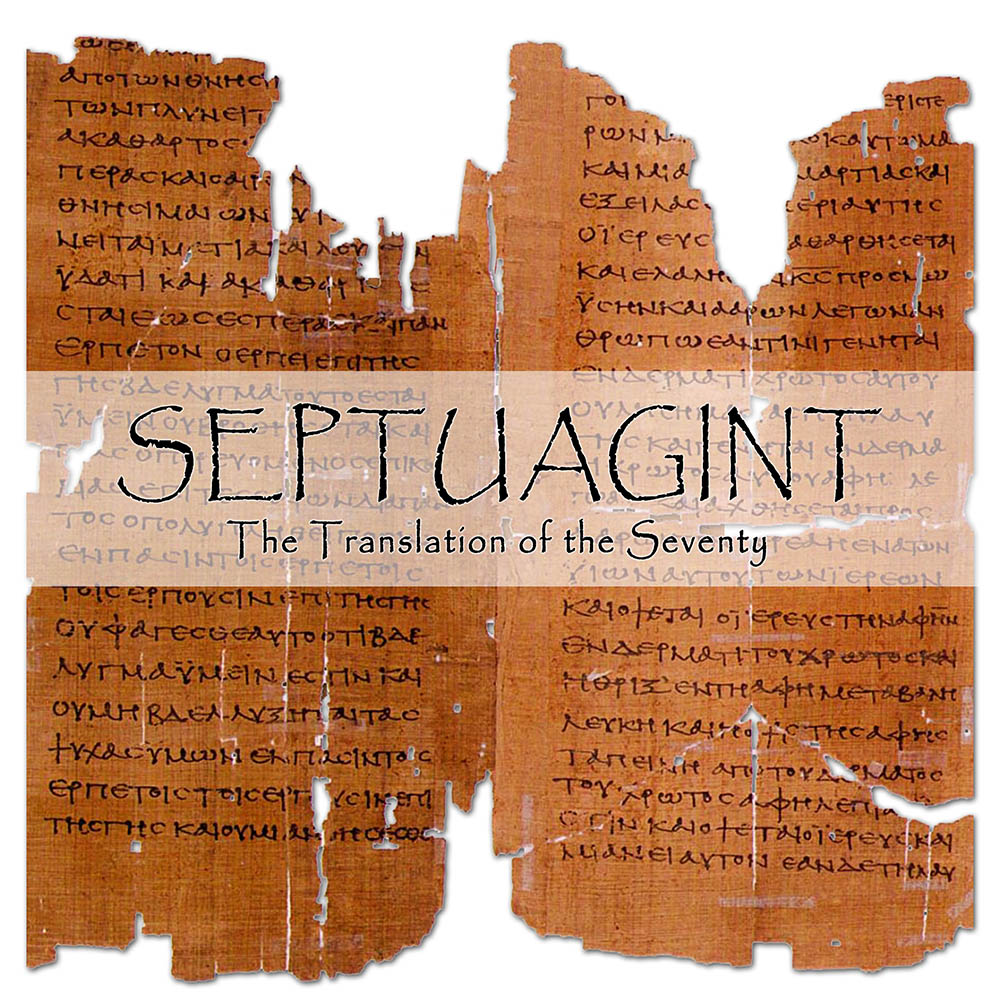
Here is a direct side-by-side comparison of the Masoretic Text with the LXX. I have concluded that the LXX is much to be preferred over the Masoretic Text, a position from which the Eastern Orthodox Church never deviated. Perhaps, if you take the time to read my comparisons and other articles, you will arrive at the same conclusion.
The Septuagint version I am using is the Lexham English Septuagint 2nd Edition, which is available in print or as part of Logos Bible Software. Occasionally I also use the Brenton translation of the LXX for insight into difficult passages.
If you want to know more, click on the following links.
- Why Christians Should Prefer the Septuagint over the Masoretic Text.
- Some Insights Gained through Comparing the Masoretic Text to the Septuagint
- More side by side comparisons of the Masoretic Text (MT) to the Septuagint (LXX).
| Masoretic Text | Septuagint | Significance |
|
6 All we like sheep have gone astray; We have turned, every one, to his own way; And the LORD has laid on Him the iniquity of us all. Isaiah 53:6 (NKJV) |
6 We all have been misled like sheep; each person was misled in his own path, and the Lord handed him over for our sins. Isaiah 53:6 (LES2) |
I find this verse extremely interesting. The MT says we sheep have “gone astray,” but the LXX says we have been “led astray” or “misled.” The Greek word used for “misled” is planao, which means to “deceive” or “wander.” We get our English word for “planet” from it. Originally what we call planets were called wandering stars or planetes asteres in Greek. Isn’t interesting that every time a person calls the earth a planet, it is the same as saying the earth is a deception? Satan appeared to Eve in the form of a talking serpent and misled her to disbelieve God’s Word and choose to give allegiance to him by obeying his voice instead of God’s. The essence of sin is going our own way instead of being loyal to God. And we do that as a consequence of being misled and believing a lie. All sin is rooted in deception. The MT next says that “the Lord has laid on him the iniquity of us all.” This could be also translated, “has caused him to encounter our sins.” The LXX says the “the Lord handed him over (Greek – paradidomai) tor our sins.” Both are true. The idea of our sins being “laid on” Jesus hearkens back to the Old Testament practice of laying hands on a sacrifice so that the sins of the offerer became identified with the offering. This also happened for our benefit to Jesus. Paul wrote: 21 For He made Him who knew no sin to be sin for us, that we might become the righteousness of God in Him. 2 Corinthians 5:21 (NKJV) Regarding the LXX, interestingly, the NT speaks of Jesus being “handed over.” The same Greek verb, paradidomai, is used in the following verses. In these cases the word is translated as “delivered.” 1 When morning came, all the chief priests and elders of the people plotted against Jesus to put Him to death. 2 And when they had bound Him, they led Him away and delivered Him to Pontius Pilate the governor. Matthew 27:1–2 (NKJV) 15 So Pilate, wanting to gratify the crowd, released Barabbas to them; and he delivered Jesus, after he had scourged Him, to be crucified. Mark 15:15 (NKJV) Isaiah’s prophecy, both in the MT and in the LXX, was perfectly fulfilled by Christ. In this case, both versions have something to tell us. |
|
7 He was oppressed and He was afflicted, Yet He opened not His mouth; He was led as a lamb to the slaughter, And as a sheep before its shearers is silent, So He opened not His mouth. Isaiah 53:7 (NKJV) |
7 And because he was afflicted, he does not open his mouth; like a sheep is led to slaughter, and like a lamb is voiceless before the one who shears it, so he does not open his mouth. Isaiah 53:7 (LES2) |
In the first part of this verse, these two translations are essentially the same, except that the LXX and MT reverse the order of sheep and lamb. I tend to go with the MT on this one because John the Baptist called Jesus the “Lamb or God.” 29 The next day John saw Jesus coming toward him, and said, “Behold! The Lamb of God who takes away the sin of the world! John 1:29 (NKJV) Jesus, the Lamb of God, was led to the slaughter on the cross for the sins of the world (Greek – cosmos), not just for the Jewish people. God’s plan included the nations from the start. Including the nations was not some after thought or “parenthesis.” On the side of the LXX, we who believe in Christ are his “sheep.” We too may be “led to the slaughter” for our testimony to Christ. (Romans 8:36) In this sense, the LXX could be a reference to the church’s laying down its life for Christ. Just a thought. |
|
8 He was taken from prison and from judgment, And who will declare His generation? For He was cut off from the land of the living; For the transgressions of My people He was stricken. Isaiah 53:8 (NKJV) |
8 His judgment was taken away in humiliation; who will describe his family? For his life was taken from the earth; he was led to death because of the lawless acts of my people. Isaiah 53:8 (LES2) |
The MT says, “He was taken from prison and judgment.” The LXX has, “His judgment was taken away in humiliation.” Once again, both seem to be true. Jesus may not have been literally in prison, but he was in the custody of the soldiers and the high priest. Righteous judgment was taken from him. He was publicly humiliated, according to the LXX, which is a recurring theme in that version of Isaiah. Jesus’ trial before the Sanhedrin was a travesty and a mockery. When he stood before Pilate, having been scourged, which was in itself extremely humiliating, the procurator said, “Behold the man.” Jesus was paraded in front of the crowd in the most humiliating fashion. That same crowd demanded his crucifixion. They rejected our Lord as their Messiah preferring a murderer named Barabbas. Imagine the humiliation for the Creator – Redeemer – Sustainer – Lord ! Both the MT and LXX ask the question, “who will declare his generation” or “who will describe his family.” Because he was “cut off from the land or the living” or “his life was taken from the earth,” he had no natural progeny. This question will later be answered after the resurrection when those who believe on him are “born again” into God’s family, creating a new version of humanity. Jesus was the “second” or “last” Adam. (1 Corinthians 15:45) The last part of the verse in the MT reads, “For the transgressions of my people he was stricken.” The LXX puts it this way, “he was led to death because of the lawless acts of my people.” Luke records the following. 26 Now as they led Him away, they laid hold of a certain man, Simon a Cyrenian, who was coming from the country, and on him they laid the cross that he might bear it after Jesus. Luke 23:26 (NKJV) In my estimation, this verse goes to the LXX. |
|
9 And they made His grave with the wicked— But with the rich at His death, Because He had done no violence, Nor was any deceit in His mouth. Isaiah 53:9 (NKJV) |
9 And I will give the wicked in place of his tomb, and the wealthy in place of death, because he committed no lawlessness, and there was no deceit in his mouth. Isaiah 53:9 (LES2) |
The wording of the first part of this verse is difficult in the LXX. Brenton’s translation put it as follows: “And I will give the wicked for his burial, and the rich for his death…” The MT is not much better. The MT said that Jesus had “done no violence.” The Hebrew word translated as “violence” can also mean “wrong.” The LXX says that Jesus committed no lawlessness. Both are right, but I tend to like the LXX better. Both agree that Jesus never lied or led people astray. In conclusion, although both the MT and the LXX offer insights into Christ’s suffering and death in the above verses, I lean toward the LXX on this one, as I do in most instances. |
|
7 …He was led as a lamb to the slaughter, And as a sheep before its shearers is silent, So He opened not His mouth. 8 He was taken from prison and from judgment, And who will declare His generation? For He was cut off from the land of the living; For the transgressions of My people He was stricken. Isaiah 53:7–8 (NKJV) |
7 …like a sheep is led to slaughter, and like a lamb is voiceless before the one who shears it, so he does not open his mouth. 8 His judgment was taken away in humiliation; who will describe his family? For his life was taken from the earth… Isaiah 53:7–8 (LES2) |
In Acts Chapter 8, the Ethiopian eunuch was reading from Isaiah 53:7-8 when Philip approached him and used these verses as a launching pad to preach the gospel. Here is the quote from the NT. 32 The place in the Scripture which he read was this: “He was led as a sheep to the slaughter; And as a lamb before its shearer is silent, So He opened not His mouth. 33 In His humiliation His justice was taken away, And who will declare His generation? For His life is taken from the earth.” Acts 8:32–33 (NKJV) It is clear that the quote came from the LXX, not the MT. The NT quote maintains the same order of sheep and lamb as does the LXX. The NT agrees with the LXX that Jesus’ judgment was taken way in humiliation. Both say that his life was taken from the earth. Though the English translation of the LXX and NT are slightly different, the Greek is the same. This shows that Luke used the LXX for his quote, not the MT. |