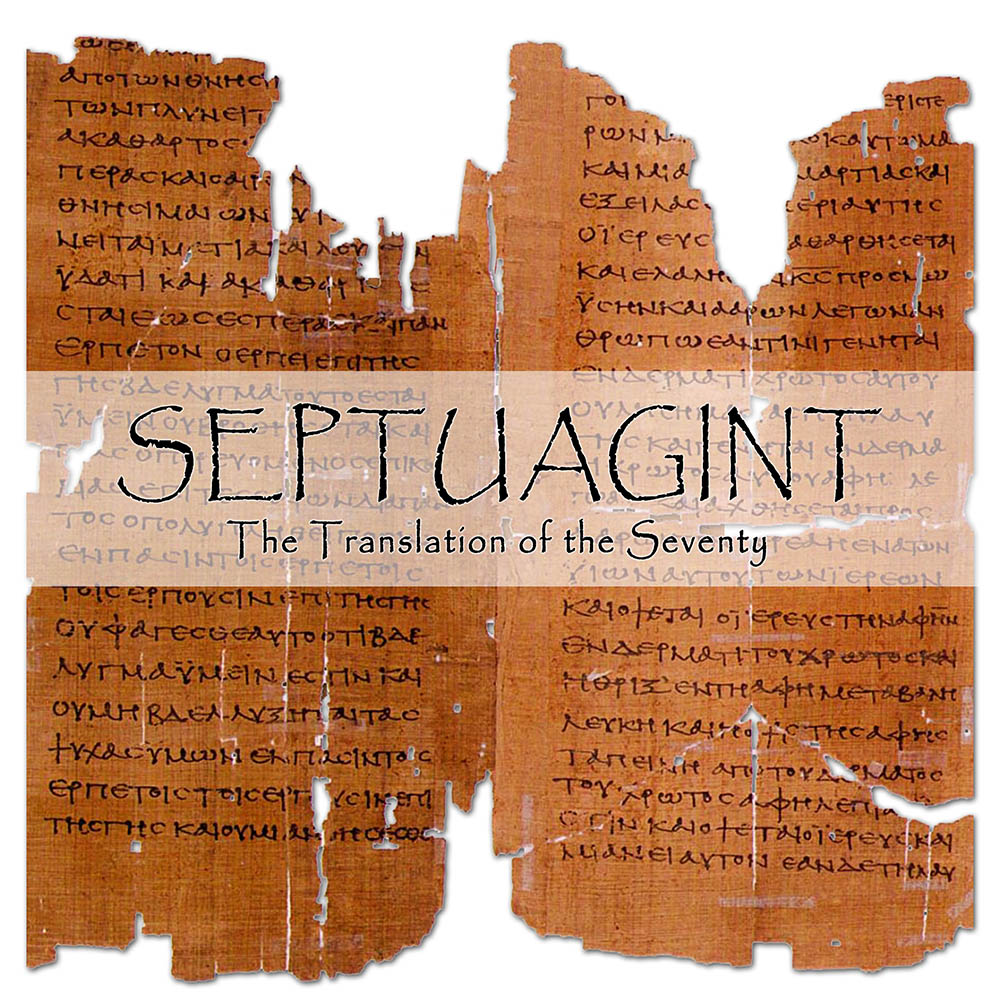
Here is a direct side-by-side comparison of the Masoretic Text with the LXX. I have concluded that the LXX is much to be preferred over the Masoretic Text, a position from which the Eastern Orthodox Church never deviated. Perhaps, if you take the time to read my comparisons and other articles, you will arrive at the same conclusion.
The Septuagint version I am using is the Lexham English Septuagint 2nd Edition, which is available in print or as part of Logos Bible Software. Occasionally I also use the Brenton translation of the LXX for insight into difficult passages.
If you want to know more, click on the following links.
- Why Christians Should Prefer the Septuagint over the Masoretic Text.
- Some Insights Gained through Comparing the Masoretic Text to the Septuagint
- More side by side comparisons of the Masoretic Text (MT) to the Septuagint (LXX).
| Masoretic Text | Septuagint | Significance |
|
16 These are the names of the men whom Moses sent to spy out the land. And Moses called Hoshea the son of Nun, Joshua. Numbers 13:16 (NKJV) |
17 These are the names of the men whom Moses sent to seek out the land. And Moses renamed Hoshea, son of Nun: Joshua. Numbers 13:17 (LES2) |
The reason I included this verse in the comparison is because the Greek word translated “Joshua” is very same word for Jesus in the New Testament. It could not be more obvious to the early church that this verse pointed to Christ. The author of Hebrews referenced Joshua and compared him to our Lord. 8 For if Joshua had given them rest, then He would not afterward have spoken of another day. 9 There remains therefore a rest for the people of God. 10 For he who has entered His rest has himself also ceased from his works as God did from His. Hebrews 4:8–10 (NKJV) The Greek word for Joshua is again the very same word for Jesus. The identification could not have been more obvious. Joshua led Israel into the promised land, as a type of Christ. Jesus brought those who believe into the promised rest of the New Covenant. |
|
26 Now they departed and came back to Moses and Aaron and all the congregation of the children of Israel in the Wilderness of Paran, at Kadesh; they brought back word to them and to all the congregation, and showed them the fruit of the land. 27 Then they told him, and said: “We went to the land where you sent us. It truly flows with milk and honey, and this is its fruit. 28 Nevertheless the people who dwell in the land are strong; the cities are fortified and very large; moreover we saw the descendants of Anak there. 29 The Amalekites dwell in the land of the South; the Hittites, the Jebusites, and the Amorites dwell in the mountains; and the Canaanites dwell by the sea and along the banks of the Jordan.” Numbers 13:26–29 (NKJV) |
26 And after scouting out the land, they returned from there after forty days. 27 And proceeding on they came to Moses and Aaron and to the whole assembly of the sons of Israel in the wilderness area of Paran Kadesh, and they related to them a verbal report and to all the assembly, and they showed the fruit of the land. 28 And they gave a thorough report to him and said, “We went into the land to which you sent us, a land flowing with milk and honey, and this is its fruit. 29 But the people dwelling on it are strong, and cities are fortified with walls and exceedingly large, and indeed we have seen the offspring of Anak there. 30 And Amalekites inhabit the land in the area to the south, and the Hittites and the Hivites and the Jebusites and the Amorites inhabit the hill country, and the Canaanites dwell by the sea.” Numbers 13:26–30 (LES2) |
This passage is essentially the same except for a couple of things. First, the MT has one less verse to cover the same material. Secondly, the MT omits the Hivites but adds the phrase “and along the banks of the Jordan.” |
|
30 Then Caleb quieted the people before Moses, and said, “Let us go up at once and take possession, for we are well able to overcome it.” Numbers 13:30 (NKJV) |
31 And Caleb silenced the people before Moses and said to him, “No! But going up we will go on up and gain possession of it, because we, powerful, will overpower them!” Numbers 13:31 (LES2) |
The language of the LXX is much more forceful. Caleb began his speech is a strong, “No!” Instead of saying, “Let’s go up,” as in the MT, he says, “Going up we will go up…” in the LXX. |
|
31 But the men who had gone up with him said, “We are not able to go up against the people, for they are stronger than we.” 32 And they gave the children of Israel a bad report of the land which they had spied out, saying, “The land through which we have gone as spies is a land that devours its inhabitants, and all the people whom we saw in it are men of great stature. 33 There we saw the giants (the descendants of Anak came from the giants); and we were like grasshoppers in our own sight, and so we were in their sight.” Numbers 13:31–33 (NKJV) |
32 And the people, who went up together with him said, “We will not go up, because we are not able to go up against the people, because they are very much stronger than we are.” 33 And they brought about a terrifying trance on the land, which they inspected among the sons of Israel, saying, “The land that we passed through to spy out is a land that consumes the people who dwell on it; all the people whom we have seen there in it are men of great stature. 34 And there we have seen the giants, and we were, compared to them, like locusts; and surely we appeared likewise before them.” Numbers 13:32–34 (LES2) |
Once again, the language in the LXX is more forceful and direct. Instead of the MT’s “We are not able to go up,” the LXX says, “We will not go up” first before adding because we are not able. This is a big difference. The decision was already made. The word translated “terrifying trance” is the Greek ekstasis, from which we get ecstasy, which is an alternate state of mind. This word is used elsewhere in the LXX with a variety of meanings. Brenton’s English translation of the LXX roughly says that the bad report caused the people to be horrified regarding the land. Genesis 15:12 uses the same word. 12 About sunset, a trance [ekstasis] fell on Abram, and look, a great dark fear fell upon him. Genesis 15:12 (LES2) Acts uses the same word when describing Peter’s vision. 9 The next day, as they went on their journey and drew near the city, Peter went up on the housetop to pray, about the sixth hour. 10 Then he became very hungry and wanted to eat; but while they made ready, he fell into a trance [ekstasis] 11 and saw heaven opened and an object like a great sheet bound at the four corners, descending to him and let down to the earth. Acts 10:9–11 (NKJV) I think our passage from Numbers should be understood as a trance producing fear entered their hearts and minds, robbing them of the ability to think rationally and critically. Fear has the ability to do that to us. They were literally overcome by fear. We should beware of that happening to us. We should never allow fear to overpower faith in God and dictate our course of action. |