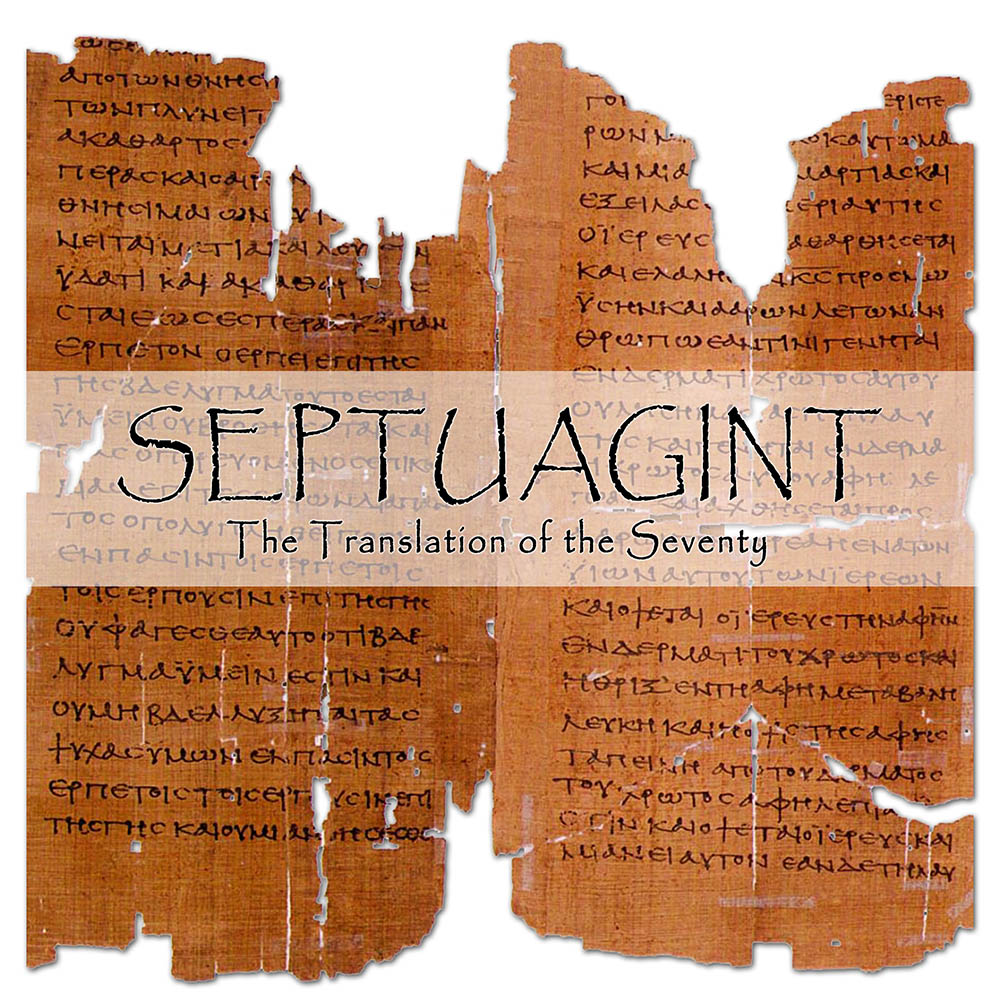
I hope you will journey with me in rediscovering the beauty of God’s Word in the Septuagint (LXX). In 285 BC, the LXX was translated from paleo-Hebrew by 70 Jewish translators into Greek, the language of most of the civilized world at that time. Due to its pre-Christ and pre-fall of Jerusalem date, the LXX cannot be accused of being influenced by any underlying animosity toward Christ or Christianity or desire to elevate Judaism’s claim to God’s blessings or the promised land. Most Christians believe the Masoretic Text (MT), upon which our English Old Testament is based, is written in the original Hebrew, but it too is a translation from the ancient and by then dead paleo-Hebrew Phoenician pictograph script into the modern Hebrew block script derived from Aramaic. The Masoretes completed it between 600 t0 1000 AD, by which time the Jews had become hostile to the Christian message, which shows up in various omissions, changes, and obfuscations of verses and passages that clearly point to Christ in the LXX.
Jesus taught us that all scripture points to him (John 5:39). As a rule, the Septuagint more clearly points to Jesus than does the MT.
In the West, Christians have not questioned the MT since Jerome chose it as the basis for his Latin Vulgate Old Testament. The Eastern Orthodox Church, to their credit, never deviated from the Septuagint, preserving it for later generations to rediscover. Because of the power of tradition, it is quite difficult for many of us in the West to think of the LXX as being more trustworthy than the MT, but I have found that a side-by-side comparison indicates otherwise.
In this series of articles, I have undertaken to illustrate the similarities and differences between the MT and LXX by examining various passages. Below is another example. The Septuagint version I am using is the Lexham English Septuagint 2nd Edition. It is available in print or digitally through Logos Bible Software. Occasionally I reference Brenton’s translation, which is a good one, but the English is somewhat dated.
| Masoretic Text | Septuagint | Significance |
|
1 The vision of Isaiah the son of Amoz, which he saw concerning Judah and Jerusalem in the days of Uzziah, Jotham, Ahaz, and Hezekiah, kings of Judah. Isaiah 1:1 (NKJV) |
1 The vision that Isaiah son of Amoz saw, which he saw against Judea and against Jerusalem during the reign of Uzziah and Jotham and Ahaz and Hezekiah who ruled Judea: Isaiah 1:1 (LES2) |
Here we see clearly how the MT routinely deemphasizes God’s judgment against Israel. It uses the word “concerning,” while the LXX says “against.” |
|
2 Hear, O heavens, and give ear, O earth! For the LORD has spoken: “I have nourished and brought up children, And they have rebelled against Me; 3 The ox knows its owner And the donkey its master’s crib; But Israel does not know, My people do not consider.” Isaiah 1:2–3 (NKJV) |
2 Hear, O heaven, and hearken, O earth, because the Lord has spoken: “I fathered and raised sons, but they have rejected me. 3 An ox knows its owner and a donkey the feeding trough of its master, but Israel has not known me and the people have not understood me.” Isaiah 1:2–3 (LES2) |
The MT uses “nourished,” but the LXX uses “fathered.” The MT says “rebelled,” but the LXX says “rejected.” The MT says that Israel “does not know,” but the LXX says, “Israel has not known me.” A case can be made that the nation as a whole never knew God. It was only select people who actively and faithfully served the Lord throughout her history. This group is called the remnant. (Psalm 103:7, Romans 11:1-5) |
|
4 Alas, sinful nation, A people laden with iniquity, A brood of evildoers, Children who are corrupters! They have forsaken the LORD, They have provoked to anger The Holy One of Israel, They have turned away backward. Isaiah 1:4 (NKJV) |
4 Woe to you, sinful nation, people full of sin, evil seed, lawless sons! You have forsaken the Lord, and you provoked the Holy One of Israel to anger. Isaiah 1:4 (LES2) |
The MT uses the word “alas,” but the LXX uses the more forceful phrase, “Woe to you.” This is the same Greek construct used by Jesus in the woes he pronounced in various places. (Matthew 11 and 23, Luke 6, 10, and 11) The MT says that the children are “corrupters,” but the LXX says they are “lawless.” Otherwise the two versions agree. |
|
5 Why should you be stricken again? You will revolt more and more. The whole head is sick, And the whole heart faints. 6 From the sole of the foot even to the head, There is no soundness in it, But wounds and bruises and putrefying sores; They have not been closed or bound up, Or soothed with ointment. Isaiah 1:5–6 (NKJV) |
5 Why should you be smitten still, continuing in lawlessness? Every head is in distress, and every heart is in sorrow. 6 From feet to head, neither a wound nor a bruise nor a purulent blow; there is no emollient to put on or oil or bandages. Isaiah 1:5–6 (LES2) |
The MT speaks of Israel as a whole, but the LXX addresses the individuals, saying “every head is in distress and every heart is in sorrow.” Verse 6 in the LXX is difficult. It seems to be saying that the wound is not external or able to be treated easily, but is on the inside and spiritual. The MT says it differently, but arrives at the same conclusion. |
|
7 Your country is desolate, Your cities are burned with fire; Strangers devour your land in your presence; And it is desolate, as overthrown by strangers. 8 So the daughter of Zion is left as a booth in a vineyard, As a hut in a garden of cucumbers, As a besieged city. 9 Unless the LORD of hosts Had left to us a very small remnant, We would have become like Sodom, We would have been made like Gomorrah. Isaiah 1:7–9 (NKJV) |
7 Your land is deserted; your cities are burned. As for your territory, foreigners devour it before you, and it has been made desolate, overthrown by a foreign people. 8 The daughter of Zion will be left behind like a tent in a vineyard, and like a garden watcher’s hut in a cucumber bed, like a besieged city. 9 And if the Lord Sabaoth had not left us seed, we would have become like Sodom and we would have been made like Gomorrah. Isaiah 1:7–9 (LES2) |
The MT and LXX agree in verses 7 and 8, but diverge significantly in verse 9. The MT obscures the reference to Christ by calling the “seed” a “very small remnant.” The seed points to Christ. (Galatians 3:16) Paul picked up on this when he quoted this verse in Romans, using the LXX. 29 And as Isaiah said before: “Unless the LORD of Sabaoth had left us a seed, We would have become like Sodom, And we would have been made like Gomorrah.” Romans 9:29 (NKJV) Of all the natural descendants of Abraham, only a remnant will be saved – those who are part of the elect, chosen in Christ before the foundation of the world. (Romans 9:26, Isaiah 10:22, Ephesians 1:3-4) This remnant is part of the group called the Israel of God or the church, which is composed of both Jew and Gentile who have become “one new man” in Christ. There is no longer any distinction between the two. (Galatians 3:28-29, Ephesians 2:14-16) |
Conclusion
If you want to know more about why Christians should prefer the Septuagint to the MT, click on this link. In another article, I share some of the things I have so far learned by making this comparison. As for me, I now prefer the LXX. It was Paul’s and the other apostles’ standard for Old Covenant truth, was used by synagogues in Jesus’s day, and is most often quoted in the New Testament. That makes it good enough for me.