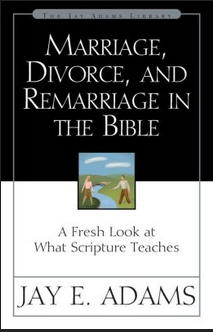
Marriage, Divorce, and Remarriage
by Jay E. Adams
I well remember when a young divorced woman requested a meeting with our elder team many years ago. Anticipating that one day she might wish to remarry and knowing that our church’s stance on the issue forbade that, she requested that we seek the Lord about the matter. She was willing to submit to whatever conclusion we might reach, but she was wise enough to ask us to reconsider before the matter might arise. Her request proved to be a pivotal point in the development of our understanding on the matter.
My father, who was the pastor of the church at that time, did some research and found the book that is the subject of this summary. He asked all of us on the team to read it, and then we discussed its contents. The result was that we changed our policy. That is why I put it in my list of important books. I have referred to it often and have reread it at least twice. Here I will summarize some of the main points chapter by chapter.
Part 1 – Marriage
Chapter 1 – Some Basic Considerations about Marriage
In this chapter Adams examines the nature of marriage. The first point he makes is that marriage was instituted by God, unlike divorce. Even though the state “regulates” and records marriages, it has no authority to define it, since it is not a man-made institution. The second point is that marriage is foundational in that it produces a family, the basic unit of society. Thirdly, marriage cannot be reduced to a legalized and responsible means of mating and producing children. Procreation is indeed a sub-purpose of marriage, but its primary function, according to God, is to provide companionship. Chapter 2 explores this in more detail. Fourthly, marriage cannot be equated with sexual relations. Marriage authorizes sexual relations, which do not per se make or break a marriage.
Chapter 2 – What Marriage Is All About
Genesis 2:18 gives us God’s evaluation of the single life, in most cases.
Then the LORD God said, “It is not good for the man to be alone. I will make a helper who is just right for him.” Genesis 2:18 (NLT)
Except for those single persons especially gifted by God to live a single life (Matthew 19:11-12 and 1 Corinthians 7:32-34), most of us will find fulfillment in marriage. Combining insights from Proverbs 2:17 and Malachi 2:14, Adams defines marital companionship as a “close, intimate relationship” that eliminates loneliness. (p.12)
Next the author looks at the Old Covenant concept of engagement, which was a contract to marry. Even though no sexual relations took place until after the marriage ceremony, the engagement was binding and could only be broken by divorce. This shows that marriage is fundamentally a contractual or covenantal arrangement that becomes binding even before the sexual consummation.
“Marriage is a formal (covenantal) arrangement between two persons to become each other’s loving companions for life.” (p. 13)
The contractual element is very important. An unmarried couple may be informally “committed” to one another, but publicly and formally declaring that commitment is integral to marriage. For the Christian, water baptism corresponds to some degree as a public acknowledgement of our allegiance to Christ. Adams points out that ”forsaking the companion of one’s youth is paralleled with forgetting the covenant of God.” (Proverbs 2:17)
Adams explores companionship further.
As his counterpart , the woman completes or fills out the man’s life, making him a larger person than he could have been alone, bringing into his frame of reference a new feminine dimension from which to view life that he could have known in no other way. Then, too, he also brings to his wife a masculine perspective that enlarges her life, making her a fuller, more complete person than she could have been apart from him. This marriage union by covenant solves the problem of loneliness not merely by filling a gap, but by overfilling it. More than mere presence is involved.” (p. 16)
This fact comes out even more fully in Genesis 2:24-25 where marriage is descibed as a cleaving (clinging or adhering) in which a man and his wife become “one flesh”… to become one person. (p. 17)
God’s revealed goal for a husband and wife is to become one in all areas of their relationship – intellectually, emotionally, physically. The Covenant of Companionship was designed to fill this need. (p. 17)
Chapter 3 – The Place of Marriage
In this chapter Adams points out the centrality of marriage in life. The primary relationship is husband and wife, not parent and child. There is no contractual relationship between a parent and child to provide companionship for one another. The nature of the parent-child relationship changes dramatically over time. Eventually, if all goes as expected, children will leave the home to establish their own families, but marriage is permanent and must not be broken. Anything that breaks the covenant of companionship is sin. Husbands and wives should put one another first, thus modeling a proper marriage to their children. By so doing, parents give their children security. No child was designed by God to be the center of attention. No parent or child should take priority over the marriage relationship.
Blood may be thicker that water, but it should not be thicker than promise. (p. 20)
Adams encourages couples to cultivate companionship to insure marital success and happiness.
Part II – Divorce
Chapter 4 – A Biblical Attitude toward Divorce
Adams opens this chapter by stating that divorce is biblical, where it is recognized and regulated.
To begin with, let us be clear about the fact that neither is the Bible silent on the subject of divorce, nor does it always, under all circumstances, for everyone, condemn divorce… While God emphatically says, “I hate divorce” (Malachi 2:16), that statement must not be taken absolutely to mean that there is nothing about divorce that could be anything but detestable, because He, Himself, also tells us… “for all the adulteries which faithless Israel has done, I sent her away and gave her a divorce bill.” (Jeremiah 3:8) (p. 23)
It is altogether true that God hates divorce. But he neither hates all divorces in the same way nor hates every aspect of divorce. He hates what occasions every divorce… He hates the results that often flow to children and to injured parties of divorce… And he hates divorces wrongly obtained on grounds that he has not sanctioned. (p. 24)
The author asks us to examine our attitude toward divorce, since that will affect how we come across to divorced persons. If people sense that we are judging them, it will be difficult, if not impossible, to help them.
Chapter 5 – The Concept of Divorce
Adams opens this chapter by pointing out that even though the Bible recognizes, permits, and regulates divorce, God did not institute it. Instead of recognizing that divorce is part of God’s divine order, Jesus pointed out that divorce alters God’s original plan.
Jesus replied, “Moses permitted divorce only as a concession to your hard hearts, but it was not what God had originally intended. Matthew 19:8 (NLT)
If Moses “allowed” divorce by regulating rather than forbidding it, we must never get the idea that God merely winked at divorce. He neither ignores it (hoping it will go away), nor in toto (as a practice) denounces it, but, rather, takes cognizance of it and does something about it (1) to see to it that divorce is permitted only under certain circumstances, and not under others (cf. Deut. 22:19, 29), (2) that when it is done it is done in an orderly fashion, and (3) that those who obtain a divorce are fully aware of the possible consequences. (Deut. 24:1-4) It is certainly correct to say that in the Scriptures God acknowledges the existence of divorce and carefully regulates it. (p. 28)
Adams reminds us that God hates divorce and did not institute it, but he does recognize and regulate it under certain biblically prescribed circumstances. He hates divorce because sin is always the cause, but that does not mean that every divorce is sinful.
The Christian’s stance, then, is that divorce is never desirable, and (among Christians) it is never inevitable. Reconciliation… is always possible for believers under the care and discipline of the church. While permitted for Christians in cases of sexual sin, divorce is never required… Every legitimate effort, therefore, ought to be made to help persons contemplating divorce to reconsider the alternatives, and to assist divorced persons to become reconciled to one another (whenever possible) before they remarry another and it is too late to do so. (p. 31)
Chapter 6 – What Is Divorce?
A divorce…is the repudiation of…(the) covenant (or agreement) in which both parties promised to provide companionship (in all its ramifications) for one another. A divorce is, in effect, a declaration that these promises are no longer expected, required, or permitted. (p. 32)
As Adams will endeavor to prove, divorce is intended to free both parties to make the same commitment to someone else. That was certainly the case in the passage previously cited from Deuteronomy 24:1-4.
The author observes that separation, as a precursor or alternative to divorce, is not a biblical idea. When the Bible uses the words “leave,” “send away,” or “separate,” it is always speaking of divorce, which renders the persons unmarried.
Chapter 7 – The Two Groups in 1 Corinthians 7
Adams believes that chapter 7 of First Corinthians is the perfect place to start because it addresses two groups of marriages – those between two believers and those in which only one spouse is a believer. Adams stresses that Paul applied Jesus’ teaching on marriage in its proper context, a marriage between two believers. Paul addresses the issue that arose as the gospel penetrated the pagan world when one spouse came to faith but the other did not. He believes that applying the principles Jesus intended for the first group to the second group can have bad consequences. The author believes this clarifies, not diminishes, the power of Christ’s words.
Adams says this distinction is true in matters of law as well. Believers are not to sue other believers because we have the resources within the church to settle such matters outside of court. However, when it comes to unbelievers, this does not work. The same is true for marriage. Believers should be able to reconcile via the resources found in God, the Bible, and the church. A marriage between a believer and an unbeliever may not be able to work things out in the same way.
Chapter 8 – Divorce among Believers (Preliminary Considerations)
In this chapter, Adams does not yet address the “exception clause,” which allows believers to divorce with God’s permission in the case of sexual infidelity. Instead he looks at the cases where believers disobey Christ’s clear command and divorce without proper cause. He states that in this and every case divorce actually dissolves the marriage, whether it is a sinful or permitted one. The divorced couple is not still “married in God’s eyes,” as some teach, but are “agamos,” that is, unmarried. The obligations and privileges of married couples no longer exist for them. Two new obligations exist for divorced believers, however.
- They are required (again by command – 1 Corinthians 7:11) to remain unmarried (i.e., not to marry another) in order to
- be able to be reconciled.
Their chief obligation is reconciliation.(p. 43)
When a divorced person remarries, reconciliation to the first spouse is not allowed by God. (Deut. 24:4)
Chapter 9 – Divorce among the Unequally Yoked
In this case, Paul addresses a group of people to whom Jesus did not refer. As previously mentioned, believers have resources available to them that unbelievers do not – the Word of God, the Holy Spirit, and the church.
Rather than commanding the believer not to divorce his unsaved partner, regardless of what happens, he (Paul) requires something less: he (or she) must not divorce a partner who is willing to make a go of their marriage. (p. 46)
This has a two-fold purpose: to hopefully lead to the salvation of the unsaved spouse and to protect the children.
Under circumstances when the unbeliever wants to get out of the marriage, Paul says, “let him separate.” (1 Cor. 7:15) The clause (literally) reads, “if the unbeliever is separating [chorizo – to separate by divorce], let him separate [chorizo]. (p. 47)
According to Adams, this in the one instance in which divorce is required.
According to 1 Cor. 7:15, when a believer divorces an unbeliever at the unbeliever’s request, it completely frees both parties from all marital obligations, rendering them free to remarry. The author wrote that Paul did not want any “loose ends” attached to these situations, but wanted the matter resolved. God wants peace. The New Living Translation captures the idea.
(But if the husband or wife who isn’t a believer insists on leaving, let them go. In such cases the Christian husband or wife is no longer bound to the other, for God has called you to live in peace.) 1 Corinthians 7:15 (NLT)
Chapter 10 – The Exceptional Clause
This chapter addresses Christ’s exception for divorce mentioned in Matthew.
You have heard the law that says, ‘A man can divorce his wife by merely giving her a written notice of divorce.’ 32  But I say that a man who divorces his wife, unless she has been unfaithful, causes her to commit adultery. And anyone who marries a divorced woman also commits adultery. Matthew 5:31-32 (NLT)

And I tell you this, whoever divorces his wife and marries someone else commits adultery—unless his wife has been unfaithful.” Matthew 19:9 (NLT)
I used the New Living Translation for these two passages because it simplifies the meaning without doing damage to the intent of original language. It is important that we accept the link between divorce and remarriage in the exception clause. Divorce in the case of unfaithfulness frees both parties to remarry without committing adultery.
Adams examines the different Greek words used in this passage – porneia and moichao, which can be translated fornication and adultery. Fornication refers to any sexual sin, and adultery, of course, is a violation of the marriage covenant. Some argue that the two verses above, therefore, only pertain to the breaking of the engagement, not the actual marriage. However, in the Bible, porneia can refer even to adultery. (Jeremiah 3:1, 2, 6, and 8, using the Septuagint translation, which is a Greek rendering of the Hebrew scriptures.) Adams points out that adultery is a broader term than the sexual act. It refers to allowing a third party to breach the covenant of companionship. (p. 54) The author quotes an interesting extra-biblical passage that joins the two words. Sirach 23:22-23 records that an unfaithful wife “committed adultery by fornication.” (p.54)
Adams makes the case that Jesus permits divorce based on the act of fornication that breaches the marriage, which is adultery.
The word porneia (fornication) covers all forms of sexual transgression: incest, bestiality, homosexuality, lesbianism, as well as adultery. That is the reason why many translators render porneia as the more inclusive “sexual sin.”
Adams dismisses the engagement thesis by listing several arguments, beginning with that Jesus and Pharisees were discussing marriage, not engagement. I will leave it to you to check these out on your own, if you are interested. (p. 55-56) He concludes by writing that the standard, historical Protestant interpretation is that a believer may divorce his spouse for committing fornication. However, even though divorce is permitted, it is certainly not required. Adams goes a step further by stating that if forgiveness is granted after repentance, the marriage cannot be terminated. (p. 56) I am not sure I agree. Forgiveness does not necessarily reestablish trust. One may forgive without remaining married. However, it is hoped that repentance can be made, forgiveness granted, and trust reestablished. That would be the best possible outcome, in my opinion.
Next the author addresses the case when the offending spouse refuses to repent. In that case, when possible, church discipline must take place. Using the paradigm given to us by our Lord, the faithful spouse should personally confront the unfaithful one. If this does not bring about repentance, one or two others should be asked to make the confrontation. If this does not have the proper effect, church discipline resulting in excommunication must be brought to bear. The result will be that the unfaithful party will then be rendered as a “heathen” practically speaking. At this point, if there is not repentance and reconciliation, the faithful party is now able to relate to the unfaithful spouse as an unbeliever, according to the principles set forth in 1 Corinthians 7. The effect will be the resolution of the matter, since believers are not permitted to marry unbelievers. God does not want things held in “limbo” for long periods of time. (pp. 57-58) Of course, if the offending party repents, reconciliation may become possible.
Chapter 11 – Christ, Deuteronomy, and Genesis
In this chapter, Adams compares passages from Genesis 1:26-28, 2:18 and 21-25, Deuteronomy 24:1-4, Matthew 5:32-32, and 19:3-9, Mark 10:2-12, and Luke 16:18. He attempts to properly interpret Jesus’ words regarding divorce by placing them in their proper Old Testament context.
I will not go through the author’s entire argument regarding the “defilement” of the divorced wife in Deuteronomy 24. Instead I will quote his concluding paragraph.
The wife of Deuteronomy 24, then, was not defiled by sexual relations with the second husband, but by her involvement in marriage and sexual relations because of a divorce (though legal) that was sinful, and so was the second marriage. Because the divorce was for some flimsy reason, it was sinful, and so was the second marriage. (p. 65)
Jesus said that a wife divorced for a sinful reason was caused to commit adultery. (Matthew 5:32) Adams states that if she had been free to remarry, she would not have committed adultery when she did (remarried), and she would not be considered defiled. (p. 66) Adams then asks the obvious question.
The sinful divorce (based only on an erwath dabar [something indecent or repulsive to the husband short of adultery]) truly broke the first marriage; the sinful adulterous marriage to the second man was a genuine marriage, though adulterous… (p. 67)
Adams reminds the reader that “adultery always involves a violation of the marriage covenant in such a way that a third party is introduced into the picture claiming the right (or privilege) to do for one of the parties what they have contracted to do for one another.” (p.67) He states that even though the first marriage is broken by divorce, the former spouses have no right to be in that state and are required by God to reconcile the first marriage. Adams “redefines” adultery by saying it is “sexual sin with someone other than the one with whom one ought to be having sexual relations.” (p. 67)
Adams closes the chapter by reminding the reader that Jesus did not consider Deuteronomy 24:1-4 to be the defining passage on marriage and divorce. Rather he considered it to be God’s way of regulating a practice already in existence, similar to concubinage or polygamy. (p. 68) From the beginning (Genesis), it was not that way. It was not what God had in mind.
Chapter 12 – The Origin of Divorce for Sexual Sin
This chapter is difficult to summarize and needs to be read in its entirety. However, I will attempt to give you the main points.
Adams explains that the origin of divorce for sexual sin came from God himself, who taught us that by “both precept and example.” (p.71) He points out that God refers to his relationship with Old Covenant as a marriage. (Ezekiel 16:8, Jeremiah 2:2) The New Covenant uses the marriage analogy to describe the relationship believers have with our Lord. (Ephesians 5:22-30) Regarding God’s relationship with Israel in the Old Covenant, the Bible points out that Israel was unfaithful “lay down like a harlot” (Jeremiah 2:20), “went after other lovers” (Hosea 2:13), and “committed adultery” (Jeremiah 3:8). In the last passage, God declares that he “put her away and gave her a bill of divorce.” Isaiah and Hosea also mention God’s divorce of Israel (Isaiah 50:11 and Hosea 2:2). Nevertheless, God still loved Israel and called her to repentance, which would be the grounds for his taking her back. (Hosea 14:1-2) In that same book, God took the initiative to woo Israel back to himself. In Isaiah, God tells Israel that he will take her back as if she were never guilty of adultery. (Isaiah 54:6-7) Adams states:
The very least we can say is that in these prophets, by His (God’s) recognition, adoption, and (implied) endorsement of the practice, God placed his approval on it [divorce]. (p.73)
The case in the New Testament when the Bible says that Joseph, being a just man, decided to divorce Mary quietly for her apparent infidelity further corroborates this. There Adams concludes:
If from no other source, Joseph and Jesus might easily have derived their view of divorce for fornication – just as we have here- from the example and words of God himself. (p.74)
Adams observes that God did not always follow the “letter” of what he calls “case law” in exacting punishment for capital offenses, such as with David regarding his sins of adultery with Bathsheba and the subsequent murder of her husband Uriah. It seems that God made room for mercy if repentance were present. When Jesus acknowledged that Moses allowed divorce because of the hardness of our hearts, it was a concession to the original creation ordinance. Adams points out that Jesus did not elaborate on the basis of the concession and it would be mere speculation to try to determine it. In any case, the exception was one of long standing practice, which gave room for Joseph to take this direction without being rebuked by God.
Part III – Remarriage
Chapter 13 – Remarriage
Adams begins by acknowledging that remarriage of widows and widowers is allowed and even encouraged. He next addresses the issue of whether a remarried man can serve as an elder. He believes that interpreting 1 Timothy 3:2 and 12 and Titus 1:6 to mean a prospective elder must have only married one time in his life is incorrect. Rather, Paul is prohibiting a polygamist from holding the office. In other words, an elder must be married to only one woman at a time.
But in the NT, while a polygamous convert was allowed to enter the body without putting away his wives (on the principle stated and reiterated in 1 Corinthians 7:17, 20, and 24), he could not become an officer. (p.81)
Adams cites various sources to prove that polygamy among the Jews existed in Paul’s day and up to the eleventh century.
Chapter 14 – Remarriage after Divorce
Adams begins the chapter by stating that remarriage of divorced persons is allowed in the New Testament. He quotes the following passage.
Are you bound to a wife? Do not seek to be released. Are you released from a wife? Do not seek a wife. 28 But if you marry, you have not sinned... 1 Corinthians 7:27-28 (NASB)
The word “loosed” clearly refers to divorce, not the death of a spouse.
To call “sin” what God expressly says is not sin (v.28) – wittingly or unwittingly – is a serious error… Nothing in the Bible forbids the remarriage of divorced persons without obligations, except to priests, who were exceptions to this policy. It is assumed in the Bible that wherever Scripture allows divorce, remarriage is also allowed… All persons properly divorced may be remarried. (pp.85-86)
Adams cites John Murray’s exegetical work to conclude that all persons divorced under Christ’s exception clause are free to remarry “in the Lord” (to another believer) without committing adultery.
Next the author begins to examine more complicated cases that arise in the aftermath of sinful divorces (those done for biblically unsanctioned reasons). Adams admits that this gets complicated, due to the fact that sin complicates life. The first such issue he addresses is the hypothetical case where a believing man divorces his unbelieving wife against her will. If the man later repents, he is not able to remarry his wife because she is not a believer; that is, unless she becomes a follower of Christ.
Next he address the complication that can arise if the church does not do its part in trying to reconcile partners who are considering divorce.
Many of the difficulties that result could have been avoided if the church had done what it ought to do at the outset. (p.88)
Here is a summary of his thoughts and conclusions. I encourage you to read the chapter in its entirety because I am omitting a lot of good information below.
If a one married partner pursues a divorce that has no scriptural basis, the church should intervene to stop it. If the one pursuing divorce will not be persuaded using standard church discipline procedures (Matthew 18:15 and following), he or she should be excommunicated and regarded as a “heathen.” This turn of events will grant the “innocent” party permission to remarry, since functionally the one pursuing the divorce is now regarded as an unbeliever. If an unbeliever desires a divorce, the believing spouse is to let them go. If church discipline is not pursued, if the couple gets a divorce, neither party is free to remarry as long as the other spouse is unmarried. They have an obligation to reconcile.
Chapter 15 – Persons with a Past
In this chapter Adams addresses how to handle situations that arise when persons with an ungodly past desire to marry or remarry. His writes that people who are born again are washed clean from the past sins. ( 1 Corinthians 6:11) He points out that King David’s union with Bathsheba was initially adulterous, but later was sanctified through forgiveness. She became part of the lineage of the Messiah, as did Rahab the harlot. Without minimizing the sins of divorce and adultery, we must acknowledge that Christ’s blood cleanses us from these sins. Therefore, when a person truly repents for his or her sin(s) of adultery and/or divorce, we must no longer consider him or her the “guilty” party. They are forgiven and declared “not guilty”.
Citing the case of David and Bathsheba, Adams writes:
If this marriage, which at its inception was knee deep in sin (David didn’t repent until after the marriage.), could be blessed by God…, why do we say that persons who are forgiven and cleansed before marrying, cannot expect God to bless their marriage because of sin in their past? (p. 95)
Adams concludes:
…remarriage after divorce is allowed in the Bible and… the guilt party – after forgiveness – is free to remarry. (p.95)
Next Adams asks if people who wish to (re)marry should be examined to see if there are any hindrances that must be first addressed. The author answers “yes” in some cases. Here are things he believes must be addressed.
- Has the person freed himself or herself from all past obligations?
- Has the person sought forgiveness from all parties hurt by the previous sinful divorce, etc.?
- Has every effort been made to reconcile if possible?
- Has every effort been made to right all wrongs such as repayment of unfairly-obtained monies from a divorce settlement or back alimony or child support?
In addition, anything that contributed to the first failed marriage should be addressed so that it will not sabotage the future marriage. This should happen in pre-marital counseling.
Chapter 16 – Dealing with Divorce and Remarriage
This chapter is a summary of the principles presented in this book with the acknowledgement that everything has not been covered. In his conclusion, Adams writes:
My prayer is that God will use this book to bring balance and blessing to His church
I have found it to be very helpful in navigating complex issues that arise while seeking to help people who have done sinful things in the past but who wish to participate in the God-given blessing of marriage going forward. I hope this summary helps you and inspires you to read the book for yourself.