
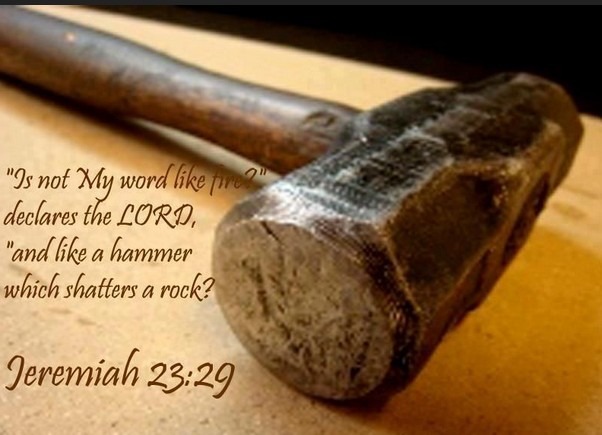
The Counter Rebellion

The introduction of heliocentric cosmology was a blasphemous rebellion against God’s and the Bible’s authority. This may shock you because we have been taught from childhood that the earth is a spinning globe hurtling through space at about a million miles per hour locked into an impossible elliptical orbit around the sun. Under this system, Helios or Sol, which are alternate names for the sun, is the center of what is called our “solar system,” holding the earth in its power and giving life to all things.

This way of describing the heavens and earth is an outright contradiction of what the Bible teaches in Genesis Chapter One and throughout the rest of its pages.

Satan, according to the Bible, led a revolt in heaven against God’s authority and apparently convinced one-third of the angels to follow him to perdition. (Revelation 12:3-4, 9) How he convinced them to throw away what they had in heaven is beyond me, but he must have been quite convincing.

The devil always uses deception to pull people (and angels) away from God and truth, and history shows that he is very good at it.

Paul called him the “god of this world” (2 Corinthians 4:4) because he rules over the hearts of the unredeemed using authority usurped from Adam. The first man’s decision to believe the serpent instead of God brought humanity and all creation into degradation and perversion. I wrote a series to explain this and how God will completely restore all things, which is entitled, The Cosmic War. I encourage you to read it. 

Our Lord Jesus stripped all authority from Satan by dying on the cross and afterward rising from the dead. (Colossians 2:15 and Matthew 28:18) Nevertheless, that deceiver wants everyone to think that he still rules. He wanted to receive glory as God, but was defeated (Isaiah 14:12-16). He is still working to obtain man’s worship through the heliocentric “soul-lure” system. By convincing people that the earth is controlled by the sun, along with other “planets” named after false gods, he uses a blasphemous “object lesson” through which virtually every child in school is taught that he still controls the earth. You see: Helios and Sol are alternate names for Satan, too.

To accept the heliocentric lie requires us to believe that the Bible is an outdated document, written by primitive pre-scientific people, that is hopelessly out of sync with  reality.

When we believe this lie, we align ourselves with the Great Deceiver, the “father of lies,” as Jesus called him, who deceives the whole world. (John 8:44, Revelation 12:9)

Through creation rights, however, the earth has always been the Lord’s. (Psalm 24:1, 89:11) He founded it upon the waters never to be moved, no matter how many lies the devil tells us.

The earth is the LORD’s, and all its fullness, The world and those who dwell therein. 2 For He has founded it upon the seas, And established it upon the waters. Psalm 24:1–2 (NKJV)
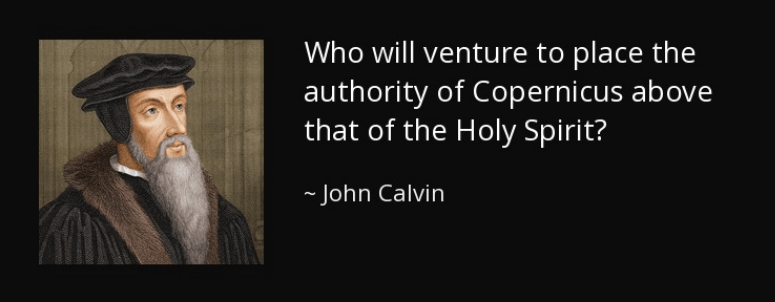
rebellion
John Calvin – Reformer

Even though Satan usurped Adam’s authority, he never officially owned the earth, and it is not, nor ever has been, fully under his power. The sun is not the center of anything. The Scripture tells us it is smaller than the earth and runs a prescribed circuit in the heavens. (Psalm 19:6, Joshua 10:12-13) Nevertheless, if Satan can convince people that the heliocentric lie is true, it accomplishes several things for him.

  1. It convinces people not to trust the Bible fully, thus undermining its authority.
  2. It opposes the reality and near proximity of heaven and brings God’s very existence into question. If he is not enthroned atop the firmament, as the Bible teaches, he must be “somewhere out there,” if he exists at all. That this theory has this effect is illustrated by the great number of astrophysicists who are declared atheists and despise God.
  3. It provides the basis for corollary lies, such as evolution, the Big Bang, aliens, and destruction by comets, asteroids, etc..
  4. It encourages us to be afraid and feel lost and hopeless. It tells us that we are insignificant specks in a incomprehensibly vast and dangerous universe, heading toward who knows what. (This is called the Copernican Principle.)

The false religion of heliocentrism was resisted initially by Reformation leaders, such as Luther and Calvin, but eventually it gained traction and now holds a favored status in the world and, ironically, in the church.

The church fell so hard for Satan’s heliocentric deception that some Christians, who claim to believe the Bible, will fight against anyone who  calls for the restoration of a proper reverence for God’s truth in the matter of cosmology.

Our willingness to abandon God’s Word in this matter derives from placing too high a regard for what is called “science.” We have been brainwashed to “Trust the Science,” the mantra used to push us into allowing the government to inject an unproven mRNA concoction into our bodies. True science is proven by experimentation. Astrophysics, by definition, is theoretical. Anything pertaining to origins is evolution fact scaled e1747836154552pure speculation, yet the world believes the declarations of the priests of science are real science, and so does much of the church. 
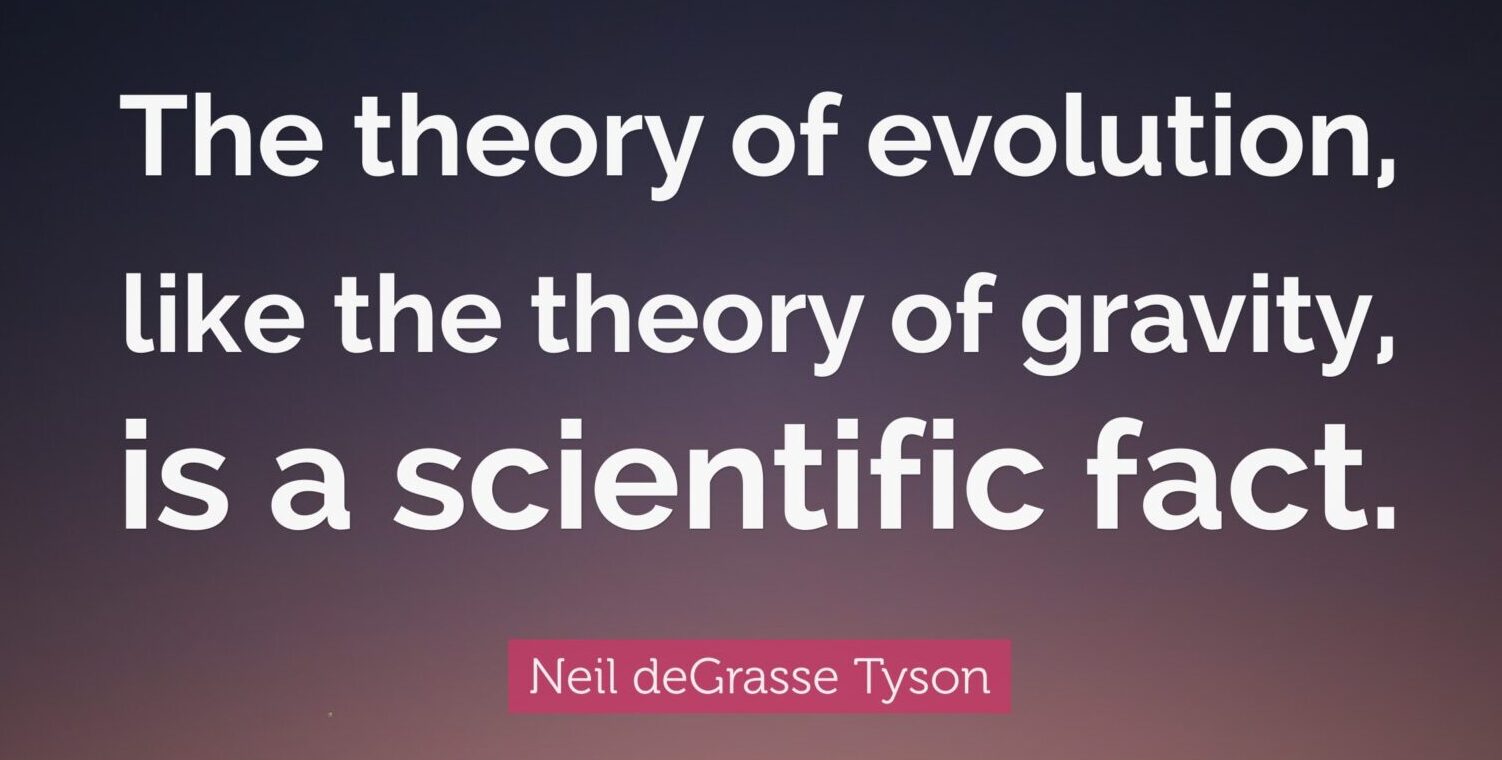
The false god of science has been so enthroned in the hearts of many Christians that we have embraced the lie that the Bible cannot possibly mean what it clearly says regarding the creation and nature of the heavens and earth.

We have assumed that we have the right, no, the duty, to reinterpret God’s holy Word and twist it to agree with the words of men.rebellionThis is nothing less than a worship of human reason.

A vast number of people believe that if something does not seem reasonable to us, it is okay to reject it as being false, even if God said it. Thus we reject God’s sovereignty over all things pertaining to truth, in effect calling him a liar. In matters of cosmology, most of the church presently stands opposed to God’s Word. This should make us tremble before a holy God.

For My hand made all these things, Thus all these things came into being,” declares the LORD. “But to this one I will look, To him who is humble and contrite of spirit, and who trembles at My word. Isaiah 66:2 (NASB95)

A proper reverence of God will lead us to humbly admit that we do not know very much at all and must rely on God’s written Word and the Holy Spirit to apprehend truth and identify deception.

Some ask why is this issue important? Does it really make any practical difference? I must confess that such a question astounds me. I have concluded that there are only a few reasons why anyone would ask it.

  1. We believe biblical cosmology is false and to identify ourselves with it is a personal embarrassment and it is also defamatory to the church.
  2. We believe it is not relevant to life and is a distraction from the gospel message.
  3. We believe the truth is unknowable; so, any debate will be fruitless.

Regarding the first point, if biblical cosmology is not true, it undermines the entire Bible, not just Genesis Chapter One, and thereby undermines the credibility of the gospel message
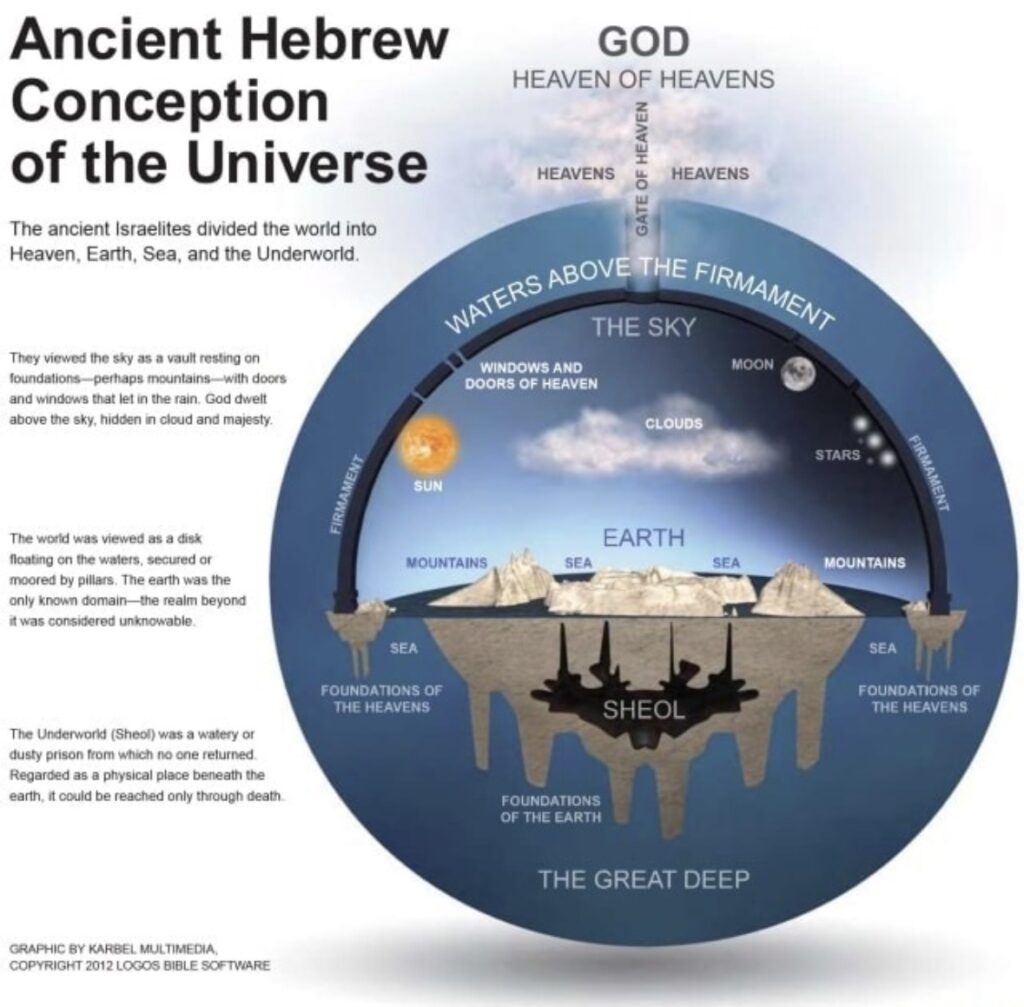
hebrew cosmos

The Bible teaches that God created the heavens and earth together in a hierarchical or layered structure with heaven above and the earth beneath, separated by a solid firmament. The twelve-part series below should convince you. Bryan Ezzo shows how the entire Bible from Genesis to Revelation consistently confirms the same version of the heavens and earth presented in Genesis.

We believe God told Adam how he made heaven and earth, which he passed on to his progeny. This probably accounts for an almost universal belief in this framework historically, before the pagan Greeks introduced the concept of a spherical earth. This heaven-earth structure is assumed and repeated all through the Bible. For example, here is a reference to the tiered structure of creation that Paul gave us.

Therefore it says, “WHEN HE [Christ] ASCENDED ON HIGH, HE LED CAPTIVE A HOST OF CAPTIVES, AND HE GAVE GIFTS TO MEN.” 9 (Now this expression, “He ascended,” what does it mean except that He also had descended into the lower parts of the earth? 10 He who descended is Himself also He who ascended far above all the heavens, so that He might fill all things.) Ephesians 4:8–10 (NASB95)

Moses, who wrote Genesis, believed it. King David believed it. Ezekiel believed it. Jesus believed it, and so did Paul. Therefore, if we reject biblical cosmology, we must also reject the rest of the Bible.

Surely calling the church to repent for believing a lie that so contradicts the Bible is important!

And are we saying that the only truth that matters is gospel truth? Are we saying that God does not care if we are deceived in other areas? Surely not! Another name for Jesus is The Truth. All truth matters. Deception is always evil. It is vitally important for us to know and believe the truth about everything, especially something so fundamental as the world in which we live.

Concerning point number two, I have been questioned whether believing in biblical cosmology is essential to salvation. The answer obviously is negative because one can get into heaven having all sorts of misguided ideas. However, what we believe about cosmology is not inconsequential to the gospel. To be saved, it is essential to believe that Christ rose from the dead and to confess that he is the Lord. (Romans 10:9-10) The gospel reestablishes Christ’s lordship one person at a time.

Recognizing Christ’s lordship is the essence of what it means to become a Christian. Surrendering to his Lordship in every area of life is the essence of discipleship.

He is not only the Lamb of God who takes away our sins; he is also the Lord of Lords.

Jesus never made it easy for prospective disciples. He made it clear that following him would cost us everything, even our lives. Why then do we try to make it easy for people to come to Christ by avoiding something a little controversial that is clearly taught in Scripture? Are we afraid our listeners will reject Christ because of a refusal to believe what the Bible says? Perhaps this is just the sort of test we need to see if we are serious about following Christ. Or maybe we simply are embarrassed to admit publicly that we believe the Bible in this area? Just a thought. Are we not committing the same error as “seeker sensitive” churches that refuse to address controversial topics, such as abortion? Will not this “consumerist” approach to the gospel likely fill our churches with people who have never been challenged to surrender everything to Christ the Lord? Are we making disciples or converts? Perhaps our reluctance to challenge others is because we have refused to submit that area to the Lord. Therefore, I believe that we need not “protect” people from the challenge of bringing our cosmology under Christ’s and the Word’s authority. 

Regarding the new birth, God takes us as we are, but works to transform us into Christ’s image by changing how we think.

And do not be conformed to this world, but be transformed by the renewing of your mind, so that you may prove what the will of God is, that which is good and acceptable and perfect. Romans 12:2 (NASB95)

The literal meaning of the Greek word metanoeo, which is translated “to repent” in English, is “to change the mind.” As we grow in our knowledge of God’s Word, he expects us to alter how we think about all sorts of things to bring our ideas into alignment with God’s truth.

If we are to proceed as a disciple or “learner,” we will be asked to surrender every thought or idea to God’s truth in the Bible.

God’s Word is the ultimate arbiter of what is true and false. Anything that contradicts what the Bible says is by definition a lie. Any refusal to surrender to the authority of God’s Word is an act of defiance similar to Eve’s transgression.

Look to God’s instructions and teachings! People who contradict his word are completely in the dark. Isaiah 8:20 (NLT)

Discipleship requires us to surrender all things to the Lord Jesus and acknowledge his authority and rule over everything in life, including our ideas about the cosmos.

When we contradict the Bible’s teaching on the cosmos, insisting that the Bible cannot be true in light of what “science” tells us, we take an unfortunate detour off the discipleship path. We cease to “continue” in Christ’s teachings, which is one essential mark of a real disciple.

Jesus said to the people who believed in him, “You are truly my disciples if you remain faithful to my teachings. 32 And you will know the truth, and the truth will set you free.” John 8:31–32 (NLT)

Therefore, I conclude that while embracing a biblical cosmology is not essential to initial salvation, it may become essential on our discipleship journey. 

God makes allowances for our ignorance and overlooks much when we are deceived, but, once we know the truth, we must make a decision. Will we let go of a rebellious God-defaming lie or stubbornly cling to it? Will we prefer what is called “science” over God’s Word?

Regarding whether biblical cosmology is relevant to everyday life, it is said by some that whether we believe it or not, we still have to get up and go to work each day. I think that anyone who makes such a statement has to believe the Bible’s cosmology is not true. Otherwise, how could we not realize that uncovering one of the greatest lies ever told is not highly important and changes how we look at the world. planck quote
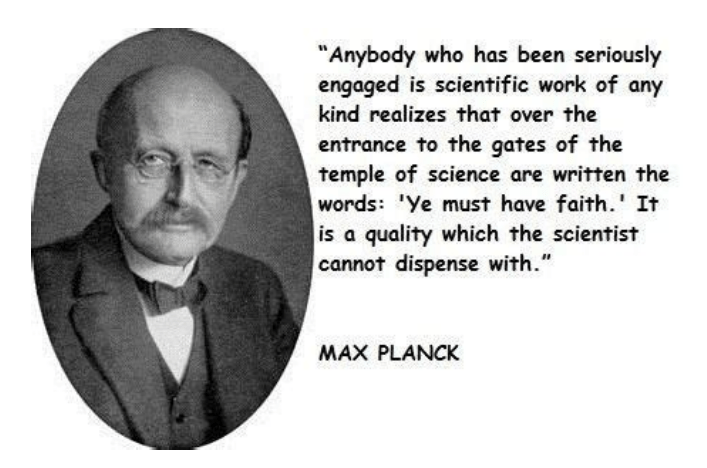
Spiritually speaking, ever since coming to the realization that the firmament is real and God’s throne is right above us, it changes how I look at the world in which we live. We cannot but be awed by a Creator who benevolently observes his creation from on high. Here is a link to some personal testimonies of people who have come to faith after accepting the truth of biblical cosmology.

Regarding the third point, whether the design of the heavens and earth is truly knowable, this is where faith comes to the forefront. I have been told that my belief in the true shape of the earth is a religious belief, rather than a rational one. I do not think the person who said that realized the irony of his words. All of life is somewhat mysterious and requires us to approach it by faith. That is why God said that without faith it is impossible to please him. (Hebrews 11:6) Even atheistic astrophysicists acknowledge that what is called “science” requires that we employ faith. The big question is faith in what or whom?

A vast number of people today, it seems, have more faith in “science” and in their own opinions than in God’s Word. 

So, yes, my conviction that biblical cosmology is true is a matter of faith, but it also agrees with observation and common sense; whereas, many of the claims of “science” in relationship to heliocentrism require us to abandon common sense and accept the words of so-called experts.
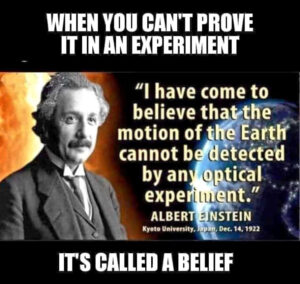
einstein belief

(Please note that our tech companies warn us not to question heliocentric orthodoxy. If it is indeed "scientifically proven," why do the ranks of those who disbelieve it continue to grow?)

Whether you agree with me or any other person about biblical cosmology is not really important, but whether we agree with God is.

Ultimately, this is an issue that requires each of us to stand individually before God and answer a huge question. Do I believe what the Bible teaches about cosmology or not? I think that God is calling us, the church, to repent for participating in the satanic heliocentric rebellion. Even though most of us got caught up in it unwittingly, once we see the truth, we have a responsibility to be active in the counter-revolution. 

If this article has sparked your interest, I hope you will read more of my articles and investigate these matters for yourself. 

Fathers Represent Abba to Their Children

As if accurately modeling Christ’s love to our wives were not daunting enough, fathers are charged to be representatives of Father God to their children, too.

Good fathers provide their children with a first idea of Abba’s character and love.

Jesus perfectly represented his Father to us, and we must do the best we can for our children.

Because of the poor job done by many human fathers, our heavenly Father has a public relations problem. I remember praying with one woman who had experienced terrible things at the hands of an abusive step-father. When she contemplated praying directly to Father God, it scared her. She had a very poor impression of a God who would allow such things to happen to her. That poisonous image of her loving Abba etched in her heart by a man who failed in his charge of properly representing Father God kept her from having a loving relationship with Abba for many years. Thankfully, Jesus set her free from all that, and she eventually came to trust her Abba. Conversely, when a father properly models Father’s heart to his children, it gives them a tremendous advantage.

This is eternal life, that they may know You, the only true God, and Jesus Christ whom You have sent. John 17:3 (NASB95)

Knowing Abba is our ultimate quest and modeling Abba as a good father is perhaps the greatest role available to a man.

Below I have listed some ways we can properly represent Abba to our children. But first, let’s meditate on the following passage from Ephesians.

For this reason I bow my knees before the Father, 15  from whom every family in heaven and on earth is named, 16  that according to the riches of his glory he may grant you to be strengthened with power through his Spirit in your inner being, 17  so that Christ may dwell in your hearts through faith—that you, being rooted and grounded in love, 18  may have strength to comprehend with all the saints what is the breadth and length and height and depth, 19  and to know the love of Christ that surpasses knowledge, that you may be filled with all the fullness of God. Ephesians 3:14-19 (ESV)  


Fathers lavish kindness and love on their children and delight in them.

The “Parable of the Prodigal Son” is a great example. Many think that story should be entitled “The Parable of the Prodigal Father” instead. To be prodigal means to spend lavishly or wastefully. We learn from this parable that…

Fathers are to lavish love and attention on their children, even when they do not respond in kind. In other words, a Father’s love is unconditional.

Abba loved us even when we were his enemies. If we did not receive this kind of love from our own dads, we must ask Abba to teach us how to give away to our children what we did not receive. 

In order to love like this, we must first receive Abba’s love.

One of the worst things we can do is to model to our children the idea that Father God is indifferent and distant from us. We must choose to properly give away a father’s love so that children gain the proper idea that God wants them around and is vitally interested in the details of their lives. Perhaps the proper word to describe all this is “delight.”

One of the great revelations in life is when we find out that Abba actually likes us, as well as loves us.

Children know when they are merely tolerated. When parents show more affection for one child than another, it communicates a rather covert form of rejection. This was true in the case of Joseph and his brothers. Jacob’s obvious preference for Joseph stirred them to jealousy and hatred. It is only natural for a fathers to get along better with some children due to personalities, but we should be careful to do our best to delight in each child. We will not be able to do this for our children if we have not come to understand that Abba delights in us.

We can only give away what we have received.

This puts a burden on every father to seek God for what we need to be for our children.

Abba spoke words of affirmation and delight over his Son.

But even as he spoke, a bright cloud came over them, and a voice from the cloud said, “This is my dearly loved Son, who brings me great joy. Listen to him.” Matthew 17:5 (NLT) 

Delight does more to affirm our children than perhaps anything else we can do for them.

Every child hopes and longs for his or her father’s approval. Do not withhold it. The withholding of delight is powerfully negative. Children know the difference between the words, “I love you,” and genuine delight.

Sometimes a father’s love is not returned, at least for a while, if his son or daughter is self-centered and determined to learn life’s lessons the hard way. Abba-like fathers will be there for their children when they finally come to their senses.

Fathers bless their children and provide a secure and safe environment for growth and expression.

Earthly fathers are responsible to provide a safe and secure environment in which their children can grow and thrive.

The LORD is my shepherd; I have all that I need. 2  He lets me rest in green meadows; he leads me beside peaceful streams. Psalm 23:1-2 (NLT)  

An important aspect of a father’s protection is shielding his children from undue criticism or rejection. Little children do not have adult abilities to discern what is true and what is mere opinion or a lie. Whatever a father tells his child will be believed when children are young.

If fathers speak words of affirmation and encouragement, it will build the child on the inside. Fathers who tear down their children with negative hurtful words impact those little lives in the wrong direction.

Children need to know they are protected from outside dangers and that the one they trust will never betray them. This is how ABBA is. It is how we fathers must be, too.

Whatever is good and perfect comes down to us from God our Father, who created all the lights in the heavens. He never changes or casts a shifting shadow. James 1:17 (NLT) 

Abba is the source of all blessings, and he designed things so that blessings should flow from him through earthly fathers to their families, if everything is working as it should.

If an earthly father is serving the devil, demonic anti-blessings (curses) may be passed down.

Fathers need to realize that they are part of a long relay race coming down through the generations. Every child inherits good and bad things from previous generations of fathers. Good decisions made by previous fathers often provide residual blessings for generations to come. Conversely sins and poor life decisions made by previous generations of fathers can negatively impact children, grandchildren, etc. We are not responsible for the sins of our ancestors, but we may reap some consequences of their sins. This called the law of sowing and reaping. (Galatians 6:7) Only Jesus can set us free from this vicious cycle. (If you want to read more about how this works, click here.)

One of the great things any father can do for his children is consciously and deliberately speak blessings aloud over them.

It may be done at a special blessing event when the child arrives at a milestone in life, such as an 18th birthday. It also can and should be done informally on a continual basis. A father’s blessing carries great weight and goes a long way to insuring success. A father’s “curse,” hurtful words spoken in anger and spite, go into the heart and soul of the child, guaranteeing future problems, unless that child is set free by Jesus.

Good fathers carefully guard their words to their children, knowing that what they say shapes their lives.

Fathers teach their children how to be successful in life.

When children are small, they need love and watchful care. As they mature, they must be prepared for the coming day when they will be thrust into the world as self-governing adults, who will need to provide for their own families. Fathers are charged to teach their children a wide variety of life skills, including a love for the truth, a fear of God, a devotion to Jesus, love for family, loyalty to friends, obedience to authority, and faithfulness in performing responsibilities. Fathers have the ability to intuitively know in what areas each of their children have talent and can gently guide them into appropriate fields of work. Fathers should model how to be a good husband and father and teach their sons and daughters how to select a spouse.

Fathers discipline their children.

For the LORD corrects those he loves, just as a father corrects a child in whom he delights. Proverbs 3:12 (NLT) 

Loving fathers discipline their children. The opposite is also true, disinterested fathers fail in this area. Discipline is difficult. It requires loving firmness and consistency. When parents get lazy, they tend to let their children get away with things until things reach a point that the parents get angry and react sometimes inappropriately harshly. Proper discipline is done with love and restraint with the ultimate good of the child in mind. We are preparing children for life, not simply trying to make things easy for ourselves as parents.

Fathers release their children into adulthood.

Godly fathers get more pleasure in seeing their sons and daughters excel than in succeeding themselves.

They are able to hand off the baton and get out of the way as soon as possible and advisable. Fathers want their children to grow up and be able to make wise decisions; so, they provide opportunities to make some choices while they still under their watchful supervision. While children are very small, they must be led with a strong hand, but as they grow older, parents must learn to give them room to develop, mature, and “spread their wings.” We should encourage our children that they are able to survive and thrive in the “adult” world.

If we succeed in adequately representing ABBA to our children and others we may mentor, we lay a foundation for their spiritual and practical growth that is incalculable.

If we misrepresent God in these areas, we can do enormous damage. Where there has been abuse or abandonment, children will need to overcome deeply embedded lies about who Abba is and what his attitude toward them is. Where there has been a failure to protect, children may have difficulty in trusting God. Where there has been criticism, children may fear expressing their true opinions and personalities or even attempting new things.

We dads have enormous shoes to fill, but God’s grace is sufficient.

It may be that you will need significant healing and breakthroughs in accepting God’s love and truth in your own life before you can be an effective father. If that is the case, please do not delay in getting the help you need. There is no sense in passing on our dysfunction to another generation. Perhaps the challenge of being a good father will be just the motivation we need to finally come to know our heavenly Father as he desires. It may well be the greatest thing to ever happen to you.

I am writing to you, fathers, because you know Him who has been from the beginning...  1 John 2:13 (NASB) 
Click here to access all articles in this series.

Husbands Represent Christ to Their Wives

Two significant gender specific roles men may play over a lifetime are husbands and fathers.

Both are weighty and beyond our natural ability requiring us to rely on God’s help. If we get these two roles right, we will be a huge blessing to those we love. If we fail through ignorance, neglect, or sinful rebellion, we will damage those we should be protecting and blessing. First, we will look at how husbands represent Christ to their wives.

The following passage written by Paul to the church in Ephesus is often used to teach husband their responsibilities with regard to their wives.

Husbands, love your wives, as Christ loved the church and gave himself up for her, 26  that he might sanctify her, having cleansed her by the washing of water with the word, 27  so that he might present the church to himself in splendor, without spot or wrinkle or any such thing, that she might be holy and without blemish. 28  In the same way husbands should love their wives as their own bodies. He who loves his wife loves himself. Ephesians 5:25-28 (ESV)

Unfortunately, men often focus more on what Paul wrote to wives regarding obeying their husbands, instead of on what God says to us men. Scripture was never meant to be used as a means to nag others into conformity. Rather, God uses it to bring each of us to repentance and obedience in our own right. When men learn to love their wives properly, their wives will be encouraged to lovingly and biblically relate to their husbands.

God has made us husbands responsible to love our wives as Christ loves the church. There could hardly be a more challenging and humbling role.

Jesus called himself the Good Shepherd. Husbands are shepherds to their families, representing the Chief Shepherd in various ways. We husbands are to model Christ to our wives and families in attitude, word, and deed. We will only be able to get this right with the help of God’s Spirit. It is no small thing to be Christ’s representative in the home. We will greatly influence our wives and children either positively or negatively, depending how well we do this.

God charges every husband with the duty to love his wife sacrificially, provide for her, protect, teach, develop her as a person and disciple, and provide godly leadership.

Many young men come into marriage with a very selfish perspective, which is the opposite of Christ. Young men are selfish sexually and in their use of time and money. The wife is often more naturally nurturing and unselfish and can be deeply hurt by her immature self-centered husband over and over again during these early years. Husbands are told to be gentle with their wives. Harshness undermines our role as Christ’s representative.

In the same way, you husbands must give honor to your wives. Treat your wife with understanding as you live together. She may be weaker than you are, but she is your equal partner in God’s gift of new life. Treat her as you should so your prayers will not be hindered. 1 Peter 3:7 (NLT) 

God works in men through marriage to make us more other-centered and unselfish.

This is part of our preparation for dynamic fatherhood. Let’s take a look at some specific aspects of our responsibilities as husbands.

Husbands model Christ’s unselfish love through serving.

Shepherds exist to care for the sheep. If you are a man who thinks that your wife and children are supposed to wait on you because you work so hard all day, you do not yet understand Christ’s relationship to the church. Jesus literally sacrificed his life for his church, his bride. He washed his disciples’ feet. He served them in countless ways while at the same time having oversight and authority. Despite clearly understanding his role as Lord, he did not “lord it over” them.

Husbands should view themselves as the family’s chief servant who models Christ.

Sacrificially loving our wives means we put their needs and desires in front of our own, which is not easy for us to do. This means we cannot do everything we want to do as young men. As Jesus put it: we are not here to serve ourselves, but others.

So Jesus called them together and said, “You know that the rulers in this world lord it over their people, and officials flaunt their authority over those under them. 43  But among you it will be different. Whoever wants to be a leader among you must be your servant, 44  and whoever wants to be first among you must be the slave of everyone else. 45  For even the Son of Man came not to be served but to serve others and to give his life as a ransom for many.” Mark 10:42-45 (NLT) 


Husbands are providers.

As shepherds of their families, an important way that men serve is by providing for them.

Some men feel overwhelmed by this responsibility, but that is only because they have not learned that Abba Father is fully committed to provide for them.

As husbands and fathers grow in their relationship with Abba, it helps them properly represent Christ. In years past, men were expected to be the sole breadwinners. Today the husband and wife often share this burden, and in some cases the wife may be the primary earner. There is nothing inherently wrong with this set up. It may simply reflect the wife’s greater abilities and opportunities. It can go wrong, however, if the husband begins to think less of himself because of his wife’s success, or if the wife begins to despise her husband as a result. Regardless of who makes the most money for the family, the husband can never abdicate his responsibility carry the primary spiritual weight of being the provider. Nor is he allowed to slip into a despondent or passive attitude, thereby thrusting the weight of the role of provider onto the shoulders of his wife.

The LORD is my shepherd; I have all that I need. 2  He lets me rest in green meadows; he leads me beside peaceful streams. Psalm 23:1-2 (NLT)


Husbands are protectors of the family.

Shepherds protect their flocks from outside attack and from bullies inside the flock. This protection includes financial, spiritual, relational, and physical aspects.

Husbands are called to be the “point men” who directly confront the enemy and stand in the gap for their families.

A husband who is introverted and less bold should never press his wife to do the hard and and uncomfortable things so he can avoid his responsibilities. Any woman who does this for her husband becomes an enabler. The husband is supposed to take the initiative to ensure that the forces of darkness are kept at bay. He should close all known doors of temptation and demonic oppression through personal repentance, careful watching, and using Christ’s authority appropriately.

Even when I walk through the darkest valley, I will not be afraid, for you are close beside me. Your rod and your staff protect and comfort me. 5  You prepare a feast for me in the presence of my enemies. You honor me by anointing my head with oil. My cup overflows with blessings. Psalm 23:4-5 (NLT)  
Husbands are teachers.

Many adults were never taught the great truths of the Bible or how to do even the simplest things by their parents. Husbands should take the lead in seeking the Lord with their wives and helping them grow in the Lord. We should be humble enough to draw upon whatever knowledge and wisdom our wives possess. Wives may come into the marriage far ahead of us in spiritual matters, but this is no excuse for our not taking responsibility. There is an “anointing” upon the husband to lead and teach. God will help us “catch up” if we are behind.

We cannot allow ourselves to be intimidated in spiritual matters. This puts a responsibility on husbands to study and grow spiritually.

Many men are lazy when it comes to spiritual things and, as a result, have little to offer, which is a great travesty and robs the wife and family of what God would have provided for them.

Husbands are leaders.

Leading does not mean that husbands get their way exclusively or have permission to “lord it over” their wives and children. It does mean that we must seek God and work with our wives to arrive at wise and godly decisions.

Even if a husband delegates some of the decision making to his wife, he is ultimately responsible before God.

Modeling leadership is one of the most effective ways to lead. The husband models what it means to be a servant leader. His wife and children benefit from the way he pours himself out in loving service to them.

He lets me rest in green meadows; he leads me beside peaceful streams. Psalm 23:2 (NLT) 
Husbands are developers.

One of the goals of a godly husband is to help his wife become all God intends, thereby enabling her to reach her full potential. Wives were never intended to be passive doormats. They complement their husbands and often have tremendous callings and abilities that need to be developed and flourish. The amazing woman in Proverbs 31 is our model.

Click here to access all articles in this series.

Part 3 – Don’t Skip This!

Before moving forward in our study of men’s gender-based roles, we should not skip the most basic role every born-again child of God has while here on the earth – being a disciple!

Jesus said:

“Come, follow me,” Jesus said, “and I will make you fishers of men.” Matthew 4:19 (NIV)

Being a disciple means we follow Christ in order to learn more about him and become more like him.

I want to know Christ and experience the mighty power that raised him from the dead. I want to suffer with him, sharing in his death, 11 so that one way or another I will experience the resurrection from the dead! Philippians 3:10–11 (NLT)

He is a real person who can be known in the Spirit. We also follow his teachings (the Scripture) and embrace his mission (the Great Commission). The role of being a disciple springs from our eternal core identity as children of God, but it is a temporary role. ln heaven we will know as we are known. At the present, we are learners (disciples).

Jesus’ method of discipleship was a combination of teaching and doing. He modeled the behaviors and ministry skills he wanted his followers to develop and gave them opportunities to learn who to use them. True discipleship must include active ministry, or we only have a Greek-style school that merely provides information.

Being a disciple is not so much about filling our heads with knowledge as it is about developing our relationship with God and putting our faith into practice in ways that will glorify God and impact the people around us.

Let your light shine before men in such a way that they may see your good works, and glorify your Father who is in heaven. Matthew 5:16 (NASB) 

We shine as lights in the world by living out our faith in a loving way, performing love-motivated good deeds in Christ’s name, and by sharing the Good News about our Savior and Lord. Disciples model God’s love in order to help people get past their objections to the message of love, the gospel. Disciples learn to share the gospel effectively, minister in the power of God’s Spirit, and generally love on people. Disciples make a point of going to where the lost and unchurched are, instead of expecting them to come to us at our church m meetings. Disciples value and model Christian hospitality as a means to extend God’s kingdom. Disciples see their neighborhoods as their mission field and invest in the people who live, work, and play around them. Fishers of men develop friends outside the church. How else will we reach them?

When Dads wholeheartedly devote themselves to the pursuit of God’s kingdom, they model for their children what it means to be a Christ follower. When Dad’s include their children in reaching out (fishing for men), it teaches them what is most most important.

I have observed that children of parents who are devoted to Christ in word and deed are more likely to adopt kingdom values and commitments than the children of nominal believers.

This is not rocket science. Kids notice what their parents love and serve, and, if there is love and respect, they will imitate them. What we do is more important than what we say, because kids see through shallowness and hypocrisy in adults who only pay God lip service. They will likely reject our words, if our lifestyle does not back them up.

We Dads cannot afford to be passive or lukewarm with regard to Christ, the gospel, discipleship, and mission.

There is much more at stake than our own eternal reward. We must think generationally and realize that how we live will impact generations to come.

Most parents feel the tension between being on mission and raising a family. The solution is to include the family when we are doing missional activities We can include them when you have friends and neighbors over. We can take them when we go on any kind of outreach, including visiting neighbors. Children have a way of disarming people and opening hearts in ways that adults cannot.

We can model what we hope to see develop in our children.

It is possible to figure out ways to include unreached people in our family meals, events, and celebrations. It is wonderful for our children to watch us share the gospel and pray for people. We can include them when we do acts of kindness for neighbors and friends.

Our children are our most important disciples. If we fail with them, our other successes will be rather hollow.

We can only give away what we have. If we give ourselves to being a disciple, we can hope to see the same develop in our children. I encourage us all to prioritize being a disciple, or we sabotage everything else.

Click here to see entire series.

Chapter 107: Providence

(lessons 104-107 are taken largely from Wayne Grudem’s Bible Doctrine published in 1999 by Zondervan.)

Definition of Providence: God is continually involved with all created things in such a way that the following is true.

  1. Preservation – God keeps all things in existence and maintains the properties with which he created them;
  2. Concurrence – God cooperates with created things in every action, directing their distinctive properties to cause them to act as they do; and
  3. Government – God directs them to fulfill his purposes. (Grudem, Bible Doctrine, p.142)
Preservation

Christ upholds or carries along the entire creation.

And He is the radiance of His glory and the exact representation of His nature, and upholds (Greek: phero – carries) all things by the word of His power. When He had made purification of sins, He sat down at the right hand of the Majesty on high,  Hebrews 1:3 (NASB95) 

The use of the present participle of the Greek verb phero indicates that Jesus is continually carrying and sustaining the creation.

He is before all things, and in Him all things hold together [consist].  Colossians 1:17 (NASB95)

Without our Lord’s continually sustaining the creation, it would cease to exist.

Only God is self-existent. Everything and everyone else must be continually sustained by the Creator.

for in Him we live and move and exist, as even some of your own poets have said, ‘For we also are His children.’  Acts 17:28 (NASB95)

You alone are the Lord; You have made heaven, The heaven of heavens, with all their host, The earth and everything on it, The seas and all that is in them, And You preserve (Hebrew: chayah – give life in an ongoing sense) them all. The host of heaven worships You.  Nehemiah 9:6 (NKJV)

God preserves us in congruity with how he made us. We maintain the same properties over time, which is the basis for science. God’s unchangeableness is reflected in this aspect of creation.

Concurrence

God accomplishes all things according to the counsel of his will while maintaining the properties of his creation.

also we have obtained an inheritance, having been predestined according to His purpose who works (Greek: energeo) all things after the counsel of His will,  Ephesians 1:11 (NASB95)

He concurs with his creation as he works all things together to accomplish his will. This includes inanimate matter, animals, and people. This means that even seemingly random or chance events are under his direction in the sense that God makes everything work together to accomplish his will. Often God’s concurrence is hidden from our sight. It may seem that events are caused solely by created beings or processes, but the Bible assures us that God is the ultimate Mover.

His sovereignty extends to nations.

For the kingdom is the Lord’s And He rules over the nations.  Psalm 22:28 (NASB95)

His sovereignty oversees every aspect of our lives, including gender, family, health, intelligence, location, lifespan (Psalm 139:16), provision (Matthew 6:11), salvation (Galatians 1:15), calling (2 Timothy 1:9), and the choices we make (Proverbs 16:9). Everything we have comes from God. (1 Corinthians 4:7)

for it is God who is at work in you, both to will and to work for His good pleasure.  Philippians 2:13 (NASB95)

God is sovereign, but he is he not responsible for evil.

The Bible maintains the twin assertions that God is sovereign and uses evil to accomplish his ends, but he is not the author of evil.

“For indeed, the Son of Man is going as it has been determined; but woe to that man by whom He is betrayed!”  Luke 22:22 (NASB95) 

this Man, delivered over by the predetermined plan and foreknowledge of God, you nailed to a cross by the hands of godless men and put Him to death.  Acts 2:23 (NASB95)

For truly in this city there were gathered together against Your holy servant Jesus, whom You anointed, both Herod and Pontius Pilate, along with the Gentiles and the peoples of Israel, 28 to do whatever Your hand and Your purpose predestined to occur.  Acts 4:27–28 (NASB95)

And we know that God causes all things to work together for good to those who love God, to those who are called according to His purpose.  Romans 8:28 (NASB95)
 As for you, you meant evil against me, but God meant it for good in order to bring about this present result, to preserve many people alive.  Genesis 50:20 (NASB95)

Let no one say when he is tempted, “I am being tempted by God”; for God cannot be tempted by evil, and He Himself does not tempt anyone. 14 But each one is tempted when he is carried away and enticed by his own lust.  James 1:13–14 (NASB95)

God does not do evil, or he would not be good. If evil does not fulfill his purposes, then evil is not under his control and might not fulfill his purposes. (Grudem, pp.149-150)

God is perfectly righteous when he judges his moral creatures for the evil we commit.

You will say to me then, “Why does He still find fault? For who resists His will?” 20 On the contrary, who are you, O man, who answers back to God? The thing molded will not say to the molder, “Why did you make me like this,” will it? 21 Or does not the potter have a right over the clay, to make from the same lump one vessel for honorable use and another for common use? 22 What if God, although willing to demonstrate His wrath and to make His power known, endured with much patience vessels of wrath prepared for destruction? 23 And He did so to make known the riches of His glory upon vessels of mercy, which He prepared beforehand for glory,  Romans 9:19–23 (NASB95)

God is sovereign and we are responsible.We cannot fully comprehend how both are true, but it is what the Bible affirms. We dare not limit the Bible’s meaning to only what we can grasp.

We have freedom to choose, but only within the bounds of God’s sovereignty. An absolute freedom that could contravene God’s purposes is not possible. Nevertheless, we do make choices that have real consequences. No one sins involuntarily, unless it is done in ignorance. We act according to our desires. This is where the New Covenant comes to bear. God changes us on the inside so that we begin to desire to do what pleases God. Then the Holy Spirit gives us the grace to carry out those things.

While acknowledging God’s sovereignty, we reject fatalism, the idea that our actions are outside of our control and predetermined. We believe God predetermines outcomes without violating our ability to choose. This is a profound mystery, but both must be true.

Just as it is written, “Jacob I loved, but Esau I hated.” 14 What shall we say then? There is no injustice with God, is there? May it never be! 15 For He says to Moses, “I will have mercy on whom I have mercy, and I will have compassion on whom I have compassion.” 16 So then it does not depend on the man who wills or the man who runs, but on God who has mercy.  Romans 9:13–16 (NASB95)

We must accept what the Bible teaches, even if we cannot completely comprehend it. Man is not the measure of what is true. God is.

Government

God providentially directs all things to accomplish his purposes.

The Lord has established His throne in the heavens, And His sovereignty rules over all.  Psalm 103:19 (NASB95) 

“All the inhabitants of the earth are accounted as nothing, But He does according to His will in the host of heaven And among the inhabitants of earth; And no one can ward off His hand Or say to Him, ‘What have You done?’  Daniel 4:35 (NASB95)

It is only because God sovereignly governs all things that Paul can say that God works everything together for good (and his glory). (Romans 8:28)

Human Responsibility

  • We are responsible for our actions.
  • Our actions have consequences that impact history.
  • Prayer is important and can change outcomes.
  • Trust in God is also called a “work” by our Lord.
  • Our faith is demonstrated by what we do. (James 2:18)
Therefore they said to Him, “What shall we do, so that we may work the works of God?” 29 Jesus answered and said to them, “This is the work of God, that you believe in Him whom He has sent.”  John 6:28–29 (NASB95)

In conclusion, we maintain that God is sovereign over creation and predetermines outcomes without violating our responsibility to choose life and reject sin and death. Ultimately, we can only choose Christ because the Holy Spirit draws us and enables us to repent and believe. When it is all said and done, we will give thanks to God for his supreme kindness to us who believe.

Click here to see all the articles in this series.

Chapter 106: The Trinity

(lessons 104-107 are taken largely from Wayne Grudem’s Bible Doctrine published in 1999 by Zondervan.)

The doctrine of the Trinity can be summarized as follows: God eternally exists as three persons, Father, Son, and Holy Spirit, and each person is fully God, and there is one God. (Grudem, p. 104)

Trinity means “triunity” or “three-in-oneness.” The actual word is not found in Scripture, but the Bible does reveal this truth.

Old Testament Revelation of the Trinity

This doctrine is somewhat hidden in the Old Testament but can be derived from various scriptures when we use New Testament revelation to explain them. One of the basic rules of hermeneutics is that the New Testament explains and expands our understanding of the Old. Everything in the Old Testament pointed to Jesus and the New Covenant.

Our first example is from Genesis.

Then God said, “Let Us make man in Our image...”  Genesis 1:26a (NASB95)

Some try to explain the use of the plural here as what is called “plurals of majesty,” but there are no instances of this elsewhere in the Hebrew Old Testament. Others have suggested that the angels were included, but nowhere does the Bible say that angels contributed in any way to creation. The best solution is one held by early church fathers that this was a reference to God’s plurality of persons. The same usage is found later.

Then the Lord God said, “Behold, the man has become like one of Us, knowing good and evil; and now, he might stretch out his hand, and take also from the tree of life, and eat, and live forever”—  Genesis 3:22 (NASB95)

Then I heard the voice of the Lord, saying, “Whom shall I send, and who will go for Us?” Then I said, “Here am I. Send me!”  Isaiah 6:8 (NASB95)

There are also Old Testament verses that differentiate between God the Father and another divine being.

Your throne, O God, is forever and ever; A scepter of uprightness is the scepter of Your kingdom. 7 You have loved righteousness and hated wickedness; Therefore God, Your God, has anointed You With the oil of joy above Your fellows.  Psalm 45:6–7 (NASB95)

“God” is this passage is the Hebrew word “Elohim,” which is itself plural. Elohim refers to two separate persons here. The one whose throne is eternal and the one who anointed him. The author of the letter to the Hebrews informs us that this verse refers to our Lord Jesus.

But of the Son He says, “Your throne, O God, is forever and ever, And the righteous scepter is the scepter of His kingdom. 9 “You have loved righteousness and hated lawlessness; Therefore God, Your God, has anointed You With the oil of gladness above Your companions.”  Hebrews 1:8–9 (NASB95)

In Psalm 110:1, David wrote:

The Lord says to my Lord: “Sit at My right hand Until I make Your enemies a footstool for Your feet.”  Psalm 110:1 (NASB95)

Jesus used this passage to silence his critics by showing that David’s descendant, the Messiah, was more than merely human.

Now while the Pharisees were gathered together, Jesus asked them a question: 42 “What do you think about the Christ, whose son is He?” They said to Him, “The son of David.” 43 He said to them, “Then how does David in the Spirit call Him ‘Lord,’ saying, 44 ‘The Lord said to my Lord, “Sit at My right hand, Until I put Your enemies beneath Your feet” ’? 45 “If David then calls Him ‘Lord,’ how is He his son?” 46 No one was able to answer Him a word, nor did anyone dare from that day on to ask Him another question.  Matthew 22:41–46 (NASB95)

It seems that David was also aware of God’s plurality of persons.

Psalm 63:10 suggests that the Holy Spirit is a distinct person, too, who has emotions and can be “grieved.” In other passages, the “angel of the Lord” is equated with God and is a divine person. Compare…

Then the angel of the Lord came and sat under the oak that was in Ophrah, which belonged to Joash the Abiezrite as his son Gideon was beating out wheat in the wine press in order to save it from the Midianites.  Judges 6:11 (NASB95)

With…

The Lord looked at him and said, “Go in this your strength and deliver Israel from the hand of Midian. Have I not sent you?”  Judges 6:14 (NASB95)

In conclusion, we cannot derive a complete doctrine of the Trinity from the Old Testament, but it certainly contains significant hints.

New Testament Revelation of the Trinity

There are passages in which all three persons of the Godhead are present at once. In the following, we have the Father, Son (Jesus), and the Holy Spirit together in one place at the same time.

After being baptized, Jesus came up immediately from the water; and behold, the heavens were opened, and he saw the Spirit of God descending as a dove and lighting on Him, 17 and behold, a voice out of the heavens said, “This is My beloved Son, in whom I am well-pleased.”  Matthew 3:16–17 (NASB95)

This passage nullifies the heresy of modalism, which states that there is only one person of God, who merely appears in different forms.

This clearly cannot be the case, since all three persons are present at the same time. In addition, modalism makes Jesus’ prayer in the garden non-sensical. Was he talking to himself? Was he pledging to do his own will, when he said, “Not my will…?”

When Jesus gave us his baptismal formula, he differentiated between the three persons of the Trinity.

Go therefore and make disciples of all the nations, baptizing them in the name of the Father and the Son and the Holy Spirit,  Matthew 28:19 (NASB95)

Jesus lets us know that the Father, Son, and Spirit are distinct persons.

Some modalists teach that it is only proper to baptize in the name of Jesus. They propose that Jesus only is God, there is no Trinity, and Jesus’ name is the only name of God that we are now allowed to use. However, this disagrees with Jesus’ own command to his disciples. Although Acts records that the early apostles baptized in the name of Jesus, we are not to infer from this that Jesus’ formula is wrong or not used by the early church. However, if we understand that water baptism is primarily a declaration of allegiance to Jesus the Lord, it makes sense that people were baptized in the name of Jesus.

Other passages also mention all three members of the Godhead.

God the Father is usually referred to as “God” or theos in Greek. The Son is called Lord or kurios. The Holy Spirit is called the Spirit or pneuma.

Now there are varieties of gifts, but the same Spirit [pneuma]. 5 And there are varieties of ministries, and the same Lord [kurios]. 6 There are varieties of effects, but the same God [theos] who works all things in all persons.  1 Corinthians 12:4–6 (NASB95)

The grace of the Lord Jesus Christ, and the love of God, and the fellowship of the Holy Spirit, be with you all.  2 Corinthians 13:14 (NASB95)

There is one body and one Spirit, just as also you were called in one hope of your calling; 5 one Lord, one faith, one baptism, 6 one God and Father of all who is over all and through all and in all.  Ephesians 4:4–6 (NASB95) 

God the Father knew you and chose you long ago, and his Spirit has made you holy. As a result, you have obeyed him and have been cleansed by the blood of Jesus Christ. May God give you more and more grace and peace.  1 Peter 1:2 (NLT)

But you, beloved, building yourselves up on your most holy faith, praying in the Holy Spirit, 21 keep yourselves in the love of God, waiting anxiously for the mercy of our Lord Jesus Christ to eternal life.  Jude 20–21 (NASB95)
God Is Three Persons in One Essence

The doctrine of the Trinity says that even though God is one essence, he is three distinct persons. Perhaps no passage illustrates this mystery better than John 1:1-2.

In the beginning was the Word, and the Word was with God, and the Word was God. 2 He was in the beginning with God.  John 1:1–2 (NASB95)

The Word (logos) was both “with” God (theos) and “was” God. We would never say such a thing about a human being. We cannot be someone while at the same time being with ourselves. Other verses in John clearly show that Jesus and the Father are distinct persons while being one.

Father, I desire that they also, whom You have given Me, be with Me where I am, so that they may see My glory which You have given Me, for You loved Me before the foundation of the world.  John 17:24 (NASB95)
 “I and the Father are one.”  John 10:30 (NASB95)

The following verse distinguishes between the Father, Jesus, and the Holy Spirit.

But the Helper, the Holy Spirit, whom the Father will send in My name, He will teach you all things, and bring to your remembrance all that I said to you.  John 14:26 (NASB95)

The Holy Spirit is called “he” in this passage. Even though the Greek word for spirit (pneuma) is neuter, the pronoun “he” (Greek – ekeinos) is masculine. Other characteristics of a person are applied to the Holy Spirit. He teaches (John 14:26), searches (1 Cor. 2:10), knows God’s thoughts (1 Cor. 2:11), is willing (1 Cor. 12:11), speaks (Acts 8:29), forbids (Acts 16:6-7), evaluates and approves (Acts 15:28), and can be grieved (Ephesians 4:30). (Grudem, p.107)

Each Person Is Fully God

God the Father is obviously fully God. Jesus is also God according to various scriptures.

In the beginning was the Word, and the Word was with God, and the Word was God.  John 1:1 (NASB95)

After his resurrection, our Lord appeared to unbelieving Thomas, telling him to put his fingers in his wounds. Thomas exclaimed, “My Lord and my God!” (John 20:28) Jesus did not correct his disciple for calling him God. Hebrews 1:8 calls Jesus God, too.

But of the Son He says, “Your throne, O God, is forever and ever, And the righteous scepter is the scepter of His kingdom.  Hebrews 1:8 (NASB95)

The Holy Spirit is also revealed to be God in such verses as follows.

But Peter said, “Ananias, why has Satan filled your heart to lie to the Holy Spirit and to keep back some of the price of the land? 4 “While it remained unsold, did it not remain your own? And after it was sold, was it not under your control? Why is it that you have conceived this deed in your heart? You have not lied to men but to God.”  Acts 5:3–4 (NASB95)

The Spirit lives inside every believer, making the church a temple of God.

Do you not know that you are a temple of God and that the Spirit of God dwells in you?  1 Corinthians 3:16 (NASB95)

 Being born again by the Spirit is also called being born of God.

Jesus answered, “Truly, truly, I say to you, unless one is born of water and the Spirit he cannot enter into the kingdom of God.  John 3:5 (NASB95)

No one who is born of God practices sin, because His seed abides in him; and he cannot sin, because he is born of God.  1 John 3:9 (NASB95)
There Is One God

While consisting of three distinct persons, the Trinity is one God.

“Hear, O Israel! The Lord is our God, the Lord is one! 5 “You shall love the Lord your God with all your heart and with all your soul and with all your might.  Deuteronomy 6:4–5 (NASB95)

When God speaks, he does so as a singular voice.

I am the Lord, and there is no other; Besides Me there is no God. I will gird you, though you have not known Me; 6 That men may know from the rising to the setting of the sun That there is no one besides Me. I am the Lord, and there is no other,  Isaiah 45:5–6 (NASB95)

The New Testament affirms God’s oneness, too.

For there is one God, and one mediator also between God and men, the man Christ Jesus,  1 Timothy 2:5 (NASB95)

In the above verse, Jesus’ manhood is preeminent, highlighting his role as mediator between God and mankind.

You believe that God is one. You do well; the demons also believe, and shudder.  James 2:19 (NASB95)
Analogies Fall Short

Sometimes we use analogies to try to convey the mystery of the Trinity, but they almost always come short of relating the complete truth. For example, the three-leaf clover that St. Patrick was said to have used to teach the Trinity in Ireland, is an imperfect analogy. Each leaf contributes to the makeup of the entire clover, but each leaf is not the clover.

Others use the three forms of water – ice, liquid, and vapor – to represent the Trinity. This one conveys part of the truth, but it is not possible to speak of one “water.” In addition, water cannot be all three at the same time. This analogy more closely corresponds to the modalistic heresy than to the truth. Perhaps the best analogy is the tripartite makeup of human beings. We are spirit, soul, and body. The three together make up the person, but each part is distinct; nevertheless, we are one person.

Now may the God of peace Himself sanctify you entirely; and may your spirit and soul and body be preserved complete, without blame at the coming of our Lord Jesus Christ.  1 Thessalonians 5:23 (NASB95)
Heresies Usually Deny One Strand of Trinitarian Truth

Modalism

This heresy teaches that God is one person who appears in three different forms or modes – Father, Son, and Holy Spirit. This heresy is attractive in that it stresses God’s oneness and seems to overcome the claim that Christianity is a polytheistic religion. This heresy runs into big problems trying to explain the atonement (Isaiah 53:11). Into whose hands did Jesus commit his spirit when ready to expire on the cross? To whom was Jesus praying when he addressed the Father? Why did Jesus say that the Spirit of God was upon him (Luke 4:18), if he and the Spirit are one? Modalism forces us to believe that God deliberately deceives us in these instances and dismisses the clear relationships between Father, Son, and Spirit.

 Arianism

This heresy denies the full deity of Jesus and the Holy Spirit. Arius, bishop of Alexandria in the fourth century, is credited with developing this false doctrine, which was condemned at the Council of Nicea in 325 AD. Modern exponents of this heresy include the Jehovah’s Witnesses. This error teaches that Jesus is a created being, not the eternal Son of God. They believe the Greek term “monogenes” (only begotten) means that Jesus was created. We can properly interpret this word in three ways. First, Jesus’ body was created when the Spirit impregnated Mary at the Incarnation. Secondly, Jesus is the first-born from the dead (Colossians 1:18), meaning he was the first to rise again from the dead permanently, making him the first-born of (the new) creation (Colossians 1:15). Additionally, the first-born of creation can mean the one having the privileges of the first-born, which includes being in charge. Thirdly, the word can also mean “one of a kind,” in a class all by itself. It is clear from other scriptures, which we covered earlier, that Jesus is indeed God and truly man.

Subordinationism

This heresy holds that, even though Jesus is divine, he is not equal to the Father. This false teaching was also rejected at the Council of Nicea. This one is interesting in that it relates to the relationship between a natural father and son and a man and his wife. The Father in heaven is not superior to the Son, but he is called “greater” by the Son out of respect. Natural children are to honor their parents, but no one would ever say that they are not equal to their parents. Equality of being is not the same as having equal roles. The same is true regarding man and wife. The man is given headship and is respected and obeyed by the wife, but he is not superior to her. These are God-given roles we play. Subordination in role is not equal to subordination in being.

The Jewish leaders understood that Jesus claimed to be equal with God and condemned him for it.

For this reason therefore the Jews were seeking all the more to kill Him, because He not only was breaking the Sabbath, but also was calling God His own Father, making Himself equal with God.  John 5:18 (NASB95)

Tritheism

No group today holds this view, but other religions, such as Islam, accuse Christians of worshiping three Gods.

Roles within the Godhead

Creation

  • God the Father spoke creative words to bring the world into being. (Genesis 1:3, 2 Corinthians 4:6)
  • The Son is the eternal Word or logos through whom the Father’s decree was carried out. (John 1:3, Colossians 1:16)
  • The Holy Spirit’s role was more mysterious. He is said to have “hovered” or “moved” over the face of the waters. (Genesis 1:2 – rachaph – grow soft, relax, tremble)

Redemption

  • God the Father planned redemption. (Ephesians 1:3-5, John 3:16)
  • Jesus carried out the Father’s plan by dying for our sins and rising again. (John 6:38-40, Hebrews 10:5-7)
  • The Holy Spirit is a sort of executor who applies the merits of Christ’s sacrifice to those whom the Father elected and draws them to Christ. (John 3:5-8, 1 Peter 1:2)

Equality of deity does not prohibit the persons of the Trinity from serving in subordinate roles. For us to operate with proper humility toward one another, it is important for us both to recognize and embrace this distinction.

The Eternal Existence of the Three Persons of the Trinity in Their Roles

Paul’s Letter to the Ephesians informs us that the Father chose us in the Son before he created the world. This indicates that their respective roles preexisted creation.

Blessed be the God and Father of our Lord Jesus Christ, who has blessed us with every spiritual blessing in the heavenly places in Christ, 4 just as He chose us in Him before the foundation of the world, that we would be holy and blameless before Him. In love 5 He predestined us to adoption as sons through Jesus Christ to Himself, according to the kind intention of His will,  Ephesians 1:3–5 (NASB95)

The different functions of the persons of the Trinity reveal the nature of their eternal relationships. Their respective roles are essential to who they are in the Godhead. In being they are the same, but in roles subordination comes into play.

Subordination does not imply inferiority.

In marriage God brings male and female into a unity in which the two become one flesh. This unity is symbolic of the relationship between Christ and his church, which is also a unity. It also reflects the unity of the three Persons of the Trinity.

“But from the beginning of creation, God made them male and female. 7 “For this reason a man shall leave his father and mother, 8 and the two shall become one flesh; so they are no longer two, but one flesh. 9 “What therefore God has joined together, let no man separate.”  Mark 10:6–9 (NASB95)

For this reason a man shall leave his father and mother and shall be joined to his wife, and the two shall become one flesh. 32 This mystery is great; but I am speaking with reference to Christ and the church.  Ephesians 5:31–32 (NASB95)

This unity in diversity is also reflected in the church which is one body but has many members.

For just as we have many members in one body and all the members do not have the same function, 5 so we, who are many, are one body in Christ, and individually members one of another.  Romans 12:4–5 (NASB95)

The doctrine of the Trinity is an important lesson in humility. If the Persons of the Trinity are able to subordinate themselves to one another, surely we can do the same.

Jesus was the perfect example. Paul wrote:

Though he was God, he did not think of equality with God as something to cling to. 7 Instead, he gave up his divine privileges; he took the humble position of a slave and was born as a human being. When he appeared in human form, 8 he humbled himself in obedience to God and died a criminal’s death on a cross. 9 Therefore, God elevated him to the place of highest honor and gave him the name above all other names, 10 that at the name of Jesus every knee should bow, in heaven and on earth and under the earth, 11 and every tongue declare that Jesus Christ is Lord, to the glory of God the Father.  Philippians 2:6–11 (NLT)

The ability to humbly function in subordinate roles when appropriate is perhaps the greatest takeaway for us in the doctrine of the Trinity. God is humble while being unfathomably great and powerful.

“Come to Me, all who are weary and heavy-laden, and I will give you rest. 29 “Take My yoke upon you and learn from Me, for I am gentle and humble in heart, and you will find rest for your souls. 30 “For My yoke is easy and My burden is light.”  Matthew 11:28–30 (NASB95)


Click here to see all the articles in this series.

Chapter 105: The Communicable Attributes of God

(lessons 104-107 are taken largely from Wayne Grudem’s Bible Doctrine published in 1999 by Zondervan.)

Whereas the “incommunicable” attributes of God are outside of our experience, the communicable attributes of God’s nature and character can be experienced or shared by us to some degree. The Bible tells us that we are to imitate God (Ephesians 5:1), which is made possible through the spiritual transformation process whereby the Holy Spirit imparts to us experientially the character of God, called the fruit of the Spirit.

But we all, with unveiled face, beholding as in a mirror the glory of the Lord, are being transformed into the same image from glory to glory, just as from the Lord, the Spirit.  2 Corinthians 3:18 (NASB95)

 For those whom He foreknew, He also predestined to become conformed to the image of His Son, so that He would be the firstborn among many brethren;  Romans 8:29 (NASB95)

God’s communicable attributes can be categorized as follows:

Attributes of God’s Being
  • Spirituality
  • Invisibility
Mental Attributes
  • Knowledge
  • Wisdom
  • Truthfulness
Moral Attributes
  • Goodness
  • Love
  • Holiness
  • Righteousness or Justice
  • Jealousy
  • Wrath
Attributes of Purpose
  • Will
  • Omnipotence
Summary Attributes
  • Perfection
  • Blessedness
  • Beauty (Grudem, pp.85-86)

Spirituality

This attribute signifies that God is a spirit and lives on a higher plane of existence than the finite physical world which he created.

“God is spirit, and those who worship Him must worship in spirit and truth.”  John 4:24 (NASB95)

By faith we understand that the worlds were prepared by the word of God, so that what is seen was not made out of things which are visible.  Hebrews 11:3 (NASB95)

When he created Adam, he made him out of the physical world (dust) and put within him a spirit. He thus became what the Bible calls a living soul.

Then the Lord God formed man of dust from the ground, and breathed into his nostrils the breath of life; and man became a living being [soul].  Genesis 2:7 (NASB95)

It appears that when Adam sinned, his spirit “died” within him, cutting him off from God’s eternal life. Jesus came to restore us spiritually through the new birth, whereby the spirit is recreated.

So also it is written, “The first man, Adam, became a living soul.” The last Adam became a life-giving spirit. 46 However, the spiritual is not first, but the natural; then the spiritual. 47 The first man is from the earth, earthy; the second man is from heaven. 48 As is the earthy, so also are those who are earthy; and as is the heavenly, so also are those who are heavenly. 49 Just as we have borne the image of the earthy, we will also bear the image of the heavenly.  1 Corinthians 15:45–49 (NASB95)

 Therefore, if anyone is in Christ, he is a new creation; old things have passed away; behold, all things have become new.  2 Corinthians 5:17 (NKJV)

We share in God’s spirituality because we have become one with him in the spirit.

But he who is joined to the Lord is one spirit with Him.  1 Corinthians 6:17 (NKJV)

This recreation of man through Christ will be culminated at the resurrection when our entire being will be restored into a glorious new spiritual reality that presently is past our comprehension.

Now I say this, brethren, that flesh and blood cannot inherit the kingdom of God; nor does the perishable inherit the imperishable. 51 Behold, I tell you a mystery; we will not all sleep, but we will all be changed, 52 in a moment, in the twinkling of an eye, at the last trumpet; for the trumpet will sound, and the dead will be raised imperishable, and we will be changed.  1 Corinthians 15:50–52 (NASB95)

So also is the resurrection of the dead. The body is sown in corruption, it is raised in incorruption. 43 It is sown in dishonor, it is raised in glory. It is sown in weakness, it is raised in power. 44 It is sown a natural body, it is raised a spiritual body. There is a natural body, and there is a spiritual body.  1 Corinthians 15:42–44 (NKJV)

After we are resurrected, we will share God’s spirituality in every area of our being – body, soul, and spirit – having received a spiritual body.

Invisibility

Because God is a spirit, he is not visible to our eyes.

He [Jesus] is the image of the invisible God, the firstborn of all creation.  Colossians 1:15 (NASB95)

Now to the King eternal, immortal, invisible, the only God, be honor and glory forever and ever. Amen.  1 Timothy 1:17 (NASB95)

He alone can never die, and he lives in light so brilliant that no human can approach him. No human eye has ever seen him, nor ever will. All honor and power to him forever! Amen.  1 Timothy 6:16 (NLT) 

However, we can observe partial manifestations of God. These are called “theophanies” or appearances of God. Jesus, when he walked on the earth, was the most perfect representation of the invisible God.

And He is the radiance of His glory and the exact representation of His nature, and upholds all things by the word of His power…  Hebrews 1:3a (NASB95)

John wrote that Jesus made the invisible God known to us.

No one has seen God at any time; the only begotten God who is in the bosom of the Father, He has explained Him.  John 1:18 (NASB95)

However, we have the promise that, after we are resurrected, we will see him as he is.

Beloved, now we are children of God, and it has not appeared as yet what we will be. We know that when He appears, we will be like Him, because we will see Him just as He is.  1 John 3:2 (NASB95)

We learn from the above verse that we share in God’s invisibility in that who we are spiritually in Christ is not yet visible to us, but one day it will be.

Knowledge or Omniscience

God is omniscient in that he always has all knowledge of all things. In other words, his knowledge is “perfect.” (Job 37:16)

Even if we feel guilty, God is greater than our feelings, and he knows everything.  1 John 3:20 (NLT)

God fully knows himself and everything about his creatures and creation.

For to us God revealed them through the Spirit; for the Spirit searches all things, even the depths of God. 11 For who among men knows the thoughts of a man except the spirit of the man which is in him? Even so the thoughts of God no one knows except the Spirit of God.  1 Corinthians 2:10–11 (NASB95)

 And there is no creature hidden from His sight, but all things are open and laid bare to the eyes of Him with whom we have to do.  Hebrews 4:13 (NASB95)

He even knows what is possible, even though it never takes place. (Matthew 11:21 and 2 Kings 13:19) God knows all things at once. He sees the end from the beginning.

Declaring the end from the beginning, And from ancient times things which have not been done, Saying, ‘My purpose will be established, And I will accomplish all My good pleasure’;  Isaiah 46:10 (NASB95)

We share this attribute with God in a limited fashion. He gives us knowledge and even shares his ability to foresee the future and hidden things through the gifts of prophecy and words of knowledge.

One day we will know as we are known.

For now we see in a mirror dimly, but then face to face; now I know in part, but then I will know fully just as I also have been fully known.  1 Corinthians 13:12 (NASB95)
Wisdom

God always wisely chooses the best course of action and the best means to reach those ends.  Paul perhaps gives us the greatest declaration of God’s wisdom in the Bible.

And we know that God causes all things to work together for good to those who love God, to those who are called according to His purpose. 29 For those whom He foreknew, He also predestined to become conformed to the image of His Son, so that He would be the firstborn among many brethren; 30 and these whom He predestined, He also called; and these whom He called, He also justified; and these whom He justified, He also glorified.  Romans 8:28–30 (NASB95)

In his foreknowledge and wisdom, combined with his sovereign power, God works out everything for our good and his glory. Paul identified him as the “only wise God.” (Romans 16:27) Evil may be cunning, but it is never wise. Only God is wise. This is affirmed by his amazingly intricate creation.

We can share in God’s wisdom by asking for it.

But if any of you lacks wisdom, let him ask of God, who gives to all generously and without reproach, and it will be given to him.  James 1:5 (NASB95)

The fear of the Lord is the beginning of wisdom. (Psalm 111:10 and Proverbs 1:7 and 9:10) When we stand in awe of God, we will lean on his wisdom instead of our own understanding. (Proverbs 3:5-6) It is wise to seek God and to trust God. Those times when life is confusing to us, we must choose to trust that God in his wisdom is working things for our good.

Truthfulness or Faithfulness

God defines truth because all his words are true. Jesus said that his Father is the “only true God.” (John 17:3) Jesus called himself the “Truth.” (John 14:6) God is looking for faithfulness in his creatures, which is a highly regarded fruit of the Spirit.

Most men will proclaim each his own goodness, But who can find a faithful man?  Proverbs 20:6 (NKJV)

Godless people have no standard for truth, but we who believe have God’s Word as the gold standard. God’s faithfulness, a corollary of his truthfulness, means that he will always do what he says. (Numbers 23:19)

God wants us to share in this attribute of truth and faithfulness. The first step is loving truth.

He will use every kind of evil deception to fool those on their way to destruction, because they refuse to love and accept the truth that would save them. 11 So God will cause them to be greatly deceived, and they will believe these lies. 12 Then they will be condemned for enjoying evil rather than believing the truth.  2 Thessalonians 2:10–12 (NLT)

Those who love the truth will pursue God and his truth.

So Jesus was saying to those Jews who had believed Him, “If you continue in My word, then you are truly disciples of Mine; 32 and you will know the truth, and the truth will make you free.”  John 8:31–32 (NASB95)

God is working in his people to make us lovers of truth and truth tellers.

Behold, You desire truth in the innermost being, And in the hidden part You will make me know wisdom.  Psalm 51:6 (NASB95)
 
Goodness

God is the final standard of what is good. All he does is worthy of approval. (Grudem, p.90)

And Jesus said to him, “…No one is good except God alone.”  Luke 18:19 (NASB95)

For the Lord is good; His lovingkindness is everlasting And His faithfulness to all generations.  Psalm 100:5 (NASB95)

God saw all that He had made, and behold, it was very good. And there was evening and there was morning, the sixth day.  Genesis 1:31 (NASB95)

Every good thing given and every perfect gift is from above, coming down from the Father of lights, with whom there is no variation or shifting shadow.  James 1:17 (NASB95)

Mercy and grace are closely related to God’s goodness. Both are given to us when we do not deserve them, out of the goodness of God’s heart.

The Lord wants us to participate in his goodness by how we love others.

Love

The Bible tells us that God is love. (1 John 4:8) The love usually associated with God is called agape in Greek, which is sacrificial in nature. God’s love existed before he created the world since it describes the relationship between the members of the triune God. Jesus spoke of this love in John’s gospel.

“Father, … You loved Me before the foundation of the world.  John 17:24 (NASB95)

but so that the world may know that I love the Father, I do exactly as the Father commanded Me. Get up, let us go from here.  John 14:31 (NASB95)

God extended his love toward us when he sent Jesus to die for our sins and restore us to a right relationship with him.

For God so loved the world, that He gave His only begotten Son, that whoever believes in Him shall not perish, but have eternal life.  John 3:16 (NASB95)

But God demonstrates His own love toward us, in that while we were yet sinners, Christ died for us.  Romans 5:8 (NASB95) 

God wants us to imitate his love by returning love to him and extending that love toward other people, even our enemies.

And He said to him, “ ‘You shall love the Lord your God with all your heart, and with all your soul, and with all your mind.’ 38 “This is the great and foremost commandment. 39 “The second is like it, ‘You shall love your neighbor as yourself.’  Matthew 22:37–39 (NASB95)

But I say to you who hear, love your enemies, do good to those who hate you, 28 bless those who curse you, pray for those who mistreat you.  Luke 6:27–28 (NASB95)

This is all possible because God first loved us. (1 John 4:19)

Holiness

Holiness means to be set apart. We are set apart for God and for his purposes. This means we are also set apart from sin and everything that works against our being set apart to God. Holiness is closely related to the fear of the Lord.

Therefore, having these promises, beloved, let us cleanse ourselves from all defilement of flesh and spirit, perfecting holiness in the fear of God.  2 Corinthians 7:1 (NASB95)

We are to be holy because God is holy. (Leviticus 19:2) He is wholly separated to his purposes and glory and from sin.

God disciplines us to share in his holiness. (Hebrews 12:10)

As we devote ourselves to holiness, we are promised that we will grow in our revelation of God. (Hebrews 12:14, Matthew 5:8)

Blessed are the pure in heart, For they shall see God.  Matthew 5:8 (NKJV)
Righteousness or Justice

Righteousness means that God always acts in accordance with and is the final standard of what is right. (Grudem, p.93) Justice and righteousness are very similar.

The Rock! His work is perfect [complete], For all His ways are just [mishpat – judgment]; A God of faithfulness and without injustice, Righteous [tsaddiq – innocent, blameless, just, righteous] and upright is He.  Deuteronomy 32:4 (NASB95) 

Whatever conforms to God’s moral character is what is right or just. That is why, without God, there is no standard of right and wrong. When we observe God’s acts, we should resist any temptation to criticize him, thinking he has been unjust or unfair in some way. This is to malign and blaspheme God. God does not always explain his actions; so, we must hold fast our commitment to regard him as being just even when things do not make sense to us. If we find ourselves in a difficult situation that makes us question why God would allow such a thing to happen to us, it would be wise to ask God to reveal to us what he is doing in our lives so we can try to fully cooperate in the process rather than resisting it. When Jesus allowed Lazarus to die in John Chapter 11, he did so because he planned to raise him from the dead, something incomprehensible to him or his sisters.

God’s justice was revealed at Calvary. He could not forgive our sins unless the just penalty was paid on our behalf. If we are tempted to feel sorry for ourselves, it is good to remember what Jesus endured on our behalf. Since Jesus took the penalty for our sin and guilt, God retained his justice while at the same time justifying us.

for all have sinned and fall short of the glory of God, 24 being justified as a gift by His grace through the redemption which is in Christ Jesus; 25 whom God displayed publicly as a propitiation in His blood through faith. This was to demonstrate His righteousness, because in the forbearance of God He passed over the sins previously committed; 26 for the demonstration, I say, of His righteousness at the present time, so that He would be just and the justifier of the one who has faith in Jesus.  Romans 3:23–26 (NASB95)

God wants us to share in his righteousness through the ongoing process of transformation. The righteousness that God imputes to us through justification is meant to be imparted experientially.

Jealousy

When people are jealous, it is usually negative and connected with an attempt to selfishly control someone. There is a godly jealousy, too. God describes himself as being jealous.

You must not bow down to them or worship them, for I, the Lord your God, am a jealous God who will not tolerate your affection for any other gods. I lay the sins of the parents upon their children; the entire family is affected—even children in the third and fourth generations of those who reject me.  Deuteronomy 5:9 (NLT)

God is not selfish, since agape love is always focused on the other. Paul felt such jealousy for God’s people in the church in Corinth.

For I am jealous for you with a godly jealousy; for I betrothed you to one husband, so that to Christ I might present you as a pure virgin. 3 But I am afraid that, as the serpent deceived Eve by his craftiness, your minds will be led astray from the simplicity and purity of devotion to Christ.  2 Corinthians 11:2–3 (NASB95)

God always deserves our honor; therefore, it is never wrong for him to be jealous for it. In addition, when we fail to honor God, it hurts us. So, God has two reasons to jealously protect us from false gods. Godly jealousy has God’s honor and the well-being of the other person in the forefront.

God wants us to share in his jealousy by hating sin and loving him and other people.

Examples of people sharing in God’s jealousy are Phinehas in the Old Testament (Numbers 25:11) and Paul in the new (2 Corinthians 11:2-3).

Wrath

God’s wrath means that he intensely hates all sin, which opposes his lordship and character and destroys the sinner. The Old Covenant Israelites frequently incited God to wrath by their flagrant idolatry and rebellion, but God’s wrath is present in the New Covenant, too. God’s intense wrath against sin fell upon Jesus at Calvary because he took our sin upon himself. It is impossible to understand the significance of Jesus’ sacrificial death unless we understand God’s intense hatred for sin.

The gospel is the announcement that God is willing to forgive our gross rebellion against his rule if we will simply believe the gospel and declare allegiance to Jesus the Lord. Those who refuse to do so, however, will eventually encounter God’s wrath.

“He who believes in the Son has eternal life; but he who does not obey the Son will not see life, but the wrath of God abides on him.”  John 3:36 (NASB95)

This means that everyone in the world lives under the threat of encountering God’s wrath on judgment day. The only escape is through believing the gospel.

Among them we too all formerly lived in the lusts of our flesh, indulging the desires of the flesh and of the mind, and were by nature children of wrath, even as the rest. 4 But God, being rich in mercy, because of His great love with which He loved us, 5 even when we were dead in our transgressions, made us alive together with Christ (by grace you have been saved),  Ephesians 2:3–5 (NASB95)

When we place our faith in the crucified and risen one, Jesus, we will be delivered from the wrath that is surely coming to those who reject the gospel.

For they themselves report about us what kind of a reception we had with you, and how you turned to God from idols to serve a living and true God, 10 and to wait for His Son from heaven, whom He raised from the dead, that is Jesus, who rescues us from the wrath to come.  1 Thessalonians 1:9–10 (NASB95)

The delay of God’s coming wrath is due to his patience in giving time for more people to repent to escape encountering his judgment.

The Lord is not slow about His promise, as some count slowness, but is patient toward you, not wishing for any to perish but for all to come to repentance. 2 Peter 3:9 (NASB95)

God wants us to understand and embody his wrath by hating sin and the devil.

The psalmist wrote about this in Psalm 139.

Do I not hate them, O Lord, who hate You? And do I not loathe those who rise up against You? 22 I hate them with perfect hatred; I count them my enemies.  Psalm 139:21–22 (NKJV)

Jesus commanded us to love our human enemies, however, and pray for them.

 Will or Sovereignty

God’s will is that attribute of God whereby he approves and determines to bring about every action necessary for the existence and activity of himself and all creation. It is the ultimate reason for everything that takes place. (Grudem, p.95)

… having been predestined according to His purpose who works all things after the counsel of His will,  Ephesians 1:11b (NASB95)

Creation itself originated and is sustained by God’s sovereign will.

“Worthy are You, our Lord and our God, to receive glory and honor and power; for You created all things, and because of Your will they existed, and were created.”  Revelation 4:11 (NASB95)

Even Christ’s death was ordained by God’s sovereign will.

For truly in this city there were gathered together against Your holy servant Jesus, whom You anointed, both Herod and Pontius Pilate, along with the Gentiles and the peoples of Israel, 28 to do whatever Your hand and Your purpose predestined to occur.  Acts 4:27–28 (NASB95)

God is never the author or originator of evil, but he allows evil to operate within the parameters set by his sovereign will. He works all things, even evil, for the good of his elect and for his glory.

And we know that God causes all things to work together for good to those who love God, to those who are called according to His purpose.  Romans 8:28 (NASB95)

What if God, although willing to demonstrate His wrath and to make His power known, endured with much patience vessels of wrath prepared for destruction? 23 And He did so to make known the riches of His glory upon vessels of mercy, which He prepared beforehand for glory,  Romans 9:22–23 (NASB95)

God has a revealed will and a secret will.

The secret things belong to the Lord our God, but the things revealed belong to us and to our sons forever, that we may observe all the words of this law.  Deuteronomy 29:29 (NASB95)

The revealed will of God is made known to us so that we can obey him and know the path he wishes us to take. The secret will of God involves those things which he decreed but has not made known to us. In these matters, we must trust in the goodness and love that accompany his sovereign rule.

Trust in the Lord with all your heart And do not lean on your own understanding. 6 In all your ways acknowledge Him, And He will make your paths straight.  Proverbs 3:5–6 (NASB95)

We only discover God’s secret will as events unfold. An example of this is how God transformed what Joseph’s brothers meant for evil into something good and salvational.

As for you, you meant evil against me, but God meant it for good in order to bring about this present result, to preserve many people alive.  Genesis 50:20 (NASB95)

God foretold via dreams that Joseph would be elevated to a place of honor, but how he did it was unknown until it took place. It was a most surprising end to what appeared to be years of suffering and futility as Joseph endured being betrayed, sold into slavery, falsely accused, imprisoned, and forgotten. Nevertheless, God turned it all around and fulfilled his purposes for Joseph and all Israel.

God’s revealed will is that he wants all men to be saved.

This is good and acceptable in the sight of God our Savior, 4 who desires all men to be saved and to come to the knowledge of the truth.  1 Timothy 2:3–4 (NASB95) 

However, he may choose to hide truth from some but reveal it to others.

At that time Jesus said, “I praise You, Father, Lord of heaven and earth, that You have hidden these things from the wise and intelligent and have revealed them to infants. 26 “Yes, Father, for this way was well-pleasing in Your sight.  Matthew 11:25–26 (NASB95)

Nevertheless, we are responsible agents who will be judged for our choices and actions. God’s sovereignty and our responsibility are not mutually exclusive, although we may not always understand how the two interact.

God’s sovereign will allows him to have complete freedom to do all that he pleases. He is not under any form of restraint, except what exists by reason of his own character.

But our God is in the heavens; He does whatever He pleases.  Psalm 115:3 (NASB95)

All the inhabitants of the earth are accounted as nothing, But He does according to His will in the host of heaven And among the inhabitants of earth; And no one can ward off His hand Or say to Him, ‘What have You done?’  Daniel 4:35 (NASB95)

God wants us to share this attribute by coming into alignment with his sovereign will.

Your kingdom come. Your will be done, On earth as it is in heaven.  Matthew 6:10 (NASB95)
 Omnipotence

Omnipotence means that God has the power to accomplish all his desires. Nothing is too difficult for God.

Ah Lord God! Behold, You have made the heavens and the earth by Your great power and by Your outstretched arm! Nothing is too difficult for You,  Jeremiah 32:17 (NASB95)

And looking at them Jesus said to them, “With people this is impossible, but with God all things are possible.”  Matthew 19:26 (NASB95)

God’s will would not be sovereign if he were not omnipotent. The only factor that limits God’s actions is his character. He will always act in agreement with his character. We “tap into” God’s omnipotence when we acknowledge and worship him in all situations, knowing that he is working them omnipotently for our good and his glory.

We can participate in his omnipotence when he enables us through faith to accomplish what would otherwise be impossible to us.

Truly I say to you, whoever says to this mountain, ‘Be taken up and cast into the sea,’ and does not doubt in his heart, but believes that what he says is going to happen, it will be granted him. 24 “Therefore I say to you, all things for which you pray and ask, believe that you have received them, and they will be granted you.  Mark 11:23–24 (NASB95)
Perfection

Perfection means that God completely possesses all excellent qualities and lacks nothing that would be desirable for him. (Grudem, p.99)

Therefore you are to be perfect, as your heavenly Father is perfect.  Matthew 5:48 (NASB95)

Every good thing given and every perfect gift is from above, coming down from the Father of lights, with whom there is no variation or shifting shadow.  James 1:17 (NASB95)

Those who are born again share in God’s perfection in the spirit. This is called justification. God intends for us to experientially share in his perfection through the transformation process and the resurrection.

For our citizenship is in heaven, from which also we eagerly wait for a Savior, the Lord Jesus Christ; 21 who will transform the body of our humble state into conformity with the body of His glory, by the exertion of the power that He has even to subject all things to Himself.  Philippians 3:20–21 (NASB95)
Blessedness

Blessedness means that God delights fully in himself and in all that reflects his character. (Grudem, p. 99)

God is perfectly happy and has fulness of joy in himself, a joy that he shares with us as we give ourselves to him.

…He who is the blessed and only Sovereign, the King of kings and Lord of lords, 16 who alone possesses immortality and dwells in unapproachable light, whom no man has seen or can see. To Him be honor and eternal dominion! Amen.  1 Timothy 6:15b–16 (NASB95)

You will make known to me the path of life; In Your presence is fullness of joy; In Your right hand there are pleasures forever.  Psalm 16:11 (NASB95)

God takes pleasure in all he made because it reflects his glory.

God saw all that He had made, and behold, it was very good. And there was evening and there was morning, the sixth day.  Genesis 1:31 (NASB95)

God’s goodness and power are revealed through his creation so that we will choose to glorify him.

But God shows his anger from heaven against all sinful, wicked people who suppress the truth by their wickedness. 19 They know the truth about God because he has made it obvious to them. 20 For ever since the world was created, people have seen the earth and sky. Through everything God made, they can clearly see his invisible qualities—his eternal power and divine nature. So they have no excuse for not knowing God. 21 Yes, they knew God, but they wouldn’t worship him as God or even give him thanks. And they began to think up foolish ideas of what God was like. As a result, their minds became dark and confused.  Romans 1:18–21 (NLT)

We find our greatest blessedness in glorifying God. Conversely, refusing to do so keeps us in darkness and sin and prohibits our enjoyment of God.

Beauty

God’s beauty means that he is the sum of all desirable qualities. (Grudem, p.100)

One thing I have asked from the Lord, that I shall seek: That I may dwell in the house of the Lord all the days of my life, To behold the beauty of the Lord And to meditate in His temple.  Psalm 27:4 (NASB95)

As we behold God’s beauty, grace transforms us to share in it.

But we all, with unveiled face, beholding as in a mirror the glory of the Lord, are being transformed into the same image from glory to glory, just as from the Lord, the Spirit.  2 Corinthians 3:18 (NASB95)


Click here to see all the articles in this series.

Be Appropriately Provocative

Paul concluded his personal testimony by making the provocative claim that God commissioned him to take the gospel to the Gentiles. This angered his Jewish listeners, who regarded the Gentiles as being relatively worthless, like dogs. They still thought that Israel was the center of God’s plan to redeem the world, not realizing that their rejection of their Messiah would remove them from the equation. (Matthew 21:43) The New Covenant would bring all peoples to God – Jew, Gentile, slave, and free. (Galatians 3:26-29)

Here is what Paul said.

I saw a vision of Jesus saying to me, ‘Hurry! Leave Jerusalem, for the people here won’t accept your testimony about me.’ ...‘Go, for I will send you far away to the Gentiles!’22  The crowd listened until Paul said that word. Then they all began to shout, “Away with such a fellow! He isn’t fit to live!” 23  They yelled, threw off their coats, and tossed handfuls of dust into the air. Acts 22:18-23 (NLT)  

Why did Paul say what he knew would anger his listeners? Didn’t he understand that we should gently lead people to receive the gospel? Was he led by the Spirit or just being inflammatory? Let’s assume he was led by the Spirit. So why would God lead the apostle to be so provocative?

Paul addressed one of the major sins blocking Jews from receiving the gospel – the racist assumption that Jews were superior to the Gentiles because of God’s choice of that nation to husband the scriptures and provide a line for the birth of the Messiah. They falsely believed that God did not plan to include the Gentiles in the blessings of Abraham, even though the Bible plainly said he would. (Isaiah 49:6) In their pride and arrogance, the Jews hated the idea of non-Jews being included in God’s kingdom.

Paul knew his statement would anger his listeners, but he said it anyway to confront them with the sin that was dragging them to hell.

In today’s politically correct world, Christians are warned that we must “color inside the lines” and not say certain things – or face the consequences.

What are the egregious sins of those who hate the gospel today? Abortion, homosexuality, and transgenderism immediately come to mind. If we call out these sins, we will surely set off an explosion of hatred and persecution, and yet these sins, and others like them, must be confronted if our listeners have any hope of repentance and forgiveness from God.

Christians are called to be unafraid of being appropriately provocative by speaking truth to our culture in a loving way, regardless of the consequences. It’s part of the cost of discipleship and is one of the reasons we need to be led by and baptized in the Holy Spirit.

Chapter 103: Release from Demonic Oppression

Introduction

In the New Testament, there is no word for being “possessed” by a demon. The Greek word used is daimonizomai, which, as is easy to see, simply means to be demonized. Regrettably, most Bible translations refer to demonization as possession, but a better English word is oppression.

All sorts of arguments have arisen as a result of using the inaccurate translation of demon “possession.” Bible teachers argue that believers in Christ cannot possibly be “owned” by an evil spirit because God owns and inhabits every believer.

Or do you not know that your body is a temple of the Holy Spirit who is in you, whom you have from God, and that you are not your own? 20  For you have been bought with a price: therefore glorify God in your body. 1 Corinthians 6:19-20 (NASB) 

I fully agree that God does not share ownership of his children with the devil. However, if we approach this issue by translating the Greek word daimonizomai  as oppression, the problem disappears. Everyone knows that even Christians suffer from being oppressed at times.

Jesus taught us that the devil’s agenda is to kill, steal, and destroy. He does this work primarily through deception and fear.

When Jesus walked the earth during his itinerant ministry, Jesus quoted Isaiah 61:1 to describe his ministry. (Luke 4:18) The apostle Peter summarized our Lord’s ministry in one sentence.

You know of Jesus of Nazareth, how God anointed Him with the Holy Spirit and with power, and how He went about doing good and healing all who were oppressed by the devil, for God was with Him. Acts 10:38 (NASB) 

In this verse the word translated “oppressed” literally means “being under the power of.” This is a good way to describe demonization; although, not everyone Jesus healed had a evil spirit of infirmity. Some were just physically sick, but all sickness is a manifestation of sin’s curse and the devil’s dominion. (Click here to see what I have written about Jesus’ victory over sickness.)

The devil seeks to use people to accomplish his purposes. He works to deceive us into aligning with his God dishonoring quest. Interestingly to me, demons have a desire to inhabit people. In my opinion, this is most likely due to two reasons. First, God created us to be temples for his Spirit. Demons wish to spoil what belongs to God. Secondly, human bodies are pleasant and useful habitations for demons, giving them a place of “rest” and providing them with the means to act out their destructive desires.

Demonization can take many forms, anything from a person crawling around on the ground as a snake to being harassed in the mind by oppressive sinful thoughts and temptations. It can also include a vast array of physical problems, which Jesus commonly addressed during his public ministry – deafness, inability to speak, crippling arthritis, and epilepsy, to name a few. Demonization can also manifest itself as it did in the Gadarene demoniac (Mark 5:1-20), who lived in constant agony, alone among the tombs, cutting and generally hating himself and his condition. His pain was so great that, when he saw Jesus, knowing our Lord could set him free, ran to him and begged for help. Paul encountered and set free a young woman who had psychic abilities that came from being demonized by a spirit of “python,” which used her as its mouthpiece.

During Jesus’ day, it was not uncommon to encounter obviously demonized people. Today we generally lock such persons away in institutions and heavily medicate them into a stupor. Many others suffer in less obvious ways.

One of the devil’s chief weapons is deception. He has managed to convince a great many people that evil spirits are not even real, but were an attempt by primitive peoples to explain medical and mental problems they did not understand.

Believers who hold that the Bible is the inspired Word of God cannot dismiss the reality of demons.

In addition, if we wish to help people experience freedom, we should not quickly conclude that Christians cannot be oppressed by demons. I have seen evidence of such oppression far too often to pretend it does not exist.

When our theology does not match reality, something is wrong with our doctrine.

My goal in these articles is to help us to properly understand the scriptures regarding demonization in order to help people find freedom in Christ.

How People Become Demonized

How do demons gain access to people? Can they simply “jump on” someone? Are we helpless before them? Is there anything we can do to protect ourselves? Can we free ourselves from their oppression? These are all good questions that I will attempt to answer in this teaching.

Thankfully demons cannot randomly oppress anyone they choose.

God is sovereign, and the devil can only operate with God’s permission within the parameters set for him. (Read the Book of Job.) If demons could oppress us at will, we would see significant demonization everywhere. In general, God protects us from Satan and his servants, but certain things can open the door to demonic oppression.

Demons are all around us for sure, but for them to be able to significantly oppress us, they must somehow gain access to us. God’s protective barrier must be breached.

Solomon gave us insight into how this can happen.

He who digs a pit may fall into it, and a serpent may bite him who breaks through a wall. Ecclesiastes 10:8 (NASB) 

In general, we or someone who has protective authority over us must break through God’s protective wall by sinning in a way that opens the door to demonization.

Adam took the lead in this, but our ancestors and living members of our families, along with other authority figures, whom God gave to protect us, sometimes fail miserably at their responsibility and actually facilitate those under their care to suffer oppression.

Demons harass people several ways. It can be helpful to think of them as flies. (Interestingly, one of the devil’s names is Lord of the Flies or Beelzebub.) Flies are attracted to putrefaction and wounds. Where these two things are present, flies usually will be on hand.

One can spend his time swatting flies or removing or treating what attracted them in the first place. Over the long haul, the latter course of action will be the most effective.

Demons look for a wound, a “nest,” or a “hook” in people to set up shop. Because unhealed traumatic inner pain is so devastating, it cries out to be resolved. If we do not find healing in Christ, demons often come knocking to offer their version of assistance.

In addition to trauma, certain personal sins can be gateways to demonization.

Involvement in the occult is especially sinister. This can be something seemingly innocuous such as children experimenting with a Ouija Board. Likewise, sexual activity with demonized people can open the door to oppression.

In general, I believe that if we abandon ourselves to sins, we run the risk of demonization.

Unfortunately, we can also be demonized when others sin against us. Sexual and other forms of abuse by adults may open the door to demonic oppression in its victims. I know this does not seem “fair,” but the devil does not care a bit. He is what may be called an equal opportunity oppressor. When parents and other trusted adults fail to be protectors of those under their care, but instead open a doorway to evil in their homes, children may be scarred for life. After all, the entire human race came under the devil’s “thumb” because of the sin of Adam. Conversely, we experience freedom because of the obedience of Christ.

Sometimes demons are passed down from generation to generation.

I remember working with a woman who was experiencing recurring nightmares. During ministry, I discovered that her grandmother was trying to recruit her to take up the family tradition of witchcraft. She renounced any such involvement and claimed her freedom in Christ from this torment. The nightmares stopped immediately.

A great first step in getting rid of demons is to remove what gave them access in the first place.

A way to look at this is to imagine that we have a front and a back door to our hearts. If we kick demons out of the front door without locking the back door, what good have we done? (Matthew 12:43-45)

The first step toward gaining freedom is to close and lock the back door, the place where demons gained access to our lives in the first place. This means we must first deal with bitterness, personal sins, generational sins, lie-based strongholds, and traumatic pain. Then we will be ready to be set free.

Diagnosis Demons

Have you ever sensed the presence of an evil spirit? How did you do it? Was it a feeling? Something said? Something you saw? Were you sure about what you discerned, or did you merely have a suspicion?

Being able to accurately discern the presence and activity of the demonic in people’s lives is a very important aspect of helping them find freedom.

Trying to cast out what is not there is an exercise in frustration and confusion. Failing to discern a demon can leave it in place to continue its harassment of the individual.

Demons in general prefer to be hidden. They also sometimes can be quite bold. I remember once when a young man looked me in the eye and said that the demon in him was going to jump on me. I suppose the evil spirit did this to try to intimidate me in some way, but it didn’t work because I know who I am in Christ.

Demons use fear and intimidation when they can no longer hide.

There are two general approaches to diagnosing the presence of demons.  The first is to assume that demons should be the first thing we look for as a cause of sinful behavior or oppression. The opposing view, which I prefer, is to look for demons last of all, unless there is some reason to think otherwise. In my experience in counseling, demons are rarely the main event. They may seek to block or distract us from continuing along the road to genuine healing and deliverance. I also believe that demons get blamed for things that are more rightly attributed to the “flesh,” a lack of proper repentance and teaching, embedded lies, unhealed pain, and generational issues.

Demons, however, often lurk in the midst of the snarls of interconnected bondage issues, and we should not be surprised to find them there.

In fact, I have had more dealings with demons while engaging in Spirit-led Counseling than at any other time. This is because going deeper into people’s issues gets to roots of bondage, where demons try to hide.

But how do we know when we are dealing with a demon? Some people believe demons are behind nearly every affliction known to man. I reject this notion, preferring to limit myself to those evil spirits identified in the New Testament. However, I must admit that once when ministering to a woman who had been unable to quit smoking, I asked her if it would be okay to check out the possibility of a demon being behind her addiction. I did not think it was, but recently someone had encouraged me to consider the possibility, and I thought it would be worth a try. She agreed; so, I asked Jesus to reveal to us if a demon was involved. My wife and I commanded any evil spirit present to manifest itself somehow so we would know. Amazingly the woman immediately had a terrible taste in her throat. We concluded that this was God answering our prayer. We cast it out, and she stopped smoking immediately. I suppose God had a good laugh at my expense, but I still don’t go looking for demons behind every affliction and addiction.

I always depend on the Holy Spirit to reveal to me whatever I need to know, since I am not clever enough to figure it out on my own. This has been the secret to whatever success I have experienced doing Spirit-led Counseling over the years. I know it is his ministry, not mine.

I try to be alert for clues pointing to demonization, and, if I find any, I then ask the Holy Spirit to show me clearly what is going on. We don’t want to make a mistake. If we try to cast out a non-present demon, the person will get no relief. This may cause the person to draw one of a couple of wrong conclusions. They may think the demon is too strong for Jesus, or they may think deliverance in general does not work. Lastly they may lose confidence in our ministry to them. None of these is good. We also should never offer anyone the false hope that simply casting out a spirit will solve all their problems. The “flesh,” which is a much greater problem, remains, and it cannot be cast out.

As a matter of covering all the bases, it is good to routinely ask if the person we are counseling has ever dabbled or practiced the occult. In fact, before engaging in Spirit-led Counseling, I ask those who will be receiving ministry to complete an extensive application which asks these sorts of questions up front. There is no sense waiting until you are far into ministry before finding out crucial details.

Occult involvement will often open the door to demonization. It is the devil’s realm powered by the demonic.

My advice is to always suspect demonization when there has been occult involvement, which includes a vast array of things from Ouija boards to palm reading, from tarot cards to seances, from witchcraft to Satanic worship, and the list goes on. The application form I use covers most everything.

Discerning spirits is a gift of the Holy Spirit (1 Corinthians 12:10) and part of the ministry of Christ. It is intuitive and works differently in individuals.

I know a minister who says she can “smell” demons. Some “see” them by the Spirit. You may simply be able to know that they are there intuitively. Sometimes I am able put the puzzle pieces together to ferret out one. When I believe I have discerned the presence of a demon, I usually ask the Holy Spirit to confirm it. I sometimes command the evil spirit, if it is there, to manifest itself in some clear way under Christ’s authority and oversight, without making a scene; so that I will know. Demons must obey our commands given in Christ’s name. Sometimes I know for sure that I am dealing with a demon, but at other times I move forward on the reasoned assumption that we are dealing with one, asking for Holy Spirit confirmation. Each person must gain experience by doing the ministry. Nothing ventured, nothing gained.

In summary, we trust the Lord to show us when we are up against demonic oppression and to give us his strategy for getting rid of it.

Remember, it is God’s ministry not ours. He is the one with the wisdom, authority, and power to get the job done. We are his representatives or ambassadors.

Biblical Names for Common Demons

A once popular book, Pigs in the Parlor, presented a model which taught ministers to look for demons behind almost every resistant spiritual problem people might experience. In contrast, the Bible only acknowledges a relatively small group of demon names.

If we are going to be properly cautious and biblical, I believe we would do well limit ourselves to calling demons by biblical names.

For example, there is no biblical precedent for calling an evil spirit a demon of nicotine addiction. This does not mean that demons cannot contribute to such an addiction. I am sure they do, but being so specific is not found in the Bible.

As mentioned before, demons oppress people in a variety of ways, using fear, intimidation, and deception. Below are the names given to these spirits by the Bible.

  • Demon (daimonion) – Matthew 7:22. This is the general term.
  • Evil Spirit (pneuma poneros) – Matthew 12:45. This is also a general term. All demons are evil. This goes for ghosts, poltergeists, etc. There is no Casper the friendly ghost. Don’t be deceived by the current fad of ghost busting. To learn more about this, consider reading Seeing Ghosts through God’s Eyes by Mark Hunnemann.
  • Unclean Spirit (pneuma akathartos) – Matthew 10:1. This is another general term, but one we in the West do not often use. The opposite of clean or holy is unclean or defiled. Unclean spirits defile what they touch. Jesus, the Clean One, cleanses unclean people with a touch. Part of his ministry was and is to drive out spirits of uncleanness.
  • Spirit of Infirmity, Weakness, or Sickness (pneuma astheneia) – Luke 13:11. Some sicknesses and diseases are caused by evil spirits. We must discern whether we are dealing with a “simple” sickness or one that is demonically induced. One requires healing. The other, deliverance.
  • Spirit of Fear, Timidity, or Cowardice (pneuma deilia) – 2 Timothy 1:7. Some spirits inspire fear in those they oppress. Spirits can only minister to others who they are and what they have. Perfect love (Jesus) drives out all fear.
  • Spirit of Python, Fortune Telling, Divination (pneuma puthon) – Acts 16:16. Evil spirits inspire false prophecy and other forms of divination (knowing things by means of an evil source). This is one reason why we must steer clear of demonically inspired sources of information, which include Ouija boards, fortune telling tarot cards, astrology, etc.. Satan always desires to bring people into bondage through false knowledge. He will reveal just enough truth to hook people, but his ultimate desire is to enslave and destroy us by means of clever lies.
  • Spirit of Slavery (pneuma douleia) – Romans 8:15. This spirit keeps people in bondage, often through fear and intimidation. Addictions may be at least partly caused by such a spirit. I believe these spirits are also at work in false religions and legalism.
  • Spirit of Antichrist (pneuma antichristos) – 1 John 4:3. This is the spirit behind false worship and false messiahs. It denies Christ and inspires others to do the same.
  • Spirit of Stupor (pneuma katanuxis) – Romans 11:8. This spirit seeks to dull people’s ability to hear and respond to God and the Gospel. When people start nodding off when anything spiritual is happening, it might be because of this spirit. Of course, they might be suffering from a lack of sleep, too.
  • Lying Spirit (ruach sheqer) – 2 Chronicles 18:22. This spirit works to keep people deceived. Some people are motivated by this spirit to lie. Others are lied to by this spirit. In the biblical example cited, lying spirits inspired false prophets to lie to the king to induce him to take a course of action that would result in his death. Today perhaps the legacy media is the closest parallel.

What evil spirits do according to the Bible.

  • Afflict – to apply pressure
  • Harass – to distress or trouble
  • Dispirit – to throw down
  • Oppress – to exercise power over
  • Torment – to make a person hurt himself and cry out
  • Inflict physical problems – such as sickness, deafness, blindness, muteness, seizures
  • Try to destroy – such as throw someone into a fire
  • Make insane – such as the Gerasene demoniac
  • Unclean spirit – Afflicts with impurity, sexual or otherwise
  • Terrify – to fall upon, startle, terrify (Saul)

When we minister, one of our responsibilities is to accurately discern and diagnose what are the sources of the bondage being experienced by the people we seek to help.

If we discern the operation of an evil spirit, it is very helpful to comprehend the nature and scope of that spirit’s oppressive influence. Some believe it is necessary to name spirits by an exact name, such as when Jesus cast “Legion” out of the demoniac. This however was the exception, not the rule. Usually Jesus simply commanded the spirit using a generic name, such as unclean spirit.

We can depend on the Holy Spirit to reveal to us what we need to know and do.

Remember, demons by nature are liars and manipulators; so, we should be extremely careful when extracting information from them in a ministry session. Once we know exactly what spirits we are dealing with and how they gained access to the person, we are ready to lead him or her through the deliverance process.

How to Cast Out Evil Spirits

Evil spirits are master intimidators and inveterate liars. They will use every trick in the book to convince us that we have no ability or right to get rid of them. The usual shenanigans include telling us that they are too strong for us, are not going to do what we tell them, have a right to be there, or to try to convince us that we have some area of personal sin that disqualifies us from ministry. For this reason, before every ministry session I spend time declaring aloud and reminding myself, the person(s) with whom I am working, the Lord, and any demons present that my righteousness is derived solely from Christ, not my own performance; my authority is Christ’s authority, I am his personal representative, and Jesus is Lord over the ministry session (and everything else). I also invite the Holy Spirit to oversee everything and ask him to work in and through me to help the other person.

If setting people free from demonic oppression depended on my righteousness or my authority, I would fail, but since it solely depends on Christ, I will succeed, and so will you.

This means that evil spirits must do what we command them to do in Christ’s name. We don’t have to raise our voices or struggle in any fashion. We don’t need a band of strong men to hold down a demonized person. If we resort to such tactics, it reveals that we think that the battle is ours instead of the Lord’s and have been deceived from the very start.

The Theology of Deliverance

The theology of deliverance is simple. When Jesus died and rose again, he stripped Satan of his authority and right rule over those who are submitted to Christ.

When you were dead in your transgressions and the uncircumcision of your flesh, He made you alive together with Him, having forgiven us all our transgressions, 14  having canceled out the certificate of debt consisting of decrees against us, which was hostile to us; and He has taken it out of the way, having nailed it to the cross. 15  When He had disarmed the rulers and authorities, He made a public display of them, having triumphed over them through Him. Colossians 2:13-15 (NASB)  

And He called the twelve together, and gave them power and authority over all the demons and to heal diseases. Luke 9:1 (NASB) 

These signs will accompany those who have believed: in My name they will cast out demons, they will speak with new tongues; Mark 16:17 (NASB)

Jesus defeated Satan when he died and rose again. Drawing upon that future victory, Jesus empowered his disciples to minister in his name even before he went to the cross. How much more can we who live in the aftermath of the resurrection do the same!

The seventy returned with joy, saying, "Lord, even the demons are subject to us in Your name." 18  And He said to them, "I was watching Satan fall from heaven like lightning. 19  "Behold, I have given you authority to tread on serpents and scorpions, and over all the power of the enemy, and nothing will injure you. 20  "Nevertheless do not rejoice in this, that the spirits are subject to you, but rejoice that your names are recorded in heaven." Luke 10:17-20 (NASB)  

Today, post-resurrection, we are in “mopping up” operations in which we are enforcing the victorious reality of Christ’s lordship. As representatives of Christ, we speak and minister in his name, releasing his authority. It is the Holy Spirit’s responsibility to back up our words with God’s power. Let me repeat this essential point.

We proclaim Christ’s victory over demonic oppression, thereby releasing his authority to set captives free. The Holy Spirit then enforces what we say and makes it happen. He is the power behind the authority.

But if I cast out demons by the Spirit of God, then the kingdom of God has come upon you. Matthew 12:28 (NASB)

Casting out demons is a clear sign of the presence of God’s kingdom. Unless we understand that the Spirit is the power behind Christ’s authority, we may resort to using fleshly means to try to cast out spirits, much to the devil’s delight.

Getting Ready

During a ministry session, we should depend on the Holy Spirit to give us insight, wisdom, discernment, and whatever else may be needed. I recommend asking him to be in charge of the session. Next, bind any evil spirits in Christ’s name, commanding them aloud not to act out in any way that might hinder or distract from Christ’s work. I tell them to keep quiet and not manifest in any way, unless by permission of Christ. If we do this, we will eliminate any showy demonic displays that are intended to provoke fear and confusion. In addition, having prayed in such a way, if a demon manifests or is otherwise discerned or detected, I assume that it is God revealing to us that it is time to deal with it. Remember, demons are never the main attraction. Instead, we should be far more interested in discerning how they got there, what has kept them there, and in helping the people to whom we minister repent and renounce whatever opened the door to demonization in the first place.

Depending on the Spirit’s Guidance

Once a demon and its entry point have been discerned with the Holy Spirit’s help and any sinful behavior or beliefs renounced, it is time to cast out the evil spirit.

Jesus and Paul cast out spirits without going through these steps, but I am not usually in the marketplace when this ministry happens, as they were. I have the luxury of being able to take the necessary time to get to the root of the matter. I suppose this is another example of what the Bible calls a “variety” of ministries in the Holy Spirit. (1 Corinthians12:5) Once again, I believe we should never simply assume that we know what to do.

Always ask the Holy Spirit for guidance. Thinking we know what to do, simply because our doctrine is correct or we have ministry experience is potentially harmful.

King David knew how to fight battles, but when he went up against the Philistine armies, he asked God for a specific strategy. (2 Samuel 5:22-25) We should do the same.

Steps to Deliverance

  1. Lead the person to confess and renounce any sin, wrong belief, generational sin, occult involvement, etc. that opened the door to demonic oppression.
  2. Ask the person to submit to Christ. Salvation is all about lordship. James wrote that the first step toward resisting the devil is to surrender to Christ the Lord. (James 4:7) We should lead the person who needs deliverance to pray a simple prayer of surrender to Jesus the Lord, especially in the area where the evil spirit has been oppressing him or her.
  3. Proclaim Christ’s victory over all the power of the enemy and over the particular spirit and area of oppression in focus. Remember: the gospel is a proclamation of Christ’s victory and Lordship which includes an invitation to be forgiven and set free from everything that has held us captive. (Acts 13:39) Saying it aloud is important. (Isaiah 61:1 and Colossians 2:15) We have no reason to think Satan can read our minds. Using our voice is crucial in gaining freedom. God uses the authority of the spoken word, enforced by the power of the Holy Spirit, to cast out evil spirits.
  4. Command any oppressive spirits to leave in Christ’s name and authority. Expect them to obey because they must.

Dealing with Obstacles

Occasionally we will encounter an obstinate demon, who apparently refuses to bend the knee to our command. There could be a couple of reasons. The first thing to do is ask the Holy Spirit for guidance and go with what he shows us. Secondly, perhaps, there is yet some “hook” that we failed to discern and get the one receiving ministry to renounce, which the Holy Spirit wants us to address. Thirdly, ask the person receiving ministry if there is anything yet not covered. Fourthly, it might be profitable to command the demon to speak the truth and and ask it why it thinks it can stay. The answer might be illuminating for further ministry. Always be aware that whatever a demon says, since there is no truth in the devil, has to be judged in light of God’s Word and the witness of God’s Spirit. If another layer of sin, pain, deception, or generational devastation is uncovered, address it as before. Then go through the deliverance process again. Here is a list of potential obstacles.

  • Unconfessed secret sin or vow
  • Undiscovered generational sin
  • Unconfessed or unrenounced occult involvement
  • Agreement with a lie
  • Pride – “My” demon is so strong that not just anyone can cast it out.

Remember: there is nothing a person may have done that can effectively block deliverance. It is all a smokescreen.

Always be aware that the demon simply is being obstinate and testing our faith and resolve. In this case, let us remember that the battle is the Lord’s, not ours. When I encounter this sort of thing, after going through every process listed above, I may use the approach of turning the evil spirit over to Jesus for him to deal with as he sees fit. I am not going to waste my time arguing or struggling with a disobedient demon.

How do we know when the evil spirit has departed?

The Holy Spirit operates in and through individuals in a variety of ways. (1 Corinthians 12:4-7) In my case, I often have an inner confirmation from the Holy Spirit when a spirit leaves. I don’t know how to describe it except that it seems to be a kind of inner “whoosh.” I am sure that this is not helpful to you at all, which is good, because the last thing we need to do is try to copy someone else. God can confirm that a spirit has been cast out in any number of ways.

First of all, remember that we do not even need a confirmation. We operate by faith, not by sight. (2 Corinthians 5:7) However, thankfully, God may give us an inner or external confirmation.

Often the person receiving ministry feels deliverance happening or senses the result of a spirit having left, as in a sense of release, joy, freedom, peace, etc. A minister may “see” it leave through spiritual discernment. (1 Corinthians 12:10) The person being delivered might have some sort of physical manifestation, such as coughing, gagging, etc. Regardless, we base our faith in God’s Word, whether we see any evidence or not. Demons must obey our commands given in Christ’s name. Period.

I remember a case when a person who was delivered approached me a few days later to let me know how much “lighter” she felt. In the aftermath of deliverance, she realized how much the spirit had previously affected her, even though she had been oblivious to its presence. If there is no immediate outward or inward confirmation, ask the Holy Spirit if anything more needs to be done. If everything is clear on his end, simply move on, trusting God to confirm the deliverance in whatever way or time he sees fit.

Deliverance requires faith and is usually a partnership between the one receiving ministry, the minister, and the Holy Spirit.

That is why it is very important to do whatever teaching is required up front so that the person receiving ministry has faith in the efficacy of Christ’s triumph, our authority to speak in Christ’s name, and the Holy Spirit’s power. We want to leave no room for doubt or hesitancy.

How to Maintain Spiritual Freedom

When Jesus sets us free from any kind of oppression, we have a responsibility to fight to keep that freedom. Our Lord warned us that demons, which have been cast out, seek to reenter a person to bring them into worse bondage than before, which is the last thing any of us should want.

"Now when the unclean spirit goes out of a man, it passes through waterless places seeking rest, and does not find it. 44  "Then it says, 'I will return to my house from which I came'; and when it comes, it finds it unoccupied, swept, and put in order. 45  "Then it goes and takes along with it seven other spirits more wicked than itself, and they go in and live there; and the last state of that man becomes worse than the first. That is the way it will also be with this evil generation." Matthew 12:43-45 (NASB) 

We learn several things from the above passage.

  • Evil spirits find “rest” in human bodies, which motivate them to seek entrance.
  • We should expect “counter attacks” after we are set free.
  • We have a responsibility to fill our hearts and minds with thoughts, words, and songs related to the Lord so that there is no room for a demonic “re-infestation”.

Paul gave us a wonderful way to “inoculate” ourselves against demonization.

...be filled with the Spirit, 19  speaking to one another in psalms and hymns and spiritual songs, singing and making melody with your heart to the Lord; 20  always giving thanks for all things in the name of our Lord Jesus Christ to God, even the Father; Ephesians 5:18-20 (NASB) 

In other words, the best defense is often a great offense.

If we fill our minds, hearts, mouths, and activities with God, there will be little room for the devil.

We should be careful to make no place for the devil. (Ephesians 4:27) We cannot afford to coddle sin. It is important for us to develop good habits, which include regular Bible reading and study, prayer, worship, fasting, and speaking God’s promises and truths out loud.

We also have a responsibility to put on the “spiritual armor” provided by God by faith.

Finally, be strong in the Lord and in the strength of His might. 11  Put on the full armor of God, so that you will be able to stand firm against the schemes of the devil. 12  For our struggle is not against flesh and blood, but against the rulers, against the powers, against the world forces of this darkness, against the spiritual forces of wickedness in the heavenly places. 13  Therefore, take up the full armor of God, so that you will be able to resist in the evil day, and having done everything, to stand firm. 14  Stand firm therefore, HAVING GIRDED YOUR LOINS WITH TRUTH, and HAVING PUT ON THE BREASTPLATE OF RIGHTEOUSNESS, 15  and having shod YOUR FEET WITH THE PREPARATION OF THE GOSPEL OF PEACE; 16  in addition to all, taking up the shield of faith with which you will be able to extinguish all the flaming arrows of the evil one. 17  And take THE HELMET OF SALVATION, and the sword of the Spirit, which is the word of God. 18  With all prayer and petition pray at all times in the Spirit, and with this in view, be on the alert with all perseverance and petition for all the saints, Ephesians 6:10-18 (NASB)  

Here are the main points.

  • We can only stand in the power of God’s might, truth, and authority, not our own.
  • Don’t be naive. God has a plan for your life, but the devil has plenty of schemes to bring us down.
  • Even though the weakness of the “flesh” is a real enemy that must be resisted, our ultimate battle is against spiritual wickedness, which requires us to use spiritual weapons.
  • We must know and stand upon the truth of our imputed righteousness in Christ. Condemnation is one of the most insidious weapons of the enemy. He will use it to try to destroy our peace and confidence in God. There is no condemnation in Christ. (Romans 8:1, John 5:24)
  • Being active in sharing our faith is actually one of our best weapons against the enemy.
  • Faith in God and his promises shields us from enemy attacks.
  • God’s truth also guards our minds from deception and fear.
  • The sword of the Spirit is God’s truth found in the Bible. We can do great damage to Satan’s kingdom by proclaiming God’s Word.
  • Prayer is an important defense against Satan’s strategies. As we submit to God in prayer, we can effectively resist the enemy.
But He gives a greater grace. Therefore it says, "GOD IS OPPOSED TO THE PROUD, BUT GIVES GRACE TO THE HUMBLE." 7  Submit therefore to God. Resist the devil and he will flee from you. 8  Draw near to God and He will draw near to you. Cleanse your hands, you sinners; and purify your hearts, you double-minded. James 4:6-8 (NASB) 

God encourages the grace of humility as a defense against the devil. Peter proudly announced his unfailing loyalty to Jesus before denying him three times. Don’t let pride open the door to the devil.

God wants us to be ruthless in defending our freedom. We must cut off those things that try to bring us into bondage, rather than be double-minded about it.

If your right hand makes you stumble, cut it off and throw it from you; for it is better for you to lose one of the parts of your body, than for your whole body to go into hell. Matthew 5:30 (NASB) 

This is a matter of our choice, as we rely on the motivation and power of the Holy Spirit to help us fight against evil.

Just as political liberty demands constant vigilance, it is a fight of faith to maintain our freedom in the spirit, too.

There are enslaving agents working relentlessly that must be warded off and defeated.

We also have to be vigilant against what the Bible calls the “flesh”. The “flesh” is that part of us still linked to the old creation in Adam because our bodies have not yet been resurrected. It lurks in the background, waiting for us to become tired, discouraged, disillusioned, or maybe overconfident; so, that it can try to rear its ugly head and lead us into sin. The flesh never reforms. It was crucified and rendered powerless to rule us by Christ, but we still can allow it to have power, if we like. This is a battle between flesh and spirit referred to by Paul.

But I say, walk by the Spirit, and you will not carry out the desire of the flesh. 17  For the flesh sets its desire against the Spirit, and the Spirit against the flesh; for these are in opposition to one another, so that you may not do the things that you please. Galatians 5:16-17 (NASB) 

This is not to say that we should be afraid that our slightest failure will result in demonization. However, we should not assume that reengaging in old sinful patterns will not result in our going into bondage again, either. We should have a wholesome fear of the Lord.

Maintaining short accounts with the Lord is always a good idea, too. We should make it a practice to quickly repent when we do sin, knowing that, no matter what, we always have access to the throne of grace to find help from God, especially in our time of need. Don’t fall for the lie that we must earn our way back to God.

For we do not have a high priest who cannot sympathize with our weaknesses, but One who has been tempted in all things as we are, yet without sin. 16  Therefore let us draw near with confidence to the throne of grace, so that we may receive mercy and find grace to help in time of need. Hebrews 4:15-16 (NASB) 

Finding a trusted and loving person with whom we can share our struggles can help immensely. This should be a person who will speak truthfully to us as a loving friend and confidant, with whom we can be honest about our struggles, defeats, and victories. This should be a person who will pray for us, ask us how we are doing, and be unafraid to ask pointed questions, and who will guard our confidences. Obviously, we should avoid using anyone who is a known gossip or who is so merciful that he or she would never confront. Except in the case of spouses, these persons should be of the same gender as we are.

To summarize, we should expect the devil to be a relentless enemy who will not easily give up. Be prepared for the battle and take proactive steps to defend what God has done to set us free. Always rely on God’s strength and power. Never allow condemnation to put a wedge between you and God. Keep short accounts and develop good spiritual habits. Put on God’s armor by faith and go on the offense.

Click here to see all the articles in this series.

Chapter 104: The Incommunicable Attributes of God

(The next four lessons are taken largely from Wayne Grudem’s Bible Doctrine published in 1999 by Zondervan.)

God wishes for us to know him, even though sin has dulled or minds and blinded us to God’s existence and glory to a very great extent. Creation itself testifies to God’s nature and power.

The heavens declare the glory of God; And the firmament shows His handiwork. 2 Day unto day utters speech, And night unto night reveals knowledge. 3 There is no speech nor language Where their voice is not heard. 4 Their line has gone out through all the earth, And their words to the end of the world. In them He has set a tabernacle for the sun,  Psalm 19:1–4 (NKJV)

For ever since the world was created, people have seen the earth and sky. Through everything God made, they can clearly see his invisible qualities—his eternal power and divine nature. So they have no excuse for not knowing God.  Romans 1:20 (NLT)

Knowing God begins when the Holy Spirit arouses us from our death-like state, causing our hearts to yearn for the One who yearns for us. God awakens our hearts, enlivens our spirits, opens our spiritual eyes, and unstops our deaf ears so that we can perceive him. The Bible calls this being drawn to God.

For no one can come to me unless the Father who sent me draws them to me, and at the last day I will raise them up.  John 6:44 (NLT)

We cannot know God unless the Holy Spirit opens our understanding. When he does this inside us, faith arises in our hearts.

Faith is a spiritual gift which takes us beyond the limitations of the human mind and allows us to connect with God. Jesus called this being born of God, born of heaven, or born again.

Jesus replied, “I tell you the truth, unless you are born again, you cannot see the Kingdom of God.” 4 “What do you mean?” exclaimed Nicodemus. “How can an old man go back into his mother’s womb and be born again?” 5 Jesus replied, “I assure you, no one can enter the Kingdom of God without being born of water and the Spirit. 6 Humans can reproduce only human life, but the Holy Spirit gives birth to spiritual life. 7 So don’t be surprised when I say, ‘You must be born again.’ 8 The wind blows wherever it wants. Just as you can hear the wind but can’t tell where it comes from or where it is going, so you can’t explain how people are born of the Spirit.”  John 3:3–8 (NLT)

When this happens, our spirits are joined to God’s Spirit, becoming one with him, giving us the “mind of Christ” and allowing us to have thoughts that transcend our natural sinful abilities. As a result, we begin to know God experientially.

But the person who is joined to the Lord is one spirit with him.  1 Corinthians 6:17 (NLT)
But it was to us that God revealed these things by his Spirit. For his Spirit searches out everything and shows us God’s deep secrets. 11 No one can know a person’s thoughts except that person’s own spirit, and no one can know God’s thoughts except God’s own Spirit. 12 And we have received God’s Spirit (not the world’s spirit), so we can know the wonderful things God has freely given us. 13 When we tell you these things, we do not use words that come from human wisdom. Instead, we speak words given to us by the Spirit, using the Spirit’s words to explain spiritual truths. 14 But people who aren’t spiritual can’t receive these truths from God’s Spirit. It all sounds foolish to them and they can’t understand it, for only those who are spiritual can understand what the Spirit means. 15 Those who are spiritual can evaluate all things, but they themselves cannot be evaluated by others. 16 For, “Who can know the Lord’s thoughts? Who knows enough to teach him?” But we understand these things, for we have the mind of Christ.  1 Corinthians 2:10–16 (NLT)

The Bible is the gold standard for truth. Everything we learn about God from the Spirit will agree with the written word of God.

Therefore, it is important for us to devote ourselves to reading and studying the Bible under the guidance and inspiration of the Holy Spirit, if we want to learn more about God.

Make them holy by your truth; teach them your word, which is truth.  John 17:17 (NLT) 

When the Spirit of truth comes, he will guide you into all truth. He will not speak on his own but will tell you what he has heard. He will tell you about the future. 14 He will bring me glory by telling you whatever he receives from me. 15 All that belongs to the Father is mine; this is why I said, ‘The Spirit will tell you whatever he receives from me.’  John 16:13–15 (NLT)

But we should always remember that knowing about God is not the same as knowing God.

We should not allow ourselves to settle for gaining information about the Lord without experiencing him. This is why worship, prayer, and “waiting” on God are so important.

This is eternal life, that they may know You, the only true God, and Jesus Christ whom You have sent.  John 17:3 (NASB95)

One area of the knowledge of God concerns his character. Theologians divide his traits or attributes into two categories: incommunicable and communicable. The incommunicable attributes of God are qualities he possesses that we do not share. The communicable attributes are ones we can share with him.

Independence or Self-Existence

God does not need us or any part of creation for any reason.

This attribute is sometimes referred to as his self-existence. Nevertheless, he loves his creatures which glorify and bring him joy.

He is the God who made the world and everything in it. Since he is Lord of heaven and earth, he doesn’t live in man-made temples, 25 and human hands can’t serve his needs—for he has no needs. He himself gives life and breath to everything, and he satisfies every need.  Acts 17:24–25 (NLT)

Who has given me anything that I need to pay back? Everything under heaven is mine.  Job 41:11 (NLT)

Only God is self-existent. Every created thing came from him.

God created everything through him, and nothing was created except through him.  John 1:3 (NLT)

Before the mountains were born, before you gave birth to the earth and the world, from beginning to end, you are God.  Psalm 90:2 (NLT)

God’s being is qualitatively different from ours. He is altogether “other,” even though we are created in his image and bear some similarities. He is the great “I am” whose thoughts and mind transcends ours.

My thoughts are nothing like your thoughts,” says the Lord. “And my ways are far beyond anything you could imagine. 9 For just as the heavens are higher than the earth, so my ways are higher than your ways and my thoughts higher than your thoughts.  Isaiah 55:8–9 (NLT)
 Unchangeableness or Immutability
I am the Lord, and I do not change. That is why you descendants of Jacob are not already destroyed.  Malachi 3:6 (NLT)

God is not a man, so he does not lie. He is not human, so he does not change his mind. Has he ever spoken and failed to act? Has he ever promised and not carried it through?  Numbers 23:19 (NLT)

But you are always the same; you will live forever.  Psalm 102:27 (NLT)

God does not change in his being, character, purposes, or promises.

But the Lord’s plans stand firm forever; his intentions can never be shaken.  Psalm 33:11 (NLT)

I know that whatever God does, It shall be forever. Nothing can be added to it, And nothing taken from it. God does it, that men should fear before Him.  Ecclesiastes 3:14 (NKJV)

Because God does not change, we can trust him to keep his promises. He is an anchor in a turbulent world in which everything else is like shifting sand.

So God has given both his promise and his oath. These two things are unchangeable because it is impossible for God to lie. Therefore, we who have fled to him for refuge can have great confidence as we hold to the hope that lies before us. 19 This hope is a strong and trustworthy anchor for our souls. It leads us through the curtain into God’s inner sanctuary.  Hebrews 6:18–19 (NLT) 

God can change his mind in the sense of changing how he responds to us based on our actions. Such a case is found in Jonah 3:10.

When God saw their deeds, that they turned from their wicked way, then God relented concerning the calamity which He had declared He would bring upon them. And He did not do it.  Jonah 3:10 (NASB95)

This change of mind merely delayed his judgment of that pagan nation. His eternal purposes did not change, only the timing.

Eternity

God has no beginning or end but exists outside of time while retaining the ability to act inside our historical timeline.

Before the mountains were born Or You gave birth to the earth and the world, Even from everlasting to everlasting, You are God.  Psalm 90:2 (NASB95)

All glory to him who alone is God, our Savior through Jesus Christ our Lord. All glory, majesty, power, and authority are his before all time, and in the present, and beyond all time! Amen.  Jude 25 (NLT)

God created the heavens and earth, thus introducing time. He existed before creating these things, outside of time.

All things came into being through Him, and apart from Him nothing came into being that has come into being.  John 1:3 (NASB95)

Because he exists outside of time, he sees all history from beginning to end. He knows and controls everything. This is directly related to his being omniscient or knowing all things.

Remember the former things long past, For I am God, and there is no other; I am God, and there is no one like Me, 10 Declaring the end from the beginning, And from ancient times things which have not been done, Saying, ‘My purpose will be established, And I will accomplish all My good pleasure’;  Isaiah 46:9–10 (NASB95)

Eventually time will cease (Revelation 10:6 – “delay” is the Greek word chronos meaning time.), but God will continue to exist, as will all those who share in his eternal life.

God intersects time with his divine purposes.

These special moments in time are sometimes referred to as “chairos” moments, rather than simple time or “chronos.” Such “chairos” moments are also referred to as the “fullness of chronos.” An example of this is Galatians 4:4-5.

But when the fullness of the time [chronos] came, God sent forth His Son, born of a woman, born under the Law, 5 so that He might redeem those who were under the Law, that we might receive the adoption as sons.  Galatians 4:4–5 (NASB95)

God created time, rules over it, and uses it for his own purposes. (Bible Doctrine, Wayne Grudem, p. 78.)

 Omnipresence

God does not have size or spacial dimensions and is present at every point of space with his whole being, yet God acts differently in different places. (Grudem, p.78.)

Am I a God who is near,” declares the Lord, “And not a God far off? 24 “Can a man hide himself in hiding places So I do not see him?” declares the Lord. “Do I not fill the heavens and the earth?” declares the Lord.  Jeremiah 23:23–24 (NASB95)

Where can I go from Your Spirit? Or where can I flee from Your presence? 8 If I ascend to heaven, You are there; If I make my bed in Sheol, behold, You are there. 9 If I take the wings of the dawn, If I dwell in the remotest part of the sea, 10 Even there Your hand will lead me, And Your right hand will lay hold of me. 11 If I say, “Surely the darkness will overwhelm me, And the light around me will be night,” 12 Even the darkness is not dark to You, And the night is as bright as the day. Darkness and light are alike to You.  Psalm 139:7–12 (NASB95)

God’s presence cannot be contained or limited.

But will God indeed dwell on the earth? Behold, heaven and the highest heaven cannot contain You, how much less this house which I have built!  1 Kings 8:27 (NASB95)

God is “other,” and we cannot define him using our human limitations. We do not believe that God is his creation as do pantheists. Instead, we believe that the Creator is distinct from what he made.

The Creator is also our Sustainer, holding the entire creation together through the Word of his power.

And He is the radiance of His glory and the exact representation of His nature, and upholds all things by the word of His power… Hebrews 1:3a (NASB95)

Although God is everywhere, he is also said to “far” from the wicked and “near” to the humble. This is a reference to how we can enjoy his presence because of the relationship we have or do not have with him. God is present in hell (Psalm 139:8), but his presence in that regard relates to his being there for judgment. Experientially, those in hell are not able to enjoy his presence.

These will pay the penalty of eternal destruction, away from the presence of the Lord and from the glory of His power,  2 Thessalonians 1:9 (NASB95)
Unity

God is not divided into parts, yet we see different attributes of God emphasized at different times. (Grudem, p.81)

All of God’s attributes are always equally present. God is both merciful and just. One attribute cannot be divorced from the other. Therefore, each attribute helps us better understand the others. This means that God is always the same. He is not wrathful in the Old Testament but loving in the New. He is always the same.

Jesus Christ is the same yesterday and today and forever.  Hebrews 13:8 (NASB95)

Some of his attributes are emphasized at various times, but the others are still present. For example, the creation emphasizes God’s unlimited power and wisdom, but the other attributes are present, too.

We should never single out one attribute of God as being more important than the others.

For example, love should never be emphasized to the exclusion of recognizing his justice. He never acts contrary to his attributes; so, if it appears to us that he did, we simply do not have the correct perspective. We should strive to know him in his entire being as the Holy Spirit reveals him to us.

God revealed to Moses that he is who he is, not necessarily who we want him to be.

God said to Moses, “I AM WHO I AM”; and He said, “Thus you shall say to the sons of Israel, ‘I AM has sent me to you.’ ”  Exodus 3:14 (NASB95)

Idols are false representations of God that cater to what we want God to be like and wish him to allow. The true God is holy and demands holiness from his people.

Speak to all the congregation of the sons of Israel and say to them, ‘You shall be holy, for I the Lord your God am holy.  Leviticus 19:2 (NASB95)


Click here to see all the articles in this series.
Share this post...