

Radical

radical

Radical: Taking Back Your Faith from the American Dream

by David Platt

Platt, a pastor of mega-church in Birmingham, AL, has written a very refreshing and impacting book that navigates the tension between the attractional church model and the Great Commission. He says he is on a journey in which God is showing he and the church he pastors how to do God’s mission as a church.

His biggest fear “even now, is that I will hear Jesus’ words and walk away, content to settle for less than radical obedience to him.” (p.3)

The book opens with a critique of the American church as a whole. Platt writes:

“I am convinced that we as Christ followers in American churches have embraced values and ideas that are not only unbiblical but that actually contradict the gospel we claim to believe.” (p.3)

“…somewhere along the way we had missed what is radical about our faith and replaced it with what is comfortable. We were settling for a Christianity that revolves around catering to ourselves when the central message of Christianity is actually about abandoning ourselves.” (p.7)

The American church has created for itself:

a nice middle-class Jesus…who doesn’t mind materialism and who would never call us to give away everything we have. A Jesus who would not expect us to forsake our closest relationships so that he receives all our affection. A Jesus who is fine with nominal devotion that does not infringe on our comforts, because, after all, he loves us just the way we are. A Jesus who wants us to be balanced, who wants us to avoid dangerous extremes, and who, for that matter, wants us to avoid danger altogether. A Jesus who brings us comfort and prosperity as we live out our Christian spin on the American dream. (p.13)

Hopefully we can all see how such a mentality is not really a worship of Jesus, but of ourselves. (p.13) This is no small thing. As Platt puts it:

“We may have loved a god that we made up in our minds, but the God of the Bible, we hate.” (p.30)

Platt points out that the root of the problem is found in our American culture

“that exalts self-sufficiency, self-esteem, and self-confidence. (p.32)

Note the contrast, however, when we diagnose the problem biblically. The modern-day gospel says, “God loves you and has a wonderful plan for your life. Therefore, follow these steps, and you can be saved.” Meanwhile the biblical gospel says, “You are an enemy of God, dead in your sin, and in your present state of rebellion, you are not even able to see that you need life, much less cause yourself to come to life. Therefore you are radically dependent upon God to do something in your life that you could never do.” (p.32)

We realize we are saved not just to be forgiven of our sins or to be assured of our eternity in heaven, but we are saved to know God. So we yearn for him. We want him so much that we abandon everything else to experience him. This is the only proper response to the revelation of God in the gospel. (p.39)

Instead of trusting in our own abilities and serving a God of our own making, the gospel beckons us to abandon ourselves to God and his mission of reaching the nations with the gospel, depending on his ability and provision.

“God gave his people his image for a reason – so they might multiply his image throughout the world” through the preaching of the gospel. (p.65)

“And to disconnect God’s blessing from God’s global purpose is to spiral downward into an unbiblical, self-saturated Christianity that misses the point of God’s grace.” (p.71)

“…we have…drawn a line of distinction, assigning the obligations of Christianity to a few (e.g. missionaries) while keeping the privileges of Christianity for us all.” (p.73)

Platt invites the reader to

“let your heart be gripped, maybe for the first time, by the biblical prospect that God has designed a radically global purpose for your life…God has created us to accomplish a radically global, supremely God-exalting purpose with our lives…and God has designed our lives for a collision course with the world.” (p.83)

Discipleship

Chapter Five shows the reader that Jesus has a surprisingly simple plan to give us a global impact – discipleship.

One of the unintended consequences of contemporary church strategies that revolve around performances, places, programs, and professionals is that somewhere along the way people get left out of the picture. But according to Jesus, people are God’s method for winning the world to himself. (p.90)

Platt points out that disciple making must take place outside the four walls of the church building, out in the community where people live, work, and play. The church must forsake its obsession with the attractional model and be willing to become the mobile church. Discipleship is more about relationships than events. Platt points out that the Great Commission not only commands us to go, but also to baptize, through which believers become identified with the church, the larger community of believers with whom we live our lives and go on mission. He writes:

“…we will multiply the gospel only when we allow others to get close enough to us to see the life of Christ in action.” (p.99)

“Jesus’ command for us to make disciples envisions a teaching role for all of us.” (p.100)

This raises the bar in our own journey with Christ. In order to teach someone else how to pray, we need to know how to pray. In order to help someone else learn how to study the Bible, we need to be active in studying the Bible. But this is the beauty of making disciples. When we take responsibility for helping others grow in Christ, it automatically takes our own relationship with Christ to a new level. (pp.100-101)

Embracing the call to be a disciple maker requires us to listen to Bible teaching as if we will need to pass it on. It’s one thing to hear a sermon for my on sake, but if I will need to share what I learn later with someone else, I will take notes. It changes everything.

“It is multiplying because the people of God are no longer listening as if his Word is intended to stop with them. They are now living as if God’s Word is intended to spread through them.” (p.103)

Mercy Ministries

Chapter Six, entitled “How Much Is Enough?,” looks at how Christians should relate to the poor.

“According to Jesus, you can tell someone is a follower of Christ by the fruit of his or her life, and the writers of the New Testament show us that the fruit of faith in Christ involves material concern for the poor…If there is no sign of caring for the poor in our lives, then there is reason to at least question whether Christ is in our hearts…if our lives do not reflect radical compassion for the poor, there is reason to wonder if Christ is really in us at all.” (pp.110-111)

Platt shows how the modern obsession with glorious buildings is really an Old Covenant idea. In the New Covenant, God’s temple is formed by“living stones,” people, and the emphasis for us should not be on structures but on people. In this chapter, the author also shows us the reason for worldly wealth, which is to have more to give.

God asks us to give sacrificially “to care for the needy around us.” (p.126)

“But the truth is, there will continue to be millions and millions of people who do not hear as long as we continue to use spare time and spare money to reach them. Those are two radically differing questions. What can we spare? and What will it take?” (p.129)

“What would happen if together we stopped giving our scraps to the poor and started giving surplus? What if we started giving not just what we are able to give but beyond what we are able to give?” (p.130)

“The lesson I learned is that the war against materialism in our hearts is exactly that; a war. It is a constant battle to resist the temptation to have more luxuries, to acquire more stuff, and to live more comfortably.” (p.136)

Platt points out that it is easier to ignore faceless need. Once we come to know those in need, everything changes.

As I see their faces, I realize that I have a choice. You and I both have a choice. We can stand with the starving or with the overfed. We can identify with poor Lazarus on his way to heaven or with the rich man on his way to hell. We can embrace Jesus while we give away our wealth, or we can walk away from Jesus while we hoard our wealth. Only time will tell what you and I choose to do with this blind spot of American Christianity in our day. (p.140)

Responsibility to Preach the Gospel

Chapter Seven deals with the urgency of preaching the gospel to those who have never heard. Platt points out that people will not be sent to hell for not hearing the gospel. Rather those who have never heard will be sent to hell for rejecting the God who created them and reveals himself through creation. Every person comes into this world with a predisposition to be God’s enemy. We cannot excuse inactivity in world missions with the hope that somehow God will give the unreached a pass because they never heard about Jesus. If this were the case, the worst thing we could ever do is preach the gospel to them and thereby bring them under stricter judgment.

“More than five thousand people groups, totaling approximately 1.5 billion people, are currently classified as ‘unreached’ and ‘unengaged.’.. Even worse, no one is currently doing anything to change their situation. No one.” (p.158)

(While, I might not agree with this last conclusion, I am impacted by my responsibility to take the gospel to those who have never heard. – Pete)

Platt goes on:

” The purpose of the church is to mobilize a people to accomplish a mission. Yet we seem to have turned the church as a troop carrier into the church as luxury liner. We seem to have organized ourselves, not to engage in battle for the souls of peoples around the world, but to indulge ourselves in the peaceful comforts of the world…The reward of the American dream is safely, security, and success found in more comfort, better stuff, and greater prosperity. But the reward of Christ trumps all these things and beckons us to live for an eternal [reward]. (pp.170-172)

Radical obedience to Christ is not easy; it is dangerous. It is not smooth sailing aboard a luxury liner; it is sacrificial duty aboard a troop carrier. It’s not comfort, not health, not wealth, and not prosperity in this world. Radical obedience to Christ risks losing all these things. But in the end, such risk finds its reward in Christ. And he is more than enough for us. (p.181)

The last chapter is a challenge to try a radical experiment for one year. Platt asks the reader consider committing to five things over the course of twelve months.

  • Pray for the entire world.
  • Read through the entire Bible.
  • Sacrifice your money for a specific purpose.
  • Spend your time in another context.
  • Commit your life to a multiplying community.

In Luke 10:2, Jesus tells us to pray to the Lord of the harvest that he will send out laborers into the harvest. “When Jesus looked at the harassed and helpless multitudes, apparently his concern was not that the the lost would not come to the Father. Instead his concern was that his followers would not go to the lost.” (p.187) Prayer, therefore, is critical to the mission.

The Word of God cannot be minimized. If God’s people do not spend adequate time reading the Bible, how will we ever fulfill our mission? As for sacrificial giving, Platt points out:

“We are an affluent people living in an impoverished world. If we make only ten thousand dollars a year, we are wealthier than 84 percent of the world, and if we make fifty thousand dollars a year, we are wealthier than 99 percent of the world.” (p.194)

We will answer to God for how we spend our wealth.

The challenge to get outside our comfort zones recognizes that for us to be  incarnational Christians, we must get involved and minister where the people live rather than expect them to come to our church world. We must immerse ourselves in their lives, culture, and needs. Platt also encourages believers to give at least one week per year to world missions. He claims convincingly that what we learn in going will dramatically impact our effectiveness closer to home. He includes all believers in this challenge when he writes:

Consider what happens when all of us begin to look at our professions and areas of expertise not merely as means to an income or to career paths in our own context but as platforms for proclaiming the gospel in contexts around the world. Consider what happens when the church is not only sending traditional missionaries around the world but also businessmen and businesswomen, teachers and students, doctors and politicians, engineers and technicians who are living out the gospel in contexts where a traditional missionary could never go. (p.203)

Lastly, Platt makes a case for committing to a local body of believers that is pursuing the mission of God, where radical commitment to Christ is taught and modeled.

“…look for the best avenue within that community of faith to be about making disciples.” (p.206)
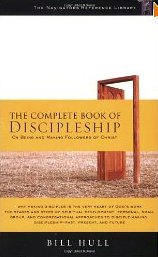
The Complete Book of Discipleship

book of discipleship


by Bill Hull

First of all, Bill has been on his discipleship journey for about forty years. He has been writing about this topic for a long time, too. This is one of those books from which you will be quoting. Not only is there a wealth of information, but Bill challenges his reader to the core.

Bill deals with the “elephant in the room” – consumerist non-discipleship Christianity. He shows how capitulation to our culture has robbed the church of her obedience, power, and vibrancy. He also addresses the false notion that discipleship can be thought of as a program for new believers that can be checked off the list and moved beyond. Discipleship is a lifetime journey.

Bill gives his readers a brief overview of the history of discipleship in the church, beginning with the Greco-Roman world up through Dietrich Bonhoeffer. At the end of the book he catches us up on present thoughts and practices. He also covers the marks of a disciple, the stages of discipleship, what is involved in spiritual transformation, the various approaches to disciple making, the role of small groups in the process, how discipleship works in the church, leaving a generational legacy through discipleship, and, finally, the future of discipleship. At the end of the book, referring to some of Barna’s research, he gives five examples of churches which seem to be doing a good job at making disciples, each one doing it a different way.

Some of the “gems” that I have taken from my reading of this book are below. I suppose everyone will be impacted slightly differently, depending on where each of us are in our own journey; but, I believe any serious disciple will benefit from giving this work a chance.

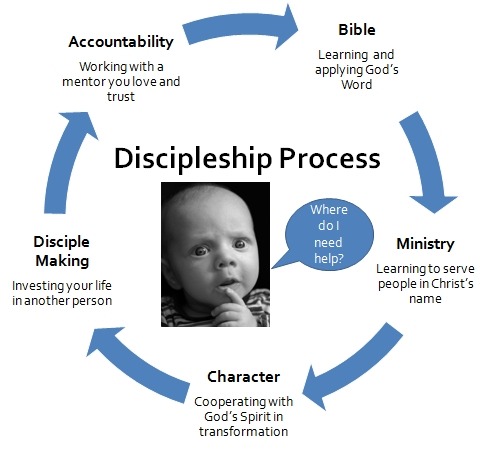
The Discipleship Cycle

(The graphic below is my design.)
discipleship processBill shares that most churches do a pretty good job at focusing on growth in knowledge of the Bible, learning ministry skills, and focusing on inner character transformation. Where we break down is usually in the area of being personally accountable to a mentor and in making a commitment to invest in at least one other person at any given time. I would add that unless sharing the Gospel with those who do not yet know Christ is added to the cycle, we will miss a fundamental aspect of disciple making.


Bill talks about entering into training rather than simply trying harder. He emphasizes the importance of cultivating the inner life, something that is a little foreign to many evangelicals formed by our consumer culture. Bill also is big on having a manageable way to measure progress, which evidences his leaning toward the engineer mindset. (See my summary of Peter Block’s book, The Answer to How Is Yes.) This does not mean we become regimented or program-oriented, but it does require giving some thought to providing a way to facilitate growth.

One of the best sections addresses the need for leaders to “detox” by giving up the “gods” that traditionally have ruled over our concept of church “success” and which militate against true discipleship. The first of these is the worship of attendance. Quoting Dallas Willard, Hull writes:

We must flatly say that one of the greatest contemporary barriers to meaningful spiritual formation into Christlikeness is overconfidence in the spiritual efficacy of “regular church services.”… One way to give up the god of attendance is to replace it with a different goal. When our goal moves from wanting recognition from others to the transformation of others, we put the god of attendance in its place. (p.265)

Secondly, leaders must stop bowing down to the god of “increase.” I will quote one line:

“Perhaps the toughest place to decrease is in the influence and power we hold over people around us. Any leadership based on increasing the leader is wrong.” (p.267)

The third “god” that must be dethroned in our lives is “competence.”

The culture honors competence. But the myth of competence is thinking that we’ll outgrow our weaknesses, sins, fears, and disappointments. The myth is that we’ll reach a place of spiritual competence where we’ll “get it together.” Those times never come. In fact, as we become more like Jesus, our dependence on God increases… Our wounds and weaknesses are real; our inabilities are exposed for others to see. When we lead with our weakness and our wounds, we gain a powerful way to touch others around us. (p.268-9)

Hull exhorts leaders to focus on the development of the inner life and giving ourselves over to the principle of discipleship.

“The principle of God’s plan of discipleship is the impact of one life on another – the character, skill, and perspective of one godly person influencing another willing person.” (p.270)

A final benefit is that this book provides a wealth of lists of reading materials for the person who wants to go deeper into learning about this most interesting and important topic. You should read this book!

Leading Missional Communities

Leading Missional Communities

by Mike Breen

Mike Breen has put together a wonderfully practical  book full of sound biblical principles and real life experiences to assist leaders of missional communities (MCs) in the challenging endeavor to reshape the church around better fulfilling the Great Commission. This summary will give you some of the highlights from the various chapters, which will hopefully whet your appetite to read the entire book.

Part One: Foundations for MCs

Chapter One: Understanding MCs and Oikos

Our commission is to compassionately reach out to those around us, invite them to join us in community, share the story of the gospel, make disciples, and gather them into families to follow Jesus together. That’s really what starting an MC is all about. This is not a fad or the latest church growth technique or a new name for cell groups. It is rediscovering the church as oikos, an extended family on mission where everyone contributes and everyone is supported. So, it isn’t that MCs aren’t important. They are, and that’s why we wrote this book.

But MCs are simply the initial vehicle we learn to drive that gets us to the real destination: learning to live as oikos, extended families functioning together on mission with God.

MCs are the training wheels that teach us how to ride the bike of oikos. They are the scaffolding that allows us to rebuild the household of oikos. MCs are the cocoon that allows the butterfly of oikos to emerge… We believe oikos is something the Spirit of God is doing in this time to restore the church’s ability to function fruitfully in discipleship and mission the way the early church did, publicly living out our faith in the various neighborhoods and relational networks of our cities.

We firmly believe this is the make-or-break issue for the Western church. We simply will not see God’s dream for the world come true unless we learn how to function as extended families on mission.(Breen, Mike. Leading Missional Communities (Kindle Locations 122-134). 3DM. Kindle Edition. Emphasis is mine.)

Breen defines a missional community as follows.

A Missional Community is a group of approximately 20 to 40 people who are seeking to reach a particular neighborhood or network of relationships with the good news of Jesus. The group functions as a flexible, local expression of the church and has the expressed intention of seeing those they are in relationship with become followers of Jesus with them. They exist to see God’s Kingdom come to their friends and neighbors. The result is usually the growth of the MC (as people become followers of Jesus and join them) and then the multiplication of new MCs (as people are trained to lead within the MC and then are sent out to start new MCs). They are networked within a larger church community, allowing for a “scattered” and “gathered” expression of church. (Kindle Locations 149-155)

As an aside, Life Community Network (dba LifeNet), where I pastor, is pioneering this church model in our area. Presently we are rather small but have a vision to expand the number of life communities as God enables us. We gather once a month as a network and scatter the other weeks into our small groups.

Missional vision is focused on sharing the good news of Jesus and making disciples among the people of a specific neighborhood or network of relationships. A neighborhood-focused MC centers on serving and bringing the good news of Jesus to the people who live or work in a particular geographic area (e.g., a housing subdivision or a few blocks of streets). A network-focused MC seeks to serve and bring the good news of Jesus to the people within a particular network of relationships (e.g., a sports club, creative professionals, a hobby group, a business community, students, a subculture in the city, etc.)…

The MC emphasizes living among and working with the people or place they are seeking to impact. This “incarnational principle” helps prevent MCs from becoming a series of service projects performed by people who are disconnected relationally from those they are serving.(Kindle Locations 184-193)

Chapter Two: Communities of Discipleship

The first principle is that you’ll need to build a discipling culture at the heart of your MC if it is going to be fruitful long-term… What do we mean by a discipling culture? … A discipling culture simply means that making disciples of Jesus is what is always happening in your MC. The Great Commission is to make disciples. Jesus says that he will build his church, (2) and our task is to make disciples. (3) Sometimes we get this backward and think that if we can figure how to build the church, then the end result will be disciples. But it actually works the other way around: We make disciples, and Jesus builds his church. Thus, the culture and mindset we want to build in our MCs is a discipling culture, where people understand clearly that we are called to both be and make disciples of Jesus. Making disciples of Jesus is what is always happening in your MC.

This means that within an MC, we are learning to trust and follow Jesus in every area of our lives, growing to become more and more like him in our character (who we are) and competency (what we can do). As we do this, we invite others to share this life of discipleship with us, growing in expectation that God’s Kingdom will break into every area of our lives.

We cultivate an identity as a “sent” people, missionaries to whatever sphere of influence or context we find ourselves in. As we truly make disciples (people who are becoming the same kind of person as Jesus was and doing the things he did), evangelism becomes a kind of overflow of our life of discipleship, rather than a program or event. Instead of feeling forced or contrived, evangelism will feel natural as people are drawn in by the fruit they see in our community.

A discipling culture is about encouraging and cultivating the development of a missional lifestyle (faith at the center of everything we do) rather than missional events (faith at the center of events we organize).(Kindle Locations 250-272)

Chapter Three: Communities of Good News

How does this understanding of the gospel play out, then? …our foundational understanding of Scripture is rooted in the two over-arching themes of Covenant and Kingdom. Right at the beginning of Genesis and all the way through to Revelation, we are called into a relationship with God (Covenant) and the responsibility of representing him to others (Kingdom)… When we look at the life of Jesus, we see him build a discipling culture by bringing to those who followed him an invitation to a Covenant relationship and a challenge to join God in the mission of the Kingdom.

As people engaged in this amazing relationship with Jesus and the adventure of the Kingdom mission, the natural outcome was that the disciples became a dynamic community on mission… Breen, Mike. Leading Missional Communities (Kindle Locations 383-390). 3DM. Kindle Edition.

The author uses a picture to illustrate some of what is related to covenant and kingdom. Breen graph 01As members of the covenant family we are in relationship with God and one another. We have a responsibility to invite others through the Gospel to enjoy the same covenant privileges as we enjoy. This is when the covenant community becomes a missional community.
Chapter Four: Finding the Person of Peace

A third foundational principle is understanding and practicing Jesus’ Person of Peace strategy for evangelism, and letting the rhythm of your MC flow from your relationships with the People of Peace you find. It is difficult to overstate how important this is. Jesus lays out this strategy in Luke 10: 1-16, instructing 72 disciples in how to prepare people in the towns and villages he was about to visit. A central part of his strategy was for them to center their ministry around a Person of Peace (translated “a person who promotes peace” in the NIV). The Person of Peace was someone who welcomed these disciples of Jesus into his or her home, was open to the message they were bringing, and served them. (Kindle Locations 520-525)

The thing about the Person of Peace strategy is that it’s not simply pragmatic. That is, it’s not just a convenient way to find people to disciple. It’s actually a way of noticing what God is already doing in your mission context. Here’s why: A Person of Peace isn’t just someone who likes you. Jesus told us, “Whoever listens to you listens to me,” so, if we are representing Jesus, these are people who are actually showing us that they are interested in Jesus!

They are people in whom God has already been working, preparing their hearts for the good news of Jesus. So we “stay with them” because, in doing so, we are joining in with what God is doing in their lives, cooperating with the Holy Spirit.

Finding a Person of Peace means discovering where God is already at work in the neighborhood or network of relationships you’re seeking to reach. The first step is always to identify the People of Peace in whatever neighborhood or network we are seeking to reach. Then, we “stay there,” as Jesus said, finding ways to intentionally spend time as a community with these People of Peace, sensitively exposing them to various “Kingdom experiences” (joy in community, kindness, service, fun, testimonies of God’s work in our lives, meals together, prayer and worship times, etc.). You simply invite them into what you’re doing as a community. (Kindle Locations 537-547)

Chapter Five: Both Organized and Organic

Families exist along a continuum of the organized and the organic, the structured and the spontaneous aspects of life together… It would be odd for a family member to attend only the dinner and leave immediately afterward if no official activities were scheduled. Likewise, it would be odd for someone to skip Thanksgiving dinner because he or she were tired or just didn’t feel like coming. Being part of a family involves a commitment to the structured and the spontaneous elements of the family’s life together. The structured times inform and feed off the spontaneous times, and vice versa. If the structured events didn’t happen, the spontaneous interactions wouldn’t be as rich. If the spontaneous stuff wasn’t happening, the structured events would eventually feel like a chore.

Families need the organized and the organic to create the texture of life together. MCs should have the same texture, the same balance of organized and organic elements, so they become places where people experience being an extended family on mission. (Kindle Locations 617-632)

Part Two: Leading MCs

Chapters Six through Eight give some practical advice on how to successfully lead missional communities. Chapter Six focuses on the importance of vision and prayer. Chapter Seven gives three examples of how missional communities can work. These are not prescriptive; rather, they are meant to inspire. Chapter Eight focuses on growing and multiplying our groups and missional community. Breen gives five signs of oikos that are helpful.

  1. Eating Together
  2. Playing Together
  3. Going on Mission Together
  4. Praying Together
  5. Sharing Resources

My own experience with leading a missional community is that pursuing oikos is one of our biggest challenges. Our society works against the process. We have become increasingly isolated from one another due to a number of factors, and rebuilding what has been lost will require vision, commitment, and perseverance. Breen writes:

It’s easy to feel overwhelmed when thinking about the rhythm of your MC, and because of this, we find that people fall into one of two ditches: They either over-program their MC, making it feel like a series of events, or they don’t meet enough because they don’t want to “burden” people. Ironically, the latter ends up making the MC again feel like a series of events, just less frequent (and poorly attended) ones. Neither ditch actually creates a sense of extended family.(Kindle Locations 944-948)

Leadership development is another large challenge to growth and multiplication. Whereas every person in an MC is discipled to be part of the community on mission, leaders must be discipled more intensely. They have more to learn and more responsibility.

MCs are a great vehicle that gets you to the missional places God is calling you to go, but discipleship is the engine.

This is the pattern of Jesus. He was always training his disciples to do the same things he did. So as you lead, you’re always raising up new leaders. As you engage in mission, you’re always raising up new missionaries. It means always having an eye on training others to do the things we’re learning to do ourselves.

Healthy multiplication happens only if you have quality leaders, and you get quality leaders only by being intentional about raising them up. They don’t get it simply by osmosis— you need to train them.

Having a healthy, accountable leader with vision is the rate-determining step for multiplication. This means that multiplication will never go faster than leadership development. You will never multiply your MC faster than you raise up new leaders who can do what you do. Breen, Mike. Leading Missional Communities (Kindle Locations 1109-1117). 3DM. Kindle Edition.

Part Three: Practical Tips

Chapter Nine gives some reasons why missional communities fail. These are worth studying as a warning us against making common mistakes. Chapter Ten answers some frequently asked questions. One of these, as you might expect, concerns properly working with children.

For MCs that have children involved (which is most of them that we’ve seen), kids are almost always one of the first issues people ask about. What do we do with the kids? How do they fit into this thing we’re doing? The overarching principle to keep in mind here is that MCs are the training wheels that help us ride the bike of oikos; MCs cultivate a sense of being an extended family on mission!

In other words, we’re not trying to plan a slick production— we’re trying to build a family. And families have kids in them.

In a family, sometimes the kids and adults are together doing a “grown-up thing,” such as dinner or evening devotions. Sometimes the kids and adults are together doing a “kid thing,” such as a birthday party or decorating Christmas cookies. And sometimes the kids and adults are doing separate but related things, such as the kids playing games in the basement while the adults talk upstairs after dinner.

The question really shouldn’t be, “How are we going to deal with the kids?” It should be, “How are we going to disciple our kids well?”… We have often been surprised by how deeply the experience of being consistently included in a family on mission imprints itself on a child’s soul. (Kindle Locations 1331-1340 and  1389-1390)

The last thing we want is for our kids to become segregated from the adults and alienated from church life as a result. Our children should be included in as much as they can handle so they will know they are integral to the missional community.

Part Four: Conclusion

Breen reminds the reader that missional communities do not have to achieve “great things;” rather, we are able to focus on doing small things well, just as the early church did. If we concentrate on ministry to people in our neighborhoods and other relational networks, if we deliberately serve those Jesus calls “the least of these my brothers” – the marginalized, the oppressed, the poor, etc, if we focus on loving people, serving them, and sharing the Gospel, these “small things” will become great in the eyes of God.

This is ultimately what starting an MC is all about. As we learn to become an oikos together, our job isn’t to try to do big things. It’s simply to do the small things we see around us with great love, trusting that God will take our small things and all the other small things we don’t see and weave them all together into a tapestry that announces His love for humanity and calls all people to new life under God, who is making everything new. (Kindle Locations 1587-1591)

Life on Mission

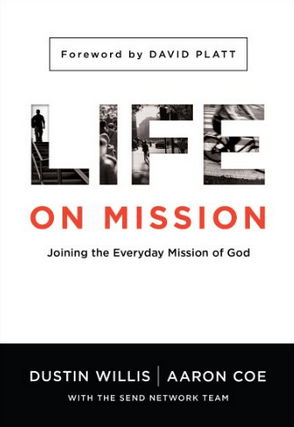
Life on MissionLife on Mission: Joining the Everyday Mission of God

by Dustin Willis and Aaron Coe

Life on Mission is a great introduction to missional living. The book is divided into four sections:

  • The Big Picture – an overview
  • Gospel Foundations – which stresses the priority of understanding, believing, living by, and preaching the true Gospel
  • Mission Practices – four areas of practice
  • Ministry Steps – practical applications

The authors’ introduction mentions that the book is aimed at the rank and file of the Body of Christ, everyday Christians who are called to be disciple makers.

We realized that within our community a large event or new program wouldn’t bring consistent transformation, but believers banding together to take responsibility for their dot on the map would. [3. Kindle Locations 196-198)]

In the sections below, I chose to mainly insert quotes from the book. This should give you an idea of what is covered. One thing to keep in mind, though, is that I have read many similar books and what I picked for quotes are what struck me as interesting and important. Another reader may be impacted differently; so, I recommend that you to read the book for yourself.

Section One: The Big Picture

Chapter One: The Everyday Missionary

Therefore, the mission of God requires that believers leverage their lives for His glory. The Great Commission is not for a select few; it is for the entirety of the church. The movement of God’s mission sweeps across everyday, ordinary lives to draw in business people, soccer moms, grandmothers, neighbors, students, lawyers, teachers, baristas, contractors, white collar, blue collar, or no collar at all. Regular people like you and me united by the one who lifts the curse of the fall. Filled with His spirit, laying down our lives, denying ourselves for the mission of God and the good of others. This is the invitation. [4. Kindle Locations 261-265]

Everyday missionaries are those who practice life on mission where God has placed them, whether that be at an office complex, a developing country, or a college campus. It is incumbent on every believer to have an “all hands on deck” mentality in order for the mission to reach its fullest potential. [5. Kindle Locations 268-270]

Life on mission is about intersecting gospel intentionality into our everyday routines. [6. Kindle Location 294]

Living life on mission should be driven not out of guilty obligation, but rather out of embracing the identity and purpose given to us in Christ. [7. Kindle Locations 298-299]

The authors assert that many people who are dodging their responsibility to obey the Great Commission fall into one of three camps.

  • The “I’m not a professional” camp
  • The “I’m too busy pondering” camp
  • The “Why are we doing this? camp

About the second, he writes about a fictional Chris.

Chris is passionate about learning as much about God as he can. He feels that knowledge about God will be his secret to his future ministry success. He loves going to seminars, reading books, and studying theology. He loves to talk about spiritual things with other believers, but his involvement in actual ministry is minimal. He goes to church, of course, but to say he is on mission with God would be a lie. He has no intentional relationships and hasn’t had a conversation with a nonbeliever in months. Though he goes “deep” in theology, he has forgotten to apply any of it to his life. [8. Kindle Locations 306-310]

In keeping with the purpose of the book, the authors state that the church must embrace simplicity if it is going to be effective.

We recognize that mission and discipleship have been overly programmed and made excessively complicated, and we have no desire to do either of those. In the Scriptures, we do not see a syllabus for a program, but rather a gospel-rich missionary process. [9. Kindle Locations 328-329]

Our mission is driven by the truth of the gospel and defined by the mission of God. God’s mission is to take what is broken and redeem it—not simply to make it better but to make it new. And the exciting part is that God Himself invites us to follow Him into a broken world as we live LIFE ON MISSION! [10. Kindle Locations 342-344]

Chapter Two: The Current Reality

Our role as everyday missionaries is to introduce people to Jesus, actively be part of their journey to become like Christ, and teach them to repeat the process with others. This is the desired reality, but before we move forward we must honestly examine the current reality of the mission field known as North America. [11. Kindle Locations 352-355]

Declining numbers and evangelical regression can lead to frustration and mission paralysis for the church. We must remember that our God is still God and His desire for movement through His church can trump any current realities. [12. Kindle Locations 415-417]

Chapter Three: The Mission of God

As we are changed and freed, we are compelled to be where He is—right in the middle of the greatest rescue mission ever given. How crazy is it that we are invited into this mission? Not only are we reconciled to God, but we are also drafted to be missionaries alongside Him, spreading the same good news that rescued us from our self-made destruction. [13. Kindle Location 474-477]

Chapter Four: Kingdom Realignment

Why don’t we embrace God’s mission? Because, frankly, we have our own mission. We have our own way of calling the shots. We decide what’s meaningful or worthwhile and order our lives accordingly. Some people’s life mission is to pursue entertainment and comfort. For others it’s security or wealth. For others it may be rising up the corporate ladder or being the most respected mom in the neighborhood. We like to be the boss of our own lives. [14. Kindle Locations 499-502]

Repent, because the kingdom already has a King, and you and I are not it. If we are ever going to get swept up into God’s kingdom, we will have to let go of our own. Our own ways of seeing and approaching our lives will have to be radically reoriented. [15. Kindle Locations 507-510]

Section Two: Gospel Foundations

Chapter Five: The Gospel

The more we grasp what Jesus has done for us and in us, the more we will be compelled by grace to clearly communicate Jesus to those around us. [15. Kindle Locations 701-702]

The gospel is the heart of the Bible. Everything in Scripture is either preparation for the gospel, presentation of the gospel, or participation in the gospel.5 The summation of the Scriptures is the message of the gospel; therefore, the gospel should transform every fabric of our lives. It reaches every facet of our being and leaves nothing untouched. Jesus doesn’t make us halfway new, He makes us fully new. [16. Kindle Locations 861-864]

Chapter Six: Spiritual Maturity

A big view of God is the starting point for mission. [17. Kindle Location 935]

Theology professor Keith Whitfield supports this idea: “We will not be able to recover a vision and passion for missions until we recover the grandeur that God made us to know and worship Him and make Him known throughout the whole earth.” [18. Kindle Locations 948-950]

Many of us live under the weight of failure because our success metrics are derived from the wrong source. Understanding God is in control of all things will work as a great starting point toward freedom from those metrics and, ultimately, grow us toward maturity. And a sign of that maturity is accepting that God is sovereign over your mission. There is not one ounce of it that He has not orchestrated. [19. Kindle Locations 968-971]

Chapter Seven: Biblical Community

When my wife and I (Dustin) moved to Atlanta, God blessed us with an incredible avenue for mission, also known as our neighborhood. We regularly invite our neighbors plus families in our church community group to cookouts in our front yard. We are intentional about inviting our community group because (1) we want to encourage other Christians to engage with their neighbors; (2) we know that some people may have greater connection with our neighbors than we do; (3) we desire to display Jesus through our group to our neighbors. [20. Kindle Locations 1157-1160]

Chapter Eight: Intentional Discipleship

The life of the church and the mission of the church are inexorably bound within the all-encompassing reality of discipleship. Growth and discipleship cannot happen apart from Christian community, and your church’s mission to make disciples can only be truly accomplished in the context of a community centered on the gospel. There are no “professional Christians” or “disciple-making specialists” who do all the work. Anyone in need of sanctification (everyone) must submit to discipleship under Christ within the context of biblical community, and anyone submitted to discipleship under Christ will obediently apply their gifts and personality to make disciples of friends, family, neighbors, and coworkers. No exceptions. [21. Kindle Locations 1223-1229]

And just as we are continually transformed by Christ’s shaping us in biblical community, we continually seek for others to be reconciled to God and transformed just as we are—this is disciple-making. [22. Kindle Locations 1253-1255]

Jesus was a great model for disciple-making. His ministry strategy was to pick twelve people and spend a ton of time with them. He didn’t give them a manual or send them to a conference; He just did life with them. [23. Kindle Locations 1263-1265]

Section Three: Mission Practices

Chapter Nine: Identify

People who live on mission are always on the move toward others. They don’t wait for the world to come to them, they seek and find the people who have needs. [24. Kindle Locations 1342-1343]

Your life on mission will require that you “go to the other side” for people. The people who need your help are not necessarily going to show up on your doorstep, so you have to identify them where they are and move toward them. [25. Kindle Locations 1347-1349]

When we combine our natural rhythms or passions with the gospel and use them to build relationships, powerful things can happen. Our passions or placement (where we live, where we go) can help us identify opportunities for sharing the gospel. [26. Kindle Locations 1428-1430]

Jesus’ social economy is completely the opposite. It’s about descending, not ascending. It’s not about looking to see what you can get from others, but identifying how you can give to others. It’s about pressing out toward the margins—to the people who need love and friendship. [27. Kindle Locations 1451-1453]

The powerhouse of a great move of God starts with prayer. The fuel of our mission is prayer. One of the best activities you can do as an everyday missionary is to walk or ride through your neighborhood and ask God to show you what He sees. [28. Kindle Locations 1465-1466]

Chapter Ten: Invest

[We must] understand that those who have been made right with God through Jesus will disadvantage themselves for the advantage of others. [29. Kindle Locations 1515-1516]

Over and over throughout the Gospels, we see that while Jesus consistently poured His life into the people closest to Him, He sacrificially served all those whom His life intersected. [30. Kindle Locations 1519-1520]

Being on mission is not always about going to a specific place—it’s about being intentional where you are. That’s investment. And investment is always intentional. It’s a lifestyle choice. [31. Kindle Locations 1538-1539]

If you’re having trouble figuring out how to invest in those around you, try this simple tool: Ask people how you can pray for them. When you’re building relationship with neighbors, coworkers, or friends, simply say, “Hey, this may seem weird to you, but I’m a Christian so I pray for people. Is there anything I can pray for you about?” Even non-Christians will oftentimes gladly accept prayer and respond to this question with genuine things that are going on in their lives. Many times this question leads to great conversations and a deeper relationship. [32. Kindle Locations 1575-1579]

Chapter Eleven: Invite

God Himself is on a rescue mission as He invites people into right relationship with Him. Joining God in His mission will require that we become willing to extend the invitation to others. [33. Kindle Locations 1627-1629]

Chapter Twelve: Increase

A simple way to see a movement of new believers is to raise up the new disciples in strong biblical foundations and to send them out to repeat the missionary process of identifying, investing, inviting, and increasing. The previous statement is not a job description for a pastor but rather the intent given to every believer of the gospel. [34. Kindle Locations 1782-1784]

The practical step of increase is all about starting the process again by sending people to identify, invest, and invite their friends and family into new communities. [35.Kindle Locations 1828-1830]

Intentionality in increasing the number of people living on mission is central to seeing the kingdom impacted. This will not happen by itself, and we need to equip and develop people as much as possible. [36. Kindle Locations 1843-1844]

Section Four: Ministry Steps

Chapter Thirteen: Pitfalls and Plans

In this chapter the authors list several pitfalls to avoid in launching into mission. The appendix contains a six-week study guide if any leader wishes to take a small group through the book as an exercise in developing a missional understanding and practice.

Untamed

untamedUntamed: Reactivating a Missional Form of Discipleship

by Alan & Debra Hirsch

The Hirschs partnered to produce a challenging and needed book on discipleship, which is the heart of the Great Commission. Believing that the success of the mission of God depends on our getting discipleship right, they write:


To be a truly radical disciple does require a relentless evaluation of life’s priorities and concerns, together with an ongoing, rigorous critique of our culture, to ensure we are not adopting values that subvert the very life and message we are called to live out.

We sincerely believe discipleship has become a frontier issue for the people of God at this time in history. And most commentators would agree that in sincerely seeking to appeal to the prevailing consumerist culture, the Western church has all but lost the art of discipleship. (p.23)

The authors see an unbreakable link between true discipleship and mission.

We take the missional agenda of the church with utmost seriousness. You simply cannot be a disciple without being a missionary – a sent one. For way too long discipleship has been limited to issues relating to our own personal morality and worked out in the context of the four walls of the church with its privatized religion… To strive for holiness and maturity in our own personal lives is extremely important, but it is only half the picture; the other half is our God-given responsibility to the world around us. The fact is that you can’t be a disciple without being a missionary: no mission, no discipleship. It’s as simple as that. (p.29)

Section One: The Untamed God

jeebus made me do it

Jesus’ holiness was compelling, drawing the outcasts and marginalized of society while repelling self-righteous hypocrites. By spending time with prostitutes, tax collectors, adulterers, Roman soldiers, Samaritans, and Gentiles,

Jesus shows us that one cannot achieve holiness by separation from the unclean… The holiness of Jesus, it seems, is a redemptive, missional, world-embracing holiness that does not separate itself from the world, but rather liberates it. (p.46)

Writing of the dangers of the herd mentality, Hirsch says:

Groupthink is not necessarily a Christian virtue, and we should not mistake a crowd for a community of Christ followers… If we are not careful, churches can easily develop a herd mentality, a crowd instinct that will tend to penalize dissenting voices and actions. The church, however, is destined for an individual and corporate responsibility to God that will almost inevitably put us at prophetic odds with society around us. (p.50)

your god is too sick

In this chapter, the authors address the tendency we have to form God in our own deformed image.

It is because of the all-too-human propensity for rationalization and self-deception that we fail in discipleship… Worship isn’t just about singing songs to God, listening to sermons, partaking in the liturgy, or even simply praying. It must include loving our neighbor, seeking justice for the downtrodden, evangelism, and the renewal of true community. (p.78)

the spirit’s edge

In this chapter, the authors take a look at holiness, which they define, as I do, more along the lines of being set apart to God’s purposes – The Great Commission.

When we talk of God as being holy or Jesus as holy, or of the Holy Spirit, we must resist the temptation to see holiness in moralistic terms, or else we do violence to the idea of the redeeming God and end up seeing God as the ultimate moralist!… Holiness begins with God, flows into our own hearts and our lives, moves from there into the community, and eventually reaches every aspect of life the world… Holiness is not gained by withdrawal from the world but by active, redemptive engagement in the world. Instead of looking at holiness as a list of “don’t’s,” see it as a list of “do’s”…

Another dimension of biblical holiness is the idea of consecration: of being set aside to do a distinct task. True holiness involves clearing the desk, setting selfish agendas aside, and being willing to partner with God in the redemption-sanctification of the world by doing all things – the everyday things – in his name and for his glory. (pp.92-93)

The Hirschs make the point that the mission of God is found in his triune nature:

“God sends his Son into the world. The Father is a sending God, and the Son is a sent one. And the Father and the Son send the Holy Spirit.” (p.95)

Section Two: The Untamed Culture

kultcha-schmultcha

The authors address the powerful impact of our consumerist culture upon the church and disciple making.

If we, in a sincere attempt to reach contemporary audiences, reconfigure the processes of Christian formation, putting the challenge of discipleship off to the end, then, in our opinion, we are opening the floodgates to being “evangelized” by the culture. When we remove Jesus’s preconditions to following him and use professional mass entertainment (no matter how sincere) to draw people to Christ, we should not be surprised at the results – we simply can’t entertain consumers into becoming disciples, nor can people consume their way into following Jesus. (p.110)

The authors address society’s attraction to Mammon and the Market.

When we look at the power of consumerism and the market in our lives, we are thoroughly convinced that we are dealing with a very significantly religious phenomenon: if the role of religion is to mediate a sense of identity, purpose, meaning, and community, it can be said that consumerism fulfills all these criteria. (p.117)

They give some practical ways to escape the clutches of our culture in order to be more authentic Christ followers.

the church that Jesus built

The implicit message church members get from a church that adopts a consumer-driven model (with marketing and all) is that they are essentially discerning consumers and that the local church is a vendor of religions goods and services. No longer is the church a disciple-making medium operating under the Great Commission; rather, the church is viewed as existing to serve my spiritual needs… In this case community exists for me, not me for the community. (pp.138-139)

The very language of “getting fed” at church betrays the fact that any attendees are not disciples at all, but rather passive (and somewhat dependent) consumers. (p.139)

Hirsch addresses the harmful effect that ordination has on Christianity as a people movement. We give lip service to the “priesthood of the believer,” but ordination actually establishes a clergy-laity divide that disenfranchises the average follower of Christ.

If one wanted to destroy the sheer transformative power of the body of Christ as a people movement, then the creation the clergy-laity divide is nothing less than a stroke of demonic genius. (p.143)

In movements it is important to distribute power and function to the outermost level… one of the biggest shifts needed is to de-professionalize the ministry/clergy class and give ministry back to the people of God. This doesn’t mean that we do not have leaders: any movement that makes any impact has definite leadership. They simply don’t confuse leadership with ministry. Not all are leaders, but all are ministers. Leadership is calling within a calling. (p.144)

Hirsch also encourages the church in America to more fully address the issue of women in ministry. He feels that we cannot afford to relegate women to a secondary status in the church if we are going to impact the world as we should.

Next the authors talk about

“undercover discipling,” writing: “…discipleship is not just for those who have accepted Jesus as their Lord and Savior – it’s for everyone!” (p.146)

Their argument is that unbelievers can be discipled to Christ. We depend on the Spirit to convert people, but our job is to disciple. This is how Jesus did it. None of the apostles were born again believers when he began the process.

Reframing mission and evangelism around discipleship makes space for long-term, authentically loving relationships with the various people in our lives. This in turn will give credibility to our message and space for real and meaningful friendships – something we are not always known for. (p.151)

The next topic addressed pertains to center-set (or open-set) and boundary-set groups.

Conceiving church as an open set engenders a truly Christ-centered approach t0 holding together, unlike the more standard religious organizations with their theological and cultural boundaries and formulas developed to keep certain people in and others out. Rather than seeing people as Christian or non-Christian, as “in” or “out,” we would see people by the degree of distance they are from the center…. this kind of movement allows for a sense of belonging before believing. (p.154)

The authors suggest that the way we practice communion should be influenced by the open-set model. They admit that doing church in this manner will be messy, but that is the cost of following Jesus, the untamed Lord.

refocusing the family

In this chapter, the Hirschs address the need for hospitality in our family structure if we are to be genuine disciples.

Surely our lack of hospitality points to something deficient in our culture, our sense of missional obligation, and therefore also our discipleship. (p.165)

They argue that our pursuit of the materialistic dream has robbed us of experiencing family as God wants. As a result of our family time being compressed due to external pressures, we have become extremely protective of preserving what little time is left to us, thereby eliminating hospitality to outsiders from the mix. This makes us missionally ineffective.

We must deny the idolization of the nuclear family in favor of seeing the church as the family of God. Jesus redefined family around the community of disciples. (Matthew 12:48-50) If we prioritize seeking first God’s kingdom with our families, our families will be blessed more than we can imagine.

Section Three: The Untamed Self

the lying mirror

Seeing the image of God in people generates compassion. Henri Nouwen makes the point that if we have true compassion for people, then we will not focus primarily on their outward behavior. (p.196)

too sexy for the church

Discipleship involves knowing and being known by God through Jesus and living our lives in the kingdom of God. As followers of Jesus, we are not called to a vague and undefined spirituality but to a spirituality that exists within the context of discipleship. (p.215)

Section Four: The Untamed Mission

going out, going deep

If missional defines our being sent out into the world, then incarnational must define the way in which we engage the world. (p.234)

If we are to follow Jesus, we need to make intentional choices to move out of our religious zones and be where the people are. It will require that we come into direct social contact with others and become a regular part of the natural rhythms of the community. (p.238)

We don’t “bring God” with us into any situation – he’s there long before you or I arrive on the scene. We simply need to discern God’s prevenient work in people’s lives and join with him. (p.243)

Identification on the level of the heart implies a certain intimacy with the people you are trying to reach… Incarnation of the heart can be costly, so we often avoid it. (pp.246-247)

Following the logic of the incarnation itself, our message is heard properly only when we have gone through the process of identifying with people,hearing them, understanding the issues they face, humbly living with them, and knowing how they experience and express their search for meaning. (p.248)

afterword: a call to untamed adventure

There are two kinds of people in the world; those who live the adventure, and those who only read about others living the adventure. (p.258)

Hirsch wrote that he determined to be one who lives the adventure. How about you?

Share this post...