
Repentance from Syncretism

In my previous article, I showed how we can repent from believing the “scientific” lie of evolution as opposed to the Bible creation story. This article will address the sin of syncretism whereby we try to blend two or more irreconcilable ideas or faiths.

God warned the Israelites that they must destroy the idols of the people who lived in Canaan to protect themselves from their deluding influence.

Watch yourself that you make no covenant with the inhabitants of the land into which you are going, or it will become a snare in your midst. 13 “But rather, you are to tear down their altars and smash their sacred pillars and cut down their Asherim 14 —for you shall not worship any other god, for the LORD, whose name is Jealous, is a jealous God— 15 otherwise you might make a covenant with the inhabitants of the land and they would play the harlot with their gods and sacrifice to their gods, and someone might invite you to eat of his sacrifice, 16 and you might take some of his daughters for your sons, and his daughters might play the harlot with their gods and cause your sons also to play the harlot with their gods. Exodus 34:12–16 (NASB95)

The people of that day recognized what many today do not understand. Demonic “principalities and powers” often gain influence and even mastery over the residents who live in certain areas because of sacrifices made to those evil beings in order to procure favor and blessings. In order to protect themselves, invading conquerors often made an effort to appease the local gods. They would not abandon their own gods but would simply add some new ones. This eclectic religion seemed very practical and revealed that they believed that there was not one supreme God over all, but many gods who vied with one another. This would result in a syncretistic blending of elements from the various religions into something new, a sort of hybrid religion.

Another definition of syncretism is “the attempted union of principles or parties irreconcilably at variance with each other.”

I hope I showed how biblical creationism and Darwinism are hopelessly irreconcilable; nevertheless, many well-meaning theologians over the years felt pressure to try to fuse the two. They did not want to seem “foolish” or “ignorant” of the latest “scientific breakthroughs.” They wanted to have their Christian religion while simultaneously bowing to the gods of science. It created something very different from simple belief in the Bible’s teachings and led people to doubt the truthfulness of God’s Word. This is always Satan’s end game. He uses “science,” otherwise called “knowledge,” to cast doubt on God’s spoken or written words.

When engaging in this sort of syncretism, something has to give, and it always seems to be our adherence and allegiance to the written Word of God.

Instead of God’s creating the known world and everything in and around it in six days, blending evolutionary theory into the mix requires us to drag things out over millions of years using supposedly naturalistic but quite impossible processes to spontaneously generate life. Such syncretism results in a sort of Deism in which God passively steps back and lets things play out on their own.

As is apparent, this compromise results in two things. First, it teaches us to distrust and abandon the literal teachings of the Bible, and, second, it makes God irrelevant and unneeded, which is exactly the goal of every satanic philosophy and “scientific” system of thought.

Followers of Christ should never cave to syncretism. As Joshua said so long ago.

“Now, therefore, fear the LORD and serve Him in sincerity and truth; and put away the gods which your fathers served beyond the River and in Egypt, and serve the LORD. 15 “If it is disagreeable in your sight to serve the LORD, choose for yourselves today whom you will serve: whether the gods which your fathers served which were beyond the River, or the gods of the Amorites in whose land you are living; but as for me and my house, we will serve the LORD.” Joshua 24:14–15 (NASB95)

Now let us consider the creation story in more detail and examine another form of syncretism that involves the Big Bang theory. Have you ever wondered where scientists got the idea of the entire known universe exploding out of nothing? This idea is found the Kabbalah, an occult form of Jewish mysticism.

All of existence started with an explosion from one point that is continually multiplying, according to Jewish mysticism. Thus, Wolfson sees a distinct relationship between the contemporary Big Bang theory and the Kabbalistic notion that the universe burst forth from a single point, which in mystical terms is the limitless light of the divine, or Infinite, known as the “Ein Sof.” In Hebrew, “Ein Sof” literally means “no end.” So the divine, or god, is just another word for infinity. Kabbalists are people who study the manifestations of infinity. And just as physicists seek a single principle, a so-called “unified theory of everything” that will explain all of life, so do mystics. “For the kabbalists, that one principle is the light of infinity, which materializes into the multiplicity of all beings,” Wolfson says. That light emerging from darkness is both physical and symbolic, the professor explains. As an idea, it shows that things are often much more complex than they appear at first glance, and that the most abstract of notions explain the material world. “Cast in the lingo of quantum physics, we could identify the immaterial light as the particle and the material vessel as the antiparticle, which meet and collide in the zero gravitational energy of empty space, the nothingness that spawns the something that is the stuff of being,” Wolfson says.  (https://qz.com/1375015/jewish-mysticism-offers-a-poetic-explanation-of-the-big-bang-and-black-holes)

This is a perfect example of satanic “science” which weaves its web around the mind, appealing to our desire to have knowledge without getting it from God. It baffles us with the appearance of intellectual brilliance.

In 1927, a prescient [Jesuit] astronomer named Georges Lemaître looked at data showing how galaxies move. He noticed something peculiar – all of them appeared to be speeding away from Earth. Not only that, but the farther away they were, the faster they went. He determined a mathematical way to represent this, and connected his relationship to Einstein’s law of General Relativity to produce a grand idea: That of a universe continually expanding. It was a radical idea then, but today it fits with our conception of a universe spawned by a Big Bang. (https://www.astronomy.com/science/the-jesuit-astronomer-who-conceived-of-the-big-bang/)

Personally I believe that Satan was just as surely behind the Kabbalistic and Jesuit versions of origins as he is behind the Big Bang theory. I think they are one and the same, only the latter is dressed up in the clothes of science rather than religious mysticism.

The Kabbalah was developed during the Middle Ages by a Jewish mystic. Practical Kabbalah is the process of engaging in rituals, summoning angels and demons, uttering incantations and divine names, using amulets and magical seals to actually change the world.

The Kaballah is syncretistic, blending biblical Judaism with witchcraft. One might say the same thing about the Big Bang theory. It seeks to weave a magical spell around our minds to keep us from seeing God’s glory in creation.

The attempt to blend the Big Bang theory and its attendant cosmology with what the Bible teaches is quite impossible, even though its seems as it might be done at first. The Bible says that God spoke the our world into existence out of nothingness. So far, so good.

In the beginning God created the heavens and the earth. Genesis 1:1 (NASB95)

But, besides refusing to credit the Creator with initiating the process, the Big Bang theory holds that the sequence of events after the initial ‘blast” unfolded is completely unlike what God’s Word tells us. Employing supposed naturalistic forces and assumptions, the Big Bang theory posits that an entire “universe” of exploded matter and energy over vast amounts of time formed into stars, planets, etc., eventually producing what we observe, including all forms of life, without any reference or reliance upon the Creator. The Bible is very specific in how God put things together, dividing his work into six twenty-four hour days. The two simply do not mix.

By giving us a naturalistic, supposedly scientific, explanation of our origins, Satan tries to make those who hold to what the Bible says seem backward, “archaic,” and ignorant. If you want to be mocked or patronized, tell your “educated” friends that you believe the Bible 100%.

The Bible does not always satisfy our curiosity by giving us the “how” or “why,” but it does give us what we need to know. Our problems start with wanting to know more than God chooses to tell us.

This insatiable quest for knowledge that goes beyond and stands opposed to what God has revealed is what got us into trouble in the first place and continues to do so now. Some things relating to origins and cosmos are simply past our comprehension and “need to know.”

When Job virtually demanded to know why God allowed him to be afflicted, God eventually appeared to him, but not to answer his questions. Job’s interaction with his Maker resulted in his gaining a new awe and admiration for God that satisfied every fiber of his being. He no longer needed to know why.

‘Who is this that hides counsel without knowledge?’ “Therefore I have declared that which I did not understand, Things too wonderful for me, which I did not know.” 4 ‘Hear, now, and I will speak; I will ask You, and You instruct me.’ 5 “I have heard of You by the hearing of the ear; But now my eye sees You; 6 Therefore I retract, And I repent in dust and ashes.” Job 42:3–6 (NASB95)

The creation is meant to impress upon us awe and wonder resulting in worship of the Creator. The Big Bang theory is meant to reduce the universe to mere materialistic mechanisms that rob us of knowing God.

King David wrote these words of worship as he pondered the heavens.

When I consider Your heavens, the work of Your fingers, The moon and the stars, which You have ordained; 4 What is man that You take thought of him, And the son of man that You care for him? 5 Yet You have made him a little lower than God, And You crown him with glory and majesty! 6 You make him to rule over the works of Your hands; You have put all things under his feet, Psalm 8:3–6 (NASB95)

God intends for us not only to grow in our knowledge and worship of him. He also wants us to understand that mankind is central to his creation purposes.

The Big Bang theory leaves us thinking that we are inconsequential specks in a vast impersonal universe. Can you not detect Satan’s hand in weaving the witchcraft-like spell of this pervasive lie? Satan hates that we who put our faith in Christ are destined to rule with him forever, seated with Christ at God’s right hand. We are handed what Satan tried to take from God.

In my next article, I will begin to explore in more detail what the Bible says about the world in which we live. It is quite at odds with the lie of the Big Bang theory. We cannot mix the two. We, like Joshua, must decide whom we will serve – modern so-called “science” with its cleverly spun lies or the God of the Bible whose words are always true. He cannot and does not ever lie.

O Timothy! Guard what was committed to your trust, avoiding the profane and idle babblings and contradictions of what is falsely called knowledge—21 by professing it some have strayed concerning the faith. Grace be with you. Amen. 1 Timothy 6:20–21 (NKJV)
Adopting a Biblical Cosmology

In my previous article, I showed why it is hazardous for us to try to blend irreconcilable ideas in a vain attempt to harmonize the Bible with godless philosophies and systems of thought.

We can avoid syncretism by allowing God’s Word to shape our thinking in every area, including our cosmology, the science of the origin and development of the heavens and earth.

Doing so will cause us to reexamine commonly held beliefs in both the natural and spiritual domains to see how faithfully they align with biblical revelation and truth. Not surprisingly, this process will likely challenge whether we trust and revere God’s Word more than what is called “science”.

During the Covid crisis, a mantra was echoed – “trust the science,” which, by the way, is very unscientific. Science is a process that requires and encourages questioning. Notwithstanding, those of us who questioned “the science” during Covid, including the efficacy of lockdowns, masks, social distancing, and an unproven mRNA jab, were ridiculed, censored, ostracized, and sometimes persecuted, as in the case of those who were fired for refusing to trust the science. We were expected to bow to the “high priests” of a new religion called scientism, instead of doing our own research and forming our own conclusions. Blindly trusting “science” is more of a religion than scientific, as revealed by how our leaders handled opposition. During Covid, many of us awakened to the fact that Satan, the great deceiver, is hard at work promulgating falsehoods designed to steal, kill, destroy, and to hold humanity captive, hindering our quest to know God and truth.

For lovers of truth, anything that contradicts the Bible must be rejected.

This will test our loyalty to God and our conviction regarding the truth of the Bible. It might require us to be willing to look foolish to “more enlightened” people who esteem the tenets of faith promoted by what is called science higher than any other source of truth.

God wants to convince us that he never lies. He may not immediately reveal everything we want to know, but he will not fudge the truth to accommodate our ignorance either.

For example, today many scientifically minded people no longer believe that evil spirits or demons exist or are behind some common sicknesses and diseases. People with this view think that God simply accommodated our ignorance of medicine in times past and told us that demons caused such things as epilepsy, instead of telling us the truth, which would have made no sense at that time.

Consider, however, that if we are willing to believe that Jesus either did not know what he was talking about or that he gave us false information, we are claiming that God sometimes gives us bad information that must later be corrected by our own discoveries.

This sounds like Eve’s quest in the garden to me. “Did God really say?”.

However, the Bible is clear on this matter.

God is not a man, so he does not lie. He is not human, so he does not change his mind. Has he ever spoken and failed to act? Has he ever promised and not carried it through? Numbers 23:19 (NLT)

God never lies, but Satan and humans do all the time.

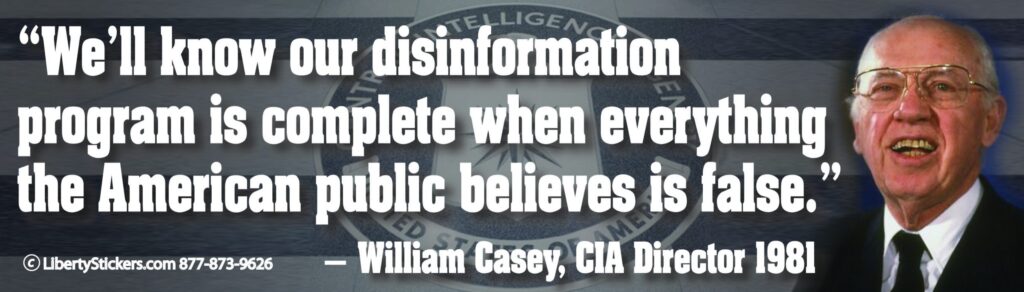
Our government has always lied to some extent, but has taken things to an entirely new level in the last several decades. A former CIA director, William Casey, once told President Reagan: “We’ll know our disinformation program is complete when everything the American public believes is false.” This quote was given by Barbara Honegger, who was in the room.

casey quote 1

With the advent of computers, video, and artificial intelligence, it is becoming increasingly difficult to navigate between truth and falsehood. This is part of Satan’s plan to demoralize us to the point we give up our quest for truth.

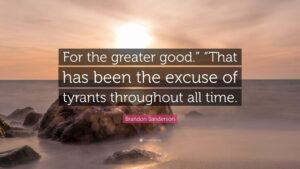
Satan has been quite successful at pulling the wool over our eyes in many areas for a long, long time. As is usual with all tyrants, however, he went too far, which has awakened more and more people to what he has been doing. During the Covid crisis, it became apparent that a supranational agency or group was manipulating things. All over the world the same sort of policies were adopted that stripped citizens of their freedoms in the name of public safety.

sanderson quote

It also became apparent that the truth was the biggest casualty during that crisis as governments censored anyone who did not go along with the party line. This happened even in the USA, where freedom of speech is enshrined in the Bill of Rights. Mattias Desmet coined the phrase “mass formation psychosis” to describe the wholesale brainwashing that took place around the world. Those of us who spoke against unscientific and totalitarian practices were ridiculed, censored, and sometimes ostracized, but, as Desmet points out, the only thing that can prevent such a brainwashed society from descending into totalitarianism is for the unyielding minority to continue to speak up.

The reason that so many people could not accept that the “jab” might be dangerous was because trusted individuals and institutions said it was safe. Surely there could never be a conspiracy so encompassing that it would include our government, Big Medicine, Big Pharma, Big Media, Big Tech, our education establishment, and supranational organizations such as WHO and the European Union! But that is exactly what happened. In this case, however, the devil pushed too far, causing many people to awaken to the level of evil and deception at work in the world.

Jesus told us that Satan is the father of lies (John 8:44) who deceives the whole world (Revelation 12:9). We should not regard this as hyperbole. It is literally true.

We know that we are of God, and the whole world lies under the sway of the wicked one. 1 John 5:19 (NKJV)

Satanic deception is not limited to religious or moral matters. It extends to every area of life. His goal is to subvert God’s truth regarding creation, the nature of reality, life itself, and God.

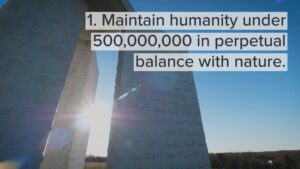
Most of us naively think that we are above being brainwashed. Knowing how easily we fall for ideas that appeal to our pride, the devil introduces philosophies and systems of thought that make us think we are smarter than anyone else and do not need to lean on that “crutch” called God or believe in “archaic ideas” contained in the Bible. At the same time, our archenemy tells us that we are insignificant, meaningless, and harmful beings that evolved by chance and need to be removed from the planet or at least significantly reduced in number. Consider the first goal written on the now destroyed Georgia Guidestones: maintain humanity under 500 million in perpetual balance with nature. Who wrote that? Who is trying to accomplish this 94% reduction in the world’s population? Whoever it is, they are in league with Satan.

georgia guidestones population

It’s ironic that in our pride we believe the satanic lie that we are smarter than God but totally insignificant.

Adopting a Biblical Cosmology

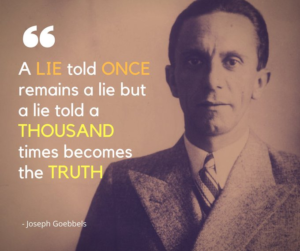
What does the Bible teach us about the world in which we live? When I took a course in astronomy in college, I was a new Christian. I remember being struck by how the textbook and teacher promulgated mere theories as fact. Our educational system, media, and government does this regularly, knowing that if a lie is repeated often people begin to accept it as true.

goebbels quote

From earliest times, men and women have observed the sun, moon, and stars and tried to comprehend or explain their movements. Due to the cosmos being outside our reach, everything was theoretical and philosophical. Philosophy always carries a bias, such the modernist presupposition that any explanation that requires a Creator must be rejected. Fortunately for us, the Bible gives us some us some extremely valuable information, which we should not dismiss as archaic or primitive. Perhaps ancient man, being closer to Adam, had greater insight that we do.


If we believe that God’s words are always true and faithful, then we will take them at face value, unless it is clear from the context that we should not.

Look to God’s instructions and teachings! People who contradict his word are completely in the dark. Isaiah 8:20 (NLT)

Genesis and other scriptures tell us several important truths upon which we can and should base our cosmology. It is not surprising that godless “science” tries to negate these words by offering us a contradictory explanation of the nature of heaven and earth how they came into being.

Day 1
In the beginning God created the heavens and the earth. 2 The earth was formless and void, and darkness was over the surface of the deep, and the Spirit of God was moving over the surface of the waters. 3 Then God said, “Let there be light”; and there was light. 4 God saw that the light was good; and God separated the light from the darkness. 5 God called the light day, and the darkness He called night. And there was evening and there was morning, one day. Genesis 1:1–5 (NASB95)

God created the “heavens” (plural) and the earth out of nothing (Hebrews 11:3) simply by speaking it into existence. Our cosmos did not spontaneously explode into existence, as Big Bang adherents insist. Explosions produce chaos and destruction and are never creative. We learn from John that everything we can observe was brought into existence and is sustained by God’s living Word, our Lord Jesus Christ. (John 1:3)

The “earth” (Hebrew “erets”) was formless and void but consisted of waters and “the deep” over which “face” the Spirit of God hovered or moved. At this point all was darkness. God then created light. It is important that we understand and believe that this light existed without sun, moon, or stars to emit it. Interestingly, Revelation states that in the new creation that will come at the very end of time, there will be no need for a sun because God himself is its light. (Revelation 21:23) Jesus also said that he is the Light of the world. (John 9:5)

The Bible’s declaration that light existed before there being any known source is a “scientific” hurdle we must clear if we are going to honor God’s Word above all contenders.

God excludes certain information or explanations from us in order to see if we will  stick to our guns by trusting him even when we do not understand the “how”. We do not want to be like those followers of our Lord who turned away because he said some things they did not comprehend . (John 6:66) God declared that the light was good and separated it from the darkness. He called the light day and the darkness night. Then the Bible declares that this separation resulted in the first day. As yet there is no sun and no solar day. Are you still there?

Day 2
Then God said, “Let there be a firmament in the midst of the waters, and let it divide the waters from the waters.” 7 Thus God made the firmament, and divided the waters which were under the firmament from the waters which were above the firmament; and it was so. 8 And God called the firmament Heaven. So the evening and the morning were the second day. Genesis 1:6–8 (NKJV)

The second day of creation challenges our scientific world view again. The English word “firmament” is only used in the KJV and NKJV. The other translations opt for such words as expanse, space, or sky, which is unfortunate. The Hebrew word is raqia, which means something hard such as beaten out metal. The Bible says it is strong enough to support the waters above it and forms a vault over the earth. Here are a couple other verses that use the word raqia.

And above the firmament over their heads was the likeness of a throne, in appearance like a sapphire stone; on the likeness of the throne was a likeness with the appearance of a man high above it. 27 Also from the appearance of His waist and upward I saw, as it were, the color of amber with the appearance of fire all around within it; and from the appearance of His waist and downward I saw, as it were, the appearance of fire with brightness all around. Ezekiel 1:26–27 (NKJV) 

“Can you, with Him, spread (literally - beat out as with a hammer) out the skies, Strong as a molten mirror? Job 37:18 (NASB95)

The heavens declare the glory of God; And the firmament shows His handiwork. Psalm 19:1 (NKJV)

God placed waters above the firmament, which are still there, according to the psalmist.

Praise Him, you heavens of heavens, And you waters above the heavens! Psalm 148:4 (NKJV)

God called the firmament heaven, which is another Hebrew word, shamayim. We know from Paul that there are (at least) three heavens. (2 Corinthians 12:2) We also know that when Jesus ascended after his resurrection he rose through the heavens. (Ephesians 4:10 and Hebrews 4:14)

Day 3
Then God said, “Let the waters under the heavens be gathered together into one place, and let the dry land appear”; and it was so. 10 And God called the dry land Earth, and the gathering together of the waters He called Seas. And God saw that it was good. 11 Then God said, “Let the earth bring forth grass, the herb that yields seed, and the fruit tree that yields fruit according to its kind, whose seed is in itself, on the earth”; and it was so. 12 And the earth brought forth grass, the herb that yields seed according to its kind, and the tree that yields fruit, whose seed is in itself according to its kind. And God saw that it was good. 13 So the evening and the morning were the third day. Genesis 1:9–13 (NKJV)

On Day 3, God separated the waters under the firmament from the land and brought forth plants. This confronts evolutionary theory that all life began in the primordial soup of the oceans. We must decide which will we believe, “science” or God?

Day 4
Then God said, “Let there be lights in the firmament of the heavens to divide the day from the night; and let them be for signs and seasons, and for days and years; 15 and let them be for lights in the firmament of the heavens to give light on the earth”; and it was so. 16 Then God made two great lights: the greater light to rule the day, and the lesser light to rule the night. He made the stars also. 17 God set them in the firmament of the heavens to give light on the earth, 18 and to rule over the day and over the night, and to divide the light from the darkness. And God saw that it was good. 19 So the evening and the morning were the fourth day. Genesis 1:14–19 (NKJV)

On the fourth day, God place “lights” or luminaries in the firmament of the heavens. Here once again God’s Word collides with the Big Bang theory head on. The Bible says the Creator placed luminaries in his vaulted heavens, which include the stars, the sun, the moon, and the wandering luminaries science calls planets after he made the earth. If our scientific cosmology has not been challenged before now, this certainly brings us to a crisis of faith. Will we believe what God says or write it off to God’s speaking within the context of an archaic and primitive worldview? If we choose the latter, we have now begun to slide down the slippery slope of deciding what parts of the Bible can be trusted and which need to be revised to accommodate the “insights” of modern so-called “knowledge.”

The Bible presents a geocentric cosmos, in which man is the center of God’s plan and purpose.

When I consider Your heavens, the work of Your fingers, The moon and the stars, which You have ordained, 4 What is man that You are mindful of him, And the son of man that You visit him? 5 For You have made him a little lower than the angels, And You have crowned him with glory and honor. 6 You have made him to have dominion over the works of Your hands; You have put all things under his feet, Psalm 8:3–6 (NKJV)

The Big Bang theory and its adjunct, heliocentrism, informs us that the earth is an inconsequential speck in a chaotic, exploding, godless, and impersonal universe. It teaches us that earth and mankind have no special significance or purpose. Once again, we are faced with an important decision. Who will we believe? To me, it is clear that one voice comes from God, and the others sounds very much like someone who hates us.

In the Bible’s geocentric view of the earth, the sun and moon are “luminaries” that God placed in the firmament and run a “circuit” over the earth.

Their line has gone out through all the earth, And their words to the end of the world. In them He has set a tabernacle for the sun, 5 Which is like a bridegroom coming out of his chamber, And rejoices like a strong man to run its race. 6 Its rising is from one end of heaven, And its circuit to the other end; And there is nothing hidden from its heat. Psalm 19:4–6 (NKJV)

Was God here merely conforming his words to a primitive understanding of the cosmos before people “discovered” the heliocentric view? Did God think that earlier people were so ignorant and stupid that he had to fudge the truth? Did he communicate something that we later would find out was not true, thus causing us to wonder if other things in the Bible are false as well? Did God really say?

When our children were very small, Martha and I had to decide if we would go along with the fantasy of Santa Claus and lie to our children about that. We decided that we never wanted to give them a cause for doubting our words or God’s; so we told them the truth. We did not take a “hard line” approach, but we did tell them the truth, without trying to strip all the fun out of the annual holiday gift giving. Being mere humans, we are not very righteous or truthful compared to God.

If we did not not want to give our children cause for doubting the truthfulness about God by telling them a lie about Santa Claus, shouldn’t we think that the God of truth would never do such a thing by lying to us about how the word was created?

Day 5
Then God said, “Let the waters abound with an abundance of living creatures, and let birds fly above the earth across the face of the firmament of the heavens.” 21 So God created great sea creatures and every living thing that moves, with which the waters abounded, according to their kind, and every winged bird according to its kind. And God saw that it was good. 22 And God blessed them, saying, “Be fruitful and multiply, and fill the waters in the seas, and let birds multiply on the earth.” 23 So the evening and the morning were the fifth day. Genesis 1:20–23 (NKJV)

On the fifth day, God created sea creatures and birds and gave the command to be fruitful and multiply. This order of things is anti-evolution, which says that life evolved out of the sea. If we believe God’s Word is true and unalterable, we quickly recognize the lie behind evolutionary thinking.

Day 6
Then God said, “Let the earth bring forth the living creature according to its kind: cattle and creeping thing and beast of the earth, each according to its kind”; and it was so. 25 And God made the beast of the earth according to its kind, cattle according to its kind, and everything that creeps on the earth according to its kind. And God saw that it was good. 26 Then God said, “Let Us make man in Our image, according to Our likeness; let them have dominion over the fish of the sea, over the birds of the air, and over the cattle, over all the earth and over every creeping thing that creeps on the earth.” 27 So God created man in His own image; in the image of God He created him; male and female He created them. 28 Then God blessed them, and God said to them, “Be fruitful and multiply; fill the earth and subdue it; have dominion over the fish of the sea, over the birds of the air, and over every living thing that moves on the earth.” 29 And God said, “See, I have given you every herb that yields seed which is on the face of all the earth, and every tree whose fruit yields seed; to you it shall be for food. 30 Also, to every beast of the earth, to every bird of the air, and to everything that creeps on the earth, in which there is life, I have given every green herb for food”; and it was so. 31 Then God saw everything that He had made, and indeed it was very good. So the evening and the morning were the sixth day. Genesis 1:24–31 (NKJV)

On the last day of creation, God made land-based animals and man. Man was created in God’s image and is most important to God, not a being that evolved by chance. The command to multiply runs contrary to globalist thinking that there are too many people. God wants us to fill this magnificent earth.

The desire to curtail multiplication through abortion and other means comes from Satan himself.

If we take God’s Word at face value, even when it confronts the “established truths” of modern science, we are well on our way to liberating our minds and hearts from the schemes and lies of the devil. I hope you will take this process seriously and allow yourself to insist on adhering to God’s Word.  As the apostle Paul wrote long ago.

...let God be found true, though every man be found a liar, as it is written, “THAT YOU MAY BE JUSTIFIED IN YOUR WORDS, AND PREVAIL WHEN YOU ARE JUDGED.” Romans 3:4 (NASB95)

The Mechanics of Deception

In my previous article, I concluded that God has given us two antidotes for the poison of deception: a map (the Bible) and a guide (the Holy Spirit). Satan uses his cleverness to pry us away from reliance upon those two gifts from God. Paul recognized this satanic strategy at work in Corinth.

But I am afraid that, as the serpent deceived Eve by his craftiness, your minds will be led astray from the simplicity and purity of devotion to Christ. 2 Corinthians 11:3 (NASB95)

The devil uses philosophies and doctrines that appeal to our vanity and desire to figure things out for ourselves instead of relying upon God.

Again, Paul warned about this.

See to it that no one takes you captive through philosophy and empty deception, according to the tradition of men, according to the elementary principles of the world, rather than according to Christ. Colossians 2:8 (NASB95)

Any system of thought that denies the truthfulness of the Bible is not from God.

The first thing Satan did to bring about the fall of mankind was to sow doubt into Eve’s mind regarding the truthfulness or God’s words.

Now the serpent was more crafty than any beast of the field which the LORD God had made. And he said to the woman, “Indeed, has God said, ‘You shall not eat from any tree of the garden’?” 2 The woman said to the serpent, “From the fruit of the trees of the garden we may eat; 3 but from the fruit of the tree which is in the middle of the garden, God has said, ‘You shall not eat from it or touch it, or you will die.’ ” 4 The serpent said to the woman, “You surely will not die! 5 “For God knows that in the day you eat from it your eyes will be opened, and you will be like God, knowing good and evil.” Genesis 3:1–5 (NASB95)

In hindsight, it is easy for us to see how Satan manipulated Eve, but, when it happens to us, it can be very confusing. The serpent began by asking an seemingly innocent question that subtly accused God. This put Eve on the defensive. Her recounting of God’s prohibition was incorrect in that she added touching the fruit in addition to eating it as a cause of death. At this point Satan flatly contradicted God’s words and accused God of being untrustworthy in the process. Eve, for some reason, bought the lie instead of defending God. Adam was present and remained quiet, which makes him responsible, too. Once Adam and Eve accepted Satan’s accusation against God, it was not much of a leap to reject God’s warning and evaluate the fruit using their own reasoning, which led them to take a bite. The rest is history. That one act of treachery cost our Lord Jesus his life.

Satan will always cast doubt on the veracity of God’s Word. He encourages us to evaluate things according to our own judgment instead of relying on God’s. He introduces arguments that appeal to our pride and sound convincing, but always lead to death.

It is amazing to me that many people easily put their faith in the Big Bang theory rather than in the Bible’s account of creation. No one was there when everything we see came into being; so, whatever position one takes regarding origins is either a matter of faith or mere conjecture. If a person wants to believe that everything we see came out of nothing all by itself, that takes more faith than believing in a Creator God. Nevertheless, spontaneous creation appeals to our pride and gives us permission to do whatever we like, since we have no one to whom we are accountable. This sin is very much like that of our first parents, the desire to be our own gods.

Similarly, many accept the unproven hypothesis of Darwinian evolution rather than the creation account of human origins. Once again, neither can be scientifically duplicated and “proven,” so, whichever one a person chooses to believe is a matter of faith – faith in God or in mere conjecture. The appeal of such a vain philosophy is apparent. It places us on the top rung of creatures who are accountable to no one. We are gods of a sort, the best “nature” has come up with so far.

This kind of thinking produces unwelcome consequences. Evolution leads to thinking that some “races” are superior or “more evolved,” leading to racism and genocide. Evolution produces the existentialist conclusion that there is no absolute truth. All we can know for sure is what we experience. That being the case, what really matters in life is pleasure, power, and being “fulfilled.”

When God’s truth is rejected, it leaves us without an anchor, drifting on seas of uncertainty and confusion.

That is where our nation is today.

Can you think of other areas in which we have allowed the wisdom and so-called knowledge or “science” propagated in the world to make us despise and forsake God’s Word?

Once we understand the mechanics of deception, it should make us even more determined to live within the framework God has given to us, using the map of the Bible and the guide – the Holy Spirit. We can decide to never again accept any philosophy or doctrine that denies what the Bible teaches. If we do this, it can lead us to some very important and exciting truths that can revolutionize our thinking and lives.

So Jesus was saying to those Jews who had believed Him, “If you continue in My word, then you are truly disciples of Mine; 32 and you will know the truth, and the truth will make you free.” John 8:31–32 (NASB95)

The Entrance and Extent of Deception

Deception is all around us, and we must ask ourselves where did it come from, what is its nature, how extensive is it, and how can we escape its influence? No person is adequate to completely answer these questions, but, using the Bible as our map and depending on the Holy Spirit to guide us, we can make progress. Otherwise, we will all be like Pontius Pilate, who heard Jesus say:

...I was born and came into the world to testify to the truth. All who love the truth recognize that what I say is true.” John 18:37 (NLT)

When the Roman governor stood face to face with the Creator and Sustainer of the universe, he could only reply, “What is truth?” (John 18:38) This is the question facing all of us.

Since the God of truth created the world and said it was “good,” how did deception and evil make their entrance? The Bible tells us that it happened when the serpent deceived Eve into choosing knowledge, falsely so called, over God’s truth.

The serpent said to the woman, “You surely will not die! 5 “For God knows that in the day you eat from it your eyes will be opened, and you will be like God, knowing good and evil.” 6 When the woman saw that the tree was good for food, and that it was a delight to the eyes, and that the tree was desirable to make one wise, she took from its fruit and ate; and she gave also to her husband with her, and he ate. 7 Then the eyes of both of them were opened, and they knew that they were naked; and they sewed fig leaves together and made themselves loin coverings. Genesis 3:4–7 (NASB95)

The truth was that disobeying God’s command would bring death. Satan convinced Eve that he knew better, which she acted upon. In violating God’s clear command, she and Adam chose so-called knowledge over God’s revealed truth. This continues to this day in many different ways, about which Paul warned us.

O Timothy, guard what has been entrusted to you, avoiding worldly and empty chatter and the opposing arguments of what is falsely called “knowledge”— 21 which some have professed and thus gone astray from the faith. Grace be with you. 1 Timothy 6:20–21 (NASB95)

Once Adam and Eve poked a hole in the wall of truth that guarded their lives, it opened a flood of deception upon the earth. All of us to some degree or another have become co-conspirators in a giant assault on the truth.

Paul wrote about this in his letter to the church in Rome.

But God shows his anger from heaven against all sinful, wicked people who suppress the truth by their wickedness. 19 They know the truth about God because he has made it obvious to them. Romans 1:18–19 (NLT)

The so-called Covid pandemic helped to open our eyes to the extent of the suppression of truth. It was incomprehensible to most people that our government, mainstream media, Big Tech, Big Medicine, and Big Pharma would join forces to suppress truth and push a lie, but that is exactly what happened and continues today. A thinking person must ask him or herself, just how far does this deception go? What other lies have we been told? Whom can be trusted?

The devil is “hell bent” on deceiving and destroying humanity in order to somehow “hurt” God. This is what Jesus said about him.

...He was a murderer from the beginning. He has always hated the truth, because there is no truth in him. When he lies, it is consistent with his character; for he is a liar and the father of lies. 45 So when I tell the truth, you just naturally don’t believe me! John 8:44–45 (NLT)

Because our hearts have been corrupted by sin, we have a natural affinity for lies, which should put us on guard against the entrance of deception, even for those of us who have come to love the truth.

The devil…

...will use every kind of evil deception to fool those on their way to destruction, because they refuse to love and accept the truth that would save them. 11 So God will cause them to be greatly deceived, and they will believe these lies. 2 Thessalonians 2:10–11 (NLT)

As a result of centuries of Satan’s work and the cooperation of those who gladly serve the serpent, much of what most people believe is based on deception.


We cannot fully trust what the government, the education system, the mainstream media (MSM), Big Tech, Big Pharma, and Big Medicine tell us. If anyone dares go against the accepted “narrative,” he or she will meet with mockery, rejection, and sometimes other forms of persecution, such as de-funding or maybe even jail time. Worse push back probably lies ahead unless things change significantly.

casey quote 1

Is there any way for us to escape pervasive lies and propaganda and learn to discern and stand for what is true? As I mentioned in my opening paragraph, God has given us a map, the Bible, and a guide, the Holy Spirit.

The Bible self-authenticates, since there is no higher authority. Jesus, the One who called himself the Way, the Truth, and the Life, was vindicated or authenticated by God the Father when he raised him from the dead. Jesus, who is truth personified, told us that the Word of God is truth.

Sanctify them in the truth; Your word is truth. John 17:17 (NASB95) 

God wants us to settle in our hearts that his Word is faithful and true. Only by so doing, can we reverse the suppression of truth initiated by Adam and Eve.

Your eternal word, O LORD, stands firm in heaven. 90 Your faithfulness extends to every generation, as enduring as the earth you created. Psalm 119:89–90 (NLT)

God gave us the Holy Spirit, who is also called the Spirit of Truth, to guide us into all truth as we are able to hear and bear it.

“But when He, the Spirit of truth, comes, He will guide you into all the truth; for He will not speak on His own initiative, but whatever He hears, He will speak; and He will disclose to you what is to come. John 16:13 (NASB95)

In addition, the truth by its very nature, is irrepressible. It will triumph in the end. Those who are open will be able to discern the truth.

Pilate therefore said to Him, “Are You a king then?” Jesus answered, “You say rightly that I am a king. For this cause I was born, and for this cause I have come into the world, that I should bear witness to the truth. Everyone who is of the truth hears My voice.John 18:37 (NKJV)

Those who close their hearts to truth will miss out and demonstrate that they are not “of God.”

Anyone who belongs to God listens gladly to the words of God. But you don’t listen because you don’t belong to God.” John 8:47 (NLT)

We can trust the Lord to guide us into truth one step at a time. The important thing is to keep moving toward it. People will resist, mock, and try to intimidate you, but it is worth the cost to discover truth. It will set us free. (John 8:32)

Prayer

Jesus, I long to be a person of truth. I want to know truth, believe it, live by it, and stand for it. I recognize that your are the Way, the Truth, and the Life. I ask you to come into my life and open my eyes and heart to your truth. I give my life to you. Use me as you see fit. Amen.

Link to next article in the series.

What Psalm 23 Reveals about God and the Gospel

torah

Psalm 23 is one of the most beautiful and most quoted passages in the Bible and reveals a lot about God and the gospel. It was inspired by the Spirit of God and written and sung by King David, who was an accomplished musician and poet. It has endured for three millennia and will continue forever because it is the unchangeable word of God. This compact psalm is packed with revelation about God’s heart and nature. Let’s take a look at it line by line. I will be using the New Living Translation for the most part.

The LORD is my shepherd; I have all that I need. Psalm 23:1 (NLT) —

Here the Spirit revealed through David that God the Lord is our shepherd, who provides, guides, and protects. David called him Yahweh-raah, the Lord my shepherd. If we know and rely upon him as our shepherd, we have everything we need. Jesus is the ultimate Good Shepherd who gave his life for his sheep. (John 10:11) He did this to bring us back to the Father by providing forgiveness for our sins, setting us free from all that enslaves us, giving us life eternal through the Holy Spirit, and making us children of God through the new birth. Ultimately we will co-rule with Christ over his creation. This is what Jesus called “abundant life.” Once we come to know Jesus as our Shepherd, life will never be the same.

Gospel Hint: If we encounter a person who feels lost, abandoned, or who generally needs a “shepherd,” we should present Christ as the One they seek. He proved his love for us at the cross and his ability to take care of us at the resurrection.

Another Old Testament compound name for God was revealed to Abraham when God tested him regarding his willingness to sacrifice his son Isaac. When the angel restrained his hand, Abraham saw a ram caught in the thicket that he could use in Isaac’s place. He named that place Yahweh-Jireh – the Lord who Provides. 

Abraham called the name of that place The LORD Will Provide, as it is said to this day, “In the mount of the LORD it will be provided.” Genesis 22:14 (NASB95) —

In the hour of his testing and obedience, God’s provision became apparent. When we truly get to know God, we find out that providing for his people is part of his nature. It is who he is. We should never doubt his kind intention to provide for our every need.

Gospel Hint: Is we find someone who is afraid that they will not have what they need, we should introduce Jesus the Good Shepherd and provider. We can always count on God to provide. If we surrender our lives to him, he graciously extends his care to us.

He lets me rest in green meadows; he leads me beside peaceful streams. Psalm 23:2 (NLT) —

For sheep green meadows and peaceful streams are part of God’s provision for them, but this verse focuses more on peace and rest. Jesus promised that he will give his disciples peace that passes natural understanding. God revealed himself to Gideon as Yahweh-shalom, the Lord who is our peace, on the day he commissioned him to fight for Israel against seemingly insurmountable odds. (Judges 6:24) Peace does not depend on our circumstances, but on God’s promises and his presence in our lives. 

Jesus said that he will give us peace in the midst of the storms we encounter in life.

Peace I leave with you; My peace I give to you; not as the world gives do I give to you. Do not let your heart be troubled, nor let it be fearful. John 14:27 (NASB95) —

Peace is one of the defining characteristics of those who know God. It is a fruit or result of God’s Spirit inhabiting and transforming us on the inside. The more we trust and rely on our Good Shepherd, the greater our peace.

Be anxious for nothing, but in everything by prayer and supplication with thanksgiving let your requests be made known to God. 7 And the peace of God, which surpasses all comprehension, will guard your hearts and your minds in Christ Jesus. Philippians 4:6–7 (NASB95) —

Gospel Hint: When we encounter someone who is afraid, we should tell them about the Good Shepherd who relieves us of our fears and replaces them with peace that passes understanding. His perfect loves displaces or casts out fear. (1 John 4:18)

He renews my strength. He guides me along right paths, bringing honor to his name. Psalm 23:3 (NLT) —

In this case, it is a good idea to compare the New Living Translation with the more literal New American Standard Bible, which translates this verse as follows.

He restores my soul; He guides me in the paths of righteousness For His name’s sake. Psalm 23:3 (NASB95) —

Our strength is renewed as the Good Shepherd restores and heals our souls. When we are born again, God makes our spirits brand new, but our souls still need work. The new birth is once for all, but the restoration of the soul takes a lifetime. This is part of Jesus’ ministry as healer. Everywhere Jesus went he healed and restored people. He still does today, but now he uses his Spirit-filled people to accomplish the work. Before we can help others, we need to experience his healing and restorative work in our own lives.

One of the compound names of God in the Old Testament is Yahweh-raphah, the Lord who heals. (Exodus 15:26) Healing is part of God’s nature or character. It is not something we have to wrestle from him. It flows from his kind heart to hurting people. Healing and deliverance from demonic oppression accompanied the preaching of the gospel in Jesus’ and the apostles’ day. Nothing has changed in God’s plan. God means for people to experience his healing and restorative touch today, too. 

Gospel Hint: If we encounter someone who has physical, emotional, or spiritual pain or disease, we should offer to pray for them as we tell them that Jesus still heals. We never know what God may do.

Right paths and paths of righteousness are different ways of looking at the same thing. God revealed himself as our righteousness in the Old Testament.

In His days Judah will be saved, And Israel will dwell securely; And this is His name by which He will be called, ‘The LORD our righteousness.’ Jeremiah 23:6 (NASB95) —

When Jesus died on the cross and rose again, he provided a right relationship with God or “justification” for those who put their faith and allegiance in him. By taking our sins upon himself and exchanging our sin with his right standing with God, we became righteous before God. (2 Corinthians 5:21) We are not self-righteous, but righteous in Christ. Apart from him we have nothing.

Now that we have right standing with God, he is working his righteousness into us on a daily basis. In other words, the Holy Spirit is transforming us on the inside so that we more and more think, speak, and act like Jesus. This allows us to “walk” as Jesus did in “paths of righteousness.” When we live like this it brings honor to God and blessings to us.

Gospel Hint: Sometimes we encounter people whose lives are a mess. We can introduce the Good Shepherd to them as the one who can restore them and get them on a path to blessings and success. It starts with their surrendering everything to Jesus the Lord and receiving all he has to offer, which is mainly himself.

Even when I walk through the darkest valley, I will not be afraid, for you are close beside me. Your rod and your staff protect and comfort me. Psalm 23:4 (NLT) —

Everyone eventually goes through a dark place. It can be very scary, especially if we feel all alone. One of the most repeated promises in the Bible is “Do not fear. I am with you.” (Genesis 26:24, Deuteronomy 31:8, 2 Chronicles 20:17, Isaiah 41:10, Matthew 14:27, and John 6:20) God revealed himself in the Old Testament as the ever-present One, Yahweh-shammah (Ezekiel 48:35). King David knew God in this way, too, as revealed in Psalm 139. Jesus also is known as the One who is present in his name Emmanuel, God with us. (Matthew 1:23) Our Lord also promised that the Holy Spirit, his executor here on earth and our helper, will always be with us.

I will ask the Father, and He will give you another Helper, that He may be with you forever; John 14:16 (NASB95) —

The Spirit’s presence in our lives is our most precious gift. Nothing compares. Because Jesus died and rose again, when we put our faith and allegiance in him, God comes to live inside us forever! We will never be alone again.

Gospel Hint: Abandonment is one of our greatest fears. Many people feel rejected and alone. Ultimately this is because our sin separated us from God. Jesus fixed this problem. All who put their faith and allegiance in him never need to be alone again.

The rod and staff represent the shepherd’s commitment to protect and guide his sheep. One of God’s compound names in the Old Testament is Yahweh-Mekoddishkem – The Lord who sanctifies you. (Exodus 31:13) God is committed to transforming us into Christ’s image as we navigate this life with his help. His loving discipline is represented by the rod. God disciplines all his children because he loves them. (Hebrews 12:6)

Gospel Hint: God accepts us just as we are, but he doesn’t leave us there. Most people would like to be better people. Only God can get us there as we learn that he is committed to transforming us on the inside without condemning us for our many failures. (John 5:24, Romans 8:1)

You prepare a feast for me in the presence of my enemies. You honor me by anointing my head with oil. My cup overflows with blessings. Psalm 23:5 (NLT) —

God revealed himself in the Old Testament as Yahweh-nissi, the Lord our banner in battle. (Exodus 17:15) Sometimes we think that peace requires us to be delivered from the threat or presence of our enemies. God prepares a feast for us right in front of our enemies. He wants us to ignore the enemy and focus on him. The Bible teaches us the the battle is the Lord’s. (2 Chronicles 20:15) He has already defeated Satan and his evil allies. All authority in heaven and earth has already been given to our Lord Jesus. Nothing can happen to us without the permission of our Lord, and he promises to work out everything, even the bad things, for our good. (Romans 8:28)

God wants us to learn how to stand against evil. (Ephesians 6:13) We do this by understanding that we are protected by God. We are seated with Christ in the heavenly places. (Ephesians 2:6) Our enemies must go through God to get to us. This does not mean that we will never encounter tests, trials, or danger. It does mean that God is always with us as we go through these things. He is our victory. Our faith makes us overcomers in everything. (1 John 5:4)

Gospel Hint: When we talk to people who are in the midst of some kind of battle, we can show them that God promises to be with us in the battle and has already overcome the enemy. If we trust in him, he will give us peace in the midst of our struggles.

One of the most exciting things about being a follower of Christ is participating with him in liberating other people. When Jesus launched his earthly ministry, he quoted Isaiah 61:1 and said that God’s Spirit rested upon him, anointing him for ministry. (Luke 4:18) The anointing, which represents the Spirit’s power and presence operating in and through us, is what we need to effectively minister to others. God honors us by allowing us to participate with him.

God is not stingy. He overflows with blessings and has more than enough for all those who trust in him. This ties into God’s being our Shepherd and provider. As we are blessed by God, we can pass these on to others.

Gospel Hint: Many people live outside of God’s blessings because they have never surrendered their lives to Jesus. The gospel promises God’s richest blessings upon all who trust and follow Jesus.

Surely your goodness and unfailing love will pursue me all the days of my life, and I will live in the house of the LORD forever. Psalm 23:6 (NLT) —

Instead of being hounded by the curse associated with sin, Jesus opened the door for us to be pursued relentlessly by God’s goodness and mercy as long as we live. When we die, we have the promise of being with God forever.

Don’t let your hearts be troubled. Trust in God, and trust also in me. 2 There is more than enough room in my Father’s home. If this were not so, would I have told you that I am going to prepare a place for you? 3 When everything is ready, I will come and get you, so that you will always be with me where I am. John 14:1–3 (NLT) —

Gospel Hint: Jesus provides his followers with blessings here on earth and eternal life with him in heaven. Who would not want this?

The Effect of God’s Kindness Is Peace

One of the most important effects or fruit of the operation of the Holy Spirit in our lives is peace. Peace is the direct result of God’s showing loving kindness to us through Christ.

Peace with God is the root of all other forms of real peace. It is a treasure freely given to all of God’s born again children that came at an incalculable cost to God.

Jesus, the Prince of Peace, suffered and died on the cross and rose again to make our peace with God a reality. Our Lord’s peace was ripped from him during those horrible hours so that the peace God gives to us can never be snatched away.

I am leaving you with a gift—peace of mind and heart. And the peace I give is a gift the world cannot give. So don’t be troubled or afraid. John 14:27 (NLT) 

Paul wrote:

Therefore, since we have been made right in God’s sight by faith, we have peace with God because of what Jesus Christ our Lord has done for us. Romans 5:1 (NLT) 

The technical term for being made right with God is justification, through which we were given Christ’s very own righteousness. When Jesus died on the cross, the Bible says that he actually “became sin.” He was completely identified with our sin so that we might be likewise one with his righteousness. Not surprisingly, theologians call this identification.

For our sake he made him to be sin who knew no sin, so that in him we might become the righteousness of God. 2 Corinthians 5:21 (ESV) 

Some Bible readers imagine this is merely a poetic way of saying that Christ substituted for us by dying in our place. Substitution is another tremendous truth connected with our salvation, but that is not what Paul is writing about here. This verse refers to something much deeper, something C.S. Lewis called “deep magic” in his Chronicles of Narnia. It is the secret wisdom God used to rescue us from the Prince of Darkness.

No, the wisdom we speak of is the mystery of God—his plan that was previously hidden, even though he made it for our ultimate glory before the world began. 8  But the rulers of this world have not understood it; if they had, they would not have crucified our glorious Lord. 1 Corinthians 2:7-8 (NLT) 

Abba Father caused all our sins to fall upon his Son (Isaiah 53:6) so that we will never have to carry them again or suffer their consequences – the terror of separation from God forever. There is no peace for the wicked (Isaiah 48:22), but the effect of righteousness is peace.

And the effect of righteousness will be peace, and the result of righteousness, quietness and trust forever. Isaiah 32:17 (ESV) 

Because God unleashed the fullness of his wrath against sin upon his Son, we will never have to face it. He was appointed to wrath so that we are forever released from that appointment. (1 Thessalonians 5:9)

Isaiah beautifully wrote about this wonderful truth of the New Covenant.

Just as I swore in the time of Noah that I would never again let a flood cover the earth, so now I swear that I will never again be angry and punish you. 10  For the mountains may move and the hills disappear, but even then my faithful love for you will remain. My covenant of blessing will never be broken,” says the LORD, who has mercy on you. Isaiah 54:9-10 (NLT) 

Paul said it another way in his letter to the church in Rome.

What shall we say about such wonderful things as these? If God is for us, who can ever be against us? 32  Since he did not spare even his own Son but gave him up for us all, won’t he also give us everything else? 33  Who dares accuse us whom God has chosen for his own? No one—for God himself has given us right standing with himself. 34  Who then will condemn us? No one—for Christ Jesus died for us and was raised to life for us, and he is sitting in the place of honor at God’s right hand, pleading for us. 35  Can anything ever separate us from Christ’s love? Does it mean he no longer loves us if we have trouble or calamity, or are persecuted, or hungry, or destitute, or in danger, or threatened with death? 36  (As the Scriptures say, “For your sake we are killed every day; we are being slaughtered like sheep.”) 37  No, despite all these things, overwhelming victory is ours through Christ, who loved us. 38  And I am convinced that nothing can ever separate us from God’s love. Neither death nor life, neither angels nor demons, neither our fears for today nor our worries about tomorrow—not even the powers of hell can separate us from God’s love. 39  No power in the sky above or in the earth below—indeed, nothing in all creation will ever be able to separate us from the love of God that is revealed in Christ Jesus our Lord. Romans 8:31-39 (NLT) 

What an amazing peace producing promise! God’s kindness toward us is eternal, which sparks the desire in us to love him back and willingly serve him with all our hearts. Generosity elicits gratefulness in the heart of the recipient.

Here is one of the most beautiful verses in the Bible.

I tell you the truth, those who listen to my message and believe in God who sent me have eternal life. They will never be condemned for their sins, but they have already passed from death into life. John 5:24 (NLT) 

Jesus endured death for us. When he died, we died. When he rose again, we rose with him to life eternal. This is essentially the message of Romans Chapter Six. This is why Paul could write.

So now there is no condemnation for those who belong to Christ Jesus. 2  And because you belong to him, the power of the life-giving Spirit has freed you from the power of sin that leads to death. Romans 8:1-2 (NLT) 

The reason we can experience victory over sin is because it no longer has the power to condemn us or rule us. Paul wrote in another place that the strength behind sin is the Law. (1 Corinthians 15:56) As long as we are subject to condemnation, sin has power over us. Because Jesus took our condemnation, sin lost its power to rule over us.

Sin is no longer your master, for you no longer live under the requirements of the law. Instead, you live under the freedom of God’s grace. Romans 6:14 (NLT) 

So, not only did Jesus provide us with everlasting peace, he also delivered us from the power of sin by taking our condemnation upon himself. How glorious!

The Inexhaustible Kindness of God


What we believe about God’s kindness will greatly influence how we experience him.

If we think he is hard to please, judgmental, and angry, we will relate to him based on that lens or filter. (Luke 19:20-23) Conversely, if we understand just how much he loves us and the inexhaustiblity of his kindness, it will transform our lives. (Psalm 18:25-27)

Paul wrote about God’s kindness in the first chapter of his letter to the church located in Ephesus in what is now Turkey.

But God is so rich in mercy, and he loved us so much, 5  that even though we were dead because of our sins, he gave us life when he raised Christ from the dead. (It is only by God’s grace that you have been saved!) 6  For he raised us from the dead along with Christ and seated us with him in the heavenly realms because we are united with Christ Jesus. 7  So God can point to us in all future ages as examples of the incredible wealth of his grace and kindness toward us, as shown in all he has done for us who are united with Christ Jesus. Ephesians 2:4-7 (NLT) 

One of the ways to understand the depths of God’s kindness is to contrast it with his wrath. Kindness toward us is only possible because Jesus absorbed God’s wrath against our sin on the cross.

Paul explained it like this.

When we were utterly helpless, Christ came at just the right time and died for us sinners. 7  Now, most people would not be willing to die for an upright person, though someone might perhaps be willing to die for a person who is especially good. 8  But God showed his great love for us by sending Christ to die for us while we were still sinners. 9  And since we have been made right in God’s sight by the blood of Christ, he will certainly save us from God’s condemnation. 10  For since our friendship with God was restored by the death of his Son while we were still his enemies, we will certainly be saved through the life of his Son. 11  So now we can rejoice in our wonderful new relationship with God because our Lord Jesus Christ has made us friends of God. Romans 5:6-11 (NLT) 

But what about when life is difficult and if we get wobbly in our devotion to God? Paul wrote in another place.

Behold then the kindness and severity of God; to those who fell, severity, but to you, God's kindness, if you continue in His kindness; otherwise you also will be cut off. Romans 11:22 (NASB) 

Depending on our theological perspective, we may understand this verse as a threat that God’s child can be separated from God’s goodness and kindness by falling from grace. It is certainly a stern warning to us all, but there is another way to view what it means. Paul said that nothing can separate us from the love of God. (Romans 8:39) Even when we are running from God, we can never get away from him. David, who spent at least nine months rebelling against God, wrote the following:

I can never escape from your Spirit! I can never get away from your presence! 8  If I go up to heaven, you are there; if I go down to the grave, you are there. 9  If I ride the wings of the morning, if I dwell by the farthest oceans, 10  even there your hand will guide me, and your strength will support me. 11  I could ask the darkness to hide me and the light around me to become night— 12  but even in darkness I cannot hide from you. To you the night shines as bright as day. Darkness and light are the same to you. Psalm 139:7-12 (NLT) 

We may encounter God’s stern discipline, if we continue in rebellion, but we will never exhaust his mercy and kindness.

What is called the doctrine of the perseverance of the saints teaches us that God’s grace and Spirit will work in us so that our faith will not fail when we are tested.

Now all glory to God, who is able to keep you from falling away and will bring you with great joy into his glorious presence without a single fault. Jude 1:24 (NLT) 

The apostle Peter verbally denied even knowing our Lord when he was put to the test during Jesus’ passion. He even spoke a curse over himself on the third time. But Jesus had foreseen Peter’s failure, warned him that it would happen, and promised him that he would eventually come around and be restored.

“Simon, Simon, Satan has asked to sift each of you like wheat. 32  But I have pleaded in prayer for you, Simon, that your faith should not fail. So when you have repented and turned to me again, strengthen your brothers.” Luke 22:31-32 (NLT) 

After Jesus’ words came true, Peter was devastated by the revelation of his own weakness and faithlessness. He could have despaired and given up on God, but he did not because Jesus had given him a reason to hope. Peter never ceased to continue in faith in God’s kindness toward him, and when the opportunity came, he ran to the Lord to get things right with him again.

Judas Iscariot, on the other hand, had no such hope. After betraying the Lord for money, upon realizing the gravity of his sin, went out and committed suicide. I am convinced that, in spite of being with Jesus for three years, he never really understood who Jesus is or believed in him. Therefore he had no anchor, nothing to fall back on, no revelation of the inexhaustible kindness of God. In his hopelessness, he took his own life.

Another great example of the inexhaustibility of God’s loving kindness is the parable of the prodigal son. This young man cared little for his father or brother. He only wanted to have a good time without regard for God or family. In other words, he turned his back on his father. Nevertheless, he was a son; so, the father never turned his back on him.

Nothing can break the relationship between father and son, even though we may go through times of difficulty and separation.

Ultimately, sons will come back to the loving embrace of the father and be fully restored. Those who are not sons, such as Judas, have no anchor, no confidence in being restored, because they do not know the loving kindness of God.

If we wander away from God, we will find out that we are on a hard path of our own making. (Proverbs 13:15)

If we backslide, we will eat the fruit of our rebellious ways (Proverbs 14:14), but even this is a kindness from God. Our pain wakes us up and reminds us that walking close to God is much better.

The prodigal son finally had enough of the suffering he brought upon himself and returned to his father’s house. Little did he expect the warm welcome he received. His father’s kindness exceeded anything he had imagined.

The elder brother was put off by his father’s extravagant show of love because he had not yet come to grips with his own need for mercy.

God is so great that he can take even the worst things that happen to us and work them for our good and his glory. (Romans 8:28) The prodigal son could have beat himself up for wasting his father’s money and treading upon his love, but that would have been counterproductive.

The only way the prodigal could receive the revelation of what his father was like was through his own failure. On the other side of his sinful wandering, he had a better understanding of his father’s love than the ever faithful elder brother.

This is not to say that we have to sin extravagantly to know God’s mercy. Far from it. But we do have to come to grips with our need for God’s kindness on a day to day basis.

How do we see God? Is he an austere demanding judge who always finds fault with us, or is he a loving and kind father who delights in us and encourages us to trust in his unchanging love and faithfulness? If you wish to know him better as the latter, Jesus will show you.

No one has ever seen God. God's only Son, the one who is closest to the Father's heart, has made him known. John 1:18 (GW) 

Nothing makes Jesus happier than to tell us all about his Father’s amazing love and the inexhaustible riches of his kindness.

Prayer

Father in heaven, I want to experience your love and kindness. Jesus,  you are the One who knows Abba perfectly. Please reveal him to me so that I can trust him completely. Teach me always to rely on God’s loving kindness. Amen.

Jacob: Hang On Until You Get the Blessing

Jacob is one of my favorite characters in the Bible. He was a deceiver, a complainer at times, fearful, and often lacking faith; yet, God chose and made him to be a father of the faith, and, despite all his failures, his life ended well.

Jacob should give us all hope that God can use even us for his purposes.

We should be encouraged that God’s grace and mercy are sufficient to carry us through, no matter how unlikely a candidate we may be.

This teaching will examine a significant episode in Jacob’s life when he was returning to his father’s home after years of a sort of self-imposed exile. God earlier promised his mother, Rebecca, that Jacob would rule over his older brother, Esau.

But the children struggled together within her; and she said, "If it is so, why then am I this way?" So she went to inquire of the LORD. 23  The LORD said to her, "Two nations are in your womb; And two peoples will be separated from your body; And one people shall be stronger than the other; And the older shall serve the younger." Genesis 25:22-23 (NASB) 

How he came into possession of that promise involves several unexpected twists and turns. Jacob came out of the womb as the second-born of twins, grasping the heel of his older brother, Esau. Jacob’s name is a word play on “heel” and carried with it the connotation of a deceiver, a theme that played out during his life.

The reason that Jacob left his father’s home was because he had tricked his father into giving him his older brother’s blessing, which enraged Esau to the point of wanting to murder him. His father, Isaac, was essentially blind due to old age, which allowed the deception to succeed. Isaac preferred Esau over Jacob, and, according to the convention of the time, Esau, being the first born, should have received a blessing giving him first place among his brothers. But God had already chosen Jacob to have that honor, which is another theme that plays out repeatedly in the Old Testament.

God chooses unlikely people to accomplish his purposes.

It is inconceivable that Rebecca did not tell her husband about the promise God gave her; nevertheless, Isaac, who also had a history of being deceptive, as did his father, Abraham, chose the give his blessing to his elder son. He sent Esau out to kill game and prepare him a delicious stew which would set the stage for his imparting the blessing of the first born. Rebecca heard what was happening and instructed Jacob to bring her a goat to prepare for his father. Following his mother’s counsel, Jacob dressed in Esau’s clothing and somehow managed to pull off the ruse and get his father’s blessing just before Esau’s return. Below is a part of that blessing.

May many nations become your servants, and may they bow down to you. May you be the master over your brothers, and may your mother’s sons bow down to you. All who curse you will be cursed, and all who bless you will be blessed.” Genesis 27:29 (NLT) 

Previously Esau had traded his birthright to Jacob for a bowl of lentil stew.

One day when Jacob was cooking some stew, Esau arrived home from the wilderness exhausted and hungry. 30  Esau said to Jacob, “I’m starved! Give me some of that red stew!” (This is how Esau got his other name, Edom, which means “red.”) 31  “All right,” Jacob replied, “but trade me your rights as the firstborn son.” 32  “Look, I’m dying of starvation!” said Esau. “What good is my birthright to me now?” 33  But Jacob said, “First you must swear that your birthright is mine.” So Esau swore an oath, thereby selling all his rights as the firstborn to his brother, Jacob. 34  Then Jacob gave Esau some bread and lentil stew. Esau ate the meal, then got up and left. He showed contempt for his rights as the firstborn. Genesis 25:29-34 (NLT) 

The birthright being Jacob’s by Esau’s choice, it only stood to reason that the blessing should also be his. However, when Esau learned that once again his brother had taken what he felt belonged to him, he was distraught and furious. He determined to kill Jacob after his father died. Upon learning this, Rebecca instructed her son, with Isaac’s blessing, to leave the country and go back to her father’s house to obtain a bride. Jacob left immediately, encountering God along the way, and after reaching Rebecca’s home, ended up marrying two of Rebecca’s nieces, Leah and Rachel. There he built his family and fortune serving his uncle Laban. Eventually God instructed him to return to his father’s home.

Then the LORD said to Jacob, “Return to the land of your father and grandfather and to your relatives there, and I will be with you.” Genesis 31:3 (NLT) 

This posed two huge problems for Jacob. Laban was sure to oppose the move, and the last time he saw Esau, he had murder in his heart. This brings us to another life lesson we can derive from this part of Jacob’s life.

When God tells us to do something, he promises to be with us, but that does not mean we will not encounter difficulties.

Jacob tried to escape Laban secretly to avoid a fight, but Laban hunted him down. The ensuing confrontation revealed to Jacob that God was helping him.

Laban caught up with Jacob as he was camped in the hill country of Gilead, and he set up his camp not far from Jacob’s. 26  “What do you mean by stealing away like this?” Laban demanded. “How dare you drag my daughters away like prisoners of war? 27  Why did you slip away secretly? Why did you steal away? And why didn’t you say you wanted to leave? I would have given you a farewell feast, with singing and music, accompanied by tambourines and harps. 28  Why didn’t you let me kiss my daughters and grandchildren and tell them good-bye? You have acted very foolishly! 29  I could destroy you, but the God of your father appeared to me last night and warned me, ‘Leave Jacob alone!’ Genesis 31:25-29 (NLT) 

Once past this significant hurdle, Jacob still faced his biggest fear – Esau. As he approached his father’s home, he got word that Esau was coming to meet him with four hundred men. How would you interpret this news? Probably just as Jacob did… He was convinced that his brother was coming to finally get his revenge. Jacob was caught between a rock and a hard place. God clearly told him to return home, but Esau had to be met for that to happen.

God is an expert at setting up situations that require us to face our fears.

He backs us into a corner from which we cannot escape except by going straight forward. Meeting Esau seemed to be the worst thing that could happen, but God was about to turn what Jacob feared into something good.

This brings us to another important life lesson. God promises that he will work all things out for good in our lives, even the seemingly terrible things. He asks us to maintain our faith in him and his promises.

And we know that God causes everything to work together for the good of those who love God and are called according to his purpose for them. Romans 8:28 (NLT) 

A secondary principle that we can derive from this verse of scripture is that we should praise God in every circumstance because we can be sure that he is at work for our good and his glory.

And give thanks for everything to God the Father in the name of our Lord Jesus Christ. Ephesians 5:20 (NLT) 

Jacob did not yet know these principles. All he knew was that God was with him and his brother appeared to be on the warpath. As the confrontation got closer, Jacob took defensive steps, sending droves of animals ahead of him as gifts to appease his brother’s wrath. The night before meeting Esau, he divided his family group in the hope that perhaps some would be spared. Then he spent the night alone by the river Jabbok.

During that sleepless night, the angel of the Lord appeared to Jacob and wrestled with him. Jacob was a powerful man, having been able to single-handedly role a huge stone that covered the opening to a well. (Genesis 29:10) Despite his prodigious strength, Jacob was unable to defeat the angel, which is not surprising. God will defeat the areas of our lives where we are self-sufficient so that we learn an important lesson.

God never intended that we be self-sufficient. We were created to draw our life and strength from God.

Until we learn to bring everything under God’s benevolent rule, we will encounter God’s loving discipline. Jacob was about to learn the biggest life lesson of all.

Even in the womb, Jacob struggled with his brother; when he became a man, he even fought with God. 4  Yes, he wrestled with the angel and won. He wept and pleaded for a blessing from him. There at Bethel he met God face to face, and God spoke to him— 5  the LORD God of Heaven’s Armies, the LORD is his name! Hosea 12:3-5 (NLT) 

According to the Bible, Jacob won his wrestling match, but that is a surprising twist to the story. His victory with God came because he lost to God. This is another key to life in God.

We win by losing our fight against God.

Jacob and the angel wrestled to a stalemate, at which time, the angel revealed that he had the power to defeat Jacob at any time. Imagine a father arm wrestling with his young son and pretending that it is a struggle.

This left Jacob all alone in the camp, and a man came and wrestled with him until the dawn began to break. 25  When the man saw that he would not win the match, he touched Jacob’s hip and wrenched it out of its socket. 26  Then the man said, “Let me go, for the dawn is breaking!” But Jacob said, “I will not let you go unless you bless me.” 27  “What is your name?” the man asked. He replied, “Jacob.” 28  “Your name will no longer be Jacob,” the man told him. “From now on you will be called Israel, because you have fought with God and with men and have won.” Genesis 32:24-28 (NLT) 

Jacob won this match with God because he refused to give up and let go, which brings us to the main point of this article.

Never let go of God and his promises until you get the blessing.

Life often confronts us with overwhelming problems that seemingly contradict or nullify God’s love and promises. The test we often face is whether we will let go of God or cling to him. Instead of fighting God, as Jacob did, why not simply surrender to His plan and purpose? 

The cross has been called the intersection or crossing of our will by God’s. The cross symbolizes the death of our will and our desire to determine our own course or direction in life. God’s will is usually attractive to us on a deep spiritual level, but the journey toward its fulfillment usually runs counter to the comfort and ease we all want.

We inevitably will encounter the cross when we embrace God’s divine purpose. We may struggle fiercely, but we cannot win against God. So why not be wise and surrender early on?

Jacob surrendered with one condition, which we should also adopt: he requested God’s blessing.

Then the man said, “Let me go, for the dawn is breaking.” 
“I will not let you go,” Jacob replied, “unless you bless me.” Genesis 32:26

As we face the trial before us, we should tell God that we surrender to His will and purpose for our lives in the trial (as best we can) and that we want the blessing contained in it. (Romans 8:28) The old saying that every dark cloud has a silver lining is certainly true with God.

There is nothing that the devil or life can throw at us that will not ultimately work for our good. Therefore, we can face everything with the bold confidence of a conqueror. In Christ the battle has already been won.

No, despite all these things, overwhelming victory is ours through Christ, who loved us. 38  And I am convinced that nothing can ever separate us from God’s love. Neither death nor life, neither angels nor demons, neither our fears for today nor our worries about tomorrow—not even the powers of hell can separate us from God’s love. 39  No power in the sky above or in the earth below—indeed, nothing in all creation will ever be able to separate us from the love of God that is revealed in Christ Jesus our Lord. Romans 8:37-39 (NLT) 

Adversity presents us with an opportunity to know God in a fresh new way.

Of course, for the Christian, the Lord is always present, but often we neglect to profit from this most amazing gift until pressed into a corner. We humans are so oriented toward self-sufficiency that we often forget about God, for all practical purposes, until we are faced with something so beyond our capacity to cope that we are forced to run to Him. God is so loving and humble of heart that He accepts us even when we come with such questionable motives.

Then Jesus said, “Come to me, all of you who are weary and carry heavy burdens, and I will give you rest. 29  Take my yoke upon you. Let me teach you, because I am humble and gentle at heart, and you will find rest for your souls. 30  For my yoke is easy to bear, and the burden I give you is light.” Matthew 11:28-30 (NLT) 

God has no illusions about our motives, but loves us anyway. He is a true friend as well as our God.

In addition to being an opportunity to meet God in a fresh new way, a severe trial is also an opportunity to hear God’s voice in a way that inspires our faith. God can and will speak to us through Scripture, other human beings, our circumstances, or simply by communicating directly with our hearts.

“Keep on asking, and you will receive what you ask for. Keep on seeking, and you will find. Keep on knocking, and the door will be opened to you. 8 For everyone who asks, receives. Everyone who seeks, finds. And to everyone who knocks, the door will be opened. Matthew 7:7-8 (NLT) 

When God requires that we face our greatest fears, it is time to get alone with Him and hang on until He gives us the blessing that is hidden in the trial. Never doubt that it is there. It was for Jacob. When he finally face his brother Esau the next day, it turned out well. Esau came in peace, eliciting these words from Jacob.

Jacob said, “Please. If you can find it in your heart to welcome me, accept these gifts. When I saw your face, it was as the face of God smiling on me. Genesis 33:10 (The Message)

Knowing that God truly loves us is a big key to our having overcoming faith.

Some believers have a feeling that God “loves” them, but fear that He secretly does not like them very much. We have a good reason to think this way, since we are so very well acquainted with our own faults and failings. Many of us still think we are on a performance basis in our relationship with God, and we imagine we are quite unworthy of genuine affection from Him.

The good news of the gospel, however, is that God loves us to the core, despite our very unlovable traits, and that He is favorably disposed to bless us, all because of what Jesus did for us.

When we love someone deeply, it gives us pleasure to show that love through gifts and other favorable acts. That is the way God loves us.

When a severe trial comes, for some it is a confirmation that God’s displeasure has been aroused and they are being punished. It is very difficult, if not impossible, to have overcoming faith if we think like that. Perhaps the word “trial” is part of the problem, since it brings to mind a courtroom setting in which we may see ourselves as the accused. If we substitute the word “test” for “trial,” we may obtain a better grasp of what God is doing.

Tests reveal to us what we know and how far we have come in our training and maturity.

They are meant to be passed, but, if we fail one, God does not discard us. Instead we must go back to the Book, the Bible, to study some more and then go back to God, our life coach, for some more internal work. Tests are good, not bad. God is not hurting us by sending tribulation and pressures our way: He is actually helping us. The Apostle Paul wrote:

That is why we never give up. Though our bodies are dying, our spirits are being renewed every day. 17  For our present troubles are small and won’t last very long. Yet they produce for us a glory that vastly outweighs them and will last forever! 18  So we don’t look at the troubles we can see now; rather, we fix our gaze on things that cannot be seen. For the things we see now will soon be gone, but the things we cannot see will last forever. 2 Corinthians 4:16-18 (NLT) 

We cannot grow spiritually without encountering tests and pressures along the way. God wants us to use them to learn how to overcome by faith.

It’s analogous to a butterfly struggling to escape its cocoon. If someone tries to “help” the insect by tearing open the cocoon, the butterfly will be robbed of its God-given opportunity to strengthen and develop its wings. It is through the struggle to get out of the cocoon that the butterfly becomes strong enough to fly. As we encounter and struggle with tests and tribulations, our faith and ability to persevere will grow.

Dear brothers and sisters, when troubles come your way, consider it an opportunity for great joy. 3  For you know that when your faith is tested, your endurance has a chance to grow. 4  So let it grow, for when your endurance is fully developed, you will be perfect and complete, needing nothing. James 1:2-4 (NLT) 

In adversity, we learn that God is faithful and true and grow strong spiritually. Most of us routinely seek to avoid or quickly escape tribulations. Rather, we should embrace any that God sends our way and seek to profit from them.

God has a purpose for everything in our lives. We just need to find it, which happens more easily when we surrender to God’s will and purpose. Our purpose is found in His purposes. In fact, it is only in the context of His sovereign will that our lives make sense. What before had been terrifying for Jacob, now became the venue in which he beheld God’s smile.

When we go through trials and tribulations with an attitude of faith and an expectation of blessing, we will come to know God in a new way and be able to see His smile.

Do we know that God is smiling at us, or do we imagine that His face is clouded, angry, or frowning in displeasure? The priestly blessing from Numbers reveals that God is indeed smiling at us, or, as the literal Hebrew says, “shining” upon us.

May the LORD bless you and protect you. 25  May the LORD smile on you and be gracious to you. 26  May the LORD show you his favor and give you his peace.’ Numbers 6:24-26 (NLT) 

A smile is one of the most effective ways to communicate our pleasure in another person. God takes pleasure in His people because we are perfectly pleasing to Him in and through His Son. We are completely justified, accepted, and blessed in Christ.

All praise to God, the Father of our Lord Jesus Christ, who has blessed us with every spiritual blessing in the heavenly realms because we are united with Christ. 4  Even before he made the world, God loved us and chose us in Christ to be holy and without fault in his eyes. 5  God decided in advance to adopt us into his own family by bringing us to himself through Jesus Christ. This is what he wanted to do, and it gave him great pleasure. 6  So we praise God for the glorious grace he has poured out on us who belong to his dear Son. 7  He is so rich in kindness and grace that he purchased our freedom with the blood of his Son and forgave our sins. 8  He has showered his kindness on us, along with all wisdom and understanding. Ephesians 1:3-8 (NLT) 

Yes, God is smiling at us, but do we believe it yet? Keep seeking the Lord until he shows you the truth about his amazing grace.

Don’t let go of God until you experience the blessing he has already given to us in Christ.

Part 29 – What to Expect during a PPM Session

This is the 29th article in a series entitled Wonderful Counseling. You can access the rest of the articles by clicking here.


Many people are apprehensive prior to their first Personal Prayer Ministry session because they do not know what to expect. It is natural to fear the unknown, but thankfully we can trust Jesus to be kind, gracious, and patient with us. He is the safest person in the universe. Anyone who would voluntarily die for us is certainly not going to treat us poorly.

PPM likely is going to be different from any other kind of counseling or ministry you have ever received. The goal of PPM is to deliberately make room for Jesus to be the Wonderful Counselor (Isaiah 9:6).

In order to accomplish this, we emphasize the following principles.

  • Relax. No one is under any pressure to “perform.” If nothing comes out of these sessions except that we spend time in prayer and listening to the Lord, it will be time well spent. However, it has been my experience that Jesus is far more interested and committed to our being set free than we are.
  • Turn off your analytical brain and listen. Many people have trained themselves to analyze everything. This goes back to the Garden of Eden and Adam’s first sin. We try to figure out the reasons for our bondage and how we can get free. While there is certainly a time and place for that, it is not during the listening portion of PPM. As we “wait upon the Lord,” we want to hear what Jesus has to say to us. His words and insights will set us free, not our analysis.
  • Don’t filter anything. This one is difficult for analysts. As we wait on the Lord, he often brings to mind memories of past events. It is important that we not filter out anything, thinking it is irrelevant. We don’t yet know what is relevant. You will be asked to share everything that comes to mind – the good, bad, ugly, silly, and the seemingly irreverent or irrelevant. The PPM minister will help decide what is or is not from the Lord and the meaning. This is important. The part you may be tempted to ignore could be critical. If you think something is not from the Lord, share it anyway. Your minister will help judge such things and determine what to do with it. Before ministry, we always pray that the only voice we will hear is from the Lord. We trust him to oversee the entire process.
  • Be open to the Lord communicating in various ways. We never know how Jesus may communicate with us. First of all, it is perfectly okay to get nothing at all. However, when all obstacles have been removed, it is usual for the Lord to speak often and clearly. He communicates through memories, visions, Bible verses, thoughts, impressions, feelings, and bodily sensations. Do not discount anything. Feelings of confusion must be felt, likewise pain, fear, etc. You will be expected to be an open book to share everything you are receiving. Remember, we are holistic beings, not mere intellects.

Opening Prayer

I begin every PPM session with prayer, covering the following points.

  • Acknowledge that Jesus is the Wonderful Counselor. We turn over the entire process to him. We ask him to direct every facet of the ministry.
  • Ask the Holy Spirit to fill us afresh and be Christ’s administrator of the session. We pray that he will inspire us and enable us in every area.
  • We proclaim Christ’s victory and authority over every form of bondage. We declare his authority over every demon, bondage, lie, generational issue, and sickness. We command any evil spirit that may be somehow involved to be bound and silent, unless directed by Jesus to manifest in some way that will contribute to the deliverance. We command every voice but that of the Lord to be still.
  • We “clothe” ourselves with Christ’s authority and righteousness, recognizing that we have none of our own. Our competency and authority to minister come from Christ.
  • We invoke Father God’s presence and love to permeate everything.
  • We thank Jesus what we can safely trust him to direct and protect every aspect of the ministry. We can be as little children in our confidence that nothing weird or harmful will take place as we depend on his guidance and oversight. We will only hear the Shepherd’s voice.

Jesus Directed

Deciding where to begin is important. The application form will likely give us clues, but we will pray asking Jesus to show us where he wants to start. This will be a continuing practice throughout the ministry times. We will always be going back to Jesus in prayer making sure we are on the same track as he. Sometimes we may need to back up and go in a different direction. This normal and to be expected. We are seeking to follow him, not direct the show.

Many Faceted

Bondage usually has many tentacles, and we want to make sure we leave no stone unturned. During the course of ministry, we will be covering bitterness issues, generational devastation, traumatic inner pain, embedded lies, and demonization, not necessarily in any specific order. We want the Spirit to lead us, but we will do our best to cover everything.

Session Duration

Sessions usually go for around two hours or until it seems like a good time to stop. The number of sessions depends on the person, but you can expect at least three or four, but perhaps more.  I have seen things go quickly, but sometimes there is a lot of work to do. We usually know when we have done all we can do. Remember: no one gets completely set free prior to the resurrection. We will

Between Sessions

In the gap between PPM sessions, the Holy Spirit does not stop his ministry. You will be asked to keep a journal of your interactions and conversations with the Lord and bring it to the next session. One of the great benefits of receiving PPM is developing your ability to hear the Lord for yourself. One goal of PPM is to help you learn to receive directly from Jesus without needing someone else to help you; although, from time to time we probably can all benefit from getting some outside help.

Conclusion

I hope this series of articles has helped you better understand PPM. If after reading it, you wish to receive ministry, please contact me, and we can discuss it. I am also open to helping train others to do this ministry.

Part 28 – The Purpose of the Application Form

This is the 28th article in a series entitled Wonderful Counseling. You can access the rest of the articles by clicking here.


The application form I use asks a number of questions that provide an array of potential areas and sources of bondage. Rather than discover things piecemeal during ministry sessions, I have found it is better to have a snapshot of your life up front. We will still need to rely on the Holy Spirit regarding how to use this information and how to proceed during our sessions.

After signing the previously mentioned waivers and reading the introductory information about commitment, etc., you will be asked to provide background information about yourself. This includes your family, educational, medical, marital, and spiritual background information, any of which may give insights into your current situation. Next, you will be asked to check off any of eighteen different possible areas of struggle that led you to seek ministry. The next sections ask you to identify any parental history that might be connected to your situation. Following that you will be asked to check off any areas of dysfunction that you can identify in your family. This may not sound like much fun, but it is interesting and enlightening. Following that, you will be asked three questions which will require more in depth answers, before moving on to fill in your family tree, as much as you know, going back to your great grandparents.

The next section may take you a while. It is an extensive list of potential bondage areas. You will be asked to circle any that apply to your family and indicate whether it refers to you personally or to some family member. All I need is the relationship, such as uncle on mother’s side, not a name. The purpose of this section is to help identify areas of generational devastation. Following that, there is a brief list of questions regarding your birth. Lastly, you will be asked to check off any of the listed personal belief statements that seem to fit. To properly complete this section, please rely on your heart level response, not a theological answer. Many times we believe lies at the heart level that we know intellectually to be false. This section will help me to identify deeply embedded lies that we may need to address.

In all there are twelve pages to this application form. This will be part of your upfront commitment to the process. If I am willing to commit to spending hours of my time working with you, it is reasonable for me to ask you to invest your time in preparation. When you complete the form, please email me either the MS Word or PDF version prior to our first session. You will need to obtain the form from me.

Share this post...