

Dispensational theology is a relatively new way of interpreting the Bible. It contrasts greatly with other historically accepted views but, nevertheless, has become the predominant eschatology among evangelicals. Dispensational theology ignores much of church history by using a futurist interpretation of many key passages in Matthew 24-24, Daniel, and Revelation. It contradicts Paul’s clear teaching regarding the New Covenant church being the “Israel of God,” and insists that today’s geopolitical entity called Israel corresponds to the Old Testament nation by the same name and is central to God’s end time purposes. I holds that Israel will be restored to worldwide to possess the lands promised to Abraham and be the base from which our Lord Jesus rules the world during his millennial kingdom. Dispensationalism encourages Christians to support the modern nation of Israel militarily, politically, and financially, claiming that we are assisting that nation to come into God’s purposes. It also claims that any failure to support national Israel will result in curses coming upon that individual or group or nation. Currently, it is claimed that to even speak against the actions of Israel equates to antisemitism and is a hate crime. So much for freedom of speech, the First Amendment.
In this series, I intend to show that Dispensational theology is a serious error that directly opposes the New Covenant and the teachings of Jesus and Paul regarding Israel.
Dispensationalism arose within the last 150 years; it is a system of interpretation for reading and understanding the Bible. It is distinct from, and incompatible with, the covenant theology held by our Reformed tradition and other Christians over the past 2,000 years of church history. A key aspect of dispensationalism is its unique views regarding the end-times events laid out in the Bible. Yet, more central to its uniqueness is its separation of Israel and the church. While covenant theology holds to the historic view that the Old Testament people of Israel and the Church are one covenant people in God’s redemptive plan throughout history, dispensationalism introduces a unique view: that God has a different plan for salvation for ethnic Israel (the Jewish people) and the Christian church.*
Central to this theology is the contention that God relates to man primarily on the basis of dispensations of grace. This conflicts with the reformed view of scripture, which holds that God has always related to mankind through covenants, about which you can read by clicking here.
Below is a graphic representation of the rather complicated dispensational scheme as developed by Clarence Larkin.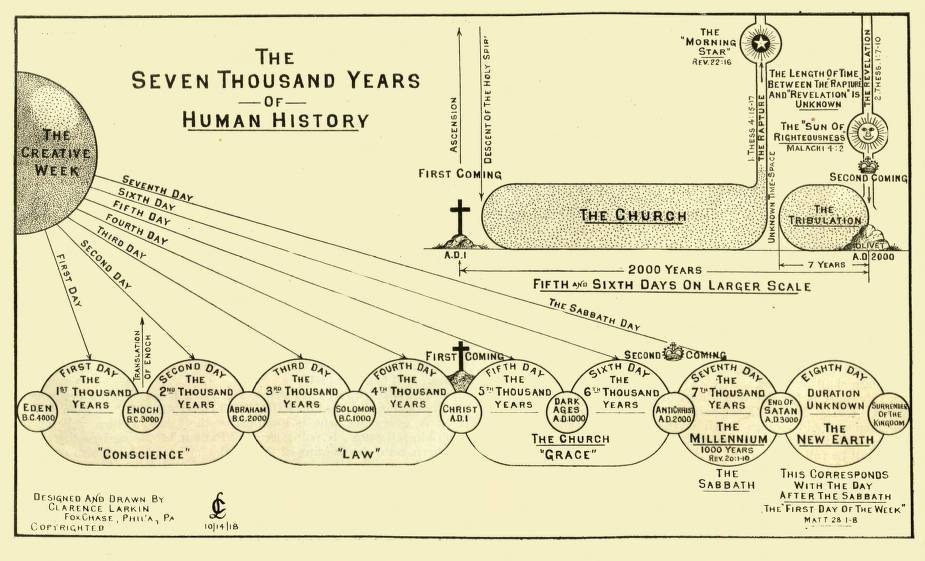
As can be seen, the above graphic neatly lays out the dispensational timeline. It seems to fit in many ways, but is generally incorrect because some of its presuppositions are false.
If our presuppositions are incorrect, so will be our conclusions.
The dispensational system of biblical interpretation first crystalized in the mid-1800s due to the ministry of John Nelson Darby with the Plymouth Brethren in Great Britain and Ireland. One of the emphases of the Plymouth Brethren movement was their anticipation for Christ to return at any time (and likely within their generation)… Darby stressed the two distinct peoples of God: Israel and the Church—a sharp division between the Old and New Testaments in how God dealt with those peoples—and he adopted a futuristic understanding of Revelation, in which God would remove the church from the world and finish his prophetic promises to the people of Israel.*
(I have written elsewhere about the various approaches to interpreting end time scriptures. I personally do hold to a futuristic view because I do not think it comports with most scripture. I recommend the book, Victorious Eschatology by Eberle and Trent, if you want to learn more about the partial preterist position.)
The idea of a “rapture” developed from the combination of this new distinction between Israel and the Church, end-times fervor, and ecstatic revivalism. Out of these, dispensationalists developed the idea that in this rapture (which would occur before the coming tribulation), God would remove the church from the world before their futuristic understanding of the events described in Revelation would occur. The first known articulation of a “pre-trib rapture” came from fifteen-year-old Margaret MacDonald in the form of an ecstatic prophetic utterance at a prayer meeting in her brother’s home in western Scotland, 1830 (MacPherson). Darby further popularized this view among the Plymouth Brethren and exported it from Great Britain to America. In America, Cyrus Scofield popularized these doctrines with his immensely popular Scofield Reference Bible, which was one of the first study Bibles, and contained dispensational commentary throughout the text of Scripture. The Scofield Reference Bible’s pessimistic views towards the history of the Church in the world, and the timing of its publication on the eve of World War I, cemented the idea into the evangelical psyche that the world was getting progressively more evil and would continue in that way until the Antichrist would arise after the Church was raptured out of the world.*
Cyrus Scofield was a charlatan and convicted fraudster. His rise to ministry fame is shrouded in mysterious connections to powerful people outside the church. He abandoned his first wife and daughters, which is condemned in the New Testament, falsely claimed to have a doctoral degree. All of this mitigates against our accepting anything doctrinal from him. Below is a video outlining his questionable story. Regardless of how much of this is true, the most fundamental reason to reject his theology is because it contradicts the New Covenant, which I will show in this series.
I have written elsewhere that I think the rapture is a false hope and will not comment further here.
During the Cold War, in the 1960s through the 1980s, dispensationalism went mainstream into the wider culture with the publication of Hal Lindsey’s book The Late Great Planet Earth and Edgar Whisenant’s book 88 Reasons Why the Rapture Will Be in 1988. As dispensationalism matured in the 20th century, confidence was stirred in its views when the modern nation of Israel was birthed in 1948, and when it miraculously won the Six-Day War in 1967 against a coalition of Arab states. In light of these historical developments, many dispensational teachers and groups continued the trend from 19th-century religious movements to believe that the current generation was the last generation before Christ’s return. Many dispensational ministers (e.g. Edgar Whisenant, Harold Camping, Chuck Smith, and others) would set specific dates or a range of years for Christ’s expected return. As the year 2000 approached, rapture fever increased and was fueled by the fictional Left Behind franchise of books and movies by Tim LaHaye and Jerry B. Jenkins, which presented dispensational end-times views in story form. *
I became a follower of Christ in 1971 and was inundated with this view of the end times. In my early days this was the predominant, if not only, view of the end times to which I was exposed. It was not until later that I became aware of alternate ways of interpreting the Bible regarding the end times.
Dispensationalists believe that the Jews’ official rejection of Jesus Christ was a significant moment in history that essentially stopped the “prophetic clock” in Scripture. They teach that the prophetic promises in Daniel, Matthew 24-25, and Revelation are now on hold during the dispensation or “age” of the Church, which has lasted 2,000 years (from Pentecost to today). According to dispensationalism, the Church exists in a parenthesis in prophetic history, as they believe the prophetic promises described in the Bible are for the people of Israel, and that the “true” Church will be raptured before the prophetic events described by Daniel, Jesus, and the Apostle John are destined to occur (during the Tribulation, and before the Millennium, when according to dispensationalists, Christ will finally rule as the Messianic King on Earth).*
Since dispensationalists are futurists, they do not generally consider what has already taken place in church history as being the fulfillment of prophecy. I have written elsewhere my position that Daniel’s prophecies describe the coming of the Messiah, his crucifixion, and the subsequent destruction of the Jewish nation and Temple.
Having restored Israel to nationhood status in 1948, dispensationalism teaches that God is actively protecting the nation of Israel. In this scenario, Israel is largely the focus of what God is doing in the end times. As these dispensations are different ages in which God is doing different things, the dispensationalists believe that God was doing something different during the time of the Mosaic covenant from the New Covenant initiated by Christ.
Dispensationalism completely distinguishes between Israel and the Church, and believes that they have separate future destinies.
According to that doctrine, the Church did not exist in the Old Testament and did not begin until Pentecost. Therefore, all the promises made to the people of Israel, in particular the physical blessings, are only for Israel and not the Church. L.S. Chafer wrote:
“The dispensationalist believes that throughout the ages, God is pursuing two distinct purposes: one related to the earth with earthly people and earthly objectives involved, while the other is related to heaven with heavenly people and heavenly objectives involved” (Chafer, Dispensationalism).*
In the following articles, I plan to show that everything in the Old Testament scriptures pointed to a fulfillment in Christ via the New Covenant.
I will demonstrate that the promise of a “seed” to Abraham was fulfilled in Christ. The multitude of descendants is and will be those who are born again into God’s family, the church composed of both Jew and Gentile. I will also show that the promises regarding land were fulfilled under Joshua, David, and Solomon and that the New Covenant exceeds this by promising the entire recreated earth to God’s born-again church. Likewise, I will demonstrate that the Jewish people forfeited their part in God’s kingdom by rejecting and murdering their Messiah. Today only a remnant of Abraham’s descendants is being saved, those who become part of the church, the “one new man” in Christ, in which racial and genetic distinctions are no longer considered. All that matters now is being a new creation in Christ. I will show that God will be glorified for all eternity in the church; therefore, it is not a “parenthesis” in God’s plan.
Israel-centered dispensational eschatology detracts from the purpose of God to sum up all things in Christ. It seeks to return us to old covenant thinking and theology instead of moving forward with God’s purposes in Christ and his church.
having made known to us the mystery of His will, according to His good pleasure which He purposed in Himself, 10 that in the dispensation of the fullness of the times He might gather together in one all things in Christ, both which are in heaven and which are on earth—in Him. Ephesians 1:9–10 (NKJV)

Now to Him who is able to do exceedingly abundantly above all that we ask or think, according to the power that works in us, 21 to Him be glory in the church by Christ Jesus to all generations, forever and ever. Amen. Ephesians 3:20–21 (NKJV)
I believe that the church has been duped by Dispensational theology into supporting a rebellious “antichrist” nation that is determined to establish world dominance without ever bowing the knee to Jesus the Lord. This is doomed to failure and should not be supported. We are called to love the Jewish people, pray for them, share the gospel with them, and perhaps support them in a limited fashion as a strategic ally, but it is a falsehood to call them “God’s Chosen People.” There is only one chosen people – God’s elect, the church.
- Go to Part 2.
- Click here to go to section of articles on dispensational theology.
- Click here to go to home page for related articles on deception.
- Click here to go to home page for related articles on the end times.
Footnotes
* "Dispensationalism, Its History & Framework (Part 1)" by Jon Brodhagen.

If you wish to read more about Covenant vs. Dispensational Theology, click here and here.
If you wish to learn more about an alternate view of the end times, I recommend Harold Eberle's book, Victorious Eschatology.

 Corrie Ten Boom, a Christian woman who miraculously survived the Nazi death camps after being betrayed by a neighbor for harboring and protecting Jews, toured the world as a speaker in her old age warning Christians that suffering is part of God’s plan to transform us and prepare us for glory. I quote her below.
 told us that the Good Shepherd will not flee when he sees the wolf coming. Watchman Nee lived and ministered in China before it fell to communism. He had the opportunity to escape but chose to remain with the people under his care. His church was among those which did not capitulate to the demands of the Communist Party. He endured great suffering as a result of his choice and languished for years in prison, but he was faithful to God and those under his care.