Walking in the Spirit Is as Easy as Flying

Walking in step with the Holy Spirit can be likened to flying in an airplane. When I fly, I like to sit by the window. It never ceases to amaze me how a jet can lift off the ground and ascend through the clouds to incredible heights. I don’t have to exert myself at all, except to purchase my ticket and jump through all the airport security hoops. The plane and pilot does the work. I simply enjoy the ride. In this article, I will attempt to help us better understand the “mechanics” of walking in the Spirit.
 
Since we are living by the Spirit, let us follow the Spirit’s leading [literally "walk in the Spirit"] in every part of our lives. Galatians 5:25 (NLT)

Paul taught that when we walk in step with the Spirit we do the things that please God.

The indwelling Spirit is always in harmony with the will of God, is always motivated to do the will of God, and is permanently available to us to enable us to live out of this motivation and harmony.

For this reason also, since the day we heard of it, we have not ceased to pray for you and to ask that you may be filled with the knowledge of His will in all spiritual wisdom and understanding, 10  so that you will walk in a manner worthy of the Lord, to please Him in all respects, bearing fruit in every good work and increasing in the knowledge of God; 11  strengthened with all power, according to His glorious might, for the attaining of all steadfastness and patience; joyously 12  giving thanks to the Father, who has qualified us to share in the inheritance of the saints in Light. Colossians 1:9-12 (NASB) 

Walking in the Spirit describes the experience of the Holy Spirit demonstrating his supernatural ability to enable us to live above the downward pull of sin and the “flesh” and experience God’s guidance and empowerment to be effective representatives of the kingdom of God.

Because most people are only familiar with living out of their own strength and resources, the idea of living above the downward pull of sin seems unbelievable.

When we live out of our own strength, we are doomed to failure because we were never intended or designed to do that.

From the beginning God planned for all people to draw on his life and ability, but Adam and Eve chose the tree of the knowledge of good and evil over the tree of life. The tree of life represents living out of God’s resources in the Spirit. The tree of the knowledge of good and evil represents living out of our own resources, knowledge, and ability. That has not worked out very well. Sin is basically the disastrous attempt to be our own boss, our own source, and our own god.

The first step in learning how to walk in the Spirit is to admit we cannot do life on our own and surrender to the Lord Jesus.

Once we take this step, he gives us his Spirit to be our Helper, the One who is called alongside and who dwells within us. At that point we begin the lifelong process of learning to “lean not on our own understanding” (Proverbs 3:5-6), but to lean on the Spirit of God.

The Law of Lift

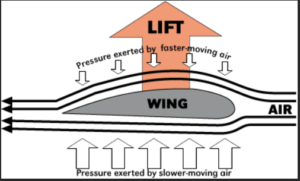
airfoil

The laws of density and buoyancy describe how objects rise if they are less dense (more buoyant) than the medium around them. When objects encounter a less dense medium they stop rising. Likewise objects fall toward the ground until they encounter something more dense. For example, a ship made of steel can float on less dense water because there is so much less dense air in its hull. If the hull is breached and fills with water, it will sink until it encounters the more dense sea floor.

Airplanes are no exception. Since they are denser than air, how is it that they can fly? The answer is that, if a plane attains enough speed, the design of the wings causes the upward lift of slower moving air under the wings to push the plane upward. If properly designed and flown, a plane overcomes gravity, as long as the necessary airspeed is maintained. The law of lift temporarily overcomes the tendency of the dense structure of the plane to fall toward the more dense ground. If airspeed drops too far, so will the plane. The law of density and buoyancy has not been suspended, but temporarily overcome by the law of lift. This is a decent analogy of what it means to walk in the Spirit.

The Downward Pull of the “Flesh”

The downward pull of the flesh does not go away when we walk in the Spirit. It is overcome by the lifting power of the Holy Spirit.

We know that our old man was crucified with him so that the body of sin would no longer dominate us [Greek: katergeo], so that we would no longer be enslaved to sin. Romans 6:6 (NET1) 

I chose the New English Translation in the verse above because it properly translates the difficult Greek word, katargeo, which means either to render inoperative or to abolish. It is clear that the “flesh” or “body of sin” still can influence us after we are born again, but we no longer must obey it. We can now walk in the freedom of the Holy Spirit if we so desire.

But I say, walk by the Spirit, and you will not carry out the desire of the flesh. 17  For the flesh sets its desire against the Spirit, and the Spirit against the flesh; for these are in opposition to one another, so that you may not do the things that you please. Galatians 5:16-17 (NASB) 

Just as surely as a plane that loses speed will descend to encounter the ground; so, the “flesh” will pull us down into sin and carnality, if we do not continually overcome it by choosing to walk in the power of God’s Spirit.

God did not annihilate our “flesh.” Instead, he removed its power to dominate us, leaving us with the option to lean on him and experience victory.

This requires us to keep our focus on the Lord. It is helpful to devote ourselves to worship, prayer, Bible meditation, and whatever helps us to continually draw upon the resources of the Lord rather than our own.

The Fear of the Lord

A good pilot spends time inspecting his plane before takeoff because once in the air everything must be working properly or bad things can happen. God expects us to vigilantly look after the things that he has put under our responsibility, so that we can walk in the Spirit each day.

Therefore be careful how you walk, not as unwise men but as wise, 16  making the most of your time, because the days are evil. 17  So then do not be foolish, but understand what the will of the Lord is. 18  And do not get drunk with wine, for that is dissipation, but be filled with the Spirit, 19  speaking to one another in psalms and hymns and spiritual songs, singing and making melody with your heart to the Lord; 20  always giving thanks for all things in the name of our Lord Jesus Christ to God, even the Father; 21  and be subject to one another in the fear of Christ. Ephesians 5:15-21 (NASB) 

A good pilot knows that attention to details can mean the difference between success and failure, life and death. You might say a good pilot has a certain good sort of fear in her or his approach to flying.

We likewise should maintain a proper fear of the Lord as we walk in the Spirit each day, realizing that we have a responsibility to make sure things are in order in our lives.

We have wicked spiritual enemies all around us who desire to sabotage our walk with the Lord, our own “flesh” being the most vile and untrustworthy.

So the church throughout all Judea and Galilee and Samaria had peace and was being built up. And walking in the fear of the Lord and in the comfort of the Holy Spirit, it multiplied. Acts 9:31 (ESV) 
Conclusion

To conclude, I believe that it is legitimate to compare walking in step with the Spirit to flying. When everything is working properly, there is no struggle in flying. The combination of a properly working plane and a good pilot creates a stress free experience of flight. Pilots, however, must be vigilant to inspect their planes regularly and do any needed repairs or maintenance. Likewise, spiritually speaking, even though we have been given all we need for success (2 Peter 1:3), we must never presume that walking in the Spirit allows us to become slack in our devotion to the Lord. Carefulness and vigilance, coupled with complete trust in the Lord, will allow us to experience the victory of the Spirit of life within us.

For the law of the Spirit of life in Christ Jesus has made me free from the law of sin and death. 3 For what the law could not do in that it was weak through the flesh, God did by sending His own Son in the likeness of sinful flesh, on account of sin: He condemned sin in the flesh, 4 that the righteous requirement of the law might be fulfilled in us who do not walk according to the flesh but according to the Spirit. Romans 8:2–4 (NKJV)
Click here to access other articles in this series.

Taking Personal Responsibility for Our Own Sanctification

While it is true that only God’s Spirit can transform us, it is also certain that we must take responsibility to do our part by cooperating with God in the sanctification process. Learning to believe in and lean on his presence and power is one of our greatest challenges and adventures.

God Never Encourages Passivity
Therefore I urge you, brethren, by the mercies of God, to present your bodies a living and holy sacrifice, acceptable to God, which is your spiritual service of worship. 2  And do not be conformed to this world, but be transformed by the renewing of your mind, so that you may prove what the will of God is, that which is good and acceptable and perfect. Romans 12:1-2 (NASB)  

Even though the Holy Spirit, our Helper, lives in and through us, our relationship with Him is a dynamic union and partnership that requires us to be active and engaged.

God wants us to actively present our bodies to him. This is necessary because our mortal bodies are the one part of our being that is still firmly linked to Adam and the judgment of death. Paul described the pre-resurrected body as a “body of death” and a “body of sin.” (See this link to read more about this.) The body is not evil, but it is linked to sin and death as a result of still being under God’s judgment against Adam’s sin. This will be rectified at the resurrection of the dead, but, until then, the “flesh” describes the Adamic body’s pull toward sin and independence from God.

In order to counter the downward pull of the flesh, we are told to actively present our bodies to God for his service.

Therefore do not let sin reign in your mortal body so that you obey its lusts, 13  and do not go on presenting the members of your body to sin as instruments of unrighteousness; but present yourselves to God as those alive from the dead, and your members as instruments of righteousness to God. 14  For sin shall not be master over you, for you are not under law but under grace. Romans 6:12-14 (NASB)  

Passivity can allow sin to master us. To defeat sin and the pull of the “flesh” on a daily basis, after reckoning that we are dead to its power through justification (Romans 6:4-7), we are instructed to partner with the Spirit to fight by adopting an aggressive posture of actively offering ourselves, our bodies, our minds, and our lives to the Lord for his service and glory.

But I say, walk by the Spirit, and you will not carry out the desire of the flesh. 17  For the flesh sets its desire against the Spirit, and the Spirit against the flesh; for these are in opposition to one another, so that you may not do the things that you please. 18  But if you are led by the Spirit, you are not under the Law. 19  Now the deeds of the flesh are evident, which are: immorality, impurity, sensuality, 20  idolatry, sorcery, enmities, strife, jealousy, outbursts of anger, disputes, dissensions, factions, 21  envying, drunkenness, carousing, and things like these, of which I forewarn you, just as I have forewarned you, that those who practice such things will not inherit the kingdom of God. 22  But the fruit of the Spirit is love, joy, peace, patience, kindness, goodness, faithfulness, 23  gentleness, self-control; against such things there is no law. 24  Now those who belong to Christ Jesus have crucified the flesh with its passions and desires. 25  If we live by the Spirit, let us also walk by the Spirit. Galatians 5:16-25 (NASB)  

The above passage tells us to actively “walk” by the Spirit, be “led” by the Spirit, and gives us the responsibility to “crucify” the flesh.

We have already been crucified with Christ (Romans 6:6), but we must take responsibility to put the pull of the flesh to death everyday by denying ourselves the right to go our own way and by choosing to trust and rely on God’s indwelling Spirit to help us.

So then, brothers, we are debtors, not to the flesh, to live according to the flesh. 13  For if you live according to the flesh you will die, but if by the Spirit you put to death the deeds of the body, you will live. Romans 8:12-13 (ESV)  

When we do this, we will discover that God’s grace comes alongside to empower us. God helps us as we seek to obey him and as we rely on God’s indwelling Spirit.

Grace never encourages us to be passive or idle when it comes to our sanctification. Rather it produces works of faith which validate the Christ life that indwells us.

But by the grace of God I am what I am, and his grace to me was not without effect. No, I worked harder than all of them--yet not I, but the grace of God that was with me. 1 Corinthians 15:10 (NIV) 
 
Saved by Works?

The apostle Paul clearly taught that we are saved (justified) by faith without having to keep the Law of Moses. (If you would like to read in more depth about this important doctrine, click here.) When it comes to sanctification, the ongoing daily process of transformation into Christ’s image, however, we are saved, in a limited sense, by works. Our works always originate and depend on God’s grace.

For of Him and through Him and to Him are all things, to whom be glory forever. Amen. Romans 11:36 (NKJV)

God works in us what we produce as good works.

For we are His workmanship, created in Christ Jesus for good works, which God prepared beforehand that we should walk in them. Ephesians 2:10 (NKJV)

Ultimately all praise and glory will go to him.

Jesus said that a good tree is known by its fruit. This means you can tell what is in a person by what comes out of him or her.

"So every good tree bears good fruit, but the bad tree bears bad fruit. 18  "A good tree cannot produce bad fruit, nor can a bad tree produce good fruit. 19  "Every tree that does not bear good fruit is cut down and thrown into the fire. 20  "So then, you will know them by their fruits. 21  "Not everyone who says to Me, 'Lord, Lord,' will enter the kingdom of heaven, but he who does the will of My Father who is in heaven will enter. Matthew 7:17-21 (NASB)  

When we stand before the Christ’s judgment seat, we will be judged in two ways.

  1. First, are we written in the Lamb’s Book of Life (justified by faith)? This is by far the most important criteria.
  2. Secondly, we will be judged according to our deeds.

For those of us who are written in the Book of Life, our deeds will determine our reward, not whether God accepts us or not. The only way to be accepted by God is on the basis of Christ’s death and resurrection, his sacrifice on our behalf and his lordship.

Those written in the Book of Life will have accompanying good deeds. Who we are will be manifested in what we think, do, and say. Christ’s indwelling life will produce good fruit because good trees produce good fruit.

For the grace of God has appeared, bringing salvation for all people, 12  training us to renounce ungodliness and worldly passions, and to live self-controlled, upright, and godly lives in the present age, 13  waiting for our blessed hope, the appearing of the glory of our great God and Savior Jesus Christ, 14  who gave himself for us to redeem us from all lawlessness and to purify for himself a people for his own possession who are zealous for good works. Titus 2:11-14 (ESV)  

God’s people do good works.

For those who are not found written in the Book of Life, their deeds will conform to their sinful independence from God at the core of their being and will confirm their just condemnation to hell.

Some may believe that I am somehow mixing grace and legalism when I say our sanctification is related to our works, but I am not. We must properly understand how the two work together.

The key to understanding the interplay of faith and works is to avoid the error of thinking that our faith can be disassociated from how we live. It cannot be. According to Jesus, what we do and say clearly reveals what we believe.

James, the Lord’s brother and leader of the church in Jerusalem, understood this well. He expressed how the two combine to reveal the true grace of God in our lives.

What good is it, my brothers, if someone says he has faith but does not have works? Can that faith save him? 15  If a brother or sister is poorly clothed and lacking in daily food, 16  and one of you says to them, “Go in peace, be warmed and filled,” without giving them the things needed for the body, what good is that? 17  So also faith by itself, if it does not have works, is dead. 18  But someone will say, “You have faith and I have works.” Show me your faith apart from your works, and I will show you my faith by my works. James 2:14-18 (ESV)  
 
Taking Responsibility for How We Live

Years ago I struggled to understand how this passage from James can be harmonized with Paul’s teaching that we are saved by faith without the works (of the Law).  It’s really very simple. If we are using our performance (keeping the Law) to establish or maintain a right relationship with God, which only comes by faith in the finished work of Christ (justification), we are guilty of legalism. We cannot earn our way into God’s good graces. It is a free gift.

However, that being said, if our faith relationship with Jesus and our partnership with the indwelling Holy Spirit does not actually change us in character and behavior, it is a counterfeit.

A good tree will produce good fruit. We can say we believe, but our actions reveal the truth of the matter more perfectly. Talk is cheap. People can and will say anything that they believe will gain a benefit for them. Actions speak louder than words.

Another way to put this is that, if our doctrine about grace does not result in our being obedient to God, it is a false gospel.

The goal of the true gospel is obedience that arises from faith.

Paul, a servant of Christ Jesus, called to be an apostle, set apart for the gospel of God, 2  which he promised beforehand through his prophets in the holy Scriptures, 3  concerning his Son, who was descended from David according to the flesh 4  and was declared to be the Son of God in power according to the Spirit of holiness by his resurrection from the dead, Jesus Christ our Lord, 5  through whom we have received grace and apostleship to bring about the obedience of faith for the sake of his name among all the nations, Romans 1:1-5 (ESV)  

Professing Christians who show no apparent change in their lifestyle as a result of their faith in Christ should question the reality of their conversion.

Those who do know the Lord should pursue ransformation, the lifelong process of of becoming more like Jesus which is carried out by the indwelling Spirit in cooperation with our faith and obedience.

See how great a love the Father has bestowed on us, that we would be called children of God; and such we are. For this reason the world does not know us, because it did not know Him. 2  Beloved, now we are children of God, and it has not appeared as yet what we will be. We know that when He appears, we will be like Him, because we will see Him just as He is. 3  And everyone who has this hope fixed on Him purifies himself, just as He is pure. 1 John 3:1-3 (NASB)

Those whose faith and hope are rooted in Christ and who know the power of the indwelling Spirit are responsible to God to purify themselves, which means we cooperate with God by actively participating in the ongoing transformation process called sanctification. We do our part, and God does his. We cannot passively expect him to do everything. That would be irresponsible.

Click here to read other articles in this series.

Sanctification: Dancing with an Invisible Partner


Sanctification or transformation is a partnership between God’s people and the Holy Spirit that can be thought of as dancing with an invisible partner. If we are to let God’s Spirit take the lead, it will require that we repent from our inborn propensity to rely on our own mind, strength, and ability, which we inherited from Adam and which has been reinforced by our living in our sin-filled world.

Living out of our own resources is the essence of sin and frustrates or nullifies the power of God’s grace in our lives.

"I do not nullify the grace of God, for if righteousness comes through the Law, then Christ died needlessly." Galatians 2:21 (NASB) 

Until we learn to lean on God’s Spirit instead of ourselves, we will live out Romans 7 and groan under the burden of frustration as did Paul.

I find then the principle that evil is present in me, the one who wants to do good. 22  For I joyfully concur with the law of God in the inner man, 23  but I see a different law in the members of my body, waging war against the law of my mind and making me a prisoner of the law of sin which is in my members. 24  Wretched man that I am! Who will set me free from the body of this death? 25  Thanks be to God through Jesus Christ our Lord! So then, on the one hand I myself with my mind am serving the law of God, but on the other, with my flesh the law of sin. Romans 7:21-25 (NASB) 

Romans 7 becomes our experience when we rely on the “flesh” instead of the Spirit. (If you are not familiar with the meaning of the word “flesh” as Paul uses it, please read my second article in this series now.) Jesus taught us that the “flesh” does not profit us in any way spiritually speaking. The only thing that helps us is what comes from and through the Spirit of God.

It is the Spirit who gives life; the flesh profits nothing. The words that I speak to you are spirit, and they are life. John 6:63 (NKJV)

Learning how to “walk” in the Spirit means that on a daily basis we live out of the strength and power of God’s indwelling Spirit doing what he puts in our hearts.

The better we get at partnering with the Holy Spirit, the happier, more fulfilled, and more useful we are to God and other people.

Jesus called this the “abundant life.” (John 10:10)

Partnering with God Who Lives inside Us
"I will ask the Father, and He will give you another Helper, that He may be with you forever; 17  that is the Spirit of truth, whom the world cannot receive, because it does not see Him or know Him, but you know Him because He abides with you and will be in you. 18  "I will not leave you as orphans; I will come to you. John 14:16-18 (NASB)  

Perhaps the most amazing part of the Christian life is that God chooses to live inside of us who believe forever.

The Holy Spirit is called the “helper” (Greek: paracletos – one called alongside). He is our best friend, someone who will never abandon us, the Person we always wanted to be, the One we are becoming like through the process called sanctification or transformation.

Jesus told his followers, whom he called “sheep,” that we are able to “hear his voice.”

My sheep hear My voice, and I know them, and they follow Me; John 10:27 (NASB) 

He said that we will know and recognize him; yet, many followers of Christ today have little or no experience of this. Perhaps it is because of a misunderstanding or misconception of what it means to hear his voice. Since our spirits are joined to the Holy Spirit (1 Cor. 6:17), our thoughts are connected to God’s thoughts (1 Cor. 2:16), and our desires are becoming more in line with God’s desires (Ezekiel 11:19-20), it is likely that we may not always be aware of when God is “speaking” to us. What God is “telling” us may seem to originate in our own minds. It may appear as if we are directing our own lives. But if we understand that God lives inside us, our desire is to live in harmony with him, and we have surrendered our lives to him as best we know how, then God’s Word teaches us something that I must accept by faith: Christ lives in me.

For through the Law I died to the Law, so that I might live to God. 20  "I have been crucified with Christ; and it is no longer I who live, but Christ lives in me; and the life which I now live in the flesh I live by faith in the Son of God, who loved me and gave Himself up for me.  Galatians 2:19-20 (NASB) 

Paul learned that his life was Christ’s life and Christ’s life was his.

It was not Paul; yet, it was Paul. It was Christ; yet, it was also Paul. This same principle is echoed elsewhere.

But by the grace of God I am what I am, and His grace toward me did not prove vain; but I labored even more than all of them, yet not I, but the grace of God with me. 1 Corinthians 15:10 (NASB) 

If we are looking for God somewhere outside us, we are still living in an Old Testament paradigm.

At times, it may seem as if I am working hard at this thing called transformation, but the reality is that it is a joint effort, as we rely on God’s Spirit and grace. Every true work of sanctification or transformation is a work of grace, no matter how it seems. The key thing is for us to maintain an attitude of rest. We do not struggle and strive to perfect ourselves. Instead, we “labor” to enter and maintain rest.

The struggle for believers, more than anything else, is to rely upon God’s ability to fulfill his promises and complete the transformative work inside us that he began. (Philippians 1:6)

So there remains a Sabbath rest for the people of God. 10  For the one who has entered His rest has himself also rested from his works, as God did from His. 11  Therefore let us be diligent to enter that rest, so that no one will fall, through following the same example of disobedience. Hebrews 4:9-11 (NASB) 

For by grace you have been saved through faith. And this is not your own doing; it is the gift of God, 9  not a result of works, so that no one may boast. 10  For we are his workmanship, created in Christ Jesus for good works, which God prepared beforehand, that we should walk in them. Ephesians 2:8-10 (ESV) 

God forgave us, justified us, reconciled us to himself, and is transforming us by his Spirit as we hold fast to his promises and keep our eyes upon the Lord.

The Law, with its demands, is external to us and speaks to us from afar. The Spirit is internal and speaks most often from within.  His voice is often so subtle that, unless we quiet our noisy minds and souls, we may miss it altogether. His voice is always in harmony with the written Word of God, but not in a legalistic sense.

The Spirit is life and makes the Word of God become life and peace to us.

But now we have been released from the law, for we died to it and are no longer captive to its power. Now we can serve God, not in the old way of obeying the letter of the law, but in the new way of living in the Spirit. Romans 7:6 (NLT) 

If we have learned to lean on the power of the human mind exclusively, we will have to learn to command it to be still and learn how to hear and live out of our spirits, much as a baby learns to walk.

The words of Solomon come to mind at this point.

Trust in the LORD with all your heart, and do not lean on your own understanding. 6  In all your ways acknowledge him, and he will make straight your paths. Proverbs 3:5-6 (ESV)  

God wants us to believe that he lives inside us, communicates with us, directs us, and empowers us, even when it seems as if it is only we who are doing it. Thankfully, however, God makes his voice and presence known to us. He does not leave us on our own. We do not always have to walk by faith only. King David knew the life-giving presence of God, and so can we.

You will show me the way of life, granting me the joy of your presence and the pleasures of living with you forever. Psalm 16:11 (NLT) 

There are times when his voice to us is so clear that it is almost as if he audibly spoke to us, but this is not the norm. Most of the time, we must learn to trust faint impressions in our minds and hearts as coming from God. It takes a while for us to learn to distinguish between God thoughts and merely human ones, but the Holy Spirit will help us, and we can lean on other more mature followers of Christ to help us grow in this area.

Walking in the Spirit can be likened to dancing with an invisible partner. As we learn to follow his lead, those watching will think that it is only we who are dancing, but we will know that is is not. We will know that it is Christ who lives in and through us.

Click here to access all the articles in this series.

What Is Sanctification?

Sanctification or transformation is the ongoing process whereby the Holy Spirit is changing us on the inside on a daily basis. In my previous article, I wrote about the eternal reality of justification, which primarily concerns the innermost part of our being, the spirit. If you have not read it yet, I encourage you to do so before going any farther. It will help you better understand this article.

Still waiting…

The apostle Paul made a very interesting statement regarding salvation and hope.

For I consider that the sufferings of this present time are not worthy to be compared with the glory that is to be revealed to us. 19  For the anxious longing of the creation waits eagerly for the revealing of the sons of God. 20  For the creation was subjected to futility, not willingly, but because of Him who subjected it, in hope 21  that the creation itself also will be set free from its slavery to corruption into the freedom of the glory of the children of God. 22  For we know that the whole creation groans and suffers the pains of childbirth together until now. 23  And not only this, but also we ourselves, having the first fruits of the Spirit, even we ourselves groan within ourselves, waiting eagerly for our adoption as sons, the redemption of our body. 24  For in hope we have been saved, but hope that is seen is not hope; for who hopes for what he already sees? 25  But if we hope for what we do not see, with perseverance we wait eagerly for it. Romans 8:18-25 (NASB)

I quoted the entire passage, but the key verse for my purposes is 24: “in hope we have been saved.” Paul argues that, even though we have been declared righteous in the court of heaven and have complete confidence that God will keep his promise to raise us from the dead, we are still waiting to see the completion of what God began.

For I am confident of this very thing, that He who began a good work in you will perfect it until the day of Christ Jesus. Philippians 1:6 (NASB)
 
Now may the God of peace Himself sanctify you entirely; and may your spirit and soul and body be preserved complete, without blame at the coming of our Lord Jesus Christ. 24  Faithful is He who calls you, and He also will bring it to pass. 1 Thessalonians 5:23-24 (NASB) 

Even though Christ already completed the perfect work of justification and we are sure that God will certainly finish what he has begun at the resurrection, we must wait for it in confident expectation, which, by the way, is the actual definition of hope (Greek: elpis).

To hope is to confidently wait for what God has promised, knowing that he will keep his word.

In the above passage, our hope is the resurrection of the body at Christ’s Second Coming at the end of time. At that point, all of creation will be recreated, producing what John the Revelator called a new heaven and earth. (Revelation 21:1) However, being saved in hope also refers to the present ongoing process of our being sanctified or transformed into Christ’s image in how we think, speak, and act as we continue to live in this time-space experience called life.

Even though justification is a once-for-all completed work and our glorification will also be once and for all at the resurrection, the transformative effects of God’s grace are being worked out in our lives on a daily basis.

For by a single offering he has perfected for all time those who are being sanctified. 15  And the Holy Spirit also bears witness to us; for after saying, 16  “This is the covenant that I will make with them after those days, declares the Lord: I will put my laws on their hearts, and write them on their minds,” Hebrews 10:14-16 (ESV)  

Justified people who have been declared righteous (“perfected”) in God’s sight are still undergoing a transformation process orchestrated by the Holy Spirit through grace by faith in an atmosphere of the fear of the Lord. God is actively writing his laws, his heart, and his mind upon our hearts and minds. We are becoming more and more like Jesus in how we think, speak, and act as we allow the Holy Spirit to live the Christ life in and through us.

Imagine if…

What if we had no way to measure our spiritual status or progress? How would we know how we are doing in God’s eyes? Would we have confidence toward God? Would we feel good about ourselves? Imagine if there were no way to “grade” ourselves spiritually. Are we passing, failing, acing it, barely squeaking by, or in danger of getting a failing grade? How does God mean for us to gauge our spiritual condition?

I have a friend who would often ask me and others, “Are you doing enough?” He asked this in good humor to try to point out that we cannot do enough to earn or maintain a right standing with God. Nevertheless, most believers, in spite of having a decent theology, labor under the thought that they do not measure up in God’s eyes. We know that what constitutes being good enough if found only in our Lord Jesus, but somehow we feel that we too need to attain to some level of works and holiness in order to be pleasing to God. Why are we so ambivalent? Why do we who know about grace wrestle with a works mentality? To find the answer, we need to go back to the Garden of Eden.

After Adam and Eve sinned, in shame they hid themselves from God having become aware of their nakedness, which previously was a non-issue or had not been evident for some reason. God asked them a telling question: “Who told you that you are naked?” (Genesis 3:11) The fact that they were aware of their condition indicated that someone had informed them of their deficiency. We know, as God did, that it was the devil, the accuser of the brethren, who did this. Sin exposed their nakedness about which they had previously been oblivious. Some think they had been clothed with the glory of God, which had been removed because of their sin. Just as the serpent had promised, their eyes were now opened to good and evil.

When Jesus died and rose again, those of us who believe in him are “clothed” with his right standing before God. (Isaiah 61:10, Galatians 3:27), which restore us to the Edenic bliss of not needing to know, care, or otherwise occupy ourselves with wondering if we good enough and acceptable in God’s sight. Since Jesus was good enough, so are we.

If we persist in trying to earn or maintain a right standing with God, it means we have not yet understood the New Covenant.

Why Trying Hard to Be Good Doesn’t Work

The process of transformation is a supernatural work of grace. It does not happen because we try very hard to make it happen. It is quite the contrary.

When we focus on what some call “sin management” – trying very hard to control our sinful urges and ways – we actually heighten sin’s power in our lives.

The sting of death is sin, and the power of sin is the law; 1 Corinthians 15:56 (NASB) 

This is because we are transformed into that upon which we focus. If we fix our gaze on our own sinfulness, it gets the upper hand in our lives. Bitter people become just like the one they hate because they are mesmerized by the offense and think about it continually. When we think about how hard it is to resist temptation, we maximize temptation’s power.

Trying to oversee our own spiritual transformation is a hopeless endeavor. God promises that we will fail.

This is because the Law has no power to transform us at all. Trying to perfect ourselves is a form of legalism. This raises the question: can we trust God to do what we cannot do?

The Law’s function is to point out how sinful we are and condemn us for transgressions, thus revealing to us our utter need for a Savior.

The Law is a harsh taskmaster who castigates us when we fall short but refuses to lift a finger to help. Paul wrote that the Law actually arouses our sinfulness. It exposes our ugly rebellion against God.

What shall we say then? Is the Law sin? May it never be! On the contrary, I would not have come to know sin except through the Law; for I would not have known about coveting if the Law had not said, "YOU SHALL NOT COVET." 8  But sin, taking opportunity through the commandment, produced in me coveting of every kind; for apart from the Law sin is dead. 9  I was once alive apart from the Law; but when the commandment came, sin became alive and I died; 10  and this commandment, which was to result in life, proved to result in death for me; 11  for sin, taking an opportunity through the commandment, deceived me and through it killed me. Romans 7:7-11 (NASB) 

Perhaps we have honestly tried to reign in sin and temptation in an effort to be more devoted to God. When we do this, we may seem to succeed for a while, but eventually we will fail miserably. God has ordained failure for our every attempt to attain sanctification and holiness by our own strength and on our own terms. Adam’s sin was trying to live independently from God. We dare not attempt the same folly, even when its done in a noble enterprise. 

Sanctification is a work of the Spirit by grace in which we cooperate. The sooner we learn how to follow the Spirit’s lead, the better.

A New and Living Way
Is the Law then contrary to the promises of God? May it never be! For if a law had been given which was able to impart life, then righteousness would indeed have been based on law. 22  But the Scripture has shut up everyone under sin, so that the promise by faith in Jesus Christ might be given to those who believe. 23  But before faith came, we were kept in custody under the law, being shut up to the faith which was later to be revealed. 24  Therefore the Law has become our tutor to lead us to Christ, so that we may be justified by faith. Galatians 3:21-24 (NASB)  

God designed the Law to illustrate his righteousness, point out our sinfulness, and lead us to Christ. The Greek word for tutor is paidagogos, which was a servant who escorted his master’s child to school to leave him or her with the instructor. Being with the paidagogos was not the goal. He was simply the means to help the child reach the true teacher.

The Law is not our goal: it is the means God uses to bring us to Christ, who is the fulfillment of the Law. (Romans 10:4)

Once we come to Christ, we no longer need the Law. It’s power to condemn us is removed. We are now joined to our new Master and Husband, Jesus the Lord.

Living by grace is called a new and living way (Hebrews 10:20, John 14:6), in which we are wholly dependent upon God’s living his life through us. To return to trying to serve God through our own futile efforts is a sin.

But now we are released from the law, having died to that which held us captive, so that we serve in the new way of the Spirit and not in the old way of the written code. Romans 7:6 (ESV) 
 
Transformation through Union and Beholding
Therefore, my brethren, you also were made to die to the Law through the body of Christ, so that you might be joined to another, to Him who was raised from the dead, in order that we might bear fruit for God. 5  For while we were in the flesh, the sinful passions, which were aroused by the Law, were at work in the members of our body to bear fruit for death. 6  But now we have been released from the Law, having died to that by which we were bound, so that we serve in newness of the Spirit and not in oldness of the letter. Romans 7:4-6 (NASB)  

Rather than being ruled by an inherited inner rebellion against God, which is ignited by the Law’s prohibitions, the spiritual transformation process begins with justification at the new birth, the subject of my previous articles in this series. God replaces the rebellious heart with a new one that loves to please God. We are joined (“married”) to God in the Spirit. His life in us replaces the “old man” inherited from Adam that formerly dominated us. Once this happens through the miracle of the new birth, we are entirely capable of living for God, as long as we do it God’s way. If we try to accomplish it on our own, the Law’s power reengages the sinful tendencies of what the Bible calls the “flesh,” which is a sinful residual connection through our yet-to-be-resurrected bodies to the sinful Adamic condition. (You can read more about that by clicking on this link.)

Real transformation takes place when we follow the Spirit’s lead to become followers of God’s Word and worshipers of God.

By focusing on our Lord and Savior and beholding his love and glory, we are silently and seamlessly changed, often without our even being aware.

God removes us from the treadmill of trying to be “good enough.” He takes away every “report card” of how we are doing and tells us to forget all that and focus on him, his promises, his grace, and his glory. He helps us to stop fighting against him and complaining of our situation. He helps us to humbly surrender everything to God in worship. If we do that, the Holy Spirit will live his life through us and transform us into Christ’s image.

But we all, with unveiled face, beholding as in a mirror the glory of the Lord, are being transformed into the same image from glory to glory, just as from the Lord, the Spirit. 2 Corinthians 3:18 (NASB) 
Click here to access all articles in this series.

Justification: An Eternal Reality

Justification by faith in the finished work of Christ is one of the gospel’s most important truths, which unites us who believe to the eternal reality of our Lord’s right standing with God the Father.

Jesus came to the earth in order to reverse what Adam’s rebellion against God’s rule set in motion. When Adam fell for Satan’s lie in the garden, he set humanity on a destructive sinful trajectory that has produced untold suffering, destruction, and death. To reverse this, several things had to take place.

  1. A new representative head of humanity had to do what Adam failed to accomplish– live a surrendered life of obedience to and dependence on God. This person would be a “Second Adam,” the source of a brand new edition of humanity. (1 Corinthians 15:47)
  2. To rescue humanity, someone had to take the punishment for our sin and rebellion against God. Either all of us had to be condemned, or a perfect substitute had to take on our collective sin, guilt, condemnation, and the sentence of death. Jesus came to die as God’s Lamb for the sins of the world. (John 1:29)
  3. The authority given to mankind by God, which Adam ceded to Satan by obeying him rather than the Creator, had to be recaptured, so that God’s effective rule over the earth and its people could be regained and retained by a new Lord, Jesus the Savior King.
  4. In order to prevent a repeat of Adam’s failure, a New Covenant had to be established that would guarantee that humanity would live a surrendered, dependent, and victorious life in partnership with God’s Spirit.

When Jesus died on the cross at Calvary and subsequently rose from the dead, he accomplished all these things. This article will focus on justification by faith, which is possible because Jesus did all four things mentioned above.

Justification: Eternal Reality Accomplished in Time

Justification means that Jesus put us who believe into a right relationship with his heavenly Father, from whom we had been alienated by sin.

Jesus, the Lamb of God, shed his blood to satisfy the wrath of God against sin and provide us with forgiveness. Our debt toward God was completely and forever paid! This is called propitiation. We who put our faith and allegiance in Christ not only are forgiven, however; we are declared “not guilty” in the court of heaven. Justification means that God sees us as if we had never sinned at all. It means that in God’s eyes it is as if we had already completed lives of perfect devotion and surrender to him in the face of every sort of adversity, temptation, and test, as was accomplished by our Lord Jesus on our behalf.

Justification means that Christ’s perfect right standing with God, which he earned at the cost of his life, has been given to us as a free gift!

When those who put their faith and allegiance in Christ one day stand before his judgment seat, we will be declared “Not Guilty” based on our identification with the risen Lamb of God who was slain for our sins. This is what it means to be “written in the Lamb’s Book of Life.”

Christ accomplished our justification by taking our place upon the cross. Since the “wages of sin is death” (Romans 6:23), we all deserved to die because of our sin, but Jesus volunteered to take our sin upon himself, even though he was completely without guilt. He fulfilled the meaning of the Passover feast by offering his innocent blood on our behalf as God’s Lamb, so that God’s judgment would “pass over” us, just as happened to the Israelites so long ago before their historic Exodus from Egypt.

According to the Bible, Jesus so identified himself with us that he actually “became sin.” In exchange, he gave us his perfect righteousness.

He made Him who knew no sin to be sin on our behalf, so that we might become the righteousness of God in Him. 2 Corinthians 5:21 (NASB) 

He completely paid the penalty for our sin and disobedience toward God. This payment, which was made on a particular day in Israel some 2000 years ago, extends and continues to impact people who believe backward and forward in time. It is an eternal reality.

By this will we have been sanctified through the offering of the body of Jesus Christ once for all. 11  Every priest stands daily ministering and offering time after time the same sacrifices, which can never take away sins; 12  but He, having offered one sacrifice for sins for all time, SAT DOWN AT THE RIGHT HAND OF GOD, 13  waiting from that time onward UNTIL HIS ENEMIES BE MADE A FOOTSTOOL FOR HIS FEET. 14  For by one offering He has perfected for all time those who are sanctified. Hebrews 10:10-14 (NASB) 

Jesus’ death on the cross was accomplished on an historical day in the history of the world, while at the same time being an eternal reality. Only God, who is unencumbered by the restraints of time, could do this.

Slain before the Foundation of the World

Please read the following verse, which is presented from two different, yet reliable, translations and consider the implications.

All inhabitants of the earth will worship the beast--all whose names have not been written in the book of life belonging to the Lamb that was slain from the creation of the world. Revelation 13:8 (NIV) 

All who dwell on the earth will worship him [the beast], everyone whose name has not been written from the foundation of the world in the book of life of the Lamb who has been slain. Revelation 13:8 (NASB) 

Obviously the above verse poses a challenge for translators. Is the eternal aspect to be assigned to our being written in the book of life or to the crucifixion, or to both? I say both.

We know from Ephesians that God chose the “elect” (his special people) from before the creation of the world. (Ephesians 1:4) This is another way to say that the elect were written in God’s book of life before the creation of the world. Therefore, the NASB translation above fits with Ephesians 1:4 and should be accepted as a valid way to translate Revelation 13:8. But let me remind you that, even though God chose his special people before the creation, we each must encounter God in our time-space experience of life. God’s sovereign eternal choice always interfaces with our responsibility to choose at some point in time. It is a mystery in how we cooperate with God’s Spirit in the entire process, upholding both his sovereignty and our responsibility.

God’s eternal choice impacts us when it becomes part of our personal history through our participation in the process. The eternal choice and work of God must be “fleshed out” in our lives. What is eternally true must become experientially and historically true for us.

Now let us take a look at the NIV translation of Revelation 13:8. Could it be correct, too? We know from Scripture that Jesus died according to the predetermined plan of God. (Acts 2:23)

God, who dwells in the eternal now (which encompasses our past, present, and future), saw his Son crucified from all eternity. This is because in God’s eternal perspective, the most real of all, his Son was already crucified, dead, buried, risen, and glorified. The plan for him to die on a given day in the history of the earth was preset, predetermined, foreordained, and certain.  It was so sure, from God’s eternal perspective, that it was done even before it took place in history.

This is why King David, who was a prophet, could write about the crucifixion as if he were experiencing it himself. (Psalm 22) That is why the prophet Isaiah could write about Christ’s coming crucifixion using the past tense. (Isaiah 53) From God’s eternal perspective, the eternal now, something in our historical future was already completed. This is why I contend that Christ was indeed slain before the foundation of the world; even though he was also put to death on a specific historical day. Once again, eternal truth must be fleshed out in human history in order for it to become part of our reality in the time-space experience which God created for us to inhabit.

By One Offering Perfected for All Time
Every priest stands daily ministering and offering time after time the same sacrifices, which can never take away sins; 12  but He, having offered one sacrifice for sins for all time, SAT DOWN AT THE RIGHT HAND OF GOD, 13  waiting from that time onward UNTIL HIS ENEMIES BE MADE A FOOTSTOOL FOR HIS FEET. 14  For by one offering He has perfected for all time those who are sanctified. Hebrews 10:11-14 (NASB)

Think about this amazing fact. When Jesus died and rose some 2000 years ago, the benefits of his sacrifice went backward and forward in time. It provided forgiveness and reconciliation for those who trusted in God before Christ’s coming to earth and provides the same for all who would come after.

In other words, God forgave past, present, and future sins by Christ’s one sacrifice.

King David was forgiven for his adultery and the murder of Bathsheba’s husband, Uriah. Both sins were punishable by death; yet, God forgave David. How could a just God do that without violating his just wrath against sin? When the woman caught in adultery was dragged before Jesus in John Chapter 8, he forgave her instantly for a sin that was punishable by stoning under the Law of Moses. How could a just God do that? The answer is that Jesus’ looming sacrifice was already considered to be in effect. Jesus made “draws” from a future deposit, which from God’s eternal perspective had already been accomplished.

It is fair, then, to say that the benefits of Jesus’ death and resurrection are not time bound. They are eternal, complete, and finished.

Our Future Glorification Is Also a Done Deal from God’s Eternal Perspective

Not only is our justification an eternal timeless truth; so is our glorification.

This is something that should “blow our minds,” if we are honest about it. Paul taught that our glorification is inexorably linked to our justification. Anyone reading Paul’s letter to the church in Rome would believe that their justification was already accomplished through a past event, Christ’s death and subsequent resurrection.

And we know that God causes all things to work together for good to those who love God, to those who are called according to His purpose. 29  For those whom He foreknew, He also predestined to become conformed to the image of His Son, so that He would be the firstborn among many brethren; 30  and these whom He predestined, He also called; and these whom He called, He also justified; and these whom He justified, He also glorified. Romans 8:28-30 (NASB)  

Astoundingly, Paul used the same aorist past tense to describe what for them and us is still historically in the future, our glorification at the resurrection of our bodies. Our threefold salvation is all included in this passage – justification, transformation (being conformed to Christ’s image), and glorification.

Election (God’s choosing us), justification (God’s declaring us righteous in his eyes), transformation (God’s conforming us to Christ’s image in our everyday life), and glorification (God’s giving us a new resurrection body) are all described using the Greek aorist past tense, which lets us know that each of these is a once-for-all-time completed event in God’s eyes.

Think about this: God sees us already in heaven with a new resurrection body! How can this be? Obviously this is not true yet in our present historical context here on the earth, but it is true in the eternal realm of God’s Spirit. However, the eternal must become my historical experience at some point because that is where we experience the eternal for now. One day Christ will raise us who believe from the dead, and we will receive a new spiritual body. At that point in time, if time still exists, the eternal truth of glorification will be fulfilled in my experience. Until then, God expects us to believe what the Bible says is true and rest in Christ’s finished work, as we cooperate with the Holy Spirit who was sent to help us “work out” what God has put within us. (Philippians 2:12-13)

Conclusion

God’s will cannot be thwarted. His plans will come to pass. His words will be fulfilled. He says that which does not yet exist in our time-space experience already exists eternally because it does.

(as it is written, “I have made you the father of many nations”). He is our father in the presence of God whom he believed — the God who makes the dead alive and summons the things that do not yet exist as though they already do. Romans 4:17 (NET1) 

But God’s eternal perspective is not ours. We still live in a time-space restricted world. We must learn to navigate the historical present on the basis of eternal truth.

I hope that most readers who have professed faith and allegiance in Christ will have no difficulty believing that Christ accomplished our justification on the cross once for all and that our righteous standing before God depends wholly on that glorious truth. I also think that most followers of Christ believe that Jesus will certainly raise us from the dead on the Last Day.

However, not so many understand how to live in the present from an eternal perspective.

Many struggle to navigate the here and now process of sanctification or transformation by faith in the finished work of Christ combined with a complete reliance upon the Holy Spirit. I will discuss this in more detail in my next article entitled “What is Sanctification?”

Click here to access all the articles in this series.

Chapter 89: Overview of the Church

Jesus established his church before he ascended to heaven. The Greek word translated church is ekklesia. Literally it means “called out ones.” In ancient Greece, ekklesias were political gatherings at which decisions were made and laws passed. The Romans later used the word to describe gatherings of citizens called together by political leaders called consuls.

The New Testament used the word ekklesia to describe gatherings of believers.

The word was never used for buildings until around 200 AD. The Jewish word that had an equivalence would have been synagogue.

There are local and universal aspects to the church.

When we are born again, we become part of the universal church. We are seated with Christ in heaven and included in the vast army of believers, both past and present.

For by one Spirit we were all baptized into one body, whether Jews or Greeks, whether slaves or free, and we were all made to drink of one Spirit.  1 Corinthians 12:13 (NASB95)

No, you have come to Mount Zion, to the city of the living God, the heavenly Jerusalem, and to countless thousands of angels in a joyful gathering. 23 You have come to the assembly of God’s firstborn children, whose names are written in heaven. You have come to God himself, who is the judge over all things. You have come to the spirits of the righteous ones in heaven who have now been made perfect. 24 You have come to Jesus, the one who mediates the new covenant between God and people, and to the sprinkled blood, which speaks of forgiveness instead of crying out for vengeance like the blood of Abel.  Hebrews 12:22–24 (NLT)

On earth, Paul taught that the church is the “body of Christ.”

When Jesus ascended to heaven, he sent the Holy Spirit to indwell and empower every believer individually and the church corporately. Jesus’ resurrected body is now seated in heaven on God’s throne. The church gives our Lord a body through which to operate on the earth in the physical realm, just as Jesus did during his public ministry.

Paul wrote about believers “clothing” themselves with Christ.

For all of you who were baptized into Christ have clothed yourselves with Christ.  Galatians 3:27 (NASB95)

When we do this, the Holy Spirit can operate through us without hindrance. Properly fitting clothes allow freedom of movement.

There are three Old Covenant examples of the Spirit of God clothing himself with individuals. Each of them was highly significant. In each case, I think it is reasonable to assume that the Spirit fully expressed himself through that person.

The Spirit clothed himself with Gideon, which enabled him to lead his small army to victory over seemingly insurmountable odds.

Then the Spirit of the Lord clothed Gideon with power. He blew a ram’s horn as a call to arms, and the men of the clan of Abiezer came to him.  Judges 6:34 (NLT)

He also “clothed himself” with Amasai, a leader who defected to David during Saul’s reign. The Spirit of God enabled him to prophesy over David.

Then the Spirit came upon Amasai, the leader of the Thirty, and he said, “We are yours, David! We are on your side, son of Jesse. Peace and prosperity be with you, and success to all who help you, for your God is the one who helps you.” So David let them join him, and he made them officers over his troops.  1 Chronicles 12:18 (NLT)

Lastly, he clothed himself with Zechariah the prophet making him a bold witness prior to his martyrdom.

Then the Spirit of God came upon Zechariah son of Jehoiada the priest. He stood before the people and said, “This is what God says: Why do you disobey the Lord’s commands and keep yourselves from prospering? You have abandoned the Lord, and now he has abandoned you!”  2 Chronicles 24:20 (NLT)

Today the Holy Spirit clothes himself with the church to carry out Christ’s desires on the earth.

God has put all things under the authority of Christ and has made him head over all things for the benefit of the church. 23 And the church is his body; it is made full and complete by Christ, who fills all things everywhere with himself.  Ephesians 1:22–23 (NLT)

As Christ’s body, we are to speak and act for him. Although the Spirit of God can interact personally with people who are not yet part of the church, as he did with Saul leading to his conversion on the road to Damascus, usually he employs the church to be his witnesses by sharing the gospel, doing ministry including signs and wonders, and loving people sacrificially.

On a local level, the body of Christ has many parts, just as does a human body, and each part has a different yet vital role to play.

But now God has placed the members, each one of them, in the body, just as He desired. 19 If they were all one member, where would the body be? 20 But now there are many members, but one body.  1 Corinthians 12:18–20 (NASB95)

The church reflects the person and ministry of Christ. As individuals, we have a role to play in making up the entire ministry of Christ on the earth.

There are governmental roles in the church, speaking ministries, and other areas of serving.

God assigns us our particular function, and part of the challenge is to figure out how we fit.

Governmental roles are primarily found in the eldership who have the responsibility to shepherd or oversee the local assembly.

The elders who rule well are to be considered worthy of double honor, especially those who work hard at preaching and teaching.  1 Timothy 5:17 (NASB95)

The Greek word translated “rule” is prohistemi, which means to preside over, govern, protect, and care for. Elders are to watch over the members of the Ekklesia to protect them from “wolves” and false doctrine. They are responsible for leading the church under the direction of the Holy Spirit. Part of their role is to minister the Word of God to the people. This does not necessarily mean that they are gifted speakers, but they should be proficient in the scriptures and competent to exhort and counsel people.

An overseer, then, must be above reproach, the husband of one wife, temperate, prudent, respectable, hospitable, able to teach,  1 Timothy 3:2 (NASB95)

One elder will usually emerge as what some call the “lead” elder. He will have a gift of leadership, which enables him to be the “first among equals.”

God always provides leadership, without which any group will drift and lack cohesion.

In our area, a lead elder is usually called the “pastor,” but this person might be one of the other translocal ministries.

Translocal roles include what some call the “five-fold” or “ascension gift” ministries: apostle, prophet, evangelist, pastor, and teacher.

Whereas elders are only elders to their own local church, translocal ministries can be effective across the larger body of Christ. When they are asked to minister outside of their own assembly, it is should always be with the permission and oversight of the local eldership. Translocal ministries usually have a God-given governmental or leadership component, which might enable them to function as a lead elder in a local assembly.

Paul lists a variety of gifts found in local churches.

And God has appointed in the church, first apostles, second prophets, third teachers, then miracles, then gifts of healings, helps, administrations, various kinds of tongues.  1 Corinthians 12:28 (NASB95)

This is not an exhaustive list, but it includes some major gifts God gives to the local assembly and the church at large. Another listing provides us with what some people call motivational gifts. These are part of people’s general make up.

In his grace, God has given us different gifts for doing certain things well. So if God has given you the ability to prophesy, speak out with as much faith as God has given you. 7 If your gift is serving others, serve them well. If you are a teacher, teach well. 8 If your gift is to encourage others, be encouraging. If it is giving, give generously. If God has given you leadership ability, take the responsibility seriously. And if you have a gift for showing kindness to others, do it gladly.  Romans 12:6–8 (NLT)

In addition, we have what are called the “gifts of the Spirit,” which are listed in Paul’s first letter to the church in Corinth.

There are varieties of effects, but the same God who works all things in all persons. 7 But to each one is given the manifestation of the Spirit for the common good. 8 For to one is given the word of wisdom through the Spirit, and to another the word of knowledge according to the same Spirit; 9 to another faith by the same Spirit, and to another gifts of healing by the one Spirit, 10 and to another the effecting of miracles, and to another prophecy, and to another the distinguishing of spirits, to another various kinds of tongues, and to another the interpretation of tongues. 11 But one and the same Spirit works all these things, distributing to each one individually just as He wills. 12 For even as the body is one and yet has many members, and all the members of the body, though they are many, are one body, so also is Christ. 13 For by one Spirit we were all baptized into one body, whether Jews or Greeks, whether slaves or free, and we were all made to drink of one Spirit. 14 For the body is not one member, but many.  1 Corinthians 12:6–14 (NASB95)

People in the ekklesia will also have various “passions” which motivate them to service. These are the concerns or areas of ministry that capture our hearts.

Discovering what roles God has given to each of us requires us to examine what is our passion, our calling, our motivational gifts, spiritual gifts, and any governmental equipping God may have given to us.

Often, we need help from others to recognize what God has given to us or called us to do. This is where we can benefit from those in oversight and those who operate in spiritual gifts.

Do not neglect the spiritual gift you received through the prophecy spoken over you when the elders of the church laid their hands on you.  1 Timothy 4:14 (NLT)

The church’s primary task is to make disciples. (Matthew 28:18)

This responsibility is carried out one-on-one, one-on-a few, and congregationally. It involves far more than simply instructing or teaching. We are to follow Jesus’ example. He taught, demonstrated, empowered others to do the same, and then gave feedback. Eventually he launched them into their own ministries, in which they depended on the Holy Spirit.

Discipleship is more caught than taught.

But you, Timothy, certainly know what I teach, and how I live, and what my purpose in life is. You know my faith, my patience, my love, and my endurance. 11 You know how much persecution and suffering I have endured. You know all about how I was persecuted in Antioch, Iconium, and Lystra—but the Lord rescued me from all of it.  2 Timothy 3:10–11 (NLT)

For this to happen, we must spend time with those whom we disciple. It cannot be done only at congregational meetings or Bible studies. The goal of discipleship is to reproduce ourselves in others and launch them into their own ministries. Small groups tend to work well to help this along.

The church is God’s plan to reach and disciple the world.

Every person in the church should be involved at some level, either as a disciple or a disciple-maker, or both. This means people need to be regular participants in church gatherings. People who try to fly solo may find themselves unprotected against the enemy and robbed of what they could have gained from others. Likewise, the church will suffer by their not being there to do their part.

And let us not neglect our meeting together, as some people do, but encourage one another, especially now that the day of his return is drawing near.  Hebrews 10:25 (NLT)
Click here to see all the articles in this series.

Developing Teamwork in the Local Church between Government and the Prophetic Ministry

In this article I will explore how to develop teamwork between local church government and the prophetic ministry. These two broad categories of responsibility and serving sometimes come into unnecessary conflict due to a lack of understanding of how they should properly relate. The body of Christ functions best when each part works in harmony with the Head, Jesus Christ. God created mankind to experience a wonderful dependence upon him and an interdependence with one another. In the local church, the proper cooperation between government and the prophetic ministry is an example of this.

When government and the prophetic properly work together, great power and authority will be released.

And we have different gifts according to the grace given to us. If the gift is prophecy, that individual must use it in proportion to his faith. 7 If it is service, he must serve; if it is teaching, he must teach; 8 if it is exhortation, he must exhort; if it is contributing, he must do so with sincerity; if it is leadership, he must do so with diligence; if it is showing mercy, he must do so with cheerfulness. Romans 12:6-8 (NET1)
An Overview of Biblical Government

Another word for church government is the episcopate, which basically means those who oversee.

Peter used this word in speaking about eldership:

Give a shepherd’s care to God’s flock among you, exercising oversight not merely as a duty but willingly under God’s direction, not for shameful profit but eagerly. 3 And do not lord it over those entrusted to you, but be examples to the flock. 1 Peter 5:2-3 (NET1)

One purpose of the episcopate is to help people grow to maturity in faith and their relationship with the Lord.

Overseers should see their people in a similar way as a father would a son or daughter. The hope and expectation is for the child to grow to maturity and have less and less need for the father in day to day affairs. The relationship will remain intact, but its nature changes dramatically over time as the child grows to maturity and gains greater responsibility and latitude to operate.

I do not mean that we rule over your faith, but we are workers with you for your joy, because by faith you stand firm. 2 Corinthians 1:24 (NET1)

Our Lord vests responsibility and authority in the episcopate, which includes such leadership ministries as pastor and elder in the local church setting. The writer of Hebrews mentions both aspects of government, leadership and oversight, in the following scripture:

Obey your leaders and submit to them, for they keep watch over your souls and will give an account for their work. Let them do this with joy and not with complaints, for this would be no advantage for you. Hebrews 13:17 (NET1)

In this article, by “government” I mean those who have oversight and leadership responsibilities in the local assembly.

This would include persons with “five-fold ministry” gifts, such as the pastor, as well as the governing elders. It could also include other leadership people, such as small group leaders, youth leaders, etc., but I will limit this discussion to pastor and elders.

Those in government have been given the overall responsibility to oversee, nurture, and protect the flock. As such, their main gifts likely will be faith, leadership, wisdom, strategy, discerning of spirits, and administration. There should also be a strong teaching component to this ministry of feeding or nurturing the flock. Those in government who are also part of the “five-fold” ministry will also have gifts to build up the body and equip it for ministry through pastoring, teaching, and prophecy, as well as through the apostolic and evangelistic impartation of Christ. Since these five-fold ministers have both a governmental anointing and a ministerial gifting, we will include them with government in this discussion.

Leadership is the ability and grace God gives to a person that enables him (or her) to effectively lead others in the direction God wants them to go.

When a person endowed with leadership vision and gifting comes under the Lordship of Christ, God will give him the responsibility and the authority needed to lead. God’s command to the leader is to be diligent, eager, earnest, and zealous. The great need of the leader is vision, courage, and wisdom.

… if it is leadership, he must do so with diligence… Romans 12:8 (NET1)
Some Generalities about Ministry

“Ministry” includes those people in the church whom God gifts to serve in any capacity, besides governmental oversight.

Another word for these people is the “diaconate.” Ministry is a very broad category, and, for this reason, in this discussion, I will narrow my focus to the prophetic-intercessory ministry. The general principles that apply to it in the governmental-ministerial relationship will be true for every other ministry person, as he or she relates to the oversight team in the church.

Prophetic people have the ability and skill to operate in the gift of prophecy and some other gifts of the Spirit such as the word of knowledge. (Here I am not including “five-fold” ministry “prophets,” which I have made part of governmental oversight. This is not a hard and fast rule, but simply how I have divided things. In this article, I identify the “prophetic” ministry with those who simply are able to operate in the gift of prophecy.)

The prophetic ministry is comprised of those people in the church who have the ability to “hear” God in a special way and pass that along to God’s people for exhortation, edification, and comfort. (1 Cor. 14:3)

The prophetic ministry relates chiefly to the ability to “see” and “hear” and “know,” especially in the spiritual realm.

In the Old Testament, prophets originally were called “seers.” Prophecy requires those who operate in it to receive revelation from God in the form of visions, dreams, thoughts, and words, which they pass along to God’s people, as is appropriate, timely, and edifying. It goes without saying that any such revelation is subject to God’s truth as revealed in the Scriptures.

The LORD said, “Hear now my words: If there is a prophet among you, I the LORD will make myself known to him in a vision; I will speak with him in a dream. Numbers 12:6 (NET1)

Intercessory prayer people, who have a prophetic gift, can use this spiritual ability to assist them in praying; therefore, the prophetic ministry can include those who operate in intercessory prayer ministry, worship leadership, counseling, and anyone else who believes he or she is hearing from God for the church corporately or for individuals. Prophetic intercessors seem to have a valid ability to gain understanding from God concerning how to pray for individuals and ministries. In the local church, they seem to have insight into what God is doing or going to do or what the enemy may be up to. For this reason they are included in the same group as the prophetic ministry, who may use their gift for personal ministry to individuals and leaders or to speak messages to the entire church during an assembly.

God’s command to the prophetic person is to stay within the limitations of his or her own faith.

And we have different gifts according to the grace given to us. If the gift is prophecy, that individual must use it in proportion to his faith. Romans 12:6 (NET1)

If we are prophetic, we should never let anyone or a desire to look good lead us to go beyond our faith when prophesying.

The great need for the prophetic person is to be under authority and properly related to the government of the church.

If we are prophetic, we must remember that our ministry is partially to assist the oversight team in their responsibility to lead and oversee as God desires, not to usurp their authority. If we believe we have heard God regarding things that are properly under the purview of the governmental ministry, we should share those things in such a way that leadership will not feel as if we are putting pressure on them. We should always strive to be “under authority” when speaking as representatives of God to the oversight ministry.

The person who speaks on his own authority desires to receive honor for himself; the one who desires the honor of the one who sent him is a man of integrity, and there is no unrighteousness in him. John 7:18 (NET1)
How Government and Ministry Relate

The lead elder or “pastor” in a congregation is normally a person who is gifted in both government and ministry gifts. This person is part of the “five-fold” ministry mentioned in Ephesians 4:11, whose purpose is to equip the saints for the work of ministry. A lead elder’s ministry gift may not be in the realm of the prophetic, but may rather be teaching, pastoring, evangelizing, or that which pertains to the apostolic.

All those whom God calls and appoints to function in church government will have a leadership gift and grace to be able to oversee the church by making judgments and decisions based on the wisdom and understanding God gives.

A person with governmental responsibility and authority from God may or may not have extraordinary pulpit ministry gifts. For example, an elder may not have a strong ministry gifting, such as teaching or preaching, but will have a strong governmental gifting and be able to teach, as needed.

The authority connected with the prophetic or other non-governmental ministry is different from the authority vested in governmental leaders.

Those who prophesy and give revelations from the Lord, unless they are five-fold prophets, generally only have the authority of the message itself; whereas, those in government carry authority in themselves, as delegated representatives of Christ’s authority and as part of their appointment to govern.

(However, this does not mean that leaders are infallible or that I am in any way espousing a domineering authoritarian type of rule in the church. Government has its own checks and balances, which I am not addressing in this article.)

In other words, God asks those in the prophetic diaconate to submit their word or revelation for others to judge with reference to how it agrees with the written Word of God and whether there is a sense that the Spirit is indeed speaking through them. The responsibility to judge prophecy falls especially on those who are prophetically gifted and who have governmental responsibility. The prophetic word or revelation will then stand or fall on its own merits.

The foundation for an effective teamwork between the governmental and prophetic begins with understanding the nature of the authority vested in each and working within those limitations.

Those who have a strong governmental anointing have an ability to discern, interpret, judge wisely, and make sound decisions. The gift of leadership carries with it an ability to discern God’s plan and timing. A leader does receive revelation from God; although, it is not always in exactly the same way as the prophetic person. The leader has vision given by God for what could and should be regarding God’s overall plan. He also has intuition and insight concerning where God is going and when it is time to move forward or wait. This is part of the basis for his or her leadership.

The prophetic person, on the other hand, often sees things and understands God’s plan and purpose long before the time for it to be fulfilled, in order that he or she may pray and prophesy it into being, as opposed to being the actual leader or activator of the event.

Take the example of Samuel and David. Samuel had the prophetic picture and anointed David to be the next king but did not personally have the calling or gifting to be the king. Neither Samuel nor David knew exactly when or how God would bring David’s kingship to pass, however.

The prophetic person may see a revelation painted in broad brush strokes, but lack the governmental wisdom to know how and when the purpose of God will come to pass, or even when the revelation should be made known to others.

The governmental person may not “see” all aspects of the prophetic picture right away, but he or she knows enough about where God is going to discern how the prophetic insight does or does not fit into the overall scheme of things, at least for the moment.

To put it another way, the governmental person often does not see all that the prophetic person sees. The prophetic person often does not understand what the governmental person knows through wisdom and governmental intuition. (When we operate in our God-given gift, we are intuitive, knowing things beyond what we can explain.) This can create a tension that may lead to big problems if a proper teamwork relationship is not established and maintained. Both parties must develop a relationship of trust based on proven faithfulness, which takes time.

How to Build Trust and a Working Relationship

In order to function well in a teamwork relationship, the prophetic person needs to know that the governmental person takes his or her prophetic gifting and ministry seriously, even though what he or she shares may not always be acted upon or even received as a word from God that must be obeyed. The prophetic person also needs to know that the governmental person will seek God about any supposed revelation that is shared.

Conversely, a governmental person needs to know that a prophetic person is willing to follow his or her leadership, even if it does not line up with the prophetic person’s understanding. The governmental ministry needs to know that the prophetic ministry is willing to have its revelations judged by those in the governmental ministry, and the prophetic ministry needs to have confidence in the wisdom and discernment of the governmental ministry to properly judge prophetic revelations. Ultimately, this means prophetic people believe that God is able to direct those in government as he wishes.

Leaders should refrain from speaking in a negative way about those in the intercessory/prophetic ministry, and those who are prophetic must learn to uphold their leaders in prayer and with their words and actions.

When the government and prophetic really respect and appreciate one another, a deep bond can develop and the ministry will thrive. One way or another, however, these relationships will be tested. You can count on that.

The Four-legged Table

For a four-legged table to firmly stand, each leg must be in place. The four legs of wise governmental decisions are listed below.

  • The right thing. We must discern what God wants to do. E.g. David discerned that it was good to bring the Ark of the Covenant to Jerusalem. (1 Chronicles 13:5)
  • The right way. We must discern how God wants His will to be done. E.g. David at first failed to understand that the Ark must be carried on the shoulders of the Levites. Instead he placed it on an ox cart. God disciplined Israel for using the wrong method, but later blessed them when the Levites were used to transport the Ark God’s appointed way. (1 Chronicles 13:12; 15:2)
  • The right person. David was correct in wanting to build a proper temple to honor the Lord, but he was not the right person to carry it out. The prophetic ministry revealed that God had selected Solomon instead. David made all the preparations and shared with his son the plans God had revealed to him, making it easier for Solomon to succeed in the enterprise. David was humble enough to accept God’s choice of the right person. So must we be.
  • The right timing. Abraham had a promise from God that he would have a son, but he jumped the gun in his impatience and begot Ishmael. If we get ahead of (or behind) God’s timing, all sorts of problems may result.
So Jesus replied, “My time has not yet arrived, but you are ready at any opportunity! John 7:6 (NET1)

Tension between government and the prophetic is possible at each point. Will God reveal the thing, the way, the person, and the timing through the leader or a prophetic person? We never know in advance and must remain open. God’s timing is perhaps our greatest challenge.

For there is a proper time and procedure for every matter… Ecclesiastes 8:6 (NET1)

How often have we rushed into doing something that we knew was God’s will, only to fall on our faces because it was not God’s timing? The prophetic and government must seek God together to discern God’s proper timing.

Timing is everything in the Kingdom of God, and carelessness here can be very detrimental and presumptuous. Prophets and leaders must learn to control their impatience in this area.

Sometimes God might withhold revelation of what to do from a leader because it is not yet time to do anything. The prophetic person may see the revelation long before the leader and need to prayerfully wait until the leader sees it, too, when it is God’s time to act upon it. All this is tied to God’s timing. Both the prophetic and government are tested on this one.

The prophetic person can pray and believe while God waits to reveal the plan to the governmental leader. This requires the prophetic person to have confidence that God will speak effectively to his leaders at the appointed time.

It’s more a trust issue concerning God than regarding the leader; but it may not be perceived that way. The prophetic person may mistrust the leader and think that God is actually speaking but the leader is not hearing. Prophetic ministries may be tempted to judge the leadership at this point and might perhaps launch out on their own, creating a division in the church or team.

Another problem is when the leader may be tempted to do something he is unsure of just because of the influence of the prophetic person. The prophetic person may seem so confident that it can be intimidating to an inexperienced leader, who has not become convinced that God will tell him everything he or she needs to know. Conversely, a leader may become defensive or negative toward a prophetic person and cease being open to their input. The leader must learn to trust in his God-given leadership gift and be open and thankful for input.

Keys to Effective Teamwork
  1. Mutual appreciation and trust
    • It is the leader’s responsibility to cultivate that atmosphere in the church by taking the lead in affirming other ministries and explaining how team ministry happens under God’s authority.
    • It is the prophetic person’s job to earn that trust by properly submitting to authority and returning appreciation to the leader.
  2. Permission
    • The primary responsibility for the welfare of the sheep falls upon the lead elder of the church.
    • If he is wise, he will employ as many people as possible in the task of pastoring, taking advantage of the various pastoral gifts in the church.
    • All those people who co-shepherd with him are doing so “with permission” since they derive their responsibility and authority from the lead elder, who gets his from Christ. We should not be engaged in our own self-directed independent ministry.
    • Delegated authority and ministry must make it their job to make the lead elder successful in his responsibility of shepherding the church.
  3. Deference
    • Those who are assisting the lead elder in ministry and oversight should honor those who are in authority over them.
    • Practically speaking, this involves deferring to them in matters that require higher-level pastoral involvement, such as when there are marital problems or any situation that requires counseling or decision making on a deeper level.
    • In other words, if a delegated ministry or authority has any question at all about how to properly handle a situation, he should defer to the one in authority over him.
    • He or she should follow all guidelines given him by the one in authority.
  4. Freedom
    • The one in authority must clearly define and communicate what are the guidelines he expects those under authority to follow.
    • As a working relationship is developed over time, more and more freedom can be given to the one under authority as they prove themselves faithful.
    • The goal is to produce a ministry team that thoroughly understands its individual roles, and within those roles, has great freedom to operate and initiate. Those under authority will be given authority. The goal is to produce mature ministers who know how to hear God and make decisions without having to be micro-managed.
Conclusion

If we fail to work together, the church will be hurt, the work slowed, and individuals will be held back from ministerial and leadership maturity. The prophetic can never reach its potential unless it works under and alongside church government. The government has the authority that can more fully release the prophetic. In addition, the government will never be able to discern all it needs to without the prophetic. The prophetic has the insight and revelation to help make the government a success.

Tips for Going Forward
  • The governmental ministry should take initiative to teach these principles to the church and especially to those in the prophetic-intercessory ministry. It is good to review these principles with all new members.
  • The governmental ministry should discuss these principles with the governmental and prophetic ministries in the church.
  • Guidelines for ministry should be set up and communicated.
  • The governmental ministry should regularly show their respect for the prophetic ministry in front of the church.
  • People in the prophetic ministry should communicate their desire to be under authority privately and publicly to the church.
  • When governmental leaders override the input of the prophetic ministry, it should be done in the fear of the Lord and with humility.
  • When prophetic ministers think they see or understand something before the governmental ministry does, they must be careful to maintain proper respect for the leadership and not undermine their authority before other people or in their own hearts, giving them space to hear God for themselves.
  • When leaders finally act upon input from the prophetic ministry, the latter should not be surprised that it will appear to be the leader’s own idea. This is part of the humility required of the prophetic ministry.


When in a Storm, Stay in the Boat

When in a storm, it is usually wise to stay in the boat. My father had a saying: “The banana that stays with the bunch doesn’t get peeled.” Hungry wolves and lions like to “peel off” weak and young members of the herd to hunt down, kill, and eat. In the animal world, there is safety in remaining with the herd and great danger in going solo. This is true when it comes to the church, too. Unfortunately, today many are choosing to abandon the church community and go solo, often with very poor results.

The reasons for this exodus from the organized church are many. Almost all of us who have been in the church world for very long can tell stories of how we were mistreated and disappointed by people we thought had our best interests in mind. It is humbling to remind ourselves at times that someone out there blames us for their troubles. As one of my dear old friends is famous for saying: “We are all offenses waiting to happen.” Because we are human beings, we offend people, sometimes intentionally and sometimes quite by accident. This happens in every organization and institution, including the family and the most basic building block of society, the married couple.

When offenses happen, we can either isolate ourselves by abandoning ship or stay put and try to work our way through them.

Some offenses are so grievous they may require us to look for another ship, but most can be worked through.

Many who now are spiritually are flying solo formerly were part of a church. Perhaps their church involvement was out of a sense of habit, duty, or tradition, rather than from a conviction it is what God wants because we need each other.

The interesting thing is that once a habit is broken, it is can be difficult to reestablish it. When believers choose to forsake assembling with others of the faith, it may seem strange at first, but we get used to it. I have observed that “de-churched” people are reticent to make the commitment to regular attendance again. Sad.

There are certain things that can only happen when we meet face-to-face. Assembling in person with other disciples on a regular basis accomplishes much good.

Let’s take a look at one of the important Bible verses that applies.

All the believers devoted themselves to the apostles’ teaching, and to fellowship, and to sharing in meals (including the Lord’s Supper), and to prayer. Acts 2:42 (NLT) 

I will approach these four point in the order of a typical small group meeting.

First, we need fellowship. Most of our small groups prioritize eating together as part of the meeting. There is something special about the fellowship and camaraderie that happens around the table. Church is supposed to be a place where deep and lasting friendships are built, and this can most easily happen in a small group setting. We need to have people in our lives who know us well enough to be able to tell if things are going well for us or not. We need those who can speak into our lives with truth and love. We need each other. Generally this happens best in person, when possible.

Secondly, we need to encouraged and exhorted. Paul wrote in his letter to the church at Rome that he longed to see them in order that he might strengthen them and be strengthened in return. (Romans 1:11-12) God created us to be mutually interdependent. None of us has everything that is needed to have a complete perspective on life. None of us has everything in the way of spiritual gifts. God wants us to receive from one another, and this most easily takes place when we gather with other disciples.

Thirdly, solid Bible teaching is crucial to our continued development and growth as a disciple. Deception most easily enters the picture when we abandon the input from trusted people in our lives who are willing to speak truth to us. Solomon wrote:

Whoever isolates himself seeks his own desire; he breaks out against all sound judgment. Proverbs 18:1 (ESV) 

This does not mean everyone in a group must toe the line and embrace group think. It does mean that we listen to others, examine the Scriptures for ourselves, and allow ourselves to be accountable to people we love and trust.

Lastly, we almost always spend time in prayer, giving thanks to our Lord, who is the Creator, Sustainer, and Redeemer. We pray for whatever is important to those present, including for one another. This is when being together is so important because when we lay hands on one another and pray, often the Holy Spirit operates through those present in various gifts, such as prophecy and healing. This can take place over the phone or internet, too, but in person is the only place where we can actually lay hands on someone. The laying on of hands is a very important principle mentioned in Hebrews 6:1-2.

The author of the letter to the Hebrews also wrote:

Let us think of ways to motivate one another to acts of love and good works. 25  And let us not neglect our meeting together, as some people do, but encourage one another, especially now that the day of his return is drawing near.Hebrews 10:24-25 (NLT) 

When God sent a worldwide deluge to destroy the wicked, he had Noah build an ark to provide the means to save one family which He would use to repopulate the earth. Only those who entered and remained in the ark were saved. When in a storm, stay in the boat.

The ark is an Old Covenant picture of the New Testament church.

We are in the midst of a storm of another kind today. This is not the time for us to abandon ship, so to speak, by isolating ourselves from other believers. Instead, we should realize how much we need one another now more than ever.

Another time in the Bible when a ship was in a storm was when Jesus and the disciples were on the Sea of Galilee. Although the disciples feared for their lives, the presence of Jesus in the boat guaranteed their safety. The same is true for the church today. Jesus, Immanuel, is with us. There is nothing to fear.

We may think everything is falling apart, but we should never abandon ship.

When the Prince of Peace is with us, we have nothing to fear. He is Lord over the storms we encounter in life. Stay in the boat.

If your boat is sinking, however, sometimes it is necessary to leave it. I tell people that we can often discern where God wants us to be in fellowship with other believers by looking at the following points. If the church you are part of or are thinking of joining (or leaving) has these things, it is probably a good fit.

  1. Does the church teach the Bible without watering it down to fit whatever the latest cultural errors are?
  2. Can you trust and follow the church leaders?
  3. Is the church’s vision something you can embrace? We want to be able to walk in step with the church and not pull against it.
  4. Do you feel the Holy Spirit nudging you to be a part of this church?

If we are looking for a perfect church with perfect leaders and people, we will never find it, and if we do, it will no longer be perfect after we join it.

Groucho Marx resigned from the Friar’s Club by saying that he did not want to be part of a club that would have him for a member. It is safe to say that he would never join any club, and some people have their reasons for not belonging to any church. Life is not a comedy routine however.

It all comes down to a matter of the heart. If we are determined not to walk with others on the discipleship journey, we can always find reasons. If we want to sound spiritual, we can blame our decision on the Lord’s leading. However, when in a dangerous neighborhood, it is much safer to walk with those who are going to the same place we want to go. This world in which we live is a dangerous place.

To sum it up, if you have abandoned ship, either climb back aboard or find another one going to your desired destination. Don’t disobey God by trying to go solo. Too much is at stake.

Joab: Undone by Looking Out for Number One

Joab was one of the more interesting people who figured prominently in David’s kingdom. Joab was a son of Zeruiah, King David’s sister (1 Chronicles 2:13–17), and was therefore one of David’s nephews. Joab’s brothers, Abishai and Asahel, were two of David’s mighty men. Joab earned the position of general of David’s armies during the battle for Jerusalem. How he became general provides a valuable insight into Joab’s subsequent behavior and eventual downfall.

King David became king after being selected and anointed for that position by God through the prophet Samuel. When King Saul understood that God was raising up David to be his replacement, instead of cooperating with the plan of God, he made it his mission to murder David. Very importantly, David steadfastly refused to take matters into his own hands, even though he had more than one opportunity to kill Saul, his adversary.

David understood that coming against God’s appointed authority never ends well.

Once when Saul entered the cave in which David was hiding, his men urged him to kill the king, saying:

“Now’s your opportunity!” David’s men whispered to him. “Today the LORD is telling you, ‘I will certainly put your enemy into your power, to do with as you wish.’” So David crept forward and cut off a piece of the hem of Saul’s robe. 5  But then David’s conscience began bothering him because he had cut Saul’s robe. 6  “The LORD knows I shouldn’t have done that to my lord the king,” he said to his men. “The LORD forbid that I should do this to my lord the king and attack the LORD’s anointed one, for the LORD himself has chosen him.” 7  So David restrained his men and did not let them kill Saul. After Saul had left the cave and gone on his way, 1 Samuel 24:4-7 (NLT) 

Instead, he waited patiently for God to remove Saul and place him into position as the king. All this is found in First and Second Samuel.

Joab’s ascension to power came very differently, however. In the heat of battle for Jerusalem, David made the following unfortunate promise. He announced that the first to go up and strike the Jebusites would become the leader of his army. (1 Chronicles 11:4–9) Joab fulfilled the requirement and became general. He earned his position; whereas, David received his position as a gift from God. Looking back with 20-20 hindsight, we can see that David should have asked God who should be his commander; nevertheless, the Lord worked through Joab’s generalship for David’s good for the most part, with a few notable exceptions.

The principle we derive from this part of Joab’s story is that how we achieve our position is how we must seek to maintain it. Joab became general through his own efforts, and that is how he sought to preserve it for the rest of his life. Since Joab did not receive his generalship as a gift from God, he had no confidence that God would preserve him in that position. He thought that he must always look out for himself first.

What we receive from God as a gift, we can trust him to keep for us. What we achieve through our own efforts, we must preserve that way.

Looking out for old number one never ends well.

If you cling to your life, you will lose it, and if you let your life go, you will save it. Luke 17:33 (NLT) 

Joab generally served David well as general. He won many victories and usually proved to be very loyal to David. He realized that David was his ticket to success.

As long as upholding David resulted in his own position being preserved, he was steadfastly loyal; but, when his position was threatened, he took matters into his own hands, revealing a lack of confidence in God.

During the years when Saul still retained the kingdom and pursued David in the wilderness, Joab loyally served David. He understood that David was God’s man who would eventually be king. Instead of serving the current king, whom God was replacing, he took the risk of backing the one who had the promise from God. This was perhaps Joab’s finest hour.

The first example of Joab’s putting his own interests ahead of David’s was in the matter of Abner. When Saul died, his son named Ish-bosheth was installed as his successor due, in large measure, to the support of general Abner. David was accepted by Judah as their king, but the other tribes remained loyal to Saul’s son. This situation went on for seven years, and battles were fought between the competing factions, which posed Abner against Joab. In one of those skirmishes, Abner killed Joab’s brother Asahel, which fueled a longing for payback in Joab. Eventually the tides of war began to go David’s way, and Abner fell out with Ish-bosheth. Acting rebelliously toward his king because, like Joab, he was seeking his own best interests, he approached David to work out a way to bring the other tribes under David’s rule. Seizing the opportunity, David made a political choice to give the generalship to Abner, which imperiled Joab and incentivized him to murder Abner, both to revenge his brother’s death and to preserve his own position as general.

Joab probably assumed that Abner would get the generalship, since he had been King Saul’s man. Though David stood to gain politically by choosing Saul’s former general Abner over Joab, Abner was an even poorer choice to be general than Joab. One can imagine how Joab must have felt when his king consorted with his rival. Nevertheless, Joab’s deceitful murder of Abner in cold blood cried out for God’s punishment, which would eventually come years later. In the meantime, Joab retained his position as general, but this episode created a big rift between David and Joab. They continued to work together, but never again would they fully trust one another. David now realized that Joab could not be controlled, and Joab understood that David was not fully loyal to him.

The next big test for Joab came when David committed adultery with Bathsheba and ordered Joab to orchestrate things in battle so that Bathsheba’s husband Uriah would be killed. Joab went along with the murderous plan, but why? Perhaps he identified with David, who in this case also was putting himself ahead of God’s will. Maybe he wanted to gain some leverage against David. Perhaps he was being blindly loyal. Whatever the case, this was a sad day in King David’s life, one for which he, his family, and the nation paid dearly. Eventually what took place here culminated in the lowest point in David’s life, Absalom’s rebellion.

Absalom became embittered against his father when David failed to properly deal with Absalom’s older half brother, Amnon. Amnon was infatuated with his beautiful half-sister, Tamar, who was also Absalom’s full sister. He raped her and subsequently cast her off. David did nothing. When Absalom discovered what happened, he coldly plotted revenge, which he pulled off at a sheep shearing event, when his men killed Amnon. He may have planned to kill David at that time as well, but the king chose not to attend the event. David banished Absalom for a season, but eventually brought him back, but they were never reconciled. Absalom began to carry out a plan to gradually win over the hearts of many in Israel. He plotted with Bathsheba’s bitter grandfather to overthrow David. At the right time, Absalom launched the rebellion from Hebron and sent his army to capture David in Jerusalem.

At this low point in David’s life, the king showed his faith in God in a big way. He told his followers that he trusted that God would restore the the kingdom to him if it pleased him. Otherwise he resigned himself to God’s will. He was not passive, however. He fled the city, and, to his credit, Joab remained loyal to David. The decisive battle came some time later. David instructed his commanders to show mercy to Absalom, but Joab paid his king no mind and personally killed Absalom when the opportunity presented itself. Once again Joab showed that he was ungovernable, but, in this case, he did exactly what needed to be done. Absalom had to die.

After the battle, David grieved for his son, confusing his victorious warriors who risked their lives to end the threat. It was at this point that Joab’s true colors once again showed themselves. He told David that he must stop weeping for his enemy or he would demoralize his faithful, which was good advice. However, he threatened to lead a coup against David, if he did not follow this directive. Joab revealed at this point that he considered himself to be in a superior position to David. He believed David was beholden to him to retain his kingship, which was the very thing Abner had done to Ish-bosheth. I believe this threat sealed Joab’s fate.

The principle here is that, when we presume to dictate to or threaten those God has put in place in our lives as governing authorities, we cross a line that begs for God’s judgment.

After Absalom’s defeat, David once again showed disloyalty to Joab by courting the general who backed Absalom in order to gather the rebellious tribes back to himself. David seemed to alternate between operating by God’s principles and the world’s. When Joab heard about this, he resorted to what he knew best. He murdered Amasa his challenger, once again shedding innocent blood. I blame this one on David, but Joab did not have to react the way he did. What would have happened if Joab had trusted God to sort things out? We will never know.

Joab’s “last rodeo” brought him down. When David was so aged that he scarcely governed, his eldest living son named Adonijah decided to step into the vacuum and have himself declared king. To pull this off, he obtained the support of the general of David’s army, Joab. Previously, God had made it clear that Solomon was the one destined for the throne, but, for whatever reasons, Adonijah thought he could pull it off, and Joab must have believed his future looked brighter serving the presumptive king rather than Solomon. This was a fatal decision.

When David got wind of what was going on, he promptly installed Solomon as king, putting those who supported Adonijah in great danger for their treason. Solomon showed great restraint and refused to punish the rebels, but on his deathbed, David ordered Solomon to take down Joab.

And there is something else. You know what Joab son of Zeruiah did to me when he murdered my two army commanders, Abner son of Ner and Amasa son of Jether. He pretended that it was an act of war, but it was done in a time of peace, staining his belt and sandals with innocent blood. 6  Do with him what you think best, but don’t let him grow old and go to his grave in peace. 1 Kings 2:5-6 (NLT) 

The opportunity to fulfill David’s directive arrived when Adonijah asked Bathsheba to seek permission for him to marry David’s former concubine, Abishag. This was tantamount to asking to be king, which infuriated Solomon, who dispatched his new commander, Benaiah the son of Jehoiada, to execute him. When Joab heard this news, he fled to the altar, hoping it would offer protection, but Jehoiada dragged him out and put him to death. Thus the old general ended poorly.

Benaiah had faithfully served David as captain of his personal body guard. He never once disregarded his king’s command or did anything solely for his own benefit. His loyalty was rewarded, and he was the man who brought God’s judgment upon the self-serving Joab, who over and over violated God’s principles of authority.

Ending well is a bigger challenge than one may think. Some of the biggest temptations come later in life. What we sow when we are young also may come home to roost later in life.

That was certainly the case with Joab. David made plenty of mistakes, too, but he repented when appropriate and kept his heart soft toward God. There is no record that Joab ever repented for his sins.

The final principle we can draw from Joab’s life is that faithfulness is eventually rewarded and rebellion punished.

Joab’s partial faithfulness was rewarded for a time, but the rebellion that was mixed in eventually brought him down. He ended up siding with a rebel, when it seemed to be to his advantage, and went down with him.

Proverbs says:

 Who may worship in your sanctuary, LORD? Who may enter your presence on your holy hill? 2  Those who lead blameless lives and do what is right, speaking the truth from sincere hearts. 3  Those who refuse to gossip or harm their neighbors or speak evil of their friends. 4  Those who despise flagrant sinners, and honor the faithful followers of the LORD, and keep their promises even when it hurts. 5  Those who lend money without charging interest, and who cannot be bribed to lie about the innocent. Such people will stand firm forever. Psalm 15:1-5 (NLT) 

Moral character has a tremendous impact on our destiny. Joab’s moral flaws led to his downfall.

It is vital that we allow the Holy Spirit to transform us so that we act, think, and speak more and more like our Lord; otherwise our personal character defects may negatively impact our lives in a big way.

May the Lord be gracious to us and help us so that we can end well as did David, rather than as did Joab. David was a serious sinner, too, but he sought and found forgiveness. Joab never did, which undid him.

Chapter 38: Lordship Matters – Lord of My Relationships

Being a disciple of Jesus Christ is a “love-hate” relationship. We are to love Him so much that all other relationships take a back seat.

The Lord used hyperbole in the following verse to make his point.

If anyone comes to Me, and does not hate his own father and mother and wife and children and brothers and sisters, yes, and even his own life, he cannot be My disciple. Luke 14:26 (NASB)

Jesus does not advocate hating our family, but, whenever there is a conflict of interest, we must come down on the side of God.

Some of us have been or will be confronted with making a choice between pleasing a family member, friend, colleague, or some other important person in our lives or Jesus. This is no small matter. We may suffer great loss and pain because of the choice we make. The early disciples faced such critical moments.

Then they brought the apostles before the high council, where the high priest confronted them. 28  “Didn’t we tell you never again to teach in this man’s name?” he demanded. “Instead, you have filled all Jerusalem with your teaching about him, and you want to make us responsible for his death!” 29  But Peter and the apostles replied, “We must obey God rather than any human authority. Acts 5:27-29 (NLT) 

When we choose God over family, friends, culture, and familiar and important places, institutions, and people, it pushes us into what some call a liminal space of uncertainty between what was and what is to come.

Abraham chose God over his home, culture, friends, and what was familiar. During his journey to Canaan, he was in a liminal space. When he arrived at the “promised land,” he still had no place to call his own. Following the Lord can be like that, which requires us to find our security in God.

Those with whom we relate impact our lives for good or bad. The opposite is also true: we impact others for good or bad. Therefore, every relationship we have should be submitted to the Lord. This means we should allow the Holy Spirit to guide us in our choice of friends.

The righteous should choose his friends carefully, For the way of the wicked leads them astray. Proverbs 12:26 (NKJV)

Don't let anyone deceive you. Associating with bad people will ruin decent people. 1 Corinthians 15:33 (GW)

This does not mean that we should cease to relate to ungodly people who need to know the Lord, but we should be careful because our friends can influence what we believe and value. Jesus prayed all night before choosing the twelve apostles who would be closest to him. He powerfully influenced them over the next three years as he prepared them to be leaders in fulfilling the Great Commission.

Conversely, the disciples did not understand Jesus’ mission to give his life as the Lamb of God. Peter even tried to dissuade him from going to the cross, which provoked our Lord to rebuke him sternly.

From then on Jesus began to tell his disciples plainly that it was necessary for him to go to Jerusalem, and that he would suffer many terrible things at the hands of the elders, the leading priests, and the teachers of religious law. He would be killed, but on the third day he would be raised from the dead. 22  But Peter took him aside and began to reprimand him for saying such things. “Heaven forbid, Lord,” he said. “This will never happen to you!” 23  Jesus turned to Peter and said, “Get away from me, Satan! You are a dangerous trap to me. You are seeing things merely from a human point of view, not from God’s.” 24  Then Jesus said to his disciples, “If any of you wants to be my follower, you must turn from your selfish ways, take up your cross, and follow me. 25  If you try to hang on to your life, you will lose it. But if you give up your life for my sake, you will save it. 26  And what do you benefit if you gain the whole world but lose your own soul? Is anything worth more than your soul? Matthew 16:21-26 (NLT) 

We must be aware that people we love may attempt to sway us from obedience to God out of their concern for us.

They may not understand God’s call on our lives and try to dissuade us from taking a course of action that seems not to be in our own best interest. These well-intentioned people sometimes simply fail to understand what Jesus values. They do not grasp that Jesus is worth any sacrifice we may make. Nothing spent on him is ever ill advised. When the woman poured the expensive perfume on Jesus’ feet, one of the disciples declared it was a waste of money, but her act has been forever memorialized in Scripture, as well as the failure of that disciple to see Jesus’ immense worth.

Let’s be among those who are willing to give away what men treasure in service to God despite the naysayers.

Jesus had to reject Peter’s counsel to spare himself a horrible death to follow his Father’s will and save us. When this sort of thing happens, it is never an excuse for us to be rude or impatient. Rather we do well if we manage to show love and respect to those whose counsel we reject and try to explain to them as best we can why we must pursue obedience to the Lord. Jesus’ rebuke of Peter was done out of love for him and to properly distance himself from a very real temptation. Plenty of God’s servants have been led off course by those they love.

An Old Testament prophet was influenced to disobey God’s direct orders by another older prophet. (1 Kings 13:11-26) Perhaps the younger one listened to that older prophet out of respect, or maybe he secretly did not want to have to do what God said, and this was a perfect excuse. Whatever the reason, this prophet was put to death because he allowed a “friend” to get him off course.

I am not suggesting that God will kill us if we allow someone to get us off course, but we may indeed suffer great loss because of our disobedience. Let us be led by God’s Spirit in everything we do.

We are wise to rely upon the Lord when it comes to choosing a spouse, which is the most influential relationship we will ever have. People choose mates for all sorts of reasons – love, companionship, security, beauty, sexual attraction, financial interests, social advancement, etc. In the world, people often choose partners who will aid them in their career advancement and the pursuit of personal goals. Finding a like-minded person is important.

For a disciple, one of the most critical factors in choosing a spouse is for him or her to have the same vision and commitment to the Lord as we.

We would be very unwise to marry anyone who is going to distract us from God’s purpose and our commitment to serve Jesus. On the other hand, we don’t want to become so “spiritual” that we neglect the human side of the equation, either. I believe God wants us to marry someone whom we genuinely love and respect, to whom we are attracted, who has similar values and goals, and who shares our passion and commitment to the Lord and His kingdom. This necessarily eliminates non-Christians from consideration for marriage.

Don’t team up with those who are unbelievers. How can righteousness be a partner with wickedness? How can light live with darkness? 2 Corinthians 6:14 (NLT) 

A wife is bound to her husband as long as he lives. If her husband dies, she is free to marry anyone she wishes, but only if he loves the Lord. 1 Corinthians 7:39 (NLT)

When it comes to choosing a spouse, probably the most important of all our relationships, disciples understand the value of seeking good counsel.

It is not always wise to rely solely on our own feelings and judgment in such an important matter. When our hormones kick in, sometimes good judgment falls to the wayside. This does not mean we allow someone else to decide for us, but it is important to listen and weigh what others say. If those we trust, especially our parents and siblings, are uneasy about our choice, it should give us pause to consider. The best scenario is when all concerned are positive with our choice and give it their blessing.

Another way we allow Jesus to be Lord of our relationships is to maintain them His way. This means we make the choice to apply kingdom principles to our relationships.

God expects us to forgive readily and not harbor offenses.*

Get rid of all bitterness, rage, anger, harsh words, and slander, as well as all types of malicious behavior. 32 Instead, be kind to each other, tenderhearted, forgiving one another, just as God through Christ has forgiven you. Ephesians 4:31-32 (NLT)

This often requires us to talk openly about difficult matters instead of burying our feelings and hurts. Paul called it speaking the truth in love, which requires honesty, self-control, courage, and love.

Then we will no longer be immature like children. We won’t be tossed and blown about by every wind of new teaching. We will not be influenced when people try to trick us with lies so clever they sound like the truth. 15  Instead, we will speak the truth in love, growing in every way more and more like Christ, who is the head of his body, the church. Ephesians 4:14-15 (NLT)

Matthew 18 tells us how to handle these kinds of situations.

If another believer sins against you, go privately and point out the fault. If the other person listens and confesses it, you have won that person back. 16 But if you are unsuccessful, take one or two others with you and go back again, so that everything you say may be confirmed by two or three witnesses. 17 If that person still refuses to listen, take your case to the church. If the church decides you are right, but the other person won't accept it, treat that person as a pagan or a corrupt tax collector. Matthew 18:15-17 (NLT)

I believe one of the most prevalent sins in the body of Christ is the failure to properly resolve relational offenses.

The problem may stem from our dislike for confronting others and the high probability that we will be likewise confronted in the process, revealing our own sinful attitudes and behavior. Sometimes we are afraid of being hurt all over again. Nevertheless, if we are committed to being disciples, we will allow Jesus to rule in this area of our lives, too.

A final way we allow Jesus to be Lord of our relationships is in the church. The Lord often brings together people from different cultural, racial, socio-economic, and other backgrounds into a local church. Many church members may be those with whom we would not ordinarily associate. However, if Jesus is our Lord and God is our Father, then a church is a family. We love and relate to family members regardless of any perceived affinities. Sometimes God places people in our lives to help us grow in this area.

If Jesus is Lord of our relationships, we will relate to those whom He puts in our lives and learn to love and appreciate them.

Jesus wants us to lay down our own selfish agendas to be kingdom people who can show the world what real Christianity looks like. This is a tall order, but whoever said serving Jesus was easy?

* For those who have suffered abuse, it is important to add that forgiving someone does not mean we naively allow them to hurt us again. Forgiveness and trust are different matters. Also, forgiving someone does not mean we are necessarily reconciled to them, which is a restoration of intimacy. However, in a normal relationship, every effort must be made to release each other from any sense of indebtedness because of past offenses. God also wants us to forgive daily to avoid becoming bitter because we continue to be offended.

Then Peter came to him and asked, "Lord, how often should I forgive someone who sins against me? Seven times?" 22 "No!" Jesus replied, "seventy times seven! Matthew 18:21-22 (NLT)

We are all offenses waiting to happen. The Lord wants to restore us to intimacy and trust despite our propensity to hurt one another repeatedly. That is why we so desperately need mercy from God and each other.

Click here to see the other articles in this series.


Questions for Further Study and Discussion 
  • Which is more challenging for you, enduring the loss of friendships because of your allegiance to Christ or lovingly confronting a someone who has hurt you?
  • Have you ever had to go against the counsel of someone you admired and loved to obey the Lord? How did that affect you?
Share this post...