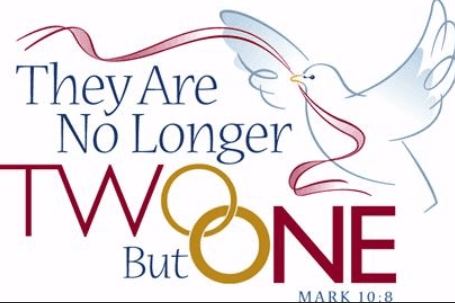
What does our marriage tell the world about God?

God designed marriage to be a kind of model of the relationship between Christ and the church. People are watching us. Whether we like it or not, people keep an eye on followers of Christ to see if we practice what we preach. They suspect we are hypocrites as are most others. Some people even hope professing Christians will fail miserably because they think that will get them “off the hook” with God. Then they can say, “See, just as I thought, Christianity is a crock! It’s not real.”

People look at our marriages, perhaps because they want to know if its even still possible to have a lasting and happy union. So many grow up in broken homes where they never witnessed what a good marriage entails. So many marriages are failing that it can be disheartening to those contemplating tying the knot! When we pledge lifelong faithfulness to our spouses, most of us, I presume, really intend to keep our vows. Even in a morally confused world, many stilly want the stability and security that lasting love provides.

One big reason why faithfulness in marriage is so important is because it reflects to the world the relationship between Christ and his church.

Jesus is the “husband” in that relationship, and the church is the “bride.”

FOR THIS REASON A MAN SHALL LEAVE HIS FATHER AND MOTHER AND SHALL BE JOINED TO HIS WIFE, AND THE TWO SHALL BECOME ONE FLESH. 32 This mystery is great; but I am speaking with reference to Christ and the church. Ephesians 5:31-32 (NASB)

God wants our faithfulness in marriage to be a living example of the faithfulness between Christ and his people. Jesus promises to never leave or forsake us, and we promise to always be faithful to him. He gave himself for his bride, the church, by dying for her on a cross. Our loving response is to live and, if necessary, die for him, as we offer ourselves back to him in loving worship and service.

God always keeps his promises, and he expects us to do the same.

When we violate our solemn covenant to be faithful until death to our spouses, we transgress and give a false testimony of the very nature of God, who dwells within each believer.

When we keep our word, we honor God and exemplify his faithfulness to a watching world. Love and faithfulness are two key character attributes of God, both of which a good marriage reflects to the world.

God’s idea is that marriage reinforce the gospel message, not detract from it.

When we tell people that God never violates his promises nor abandons his people, if our marriages do not reflect the same kind of faithfulness, it likely will seem a little hollow. Sure, as humans we fail, but God remains faithful.

Even if our marriages do fail, we can still testify to the mercy and redemptive power of God, but how much stronger is our witness when we live out covenant faithfulness as a kind of living parable!

People are watching us to see if following Christ makes any practical difference at all. Let our marriages be a resounding “Yes!”

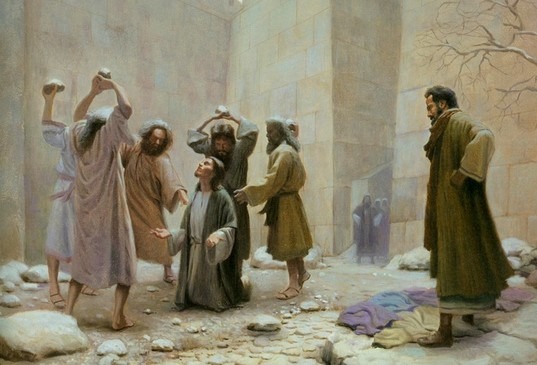
The Prophetic Significance of the Stoning of Stephen for Israel

IsraelThe stoning of Stephen had tremendous prophetic significance concerning the nation of Israel. Stephen began his final speech to the Jews by giving a short account of Israel’s history with God. Suddenly, he switched gears to pronounce a scathing judgment upon the Jews.

“You stiff-necked and uncircumcised in heart and ears! You always resist the Holy Spirit; as your fathers did, so do you. 52 Which of the prophets did your fathers not persecute? And they killed those who foretold the coming of the Just One, of whom you now have become the betrayers and murderers, 53 who have received the law by the direction of angels and have not kept it.” Acts 7:51–53 (NKJV)

We must assume that the Holy Spirit prompted him to pronounce this indictment. His death, witnessed by Saul, who later became the apostle Paul, fulfilled the timing found in one of the prophet Daniel’s visions.

Stephen’s wording was exact. He did not use hyperbole when he said the Israelites always resist the Holy Spirit and never kept the Law. Yes, there were significant men and women during her history who walked with God, but the nation as a whole was steeped in idolatry and did not submit to God. We now know that it was impossible for them to do so and still is, apart from being reborn in the Spirit, for no one is able to keep the Law.

But now the righteousness of God apart from the law is revealed, being witnessed by the Law and the Prophets, 22 even the righteousness of God, through faith in Jesus Christ, to all and on all who believe. For there is no difference; 23 for all have sinned and fall short of the glory of God, 24 being justified freely by His grace through the redemption that is in Christ Jesus, Romans 3:21–24 (NKJV)

The window of opportunity for the entire nation of Israel to repent and confess that Jesus is Lord came to a close when the Jews killed Stephen.

The more complete outworking of that judgment was fulfilled years later when the Roman army sacked Jerusalem and destroyed the temple in 70 AD, thereby ending the sacrificial system forever. 

When He said, “A new covenant,” He has made the first obsolete. But whatever is becoming obsolete and growing old is ready to disappear. Hebrews 8:13 (NASB95)
 
Daniel’s Vision

I wrote another article about the partial preterist interpretation of Daniel’s seventy weeks, which you can read, if you like, by clicking on the link above. I believe this interpretation better agrees with scripture and history. You can click here to read more about my position regarding dispensational theology. Below I will summarize a section of my article on Daniel’s vision. 

“Seventy weeks are determined For your people and for your holy city, To finish the transgression, To make an end of sins, To make reconciliation for iniquity, To bring in everlasting righteousness, To seal up vision and prophecy, And to anoint the Most Holy. 25 “Know therefore and understand, That from the going forth of the command To restore and build Jerusalem Until Messiah the Prince, There shall be seven weeks and sixty-two weeks; The street shall be built again, and the wall, Even in troublesome times. 26 “And after the sixty-two weeks Messiah shall be cut off, but not for Himself; And the people of the prince who is to come Shall destroy the city and the sanctuary. The end of it shall be with a flood, And till the end of the war desolations are determined. 27 Then he shall confirm a covenant with many for one week; But in the middle of the week He shall bring an end to sacrifice and offering. And on the wing of abominations shall be one who makes desolate, Even until the consummation, which is determined, Is poured out on the desolate.” Daniel 9:24–27 (NKJV) 

A generally accepted convention for interpreting prophecy is making a day into a year. Below is a breakdown of how the partial preterist position interprets the 70 weeks.

  • 7 weeks (49 years) – 457 BC (the decree of Artaxerxes to rebuild Jerusalem) to 408 BC, during which time were the ministries of Ezra (rebuilding the temple) and Nehemiah (rebuilding the wall of Jerusalem).
  • 62 weeks (434 years ) – 408 BC to the baptism of Jesus in AD 27 (The anointing of the Holy One.) He was baptized and anointed with the Holy Spirit to carry out the work of the ministry.
  • 1 week (7 years)
    • AD 27 to AD 31: 3.5 years – The time from the beginning of Jesus’ ministry until his crucifixion. He was the the Anointed One who was cut off. The Messiah will be cut off, but not for himself, ending the need for any more animal sacrifices. He, the Messiah, shall confirm a covenant – the New Covenant.
    • 31 AD to 34 AD: 3.5 years from the crucifixion to the stoning of Stephen, after which the door was officially opened to the Gentiles and a door of opportunity shut for the Jews as a nation. Paul was called and commissioned shortly thereafter.
  • 70 AD: the destruction of the Temple by Titus and the Roman army (the people of the prince), effectively ending all animal sacrifices.

The partial preterist view does not put a 2000-year gap between the 69th and 70th week, as does dispensational theology. Therefore, Daniel 9 does not predict what will happen at the very end of time just prior to the Second Coming. If we accept the partial preterist interpretation, it is quite understandable why Daniel was so upset by the vision. God showed him that Israel would reject and murder their Messiah and Jerusalem and the temple destroyed!

Jesus’ Prophetic Warning to Israel

Jesus also foretold the destruction of Jerusalem and the Temple (Matthew 24:2, Mark 13:2, Luke 21:6, Luke 21:20, Luke 19:43-44), which signified the end of God’s purpose for Israel.

Israel had the glorious role of stewarding God’s promises and the scriptures as well as providing the human pedigree for the Messiah. However, just as John the Baptist’s role was concluded when he introduced Jesus to the nation, Israel’s role sadly reached its end when it fulfilled the scriptures by crucifying the Messiah! 

In Acts chapter two, on Pentecost, the apostle Peter offered those present in Jerusalem for the great feast an opportunity to repent of this great evil, and 3000 did! Unfortunately, the preponderance of the people and leaders continued to resist the Holy Spirit, just as Stephen said in his last sermon.

Jesus prophesied that all this would happen and that the kingdom of God would be given to another people, one that would embrace him as Lord.

“Therefore I say to you, the kingdom of God will be taken away from you and given to a people, producing the fruit of it. 44 “And he who falls on this stone will be broken to pieces; but on whomever it falls, it will scatter him like dust.” 45 When the chief priests and the Pharisees heard His parables, they understood that He was speaking about them. Matthew 21:43–45 (NASB95)

This new people was later revealed to be the Church, the “one new man” (Ephesians 2:15) composed of elect Jews and Gentiles who are born again by the Holy Spirit, a new nation and people springing forth from the second or last Adam. (1 Corinthians 15:45-49)

God’s Plan All Along

The surprising emergence of the church had been God’s intention all along, contrary to the claims of dispensationalism. The church was not a “plan B,” but was God’s original intent as revealed in several places in Scripture.

...to the intent that now the manifold wisdom of God might be made known by the church to the principalities and powers in the heavenly places, 11 according to the eternal purpose which He accomplished in Christ Jesus our Lord, 12 in whom we have boldness and access with confidence through faith in Him. 13 Therefore I ask that you do not lose heart at my tribulations for you, which is your glory. Ephesians 3:10–13 (NKJV)

From the beginning of Israel’s history, God revealed that he would eventually destroy that nation for its blatant rebellion and raise up another people who would fulfill his will.

The first example was at Mount Sinai. Moses ascended to mountain to receive the ten commandments. Upon his return, he found that the people had quickly abandoned their devotion to God and made an idol for themselves to worship. Here is God’s pronouncement of judgment.

The LORD said to Moses, “I have seen this people, and behold, they are an obstinate people. 10 “Now then let Me alone, that My anger may burn against them and that I may destroy them; and I will make of you a great nation.” Exodus 32:9–10 (NASB95)

Why did God say this? Did he have a “short fuse” which made him prone to utter rash words in anger? Of course not! God knew that the nation of Israel, like all fallen humans, had zero ability to keep his commandments and remain devoted to him.

In the passage above God prophetically foreshadowed his plan to raise up another prophet like Moses (Deuteronomy 18:15) from whom he would bring forth another people capable of serving him wholeheartedly. This new people would be the New Covenant church, who would be indwelled and empowered by God’s own Spirit. (Jeremiah 31:31-34)

Again, when the Israelites rebelled against God in the wilderness on their way to the promised land, God pronounced a judgment that revealed his future plan to raise up the church through Christ.

The LORD said to Moses, “How long will this people spurn Me? And how long will they not believe in Me, despite all the signs which I have performed in their midst? 12 “I will smite them with pestilence and dispossess them, and I will make you into a nation greater and mightier than they.” Numbers 14:11–12 (NASB95)

When Israel came to edge of the Promised Land the first time, once again they rebelled against God’s command to enter the land and conquer the inhabitants. Only Joshua and Caleb had faith in God’s promises. The rest were sentenced to die in the wilderness over the next forty years of wandering. Only Joshua, Caleb, and the new generation were able to eventually obtain the promises of God.

The principle is simple, the old fallen fleshly order cannot inherit the promises of God. Only those born of the Spirit can enter by faith.

Interestingly, once Israel heard God’s pronouncement of his rejection of their generation, they rebelled once again and decided they would after all enter and conquer the Canaanites. But it was too late. The door had been shut. Their attempt to enter in their own strength did not have God’s support or blessing. It was doomed to failure. (Numbers 14:39-45)

I believe that the nation of Israel today is like that group of rebels. Until the people of Israel submit to Jesus as Lord, they will not succeed. 

When it came time for Moses to die, he again warned the Israelites of what was to come.

Take this book of the law and place it beside the ark of the covenant of the LORD your God, that it may remain there as a witness against you. 27 “For I know your rebellion and your stubbornness; behold, while I am still alive with you today, you have been rebellious against the LORD; how much more, then, after my death? Deuteronomy 31:26–27 (NASB95)

Once again, God pointed out that Israel was incapable of pleasing him because that nation was of the flesh, born of Adam, and part of the old fallen order. No flesh can inherit the kingdom of God (1 Corinthians 15:50), but only that which is born of God by the Spirit. (John 3:5).

Neither the nation of Israel nor any other human institution or people is capable of pleasing God or inheriting his kingdom outside of the New Covenant transformation caused by the new birth.

Therefore if anyone is in Christ, he is a new creature; the old things passed away; behold, new things have come. 2 Corinthians 5:17 (NASB95)

Those whom God so transforms from within are part of God’s elect, the church, the Israel of God. (Galatians 3:7, Galatians 3:29, Galatians 6:16, Romans 2:29, Romans 9:6, Philippians 3:3)

When Joshua was near death, he, too, warned Israel that it was impossible for them to be faithful to God, to which they objected, as we all do before God shows us how hopelessly lost we are without Christ.

Then Joshua said to the people, “You will not be able to serve the LORD, for He is a holy God. He is a jealous God; He will not forgive your transgression or your sins. 20 “If you forsake the LORD and serve foreign gods, then He will turn and do you harm and consume you after He has done good to you.” 21 The people said to Joshua, “No, but we will serve the LORD.” 22 Joshua said to the people, “You are witnesses against yourselves that you have chosen for yourselves the LORD, to serve Him.” And they said, “We are witnesses.” Joshua 24:19–22 (NASB95)

The Jews who reject Christ will be judged by the Law, as will we all. (John 5:45)

The law’s purpose is to reveal how hopelessly lost we are. It was never a viable means for us to save ourselves through obedience to it. It only showed how badly we need a Savior.

But the Scripture has shut up everyone under sin, so that the promise by faith in Jesus Christ might be given to those who believe. 23 But before faith came, we were kept in custody under the law, being shut up to the faith which was later to be revealed. 24 Therefore the Law has become our tutor to lead us to Christ, so that we may be justified by faith. 25 But now that faith has come, we are no longer under a tutor. 26 For you are all sons of God through faith in Christ Jesus. 27 For all of you who were baptized into Christ have clothed yourselves with Christ. 28 There is neither Jew nor Greek, there is neither slave nor free man, there is neither male nor female; for you are all one in Christ Jesus. 29 And if you belong to Christ, then you are Abraham’s descendants, heirs according to promise. Galatians 3:22–29 (NASB95)

It is so difficult for us to admit that we cannot save ourselves, but until we come to the end of thinking we can, we are not ready to receive God’s offer of eternal life through his Son. If we reject the Son, we do not have the Father either. (1 John 2:23) Jesus warned the Jewish leaders that, rather than being children of God, they were offspring of the devil. (John 8:44) Later in Revelation, he calls them the “synagogue of Satan” in two different places.

I know your tribulation and your poverty (but you are rich), and the blasphemy by those who say they are Jews and are not, but are a synagogue of Satan. Revelation 2:9 (NASB95) 

Behold, I will cause those of the synagogue of Satan, who say that they are Jews and are not, but lie—I will make them come and bow down at your feet, and make them know that I have loved you. Revelation 3:9 (NASB95)

These are not my words, but our Lord’s. He was not antisemitic, and neither am I. Jesus spoke the truth, and I attempt to follow in his steps.

The nation of Israel today claims to be God’s chosen people, but they are not. God has only one chosen people, the elect, who are known by their faith and allegiance to Christ.

But it is not as though the word of God has failed. For they are not all Israel who are descended from Israel; 7 nor are they all children because they are Abraham’s descendants, but: “THROUGH ISAAC YOUR DESCENDANTS WILL BE NAMED.” 8 That is, it is not the children of the flesh who are children of God, but the children of the promise are regarded as descendants...11 for though the twins were not yet born and had not done anything good or bad, so that God’s purpose according to His choice would stand, not because of works but because of Him who calls, Romans 9:6–8, 11 (NASB95)

For us to believe that the nation of Israel is God’s chosen people is to misunderstand the New Covenant.

We cannot have it both ways. There are not two tracks for salvation, one that pertains only to Israel after the flesh and another that pertains to all other humans through God’s Spirit. God has only one way to be saved, which is through the new birth by faith in Christ’s resurrection and by declaring allegiance to him. (Romans 10:9-10)

To back Israel now as God’s chosen people is akin to when the northern tribes backed Absalom against God’s chosen king.

Those tribes were deceived into supporting a rebel and pretender to the throne. It did not end well. Many died in a vain rebellion against God’s true king. We dare not fall into that trap today by supporting the nation of Israel as it attempts to regain what God stripped from them in 70 AD. They will not succeed.

God will be glorified in Christ and his church through all eternity, not in the nation of Israel. 

Glory to him in the church and in Christ Jesus through all generations forever and ever! Amen. Ephesians 3:21 (NLT)

Only those descendants of Abraham who acknowledge that Christ is Lord will be included in what is called the Israel of God.

When all the elect Jews and Gentiles are finally born again into the church, the end will come and all Israel (the true Israel of God) will be saved. (Romans 11:26)

The stoning of Stephen was a prophetic marker that closed the door to the nation of Israel. Thereafter, the true born again Israel of God would be assembled from every nation under heaven.

And they sang a new song, saying, “Worthy are You to take the book and to break its seals; for You were slain, and purchased for God with Your blood men from every tribe and tongue and people and nation. 10 “You have made them to be a kingdom and priests to our God; and they will reign upon the earth.” Revelation 5:9–10 (NASB95) 

How to handle inevitable disappointment in my spouse

When counseling young couples before marriage, I usually warn them about future disappointment by using a little humor. The man comes into the marriage hoping his wife will never change. The wife hopes to change her husband. Both are going to be disappointed. The old saying is that love is blind. We tend to gloss over our intended’s failings at first as we focus on what makes him or her so special to us. As the newness of marriage wanes, those blemishes start to stand out more. What we might have regarded as “cute” flaws may loom much larger as time goes by. We also will likely discover things about our spouses that we did not previously know, some good and some bad.

Since humans are flawed and all of us are prone to sin, disappointment in marriage is somewhat inevitable.

So, how do we handle it in a way that pleases God and maintains a strong marriage bond?

Since everyone of us has faults and habits that are not ideal, we must decide if what we see in our spouse is something that needs to be confronted or overlooked.

Some sins require confrontation, which our Lord addressed in Matthew Chapter 18. We are to speak to our spouses about what offends us in their behavior, hoping that they will take our words to heart and repent. If that is the case, perfect. If no repentance is forthcoming, we may need to take things to the next level, which is to enlist help from a trusted friend. Every marriage probably needs such a person,  who is trusted by both the husband and the wife and who can speak candidly to both about any issue that may arise. If that does not work, depending on the seriousness of the offense, it may become necessary to involve church leadership in a final attempt to right the wrong. It goes without saying that this would only be employed in serious cases, such as when abuse, adultery, addiction or some other marriage-damaging issue is in play. 

Most of the time, however, we are faced with less serious faults and failings in our spouses that require a different approach. This is where the following verse from Peter’s first letter comes into focus.

Most important of all, continue to show deep love for each other, for love covers a multitude of sins. 1 Peter 4:8 (NLT)

When we see a fault in our spouses, we can choose to focus on it or overlook it. The more we focus on something, the larger it becomes to us.

Once we go down the path of negativity toward our spouses, it may cause us to overlook their good qualities instead of their faults. It goes without saying that once this dynamic sets up in a marriage, it breeds criticism, discourages our spouses, sets up the sowing and reaping principle, and hurts the marriage. If we want to keep the marriage bond strong, we will need to make the decision to lovingly overlook some things.

Make allowance for each other’s faults, and forgive anyone who offends you. Remember, the Lord forgave you, so you must forgive others. 14 Above all, clothe yourselves with love, which binds us all together in perfect harmony. Colossians 3:13–14 (NLT)

If this seems too difficult, remember that our spouse is faced with the same choice regarding our faults and failings. Every single one of us is someone else’s “grace tester.”

We will need to enlist the Lord’s help in this matter. The Holy Spirit puts up with us and he can show us how to love our spouses despite their flaws. 

We should ask the Lord to remind us of the many good qualities in our spouses, which we may be taking for granted. If we make the choice to be thankful for those, the flaws will tend to fade in significance. The choice is ours. We can be critics or encouragers. We know that the devil accuses; so, we want to avoid becoming like him. The Holy Spirit is the greatest of all encouragers. He wants us to develop that ability with his help. The more we encourage and appreciate our spouses, the more they will flourish and our marriage be a joy. Who knows, they might even stop doing some of those aggravating things? If they do, we might not even notice.

Click here to read more articles on marriage.

Lord, I am having a hard time submitting to my husband!

Since it is often quite a challenge for a wife to respect and submit to her husband, as the Bible teaches, I want to share a couple of things that might make it a bit easier. Being under authority is a challenge for almost all of us, whether it relates to government, work, church, or the home.

Honoring, respecting, supporting and following those God has put in authority over us requires humility and faith in God’s promise and ability to take care of us.

There are a couple of main reasons why it may be challenging for us to be “under” authority. First, we are all born with a sinful predisposition to resent when anyone, including God, tells us what to do because we think that being subordinate implies that we are inferior. Secondly, following another human being’s leadership exposes us to potential harm, especially if that person is seriously flawed in his or her capabilities, motivation, or judgment. It is no wonder, then, that many wives resent, resist, and sometimes refuse their God-given responsibility to be in submission to their husbands. This is especially true if the husband does not value or listen to his wife, even though she may be the more capable or wiser of the two.

Our resentment of anyone having authority over us goes back to the Garden of Eden.

Adam and Eve attempted to throw off God’s rule in their lives through direct disobedience to a clear command. God created humans to reproduce who and what we are in our offspring. We inherit both good and bad, physical and spiritual. Since Eden, thanks to this inherited predisposition to rebellion, sometimes called the “old man” or the “flesh,” we naturally tend to resist or rebel against authority.

Jesus is the “second Adam” who came to undo the curse of sin and restore humanity and creation back to a right relationship with God, under his authority and blessing.

The Gospel calls us to voluntarily submit ourselves to God again by coming under the authority of Jesus the Lord. Confessing that Jesus is Lord is the key.

We are usually only willing to do this after we become aware of the futility of trying to live independently from God’s life and blessings. Repentance means we acknowledge our sinful independence and yield to God.

For wives, or any of us, to flourish in a subordinate role, whether in the home, at work, in the church, in the community, or at school, we must first come under the authority of Christ. With respect to him, we are all subordinates.

It is vital for us to see that subordinating ourselves to human authority, wherever it exists, is a form of yielding to Christ, because all authority ultimately derives from him.

Let every person be subject to the governing authorities. For there is no authority except from God, and those that exist have been instituted by God. Romans 13:1 (ESV) 

This requires us to embrace the doctrine of God’s sovereignty. We are asked to rest in the truth that ultimately works everything in our lives out for good and his glory. (Romans 8:28) If we believe this important truth, we will be able to submit to those in authority with the conviction that God will protect and bless me in the process, even if the person I submit to is seriously flawed. We can trust that God is able to deal effectively with leaders and those in authority as needed and come to our defense when necessary. When a wife voluntarily subordinates herself to her husband’s headship, she does so with the understanding that ultimately she is subordinating herself to God, who has promised to be her defender and keeper and who will “deal with” her husband, should he “get out of line.”

Therefore, the ability to be under a husband’s authority is directly linked to the choice to come under Christ’s authority and faith in God’s sovereignty.

People resent being mistreated and devalued. Because of our sin nature, those in authority sometimes abuse their position or role, perhaps without even intending to do so. It just comes “naturally.” 

Whether we are “in” authority or “under” authority, we often read too much into the roles God has given us, imagining that they confer some sort of inherent value to us. 

Those who have been given headship frequently think it makes them superior to those whom they govern. Conversely sometimes people under authority wrongly see themselves as being inferior. An air of superiority is difficult, if not impossible, to hide (except from ourselves), and it rankles those who are asked to subordinate themselves to us. We are all fallible humans in desperate need of a Savior and accountable to God for everything we do, whether we are the “top dog” or the lowest “peon.”

In marriage,  a wife may resent her husband’s headship, if he abuses it to devalue or dominate her, both of which communicate an attitude of superiority on his part.

On the other hand, the husband may treat his wife with the utmost honor, but she still may feel resentment because she does not like being under authority, period. Whatever the reason, if a wife resents her husband, it will make it very difficult for her to properly fulfill her subordinate role in the marriage or show respect to him, which is a primary responsibility toward her husband.

However, let each one of you love his wife as himself, and let the wife see that she respects her husband. Ephesians 5:33 (ESV) 

Resenting and disrespecting our husbands is a sin problem.

Resentment springs from a hardened heart and is a form of bitterness, one of the most serious sins we all must combat. Disrespect toward our husbands is a form of disrespect toward God, since husbands represent Christ in the marriage.

Wives, submit to your own husbands, as to the Lord. 23  For the husband is the head of the wife even as Christ is the head of the church, his body, and is himself its Savior. 24  Now as the church submits to Christ, so also wives should submit in everything to their husbands. Ephesians 5:22-24 (ESV)  

Therefore, repentance is our first priority when we struggle with resentment and disrespect.

Even when husbands fail to lead properly, they “deserve” to be respected simply because of the headship principle. Respect, in this case, is not earned but is given because it is the right thing. We might call it “unconditional respect.”

Most people accept the idea of unconditional love, but fewer understand unconditional respect, which is a cornerstone of being properly subordinate.

In the military, soldiers are trained to respect and obey any officer who commands them, whether or not they like him or her, or even if they think he or she is incompetent. There are proper channels for getting relief when officers are terrible, but mutiny is never an acceptable option. The same is true in a marriage. Wives should respect their husbands as “unto Christ,” simply because husbands represent Christ’s authority. (Ephesians 5:22) Should a wife be subjected to unloving treatment by her husband, if she is in a local church, she can turn to the pastor and elders to come to her defense, while maintaining a proper attitude of respect toward her husband.

Being respectful toward and submitting to “undeserving” authorities is one of the greatest challenges any of us may face in this life.

Husbands are to unconditionally love their wives, as Christ loves the church, and wives are to unconditionally respect their husbands, as the church respects and obeys Christ. In both cases, Christ is our example and the one who empowers us to be obedient. He was unconditionally obedient to the Father and unconditionally laid down his life for those who were then his enemies.

If the husband unconditionally loves, values, and dignifies his wife, it will be much easier for her to respect and obey her husband.

Resentment tends to disappear when the husband properly loves his wife.

But sometimes loving husbands are not as smart or competent as their wives. How can a wife avoid resenting being under the headship of such a man? She may imagine that God wants her to be passive, a kind of “doormat” who has nothing to offer and who gets run over continually. Nothing could be further from the truth.

Passivity is a warped and dysfunctional form of submission. To drop out of the “game” by simply “going along for the ride” is lazy and cowardly, and not God honoring or truly supportive of the husband. 

Being properly subordinate requires us to do everything in our power to work for the success of our superiors.

Sometimes this requires us to firmly voice our opposition to their position or pending decisions, before the course is firmly set.  Good leaders want those under their authority to present points of view different from their own, because no one has the complete picture or has all wisdom. But once a decision is made, leaders expect those under their authority to lend their support.

Wives should clearly share their (differing, opposing, or confirming) points of view with their husbands. Wise husbands will listen and give proper consideration of their wives’ input.

Wise husbands will also delegate significant decision making ability to their wives in the areas where they have wisdom and expertise.

When husbands do this, it benefits everyone and helps wives feel their worth. Working together as a team builds unity and is God honoring. If a wife is married to a man of abilities that are inferior to hers in some areas, she should ask God and her husband for ways to use those abilities in support of her husband’s leadership. If he is uncooperative or defensive, it may require prayer and patience, and maybe even some counseling.

It takes faith and humility to lead and to follow. Whether we have been assigned a headship role or a subordinate one, functioning in a way that brings glory to God requires us to keep our eyes on him and rely on the help of the indwelling Spirit. We husbands must examine our hearts continually, asking the Spirit to show us how to properly love, honor, dignify, protect, support, lead, and provide for our wives. Wives should ask the Spirit’s help in respecting, honoring, supporting, loving, and making their husbands successful in God’s sight.

God is most glorified when husbands and wives truly love and honor one another and work as a complementary team to advance God’s kingdom.

Click here to read more articles in this series.

Why some husbands refuse or abuse being the head of the family…

God intends for husbands to have what is called headship in marriage. This means they have the responsibility to lead. When men accept this privilege and duty, with God’s help they can be a source of blessing to the wife and children. Unfortunately, some husbands either abuse or refuse this privilege and responsibility, which creates significant problems for the wife and children.

Husbands are most responsible before God for the well-being of the family and the most culpable if things go wrong. Because some men are afraid of or resent that role because of the pressure and work attached to it, they sometimes “abdicate the throne,” becoming self-centered or passive, leaving the family directionless, unprotected, and floundering spiritually and in other ways. Wives of such men sometimes resort to taking matters into their own hands rather than watch their family suffer. In many households, the wife takes the reins to keep the family from self-destructing. They operate as the functional head of the family, which may suit the husband fine, apparently getting him off the hook. Though this sort of set up may “work,” it is not God’s best. It can lead to the wife losing respect for her husband and the man losing self-respect, too.

Apparently, Adam was just such a man. During the temptation in the garden, Eve took the initiative and Adam passively went along for the ride. Adam was the one God had commanded not to eat of the tree of the knowledge of good and evil, giving him prime responsibility for being obedient. He must have communicated what God said to Eve, but either he misstated it or she misunderstood it, because the version she related to the serpent was incorrect. So, right from the start, we see a breakdown of the proper functioning of headship.

  • Adam failed to properly or clearly instruct his wife.
  • Secondly, he left her unprotected from the snake’s temptation. Why did he not step in and tell the serpent to leave his wife alone?
  • Thirdly, he did not resist Eve when she offered him the fruit. He passively went along, allowing her to lead him down a path to destruction.

The flip side of abdication is abuse. Many men relish being in charge and greedily grab the privileges and power associated with being the head in order to get their own way. Instead of serving their families, they domineer, intimidate, and abuse them. 

Abdication and abuse are both examples of a husband’s failure to properly lead, serve, guard, and provide for his family.

Both of these failures generally promote insecurity and resentment. Not surprisingly, both tend to damage a wife’s ability to respect and follow her husband’s leadership. Some wives of passive men may sink into fear, insecurity, and a sense of powerlessness. Those with a stronger personality may take to themselves what their husbands cast aside. Plenty of families are led by strong women married to passive men. Taken to the extreme, wives can become domineering and abusive in their own right and very much out of God’s proper order. Wives of domineering men, may fight back or become victims. Either way, respect and love are damaged. Sometimes the presence of the resulting resentment, unless released through repentance and forgiveness, can rip a marriage apart.

Husbands who have run from their responsibilities, whether they have an aggressive “leadership” personality or not, must make the decision to accept the responsibility for leading, providing for, protecting, and teaching their families. Husbands who have selfishly abused headship must repent of seeking their own agendas at the expense of the well-being of the wife and children.

Headship, according to Jesus is servant leadership. Jesus laid down his life for his “wife,” the church. We husbands are to do the same for our wives and families.

For the husband is the head of the wife, as Christ also is the head of the church, He Himself being the Savior of the body. 24  But as the church is subject to Christ, so also the wives ought to be to their husbands in everything. 25  Husbands, love your wives, just as Christ also loved the church and gave Himself up for her, Ephesians 5:23-25 (NASB)  

God will help us men to overcome our fears and self-centeredness. He always gives grace to help us do what he commands. If it is scary for us to lead, we can be assured that it is scary for our wives and family to follow us, too. (Smile) If it is difficult to humble ourselves to serve our family instead of dominating them, we can be certain that it takes great humility to follow another person’s lead, too.

Whether we are called to lead or follow, it takes faith and humility. Both are done in the fear of the Lord in order to please the Lord.

Husbands must also realize that leading does not mean that they must do everything. Good leaders know how to delegate. Our wives may have abilities in various areas that surpass ours.

A wise leader delegates without relinquishing overall responsibility.

Those of us who tend toward being domineering must learn to put others first and become servants. Serving others is not a sign of weakness. Jesus was the greatest servant of all, but he is unquestionably the Lord of lords.

Even strong women usually appreciate husbands who step up to lead. Less strong wives perhaps may appreciate it even more. However, when a wife has operated as the functional head of the family for a long time, it may be quite a challenge for her to let go and trust the husband to assume his proper place. God’s grace will be needed for both spouses.

Husbands who act as servant leaders and provide proper headship for their wives and families help create a safe atmosphere of security, love, and peace in their families and removes pressure from the wife that God never intended for her to carry. 

Proper headship erects a barrier against satanic temptation and attack. Proper leadership gives good instruction and guidance, helping to insure that children have every advantage in life. There are no negatives to husbands being loving and humble servant leaders to their families.

Prayer for Husbands Who Want to Lead Properly

Lord, Jesus, please help me to be the leader, provider, protector, teacher, guide, and keeper of my family. I understand that you are all those things for me. It gives you pleasure to help me represent you to those I love. Help me to lovingly serve my wife and children. Help me to be an example of a disciple and show them how to follow you for themselves. Amen.

Am I willing to play a role or must I be the director?

A biblical marriage asks both spouses to accept the privileges and responsibilities and operate within the boundaries of their God-given roles. 

Shakespeare penned these memorable words:

All the world’s a stage, And all the men and women merely players; They have their exits and their entrances, And one man in his time plays many parts… (As You Like It – Act 2, Scene 7)

The author of a play creates the characters and plot, scripts the lines, and decides how it begins and ends. The director decides who plays what role and instructs them to some degree how to act. Those who play the roles must be willing to act in agreement with how the play is written and under the oversight of the director. If actors play their roles well, an observer might even conclude that they are actually that person in real life, but they would usually be wrong. The role is not the same as the actual identity of the actor or actress. The success of the play largely depends on how well the actors play their respective roles. 

Life is like that. God wrote and directs the “play,” created the set (the world) and the characters (us), and assigns to everyone our particular roles to play. How willingly and well we accept our God-given roles in life, some of which are gender-specific, will greatly influence our success during our short stay on the earth. It may also determine in some measure our eternal reward. But just as with a play or movie, the temporary role we play does not define our real identity.

What truly defines a person? Gender, age, politics, religious beliefs, job, or our role as a spouse, father, mother, son, daughter, grandmother, etc.? All of these things contribute to an overall picture of who we are as individuals, but none of these things truly defines us.

At our core, we are spiritual beings, who can only properly be known and defined by God, since he is our Creator, Sustainer, and, hopefully for you and me, our Redeemer.

God breathed spirit into Adam’s body, and he became a living soul. (Genesis 2:7) Our bodies are the outer shell that people see, our souls or personalities are more hidden and are what we may choose to present to other people as the deeper “us,” but God knows each one of us at a still deeper level in the spirit.

For who knows a person’s thoughts except the spirit of that person, which is in him? So also no one comprehends the thoughts of God except the Spirit of God. 1 Corinthians 2:11 (ESV) 

When Jesus rose from the dead, he ushered in a new reality, which he shares with us, at least in seed form, when we are “born again”. Through the new birth, our deepest and truest identity is linked to Christ through being joined to and becoming “one” with him.

I have been crucified with Christ. It is no longer I who live, but Christ who lives in me. And the life I now live in the flesh I live by faith in the Son of God, who loved me and gave himself for me. Galatians 2:20 (ESV)   

Believers in Christ are not defined by our sins, defects, failures, or past. We are identified with Christ through what is called the “new creation.” (2 Corinthians 5:16-17)

At the resurrection of the dead, we will fully experience this new reality in our bodies, souls, and spirits. The things that now tend to limit and separate us from each other will be obliterated, as Paul so eloquently wrote long ago.

For you are all sons of God through faith in Christ Jesus. 27  For all of you who were baptized into Christ have clothed yourselves with Christ. 28  There is neither Jew nor Greek, there is neither slave nor free man, there is neither male nor female; for you are all one in Christ Jesus. 29  And if you belong to Christ, then you are Abraham's descendants, heirs according to promise. Galatians 3:26-29 (NASB) 

As beautiful as that spiritual reality is and will be, we currently live in a fallen world that is waiting to experience its resurrection transformation.

For we know that the whole creation groans and suffers the pains of childbirth together until now. 23 And not only this, but also we ourselves, having the first fruits of the Spirit, even we ourselves groan within ourselves, waiting eagerly for our adoption as sons, the redemption of our body. Romans 8:22–23 (NASB95)

In our current state, there are still Jewish people and Gentiles, slaves and free in some areas of the world –  bosses and employees where we live, and male and female. As much as some wish to obliterate gender differences, they still are very much a part of everyday life and our current reality, down to the chromosomal level.

As born-again Christians, we are challenged to learn how to navigate our current situation in light of the resurrection reality that awaits us.

We have been given a foretaste of heaven in the spirit, but we still live in a fallen world, where gender differences are extremely important and consequential. Men and women have very different bodies with unique functions and abilities. Only a woman can conceive, carry, and give birth to a child. Only a man can be a father. Regardless of what many might desire, our genders greatly define our roles in life, especially those of husband, wife, mother, and father.

Gender specific roles are similar to parts in a play. The better we play our assigned role, the more faithful we will reflect the author’s intent and the greater will be our success. The roles that God has given us in this life do not define us at a core level, but we are assigned by God to play the part given to us.

These roles in marriage include the man’s having the responsibilities and privileges associated with headship. Women are given the Christ-honoring role of being a complementary partner who responds lovingly to the husband’s headship. This is called submission, which means to come under and often carries a very negative connotation. However, God never intended for there to be anything negative about submission. Sin did that to us. Submission exists within the Trinity where there is no hint of inferiority or subservience. We should not be scared off by headship and submission, just because the world hates these concepts or because we have never seen them properly modeled. God intends that these temporary roles be beautifully beneficial, fulfilling, and God-glorifying.

In the next two articles, I will take a look at headship for the husband and submission for the wife from the Bible’s perspective. I hope that, when we have a better understanding of what God intends, it will motivate us to fully embrace these roles to the glory of God and our own personal happiness. We will understand that…

God wants us to be role players, not the director of the play.

Click here to read more articles about marriage.

A Key to a Successful Marriage – Three Are Better than Two

The greatest secret to a successful Christian marriage is the presence of the Holy Spirit. He make the third party in the relationship, working in each spouse to transform us into people who can maintain a solid marriage. We were not created to do life or marriage alone. God designed us to live in a dependent relationship with him, drawing from his life, strength, and wisdom. This article will examine how the Holy Spirit works inside followers of Christ to help us to become better marriage partners. If we put our faith in Jesus Christ and make him the center of the marriage, he promises to help us to love and be faithful to each other. What makes a good disciple of the Lord is also what makes us successful at marriage.

Being a disciple of Christ is a very important part of enjoying a happy and lasting marriage.

The Christian’s Greatest Secret

Some who call themselves followers of Christ have not yet discovered what is perhaps the greatest secret of the Christian life. Jesus died for our sins, so that we can be forgiven and restored to a right relationship with God our Father, but the blessing does not stop there. Our Lord sent the Holy Spirit to indwell and empower those who pledge allegiance to him.

What makes the New Covenant so radically different from the Law or any other religious or self-help system is that, when we are born again, the Holy Spirit becomes one with our spirits and begins to live God’s life through us. (1 Corinthians 6:17)

He transforms us from within as we learn to rely on and cooperate with him each day. Christianity is a partnership with God’s Spirit, a dance with an invisible partner, and a drawing of life from the vine of which we are branches.

Remain in me, and I will remain in you. For a branch cannot produce fruit if it is severed from the vine, and you cannot be fruitful unless you remain in me. 5  “Yes, I am the vine; you are the branches. Those who remain in me, and I in them, will produce much fruit. For apart from me you can do nothing. John 15:4-5 (NLT)  
Being “Equally Yoked”

What does being equally yoked mean for a Christian marriage? If a man and a woman want to wed, one of the first questions that should be asked is whether or not both are believers and committed to following Christ and his teachings. If not, the Bible calls this dissimilar pairing being “unequally yoked”. Oxen are paired in a yoke to pull heavy loads. Unless they pull together, things do not work well. Unless a husband and wife are on the same team spiritually and in other ways, the marriage is likely headed for trouble.

Don’t team up with those who are unbelievers. How can righteousness be a partner with wickedness? How can light live with darkness? 15  What harmony can there be between Christ and the devil? How can a believer be a partner with an unbeliever? 2 Corinthians 6:14-15 (NLT)  

Marriage is the ultimate sharing of life, and requires both the husband and wife to be unified in their dedication as disciples. Otherwise, frustration may be experienced down the road. The Bible warns against marrying someone who is not a committed follower of Christ.

However, if both partners desire to serve the Lord, they have a good basis for building a strong, lasting, and fulfilling marriage. The things that make a good disciple also make a good spouse.

This is because disciples will be committed to the following three things.

  1. Putting Christ’s teachings into practice. This means we will love truth, practice the “Golden Rule,” be quick to forgive, honest, patient, faithful, etc., which are character qualities which the Holy Spirit develops within us.
  2. Allowing the Holy Spirit to work inside us. The Spirit points out to us when we need to repent and ask forgiveness. He changes our desires from within, transforming us into people who make better marriage partners, people who love, put others first, are unselfish, etc. He teaches us what we need to know and reminds us about what the Bible teaches.
  3. Living in the fear of the Lord. The fear of the Lord constrains us from pursuing foolish and self-centered agendas that would violate the marriage covenant and Christ’s teachings.
A Threefold Cord
Two are better than one, because they have a good reward for their toil. 10  For if they fall, one will lift up his fellow. But woe to him who is alone when he falls and has not another to lift him up! 11  Again, if two lie together, they keep warm, but how can one keep warm alone? 12  And though a man might prevail against one who is alone, two will withstand him—a threefold cord is not quickly broken. Ecclesiastes 4:9-12 (ESV)

Solomon’s words have much to say about marriage. It is better to be married than be alone, but, having Christ woven into the marriage is best of all.

Making our Lord the center of our marriage makes it very strong. Two are good, but three are better.

Application

If we are already a committed follower of Christ and are married to one, it is a good thing to reaffirm with our spouses our joint commitment to Christ, his teachings, and to our marriages. We can ask the Holy Spirit to bind us together in committed love as he works in each of us individually.

If I am not yet a follower of Christ, what is stopping me from becoming one now? It simply requires my acknowledgement that I am no longer willing to be an independent operator. We can surrender our lives to Christ, the Good Shepherd and ask him run things from now on. We can ask him to forgive our past sins and restore us to a right relationship with Father God. We can ask him to send the Holy Spirit to live inside us and change us from the inside out. (Here is a sample prayer.)

What if I am committed to Christ, but my spouse is not? We can ask God to open his or her heart to the gospel. We can pray, share our testimonies, and love her in a way that helps her understand how much God loves her. God encourages us to be patient. We can trust the Lord to work in our spouses, even if it takes a while. The important thing is to never give up.

Don’t you wives realize that your husbands might be saved because of you? And don’t you husbands realize that your wives might be saved because of you? 17  Each of you should continue to live in whatever situation the Lord has placed you, and remain as you were when God first called you. This is my rule for all the churches. 1 Corinthians 7:16-17 (NLT)  
Click here to read more articles about marriage.

Commitment – An Important Key to Happiness in Marriage

Commitment to making a marriage work is an important key to happiness and longevity in marriage. About half of all marriages end in divorce. No wonder many opt simply to live together, in the likely case things don’t work out. However, choosing against marriage also carries a heavy price tag, which I covered in my first article in this series entitled, Why Do People Hate Marriage.” A good marriage is something to be desired, and it is attainable. God created marriage to provide companionship, children, societal stability, and many other blessings. Maintaining a good marriage is not always easy, but what worth having comes easily?

Marriage Is a Covenant

It’s hard to build something as complex as a good marriage, if no plans or instructions are available. Those of us who come from broken families have a more difficult time because we have not seen or experienced a good marriage in action. What is portrayed on television and in the movies is not always conducive to building a strong marriage either. Where can we find a good model or trustworthy instructions? The Bible is a great place to start.

The Bible says that marriage is first of all a covenant of companionship.

Then the LORD God said, “It is not good for the man to be alone; I will make him a helper suitable for him.” Genesis 2:18 (NASB95)

The marriage covenant is a vow made before God and human witnesses that we will be faithful until death to our spouses, forsaking all other competitors for our love. In our culture, rings are usually exchanged to remind us of our vow and to provide visible evidence to everyone else of our having made this commitment. Breaking the vow through adultery, abandonment,  abuse, or divorce carries a serious consequence, which is spiritual, psychological, social, and financial. 

Divorce ought to be costly, because it tears apart something God put together.

Jesus taught the following:

And Pharisees came up to him and tested him by asking, “Is it lawful to divorce one’s wife for any cause?” 4  He answered, “Have you not read that he who created them from the beginning made them male and female, 5  and said, ‘Therefore a man shall leave his father and his mother and hold fast to his wife, and the two shall become one flesh’? 6  So they are no longer two but one flesh. What therefore God has joined together, let not man separate.” 7  They said to him, “Why then did Moses command one to give a certificate of divorce and to send her away?” 8  He said to them, “Because of your hardness of heart Moses allowed you to divorce your wives, but from the beginning it was not so. 9  And I say to you: whoever divorces his wife, except for sexual immorality, and marries another, commits adultery.” Matthew 19:3-9 (ESV)  

Marriage is not a simple agreement, which can be easily amended or canceled. It is not a business contract; even though some approach it that way with “pre-nup” agreements. It is a covenant before God and witnesses that we will be faithful until death to our promises.

In the Old Testament a covenant was a solemn promise in which blood was usually shed. It also usually had some sort of seal or token of commitment. Violation of the covenant carried a stiff penalty. A good example is the covenant God made with Abraham. The Lord instructed him to kill animals and split them in half, placing the divided halves on the ground with a space between them. Normally both covenant parties would walk between these portions with the understanding that violating the covenant invited punishment equivalent to what happened to the animals. In Abraham’s case, God alone walked through the carcasses, taking upon himself unilateral responsibility to keep his covenant promises to Abraham. The sign of the covenant was circumcision. Abraham had a permanent reminder in his body of the covenant between him and God.

Marriage is a bilateral covenant. Both parties take on the responsibility to be faithful. The sign of the covenant is the ring. 

Since marriage is a covenant made before God, we will answer to him for how well we uphold our end of the deal. We will also be rewarded by him for keeping our vows.

The Importance of Keeping Our Word

In today’s world, many people have little or no fear of God or of being judged by him at the end of time. Nevertheless, every one of us will give our Lord Jesus Christ an account for our lives and whether or not we have been faithful to him and to our word. Keeping promises is very big on God’s list of priorities. He is a promise keeper and expects us to do the same.

God is not man, that he should lie, or a son of man, that he should change his mind. Has he said, and will he not do it? Or has he spoken, and will he not fulfill it? Numbers 23:19 (ESV) 

Faithfulness means we maintain our allegiance to God, first of all, and to our promises secondly. Those who maintain faithfulness will be rewarded by God.

Many will say they are loyal friends, but who can find one who is truly reliable? 7 The godly walk with integrity; blessed are their children who follow them. Proverbs 20:6–7 (NLT)

Many in our culture place personal happiness at the very top of their list of values. I have known people who justified divorcing their spouses because they insisted that God wanted them to be happy, which was not possible while they remained married to their then current spouses.

God does care about our happiness, but he values our faithfulness to our promises even more. Happiness is a temporary thing, but faithfulness carries an eternal reward.

When we make a covenant promise to our spouse at marriage, keeping it becomes one of the most important issues in our lives, even more important than having a spouse who fulfills our desire for personal happiness.

I am sure I just lost some of you, but consider that being faithful carries its own brand of happiness, which will never fade and which we will carry with us to judgment, where we will hear our Lord say, “Well done, good and faithful servant.” (Matthew 25:21) In other words, if we put being faithful above the pursuit our own pleasure, I believe that God will make sure that we experience happiness, but maybe not the superficial kind. We will know the deep satisfaction of loving someone unconditionally, just as God loves us. We will find the joy of loving someone despite his or her faults, shortcomings, and sins, just as God shows us. I am sure it was absolutely no fun whatsoever for Jesus to be nailed to a cross, but his faithfulness to God and us enabled him to endure the shame and pain because he understood that on the other side of that suffering was something indescribably valuable.

Understanding the importance of being faithful until death will help us enter marriage with a proper sense of soberness and give us a reason to persevere if things get tough.

Remember: at the altar, we vow to be faithful until death, not until something or someone better comes along.

In summary, knowing that marriage is a covenant before God and embracing the commitment to remain faithful for life to our spouse are important keys to building a strong marriage. Making this commitment up front will preserve us from ever considering that divorce is an option, barring adultery, abandonment, or abuse, and even then there may be hope for reconciliation.

Making the commitment to keep our covenant promises is a huge key to the happiness that comes from building a strong and lasting marriage.

Click here to see other articles in this series.

Why Do People Hate Marriage?

Today, young couples and old often choose not to marry for a number of reasons. In some ways, marriage has become a controversial topic. Is it an outdated man-made social institution that we should discard, or is it a God-given protection and blessing?

The assault on traditional marriage by many who have political power today is a form of spiritual warfare and an attempt to undermine God’s benevolent rule.

Those who reject marriage reject God’s plan and the attached blessings. These people are sowing the wind and will reap the whirlwind. (Hosea 8:7)

The Materialistic Worldview and Marriage

One prevalent modern way of interpreting reality is through the lens of the materialistic worldview, which holds that there is no God, no Creator, and no being outside of ourselves to whom we are ultimately accountable. According to this viewpoint, life is strictly biological and mechanistic, having no spiritual component or value. We are sentient beings who randomly evolved from unconscious and uncaring matter of an unknown origin. This worldview leaves us accountable to no one but ourselves for our attitudes and actions.

In this way of seeing the world, all morality, laws, and values are human constructs that can be altered or abolished at will. There is no ultimate test for what is right or wrong. All that we have are socially accepted norms enforced by those in power.

People in the West are increasingly embracing this way of looking at things, which is fueling our drift away from traditional marriage and family values, which derive from the ancient Judaeo-Christian ethic and tradition.

Under the naturalistic worldview, marriage is a primitive social institution, perhaps needed in an age when women were unable to fend for themselves and were more at risk. It is not needed today since women have been empowered by society to forge their own destinies and compete on an equal footing with men.

According to this worldview, the institution of marriage can be tinkered with or even abolished, according to the whims or preferences of whoever is in power politically, without any fear of repercussions coming from a Supreme Being. Man is evolving and so should society and its laws.

Marriage may be viewed by naturalists as limiting people and against “nature,” since we may be drawn to a variety of sexual partners over a lifetime. Why should we limit ourselves to one person or encumber ourselves with all the legal and financial obligations of the marriage “contract?” Today sex is readily available outside of the marriage bond: so, being wed is no longer viewed as the only safe and legitimate way to enjoy sexual privileges, as was the case in years past.

In addition, why should a primary wage earner or wealthy person take the financial risks associated with marriage? We see examples all around us of unfaithful partners exiting the marriage and exacting financial revenge on their former spouses, perhaps leaving there wealthy partners with half of there assets, perhaps never having intended to be faithful over the long haul.. Former husbands, who may have done nothing to destroy their marriages, often are forced to carry the impossible burden of supporting two households, even in cases when the wife abandons the marriage to pursue someone else and takes the children.

The only reason for marriage under the naturalistic worldview is for the stability it offers to the one who is not the primary wage earner and to the children.

If not for the marriage agreement, many primary wage earners might abandon their spouse and children, leaving them destitute.

However, even the naturalist must acknowledge the emotional forces that influence people to marry. It seems that humans have a built in desire, at least at first, to be forever committed and faithful. Multitudes of love songs illustrate that lovers regularly promise lifelong fidelity to the one they desire. Unfortunately, over the long haul, those strong feelings of love and sexual desire often fade, leaving people thinking that they may have been somehow robbed of the happiness they wanted and desire. This often prompts them to go looking for another with whom to go through the cycle again, producing serial monogamy at best, and transient sexual partners at worst.

It is easy to see why, looking at life through the naturalistic worldview, marriage may not be a great idea.

Why not cohabit without legal ties with the person with whom we want to share life? Why not depend on a person’s desire to remain in the relationship, instead of binding the person legally? Why not leave the door open for escape without the repercussions and expense involved with a legal divorce? That is the reasoning many today use as they forego marriage and choose to simply live together. Many teven have and raise children under this set up. Time will tell if this is a wise course of action. Our aging populace may one day rue not having established a stronger relational foundation for a lifetime.

The Biblical Worldview

The God-centered worldview has many subsets. I will limit myself to the Christian biblical viewpoint, because that is mine.

This approach accepts that the Bible is a completely reliable source of truth and its account of creation is accurate.

Therefore, Scripture provides us with the truth about God, mankind, life, destiny, judgment, salvation, and many other things, including the subject of marriage.

Faith in the God of the Bible and his words shapes our entire way of looking at life.

The biblical worldview teaches us that God created the first man, named Adam. Out of Adam, he created, Eve, a suitable or complementary partner for him.

Then the LORD God said, “It is not good for the man to be alone. I will make a helper as his complement.” Genesis 2:18 (HCSB) 

The Bible teaches that God created humans in his image. The logic here is that by pulling Eve out of Adam, God requires the recombination of male and female in marriage to get back to the whole. Another way to put this is that it takes both the male and female to give us a more complete idea of what God is like. This complementarian view acknowledges that men and women need each other for more than just producing children.

God prefaced the creation of Eve with the acknowledgement that “it is not good for the man to be alone.”

The first reason God brought a man and woman together was to alleviate loneliness.

Some have called marriage first and foremost a “covenant of companionship.”  

The second paramount reason for a man and woman to be joined together in marriage, according to the Bible, is to fulfill God’s first commandment following creation to be fruitful and multiply.

God created marriage therefore, to provide companionship and children. This is called the family, the basic unit of society, the most important social institution on the earth.

The family provides protection, provision, training, and guidance to its members and stability to society.

Since God created us male and female, and joined a man and woman together for life, humanity does not have permission to alter what God instituted.

Nor can we lightly terminate marriages without going against God’s created order. Jesus taught us the the only legitimate reason for breaking a marriage is adultery.

Some Pharisees came to Jesus, testing Him and asking, "Is it lawful for a man to divorce his wife for any reason at all?" 4  And He answered and said, "Have you not read that He who created them from the beginning MADE THEM MALE AND FEMALE, 5  and said, 'FOR THIS REASON A MAN SHALL LEAVE HIS FATHER AND MOTHER AND BE JOINED TO HIS WIFE, AND THE TWO SHALL BECOME ONE FLESH'? 6  "So they are no longer two, but one flesh. What therefore God has joined together, let no man separate." 7  They *said to Him, "Why then did Moses command to GIVE HER A CERTIFICATE OF DIVORCE AND SEND her AWAY?" 8  He *said to them, "Because of your hardness of heart Moses permitted you to divorce your wives; but from the beginning it has not been this way. 9  "And I say to you, whoever divorces his wife, except for immorality, and marries another woman commits adultery." Matthew 19:3-9 (NASB)  
Why Marriage Is Hated by Many

The basic sin of humankind is rebellion against God. People who do not acknowledge that God is the Creator are participating in a war against God and his authority, whether they understand it or not.. The rebel’s mission is to try to throw off any rules and regulations that God has instituted.

Why are the nations in an uproar And the peoples devising a vain thing? 2 The kings of the earth take their stand And the rulers take counsel together Against the LORD and against His Anointed, saying, 3 “Let us tear their fetters apart And cast away their cords from us!” Psalm 2:1–3 (NASB95)

This is what Adam and Eve did in the garden, when they decided to disobey God’s simple command and make a go of doing life outside the boundaries which God set. That did not work well, and neither will we fare well when we try something similar.

Since marriage was  instituted by God and declared by Jesus to be non-violable, it is only reasonable that those who will not acknowledge or surrender to Jesus’ lordship will not submit to this ordinance either.

Just as Adam and Eve decided to make their own decisions regarding right and wrong without reference to anything God said,, mankind today continues with this exercise in futility by questioning and discarding something as foundational as marriage.

The Bible teaches that those who launch out on this course become foolish and bring destruction upon themselves. (Romans 1:21-22)

Today marriage is a controversial topic because Satan and those under his influence are working hard to destroy it.

The devil knows that if marriage goes, so does society. He is a destroyer, thief, and murderer. He wants humanity to suffer and society to be overthrown.

Experience, research, and statistics show that broken marriages harm everyone involved, particularly children. In single family homes, children are far more likely to drop out of school, turn to crime, and under-perform in life. In addition, children from broken and single parent homes usually lack a good model for marriage. Therefore, they do not know what a good marriage is or how to work toward having one. Generally, broken families perpetuate themselves for generations, unless with God’s help people rise to the occasion and make a stand to build and maintain good marriages.

Making the Commitment to Build a Strong Marriage

Hopefully, we agree on the importance of marriage and are willing to make a commitment to build strong ones for our own good, the good of our children, the good of society, and, most importantly, the glory of God. The teachings that follow will provide you with some keys and insights that will help us to build great marriages, if we are willing to follow Christ’s teachings and trust in the Holy Spirit to do in us and our spouses the deep inner work that will be needed.

Prayer

Lord Jesus, I acknowledge that you are the Lord of my life. I submit myself, my marriage, my spouse, and my family to you. I ask you to teach me your ways and change me on the inside, so that I can better obey you and love my spouse and family. I ask you to bless my spouse and marriage. Amen.

What Jacob’s Deception Teaches Us About Christ

Most Bible readers are probably familiar with the account in Genesis of the deception Jacob employed when he stole his brother Esau’s blessing. (Genesis 27 – I recommend you read this chapter to familiarize yourself with the details.) What most Bible students have never understood is what this story of deception and intrigue tells us about Christ.

Jacob has always been one of my favorite characters, not because I think he was a great guy, but because, if God can love and use him, there is hope for us all. He was a deceiver, a conniver, and a schemer. He was not overly courageous, nor a man of great faith; yet, God loved him and made him part of the chain that began with Abraham that launched a nation and ushered in the Messiah and the New Covenant.

What can we learn from Jacob’s deception? Most of what happened was anything but recommended behavior. God had previously spoken to Rebecca (Genesis 25:23) that Jacob would rule over his elder brother, Esau, but Isaac loved Esau better for very human reasons and planned to give him the double portion blessing that ordinarily would go to the elder brother. Apparently Isaac did not highly regard the previous prophecy about Jacob having the rule, maybe because women were not regarded as highly then by many, or maybe Rebecca had not told him, or maybe he did not greatly fear the Lord in this matter, if he did know about it. He went with his natural instincts instead. Rebecca, however, did remember what God had said, and she preferred Jacob over Esau. Instead of quietly approaching her husband to remind him of what God had already spoken, she determined to deceive her husband instead. Perhaps she knew that Isaac would not change his mind. We left in the dark. Regardless, nowhere does the Bible suggest that Rebecca illustrated the kind of behavior we should imitate. Rather, what happened serves as a cautionary tale. The results of her actions split the family apart, but it did accomplish God’s will to bless Jacob. (Romans 8:28 – God works all things together for good.)

One can feel the tension in the air as Jacob brought the delicious meal to his father that his mother had prepared. Since Isaac was blind, he had to rely on his senses of smell, touch, and hearing. Apparently he did not rely heavily on spiritual discernment. The voice was Jacob’s but because he was wearing Esau’s clothing, the deception worked. Despite his misgivings, Isaac gave the younger son the elder brother’s blessing. When Esau found out what happened, he was enraged and determined to kill his brother. So Jacob was sent far away to find a bride and his destiny. He never saw his mother again, but his great adventure had begun. He would one day return a humbled, wealthy, and changed man. Esau got over his rage and they were later reconciled. The story ends well.

One of the basic principles for understanding Scripture is that everything points to Jesus. (Luke 24:27) Such a pivotal story as the one we just summarized tells us much about Jesus and how we receive the blessings of the New Covenant. But the beauty is hidden from plain sight. Paul tells us to “clothe” ourselves with Christ. (Romans 13:14, Ephesians 4:24) Isaiah prophesied that the New Covenant would allow us to don “garments of salvation.” (Isaiah 61:10) The New Covenant reveals that when we put our faith and allegiance in Christ, Father God “imputes” or gives Christ’s right relationship with himself to us. This is called justification. The Spirit of the Son (the Holy Spirit) unites with our spirits, giving us the same relationship with Abba that Jesus has, minus the divinity, or course. (Romans 8:15-16)

In other words, the new birth gives us Christ’s clothes, so to speak. To refer back to the Jacob story, we receive the elder brother’s blessing because we are wearing his clothes. But in our case, the Father is not deceived. It was his plan all along, and Jesus is not resentful, as was Esau. He gladly distributes his never ending blessing.

So the next time you read Genesis 27, keep in mind the rest of the story. And if you have never asked the Father to clothe you with Christ’s righteous clothing, do so now. Do not miss out on the blessing.

Share this post...