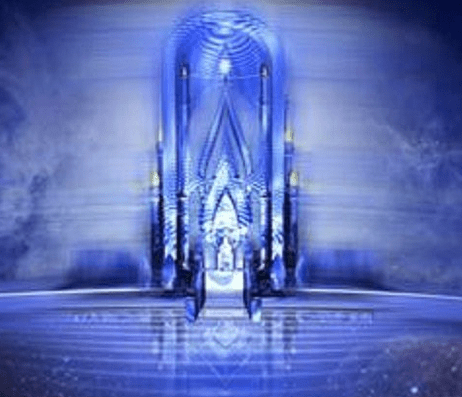
The temple constructed by Solomon was made of stone, a departure from God’s heaven-earth complex that was fashioned like a tent. If Andy Hoy is correct, the tabernacle in the wilderness was a very good likeness of what God made in the beginning. He believes it was a dome-type tent, similar to a yurt. According to his research, it is the only model that works without making adjustments to the exact materials spelled out in the biblical text.
The temple, however, conforms to the rectangular design most people have always assumed for the tent in the wilderness. The first stone temple was indeed glorious, as no doubt heaven is. Like the tabernacle in the wilderness, it also had the dividing veil or curtain decorated with cherubim and the other furniture in the inner court. The Ark of God’s presence was in the Holy of Holies.
The Jews defiled this stone temple, just as Adam and Eve defiled God’s first temple, the earth.
The temple of Solomon started well, as did that great king. However, just as King Solomon soon became corrupt and began worshiping other gods, God’s temple eventually was corrupted as well. As Israel and Judah sank deeper into idolatry, pagan idols were brought into the temple itself.
He built altars in the house of the LORD, of which the LORD had said, “In Jerusalem I will put My name.” 5 For he built altars for all the host of heaven in the two courts of the house of the LORD. 6 He made his son pass through the fire, practiced witchcraft and used divination, and dealt with mediums and spiritists. He did much evil in the sight of the LORD provoking Him to anger. 7 Then he set the carved image of Asherah that he had made, in the house of which the LORD said to David and to his son Solomon, “In this house and in Jerusalem, which I have chosen from all the tribes of Israel, I will put My name forever. 2 Kings 21:4–7 (NASB95)
Ezekiel saw in a vision the extent of this corruption and the impending destruction of the first temple.
Then He said to me, “Son of man, raise your eyes now toward the north.” So I raised my eyes toward the north, and behold, to the north of the altar gate was this idol of jealousy at the entrance. 6 And He said to me, “Son of man, do you see what they are doing, the great abominations which the house of Israel are committing here, so that I would be far from My sanctuary? But yet you will see still greater abominations.” 7 Then He brought me to the entrance of the court, and when I looked, behold, a hole in the wall. 8 He said to me, “Son of man, now dig through the wall.” So I dug through the wall, and behold, an entrance. 9 And He said to me, “Go in and see the wicked abominations that they are committing here.” 10 So I entered and looked, and behold, every form of creeping things and beasts and detestable things, with all the idols of the house of Israel, were carved on the wall all around. 11 Standing in front of them were seventy elders of the house of Israel, with Jaazaniah the son of Shaphan standing among them, each man with his censer in his hand and the fragrance of the cloud of incense rising. 12 Then He said to me, “Son of man, do you see what the elders of the house of Israel are committing in the dark, each man in the room of his carved images? For they say, ‘The LORD does not see us; the LORD has forsaken the land.’ ” 13 And He said to me, “Yet you will see still greater abominations which they are committing.” 14 Then He brought me to the entrance of the gate of the LORD’S house which was toward the north; and behold, women were sitting there weeping for Tammuz. 15 He said to me, “Do you see this, son of man? Yet you will see still greater abominations than these.” 16 Then He brought me into the inner court of the LORD’S house. And behold, at the entrance to the temple of the LORD, between the porch and the altar, were about twenty-five men with their backs to the temple of the LORD and their faces toward the east; and they were prostrating themselves eastward toward the sun. 17 He said to me, “Do you see this, son of man? Is it too light a thing for the house of Judah to commit the abominations which they have committed here, that they have filled the land with violence and provoked Me repeatedly? For behold, they are putting the twig to their nose. 18 “Therefore, I indeed will deal in wrath. My eye will have no pity nor will I spare; and though they cry in My ears with a loud voice, yet I will not listen to them.” Ezekiel 8:5–18 (NASB95)
Eventually God used the Babylonian army to destroy Jerusalem and the temple and take a large number of the remaining people into captivity. After seventy years, the temple was rebuilt at the command of King Cyrus of Persia.
The most detailed contemporary description of this second temple comes from the Jewish historian Flavius Josephus (a priest who knew the Temple firsthand) in The Jewish War (5.5.4 §§212–214):
“It was a Babylonian curtain [or tapestry], embroidered with blue, and fine linen, and scarlet, and purple, and of a contexture that was truly wonderful. Nor was this mixture of materials without its mystic meaning… Portrayed on it was a panorama of the heavens [or entire heavens], except for the signs of the zodiac.”
It continued to represent the firmament, but it is notable that it was a “Babylonian” curtain. The Babylonian Talmud, which made up a great deal of the teachings of the Pharisees, led to the Jewish people departing from the faith of Abraham and embracing a works-based religion which Jesus condemned.
Woe to you, scribes and Pharisees, hypocrites, because you travel around on sea and land to make one proselyte; and when he becomes one, you make him twice as much a son of hell as yourselves. Matthew 23:15 (NASB95)
Jesus, the long-promised Messianic King, brought the reality of the kingdom of God to the earth.
He told the Samaritan woman at the well that the day was fast approaching when the temple would no longer be significant. He told his disciples that no stone would remain intact after the coming destruction. This was inconceivable to his followers, but necessary. In 70 AD, the Roman army completely destroyed that temple, which has never been rebuilt. The old order of things, including the temple and its sacrifices, were coming to an end. Something brand new was coming. That will be the subject of the next article.