
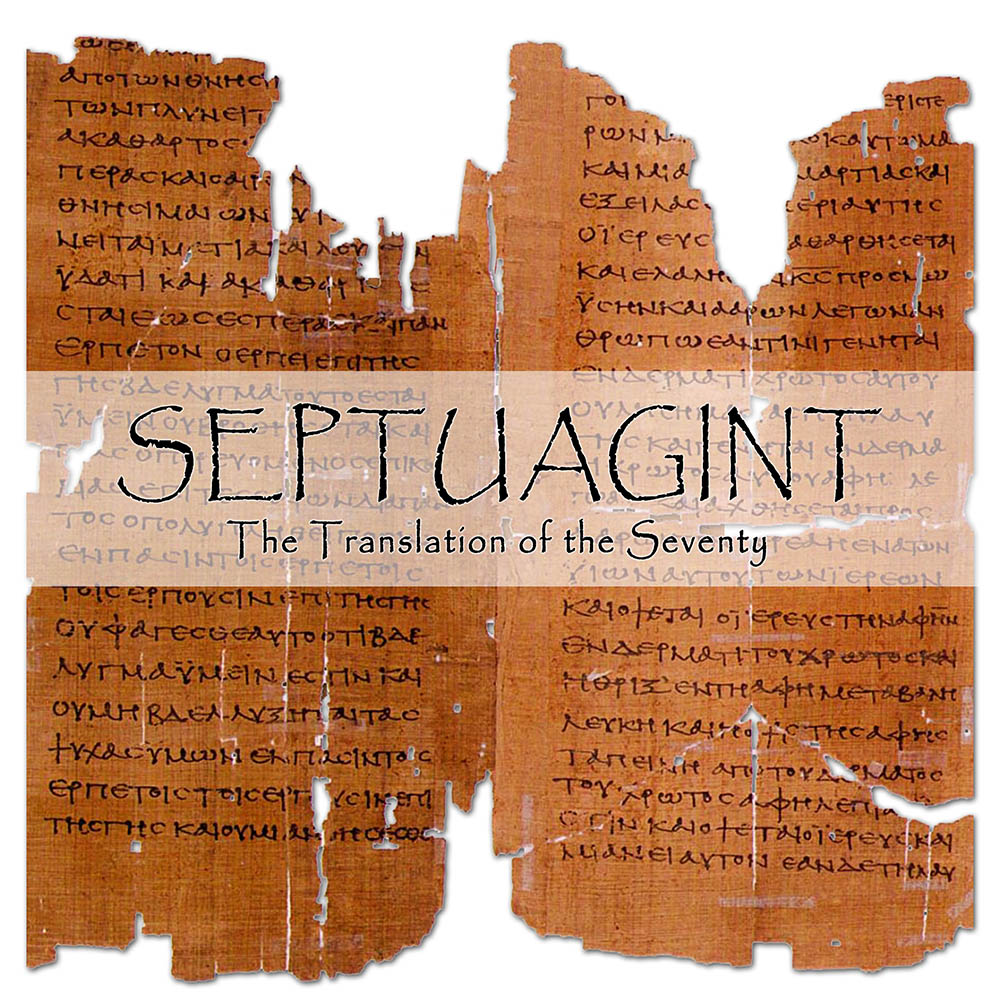
New Testament Use of the Septuagint – Matthew 4:5-7

Here is New Testament passage that shows that the Septuagint was the version of the Scriptures used by the early church and the Holy Spirit. The Septuagint version I am using is the Lexham English Septuagint 2nd Edition, which is available in print or as part of Logos Bible Software. Occasionally I also use the Brenton translation of the LXX for insight into difficult passages.

If you want to know more, click on the following links.

NT Quote
LXX
MT
Comment

5 Then the devil took Him up into the holy city, set Him on the pinnacle of the temple, 6 and said to Him, “If You are the Son of God, throw Yourself down. For it is written: ‘He shall give His angels charge over you,’ and, ‘In their hands they shall bear you up, Lest you dash your foot against a stone.’ ” 7 Jesus said to him, “It is written again, ‘You shall not tempt the LORD your God.’ ” Matthew 4:5–7 (NKJV) 

11 because he will command his angels concerning you, to guard you in your ways. 12 Upon hands they will lift you, lest you strike your feet against a stone. Psalm 90:11–12 (LES2) 

11 For He shall give His angels charge over you, To keep you in all your ways. 12 In their hands they shall bear you up, Lest you dash your foot against a stone. Psalm 91:11–12 (NKJV) 

This matches the LXX perfectly. There is no conflict with the MT, but I will give this to the LXX.

It is noteworthy that Satan left out the second part of verse 11, God’s promise to keep Jesus in his ways.

“


New Testament Use of the Septuagint – Matthew 4:4

Here is New Testament passage that shows that the Septuagint was the version of the Scriptures used by the early church and the Holy Spirit. The Septuagint version I am using is the Lexham English Septuagint 2nd Edition, which is available in print or as part of Logos Bible Software. Occasionally I also use the Brenton translation of the LXX for insight into difficult passages.

If you want to know more, click on the following links.

NT Quote
LXX
MT
Comment

4 But He answered and said, “It is written, ‘Man shall not live by bread alone, but by every word that proceeds from the mouth of God.’ ” Matthew 4:4 (NKJV) 

…man shall not live on only bread, but a man shall live on every word going out through the mouth of God. Deuteronomy 8:3 (LES2) 

…man shall not live by bread alone; but man lives by every word that proceeds from the mouth of the LORD. Deuteronomy 8:3 (NKJV) 

The Greek in Matthew exactly matches the LXX.

“


New Testament Use of the Septuagint – Matthew 3:1-3

Here is New Testament passage that shows that the Septuagint was the version of the Scriptures used by the early church and the Holy Spirit. The Septuagint version I am using is the Lexham English Septuagint 2nd Edition, which is available in print or as part of Logos Bible Software. Occasionally I also use the Brenton translation of the LXX for insight into difficult passages.

If you want to know more, click on the following links.

NT Quote
LXX
MT
Comment

1 In those days John the Baptist came preaching in the wilderness of Judea, 2 and saying, “Repent, for the kingdom of heaven is at hand!” 3 For this is he who was spoken of by the prophet Isaiah, saying: “The voice of one crying in the wilderness: ‘Prepare the way of the LORD; Make His paths straight.’ ” Matthew 3:1–3 (NKJV) 

3 The voice of one calling in the desert, “Prepare the way of the Lord! Make the paths of our God straight!” Isaiah 40:3 (LES2) 

3 The voice of one crying in the wilderness: “Prepare the way of the LORD; Make straight in the desert A highway for our God. Isaiah 40:3 (NKJV) 

Matthew’s quote exactly matches the LXX. He connects Isaiah’s prophecy to John the Baptist, as did John himself. (John 1:23)

This one goes to the Septuagint.

“


New Testament Use of the Septuagint – Matthew 2:23

Here is New Testament passage that shows that the Septuagint was the version of the Scriptures used by the early church and the Holy Spirit. The Septuagint version I am using is the Lexham English Septuagint 2nd Edition, which is available in print or as part of Logos Bible Software. Occasionally I also use the Brenton translation of the LXX for insight into difficult passages.

If you want to know more, click on the following links.

NT Quote
LXX
MT
Comment

23 And he came and dwelt in a city called Nazareth, that it might be fulfilled which was spoken by the prophets, “He shall be called a Nazarene.” Matthew 2:23 (NKJV) 


This corresponds to no specific quotation in the OT. Perhaps this is meant to be an allusion to several places in the prophets. It can be associated with Samson’s  mother  being promised he would be a Nazirite. (Judges 13:5)

It might also allude to the Hebrew word neser, which means “branch,” mentioned in Isaiah 11:1.

The connection Matthew makes, however, is to a location that was associated with people held in low estimation, as indicated from Nathaniel’s comment in John 1:46.

“


New Testament Use of the Septuagint – Matthew 2: 17-18

Here is New Testament passage that shows that the Septuagint was the version of the Scriptures used by the early church and the Holy Spirit. The Septuagint version I am using is the Lexham English Septuagint 2nd Edition, which is available in print or as part of Logos Bible Software. Occasionally I also use the Brenton translation of the LXX for insight into difficult passages.

If you want to know more, click on the following links.

NT Quote
LXX
MT
Comment

17 Then was fulfilled what was spoken by Jeremiah the prophet, saying: 18 “A voice was heard in Ramah, Lamentation, weeping, and great mourning, Rachel weeping for her children, Refusing to be comforted, Because they are no more.” Matthew 2:17–18 (NKJV) 

15 This is what the Lord said: “A voice of lamentation and weeping and mourning was heard in Ramah. Rachel, weeping over her sons, was unwilling to desist, because they were no more.” Jeremiah 38:15 (LES2) 

15 Thus says the LORD: “A voice was heard in Ramah, Lamentation and bitter weeping, Rachel weeping for her children, Refusing to be comforted for her children, Because they are no more.” Jeremiah 31:15 (NKJV) 

The first thing we note is that the LXX chapter of Jeremiah is different from the MT.  I will cover when I take a longer look at Jeremiah. 

The quote begins by following the wording of the MT. The Greek words Matthew uses match those of the LXX, except in the last part, where the LXX says Rachel was unwilling to stop weeping, but Matthew and the MT says she refused to be comforted. This is not a big deal, but it does not match the quote.

This one goes to the MT, but nothing in it contradicts the LXX. This is unlike some cases when the MT says something quite opposite from what the NT quotes from the LXX.

Apparently Matthew was using documents that were written in block style Hebrew, which was then being developed, instead of referring to the LXX. Matthew and the Holy Spirit saw fit to use it.

“


New Testament Use of the Septuagint – Matthew 2:13-15

Here is New Testament passage that shows that the Septuagint was the version of the Scriptures used by the early church and the Holy Spirit. The Septuagint version I am using is the Lexham English Septuagint 2nd Edition, which is available in print or as part of Logos Bible Software. Occasionally I also use the Brenton translation of the LXX for insight into difficult passages.

If you want to know more, click on the following links.

NT Quote
LXX
MT
Comment

13 Now when they had departed, behold, an angel of the Lord appeared to Joseph in a dream, saying, “Arise, take the young Child and His mother, flee to Egypt, and stay there until I bring you word; for Herod will seek the young Child to destroy Him.” 14 When he arose, he took the young Child and His mother by night and departed for Egypt, 15 and was there until the death of Herod, that it might be fulfilled which was spoken by the Lord through the prophet, saying, “Out of Egypt I called My Son.” Matthew 2:13–15 (NKJV) 

1 …“Because Israel was an infant, and I loved him, and out of Egypt I called back his children. Hosea 11:1 (LES2) 

1 “When Israel was a child, I loved him, And out of Egypt I called My son. Hosea 11:1 (NKJV) 

In this case, Matthew quotes the MT, thus showing that we cannot put God “in a box” by making a rule that only the LXX is a valid rendering of the Old Testament. Even though the  preponderance of NT quotes come from the LXX, there are exceptions.

I still believe we can more safely rely on the LXX. Whatever is quoted by the NT is God’s Word, but it does not mean the LXX is inaccurate. God certainly did call back his children from Egypt. This had an old covenant fulfillment at the Exodus, and it is fulfilled in Christ in the new covenant. All those who put their faith and allegiance in Christ are rescued from the slavery of sin and death, which is spiritual Egypt.

“


New Testament Use of the Septuagint – Matthew 2:6

Here is New Testament passage that shows that the Septuagint was the version of the Scriptures used by the early church and the Holy Spirit. The Septuagint version I am using is the Lexham English Septuagint 2nd Edition, which is available in print or as part of Logos Bible Software. Occasionally I also use the Brenton translation of the LXX for insight into difficult passages.

If you want to know more, click on the following links.

NT Quote
LXX
MT
Comment

6 ‘But you, Bethlehem, in the land of Judah, Are not the least among the rulers of Judah; For out of you shall come a Ruler Who will shepherd My people Israel.’ ” Matthew 2:6 (NKJV)

2 And you, O Bethlehem, house of Ephrathah, you are very small to be in the thousands of Judah, from which for me one will come out to be for a ruler of Israel, and his goings out are from the beginning, from the days of eternity.” Micah 5:2 (LES2) 

2 “But you, Bethlehem Ephrathah, Though you are little among the thousands of Judah, Yet out of you shall come forth to Me The One to be Ruler in Israel, Whose goings forth are from of old, From everlasting.” Micah 5:2 (NKJV) 

Matthew only quotes a part of this verse, which I underlined. Matthew’s quote does not agree with the exact wording of either the LXX or MT. The word for “ruler” in Matthew is different from what the LXX uses. Therefore, this quote is a hybrid inspired by the Holy Spirit that cannot support the contention that Matthew relied on the LXX.

The verse in Micah sheds light on the Messiah, however, indicating that he is an eternal being, just as the New Testament claims for Jesus. (John 1:1-2, 8:58)

“


New Testament Use of the Septuagint – Matthew 1:18-23

Here is New Testament passage that shows that the Septuagint was the version of the Scriptures used by the early church and the Holy Spirit. The Septuagint version I am using is the Lexham English Septuagint 2nd Edition, which is available in print or as part of Logos Bible Software. Occasionally I also use the Brenton translation of the LXX for insight into difficult passages.

If you want to know more, click on the following links.

NT Quote
LXX
MT
Comment

18 Now the birth of Jesus Christ was as follows: After His mother Mary was betrothed to Joseph, before they came together, she was found with child of the Holy Spirit. 19 Then Joseph her husband, being a just man, and not wanting to make her a public example, was minded to put her away secretly. 20 But while he thought about these things, behold, an angel of the Lord appeared to him in a dream, saying, “Joseph, son of David, do not be afraid to take to you Mary your wife, for that which is conceived in her is of the Holy Spirit. 21 And she will bring forth a Son, and you shall call His name JESUS, for He will save His people from their sins.” 22 So all this was done that it might be fulfilled which was spoken by the Lord through the prophet, saying: 23 “Behold, the virgin [parthenos] shall be with child, and bear a Son, and they shall call His name Immanuel,” which is translated, “God with us.” Matthew 1:18–23 (NKJV) 

14 Because of this, the Lord himself will give you a sign: Look, the virgin [parthenos] will conceive in the womb and will bear a son, and you will call his name Immanuel. Isaiah 7:14 (LES2) 

14 Therefore the Lord Himself will give you a sign: Behold, the virgin [almah] shall conceive and bear a Son, and shall call His name Immanuel. Isaiah 7:14 (NKJV) 

The LXX uses the specific word for virgin in Greek, which is parthenos, just as Matthew does. The MT uses a less specific word, almah, which means young woman. The NKJV translators knew that the proper translation is “virgin,” according to the New Testament; so, they relied upon the LXX and departed from the MT in this case. 

Once we see evidence of tampering, should we not abandon the MT altogether?

“


New Testament Use of the Septuagint – Matthew 1:1

Here is New Testament passage that shows that the Septuagint was the version of the Scriptures used by the early church and the Holy Spirit. The Septuagint version I am using is the Lexham English Septuagint 2nd Edition, which is available in print or as part of Logos Bible Software. Occasionally I also use the Brenton translation of the LXX for insight into difficult passages.

If you want to know more, click on the following links.

NT Quote
LXX
MT
Comment

1 The book of the genealogy [genesis] of Jesus Christ, the Son of David, the Son of Abraham: Matthew 1:1 (NKJV) 

1 This is the book of the generation [genesis] of humans on the day when God made Adam, he made him according to the image of God. Genesis 5:1 (LES2) 


The Greek word translated “genealogy” is genesis, hearkening back to the first book of the Bible.


Genesis 10: Noah’s Descendants

Here is a direct side-by-side comparison of the Masoretic Text with the LXX.  I have concluded that the LXX is much to be preferred over the Masoretic Text, a position from which the Eastern Orthodox Church never deviated. Perhaps, if you take the time to read my comparisons and other articles, you will arrive at the same conclusion.

The Septuagint version I am using is the Lexham English Septuagint 2nd Edition, which is available in print or as part of Logos Bible Software. Occasionally I also use the Brenton translation of the LXX for insight into difficult passages.

If you want to know more, click on the following links.

Masoretic Text Septuagint Significance

1 Now this is the genealogy of the sons of Noah: Shem, Ham, and Japheth. And sons were born to them after the flood. Genesis 10:1 (NKJV) 

1 These now are the generations of the sons of Noah: Shem, Ham, Japheth; and sons were born to them after the flood. Genesis 10:1 (LES2) 

Everyone on earth traces back to Noah and his sons. 

2 The sons of Japheth were Gomer, Magog, Madai, Javan, Tubal, Meshech, and Tiras. 3 The sons of Gomer were Ashkenaz, Riphath, and Togarmah. 4 The sons of Javan were Elishah, Tarshish, Kittim, and Dodanim. 5 From these the coastland peoples of the Gentiles were separated into their lands, everyone according to his language, according to their families, into their nations. Genesis 10:2–5 (NKJV) 

2 The sons of Japheth were Gomer and Magog and Madai and Javan and Elishah and Tubal and Meshech and Tiras. 3 And the sons of Gomer were Ashkenaz and Riphath and Thorgama. 4 And the sons of Javan were Elishah and Tarshish, Kittim, Rodanim. 5 The islands of the nations were marked off from these on their land, each according to their tongue in their tribes and their nations. Genesis 10:2–5 (LES2) 

The LXX adds Elishah to the sons of Japheth. Gomer’s son Ashekenaz is said by some to be related to modern Ashkenazi Jews. Although interesting, it is unproved.

6 The sons of Ham were Cush, Mizraim, Put, and Canaan. 7 The sons of Cush were Seba, Havilah, Sabtah, Raamah, and Sabtechah; and the sons of Raamah were Sheba and Dedan. 8 Cush begot Nimrod; he began to be a mighty one on the earth. 9 He was a mighty hunter before the LORD; therefore it is said, “Like Nimrod the mighty hunter before the LORD.” 10 And the beginning of his kingdom was Babel, Erech, Accad, and Calneh, in the land of Shinar. 11 From that land he went to Assyria and built Nineveh, Rehoboth Ir, Calah, 12 and Resen between Nineveh and Calah (that is the principal city). 13 Mizraim begot Ludim, Anamim, Lehabim, Naphtuhim, 14 Pathrusim, and Casluhim (from whom came the Philistines and Caphtorim). Genesis 10:6–14 (NKJV) 

6 The sons of Ham were Cush and Egypt, Put and Canaan. 7 The sons of Cush were Sheba and Havilah and Sabtah and Raamah and Sabteca. The sons of Raamah were Sheba and Dedan. 8 Cush fathered Nimrod. He was the first to be a giant on the earth. 9 He was a mighty hunter before the Lord God; because of this they will say, “As Nimrod was a mighty hunter before the Lord.” 10 And the beginning of his kingdom became Babylon and Erech and Accad and Calneh in the land of Shinar. 11 From that land he went out to Assyria and built Nineveh and the city of Rehoboth and Calah, 12 and Resen between Nineveh and Calah; this is the great city. 13 And Egypt fathered the Lydians and the Nephthalim and the Anemim and the Lehabim 14 and the Pathrusim and the Casluhim, from whom the Philistines came, and the Cretans. Genesis 10:6–14 (LES2) 

This passage identifies the descendants of Ham, from whom great evil sprang.

The LXX correctly identifies Mizraim with Egypt.

In verse 7, Nimrod is first mentioned. The MT says he was a mighty hunter, but the LXX says he was a giant, probably indicating he was descended from a fallen angel. He founded what eventually became Babylon and built the city of Nineveh, both of which are still identified with great evil. 

The Philistines, those perennial enemies of Israel, also came from Ham, as did the proverbial liars of Crete. (Titus 1:12)

15 Canaan begot Sidon his firstborn, and Heth; 16 the Jebusite, the Amorite, and the Girgashite; 17 the Hivite, the Arkite, and the Sinite; 18 the Arvadite, the Zemarite, and the Hamathite. Afterward the families of the Canaanites were dispersed. 19 And the border of the Canaanites was from Sidon as you go toward Gerar, as far as Gaza; then as you go toward Sodom, Gomorrah, Admah, and Zeboiim, as far as Lasha. 20 These were the sons of Ham, according to their families, according to their languages, in their lands and in their nations. Genesis 10:15–20 (NKJV) 

15 Canaan fathered Sidon, his firstborn, and the Hittite 16 and the Jebusite and the Amorite and the Girgashite 17 and the Hivite and the Arkite and the Sinite 18 and the Arvadite and the Zemarite and the Hamathite. After this the tribes of the Canaanites were scattered around. 19 And the boundaries of the Canaanites were from Sidon until one comes to Gerar and Gaza, until one comes to Sodom and Gomorrah, Admah and Zeboiim, as far as Dasa. 20 These are the sons of Ham, in their tribes according to their tongues in their territories and in their nations. Genesis 10:15–20 (LES2) 

Canaan was cursed by Noah after his father, Ham, exposed his naked drunken state. Most of Israel’s enemies, which had to be defeated in the land named after Canaan, descended from this man.

21 And children were born also to Shem, the father of all the children of Eber, the brother of Japheth the elder. 22 The sons of Shem were Elam, Asshur, Arphaxad, Lud, and Aram. 23 The sons of Aram were Uz, Hul, Gether, and Mash. 24 Arphaxad begot Salah, and Salah begot Eber. 25 To Eber were born two sons: the name of one was Peleg, for in his days the earth was divided; and his brother’s name was Joktan. 26 Joktan begot Almodad, Sheleph, Hazarmaveth, Jerah, 27 Hadoram, Uzal, Diklah, 28 Obal, Abimael, Sheba, 29 Ophir, Havilah, and Jobab. All these were the sons of Joktan. 30 And their dwelling place was from Mesha as you go toward Sephar, the mountain of the east. 31 These were the sons of Shem, according to their families, according to their languages, in their lands, according to their nations. Genesis 10:21–31 (NKJV) 

21 And to Shem were born children, even to him, the father of all the sons of Eber, the brother of Japheth the great. 22 The sons of Shem were Elam and Assyria and Arpachshad and Lud and Aram. 23 And the sons of Aram were Uz and Hul and Gether and Meshech. 24 And Arpachshad fathered Kenan, and Kenan fathered Shelah. Shelah fathered Eber. 25 And to Eber was brought forth two sons: the name of the first was Peleg, because in his days the earth was divided, and the name of his brother was Joktan. 26 Joktan brought forth Almodad and Sheleph and Hazarmaveth and Jerah 27 and Hadoram and Uzal and Diklah 28 and Abimael and Sheba 29 and Ophir and Havilah and Jobab. All these are the sons of Joktan. 30 And their dwelling was from Massa until coming to Ophir, a mountain of the east. 31 These are the sons of Shem in their tribes according to their tongues in their territories and in their nations. Genesis 10:21–31 (LES2) 

Shem is part of the Messianic line. (Genesis 9:26, Luke 3:36) Some of the nations that eventually were enemies of Israel (Elam and Assyria, for example) came from Shem.

Verse 25 is interesting because it speaks of the dividing of the earth in Peleg’s days. The only division mentioned is what happened after Babel, which is the topic of the next chapter of Genesis.

32 These were the families of the sons of Noah, according to their generations, in their nations; and from these the nations were divided on the earth after the flood. Genesis 10:32 (NKJV) 

32 These are the tribes of the sons of Noah according to their generations, according to their nations. From these the islands of the nations were scattered about on the earth after the flood. Genesis 10:32 (LES2) 

The MT and LXX essentially agree in this verse.


Share this post...