
How to Have Peace in Scary Situations

storm


Warfare results when two wills clash in an effort to gain supremacy. The only lasting solution is the unconditional surrender of one of the parties. Until that happens, there may be temporary cessations of hostilities, but conflict always reemerges. Our life on the earth is a series of conflicts and difficulties that eventually will terminate in physical death. Because of the entrance of sin, the beginning of hostilities against God’s will, all of life is a battle against hostile forces that seek to destroy us – evil or misguided people, germs, demons, natural disasters, the aging process, etc. Jesus told us that the devil, who is our archenemy and the archetype of resistance of God, seeks to steal, kill and destroy. (John 10:10) Peter wrote that Satan “prowls about like a roaring lion, seeking someone to devour.” (1 Peter 5:8) Warfare, stress, and difficulties, thanks to Adam’s sin, are a fact of life. We can either be terrified by it, surrender to the devil as a means to gain a temporary reprieve, or surrender to God and become part of his army as he brings final victory to his people. Ultimately, the battle is the Lord’s. It is he who took the initiative to regain what Adam lost. It is he who sent his Son to wrest dominion back from Satan.

The pivotal question is to whom will we surrender? Who will be our lord – God, Satan, or ourselves?

The essence of what it means to become a Christian is to surrender our wills to Jesus. This is what it means when we call him Lord. Surrender to Jesus means we repent from living self-directed lives and come under his authority. This takes place initially when we understand the gospel message and confess with mouths that he is our Lord. (Romans 10:9-10) Over our lifetimes, we will need to continually re-surrender every time we find ourselves resisting or doubting his sovereignty, wisdom, goodness, and love for us. It can be a scary thing to surrender ourselves to the will of an invisible God, whose ways are often confusing to us, and to trust that he is in control and always has our best interests in mind, even when everything around us seems to indicate the opposite. In all of life, and particularly when we are in the middle of a difficult or scary situation, if our wills are battling against God’s, lasting peace can only come through our unconditional surrender to God.

Oddly enough, even though we are surrounded by external dangers, sometimes we are our own worst enemy. Our sin and the fear and mistrust in our hearts toward God can sabotage our efforts to be true to Him. God has a plan for our lives, but if we stubbornly and fearfully refuse to go along with that plan, we can end up in an unprotected place outside of God’s best for our lives, in need of His correction and deliverance. Surrender to God and His will requires that we lay down our own agendas and our desire to control our lives and protect ourselves at all costs. It means that we must be open to the possibility that God will require us to go through something we dread.

Unless we unconditionally surrender to God, we cannot have unconditional peace.

By surrendering to God I do not suggest that we become passive. When we find ourselves under attack or in the middle of something scary to us, our first responsibility is to turn to God and acknowledge that he is sovereign over all things, including our current situation.

Unless God allows something to enter our lives, it will not take place. Satan is not in control.

God is not the author of evil, sin, suffering, or sickness. However, God’s sovereignty transcends all these things in a magnificent and mysterious way that is beyond explaining. Wisdom tells us that, no matter what God allows to come into our lives, we are first to acknowledge His sovereignty, seek Him and His will, and then respond as directed and appropriate.

Trust in the LORD with all your heart And do not lean on your own understanding. 6  In all your ways acknowledge Him, And He will make your paths straight. Proverbs 3:5-6 (NASB)  

When the Philistines attacked David, his first response was to seek the Lord, who gave him specific instructions regarding how to proceed. (2 Samuel 5)

God created us to depend on him in all situations.

Adam’s first sin was to reject this divine order in an attempt to make his own decisions without reliance on God. A little knowledge can be dangerous. When Christians learn principles of authority and Christ’s victory, we sometimes think we no longer need to receive our directions from the Spirit any more. We think we can go it alone. This is wrong and dangerous. Too often we Christians, when we find ourselves in a scary situation, start rebuking the devil and claiming the promises, rather than seeking the Lord.

It may never occur to us that God has actually designed our situation in order to do a deep work in us. After all, God’s goal is to transform us into Christ’s image, not keep us comfortable.

When Jesus stood before Pilate, our Lord declared that the Roman ruler could only do to Him what God allowed. (John 19:10-11) The passion and crucifixion of our Lord was a time that God temporarily allowed darkness to rule. 

Why didn’t you arrest me in the Temple? I was there every day. But this is your moment, the time when the power of darkness reigns.” Luke 22:53 (NLT) 

Just prior to this, in the Garden of Gethsemane, Jesus first did business with His heavenly Father – the real Ruler in every situation. His prayer was a model for us:

“Father, if you are willing, please take this cup of suffering away from me. Yet I want your will to be done, not mine.” Luke 22:42 (NLT) 

When we are about to enter a trial or are in the middle of one, we should first go to God and be sure our hearts and wills are submitted to him and what He wants to accomplish in our lives through the difficulty.

It is only against a backdrop of trust and submission that we can know more perfectly what other actions we must take.

This takes faith and humility.

If instead we simply begin to engage in what we might want to call “spiritual warfare,” we may find ourselves unhappily resisting God Himself. Imagine if Jesus had rebuked Satan instead of surrendering to death as God’s Lamb! This is what Peter earlier advised Jesus to do, but Jesus rebuked his misguided friend by telling him that he did not have the things of God in mind. (Matthew 16:21-23) Imagine how foolish it would be for us to fight against a situation orchestrated by God that is the avenue of our knowing Christ as Provider, Healer, or in whatever other way we need to know Him! Check in with God first. Find out what He wants to do; then, join His program. This is what it means to have Christ as Lord.

But He gives a greater grace. Therefore it says, "GOD IS OPPOSED TO THE PROUD, BUT GIVES GRACE TO THE HUMBLE." 7  Submit therefore to God. Resist the devil and he will flee from you. James 4:6-7 (NASB) 

A severe trial or difficulty will often cause whatever rebelliousness and fear we still may have deeply buried in our hearts to bubble to the surface. God knew it was there all along, but we may be surprised to discover what is hidden inside of us.

The fire of affliction tests and reveals our hidden motives and the nature and strength of our faith.

If we believe that God is completely in charge of our lives and every situation and loves us enough to expose these things in order to deliver and transform us, we will better be able to cooperate with the process. Unless we go through the fire, we will never know for sure what is inside us. Until we face our fears, the strength of our faith is somewhat of a mystery. Soldiers who have never been in combat wonder what they will do under fire. No one can know for sure ahead of time. Once we go through our first battle, however, we know.

That which we fear can become for us a gateway into great growth and victory after we have faced it in faith and found that God’s grace enables us to overcome.

Job had to endure what he feared so that his subtle self-righteousness and proud indignation against God’s apparent lack of justice would bubble to the surface. God was far more interested in revealing Himself in a greater way to Job than in keeping him pain free.

When we realize that character transformation is a higher priority than our comfort and ease, we will begin to better understand God’s ways.

If we embrace God’s ways, we will be pliable in His hands for Him to mold us however He wishes.

As long as our peace hinges on a certain set of conditions or a certain answer to prayer, we will always be subject to our circumstances and miss out on experiencing real and lasting peace.

Being enslaved to our circumstances is a terrible way to live because we can never be completely at rest. What we dread could be just around the corner…and then what? It is no use trying to insulate ourselves from what we fear by “having enough faith.”

Faith was never designed to protect us from trials: rather, it keeps us while we are in trials.

Ponder Christ’s words:

I have told you these things so that in me you may have peace. In the world you have trouble and suffering, but take courage — I have conquered the world.John 16:33 NET

If we believe that trusting in Christ is our ticket to a trouble free life, we are in for a shock. Nothing could be further from the truth. God actually appoints us to tribulations.

We sent Timothy, our brother and fellow worker for God in the gospel of Christ, to strengthen you and encourage you about your faith, 3 so that no one would be shaken by these afflictions. For you yourselves know that we are destined for this.1 Thessalonians 3:2-3 NET

Trials, afflictions, suffering and tribulations work for us. They teach us perseverance and build character. Here is what Paul wrote to the church in Rome.

Not only this, but we also rejoice in sufferings, knowing that suffering produces endurance, 4 and endurance, character, and character, hope. 5 And hope does not disappoint, because the love of God has been poured out in our hearts through the Holy Spirit who was given to us. Romans 5:3-5 NET

It is only when we reconcile ourselves to the fact that life will contain many difficulties, and only when we choose to surrender to God in the midst of them, trusting in His love and power to accomplish in us His desire through them, that we are able to have peace that passes understanding. I call this “unconditional peace” because it does not depend on any outward circumstance or condition. Whether we live or die, we have peace. Whether we get the answer we want or not, we have peace.

Peace resides in a Person, and His name is Jesus. As we fully surrender to him, we receive all  he has and is. One of His titles is the Prince of Peace. His peace becomes our peace, a peace that can never be shaken.

Peace I leave with you; my peace I give to you; I do not give it to you as the world does. Do not let your hearts be distressed or lacking in courage. John 14:27 NET

Moses wrote about this place of surrender and peace. It is a secret place hidden from life’s storms and the threats of the enemy. It is a place where God’s peace and presence reign undisturbed. We have access to that secret place by surrendering unconditionally to God’s will for our lives.

As for you, the one who lives in the shelter of the sovereign One, and resides in the protective shadow of the mighty king — 2 I say this about the LORD, my shelter and my stronghold, my God in whom I trust. Psalm 91:1-2 NET

Surrendering to God’s will and plan for our lives will not make us passive door mats. In fact, we will find that, as we unconditionally surrender to God, great faith will rise up in our hearts – faith to overcome.

Always be full of joy in the Lord. I say it again—rejoice! 5  Let everyone see that you are considerate in all you do. Remember, the Lord is coming soon. 6  Don’t worry about anything; instead, pray about everything. Tell God what you need, and thank him for all he has done. 7  Then you will experience God’s peace, which exceeds anything we can understand. His peace will guard your hearts and minds as you live in Christ Jesus. Philippians 4:4-7 (NLT) 

SeeingGodsSmile nooksize


If you want to read more about having peace in every situation, you can purchase my book, Seeing God’s Smile When Life Is Difficult, from Amazon.


Dealing with Disappointment in Friendship

I suppose all of us who have lived for very long have experienced disappointment in friendship – anything from failure to keep a promise or a confidence to outright betrayal, from unkind words to slander and lies.

There are “friends” who destroy each other, but a real friend sticks closer than a brother. Proverbs 18:24 (NLT) 

Every follower of Christ will be faced with relational disappointment because we are fallen people living in a sin-scarred world.

The world and the church are full of people who are “broken” or at least still “under construction,” who will disappoint us at times or maybe quite often. Rather than becoming embittered or disillusioned when this happens, Jesus wants to teach us how to handle these disappointments in friendship properly. Our own spiritual life and growth is at stake. Our Lord was thoroughly and completely betrayed by one of his own disciples, and even Peter, who was one of his closest three followers, publicly denied knowing Jesus at the time of his most severe testing. How did our Lord handle these “disappointments” and what can we learn from him?

Understanding Our New Covenant Relationship with Father God

Before looking in more detail at the idea of friendship, let us consider what a covenant relationship is. Today, when we talk about covenants, we usually mean some sort of business contract. In the Bible, covenants were much more relationally pervasive and meaningful.

A Bible covenant is a solemn promise made before God between two or more persons that is often sealed in blood, usually has some sort of sign or token attached to it, and stipulates a punishment for those who violate it.

In Genesis 15, when Abraham asked for “proof” that the promises God made to him would come to pass, the Lord had Abraham kill and divide several animals and lay them out on the ground. In the evening, God appeared in the form of a smoking fire pot and a flaming torch and passed (walked) between those pieces. The slain animals represented what would happen to whomever violated the covenant. Since God alone walked through the pieces of the slain animals, it meant he took upon himself sole responsibility for keeping the covenant. This made it a unilateral or one-sided covenant. Normally, in bilateral (between two parties) covenants, both parties would walk together, illustrating their commitment to keep the terms of the covenant or face the fate of the slain animals for violating it.

It is powerfully encouraging that God represented himself by two symbols. The New Covenant is a covenant between the Father and the Son (Jesus). Jesus took full responsibility for keeping the covenant with his Father upon himself (carrying us on his shoulders, so to speak), and even paid in advance the penalty of our violation of the Old Covenant by dying in our place on the cross. Did I hear you say, “Hallelujah?”

Both the Abrahamic Covenant and New Covenant are unilateral, unconditional covenants of grace.

God, the covenant maker, by walking between the slain animals, said to Abraham (and us) in symbolic form, “May it be done to me as has been done to these animals, if I fail to keep the terms of this covenant.” The author of the Letter to the Hebrews mentions this:

God also bound himself with an oath, so that those who received the promise could be perfectly sure that he would never change his mind. 18  So God has given both his promise and his oath. These two things are unchangeable because it is impossible for God to lie. Therefore, we who have fled to him for refuge can have great confidence as we hold to the hope that lies before us. Hebrews 6:17-18 (NLT) 

Covenants can be between equals, between a sovereign and his vassals, between a husband and wife, or between God and his people.

The New Covenant was inaugurated when Jesus shed his blood on the cross for us. We enter into a relationship with Father God as his child through the New Covenant with Jesus having paid in advance for all of our sinful breaches of covenant faithfulness to God. We are completely secure in God’s love because we no longer relate to him on a performance basis. We have nothing more to prove. We have been given Christ’s very own righteous standing before our heavenly Father! Ours is now to live out what Christ has provided for us. We have been given a new nature. We are inhabited by God’s own Spirit. We now have the ability to live as covenant sons and daughters through the power of the indwelling resurrected Christ.

Our heavenly Father is not waiting for us to “mess up” so he can terminate the relationship. (Hebrews 8:7-12)

Rather, he knew ahead of time that we all would fail on our end; so, he sent his Son to pay the penalty for our failure in advance; so that we can enjoy the privileges and pleasure of being God’s children forever. This is the basis of our eternal friendship with God, which was provided for us at a tremendous price by Someone who was and is absolutely committed to us.

Covenant Commitments and Friendship

Friendships may come and go, but covenant bonds remain. Let that sink in. This is why marriage is traditionally launched by a covenant ceremony in which each partner pledges exclusive fidelity to the other until death.

Friendships are broken by some people for relatively trivial reasons, but covenant bonds, like marriage, should never be treated so lightly.

Friendships may crash upon the rocks of unmet expectations, but covenant relationships are built upon a vow of faithfulness, regardless of how things may turn out – for better, for worse, for richer, for poorer, in sickness and in health.

In covenant relationships, personal happiness or fulfillment is never the highest good. Faithfulness to the other person is. This runs counter to our pop culture, but lines up perfectly with God’s ways.

People today are often unfaithful to the promises they make. Instead many live in a foolish pursuit their own interests and desires, regardless of how that may affect others. Divorce has become widely acceptable for the flimsiest of reasons. Many choose to avoid the drama and cost associated with divorce by refusing to make a covenant commitment in the first place. They opt to live together as long as it suits them, keeping open the option of abandoning the other, claiming that this encourages a healthy relationship.

This lack of commitment pervades society and has profoundly affected the church, too. It is not surprising that the USA leads the world now in the percentage of children living in single parent homes. People come and go in their relationship to local churches, feeling no sense of “belonging” or “commitment.” For those who have drunk deeply of our culture’s abandonment of covenant commitment, church is just one more consumer offering. Whichever church best suits my needs for the moment has my temporary allegiance and, perhaps, financial support. Some people, who have been previously hurt or disappointed by church, in order to avoid being hurt again, refuse to commit at all and just hang out on the periphery. This creates a huge loss for the individual and the kingdom of God.

Not much good happens in life without commitment.

Handling Unmet Expectations

One of the greatest friendship destroyers is when one friend fails to meet the expectations of the other. Despite having been saved by grace, we may still measure other people in a “tit for tat” manner. This is how the world operates, but is a far cry from what Jesus taught his followers. Take a look at the following verses from the sermon on the mount.

Do to others as you would like them to do to you. 32 “If you love only those who love you, why should you get credit for that? Even sinners love those who love them! 33 And if you do good only to those who do good to you, why should you get credit? Even sinners do that much! 34 And if you lend money only to those who can repay you, why should you get credit? Even sinners will lend to other sinners for a full return. 35 “Love your enemies! Do good to them. Lend to them without expecting to be repaid. Then your reward from heaven will be very great, and you will truly be acting as children of the Most High, for he is kind to those who are unthankful and wicked. 36 You must be compassionate, just as your Father is compassionate. Luke 6:31-36 (NLT)

Jesus challenges us to love on a higher level than comes naturally to us. Instead of passively accepting violations of friendship or retaliating in kind, Jesus teaches us to counter punch with love.

What would happen if we handled our disappointments in friendship this way?

All of us are “broken” by sin in some way. Unhealed brokenness promotes a dysfunctionality in which we try to fill up the “hole” in our souls with another human being. We consciously or unconsciously hope they will be for us what only God can be.

Such dysfunctionality can lead us to place unreasonable expectations on our friends and spouses. Few things are so devastating to a relationship.

No human being is capable of measuring up to such demands. Healthy people run away from these kinds of dysfunctional expectations, but unhealthy individuals allow themselves to become entangled in destructive relationships. Until Jesus heals us, we cannot discern what is wrong, since we are part of the problem. Jesus wants us to love dysfunctional people without being sucked into their dysfunction, if they will allow us.

Betrayal

But what about when a relationship is shaken by betrayal? Betrayals are woven into the fabric of life because people are inherently sinful. Everyone has been or will be betrayed eventually, and, even worse, we may betray someone who deserves far better from us.

Does betrayal require the termination of a relationship? It certainly can be legitimate grounds, as our Lord demonstrated when he taught that the marriage covenant can be terminated if one party commits adultery against the other. (Matthew 5:32)

Betrayal is first and foremost a breach of trust.

Once trust is broken, it is difficult, perhaps impossible, to restore. Someone once said that trust is like a rose. A betrayal is similar to taking that rose and crushing its petals. A heartfelt apology and repentance go a long way to mending the damage done by a betrayal, but it cannot restore the rose to its former beauty. Thankfully, with God, all things are possible. I have seen couples rocked by adultery rebound over time with an even stronger relationship and marriage than they had before the betrayal. But trust takes time to mend. Never abandon hope.

A great example of God’s power to restore is Peter’s denial or betrayal of the Lord. Peter imagined that he was the most loyal of all Jesus’ band. He openly affirmed that even though everyone else might abandon Jesus, he never would. Peter imagined that his close relationship with the Lord was built upon his own faithfulness. Jesus, however, is never fooled by appearances. He understood Peter’s weaknesses, even to the point of publicly prophesying that Peter would deny him three times.

Can you imagine the scene? Peter had just boasted that he would always be faithful, even unto death, when Jesus looked him in the eyes and told him that he would betray him that night. What must Peter and the other disciples have thought?

Jesus knows exactly what is in each of us and loves us anyway. Our relationship with Jesus is grounded in his faithfulness, not ours. That is the essence of the New Covenant.

My folksy definition of a true friend is someone who knows what we are really like and loves us anyway. Jesus certainly is such a true friend. He was Peter’s friend, even in the aftermath of betrayal. Peter’s denial did not surprise or offend Jesus. He knew it was coming and realized it was part of Peter’s development as a disciple. Peter had to learn that he could not trust in himself, but only in the Lord. Many leaders would write off a person like Peter, who failed miserably under pressure. How could one possibly trust such a person again? Jesus, however, not only continued to love Peter, but he kept him in his leadership role, giving him pastoral responsibilities toward the rest of the disciples. Amazing!

History tells us that Peter never again abandoned his faithfulness to Jesus and eventually died as a martyr, being crucified upside down.

One of the most powerful life changers in the world is encountering unconditional love, especially after we fail in some significant way.

God’s love “never fails” according to First Corinthians Chapter Thirteen, but unfortunately church people often do.

Covenant Christians are called to demonstrate unfailing love toward one another and toward a lost and hurting world. The basis of our salvation is that God loved us despite our treachery toward him. He asks us to pass on the blessing to others.

Conclusion

When we enter into a friendship with another person, it is always “risky,” but, since true friendship is worth it, we take the risk in the hope that things will end well. Friendships can grow, remain steady, or can wither away. Sometimes they end abruptly because of some offense or disappointment. One reason our friendships are so up and down is because they are riding upon our expectations rather than our commitment to love the other person. A wise person enters every relationship cautiously, realizing that it is necessary to periodically evaluate the true nature of a relationship. This helps us to guard against placing unrealistic expectations upon the other person.

Unlike us, Jesus knows in advance all our weaknesses and failures. When he chooses to befriend us, it is without any misplaced hopes or expectations. Because of this, he is never surprised and remains constant regardless of our ups and downs. He never wavers in his love and commitment to us.

I suggest that we enter into friendships and covenant relationships with the understanding that we certainly will be disappointed at some point along the way. Go ahead and get that behind you from the start. Then start building a redemptive friendship that remains true in the face of adversity. Be one of those friends who “sticks closer than a brother.” Let’s show the world what real love looks like.

The Dark Side of Following Christ

storm


Sometimes it seems that there is a dark side to following Christ, usually when we go through suffering without comprehending why. Once when Jesus forewarned his disciples that he would suffer, die, and rise again, the apostle Peter objected and gave Jesus what he felt was some much needed counsel.

And Peter took him aside and began to rebuke him, saying, “Far be it from you, Lord! This shall never happen to you.” Matthew 16:22 (ESV) 

Jesus’ response to his words must have shocked everyone present.

But he turned and said to Peter, “Get behind me, Satan! You are a hindrance to me. For you are not setting your mind on the things of God, but on the things of man.” 24 Then Jesus told his disciples, “If anyone would come after me, let him deny himself and take up his cross and follow me. 25 For whoever would save his life will lose it, but whoever loses his life for my sake will find it. Matthew 16:23-25 (ESV)

Why did Jesus react so angrily to Peter’s words? Our Lord actually addressed Satan, which we might find strange, unless we realize that Satan was using Peter as a mouthpiece at that moment to tempt Jesus to turn away from his God-given mission to die as the Lamb of God. How could Satan so influence Peter without his being aware of it? I believe it was because in this matter Peter’s human desire for his and his Lord’s self-preservation meshed perfectly with Satan’s desire to manipulate Jesus away from the suffering and glory awaiting him. Our Lord came to give his life away, not to protect himself from harm. Peter could not fathom how it possibly could be advantageous for the leader of the movement to die, but going to the cross was the key to everything God had in mind. Our Lord knew that the cross was absolutely necessary and the only route to victory over sin, Satan, and death. Without the cross there could be no resurrection, and, without the resurrection, there would be no salvation for us or the restoration of the creation to God. Peter unwittingly asked Jesus to forsake his mission and disobey the Father’s will, all the while thinking that he was being considerate of Jesus’ best interests. It was a powerful temptation, which accounts for why Jesus reacted so strongly. No one wants to die an agonizing death, not even the Lamb of God.

Temptations to avoid God’s appointed suffering must be firmly rejected.

God’s Puzzling Ways

For my thoughts are not your thoughts, neither are your ways my ways, declares the LORD. 9 For as the heavens are higher than the earth, so are my ways higher than your ways and my thoughts than your thoughts. Isaiah 55:8-9 (ESV)

God’s ways are very unlike ours. One of his ways that is hard for us to wrap our minds around is that God often makes his most dedicated followers pass through what some have called the “death of a vision.”

Between the mountain top experience of receiving a promise from God and the exhilaration of seeing its fulfillment there may be a period of contradiction and waiting, which is very difficult to endure.

We can call it “the cross” or the “valley of the shadow of death,” or, as it is described in Genesis, “a horror of great darkness.”

God tells us what he will do, and then requires us to wait. Only God knows for how long. As we wait for God to fulfill his promises, the Lord may allow something to come against us that seemingly threatens to destroy the promise, something we cannot run from or otherwise avoid. In such cases, God requires us to face down such adversity and contradiction by faith, go through the darkness of delay and disappointment, and come out the other side into victory and the fulfillment of the promise. We can only do this if we completely release the outcome to the Lord and fully trust in his faithfulness and love.

God asks us to place everything in his loving hands in order to gain the promise.

Some Biblical Examples

Abraham

After God promised that he would make him, a childless man, into a great nation and inherit the land of Canaan, he told our forefather of faith to divide some animals for a covenant cutting ceremony. As Abraham waited, the Bible says that a “horror (or terror) of great darkness” fell upon him (Genesis 15:12). Abraham fought off the birds of prey which attempted to steal the sacrificial animals, and God appeared in the darkness to seal the unilateral covenant and validate the promise. Abraham is a great example of fighting through every form of resistance in order to “press into God.”

We too must be prepared to be “horrified” by God in order to receive his wonderful promises.

Later God required him to endure the horror of surrendering his only begotten son to God as a human sacrifice. By faith he was willing to give back to God the one whom he had waited so long. It is one thing to wait patiently for a promise to be fulfilled, but quite another to surrender the promise back to God. Abraham, the father of our faith, did both.

Jacob

Jacob is one of my favorite people in the Bible. If God could use this deceptive rascal, there is hope for us all. God promised him all that he had pledged to his fathers, Abraham and Isaac. After Jacob fled from Canaan out of fear for his life and after having lived with relatives for years, God told him to return to the land of his inheritance. One major obstacle stood in his way – his estranged brother Esau, who had previously promised to murder him for stealing his birthright and inheritance. When Jacob and his family and all his possessions arrived at Canaan, Esau came with a party of 400 armed men to “greet” him. Jacob was terrified as he expected the worst. He wrestled with God all night (Sounds like prayer to me.), as he prepared to confront his worst fear. God blessed him at the end of that struggle. The next morning he faced Esau and found that God had given him favor with his brother and safe passage into Canaan. We learn from Jacob’s story that we can only run from our fears for so long.

For Jacob, receiving the promises required him to endure the horror of facing his fears with faith and courage.

Joseph

This great man of faith received the promise that he would have authority over his brothers and parents, but he had to endure the horrors of false accusation, betrayal, abandonment, and imprisonment for years before the promise was fulfilled. He never seemed to lose heart during the ordeal. The psalmist wrote: “Until the time came to fulfill his dreams, the LORD tested Joseph’s character.” [Psalm 105:19 (NLT)]

The “horror of darkness” and testing reveals our character and our faithfulness toward God, which illustrate whether we truly believe that He is faithful and loving.

Our faithlessness is an indictment against God’s character, as much as it is against our own. Unbelief is an insult to God and a disgrace to us. God is glorified when people hang on to their promises in the face of great contradiction.

David

King David received the amazing promise that God had ordained him to be the next king, but he spent the next several years of his life in a living “horror.” King Saul made it his goal to ferret him out of hiding and kill him. In addition, God did not permit David to take matters into his own hands. Instead he had to patiently wait for the Lord to act on his behalf.

The time of testing, the terrible interim between the promise and the fulfillment, forged David and his followers into mighty men of faith.

David is a great example of patiently waiting for God to work, in the face of external pressure to take matters into our own hands.

The Principle of the Resurrection

Each example above illustrates that before resurrection life can emerge, death first must take place, which is the principle of the resurrection. Jesus taught this to his disciples.

Truly, truly, I say to you, unless a grain of wheat falls into the earth and dies, it remains alone; but if it dies, it bears much fruit. 25 Whoever loves his life loses it, and whoever hates his life in this world will keep it for eternal life. John 12:24-25 (ESV) 

God sometimes tests our faith because allegiance to him in the midst of suffering glorifies and pleases him and opens the door to amazing blessings.

If we choose to run away from the terror of the cross, we may miss out on experiencing the fulfillment of his promises that waits on the other side. This can interfere with our being able to share in God’s glory as we could have.

The Spirit himself bears witness with our spirit that we are children of God, 17 and if children, then heirs—heirs of God and fellow heirs with Christ, provided we suffer with him in order that we may also be glorified with him. Romans 8:16-17 (ESV) 

Since Jesus’ main goal in life was to please his Father in heaven, it is no wonder that he was so upset with Peter in our opening passage. Peter was voicing Satan’s attempt to derail Jesus and keep him from obeying God’s will and experiencing the resurrection with all the glory that would follow.

Application

Practically speaking, what does this mean for us? Has God promised to be your provider? Then you may go through a dark time of having no apparent provision. Has God promised to be your healer? Then you may be required to endure sickness through which you will experience healing.

Everyone likes the idea of resurrection, but few are volunteering to die. No death… no resurrection. No test… no testimony.

If God has given you some wonderful promises, and you find yourself in a situation that seems to contradict everything God has said, rejoice! You are in the midst of the cross. Hang on to God, be patient, and watch how he comes through for you. If you have the promise, but have not yet encountered the test, be patient. It is surely coming, and in Christ God has already given to you the necessary faith and courage to endure.

Blessed be the God and Father of our Lord Jesus Christ! According to his great mercy, he has caused us to be born again to a living hope through the resurrection of Jesus Christ from the dead, 4 to an inheritance that is imperishable, undefiled, and unfading, kept in heaven for you, 5 who by God’s power are being guarded through faith for a salvation ready to be revealed in the last time. 6 In this you rejoice, though now for a little while, if necessary, you have been grieved by various trials, 7 so that the tested genuineness of your faith—more precious than gold that perishes though it is tested by fire—may be found to result in praise and glory and honor at the revelation of Jesus Christ. 1 Peter 1:3-7 (ESV)

If you have received the promise, endured the test, and experienced the resurrection side of things, encourage your brothers and sisters who are in the middle of their “horror of darkness.” We and God are in this together.

The Real Story about Suffering

storm


The pain mothers endure during labor and childbirth should give us a big clue that life and pain are connected. Although we do not remember our birth, it is never an easy passage from the either the mother’s or the newborn’s point of view. Why then do we sometimes imagine that life should be pain free? Something in us hearkens back to Eden and the pre-Fall state of humanity. Deep down we long for the restoration of Eden, which was promised by our God.

I heard a loud shout from the throne,  saying, “Look, God’s home is now among his people! He will live with them, and  they will be his people. God himself will be with them. 4  He will wipe every tear from their eyes, and there  will be no more death or sorrow or crying or pain. All these things are gone  forever.” Revelation 21:3-4 (NLT)  

Just as our natural conception eventually requires us to go through the narrow gate of the birth canal to emerge into a difficult world of suffering, so too our new birth was accomplished through Christ’s travail and thrusts us into a road of suffering designed by God to prepare us for a glorious eternal destiny and reward with God.

Jesus often warned his disciples that following him would entail suffering.

Enter by the narrow gate. For the gate  is wide and the way is easy that leads to destruction, and those who  enter by it are many. 14 For the gate is narrow and the way is hard that  leads to life, and those who find it are few. Matthew 7:13-14 (ESV)

Paul, who was no stranger to suffering, wrote the following to prepare his disciples for what would surely come.

The Spirit himself bears witness with  our spirit that we are children of God, 17 and if children, then  heirs—heirs of God and fellow heirs with Christ, provided we suffer with  him in order that we may also be glorified with him. Romans 8:16-17 (ESV) 

Big Idea: The pathway to glory must include suffering, or it is a false way that will take you away from the Lord and his plan for your life.

Beware of ingratiating teachings or glowing prophecies and promises that only assure you of a good outcome but conceal or minimize the painful process that God will use to get you there. Rarely does God immediately fulfill his promises. Why would faith be needed in that case? How would we be transformed into persevering, fearlessly trusting people? How would we bring glory to God by choosing him in the face of contradiction and adversity?

Our journey is often long and difficult. God tells us ahead of time what will be the eventual outcome in order to prevent our giving up. He wants us to hang on to his promises through whatever may come our way. The conclusion of the matter will be our participation in the life and glorious reign of God.

Few are those who begin with the new birth, and fewer still are those who choose to walk the difficult path of suffering to arrive at the glorious end.

 For many are called, but few are chosen. Matthew 22:14 (ESV) 

When the angel Gabriel visited Mary to inform her that she was favored by God, the young virgin was troubled, and rightly so. Why would an angel give her such a greeting? She was waiting for the other shoe to drop, so to speak. Gabriel was like a proverbial door to door salesman who sets you up by telling you something that seems too good to be true. You just know that there must be a catch, and so there was for Mary.

God’s magnificently generosity is always working toward his intended end – our sharing his glory. This can only happen if we surrender to him and his will as an act of worship.

I appeal to you  therefore, brothers, by the mercies of God, to present your bodies as a  living sacrifice, holy and acceptable to God, which is your spiritual  worship. 2   Do not be  conformed to this world, but be transformed by the renewal of your mind,  that by testing you may discern what is the will of God, what is good  and acceptable and perfect. Romans 12:1-2 (ESV)  

When God comes to us as the angel did to Mary, it is absolutely wonderful. In his presence is fullness of joy. I have no doubt that Mary experienced something profoundly glorious during that angelic visitation so long ago. Nevertheless, being a perceptive and wise young woman, she realized that something was up. Next she was told not to be afraid because she had found favor (Greek: charis, grace) with God. God graced her for something extremely unique and special, but the associated price tag was incalculably high. She was to conceive the Messiah!

God brought Mary to the gate of promise that opened into a pathway of suffering that would eventually end in the fulfillment of her destiny. What would she do?

The first thing she did was to ask how God intended to do this remarkable thing, since she was an unmarried virgin? This was a very reasonable and proper question that received what must have seemed to be a very surprising and mysterious answer. Did she expect the angel to tell her that after she married Joseph they would conceive this amazing child of destiny? The answer she got must have been extremely disconcerting, even in the presence of an angel. God himself would impregnate Mary by the operation of the Holy Spirit! I wonder if Mary’s mind was somewhat befuddled, as mine probably would have been, or if she immediately grasped the fallout that would come her way should God do this thing. It sounds quite glorious to be chosen by God to be the mother of the Messiah, but at what price? God asked her to embrace a path of suffering and misunderstanding. Most people would not believe her story, as they do not even today.

Many unbelievers wink at Christians who claim to believe in the virgin birth and say, “You don’t really believe that Mary conceived Jesus without having sex do you?” Any sensible person would think that Mary was not only immoral but also either a liar or delusional, including her own family. (Mark 3:21)

How soon did Mary realize that agreeing to God’s plan might cost her relationship with Joseph? If Joseph stayed with her, Mary’s obedience would pull him into the path of suffering, too.

It’s hard enough when choosing to say “yes” to God costs us personally, but it is even more difficult when it brings suffering to those we love.

Joseph was brought to the same narrow gate that believers face today. Can we believe Mary’s story, that Jesus was indeed conceived by God?

The virgin birth is not some optional or insignificant doctrine: it is at the heart of the gospel. If Jesus was not born miraculously by God, he was not able to offer the perfect sacrifice, and we are still in our sins.

Even today adhering to Mary’s story costs us in the eyes of many.

What enabled Mary and Joseph to go through the gate of faith in God’s promises and start their journey down the narrow path of suffering and pain? What enables all believers over time to take the same journey? Mary had to embrace God’s promise and plan for her life. She had to be willing to take the narrow path of suffering. Her answer to the angel must be the answer we all give to God.

“Behold, the bondslave of the Lord; may it be done to me according to your word. Luke 1:38 (NASB)

Her reply was a response of faith. She believed the angel and accepted God’s invitation to be obedient. She understood that her job was to be utterly submissive to God’s will, no matter how confusing or costly, which opened the door for God to fulfill his promises to and through her.

Surrender to the Lordship of Christ at the time of the new birth is the narrow gate that leads to life.

The reason why so few enter by this gate is twofold. First, it depends on God’s choice. God chose Mary, not the other way around. God did not post a job opening for mother of the Messiah for which Mary interviewed. God was sovereign in his choice. The Father also chose us to be Christ followers before the foundation of the world. (Ephesians 1:4) Jesus told his disciples that they had not chosen him, but that he chose them. (John 15:16) Becoming a follower of Christ has a divine component to it.

The gospel is not something we can comprehend merely intellectually and afterward “make a decision for Christ.” Unless the Holy Spirit reveals Christ to a person, he or she will not really understand who the Lord is or be able to believe and follow him.

Secondly, becoming a follower of Christ does not mean we merely receive the benefits of faith, such as eternal life, forgiveness, and reconciliation to God. It is also requisite that we grasp the significance of his identity as Lord of Lords. Seeing who Jesus is by revelation necessitates a surrender to his will. When Paul was knocked to the ground, his first question was “Who are you, Lord?”

When God reveals himself to us, if surrender is not our natural response, it is doubtful we had a true encounter with God.

True revelation produces true surrender. Both Mary and Joseph bowed the knee to God’s Lordship from the outset, and so must we.

Once we go through the gate of faith and allegiance to Christ, however, we discover that the continuing path is narrow and difficult, because it requires us repeatedly to choose to surrender to the will of God over a lifetime, no matter what the personal cost to us. The narrow path is a path to glory – not our own, but God’s.

Whoever chooses to walk the narrow path of obedience to God must make God’s glory the highest aim in life.

This is what Jesus did, what Mary did, and what we must do. What makes this journey so potentially excruciating is that we usually do not know where the finish line is. Will we have to suffer a short while or for a long time? Only God knows. Abraham waited 25 years for his promise and then was required to offer his son as a sacrifice. Joseph waited some 17 years, much of that time in prison, for God to fulfill the promise he made to him. David spent years hiding in the wilderness and fleeing for his life while he waited for God to make him king as he had promised.

Every God-given destiny begins with a promise that takes us through a narrow gate of faith and puts us on a narrow path of suffering until we reach our destination.

Few are those who enter and fewer still who persevere to the end in order to receive a full reward. Christ’s conception and birth are about the beginning of his journey. It concerns the coming of the Promised One who would bring salvation and blessing to so many. Only God knew what the price tag would be. Thank God for Mary who surrendered herself to God and his plan for her so it could all take place!

Will people one day thank God that you paid the price to be the bearer of good news to them? They surely will if you choose to enter the narrow gate and walk the difficult path, and keep going to the end. God’s grace will see you through. The reward of God’s glory is definitely worth it.

Want to read more about how to find God when life is difficult? Read Pastor Pete's book - Seeing God's Smile When Life Is Difficult.


Don’t Waste Your Storm

Life comes with storms.

"Therefore everyone who hears these words of Mine and acts on  them, may be compared to a wise man who built his house on the rock.  25  "And the rain fell, and the floods came, and the winds  blew and slammed against that house; and yet it did not fall, for it had  been founded on the rock. 26  "Everyone who hears these words of  Mine and does not act on them, will be like a foolish man who built his house on  the sand. 27  "The rain fell, and the floods  came, and the winds blew and slammed against that house; and it fell—and great  was its fall." Matthew 7:24-27 (NASB)  

A storm is any potentially or actually calamitous situation that God allows to come our way. When we enter one of life’s “storms” we may feel pressure and/or fear for our safety. Most of the time our first inclination is to escape from the danger as quickly as possible, but if we learn that it is in the storm that we can discover who Jesus really is, we may change our strategy.

Storms reveal how solid is our foundation of faith. Are we relying on God’s promises or our feelings? Do we truly believe that God is sovereign over our affairs or just an onlooker? Do we think that God is bigger than our suffering or not? Are we controlled by faith or fear? All these things come to the surface very quickly when we enter a storm.

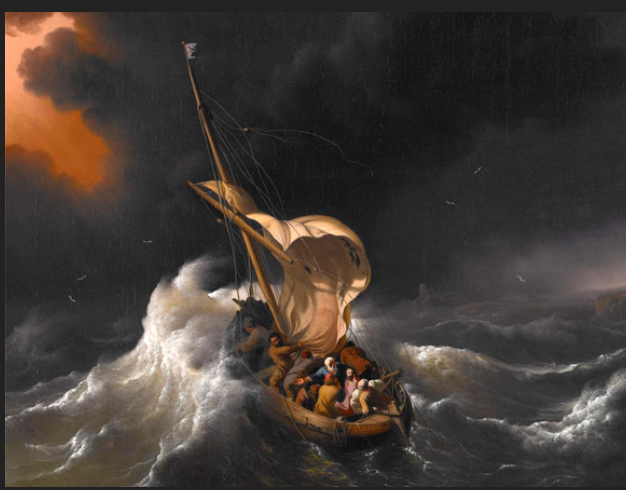
The disciples, who were in discovery mode regarding Jesus’ identity, entered just such a situation as they rowed across the Sea of Galilee. Jesus had fallen asleep before the storm arose and continued to slumber, despite the increasing intensity of the wind and waves. The disciples, all experienced fishermen, feared for their lives. It must have been a severe tempest. When their fear outweighed their competence as sailors, not knowing what else to do, they awakened their Master and informed him of the situation.

The disciples went and woke him up, shouting, “Master, Master, we’re going to drown!” When Jesus woke up, he rebuked the wind and the raging waves. The storm stopped and all was calm! 25  Then he asked them, “Where is your faith?” The  disciples were terrified and amazed. “Who is this man?” they asked each  other. “When he gives a command, even the wind and waves obey him!” Luke 8:24-25 (NLT)  

Here are some principles we can derive from the above passage that can help us survive and thrive in the storms that God allows in our own lives.

  1. Calm your soul in God’s presence. If Jesus is not upset, why should we be? Take your cue from the Lord. Listen to the voice of God’s Spirit when you are in the storm. He will tell you what to do.
  2. Think about who you are and God’s purpose for your life. If the disciples had given some thought to their situation, they would have realized that the Messiah was not going to drown. God also will guard our lives and keep us safe as long as we are supposed to be here on the earth.
  3. Remind yourself of God’s power and sovereignty in your life. God is in control of every situation. Faith in his sovereign power is essential, if we are to remain at peace during the storm. Remember Romans 8:28: God is working all things for good in our lives.
  4. Pray for God to be glorified in your situation. This is the fatal dagger we can thrust into fear. When God’s glory becomes our goal, fear has to go.
  5. Ask the Holy Spirit to reveal more of Christ to you. If we have eyes to see, ears to hear, and an understanding heart, the Holy Spirit will open our eyes to see who Jesus really is. He is more than a man: He is the Sovereign Lord. A storm is an ideal place for us to have our understanding enlarged.

Are you going through a storm right now? Don’t panic. Turn to Jesus and ask him to handle it for you. Ask the Holy Spirit to open your spiritual eyes and enlarge your faith. Don’t miss the opportunity. Don’t waste your storm.


Are You Stuck? Confused? Desperate?

follow me


Life is a journey with plenty of ups and downs, easy times and difficulties, which may influence us to feel stuck, confused, or even desperate. All of us must make important choices along the way, and these decisions often have far reaching consequences. Sometimes we can back away from a bad decision and get back on the right path. Other decisions we make tend to lock us into a bad outcome that may leave us feeling stuck, confused, or desperate.

All believers have the Bible to guide them. It is up to us to study God’s word and familiarize ourselves with the truths it teaches, seeking to apply them to each life situation.

Your word is a lamp to guide my feet and a light for my path. Psalm 119:105 (NLT) 

In addition, Jesus is the Lord of life and positions himself at every fork in the road in each of our life journeys, offering his guidance and protection, if we will choose to walk with him. All believers are indwelled by God’s own Spirit who guides us from within. Every follower of Christ has the ability to hear his voice and sense his guidance.

"My sheep hear My voice, and I know them, and they follow Me; John 10:27 (NASB) 

Even when we do not have any objective way to discern his voice, we know that the Spirit guides us nevertheless in imperceptible ways.

These pivotal forks in the road on our life journey test our willingness to follow the Spirit and our ability to trust in God and his power, protection, provision, wisdom, and love.

If we are not yet at a place where we are able to trust in God, we generally try to figure out things for ourselves and rely on whatever strengths and understanding we think we have. By nature, we generally tend to become independent operators in a world which God designed for us to continually depend on him. Whenever we choose to walk alone, it often leads to an increasingly difficult and confusing path, causing much consternation and, eventually, desperation. Sin invariably produces bad consequences, even if they are slow in coming.

If we choose to walk away from Jesus and his path for us, he will pursue us, using the difficulties that we encounter will help us to come to our senses and return to him and his path of life.

People tend to get stuck in life when we are unable to trust God in some area and fail to take the road Jesus offers. There are multiple reasons why we get stuck: fear, pride, rebelliousness, greed, lust, and the list goes on. Basically, we get stuck or choose wrong paths when we love something or someone more than we love God. This is what the Bible calls idolatry. Idols can do nothing for us except strip us of our dignity and drain the very life out of us. Serving false gods is based on having false beliefs and false hopes. Jesus is the only One who offers real life and hope. He is the only One who can be safely trusted.

Are you stuck? Have you become increasingly aware that somewhere along the way you took a wrong turn, and now things have gotten dark and confusing? Are you finally ready to surrender your life to Jesus? You can be assured that he has been keeping a watchful eye upon you, waiting for the turnaround. If you return to him, he will never ever reject or belittle you. Instead, he will place your feet back on the highway of life and remove the desperation and confusion. It’s good to be back under the Shepherd’s care.

O people of Zion, who live in Jerusalem, you will weep no more. He will be gracious if you ask for help. He will surely respond to the sound of your cries. 20  Though the Lord gave you adversity for food and suffering for drink, he will still be with you to teach you. You will see your teacher with your own eyes. 21  Your own ears will hear him. Right behind you a voice will say, “This is the way you should go,” whether to the right or to the left. 22  Then you will destroy all your silver idols and your precious gold images. You will throw them out like filthy rags, saying to them, “Good riddance!” Isaiah 30:19-22 (NLT)  

Beware of Mass Deception in the Last Days

deception


We live in a time when lying has become an art form practiced by the mainstream media and politicians. Joseph Goebbels, the infamous Nazi propagandist, said these words in Nuremberg in 1934 as he was helping the Nazis gain and maintain power.

The people should share the concerns and successes of its government. Its concerns and successes must therefore be constantly presented and hammered into the people so that it will consider the concerns and successes of its government to be its concerns and successes. Only an authoritarian government, firmly tied to the people, can do this over the long term. Political propaganda, the art of anchoring the things of the state in the broad masses so that the whole nation will feel a part of them, cannot therefore remain merely a means to the goal of winning power. It must become a means of building and keeping power. (http://research.calvin.edu/german-propaganda-archive/goeb59.htm)

Propaganda is the art and science of manipulating information to cause the masses to think and act in a desired way.

What would have been unthinkable fifty years ago is happening in the United States right now. We are being subjected to a Nazi or Soviet-like blitz of propaganda by a mainstream media that is complicit with the Democratic Party’s efforts to overthrow our constitutional republic. Whether or not they succeed will determine to large degree what our nation becomes. If they succeed, we will descend into dark totalitarianism, which will undoubtedly lead to persecution of truth speakers, especially Christians. How did we get here?

The Origins of Deception

Since the beginning of humanity, according to the Bible, people have displayed an inherent tendency to believe lies more than truth.

Adam and Eve fell for the serpent’s mis-characterization of God, even though the Creator had been only wonderfully kind to them. We learn from the Genesis account that, even in their most pristine state, Adam and Eve were easily deceived. At that moment of disobedience, Satan gained a foothold in the human race.

Sin entered our hearts, deforming our ability to reason properly.We have become even more susceptible to deception than our first parents were because now we are born with a default propensity to deceive and be deceived.

Some people call this the sin nature. No one needs to teach a baby how to sin. It comes naturally.

Jesus identified Satan is the “father of lies.” (John 8:44) Satan is an evil mastermind and the arch-propagandist. He is able to manipulate entire nations, as was the case with Nazi Germany and is becoming increasingly the case with the United States.

When the thousand years come to an end, Satan will be let out of his prison. 8  He will go out to deceive the nations—called Gog and Magog—in every corner of the earth. He will gather them together for battle—a mighty army, as numberless as sand along the seashore. Revelation 20:7-8 (NLT)  

There are various ways to interpret this passage, but, as I see it, we are seeing this happening right before our eyes. Mass deception is taking place on a global scale as the nations seem to be aligning themselves against God’s people in preparation for an apocalyptic battle. Whether or not you agree with my interpretation, I hope you can agree that Satan has the ability to deceive on a grand scale. How does he do this?

As I already mentioned, every person comes into the world with a built-in sin nature that defaults toward doubting God and embracing lies. If we refuse to acknowledge and glorify God as our Creator, it is a form of idolatry. We are going to believe in something. If we do not accept the truth about God, then we will fall for something else.

Satan gains a foothold into people’s minds when they embrace some form of idolatry.

Any time a person or a society rejects the truth about God and chooses to believe something else, they are given over to what the Bible calls an “unfit mind.” People like this lose their ability to think critically and easily fall victim to propaganda.

I will add my own notes, which are in blue italics, to the following Bible passage that clearly addresses this subject.

For the wrath of God is revealed from heaven against all ungodliness and unrighteousness of men, who by their unrighteousness suppress the truth. [Truth must be suppressed for lies to flourish. Our government has systematically repressed the truth about creation for decades through propaganda about "evolution," producing generations of students who reject God and easily believe lies.19  For what can be known about God is plain to them, because God has shown it to them. 20  For his invisible attributes, namely, his eternal power and divine nature, have been clearly perceived, ever since the creation of the world, in the things that have been made. So they are without excuse. [Little children know intuitively that there is a God. If our minds were not darkened by sin, we would see God's hand all around us in the world he has made. We have to be conditioned not to see this.]  21  For although they knew God, they did not honor him as God or give thanks to him, but they became futile in their thinking, and their foolish hearts were darkened. [What else can account for our government’s routine denial of the severity of the external threats against our nation? We have lost our ability to think and are deluded that our enemies are of no real consequence.22  Claiming to be wise, they became fools, 23  and exchanged the glory of the immortal God for images resembling mortal man and birds and animals and creeping things. 24  Therefore God gave them up in the lusts of their hearts to impurity, to the dishonoring of their bodies among themselves, 25  because they exchanged the truth about God for a lie and worshiped and served the creature rather than the Creator, who is blessed forever! Amen. [Our nation has been given over to sensuality and immorality. That which for centuries has been called sin is now being embraced as good and normal.26  For this reason God gave them up to dishonorable passions. For their women exchanged natural relations for those that are contrary to nature; 27  and the men likewise gave up natural relations with women and were consumed with passion for one another, men committing shameless acts with men and receiving in themselves the due penalty for their error. 28  And since they did not see fit to acknowledge God, God gave them up to a debased [Greek: adikomos – failing to be approved, unfit] mind to do what ought not to be done. Romans 1:18-28 (ESV)

The principle here is simple: if people embrace the truth about God, they will more likely be able to think correctly, but if we reject the truth about God, we lose our ability to properly reason.

As a nation, the United States has progressively rejected God and his truth. We eliminated prayer and Bible reading from the classroom, and outlawed the teaching of creationism. As with other examples of classic propaganda, those is power have gained ownership of the language and use terms that frame their goals in the most favorable light. For example, abortion, the termination of a living baby in the womb, has been reframed as a woman’s “right” and a non-negotiable part of “reproductive freedom.”

What is called “progressivism” is actually a calculated push toward totalitarianism and requires a wholesale abdication of Bible truth and a manipulation of the populace toward the desired end of globalist control.

Last Days Deception

Those of us who fear God can see what is happening, and it does not surprise us at all. Those who do not know Christ do not have the Holy Spirit, who is also called the Spirit of truth (John 14:17), residing in them.

The Holy Spirit gives believers a love for the truth. This truth is found in Christ, who is called the Truth (John 14:6) and in the Bible. (John 17:17). Those without the Spirit love lies. This is one way we can distinguish between those who truly know God and those who do not. Those who do not know him easily all for mass deception.

Jesus told them, “If God were your Father, you would love me, because I have come to you from God. I am not here on my own, but he sent me. 43  Why can’t you understand what I am saying? It’s because you can’t even hear me! 44  For you are the children of your father the devil, and you love to do the evil things he does. He was a murderer from the beginning. He has always hated the truth, because there is no truth in him. When he lies, it is consistent with his character; for he is a liar and the father of lies. 45  So when I tell the truth, you just naturally don’t believe me! John 8:42-45 (NLT) 

The Bible predicts this kind of mass deception in the last days. Jesus warned us:

Then if anyone says to you, ‘Look, here is the Christ!’ or ‘There he is!’ do not believe it. 24  For false christs and false prophets will arise and perform great signs and wonders, so as to lead astray, if possible, even the elect. Matthew 24:23-24 (ESV)

In his seminal book, The Islamic Antichrist, Joel Richardson points out that Muslims have their own doctrines of the end times. They state that Jesus was not resurrected because he never really died. Instead, God took him to heaven, where he remains until he will return to earth as second in command to the Mahdi, commanding the nations to convert to Islam and worship Allah. What deception could be greater? The Bible warns us that an Antichrist is coming (the Mahdi?) who will be served and accompanied by a false prophet, who will do signs and wonders to convince people to follow the Antichrist. This sounds very much in line with the Islamic version of Christ. If this happens, those who are nominal Christians will probably be completely deceived, along the rest of the world. Those of us who know the truth will not fall for this, however.

Paul wrote:

Let no one in any way deceive you, for it [the Second Coming] will not come unless the apostasy comes first, and the man of lawlessness is revealed, the son of destruction, 4  who opposes and exalts himself above every so-called god or object of worship, so that he takes his seat in the temple of God, displaying himself as being God. 5  Do you not remember that while I was still with you, I was telling you these things? 6  And you know what restrains him now, so that in his time he will be revealed. 7  For the mystery of lawlessness is already at work; only he who now restrains will do so until he is taken out of the way. 8  Then that lawless one will be revealed whom the Lord will slay with the breath of His mouth and bring to an end by the appearance of His coming; 9  that is, the one whose coming is in accord with the activity of Satan, with all power and signs and false wonders, 10  and with all the deception of wickedness for those who perish, because they did not receive the love of the truth so as to be saved. 11  For this reason God will send upon them a deluding influence so that they will believe what is false, 12  in order that they all may be judged who did not believe the truth, but took pleasure in wickedness. 2 Thessalonians 2:3-12 (NASB)


What must we do?

Here are some recommendations for those of us who understand the signs of the times.

  • Pray for God to open the eyes of the blind. Ask the Holy Spirit to remove the blinders from the eyes and unstop the ears of those who do not yet know Christ. Faith in Christ and surrender to his Lordship is the only means of escape from the mass deception that is descending upon the world.
  • Pray for our leaders. Ask the Lord to give our leaders insight and courage to do the right thing, despite the incessant onslaught of the “false prophets” in the mainstream media and educational establishment.
  • Pray for God to uncover hidden wickedness in high places. The “lie” prospers under the cover of darkness. Ask the the Lord to expose evil, wherever it may be, especially in places of power and influence.
  • Repent of any wickedness in our own lives. We must embrace truth personally, if we want this to happen on a national level.
  • Speak the truth courageously and with love. Evil people prosper when good people do nothing.
  • Share the Gospel. The Gospel is the only means for liberating deceived people. We can pray until we drop, but if we do not share the Good News and give the Holy Spirit the opportunity to convert people, nothing much will change. When a large number of people in a nation surrender their lives to Jesus’ lordship, things will improve.

Is it okay for a follower of Christ to be a Mason?

deception


It is just as outlandish for a follower of Christ to be a Mason as it would be to be a Satanist.

The devil seldom appears as he truly is. Deception is his main game. The Apostle Paul wrote that Satan disguises himself as an angel of light in order to deceive the naive. (2 Corinthians 11:14) In the Garden of Eden, the devil appeared as a talking serpent in order to convince Eve that God was not to be trusted. (Genesis 3:4-5) Satan always tries to reverse the truth, presenting himself as good and the true God as evil. This is exactly the position of the Masons.

Albert Pike wrote quite a bit of material on the Masons and is regarded as an authority on the subject by the Masons. Wikipedia claims the following.

Pike first joined the fraternal Independent Order of Odd Fellows in 1840. He next joined a Masonic Lodge, where he became extremely active in the affairs of the organization. In 1859 he was elected Sovereign Grand Commander of the Scottish Rite’s Southern Jurisdiction.[10] He remained Sovereign Grand Commander for the remainder of his life (a total of thirty-two years), devoting a large amount of his time to developing the rituals of the order.[18] Notably, he published a book called Morals and Dogma of the Ancient and Accepted Scottish Rite of Freemasonry in 1871, of which there were several subsequent editions. This helped the order grow during the nineteenth century. He also researched and wrote the seminal treatise Indo-Aryan Deities and Worship as Contained in the Rig-Veda. In America, Pike is still considered an eminent[19] and influential[20] Freemason, primarily in the Scottish Rite Southern Jurisdiction.[21]

Here are some relevant quotes from Pike’s works.

Lucifer, the Light-Bearer! Strange and mysterious name to give to the Spirit of Darkness! Lucifer, the Son of the Morning! Is it he who bears the light, and with its splendors intolerable blinds feeble, sensual or selfish Souls? Doubt it not! [Albert Pike, Morals and Dogma of the Ancient and Accepted Scottish Rite of Freemasonry Prepared for the Supreme Council of the Thirty-Third Degree, for the Southern Jurisdiction of the United States, and Published by Its Authority (Richmond, Virginia: L.H. Jenkins, 1871, Reprinted 1944): 321.]

The true name of Satan, the Kabalists say, is Yahweh (GOD) reversed; for Satan is not a black god, but a negation of God…the Kabala imagined Him to be a “most occult light.” [Ibid: 102, 704.]

That which we must say to a crowd is—We worship a God, but it is the God that one adores without superstition. To you, Sovereign Grand Inspectors General, we say this, that you may repeat it to the Brethren of the 32nd, 31st, and 30th degrees—The Masonic Religion should be, by all of us initates of the high degrees, maintained in the purity of the Luciferian Doctrine. If Lucifer were not God, would Adonay whose deeds prove his cruelty, perdify and hatred of man, barbarism and repulsion for science, would Adonay and his priests, calumniate him? Yes, Lucifer is God, and unfortunately Adonay is also god. For the eternal law is that there is no light without shade, no beauty without ugliness, no white without black, for the absolute can only exist as two gods: darkness being necessary to the statue, and the brake to the locomotive. Thus, the doctrine of Satanism is a heresy; and the true and pure philosophical religion is the belief in Lucifer, the equal of Adonay; but Lucifer, God of Light and God of Good, is struggling for humanity against Adonay, the God of Darkness and Evil. [Albert Pike, “Instructions to the 23 Supreme Councils of the World” (July 14, 1889), as recorded by Abel Clarin de La Rive, La Femme et l’Enfant dans la Franc-maçonnerie Universelle (1894): 588.]

Freemasonry is a secret society. This is because they have something to hide. They force members to swear self-maledictory oaths that pledge their secrecy. Why? Jesus did everything in the open. Christians should not swear oaths, should not swear self-malediction, and should never be part of any group that calls the devil good and the true God bad. Freemasonry deceives its own members.

“The Blue Degrees are but the outer court or portico of the Temple. Part of the symbols are displayed there to the Initiate, but he is intentionally misled by false interpretations. It is not intended that he shall understand them; but it is intended that he shall imagine he understands them. Their true explication is reserved for the Adepts, the Princes of Masonry.” (Morals and Dogma, p.819) Albert Pike, [1871 Morals and Dogma: Council of Kadosh: XXX. Knight Kadosh.

Freemasonry is essentially a cleaned up paganism, which places a Bible front and center to deceive the naive.

According to accredited Masonic historians, the lodge claims to be a revival of the ancient philosophy of Egypt, Phoenicia and other pagan nations. These all practiced a secret worship in honor of a sun god (Lucifer). While pagan societies sponsored public worship directed toward idols, the priests, rulers and philosophers always maintained a different, secret worship centered around a sun god. This latter was designated as the “Mysteries.” These “Mysteries” were revived by the “Masonic fathers” at the beginning of the eighteenth century.

In other words what formerly constituted the mysteries of freemasonry. In every feature they are identical. Dr. Mackey, Masonic authority, states they are the “same in substance, being derived from one source and celebrated in honor of the same dieites.” Pierson says plainly “…we readily recognize in Hiram Abiff the Osiris of the Egyptians, the Mithras of the Persians, the Bacchus of the Greeks, the Dionysiius of the Fraternity of the Artificers, the Atys of the Phrygians, whose passion, death and resurrection were celebrated by these people.” [http://www.jesusdelivers.com/the-demonic-roots-of-freemasonry]

Freemasonry incorporates parts of various pagan religions while pretending to be above and inclusive of all religion. As such it is explicitly anti-Christ. Jesus said that he alone is the way to the Father. (John 14:6) He is not one of many ways to God. He is the only way. Freemasonry asserts that its members can come to God using any religious pathway.

Below is a great summary of why Christianity and Masonry are completely incompatible. It is found in GotQuestions.org. (https://www.gotquestions.org/free-masonry.html)

Salvation from Sin:

The Bible’s View: Jesus became the sinner’s sacrifice before God when He shed His blood and died as the propitiation (payment) for the sins of all those who would ever believe (Ephesians 2:8-9, Romans 5:8, John 3:16).

Mason’s View: The very process of joining the Lodge requires Christians to ignore the exclusivity of Jesus Christ as Lord and Savior. According to Freemasonry, a person will be saved and go to heaven as a result of his good works and personal self-improvement.

The View of the Bible:

The Bible’s View: The supernatural and plenary inspiration of the Scriptures—that they are inerrant and that their teachings and authority are absolute, supreme, and final. The Bible is the Word of God (2 Timothy 3:16, 1 Thessalonians 2:13).

Mason’s View: The Bible is only one of several “Volume(s) of Sacred Law,” all of which are deemed to be equally important in Freemasonry. The Bible is an important book, only as far as those members who claim to be Christians are concerned, just as the Koran is important to Muslims. The Bible is not considered to be the exclusive Word of God, nor is it considered to be God’s sole revelation of himself to humankind; but only one of many religious sourcebooks. It is a good guide for morality. The Bible is used primarily as a symbol of God’s will, which can also be captured in other sacred texts, like the Koran or Rig Vedas.

The Doctrine of God:

The Bible’s View: There is one God. The various names of God refer to the God of Israel and reveal certain attributes of God. To worship other gods or to call upon other deities is idolatry (Exodus 20:3). Paul spoke of idolatry as a heinous sin (1 Corinthians 10:14) and John said that idolaters will perish in hell (Revelation 21:8).

Mason’s View: All members must believe in a deity. Different religions (Christianity, Judaism, Islam, etc.) acknowledge the same God, only call Him different names. Freemasonry invites people of all faiths, even if they use different names for the ‘Nameless One of a hundred names,’ they are yet praying to the one God and Father of all.

The Doctrine of Jesus and the Trinity:

The Bible’s View: Jesus was God in human form (Matthew 1:18-24, John 1:1). Jesus is the second person of the trinity (Matthew 28:19, Mark 1:9-11). While on earth, He was fully human (Mark 4:38, Matthew 4:2) and fully divine (John 20:28, John 1:1-2, Acts 4:10-12). Christians should pray in Jesus’ name and proclaim Him before others, regardless of offense to non-Christians (John 14:13-14, 1 John 2:23, Acts 4:18-20).

Mason’s View: There is no exclusivity in Jesus Christ or the Triune God who is the Father, Son, and Holy Spirit; therefore there is no doctrine of the deity of Jesus Christ. It is deemed to be un-Masonic to invoke the name of Jesus when praying, or mention His name in the Lodge. Suggesting that Jesus is the only way to God contradicts the principle of tolerance. The name of Jesus has been omitted from biblical verses that are used in Masonic rituals. Jesus is on the same level as other religious leaders.

Human Nature and Sin:

The Bible’s View: All humans are born with a sinful nature, are totally depraved, and need a Savior from sin (Romans 3:23, Romans 5:12, Psalm 51:5, Ephesians 2:1). The Bible denies that because of the Fall, humanity has within itself the capacity for moral perfection (1 John 1:8-10, Romans 1:18-25).

Mason’s View: Through symbols and emblems, Masons teach that man is not sinful, just “rude and imperfect by nature”. Human beings are able to improve their character and behavior in various ways, including acts of charity, moral living, and voluntary performance of civic duty. Humanity possesses the ability of moving from imperfection toward total perfection. Moral and spiritual perfection lies within men and women.

When a Christian takes the oath of Freemasonry, he is swearing to the following doctrines that God has pronounced false and sinful:

1. That salvation can be gained by man’s good works.
2. That Jesus is just one of many equally revered prophets.
3. That they will remain silent in the Lodge and not talk of Christ.
4. That they are approaching the Lodge in spiritual darkness and ignorance, when the Bible says Christians are already in the light, children of the light, and are indwelt by the Light of the World—Jesus Christ.
5. By demanding that Christians take the Masonic oath, Masonry leads Christians into blasphemy and taking the name of the Lord in vain.
6. Masonry teaches that its G.A.O.T.U. [Great Architect of the Universe], whom Masonry believes is the true God of the universe, is representative of all gods in all religions.
7. Masonry makes Christians take a universalist approach in their prayers, demanding a “generic” name be used so as not to offend non-believers who are Masonic “brothers”.
8. By swearing the Masonic oath and participating in the doctrines of the Lodge, Christians are perpetuating a false gospel to other Lodge members, who look only to Masonry’s plan of salvation to get to heaven. By their very membership in such a syncretistic type organization, they have severely compromised their witnessing as Christians.
9. By taking the Masonic obligation, the Christian is agreeing to allow the pollution of his mind, spirit, and body by those who serve false gods and believe false doctrines.

As you can see, Masonry denies and contradicts the clear teaching of Scripture on numerous issues. Masonry also requires people to engage in activities which the Bible condemns. As a result, a Christian should not be a member of any secret society or organization that has any connection with Freemasonry.

Faith’s Reward

follow me


Faith is the lynch pin upon which hangs our salvation. The author of Hebrews spent an entire chapter illustrating this (Hebrews 11), which he summarized as follows.

And it is impossible to please God without faith. Anyone who wants to come to him must believe that God exists and that he rewards those who sincerely seek him. Hebrews 11:6 (NLT) 

Faith is the central thing God is looking for in us. We really don’t bring a whole lot to the table when we approach God besides faith. As we covered in the first article in this series, faith is loyalty to God because we are convinced that he is absolutely trustworthy. Faith honors God. Our faith opens the door for everything else. God sends his Spirit to indwell and transform those who believe, propelling us toward God’s goal for our lives – that we become like Jesus.

And we know that God causes everything to work together for the good of those who love God and are called according to his purpose for them. 29  For God knew his people in advance, and he chose them to become like his Son, so that his Son would be the firstborn among many brothers and sisters. Romans 8:28-29 (NLT) 

God’s honor and glory is always the most important thing, but, since our Lord is the kindest and most loving Being, he always chooses to share what he has with those who trust in him.

Faith is a gift from God (Ephesians 2:8) administered by the Spirit of God, who is also called the Spirit of faith (2 Corinthians 4:13). We cooperate with God’s gift and Spirit by choosing to believe the gospel message of his resurrection from our hearts and giving Christ our full allegiance.

The Christian life can be thought of as an opportunity to display our loyalty to Christ, no matter what we may encounter.

Thinking of faith as allegiance helps make sense of why God allows us to face and endure difficulties, tests, and trials of our faith. As we maintain our faithfulness in the midst of these things, it brings great glory to God. And God, the most generous beings of all, will not let such allegiance go unrewarded.

All praise to God, the Father of our Lord Jesus Christ. It is by his great mercy that we have been born again, because God raised Jesus Christ from the dead. Now we live with great expectation, 4  and we have a priceless inheritance—an inheritance that is kept in heaven for you, pure and undefiled, beyond the reach of change and decay. 5  And through your faith, God is protecting you by his power until you receive this salvation, which is ready to be revealed on the last day for all to see. 6  So be truly glad. There is wonderful joy ahead, even though you have to endure many trials for a little while. 7  These trials will show that your faith is genuine. It is being tested as fire tests and purifies gold—though your faith is far more precious than mere gold. So when your faith remains strong through many trials, it will bring you much praise and glory and honor on the day when Jesus Christ is revealed to the whole world. 1 Peter 1:3-7 (NLT)  

Therefore, the difficulties and tests we face in life are not pointless exercises in frustration and futility. Quite the opposite, seen in the correct light, they are God-given opportunities to earn eternal reward by maintaining loyalty to our unseen God.

Jesus accomplished this when he died on the cross. He kept his eyes on the reward by faith, which gave him the strength and endurance to continue faithful to the end.

Therefore, since we are surrounded by such a huge crowd of witnesses to the life of faith, let us strip off every weight that slows us down, especially the sin that so easily trips us up. And let us run with endurance the race God has set before us. 2  We do this by keeping our eyes on Jesus, the champion who initiates and perfects our faith. Because of the joy awaiting him, he endured the cross, disregarding its shame. Now he is seated in the place of honor beside God’s throne. 3  Think of all the hostility he endured from sinful people; then you won’t become weary and give up. Hebrews 12:1-3 (NLT)  

Never cast away your faith. It has a great reward.

So do not throw away this confident trust in the Lord. Remember the great reward it brings you! 36  Patient endurance is what you need now, so that you will continue to do God’s will. Then you will receive all that he has promised. Hebrews 10:35-36 (NLT)  

Faith Is Boldly Courageous

follow me


By its nature, faith takes action. God is not fearfully passive, and neither are people of faith. Faith is convinced that what God says is true and lives accordingly. When we know that God is our Creator – Sustainer – Redeemer – Provider – Lord who keeps his promises, it gives us an enormous amount of confidence. If God will always be with us and has our back in every situation, we know that we can act boldly and courageously. If we know that God is ultimately in control of every situation, we can joyfully encounter the unknown and thrive in the midst of uncertainty. If we are convinced that death cannot defeat us, that life extends beyond the grave, and that Jesus holds the keys of hell and death, we can boldly face death and suffering.

Faith is known by its boldness and courage.

One of my favorite stories in the Bible is about Gideon, the timid man that God converted into a mighty warrior and leader of Israel. I will not recount the story here, but I encourage you to read it in its entirety. (Judges 6-7) Suffice it to say that God took a man who was afraid of his enemies and too timid to lead and made him into a fearless warrior who led Israel to victory in a battle against ridiculous odds. It was possible because God convinced him that he would always be with him. When God is with us, it is enough. That is what he told Moses (Exodus 3:11-12), Joshua (Joshua 1:5), and what he tells us. (John 14:16-17)

The first key to boldness and courage is knowing that God will always be with us.

A second component of the boldness and courage that belong to faith is being sure to what God has called us to do and embracing it.  Going back to Gideon, it took quite a bit of convincing to get that man to buy into God’s seemingly outlandish plan, but when he did, there was no turning him back. The steps in Gideon’s development were as follows:

  1. The Call. God called Gideon a mighty warrior and proceeded to give him a job to deliver Israel from her enemies. The call seemed crazy to Gideon, but he was willing to go with God on a faith journey. God revealed himself to Gideon as Jehovah-Shalom, the God who is peace, as he set him on a collision course with the enemies of God. God gives us peace as we stand strong in faith against God’s enemies.
  2. The First Test. God commanded Gideon to confront the idolatry in his family and tribe. If he could face the wrath of his own people, it would help prepare him to take on a vast enemy army. God was with him and protected him after he tore down the community altar to a false god.
  3. The Commission to Do the Impossible. God called Gideon to lead Israel into battle against an enemy whose forces were astronomically larger than his. It made no sense, but God went to great pains and was very patient with our reluctant hero in order to convince him that it was really God asking him to do this. Once that happened, Gideon was fearless. Faith enters our hearts when we know for sure what God wants us to do.
  4. The Victory. Gideon followed God’s specific instructions and led 300 God-selected men against an army of 135,000. That is 450 to 1! Numbers do not matter to God. All that matters to him is having people who boldly and courageously follow him.

Jesus called his disciples to go to “war” against equally impossible odds. The Jewish leaders and the Roman empire opposed them and their message. Jesus taught his disciples to boldly face death and persecution as his representatives, which they did. The early disciples were convinced that the Spirit of God was with them, that the gospel message would eventually triumph, and that death and pain were nothing to be feared. As John wrote:

Then I heard a loud voice shouting across the heavens, “It has come at last— salvation and power and the Kingdom of our God, and the authority of his Christ. For the accuser of our brothers and sisters has been thrown down to earth— the one who accuses them before our God day and night. 11  And they have defeated him by the blood of the Lamb and by their testimony. And they did not love their lives so much that they were afraid to die. 12  Therefore, rejoice, O heavens! And you who live in the heavens, rejoice! But terror will come on the earth and the sea, for the devil has come down to you in great anger, knowing that he has little time.” Revelation 12:10-12 (NLT)  

My friends, I hope this meditation does not seem to be to you a lesson in ancient history. The accuser of the brethren, the devil, is still at work. We see him in operation on a daily basis as the politics of the day plays out. Our president has been constantly accused of being treasonous and illegitimate since his election. Those who follow the media have heard the chorus for his impeachment literally “day and night.” Those who vilify and curse authority are at war with God himself, who is the one who appoints all authority.

Everyone must submit to governing authorities. For all authority comes from God, and those in positions of authority have been placed there by God. 2  So anyone who rebels against authority is rebelling against what God has instituted, and they will be punished. Romans 13:1-2 (NLT)  

Whether or not leaders are righteous, we are still called to respect and obey them whenever they do not command us to do things that oppose God’s commands or our conscience. We should not think for a moment that the Left is merely opposing our president. We are in the midst of a movement to overthrow all vestiges of Christianity in our country.

Many Christians are concerned with what they perceive to be the increasing secularization of popular culture today. They express concern that Christianity will one day become hated and persecuted in America as it is in much of the world. That day may not be far off. (Life Site News)

Those who seek to conserve the founding values of our nation were described by then President Obama as “bitter” people” who cling to guns, religion, and hatred of those unlike them. This does not do justice to the Christians I know who oppose the godless drift of our culture and nation, but who care about their neighbors. As the nation rapidly shifts to a “Progressive” (shall we be honest and say, “communist”?) mindset, those who hold to Christ and his teachings are being positioned more and more like a group of people who stand in the way of enlightened progress. It is not hard to imagine the nation turning on us. I believe that we must prepare ourselves for the persecution that is surely coming. My friends, the Last Days are upon us.

Whether or not such a Last Days scenario actually develops in the near future, followers of Christ are called, like Gideon, to face up to a seemingly unconquerable foe, our culture, with courage and zeal.

We are not fighting with conventional weapons of war. We do battle in the spiritual realm.

For we are not fighting against flesh-and-blood enemies, but against evil rulers and authorities of the unseen world, against mighty powers in this dark world, and against evil spirits in the heavenly places. Ephesians 6:12 (NLT) 

Part of the genius of Christianity is that we overcome by spiritual means – the blood of the Lamb, the word of our testimony, and courageous faith often leading to martyrdom.

Perhaps we will one day take our place in the history of Christianity alongside other martyrs. We shall see. Be strong in faith.

Be on guard. Stand firm in the faith. Be courageous. Be strong. 14  And do everything with love. 1 Corinthians 16:13-14 (NLT)  
Share this post...