
Chapter 100: How God Removes Deeply Embedded Lies

This lesson will show how God helps us to remove deeply embedded lies that are the building blocks for powerful logical arguments that block us from knowing God or believing his promises. One of the major ways Jesus sets us free from bondage is by identifying and removing deeply embedded lies and replacing them with truth.

Once the darkness of the lie is exposed to the light of God’s truth, it loses its power to control us.

According to Paul, these “lie-based” strongholds are built upon sinful logic and reasoning that opposes the truth of God’s Word and tempts us to impugn God’s character.

For though we walk in the flesh, we do not war according to the flesh, 4 for the weapons of our warfare are not of the flesh, but divinely powerful for the destruction of fortresses. 5 We are destroying speculations and every lofty thing raised up against the knowledge of God, and we are taking every thought captive to the obedience of Christ,  2 Corinthians 10:3–5 (NASB95)

Satanic lies are extremely deceptive, and often we do not even realize that we believe and serve them until the Holy Spirit shows us.

An important concept for us to grasp is that we can believe one thing in our minds and quite another thing at the heart level.

Lie-based strongholds are built upon stubbornly held internal arguments and conclusions (or speculations) which are based on our observations and experience of life. We may have good theology at an intellectual level but be practical idolators or atheists at the heart level. What we claim to believe may be betrayed by how we act or speak. If there is a disconnect between our words and actions, there may be embedded lies hidden deep in our hearts that must be identified and expelled.

If we react with negative emotions out of proportion to the provocation, this may point to the presence of a painful lie-based stronghold in our lives. What we do, say, and think when we are under pressure can reveal what we really believe down deep.

Unless we allow the Lord to reveal what these lies are and replace them with a revelation of himself and his truth, we likely will stay in bondage. Lie-based strongholds resist most attempts to remove them; so, simple debate is usually fruitless. We cannot reason with fear and unbelief. It takes divine intervention.

An Example of a Logical Stronghold Built on Lies

Over the years I have been privileged to work with many sexual abuse victims. Any person who has experienced the betrayal and traumatic pain associated with abuse as a child at the hands of people who should have protected him or her, will often have great difficulty trusting God for protection as an adult. I think this should be rather obvious.

The argument will probably sound like the following. God did not protect me from being abused when I was young; so, why should I trust him to do so now? Either he was not able to protect me or chose not to protect me then. What is different now? This logic seems to be impregnable because it is based on personal experience, which cannot be denied.

We must concede that God, since he is almighty and sovereign, did allow the abuse to happen. Logically, based on the interpretation of his or her personal experience, the person feels justified in concluding that God cannot be trusted. This argument can hold us tenaciously in its grip despite the Bible’s clear teaching that God is our loving and powerful defender and Keeper. (Psalm 121:7-8) This is a perfect example of a lie-based stronghold, one which I have seen God help several people to overcome.

The foundational lie of this stronghold is that God is not trustworthy. This is the same lie that Satan presented to Eve in the Garden. It is perhaps the most insidious of all lies, especially when we are presented with seemingly inescapable logical proof that it is so. Perhaps you know someone whose faith in God was derailed by such an argument. I do. Anyone captured by this satanic logic is in deep trouble, and without the help of the Holy Spirit, probably will stay enslaved by the lie.

How does God liberate us?

We tend to believe what we see and experience more than we believe God and his promises because deep down we are fiercely independent sinful beings.

When we are born again, we receive a new identity. Our reborn spirit is joined to and loves the Lord. (1 Corinthians 6:17 and 2 Corinthians 5:17). However, even though our spirits are reborn, we still have a connection to Adam’s sinful independence through our yet unresurrected bodies, which the Bible calls “the flesh” (Greek: sarx). We are beings who are a combination of a new creation spirit and an old creation not yet resurrected body. Our souls (mind, will and emotions – the personality) are conflicted as a result. (I have written about this extensively in my series, Living Free in the Spirit.) We have a sort of “split personality.”

For I joyfully concur with the law of God in the inner man, 23 but I see a different law in the members of my body, waging war against the law of my mind and making me a prisoner of the law of sin which is in my members.  Romans 7:22–23 (NASB95)

Part of us loves God deeply and wants to serve him, but the “flesh” still wants to be an outlaw and live off God’s grid. The “flesh,” still insists on making its own decisions and evaluations instead of relying upon the Lord and trusting his words. The “flesh” never disappears, until the resurrection, and cannot be rehabilitated. According to Paul, the “flesh” was crucified with Christ and must be constantly put to death by us.

For while we were in the flesh, the sinful passions, which were aroused by the Law, were at work in the members of our body to bear fruit for death. 6 But now we have been released from the Law, having died to that by which we were bound, so that we serve in newness of the Spirit and not in oldness of the letter.  Romans 7:5–6 (NASB95)

Now those who belong to Christ Jesus have crucified the flesh with its passions and desires. 25 If we live by the Spirit, let us also walk by the Spirit.  Galatians 5:24–25 (NASB95)

The flesh wants to be able to provide for itself rather than trust the invisible God. It wants to protect itself, instead of relying on God to be its defender. This reveals that we still hold to a belief that we are better off on our own in life, which is exactly what prompted Adam and Eve to reject God and choose independence so long ago. They failed their test. God helps us to overcome this temptation to opt for a self-directed independence, which allows us to experience the freedom Christ died to give us.

Sinful logic has a very limited perspective and does not factor in God’s wisdom and understanding.

It is not built on any sort of revelation of God or faith in his promises. Think of how modern TV shows and movies are written and produced. Most of them present a version life in which God is never in the picture and people fend for themselves. Karl Marx called religion the “opiate of the masses,” a crutch for weak-minded people who cannot handle life on their own. The “flesh” laps up this sort of logic, which is one reason why so many fall for the lies behind Marxism and evolution, which are God-denying, man-glorifying approaches to life.

The Way Out

If a person who is captured by such a stronghold wishes to experience freedom, he or she must eventually reject their sinful logic and make a decision to rely on what the Bible says about God and his promises.

I can almost hear you thinking, “Yeah, right. That sounds pretty easy but actually is close to impossible.” Exactly! That is why we need God’s help. When we approach God in prayer, asking for his help, he will never let us down. He is more willing to help us to experience freedom than we are to seek it. Jesus already paid the price for our liberation.

The Holy Spirit is waiting for us to ask for his help.

Changing how we think about things is called repentance, which comes from the Greek word metanoeo and means literally to “change the mind.” Changing how we think precedes changing who and what we believe.

Repentance moves us from trusting in ourselves to trusting in God.

Repentance and faith are gifts from God. (Acts 5:31 and Ephesians 2:8) Unless God reveals himself to us in a personal way, we cannot repent or believe using only our own abilities. The Holy Spirit is always at work when people truly repent and trust in God from the heart. Bondage derives from sinful logic, but a heart that turns back to God in simple trust will experience freedom.

That is why it is vital for us to take any of our lie-based logical strongholds directly to the Lord in prayer and ask him to help us with them through his written Word and the Holy Spirit. Lie-based strongholds are always arrogant and proud obstacles that stand between us and knowing God. The only way to destroy such a stronghold is to confront it head on with repentance, humility, and a determination to move forward with faith in God and the truth of his Word. We cannot make it through this process without God’s direct help.

If we suspect the presence of such a stronghold, we can go directly to God in prayer. A good time to do this is when we feel the direct impact of any attached negative emotions, which are smoke indicating the presence of a fire, so to speak. We can ask the Lord why we feel these emotions. The next step is to listen, expecting him to speak to us. It’s a good idea to keep a journal of such prayer times where we record what we believe the Lord reveals to us. It is also a good idea to use a trusted friend or counselor as a “sounding board” to assess what we think we hear God speak to us.

Once we identify the lie, we can ask the Lord to speak his truth to us. The entrance of God’s truth turns on the light, driving out the darkness and setting us free.

The unfolding of Your words gives light; It gives understanding to the simple.  Psalm 119:130 (NASB95)

And you will know the truth, and the truth will set you free.”  John 8:32 (NLT)

Click here to see all the articles in this series.

Chapter 102: Jesus, the Healer of Our Souls

Praise the LORD! For it is good to sing praises to our God; for it is pleasant, and a song of praise is fitting. 2 The LORD builds up Jerusalem; he gathers the outcasts of Israel. 3 He heals the brokenhearted and binds up their wounds. Psalm 147:1-3 (ESV)

Deep unhealed wounds and the associated traumatic pain can interfere with our experiencing all that Jesus died to provide. The devastation experienced because of unconfessed and unforgiven generational sins and their attached judgments is overcome through actively claiming and applying Jesus’ releasing us from the power of the curse when he died on the cross. Lie-based strongholds are defeated through our recognizing and renouncing any lies we have believed and replacing them with promises and truths from the Bible. The truth sets us free from the power of the lie. (John 8:31-32) We must learn to listen to the voice of the Holy Spirit to guide us through this process. When it comes to deep pain, however, neither the authority of the resurrected Christ over all generational devastation nor the bondage breaking power of the truth is the complete answer.

Deep traumatic pain requires the healing touch of Jesus.

All sin and bondage is based on lies. The bondage of sin and death began because a satanic lie was spoken, believed, and acted upon, which opened the door to a lifestyle of sinful independence with its resultant pain and destruction. When we encounter pain in our lives, we usually attempt to understand and make sense of it to protect ourselves by using the carnal or fleshly (Greek: sarx) mind, which lacks wisdom and often weaves for itself another layer of deception. The lies we believe, when acted upon, can introduce even more pain, setting the cycle in motion once again. Demons often take advantage of this situation and may present themselves as our “friends” who are trying to help. Demons look for a “nest” of lies and pain to set up housekeeping. Sometimes they rely upon some sort of “hook” in our souls, such as involvement in the occult. Such demonization may go back generationally. Deliverance from bondage needs to address these interrelated areas.

Identifying the Presence of Inner Hurts

Hurts and wounds of the soul are carried on the inside of a person and may be invisible except for how they affect our reactions and relationships. Their presence may be revealed by exaggerated emotional responses, bizarre behaviors, and irrational thinking. When our reactions are out of keeping with a provocation, inner hurts and associated lies may lie beneath the surface.

In the process of asking the Lord Jesus to set us free from inner hurts, embedded lies, generational devastation, and demonization, a good strategy may be to begin where the pain is the greatest. In fact, the reason most people seek help is because the pain has become unbearable. Pain motivates us to seek a cure. A good practice for each of us when we experience emotions that are not from God’s Spirit is to ask the Lord what is going on inside us. If we listen to the Spirit, he may reveal to us bondage breaking truth and provide healing.

Receiving healing from inner hurts may involve our repenting for known sin, identifying and claiming freedom from generational devastation, asking Jesus to heal our pain and replace lies with truth, and casting out any attached demonic influence in Christ’s name and authority.

Demons are not always part of the problem, however, and should not be assumed unless they are discerned with the aid of the Holy Spirit. Unless we use this broad approach to deliverance, we may leave key components of bondage in place, providing an incomplete form of help.

Usually, our pain has an historical basis and is directly connected to events we experienced, to words spoken over us, or to attitudes expressed to us.

None of these things has the power to bring us into bondage unless we believe some lie as a result. Jesus experienced all sorts of negative things in his life but never reacted sinfully and never came into bondage.

For example, when a parent fails to love his or her child properly, it may break the heart of that little one. As a result, depending on the personality of the child, the response might be to become afraid, depressed, angry, or maybe just shut down emotionally to wall out the pain. Lie-based strongholds are often generated as we try to understand and cope with our pain. We may come to believe that we have no personal worth, because our parents did not value us enough to live with us, spend significant time with us, or speak affirming words to us. We may feel ashamed and think there is something inherently wrong with us, causing everyone who is important to us to eventually abandon us.

As you can imagine, believing such things triggers corresponding behaviors that can be a sort of self-fulfilling prophecy.

For example, we may expect to be rejected; so, to protect ourselves from that pain, we reject the other person first. These hurts must be healed, and the lies must be addressed and replaced with God’s truth. The generational side of things usually needs to be addressed as well.

At times we need to consider that some events have produced a deep level of hurt in an entire group of people. Think of what happened at Wounded Knee when the US Army massacred an entire Indian village. Dee Brown wrote a book entitled Bury My Heart at Wounded Knee, which communicates some of the pathos attached to that event. A once proud people were reduced to living in poverty on reservations supplied by a government that systematically lied to them, destroyed them, and divested them of their territories over several decades. We would have to ask a Native American what kind of pain remains and how has it affected both mental health and personal fulfillment and happiness. Poverty, hopelessness, and alcoholism run rampant on reservations. This is a generational inner hurt accompanied by generational lies and probable demonization.

Unless these past injuries are properly addressed, we may be hindered in moving forward in life.

Jesus can heal us from the pain associated with our personal, group, or family past, too.

Binding Up the Brokenhearted

How does Jesus bind our wounds and heal our broken hearts? When Jesus launched his public ministry, he told his followers what his focus would be by quoting the prophet Isaiah.

The Spirit of the Lord GOD is upon me, because the LORD has anointed me to bring good news to the poor; he has sent me to bind up the brokenhearted, to proclaim liberty to the captives, and the opening of the prison to those who are bound; Isaiah 61:1 (ESV) 

The poor in this passage are those who have been so reduced by their neediness that they crouch and cower. Captives are those who have been conquered and made prisoner. The oppressed are people who have been “broken to pieces,” and part of their breaking has been the rending of their hearts. Many people have hearts that are thoroughly broken. They often are incapable, without proper mending, of feeling emotions properly or trusting God adequately.

Faith comes from the heart, and if the heart is broken, how can we feel or trust properly? That is one reason why the healing ministry of Jesus is so needed.

Surely our griefs He Himself bore, And our sorrows He carried; Yet we ourselves esteemed Him stricken, Smitten of God, and afflicted. 5 But He was pierced through for our transgressions, He was crushed for our iniquities; The chastening for our well-being fell upon Him, And by His scourging we are healed. Isaiah 53:4-5 (NASB)

Jesus endured the crushing pain of abandonment, false accusation, betrayal, fear, powerlessness, rejection, invalidation, and confusion. All the common maladies of the soul fell upon him as armed bandits might fall on an innocent, defenseless traveler. Jesus offered no defense but, full of trust in his Abba Father, went to his death as a sheep to the slaughter, as the Lamb of God.

The crushing Jesus experienced provided for our well-being and healing.

Jesus is not indifferent to our pain. He experienced it for himself and knows exactly how to heal it. In fact, he has already paid the price for our healing and restoration, if we turn to him, just as the woman with the issue of blood relentlessly pursued Jesus until she touched the hem of his garment and was healed.

Finding healing in Christ begins with the understanding that he cares, loves, and feels deeply for us. He knows about our pain – how it feels, where it came from, and what it has done to us. He also suffered in his own soul and body to provide for our healing.

If we will believe that Jesus is God the Healer, Jehovah-Rapha, and believe that he has already paid the price for our healing, and if we will come to him in faith, asking him to heal and restore us, we can experience healing at his hands.

This pursuit of healing may require us to revisit the memories of when painful things happened to us, reopening old wounds and unsealing long-repressed pain. We will need the courage to allow ourselves to once again feel that pain and ask Jesus to heal us. This has been labeled “inner healing” or “healing of the memories.” It is simply recognizing that our pain has an historical origin of which Jesus is aware. Our Lord was there when it happened; although, we knew it not. He knows what it felt like, what we were thinking, the lies that were set up in our hearts, etc. He also knows exactly how to set us free because he is the Wonderful Counselor! (Isaiah 9:6)

If we take these painful memories to him and ask him to heal us, the results can be amazing. Often God is far more interested in setting us free than we are in pursuing that freedom.

Some of us were so deeply hurt that it will take a great amount of bravery and trust in Jesus to permit him to visit the hidden places in our hearts. This is what blocks many from the pursuit of freedom. But the Bible tells us that Jesus can be trusted completely. He will be careful and kind to us on our journey to wholeness. Just as surely as he delivered the woman at the well in Samaria from her pain in John Chapter 4 and set the adulteress woman free from her condemnation and pain in John Chapter 8, he can do the same for us. He is the Healer of our souls.

Click here to see all the articles in this series.

How We Condemn Ourselves to Hell

When Paul preached the gospel in Antioch of Pisidia, the Jewish leaders rejected his message, thereby condemning themselves to hell.

Then Paul and Barnabas spoke out boldly and declared, “It was necessary that we first preach the word of God to you Jews. But since you have rejected it and judged yourselves unworthy of eternal life, we will offer it to the Gentiles. Acts 13:46 (NLT) 

People who object to the gospel’s claim of being God’s only means of salvation sometimes ask the question: “What about those people who never have the opportunity to hear it? Is God so unrighteous that he would condemn them without giving them a chance to be saved?”

This question reveals an arrogant presupposition: it assumes that we have a “right” to be saved. Nothing could be farther from the truth. No one has a right to anything except what our sins earn for us, which is condemnation and death.

As the Scriptures say, “No one is righteous— not even one. 11 No one is truly wise; no one is seeking God. 12 All have turned away; all have become useless. No one does good, not a single one.” Romans 3:10–12 (NLT)

For the wages of sin is death, but the free gift of God is eternal life through Christ Jesus our Lord. Romans 6:23 (NLT)

A more important question for anyone reading this meditation is the following: “What about those who do hear the gospel and reject it?” Paul clearly said that, if we reject God’s generous offer to be forgiven and reconciled to him, we condemn ourselves.

It turns out that God is completely righteous (Psalm 92:15), and no one goes to hell against his or her will.

The Bible says that those who seek God will find him. God never turns away any honest seeker, but will provide a way for them to know him.

You will seek Me and find Me when you search for Me with all your heart. Jeremiah 29:13 (NASB95)

Ask, and it will be given to you; seek, and you will find; knock, and it will be opened to you. 8 “For everyone who asks receives, and he who seeks finds, and to him who knocks it will be opened. Matthew 7:7–8 (NASB95)

Jesus made this possible by taking upon himself the guilt and condemnation associated with our rebellion against God and dying on the cross.

If we put our trust and allegiance in him, the risen Lord, we will be released from God’s just death sentence. If we choose to reject this offer, we seal our own doom – an eternity without God. The choice is ours.

God sent his Son into the world not to judge the world, but to save the world through him. 18  “There is no judgment against anyone who believes in him. But anyone who does not believe in him has already been judged for not believing in God’s one and only Son. John 3:17-18 (NLT)  

Are you ready to get right with God? Here is a sample prayer you can use right now, if you want.

Prayer

Father God, the thought of spending eternity separated from you, the Author and Sustainer of life, terrifies me. Please forgive me for all my sins, especially for trying to live without any reference to you. Thank you for sending your Son to die for me. Jesus, I acknowledge that you are the risen Lord. I receive you into my life and dedicate my remaining days to your service. Holy Spirit, come live in and through me. Transform me on the inside to be more like Jesus. Empower me to be bold in telling others about how you make people right with you. Amen.

Warning!

Paul concluded his gospel presentation at Antioch of Pisidia with these words of warning.

Be careful! Don’t let the prophets’ words apply to you. For they said, 41  ‘Look, you mockers, be amazed and die! For I am doing something in your own day, something you wouldn’t believe even if someone told you about it.’” Acts 13:40-41 (NLT)  

No Jew would have ever imagined that Israel would be cut off from Abraham’s promises! Their rejection of the Messiah brought judgment upon that nation in 70 AD when Titus and the Roman army destroyed Jerusalem.  Gentiles will encounter a similar judgment on the Last Day, if we reject the gospel. Those who reject the message doom themselves to a continuation of their present condition as spiritual orphans in the universe – an eternity away from God’s loving presence.

And God will provide rest for you who are being persecuted and also for us when the Lord Jesus appears from heaven. He will come with his mighty angels, 8  in flaming fire, bringing judgment on those who don’t know God and on those who refuse to obey the Good News of our Lord Jesus. 9 They will be punished with eternal destruction, forever separated from the Lord and from his glorious power. 10  When he comes on that day, he will receive glory from his holy people—praise from all who believe. And this includes you, for you believed what we told you about him. 2 Thessalonians 1:7-10 (NLT) 

The presentation of the gospel puts us in a place of decision: will we receive Jesus as Lord and Savior or reject God’s amazing offer? 

With how we spend our eternity on the line, the loving thing to do is warn our hearers about the enormous consequences connected to our response to the gospel.

Whose Fool Am I?

Evidently being considered or called a fool is one of life’s greatest fears. Society exerts pressure on all of us to fall in line with accepted beliefs and norms. People who refuse to comply are ostracized in some fashion, either by criticism, shunning, or outright persecution.

Bible-believing Christians hold some beliefs that the world considers to be downright crazy. We believe in an invisible, all-powerful Creator and Sustainer of the universe to whom we are accountable. We believe this God created the earth and heavens in six days, flooded the entire earth during Noah’s day, parted the Red Sea for Moses, and stopped the sun and moon to assist Joshua in battle. We believe that Jesus was born of a virgin, lived a sinless life, did astounding miracles, rose again from the dead, ascended into heaven, and will one day return in glory to judge the living and the dead. All this is found in the Bible, which most Christians believe is inspired by God and infallibly true.

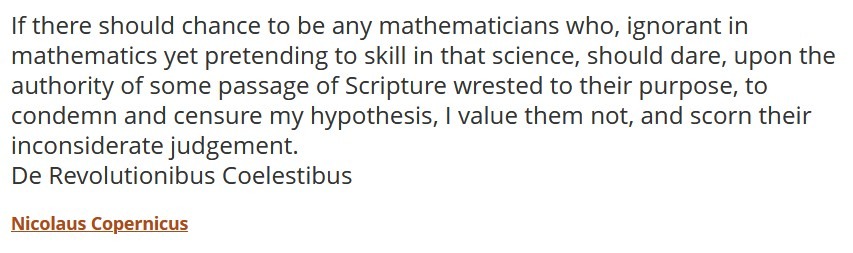
The “scientific” age began during what is called the Enlightenment. One goal of so-called science has been to set us free from the confines of the Bible. Copernicus, to whom history gives credit for the heliocentric theory, wrote the following to illustrate my point.

copernicus scripture quote

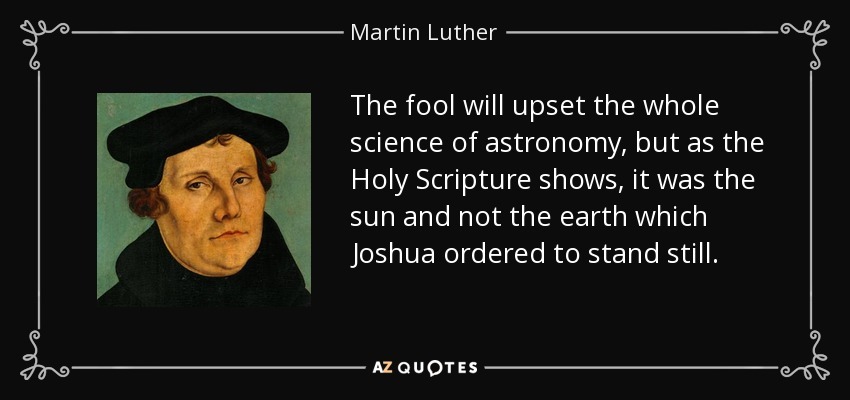
Martin Luther, as did John Calvin, considered Copernicus to be a fool.

luther flat earth

Over the years since the introduction of the heliocentric theory, the development of the theory of evolution, and advent of the Big Bang theory, so-called science has attacked the Scripture with barrage after barrage. In an effort to retain the appearance of wisdom in the face of such attacks, some Christians have developed “ingenious” ways to interpret the Bible to twist it into some imagined harmony with what is called science. For example, rather than accept the biblical account of creation in six days, some expositors of scripture have elongated that short time frame in all sorts of ways to attempt to conform it to the eons of time required by the false theory of evolution.

Some of us would rather change what the Bible says than risk looking foolish in the eyes of the world, but looking foolish in God’s eyes is far more serious.

The Bible says that those who do not believe in God are fools. (Psalm 14:1)  Jesus rebuked his own disciples for their foolishness in not believing the Bible. (Luke 24:25) We need to realize that much of what is called scientific “fact” is in fact a mere theory, often propped up by other theories that have become regarded as facts over time.

evolution fact scaled

Adam and Eve believed a lie because the devil made them feel foolish for believing God. 

Science, falsely so-called, is doing the same thing today. Many Christians are made to feel foolish for believing that the Genesis account regarding the nature of the heavens and earth is literally true. Many others choose to side with “science,” inventing all sorts of devious ways to twist the scriptures to accommodate error. It is a sad commentary on the state of the church.

O Timothy, guard what has been entrusted to you, avoiding worldly and empty chatter and the opposing arguments of what is falsely called “knowledge”— 21 which some have professed and thus gone astray from the faith. Grace be with you. 1 Timothy 6:20–21 (NASB95)

Eventually we all have to make a decision. Whose fool am I? God’s or the world’s?

Click here to go to series home page.

The Gospel Offers Forgiveness and Reconciliation to God

The gospel offers forgiveness and reconciliation to God. Paul delivered the extraordinary good news that through the risen Jesus, the Messiah King who was rejected and crucified, God offers forgiveness and reconciliation to all who believe and declare allegiance to him.

“Brothers, listen! We are here to proclaim that through this man Jesus there is forgiveness for your sins. 39  Everyone who believes in him is declared right with God—something the law of Moses could never do. Acts 13:38-39 (NLT) 

God does not hold our rebellion against his rule and our rejection of his person against us, if we repent, believe the good news, and receive Jesus as Lord and Savior. This good news includes giving us a personal relationship with Father God and making us a part of his eternal family through the new birth!

This means we are able to reconnect with the Source of Life and all that is good and true! We will be spiritually reconnected to the Creator and Sustainer of the Universe through our Redeemer and Lord, Jesus!

Only a fool or a hardened rebel would pass up such an offer; yet, without the Holy Spirit’s help, that is exactly what people do. We can ask the Spirit of God to open our sin-blinded eyes, unstop our deaf ears, soften our hardened hearts, and bring us back to God.

Prayer

I have been a rebel long enough! Today I turn away from the path I have been following that leads to judgment and death. Holy Spirit, come into my life and help me. Change me on the inside. Jesus, I acknowledge that you are the Lord that I have spurned these many years. I give you my life and receive your forgiveness. Father God,  I have heard about you but never known you. Thank you for sending your Son to die for my sins. I want to know, love, and serve you from this day forward. Amen.

The Old Testament Points to Jesus

The Old Testament points to Jesus. It is important for us to include in our gospel presentation how Jesus fulfilled promises made in the Old Testament.

And now we are here to bring you this Good News. The promise was made to our ancestors, 33  and God has now fulfilled it for us, their descendants, by raising Jesus. This is what the second psalm says about Jesus: ‘You are my Son. Today I have become your Father.’ 34  For God had promised to raise him from the dead, not leaving him to rot in the grave. He said, ‘I will give you the sacred blessings I promised to David.’ 35  Another psalm explains it more fully: ‘You will not allow your Holy One to rot in the grave.’ 36  This is not a reference to David, for after David had done the will of God in his own generation, he died and was buried with his ancestors, and his body decayed. 37  No, it was a reference to someone else—someone whom God raised and whose body did not decay. Acts 13:32-37 (NLT)  

The Old Testament points to Jesus and can only be properly understood in reference to him.

The birth, life, death, resurrection, ascension, and Second Coming of Jesus the Messiah is the goal of God’s interactions and promises made in the Old Testament. Jesus’ resurrection caused verses that seemed mysterious or unclear to come into sudden bold relief, such as the ones quoted by Paul above.

So a time was set, and on that day a large number of people came to Paul’s lodging. He explained and testified about the Kingdom of God and tried to persuade them about Jesus from the Scriptures. Using the law of Moses and the books of the prophets, he spoke to them from morning until evening. Acts 28:23 (NLT) 

Once Paul’s eyes were open to Jesus’ true identity, the entire Bible came to life for him. Jesus is the focus and goal of the entire Bible. Eventually all things will be summed up in him.

For by Him all things were created, both in the heavens and on earth, visible and invisible, whether thrones or dominions or rulers or authorities—all things have been created through Him and for Him. 17 He is before all things, and in Him all things hold together. 18 He is also head of the body, the church; and He is the beginning, the firstborn from the dead, so that He Himself will come to have first place in everything. Colossians 1:16–18 (NASB95)

How Have I Responded to the Gospel?

It is important for everyone to ask him or herself, “How have I responded to the gospel?” Paul summarized the gospel message in a paragraph.

“Brothers—you sons of Abraham, and also you God-fearing Gentiles—this message of salvation has been sent to us! 27  The people in Jerusalem and their leaders did not recognize Jesus as the one the prophets had spoken about. Instead, they condemned him, and in doing this they fulfilled the prophets’ words that are read every Sabbath. 28  They found no legal reason to execute him, but they asked Pilate to have him killed anyway. 29  “When they had done all that the prophecies said about him, they took him down from the cross and placed him in a tomb. 30  But God raised him from the dead! 31  And over a period of many days he appeared to those who had gone with him from Galilee to Jerusalem. They are now his witnesses to the people of Israel. Acts 13:26-31 (NLT)  

Paul told his listeners and us that Jesus is the one promised by God in the Old Testament, who was rejected by the Jewish leaders, put to death, buried, rose again from the dead, and appeared to many. All that remains is to explain what this means to those who believe and receive it: forgiveness of our sins and being restored to a right relationship with God.

The gospel is a spoken or read message that requires a response.

We can hear it and believe. We can hear and reject it, or we can simply ignore it. Only one of these responses results in salvation. How have you responded?

Prayer

Jesus, I finally “get” it. You died for my sins and rose again. I receive you as my Savior and my Lord. I receive your forgiveness and give my life to you. Holy Spirit, come live in and through me. Thank you for eternal life. Help me to tell others about this amazing gift. Amen.

God Promised Israel a Messiah Who Would Save the World

God promised Israel a Messiah who would save the entire world. On his first missionary journey, Paul the apostle preached the gospel to Jews living in Antioch of Pisidia. He correctly assumed that they were familiar with the promises God earlier made to King David, that one of his descendants would sit upon the throne of Israel forever. (2 Samuel 7:12-13)

“And it is one of King David’s descendants, Jesus, who is God’s promised Savior of Israel! 24  Before he came, John the Baptist preached that all the people of Israel needed to repent of their sins and turn to God and be baptized. 25  As John was finishing his ministry he asked, ‘Do you think I am the Messiah? No, I am not! But he is coming soon—and I’m not even worthy to be his slave and untie the sandals on his feet.’ Acts 13:23-25 (NLT)  

When we share the gospel with those who are not as familiar with the Bible, we have an opportunity to explain how Jesus came in fulfillment of promises made to Israel long ago.

The gospel only makes sense when we understand its historical context. God promised that one day a Savior would defeat Satan and deliver us from his dominion. This began in the Garden of Eden, continued with Abraham, Isaac, and Jacob, was reiterated to Moses, amplified with King David, and prophesied by Isaiah and others.

What was not understood until God revealed it to Paul was that the Messiah was sent to save the entire world, not just Israel.

He says, “It is too small a thing that You should be My Servant To raise up the tribes of Jacob and to restore the preserved ones of Israel; I will also make You a light of the nations So that My salvation may reach to the end of the earth.” Isaiah 49:6 (NASB95)
For God so loved the world, that He gave His only begotten Son, that whoever believes in Him shall not perish, but have eternal life. John 3:16 (NASB95)

By referring to this, when you read you can understand my insight into the mystery of Christ, 5 which in other generations was not made known to the sons of men, as it has now been revealed to His holy apostles and prophets in the Spirit; 6 to be specific, that the Gentiles are fellow heirs and fellow members of the body, and fellow partakers of the promise in Christ Jesus through the gospel, Ephesians 3:4–6 (NASB95)

One day in the not so distant future, the very real historical person named Jesus, the glorious resurrected Son of Man prophesied by Daniel, will return in the clouds with great power to judge all mankind.

At that point in time, all the earth will come to realize that the gospel is a wonderful announcement of mercy to those who believe it which is based on the historical facts relating to Jesus’ life, death, and resurrection. It is also a narrative of the historical fulfillment of God’s promises to Israel.

Therefore, it is important for gospel preachers to familiarize themselves with the the Old Testament and how it points to Jesus and the glorious gospel that is offered to every person in the world, regardless of ethnicity, gender, age, or socioeconomic status. That is how the early church presented Christ, and so should we!

If you are inclined to learn better how to do this, I suggest Scot McKnight's masterpiece, The King Jesus Gospel. I wrote a summary, which you can access by clicking here.

Water Baptism and the Baptism in the Spirit Are Distinct

Water baptism and the baptism in the Spirit are distinct. When Cornelius spoke in tongues, Peter arrived at an obvious conclusion. God accepted the Gentile Cornelius in exactly the same way he had the Jewish apostles!

The Jewish believers who came with Peter were amazed that the gift of the Holy Spirit had been poured out on the Gentiles, too. 46  For they heard them speaking in tongues and praising God. Then Peter asked, 47  “Can anyone object to their being baptized, now that they have received the Holy Spirit just as we did?” 48  So he gave orders for them to be baptized in the name of Jesus Christ... Acts 10:45-48 (NLT)  

The Bible promises that Jesus will baptize his followers in the Spirit. (Luke 3:16) The evidence of this outpouring or baptism is speaking in tongues, as first experienced by the Jewish believers on Pentecost. In Acts 10 it happened again with Gentiles, which astounded the ethnocentric Jews, who imagined that they alone were eligible.

The giving of the Spirit is a proof of our acceptance into God’s heavenly family.

Only born-again children of God are given this amazing evidence of God’s love. (Luke 11:13)

When we share the gospel, we should inform our hearers that the Holy Spirit will be given to those who put their faith in Christ, both as the indwelling source of life and identity and as an outpoured source of power and boldness.

These two experiences with God’s Spirit are distinct: the first is a result of being born again, and the second from being baptized in the Spirit. Believers are to submit to water baptism as a public testimony of allegiance to our Savior and Lord and then receive the baptism in the Spirit.

POTF front cover
Promise of the Father

To learn more about the baptism in the Spirit, click here. I have also written a book on this important subject, which is available on Amazon.

Share this post...