The Primary Importance of Genesis Chapter One

Genesis Chapter One describes how God created the cosmos – the seas, earth, firmament, sun, moon, and stars, as well as living creatures. As such, it is of primary importance.

The battle of the ages is being fought over Genesis because, if it can be shown that it is not literally and actually true, then there is no reason to assume that anything else in the Bible is true.

This is why Satan has worked so hard to convince us that the story proposed by those who espouse evolutionary astrophysics is real. If we accept the Big Bang theory and the heliocentric model as reality, we must conclude that the Bible is an archaic fairy tale.

I have conversed with numerous Bible-believing Christians who insist that it is not necessary or even correct to accept that Genesis is literally true. They believe that Jesus rose from the dead. They believe that the gospel message is true and tell me that insisting on a literal interpretation of Genesis is an unnecessary obstacle to people’s accepting the gospel’s claims.

Without fully realizing it, those who reject the literal truth of Genesis have set foot upon the slippery slope of deciding which parts of the Bible are true and which merely contain truth, which is exactly the position of the more liberal denominations which have departed from the faith.

By the way, how can something untrue contain truth? That is the equivalent of saying that God can use a lie to lead us into truth.

Why do any of us who believe the Bible think that it is necessary to reject a literal interpretation of Genesis Chapter One? Is it not because we regard the claims of what is called science to be of greater value than God’s Word?

If we accept the proclamations of theoretical science above God’s Word, we have become idolators who worship at the altar of “Scientism,” which has its own high priests and prophets who tell us what we must believe.

I admit that people come to faith in Christ and his resurrection without believing that Genesis is literally true. I did. But this does not mean that believing Genesis is true is not important. Jesus said the the scripture cannot be “broken,” (John 10:35) meaning that every word of God is true. He said in another place that we are to live by every word that proceeds from the mouth of God (Matthew 4:4). People who already believe in Jesus will continue to do so regardless of whether they accept a literal interpretation of Genesis. To them, it is whether Genesis is literally true is non-essential. However, those who are in the process of exploring the claims of the Bible and who read Genesis are faced with a huge obstacle to faith. Everything they have been taught from infancy rejects the creation account of Genesis. They must decide what to do with the Bible. Many decide that Genesis is not true and therefore reject all the Bible’s claims.

The goal of evolutionary astrophysics, geology, paleontology, and biology is to convince us that our universe and all life sprang from nothingness by random chance without any input from a Creator.

We have to admit that Satan’s plan has wonderfully succeeded. He has successfully eliminated the Bible from public education and the halls of what is called science. Any reference to a Creator is rejected as being unscientific. Science must be able to explain everything without any reference to God, using only mechanistic processes. The Bible takes the exact opposite position: in the beginning – God.

Therefore, the best way to combat the lie of evolutionary “science” is by reestablishing faith in the literal truth of Genesis.

Is this too great a leap for those who say they believe in the virgin birth and resurrection of Jesus? Have we allowed the world to slice off our faith in Jesus and place it in a little box called “religious truth,” which has no bearing or impact on the “real” world?

It is impossible to accept that the Genesis account is true and arrive at a heliocentric “solar system” in an ever-expanding universe.

Until we are willing to repent for our unbelief in the literal truth of the Genesis account, we are shooting ourselves in the foot. Any thinking person who examines the gospel’s claims and sees that we do not think Genesis is true would do well to question why we believe anything in the Bible. Cannot we see that?

But when we come face to face with the truth about the heavens and earth that God made, we can only arrive at one conclusion. There must be a Creator because no matter how truth is twisted, evolutionary processes cannot explain the existence of the solid dome-like firmament.

It is not a far jump to show those who acknowledge the Creator that the one who made everything is named Jesus, the Eternal Logos, who became a man and died for our sins and then arose as Lord of Lords, who will come again in glory when God dissolves the firmament. (2 Peter 3:12)

In the beginning was the Word, and the Word was with God, and the Word was God. 2 He was in the beginning with God. 3 All things were made through Him, and without Him nothing was made that was made. 4 In Him was life, and the life was the light of men. 5 And the light shined in the darkness, and the darkness did not comprehend it. John 1:1–5 (NKJV)

Resources for Researching Biblical Cosmology

Pete 2026It is not easy to find confirming resources and information regarding biblical cosmology because big tech censors have developed algorithms that feature almost all negative information to lead people away from this amazing truth. This page contains information I have assembled while doing my own research. I hope it is helpful to you.


Everyone is on a life journey that hopefully will lead us to Christ, but not everyone who holds to the biblical version of the shape of the earth is a follower of Christ or a Bible believer. Some apparent proponents may be putting out information just for the money or to achieve notoriety. Other advocates of biblical cosmology may be truth seekers who have yet to find the One who is the Truth, Jesus. In addition, some who hold to the “flat earth” also have some very strange non- or anti-biblical theories. I have found that Satan always injects weirdness into anything God is revealing to try to bring confusion and demoralize truth seekers. As a result, we may need to glean truth from people with strange beliefs. We have to learn to “eat the chicken and spit out the bones.”

Those of us who already know the Lord have a guide, the Holy Spirit, and a map, the Bible. When we discover something new that is confirmed in the Bible, we can be sure it is the truth. Blessings to you on your journey.

Below I have broken down my information into categories, each with a separate page.

Pete Beck III


A Place to Start…

A Short Introductory Video

Other good articles

Recommended Video Series

Documentaries

Stand Alone Videos

Recommended Rumble Channels

Recommended YouTube Channels

Recommended Books


Sealed

Contrary to the popular straw man argument against flat earth, it is impossible to sail off the edge. This is because God designed the earth with a rim to contain the water.

When He assigned to the sea its limit, So that the waters would not transgress His command, When He marked out the foundations of the earth, Proverbs 8:29 (NKJV)

These water-containing edges, which are also called the “ends” of the earth, consist of an ice wall that surrounds the circle of the earth. The continent of Antarctica does not exist, which is why it is so closely guarded today. The powers that be do not want us to find out that we live in an enclosed world created by God.

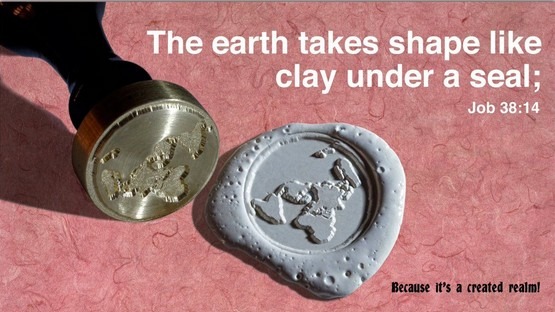
God told Job that the earth was formed like clay under a seal. We do not use these devices any longer, but the picture below shows how edges are formed when the seal is pressed into the soft medium. This is how the seas are contained on the “flat” earth.

clay seal 2

God created it. He should know.

Click here to go to series home page.

The Importance of Sharing Our “Back Story”

Paul continued his testimony by telling his Jewish listeners the back story of how he previously opposed the gospel, just as they were doing at that time. This let them know that he understood their motives.

And I persecuted the followers of the Way, hounding some to death, arresting both men and women and throwing them in prison. 5  The high priest and the whole council of elders can testify that this is so. For I received letters from them to our Jewish brothers in Damascus, authorizing me to bring the Christians from there to Jerusalem, in chains, to be punished. Acts 22:4-5 (NLT)  

If people are meeting us for the first time, they have no context for understanding how Christ has impacted our lives. It can be helpful for us to relate what we were like before we became followers of Christ. This is especially important if we are speaking to someone with whom we share a common background. Our listeners can profit from knowing that we were not always as we are today.

Sharing our “back story” is another way for us to establish common ground with our listeners and sets the stage for relating how Christ intersected and transformed our lives.

People may argue with our doctrine and conclusions, but they cannot deny our personal story. This sets us up to share the gospel as the “how” and “why” for this transformation.

Establish Common Ground

One of the most important things we can do when we share our testimony is show our listeners what we have in common with them. Paul was in Jerusalem when hostile Jews attacked and falsely accused him. In order to quell a riot, Roman soldiers took him into custody. On his way to the military outpost, the commander granted Paul permission to speak to the crowd.

Paul provides us with a model for sharing our personal testimonies.

Then Paul said, “I am a Jew, born in Tarsus, a city in Cilicia, and I was brought up and educated here in Jerusalem under Gamaliel. As his student, I was carefully trained in our Jewish laws and customs. I became very zealous to honor God in everything I did, just like all of you today. Acts 22:3 (NLT) 

The first thing Paul did was identify with his persecutors, who thought that he had turned his back on his God and nation. Most people do not understand what motivates Christians to follow Jesus. Hopefully they noticed something different about us after we professed faith in Christ, but sometimes being different is viewed suspiciously.

If I find myself conversing with someone who admits to being a Roman Catholic, I will usually mention that I, too, was once a Catholic. This communicates that I understand them and what they believe, while simultaneously arousing curiosity as to why I no longer identify as one.

If we want to increase our chance of being heard, we might try showing our listeners that we understand them.

Since Paul was addressing Jews, he first established that he was one, too, and understood their issues. Not only was Paul Jewish, he also had been a man of stature in the community, having studied under the finest teachers. In other words,

Paul told his audience that he was one of them.

Secondly, Paul complimented them on their zeal, however misplaced. As mentioned in a previous article, if we can find common ground with our listeners, it helps a lot. It is rarely a good idea to launch an attack on those whom we are trying to lead to Christ. Even though his antagonists hated him, Paul found something for which to praise them: their zeal for Jewish beliefs.

We can also look for something we can acknowledge as being good in our listeners in an effort to establish solidarity prior to sharing the gospel.

Confronting the Science Idol

Have you ever wondered why its okay to believe in the resurrection, but not in the biblical earth and heavens? Both contradict the tenets of science.

resurrection

hebrew earthNon-believers usually will not challenge us Christians when we proclaim that Jesus died for our sins and rose from the dead, because it relegates such professions to the category of “religion,” where Jesus is just one god among many, and our declaration of faith is viewed as a faith in a myth that does not impact any part of the “real world.” Believing that the Bible’s version of the earth and heavens is true, however, challenges a great number of scientific myths that propagandists have convinced people to swallow “hook, line, and sinker.”

The world does not understand that when Jesus rose from the dead, God declared him to be Lord over everything.

Therefore, God elevated him to the place of highest honor and gave him the name above all other names, 10 that at the name of Jesus every knee should bow, in heaven and on earth and under the earth, 11 and every tongue declare that Jesus Christ is Lord, to the glory of God the Father. Philippians 2:9–11 (NLT)

This means that he rules over every aspect of life: religion, family life, sexuality, business, education, entertainment, science, and government. The early Christians were persecuted and martyred for professing Jesus’ lordship over the Roman empire, which included Caesar. This made the Romans and Caesar, in particular, angry. They wanted everyone to profess allegiance to their gods and to their leader over every other god. Christians could not do that. They had one God and one Lord, for whom they were willing to suffer and die.

Whenever we confront society’s idols, we will make people angry.

Jesus is called both the “Word of God” (John 1:14) and the “Truth” (John 14:6). Our Lord taught us that the Word of God is true (John 17:17) and cannot be “broken” (John 10:35) or changed. Since Jesus is lord over everything and the Bible is always true, this makes the Bible our gold standard for truth in all matters which it addresses, not just religion and morals.

If we deny or resist what the Bible teaches on a certain matter, we are in rebellion against God in that particular area and have elevated something above God, making it an idol.

The areas in which the Bible’s authority is being assaulted with the greatest ferocity are the places where Jesus’ lordship is being contested the most and where Satan is working hardest. Presently, the world most seems to hate with great passion what God’s Word says in the areas of abortion, sexuality, and gender. When we rebel against God’s truth in these areas, it is the equivalent of telling God that we don’t like how he made us or how he says we are to live. People do this without realizing that everything God does and says is meant for our good. Our fundamental rebellion is against God’s having any right to tell us what to do, isn’t it? Our greatest sin is that we want to live without any regard to or relationship with the one who created and sustains us.

Sadly, I have observed that many who profess faith in Christ and generally seek to submit to his lordship, have a rather significant area of idolatry  – science. 

Many of us Christians unwittingly have allowed the world to dictate what we are allowed to believe is true “scientifically,” instead of adhering steadfastly to the scriptures. We have been intimidated by those who claim to be smarter than God into thinking that the authors of the Bible were ignorant and rather simple-minded. Satan convinced Eve that to believe what God said was naive and not in her best interests, fueling a desire to go astray from God’s command. Too many of us have been convinced that it is quite stupid or ignorant to believe that the scriptures are literally true when it comes to creation and the nature of the heavens and earth.

Like Eve in the garden, we have been told that if we want to be wise, and we do, we need to believe the scientists rather than what God has told us in the Bible.

The heretics of the Enlightenment, whom the world idolizes, threw off the constraints of the Bible and established what is now considered to be the “gold standard” of cosmological truth, which includes the Big Bang theory and the heliocentric model. This theory of the cosmos has been inculcated into every child for many, many years now, grooving the minds of millions to think in only one direction. We have been so convinced that this way of viewing the cosmos is correct that we manage to overlook or twist what the Bible says to make it fit what we have been taught is “gospel” truth.

However, it is impossible to believe in heliocentrism or the Big Bang while at the same time believing that Genesis Chapter One is true. A decision must be made whether we will believe God or man.

The world (Satan) has convinced many Christians that Genesis and the rest of the Bible are useless for science and understanding the true nature of the heavens and earth. This means that either God is a liar or the Bible is not really his inerrant Word, which is exactly where Satan wants to guide us. This is why so many modern day astrophysicists are atheists. They have believed a false version of the cosmos, which testifies that there is no God. The true version, however, reveals God’s existence. (Psalm 19:1) That is why so many previously atheistic “flat earthers” have come to believe in the Creator God. (Click here to listen to testimonies.)

The earth and heavens as described in Genesis could not exist without a Creator.

Perhaps we Christians who still believe in heliocentrism do so because we have not been challenged to repent of our worship of science. If this article made you angry, perhaps your idol is being confronted. I encourage you to return to faith in God’s Word above every false contender for your allegiance.

Prayer

Lord, I pray that you will open our eyes to any area where we have bowed the knee to man instead of believing your Word. Help us to tear down the altar to science that we may have erected in our hearts that boasts against your Word and calls you a liar. We repent and ask forgiveness. Help us to exalt you and your word, even if it means enduring the scorn of those who choose to regard men’s opinions higher than God’s truth. Help us not to serve anyone or anything except you, Jesus, the one who created the cosmos and certainly knows how it works. Amen.

Click here to go to series home page.
Click here to see Resource Page.

What is the Worst Response to the Gospel?

After Paul addressed a crowd in Athens, his listeners responded in three ways, one of which was the very worst possible response.

When they heard Paul speak about the resurrection of the dead, some laughed in contempt, but others said, “We want to hear more about this later.” 33  That ended Paul’s discussion with them, 34  but some joined him and became believers. Among them were Dionysius, a member of the council, a woman named Damaris, and others with them. Acts 17:32-34 (NLT) 

Lack of interest is the worst response to the gospel. Far better that a person be hostile than be indifferent.

Jesus warned in Revelation:

I know all the things you do, that you are neither hot nor cold. I wish that you were one or the other! 16  But since you are like lukewarm water, neither hot nor cold, I will spit you out of my mouth! Revelation 3:15-16 (NLT) 

Even though Jesus spoke these words to the church, the principle still applies. If people actively resist the gospel, it is because they are seriously listening and do not like what they hear. There is hope for such a person. Perhaps the Holy Spirit will bring them around as they continue to ponder the implications of the gospel. The “lukewarm” disinterested person, however, will probably not give the gospel a second thought. He does not think he is rejecting the message, just saving it for later consideration, which quite probably will never happen. Procrastination is not a virtue when it comes to the gospel. The “hot” response is most to be desired. These people “get it” and respond positively right away.  The next time someone becomes hostile to the message, we should give thanks to God. At least we were heard.

Can I Quickly Summarize the Gospel?

While addressing a crowd in Athens, Paul showed us how to summarize Bible history from creation to the resurrection in one paragraph.

“He is the God who made the world and everything in it. Since he is Lord of heaven and earth, he doesn’t live in man-made temples, 25  and human hands can’t serve his needs—for he has no needs. He himself gives life and breath to everything, and he satisfies every need. 26  From one man he created all the nations throughout the whole earth. He decided beforehand when they should rise and fall, and he determined their boundaries. 27  “His purpose was for the nations to seek after God and perhaps feel their way toward him and find him—though he is not far from any one of us. 28  For in him we live and move and exist. As some of your own poets have said, ‘We are his offspring.’ 29  And since this is true, we shouldn’t think of God as an idol designed by craftsmen from gold or silver or stone. 30  “God overlooked people’s ignorance about these things in earlier times, but now he commands everyone everywhere to repent of their sins and turn to him. 31  For he has set a day for judging the world with justice by the man he has appointed, and he proved to everyone who this is by raising him from the dead.” Acts 17:24-31 (NLT)  

Sometimes we find ourselves in situation where we have a very small window of time in which to communicate big ideas.

To be an effective gospel communicator we need to learn how to share the good news with great thoroughness when given the opportunity and be able to summarize it when that is required.

I am not sure what kind of time pressure Paul found himself, but it seems that he knew his audience’s attention span was short. He covered thousands of years in a few sentences. Let’s see what he established in that one paragraph.

  1. God is the Creator.
  2. Man-made religion and idols are useless.
  3. God is sovereign over the affairs of the world.
  4. God’s purpose for mankind was for us to seek and find him. He is near at hand.
  5. God is calling everyone to repent and turn to him.
  6. He will one day judge the world through one he raised from the dead.

Paul did not share the entire gospel in this paragraph, but he did manage to get their attention and provoke a response. He found out who was open and who just wanted to debate, which was a decent outcome.

Do we understand the gospel message well enough to share it succinctly? Can we go into detail?

We owe it to God and unsaved people to study the gospel message and learn how to share it effectively.

Find Common Ground

When given the opportunity to address a crowd in Athens, Paul found common ground as a way to segue into the gospel message.

So Paul, standing before the council, addressed them as follows: “Men of Athens, I notice that you are very religious in every way, 23  for as I was walking along I saw your many shrines. And one of your altars had this inscription on it: ‘To an Unknown God.’ This God, whom you worship without knowing, is the one I’m telling you about. Acts 17:22-23 (NLT)  

When we have the opportunity to converse with friends, neighbors, workplace colleagues, and even strangers, wisdom teaches us to look for “common ground” in which we agree. Finding areas of mutual interest and agreement increases the likelihood that we can have a decent conversation because our listeners will not have assumed a defensive posture. Paul found common ground with the Athenians in a most surprising way. Instead of negatively focusing on their pagan idolatry, he pointed out one thing they shared – worship of who to them was an unknown God. He offered to identify this God for them, which I am sure piqued their interest. He no doubt anticipated that most of the Greeks would reject his gospel message, but at least he got the chance to share it by finding common ground.

Finding common ground with our listeners can open the door to deepening a relationship or even sharing the gospel.

When we talk with people, we should be alert to opportunities to share the gospel. We should ask the Holy Spirit to reveal to us where we can find a launching point to share Jesus, if it is appropriate. I am not of the persuasion that every conversation needs to end up with our sharing the gospel. That is a good way to alienate people. If we hope to have a long-term connection with our listeners, we must be socially aware and smart. If we are preaching at a gospel crusade, we can be a gospel bulldozer that flattens everything in its path, but in one-on-one conversations, we need tact and wisdom.

Sometimes God will open a way to share the gospel in a first conversation with someone. Other times we may need to cultivate a relationship. If we know we will never see the person again, we might be more aggressive. If we love people, it will make it easier to decide what to do. We will do the loving thing.

Let your conversation be gracious and attractive so that you will have the right response for everyone. Colossians 4:6 (NLT) 

What about Herman?

One of my favorite comedic movies is What about Bob, starring Bill Murray. Murray plays the part of neurotic psychiatric patient whose persistence enables him to move from being a pesky nuisance to becoming the most important member of the family.

When it comes to understanding the Bible creation account in Genesis Chapter One, perhaps we should ask, “What about Herman?”

Like Bob in the movie, Herman may seem irritating at first, but he can help us a lot. Who is Herman? I am glad you asked. His full name is Herman Neutics.

Hermeneutics is the study of the general principles of Bible interpretation which are meant to guide us to a proper exegesis (a pulling out of the meaning) of biblical passages, as opposed to eisegesis, which is the reading our presuppositions into the Bible text.

One of the basic ideas of good Bible interpretation is that a passage must at least mean what the author meant it to say. It could mean more, but not less. This is important when it comes to the creation account and the nature of the earth and heavens.

We should ask ourselves, “What was the view of the cosmos held by the authors of the Bible?”

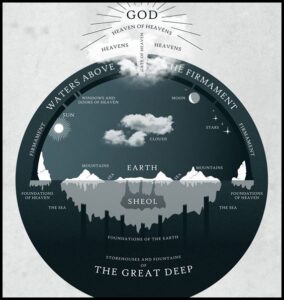
It is acknowledged by Bible scholars that the Hebrew conception of the earth and heavens is represented by the following illustration. hebrew earth

This view was held until around 500 years ago with the advent of the Copernican revolution and the Enlightenment. Such notable teachers as Luther and Calvin rebuked the Copernican heresy for contradicting the Bible. How sad that a few centuries later we think that those esteemed men were ignorant and misguided. They may have been unschooled in the theories of  modern astrophysics, but they knew the Bible. Today, it is often quite the opposite. Many professing Christians know more about the heliocentric theory than the Bible. This raises an important question.


Which has more authority in our lives and the quest for truth, so-called science or the Bible?

I am a child of the modern era and was schooled in the heliocentric view. I, like everyone else I know, was indoctrinated with an almost ever-present globe model of the earth. All the important teachers in my life told me the same story. The earth is an extremely old spinning water ball hurtling through the vast emptiness of outer space, kept in line by the power of gravity. No one I knew ever questioned this theory, even though, looking at it with fresh eyes, in many ways it is quite ludicrous.

Soon after becoming a follower of Christ in 1971, I became convinced that the Bible is God’s inerrant Word. This profoundly impacted my life. I made it my quest to study it and try to live by Jesus’ teachings. When it came to the Genesis creation account, however, I suspended critical thinking and simply admitted that I did not begin to know how to make it agree with modern astrophysics. This is where most Christians find themselves today. We must either reject Genesis Chapter One as a myth, poetry, or a symbolic account that has no translation into scientific fact, or believe it is literally true. It seems that most have gone with one of the former options.

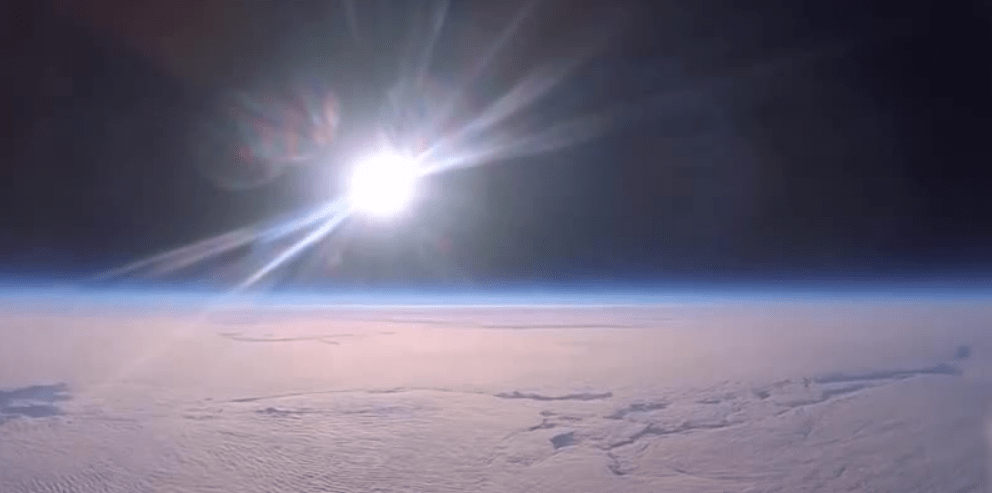
This all changed for me when I saw that the earth has no provable curvature. All empirical measurements show that it is flat. The only way globe believers can make their case is by relying on NASA images from “outer space” and by interpreting eclipses to “prove” the earth’s shape. But proving curvature in some other way has not and cannot be done because the earth is a plane, not a globe. (I believe the images delivered by NASA and other space agencies are computer generated, and eclipses can be explained in other ways using a flat earth model. I have created a resource page for those wishing to learn more.)

After becoming convinced that the earth’s surface does not curve as the globe model requires, I read Genesis with new eyes. Now I accept Genesis One as a true account, an actual history of how God did it. Herman and I are back in sync. I now see the scriptures with the same eyes as those who authored the Bible.

It’s amazing how the Scriptures come alive when we stop superimposing our “scientific” presuppositions upon the text and let it speak for itself.

Now I can accept that God created the dome of the firmament on Day Two, and the sun on Day Four, placing it, the moon, and the stars in the firmament. We do not revolve around them. They go around us. That’s how the ancients saw it, and, guess what, they were right. We have been grossly deceived and tricked into rejecting the Bible. Sound familiar?

Click here to go to series home page.
Share this post...