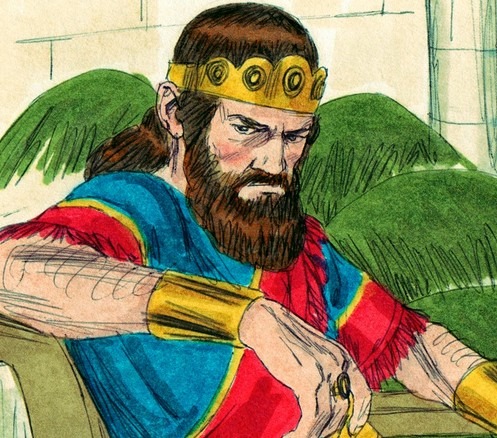
 King Saul and his relationship with David can be understood as an Old Testament prophetic picture of the nation of Israel and its relationship with Jesus the Messiah. Below I will recount Saul’s story in relation to David. Alongside I will put comparisons to Israel’s relationship to Jesus Christ.
King Saul was the first king of Israel, a man selected by God after Israel demanded that the prophet Samuel provide them with a king. He was head and shoulders taller than his countrymen and possessed the kind of physical attributes people look for in a ruler..
He had a son whose name was Saul, a choice and handsome man, and there was not a more handsome person than he among the sons of Israel; from his shoulders and up he was taller than any of the people. 1 Samuel 9:2 (NASB95)
The Israelites were tired of relying on God periodically to raise up judges as needed to lead them into battle to defeat their enemies, deliver them from bondage, and rule justly. They wanted the kind of stability they thought a human dynasty would provide. They were oblivious to the fact that their request was an insult to God’s rule. On the surface, Saul appeared to be a great choice, but it took a while for him to win the confidence of the people. God allowed Samuel to carry out the installation of a king, even though the Lord knew that future kings would mostly apostatize and lead the nation into idolatry and ruin.
Even though Saul was chosen by God to be Israel’s first king, he ended up being a tragic figure in that nation’s history. This was inevitable. Without Christ, mankind is doomed to failure.
Saul and the kingdom of Israel were of the old Adamic natural order that had been corrupted by sin and needed to be redeemed. Saul started well, reluctantly accepting the responsibility of the kingship, but his character deficiencies soon betrayed him, as manifested in repeated disobedience to God. The nation of Israel likewise began well, though not without some episodes in the lives of the founding fathers that revealed their moral deficiencies. Once again this should not surprise us because without Christ everyone falls short of the righteousness of God.
But now apart from the Law the righteousness of God has been manifested, being witnessed by the Law and the Prophets, 22 even the righteousness of God through faith in Jesus Christ for all those who believe; for there is no distinction; 23 for all have sinned and fall short of the glory of God, 24 being justified as a gift by His grace through the redemption which is in Christ Jesus; 25 whom God displayed publicly as a propitiation in His blood through faith. This was to demonstrate His righteousness, because in the forbearance of God He passed over the sins previously committed; 26 for the demonstration, I say, of His righteousness at the present time, so that He would be just and the justifier of the one who has faith in Jesus. Romans 3:21–26 (NASB95)
Abraham lied regarding his relationship with Sarah, putting her integrity at risk in order to preserve his own life. Isaac similarly dissimulated. Jacob made deception a lifestyle until God finally wrestled him into surrender. The history of Israel under Moses was likewise a story of repeated serious integrity failures. The people repeatedly turned away from their devotion to God, choosing false gods instead. There was absolutely no possible way that the nation of Israel could inherit the promises of God.
Now I say this, brethren, that flesh and blood cannot inherit the kingdom of God; nor does the perishable inherit the imperishable. 1 Corinthians 15:50 (NASB95)
Instead, that fell to the one and only begotten Son of God, the seed of promise.
Now the promises were spoken to Abraham and to his seed. He does not say, “And to seeds,” as referring to many, but rather to one, “And to your seed,” that is, Christ. Galatians 3:16 (NASB95)
After Saul disobeyed God’s clear command to kill all the Amalekites and destroy their livestock, Samuel informed Saul that he had been rejected as king and would be replaced with another more deserving man, one who loved God with all his heart.
“For rebellion is as the sin of divination, And insubordination is as iniquity and idolatry. Because you have rejected the word of the LORD, He has also rejected you from being king.” 1 Samuel 15:23 (NASB95)
Looking at this story with the wisdom of hindsight, it becomes clear that Saul’s disappointing reign was a necessary prelude to the David’s. It provided a context by which to compare and contrast how David related to God, carried out the responsibilities of the kingship, and handled adversity, and transitioned to the new king, Solomon, with how Saul lived, died, and failed to transition.
David was a New Covenant man living in an Old Covenant era. God graced him to experience many New Covenant blessings. Otherwise, his kingship would have failed as miserably as Saul’s.
Like Saul, Israel also served in a transitory capacity. Just as John the Baptist’s privileged role was to identify and introduce the Messiah and then fade into the background, Israel was granted the wonderful responsibility to provide and guard God’s inspired Word and to be the human conduit for the Messiah’s bloodline. When the actual Messiah arrived on the scene, the promised one, Israel’s job was completed.
He must increase, but I must decrease. John 3:30 (NASB95)
That nation should have handed off the baton and simply gotten out of the way, but like Saul, Israel failed miserably. It did not realize that it was to its advantage to go quietly instead of fighting to retain something that did not belong to it. Since Israel was part of the Old Covenant, it could not inherit God’s kingdom. It had to pass away like the Covenant of which it was part.
When He said, “A new covenant,” He has made the first obsolete. But whatever is becoming obsolete and growing old is ready to disappear. Hebrews 8:13 (NASB95)
Upon learning of God’s rejecting him from being king, instead of humbly accepting the Lord’s decision and asking how he could peacefully transition the kingdom to the new man, Saul grew paranoid, depressed, and murderous. He tried to clutch what God had given to him but now was removing.
He said, “Naked I came from my mother’s womb, And naked I shall return there. The LORD gave and the LORD has taken away. Blessed be the name of the LORD.” 22 Through all this Job did not sin nor did he blame God. Job 1:21–22 (NASB95)
An evil spirit began to torment Saul after this. In his rebellion, he became a tragic anti-God figure by doing his best to kill David before he could assume the throne. Below he expressed his violent intent to his son Jonathan, the heir apparent, who remained loyal to David, expecting one day to serve him.
“For as long as the son of Jesse lives on the earth, neither you nor your kingdom will be established. Therefore now, send and bring him to me, for he must surely die.” 32 But Jonathan answered Saul his father and said to him, “Why should he be put to death? What has he done?” 33 Then Saul hurled his spear at him to strike him down; so Jonathan knew that his father had decided to put David to death. 1 Samuel 20:31–33 (NASB95)
Interestingly, David, who was a type of Christ, also faced a rival claimant to the throne in his son Absalom. David exemplified a Christ-like spirit in how he handled that situation.
The king said to Zadok, “Return the ark of God to the city. If I find favor in the sight of the LORD, then He will bring me back again and show me both it and His habitation. 26 “But if He should say thus, ‘I have no delight in you,’ behold, here I am, let Him do to me as seems good to Him.” 2 Samuel 15:25–26 (NASB95)
This compares to Christ’s words as he hung on the cross: “Into thy hands I commit my spirit.” (Luke 23:46) How different from Saul!
When it became apparent that Jesus was gaining popularity with the people, Israel’s leaders were jealous and fearful that he would spoil things for them, putting in jeopardy all the perks and privileges that they enjoyed by cooperating with Roman rule. Like Saul, their behavior mirrored Satan, the murderer. Instead of seeking God’s will, they determined to put Jesus to death.
But one of them, Caiaphas, who was high priest that year, said to them, “You know nothing at all, 50 nor do you take into account that it is expedient for you that one man die for the people, and that the whole nation not perish.” 51 Now he did not say this on his own initiative, but being high priest that year, he prophesied that Jesus was going to die for the nation, 52 and not for the nation only, but in order that He might also gather together into one the children of God who are scattered abroad. 53 So from that day on they planned together to kill Him. John 11:49–53 (NASB95)
Backtracking a bit to the first time David appears in the Bible, God told Samuel that one of Kish’s sons would be the next king to replace Saul. David was the youngest who kept the sheep and was so little esteemed by his father that he was not even invited to be on hand when Samuel visited. Nevertheless, at Samuel’s command, David was brought to the gathering. It was at this time that the Lord revealed to Samuel that David would be the next king. This young man who had been assigned the lowly task of shepherding his father’s flocks was called to shepherd the entire nation.
So he sent and brought him in. Now he was ruddy, with beautiful eyes and a handsome appearance. And the LORD said, “Arise, anoint him; for this is he.” 13 Then Samuel took the horn of oil and anointed him in the midst of his brothers; and the Spirit of the LORD came mightily upon David from that day forward. And Samuel arose and went to Ramah. 1 Samuel 16:12–13 (NASB95)
Jesus was also lightly esteemed. He was born under unusual circumstances that made him appear to be the bastard son of Mary and Joseph, rather than the product of a supernatural conception. His adoptive father was an inconspicuous carpenter from Nazareth. There was nothing about our Lord’s background or appearance that made him stand out as the divinely appointed Messiah. Like David, he was a divine choice.
For He grew up before Him like a tender shoot, And like a root out of parched ground; He has no stately form or majesty That we should look upon Him, Nor appearance that we should be attracted to Him. 3 He was despised and forsaken of men, A man of sorrows and acquainted with grief; And like one from whom men hide their face He was despised, and we did not esteem Him. Isaiah 53:2–3 (NASB95)

“And behold, you will conceive in your womb and bear a son, and you shall name Him Jesus. 32 “He will be great and will be called the Son of the Most High; and the Lord God will give Him the throne of His father David; 33 and He will reign over the house of Jacob forever, and His kingdom will have no end.” Luke 1:31–33 (NASB95)
The prophet Samuel anointed David’s head with oil, telling him of God’s choice, but that event only set him apart and gave him grace for the job. The actual accession to the throne came years later after great suffering, testing, and enduring continual danger. Jesus likewise was anointed by the Holy Spirit (Luke 4:18) and afterward endured temptation, testing, suffering, and even death before he was exalted as Lord of Lords by his resurrection.
Being found in appearance as a man, He humbled Himself by becoming obedient to the point of death, even death on a cross. 9 For this reason also, God highly exalted Him, and bestowed on Him the name which is above every name, Philippians 2:8–9 (NASB95)
David entered Saul’s life after an evil spirit began to torment the king. David was known as an accomplished musician who could play soothing music when the evil spirit came upon the king. Through this service, David gained Saul’s favor and an introduction into the affairs of the kingdom.
Now the Spirit of the LORD departed from Saul, and an evil spirit from the LORD terrorized him. 15 Saul’s servants then said to him, “Behold now, an evil spirit from God is terrorizing you. 16 “Let our lord now command your servants who are before you. Let them seek a man who is a skillful player on the harp; and it shall come about when the evil spirit from God is on you, that he shall play the harp with his hand, and you will be well.” 17 So Saul said to his servants, “Provide for me now a man who can play well and bring him to me.” 18 Then one of the young men said, “Behold, I have seen a son of Jesse the Bethlehemite who is a skillful musician, a mighty man of valor, a warrior, one prudent in speech, and a handsome man; and the LORD is with him.” 19 So Saul sent messengers to Jesse and said, “Send me your son David who is with the flock.” 20 Jesse took a donkey loaded with bread and a jug of wine and a young goat, and sent them to Saul by David his son. 21 Then David came to Saul and attended him; and Saul loved him greatly, and he became his armor bearer. 22 Saul sent to Jesse, saying, “Let David now stand before me, for he has found favor in my sight.” 1 Samuel 16:14–22 (NASB95)
Jesus’ initial ministry also provided relief and deliverance to those oppressed by the devil in Israel. He gained notoriety and esteem by providing healing and deliverance to great numbers of people.
You know of Jesus of Nazareth, how God anointed Him with the Holy Spirit and with power, and how He went about doing good and healing all who were oppressed by the devil, for God was with Him. Acts 10:38 (NASB95)
Later the Philistine giant Goliath taunted Israel’s armies, challenging the king to send out a man to fight him in representative combat. This revealed that no one was willing to risk his neck in such a fight and kept the king and entire army paralyzed in fear. The arrogance of Goliath against the God of Israel angered David, who immediately volunteered to fight the giant alone, believing that God would enable him to defeat the giant.
Then David spoke to the men who were standing by him, saying, “What will be done for the man who kills this Philistine and takes away the reproach from Israel? For who is this uncircumcised Philistine, that he should taunt the armies of the living God?” 1 Samuel 17:26 (NASB95)
When word got back to Saul, who was not present on the field of battle, he thought David would not be up for the task, being but a boy without training as a military man. In fact, it appears that no one in Israel except David believed that Goliath could be defeated. David was able to convince the king that he had already killed a bear and a lion as part of his shepherding duties and would surely be able to whip Goliath. Saul eventually permitted David to do representative combat for the entire nation. If he won, the Philistines would surrender – supposedly. If David lost, the Israelites would forfeit to the enemy. The stakes were high indeed for the nation, but even more so for David.
Our Lord Jesus took on an even more formidable foe, Satan himself, who kept the entire world under bondage and in fear because of our sin. Just as in David’s case, no one was able to confront this giant, except the unique Son of God, who had been selected by God for the task.
And He saw that there was no man, And was astonished that there was no one to intercede; Then His own arm brought salvation to Him, And His righteousness upheld Him. 17 He put on righteousness like a breastplate, And a helmet of salvation on His head; And He put on garments of vengeance for clothing And wrapped Himself with zeal as a mantle. 18 According to their deeds, so He will repay, Wrath to His adversaries, recompense to His enemies; To the coastlands He will make recompense. Isaiah 59:16–18 (NASB95)
David killed Goliath and, as a result, became quite famous and highly esteemed by the whole nation. Saul put him in charge of part of his military, and he was more successful than any of his other commanders. Once when returning from a won battle, Saul heard something that greatly troubled him.
The women sang as they played, and said, “Saul has slain his thousands, And David his ten thousands.” 8 Then Saul became very angry, for this saying displeased him; and he said, “They have ascribed to David ten thousands, but to me they have ascribed thousands. Now what more can he have but the kingdom?” 9 Saul looked at David with suspicion from that day on. 1 Samuel 18:7–9 (NASB95)
Over time, Saul became convinced that David was indeed the one God had chosen to replace him. Sadly, Saul’s insecurity, fear, and jealousy drove him to attempt to murder the heir apparent.
The Jewish leaders conspired together to put Jesus to death as his popularity rose and people began to believe he could be the long awaited Messiah.
So from that day on they planned together to kill Him. 54 Therefore Jesus no longer continued to walk publicly among the Jews, but went away from there to the country near the wilderness, into a city called Ephraim; and there He stayed with the disciples. John 11:53–54 (NASB95)
Eventually David fled the city and hid out in the wilderness, where God began to gather faithful warriors who supported him as he waited for God’s timing to assume the thrown. Saul tried to hunt him down and kill him, but never could succeed. Saul even put to death any who appeared to support David. Eventually, David despaired of remaining safe in Israel and fled to the land of Israel’s enemies, the Philistines, where he remained until Saul’s death.
Jesus was hunted down and harassed during his public ministry. His followers were threatened and even killed after his resurrection, Nevertheless, God gathered around Jesus a faithful band of disciples who fearless carried the gospel to the world after his ascension into heaven.
As a result of Saul’s hardened condition against God’s will, the Lord no longer communicated with him. He had never been one to seek God personally, and now no prophet was available to hear God for him after Samuel’s death. Eventually, the time for Saul’s demise arrived. The Philistines gathered a large army to fight against Israel. David, his best commander, was no longer available to help. In panic, the king turned to a witch to try to contact the dead prophet Samuel. This final act of rebellion against God by employing occult assistance preceded his death by his own hand after he was fatally wounded in battle. His sons were likewise killed and the ark of the covenant was captured by the Philistines. Upon hearing what happened, Eli, the high priest, fell over dead. Following Saul’s death, David, who had always refused to take any part in overthrowing Saul, began a seven-year transition into becoming accepted as the king over all Israel.
After Jesus was put to death, rose again, ascended to heaven, and was enthroned, Israel’s purpose had been completed. Now God’s kingdom included people from every ethnic group, both Jew and Gentile. Now the land of the redeemed would be the entire earth, instead of a sliver of property called Palestine. When the Jews put the Messiah to death and continued to stubbornly resist the gospel, God stopped speaking to them. After the martyrdom of Stephen, the gospel went primarily to the Gentiles; although, a remnant of Jews continued to be saved, even up to this day.
It is apparent that modern Judaism, following the fall of Jerusalem and the temple, and probably even before, ceased to resemble what was practiced by the fathers of the faith. The sacrificial system was terminated by God since the Lamb of God had been slain. The Bible was largely replaced by the Babylonian Talmud, which consisted of written oral traditions. Even in Jesus’ day, this process had begun to take place, even though those teachings had not been put in print yet. Our Lord accused the Jewish leaders of serving their true father, the devil. (John 8:44) Later, in the book of Revelation, twice Jesus called the Jews a “synagogue of Satan.” (Revelation 2:9 and 3:9) Stephen accused them of worshiping the false God Saturn / Moloch / Chiun / Remphan, whose hexagram is now found on the flag of Israel. There is a debate over whether this modern symbol of Israel has occult intent, but I am inclined to think so, based on that nation’s history of idolatry, the teachings of the Talmud and Kabbalah, and Stephen’s pointed accusation (Acts 7:43). If not true, it is a very unwise choice for a national symbol.
The Dispensational belief that the land still belongs to Jews fails to acknowledge that the “seed” of promise is our Lord Jesus. All the land belongs to him, the whole earth, not to the currently apostate Jews.
I will declare the decree: The LORD has said to Me, ‘You are My Son, Today I have begotten You. 8 Ask of Me, and I will give You The nations for Your inheritance, And the ends of the earth for Your possession. Psalm 2:7–8 (NKJV)
I hope and pray that modern Israel’s leaders have not turned to evil means to obtain and maintain their ancestral homeland for God cannot bless that. The Zionist purpose to re-establish a Jewish homeland at the expense of those who previously occupied the land is even opposed by some Jews.
We should not fall into the trap of continuing to believe that this people who have rejected the Messiah are God’s Chosen People. A few of them, no doubt, are part of the remnant chosen by God, but not the rest. (Romans 9:29) Neither are Gentiles the chosen people of God. There is only one chosen people – the elect in Christ from before the foundation of the world. (Ephesians 1:4)
The Jews were greatly privileged to have been used by God for his purposes for a season. They also have a long and sad history of idolatry and disobedience to God, just like the rest of mankind. Their ultimate rejection and murder of Jesus ended their role in the world regarding God’s kingdom. Jesus clearly said that the kingdom would be taken from them and given to another people, who it turns out, is the church, God’s born-again people composed of both Jew and Gentile, the “Israel of God.” (Matthew 21:43, Galatians 6:16)
I always wondered what was God’s purpose in making Saul king. Now, I think I have a better understanding. He prefigured the nation of Israel’s tragic relationship with the man after God’s own heart, our Lord Jesus.
May we learn from this lesson that it is wrong to support any person or nation from which God has withdrawn his favor and blessing.
Instead, let us continue to pray that God will draw to himself from all those of Jewish descent who are called to be part of God’s glorious Israel of the New Covenant, the church composed of both Jew and Gentile, through which God will obtain glory for all eternity. (Ephesians 3:21)