
This teaching focuses on Jesus’ third ministry or role that was prophesied by John the Baptist – the Baptizer in the Holy Spirit and Lord of the Harvest.
Everyone who is a Christ follower believes that Jesus is the Savior who died for our sins. Fewer, perhaps, realize that embracing his lordship over our lives is the gateway to salvation, according to Romans 10:9-10, the subject of my last teaching. Still fewer, it seems, understand the importance of his being the baptizer in the Holy Spirit and lord of the harvest. Perhaps even a smaller percentage receive this important gift from our Lord. This should not be!
John the Baptist said the following about Jesus and the baptism in the Spirit.
“I did not recognize Him [the Messiah], but He who sent me [God] to baptize in water said to me, ‘He upon whom you see the Spirit descending and remaining upon Him, this is the One who baptizes in the Holy Spirit.’ John 1:33 (NASB)
As the baptizer in the Holy Spirit, Jesus reigns as the Lord of the Harvest. The baptism in the Spirit is a gift he gives to his people to equip and empower us to be his witnesses.
Jesus instructed his followers to wait in Jerusalem until this gift was poured out on the first New Covenant Pentecost, saying:
...“Do not leave Jerusalem until the Father sends you the gift he promised, as I told you before.5 John baptized with water, but in just a few days you will be baptized with the Holy Spirit.”...8 But you will receive power when the Holy Spirit comes upon you. And you will be my witnesses, telling people about me everywhere—in Jerusalem, throughout Judea, in Samaria, and to the ends of the earth.” Acts 1:4-8 (NLT)
The baptism in the Spirit is so important that the first believers were commanded to refrain from announcing the Good News of Jesus’ resurrection and lordship until they first received it. In Acts Chapter 2 we have the account of when this happened, with the result that 3000 people surrendered their lives to Christ after hearing Peter’s inspired and empowered gospel message!
The power and presence of the Holy Spirit that was released in the disciples when they were baptized in the Spirit launched the church into fulfilling the Great Commission. God intended for this to be the model for all believers going forward.
Three Baptisms
The New Testament speaks of three distinct baptisms: into the body of Christ, into water, and into the Holy Spirit. Each of these baptisms has a different baptizer, a different medium, a different evidence, and a different result or purpose.
- The baptism into the body of Christ takes place when we are born again. The Holy Spirit plunges us into Christ (1 Corinthians 12:13), and we become one with him (1 Corinthians 6:17). The evidence is a changed life. It can also be thought of as a sprinkling of Christ’s blood.
- Baptism into water by immersion is what another believer does to us, giving us an opportunity to publicly proclaim and acknowledge what God has already done in the Spirit. It is our public declaration of allegiance to Jesus. We tell the world that our old way of life is dead. From now on we belong to Jesus and will live for him. The evidence of this baptism is simply that we get wet.
- Jesus is the One who baptizes us into the Spirit to empower us to be bold witnesses. This baptism or outpouring may be likened to standing under a waterfall. We are effectively immersed, but its purpose is not identification or a declaration of allegiance. Instead, the Spirit is poured out upon us to empower us for ministry. The evidence of the baptism in the Spirit is speaking in tongues and prophecy. The Holy Spirit baptism is also God’s confirmation to the world that we are his children.
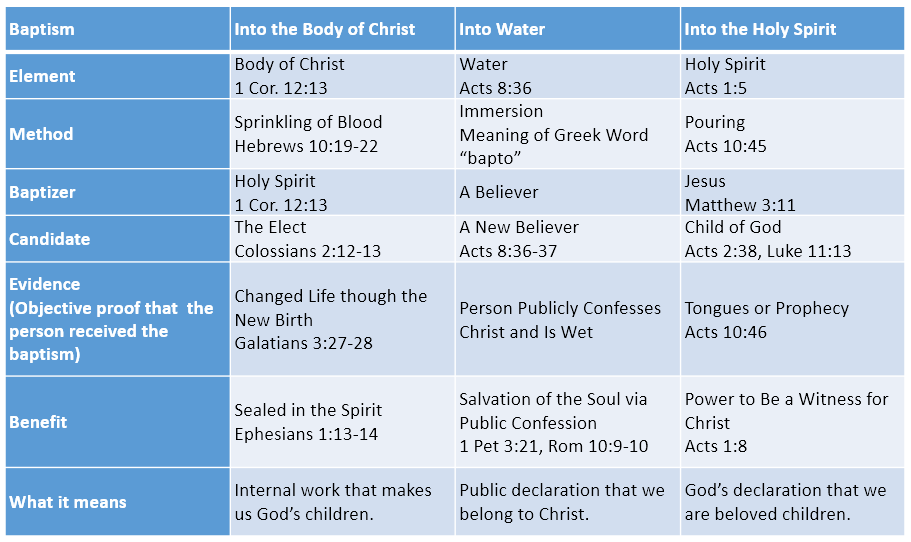
These three baptisms are separate, but occasionally the new birth and baptism in the Spirit happen concurrently, as with Cornelius (Acts 10:44). At other times, as in Ephesus (Acts 19:5-6) and Samaria (Acts 8:14-15), the baptism in the Spirit happens after the new birth. Water baptism should be performed very soon after conversion. (Acts 8:36-38)
The three baptisms also relate to the three major feasts of Israel.
Passover corresponds to the baptism into the body of Christ and the new birth, when we come to know Christ as Lamb of God and Savior and his blood is sprinkled upon us. The Feast of Pentecost corresponds to the outpouring and baptism of the Holy Spirit, which launched the church into the Great Commission. The last great feast is the Feast of Booths and Tabernacles, which takes place in the Fall of the year at harvest time. Many believe that this corresponds to Christ’s Second Coming as the glorious Son of Man, about which I will cover in the next lesson.
The point I wish to make is that the Israelites were expected to attend all three feasts.
We, as New Covenant believers, are meant to experience Christ in all the ways I am covering in this series – as Lamb of God or Savior, Son of God or Lord, as Baptizer in the Holy Spirit or Lord of the harvest, and as the coming Son of Man who will raise us from the dead and has authority to judge the living and the dead.
When Jesus ascended into heaven, on the fiftieth day after his resurrection, he poured out the Spirit on the feast of Pentecost in Jerusalem. This outpouring proved his lordship and confirmed his role as Lord in charge of the harvest or Great Commission.
To be under Christ’s authority regarding the Great Commission, we must do as he said and receive the baptism in the Spirit.
God wants his children to receive the baptism in the Spirit by asking for and receiving it by faith.
“If you then, being evil, know how to give good gifts to your children, how much more will your heavenly Father give the Holy Spirit to those who ask Him?” Luke 11:13 (NASB95)
This gift is available to all who put their faith and allegiance in Christ.
“For the promise is for you and your children and for all who are far off, as many as the Lord our God will call to Himself.” Acts 2:39 (NASB95)
The evidence of receiving this gift is speaking in tongues or prophesying. We speak in tongues by faith. We open our mouths and God gives us the words. (Psalm 81:10)
And they were all filled with the Holy Spirit and began to speak with other tongues, as the Spirit was giving them utterance. Acts 2:4 (NASB95)
The human intellect cannot comprehend the things of the Spirit. We cannot understand what the words mean when we speak in tongues, but the language is real. The Bible says we worship and pray according to God’s will.
For one who speaks in a tongue does not speak to men but to God; for no one understands, but in his spirit he speaks mysteries. 1 Corinthians 14:2 (NASB95)

For if I pray in a tongue, my spirit prays, but my mind is unfruitful. 1 Corinthians 14:14 (NASB95)

In the same way the Spirit also helps our weakness; for we do not know how to pray as we should, but the Spirit Himself intercedes for us with groanings too deep for words; 27 and He who searches the hearts knows what the mind of the Spirit is, because He intercedes for the saints according to the will of God. Romans 8:26–27 (NASB95)
God told the first disciples to receive this baptism in the Spirit to empower them for fruitful ministry.
Gathering them together, He commanded them not to leave Jerusalem, but to wait for what the Father had promised, “Which,” He said, “you heard of from Me; 5 for John baptized with water, but you will be baptized with the Holy Spirit not many days from now.” Acts 1:4–5 (NASB95)

but you will receive power when the Holy Spirit has come upon you; and you shall be My witnesses both in Jerusalem, and in all Judea and Samaria, and even to the remotest part of the earth.” Acts 1:8 (NASB95)
As is the case with the lordship of Christ, this aspect of Jesus’ ministry opposes modern-day consumerism. Unless we surrender to Christ’s lordship, embrace the call to obey the Great Commission, and receive the empowering of the Spirit, believing in the Lamb of God may become a self-centered pursuit of blessings.
Rather than allowing us to comfortably settle for being churchgoers, the Lord of the Harvest and Baptizer in the Spirit calls us to love and serve him through evangelism and making disciples.
It takes great courage to testify to the Lordship of the risen Jesus and to call people to repentance from a self-directed life. That is why we need to be empowered by the Spirit.
God intends for us to share the gospel in word and power.
and my message and my preaching were not in persuasive words of wisdom, but in demonstration of the Spirit and of power, 5 so that your faith would not rest on the wisdom of men, but on the power of God. 1 Corinthians 2:4–5 (NASB95)
God wishes to confirm the truth of his word by healing people, doing miracles, and delivering people from evil spirits. The nine gifts of the Spirit are available to us.
The baptism in the Spirit is the gateway into the armory of the Spirit.
Speaking in tongues is not only the most common evidence of being baptized in the Spirit. It is also a tremendously important gift in its own right. When we pray in the Spirit (tongues) we pray in a real language known to God, but not us. Romans 8:26 tells us that when we pray in tongues we pray according to God’s will. I usually pray in tongues first when I pray over someone. Not only am I praying according to God’s will a perfect prayer, but I am also “tuning in” to God’s spiritual “frequency.” I find that as I pray in tongues, he often gives me scriptures, insight, revelation, visions, prophetic words, and faith for the person. Tongues is a type of gateway gift in that it requires us to stop relying on our human intellect (since it is “unfruitful” – 1 Corinthians 14:14) and trust in the Spirit’s leading. Learning to do this enables us more easily to operate in the other spiritual gifts.
But to each one is given the manifestation of the Spirit for the common good. 8 For to one is given the word of wisdom through the Spirit, and to another the word of knowledge according to the same Spirit; 9 to another faith by the same Spirit, and to another gifts of healing by the one Spirit, 10 and to another the effecting of miracles, and to another prophecy, and to another the distinguishing of spirits, to another various kinds of tongues, and to another the interpretation of tongues. 11 But one and the same Spirit works all these things, distributing to each one individually just as He wills. 1 Corinthians 12:7–11 (NASB95)
Prophecy, words of knowledge, and words of wisdom all are ways God communicates to us in the Spirit. When God gives us a “word” for someone, we need his wisdom to know what to do with it. Often God uses visionary means to communicate important truths or insights to us. Being able to interpret the vision is more important, because the interpretation is usually the part that is helpful. A message in tongues for the entire assembly also requires interpretation or it only benefits the speaker. If no one has the faith or ability to interpret, Paul tells us to pray in tongues silently to God. (1 Corinthians 14:27-28) We can pray any time we like in the Spirit because we are commanded to pray always in the Spirit. (Ephesians 6:18) It is the only gift under our direction, except in the case when it requires an interpretation. Then it is like the others which require a specific leading from the Holy Spirit.
Faith, miracles, and healing are what some call the power gifts. The Lord can reveal to us whom he wants to heal via visions, words of knowledge, etc. We have to learn how the Spirit communicates to us. It takes practice, trial and error, and courage to operate in the gifts and become proficient at it.
The last gift in the above passage helps us to discern spirits, which is tremendously important. We want to know when we are encountering the Holy Spirit, angels of God, angels of darkness, and demons. Those who engage in evangelism will especially need this gift, as do all of us. Wisdom, faith, and an understanding of the authority we have in Christ are needed to properly handle any demons we may encounter.
Wherever God’s kingdom is proclaimed, we should see evidence of God’s power.
And as you go, preach, saying, ‘The kingdom of heaven is at hand.’ 8 “Heal the sick, raise the dead, cleanse the lepers, cast out demons. Freely you received, freely give. Matthew 10:7–8 (NASB95)
When we share the gospel, we should challenge our hearers to receive the baptism in the Holy Spirit as part of the complete package. We do not want anyone to settle for less than God intends. The early Church expected new believers to receive the baptism in the Spirit.
Peter said to them, "Repent, and each of you be baptized in the name of Jesus Christ for the forgiveness of your sins; and you will receive the gift of the Holy Spirit. Acts 2:38 (NASB)
They were committed to knowing Christ as Baptizer in the Spirit and to fulfilling the Great Commission. We should do no less.
Steps to Receive the Baptism in the Spirit
All that remains is for us to ask God for this gift that Jesus died to give us.
This is the only thing I want to find out from you: did you receive the Spirit by the works of the Law, or by hearing with faith? Galatians 3:2 (NASB95)
If we are submitted to the Lord of the Harvest who is seated at God’s right hand, from where he sent his Holy Spirit, we will ask for and receive this gift.
-
Believe that God will do what he says.
If we grasp that God has provided all believers with the privilege of receiving the baptism of the Holy Spirit, the next step is for us to believe that God is always faithful to his promises.
God’s complete trustworthiness is the foundation of all faith.
This is a simple concept; yet many people get hung up at this point. They may think, maybe it is not for me? God will bless everyone else, but not me. Such thinking is sinful unbelief from which we must repent. Cast that lie away and start believing God.
God is not a man, that He should lie, Nor a son of man, that He should repent; Has He said, and will He not do it? Or has He spoken, and will He not make it good? Numbers 23:19 (NASB)
-
Ask and receive with simple faith as a child.
"For everyone who asks, receives; and he who seeks, finds; and to him who knocks, it will be opened. 11 "Now suppose one of you fathers is asked by his son for a fish; he will not give him a snake instead of a fish, will he? 12 "Or if he is asked for an egg, he will not give him a scorpion, will he? 13 "If you then, being evil, know how to give good gifts to your children, how much more will your heavenly Father give the Holy Spirit to those who ask Him?" Luke 11:10-13 (NASB)
As a child, believe, ask, and receive.
If something in our minds whispers that this is not going to happen for me, repent of that unbelief.
...You do not have because you do not ask. James 4:2 (NASB)
If I extend my hand to offer someone a hundred-dollar bill, what will that person need to do? Would it be enough to say thank you without making any effort to come forward to receive it? If we want the money, we will act. Similarly, we receive the baptism in the Spirit by asking the Lord to baptize us and then by actively receiving.
Faith receives before it sees any outward visible evidence. Faith depends on the promises and character of God alone. It knows that God will keep his word and that his promises are true.
Faith does not doubt. It does not struggle with wondering if God will keep his end of the deal. It receives and moves on, just as when the Roman Centurion believed Jesus healed his servant and returned home. (Luke 7:10)
-
Give thanks.
After receiving a gift, grateful people say, “Thank you.” After we ask for and receive the baptism in the Spirit by faith, we should begin to thank and praise God.
Thanksgiving demonstrates faith.
The opposite is either silent passivity or doubtful complaining. Some people refuse to believe before seeing because they are afraid of getting their hopes up, only to be let down. Should we only praise God after he “comes through” for us or when we grasp that he is always faithful to his promises and will surely do what he said? Real faith acts before it ever sees the confirmation or fulfillment of what it believes because it is convinced that God is true.
The kind of praise and worship that gives God the most honor is what comes from people who exalt God’s faithfulness before they ever see the fulfillment of what was promised.
Faith knows and overflows. Only faith filled (faithful) people give thanks. Let’s show our faith by our praise.
-
Speak in tongues.
Speaking in tongues is a supernatural overflow of the Spirit. Our mouths speak out of the abundance of the Spirit’s filling of our hearts. The sure evidence of the baptism in the Spirit is speaking in tongues. At this point the one wishing to experience this confirming gift should take a step of faith and begin speaking, trusting that the Holy Spirit will give the words.
Who Baptizes Us?
The Bible teaches us that baptizing people in the Holy Spirit is the personal ministry of Jesus. John the Baptist announced this ministry to the world.
As for me, I baptize you with water for repentance, but He who is coming after me is mightier than I, and I am not fit to remove His sandals; He will baptize you with the Holy Spirit and fire. Matthew 3:11 (NASB95)
Our Lord often uses the agency of people laying hands on us to accomplish this baptism because Jesus desires for us to share in his ministry. The apostles often laid hands on individuals prior to their receiving this baptism.
Now when the apostles in Jerusalem heard that Samaria had received the word of God, they sent them Peter and John, 15 who came down and prayed for them that they might receive the Holy Spirit. 16 For He had not yet fallen upon any of them; they had simply been baptized in the name of the Lord Jesus. 17 Then they began laying their hands on them, and they were receiving the Holy Spirit. Acts 8:14–17 (NASB95)
At other times, the Spirit fell upon people without human agency, such as at Pentecost and when Peter preached to Cornelius.
While Peter was still speaking these words, the Holy Spirit fell upon all those who were listening to the message. 45 All the circumcised believers who came with Peter were amazed, because the gift of the Holy Spirit had been poured out on the Gentiles also. 46 For they were hearing them speaking with tongues and exalting God. Then Peter answered, Acts 10:44–46 (NASB95)
Prayer to Receive the Baptism in the Spirit
Jesus, I believe you died and rose again to save me and baptize me in the Spirit. You said that if we ask, you will certainly give us this wonderful promise. I ask you right now to baptize me in the Spirit and fill me to overflowing. I receive this promise by faith and give you thanks for your faithfulness to keep your promises. Holy Spirit, fill me up. Help me now to pray in tongues. I will open my mouth to speak with the expectation that you will give me the words. Amen.
Click here to see other articles in this series.
(If you wish to learn more about this amazing gift, you may wish to purchase my book, Promise of the Father, which is available on Amazon, and read my other articles on the subject.)